

Introduction and Context
Despite economic problems worldwide over the past few years, organic food sales have expanded over the past decade, reaching almost US$60 billion in 2010, up from US$25 billion in 2003Reference Willer and Kilcher1, Reference Dimitri and Oberholtzer2. Historically, the vast majority of organic sales were made in the USA and Europe. Although this is still true, markets for organic products are growing in many other countriesReference Willer and Kilcher1. At the same time, support of organic agriculture in developing countries by international organizations and assistance through monetary aid has also expanded3. As a result, organic farmland and the number of organic farms across the globe have increased quickly. Approximately one-third of the world's organic land and 80% of its organic producers are now in the developing and emerging marketsReference Willer and Kilcher1. Many of these countries are targeting the USA and the European Union (EU) as fertile export markets for their organic products.
Anecdotal evidence suggests that imports of organic products into the USA have increased over the past decade. The implementation of the National Organic Standards in 2002, and more recent policy changes, such as the completion of an organic trade equivalency agreement with Canada and the EU, have served to enhance the ability of the industry to import and export organic products. Organic handlers (manufacturers, brokers, processors, and packers and shippers certified to handle organic products in accordance with the National Organic Standards) are the main importers of organic products. As they are situated in the middle of the organic supply chain—procuring from farmers and other suppliers and selling to retailers and other outlets—the decision to import products made by organic handlers can be affected by changes in demand vis-à-vis transactions with retailers (and ultimately their consumers) and supply through transactions with farmers.
For organic handlers, there are many competing consumer and producer interests influencing the decision to import organic products. The US market for organic products has expanded rapidly over the past decade, with sales reaching US$22.3 billion in 20094. As the organic industry has grown, some organic firms have developed international supply chains to satisfy consumer demand for off-season organic produce (such as grapes produced in Chile during the US winter months), as well as for products grown primarily outside the USA, such as tropical fruits, coffee, tea and cocoa.
At the same time as many consumers have demanded an increasing array and quantity of organic products, some consumers have not been welcoming imports of organic food. While most research has suggested that consumers purchasing organic products are interested in the health, food quality or environmental aspects of organic foodReference Pearson, Henryks and Jones5, a segment of organic consumers is strongly interested in supporting local or regional farmers. Some consumers feel that purchasing products from producers abroad, along with the environmental costs incurred in transporting imported products over thousands of milesReference Richter, Schmidt, Freyer, Halpin and Vetter6, Reference Sigrid7, is counter to the intentions of organic production. In other cases, consumers and advocacy groups may be wary that inspection and regulation in other countries (such as China) is lax compared to those in the USA, even if the farms must be inspected by a third-party certifier regulated by the US governmentReference Hodes8. Other recent informationReference Gale and Buzby9 and incidents, such as a fraudulent National Organic Program organic certificate produced by an uncertified operation in China (for soybean, millet and buckwheat)Reference Kim10, are related to these rising concerns.
Retailers have taken notice of the consumer objections toward imported organic foods in the USA, particularly those products raised in China. Trader Joe's, for example, discontinued selling both organic and non-organic single ingredient foods, such as garlic, frozen organic spinach and edamame, produced in China based on consumer concernsReference Schmit11, while Whole Foods limited their imports of organic products from the country for the same reasonReference Neuman and Barboza12. A recent study of US food retailers selling organic food found that 29% of those importing organic products for sale discontinued an imported organic product because of customer complaints about the geographic origin of the produce. The vast majority of those customer complaints were about imports of organic products from ChinaReference Jaenicke, Dimitri and Oberholtzer13.
The domestic supply of organic products can also influence a handlers’ decision to import organic products. Adoption of organic agriculture has been relatively slow in the USA, with only 0.5% of organic crop and pastureland under organic farms by 2005Reference Greene, Dimitri, Lin, McBride, Oberholtzer and Smith14. The organic industry has experienced periodic shortfalls of some organic products, such as milk and meat, while other domestic products, such as soybeans, have become especially costly at timesReference Dimitri and Oberholtzer15. The import of organic products in such cases can help organic firms procure needed products and reduce their input costs. However, like consumers, some domestic producers are not welcoming the increased competition from imported organic commodities. In the late 2000s, processors of organic grains, oilseeds and soybeans were concerned about increasing imports of these productsReference Clarkson16. The low organic adoption rate for grain crops, especially, has been a bottleneck for expansion of the US organic livestock sector, with only 0.2% of the US corn and soybean crops grown under the certified organic farming systems in 2005Reference Greene, Dimitri, Lin, McBride, Oberholtzer and Smith14.
Data on imported organic products are limited. The extent of international trade of organic products, as well as the impact of increasing trade for both industry stakeholders and consumers, is largely unknown. Recently organic-specific trade codes have been developed to track the flow of organic products both imported and exported from the US. Implemented in 2011, imports of 20 organic products and exports of 23 organic products are being recorded. Over the first 8 months of 2011, the dollar value of the organic products imported was US$509 million, with coffee, soybeans and tea (from the list of 43 products) leading imports17.
This paper adds to the literature by providing the first examination of imports of organic products into the USA. We use data from a national survey of US certified organic handlers in 2007 to examine the extent, types and origins of imported organic commodities. Unlike the newer trade data that have just now become available, this dataset provides an opportunity to analyze all imported organic products with characteristics and procurement practices undertaken by organic handlers, the primary importers of organic products. As such, we utilize a Heckman model to investigate factors that influence an organic handler's decision to import organic products, and the level at which they import a product. Given these results, we explore future research needs, including studies on consumer preferences and the impact of increased imports on domestic organic farms.
Methodology of Survey of Organic Handlers
A survey of organic handlers was conducted to collect data about their procurement and marketing practices for 2007. The survey instrument was developed in consultation with organic stakeholders, and was administered by Washington State University's Social and Economic Science's Research Center using the Tailored Design Method (TDM)Reference Dillman18. The survey was authorized by the US Office of Management and Budget (control number 0563-0078). The 58-question survey was developed to study the basic characteristics of the facilities (sales, function and year first certified organic), marketing practices (products sold, marketing outlet and geographic location of sales), procurement practices (imports, types of procurement arrangements, attributes, and activities with suppliers), and the use of contracts for procurement.
All firms holding certificates to handle organic products were surveyed and approximately 3900 facilities were certified in 2007. The mailing list was created by starting with USDA's National Organic Program list of certified entities, and refining it, using a list of organic handlers developed for a previous (2004) survey to identify facilities under subcontract. All facilities were first pre-notified by postcard. The pre-notification postcard was followed by a letter from the administrators of USDA's Economic Research Service (the lead research organization for the survey) and Risk Management Agency (the funding institution) and letters of support from organic stakeholders, including the Organic Trade Association and the Organic Farming Research Foundation. The survey was sent by first class mail and was followed by multiple carefully timed contacts, including two postcards, a subsequent questionnaire mailing and phone contacts. As an experiment, incentives of US$5.00 were sent with a portion of the surveys. In total, 1408 facilities completed the survey, representing a 39% return rate of eligible facilities. The response rates differed for incentive (50%) and non-incentive (33%) respondents.
To study imports of organic products, the survey gauged the distance over which handlers purchased their ingredients, specifically asking whether, by percentage of volume procured, they procured locally (within an hour's drive), regionally (within state and surrounding states), nationally and internationally. The survey also incorporated additional questions focused on organic imports, including questions on the three primary organic products imported by the facility, the percent of the product's total volume needed that was imported, and the country from which the top product was imported. The products listed by respondents were categorized into 46 individual commodities (such as carrots, corn, apples and pears), and then grouped into nine major product categories (such as vegetables and melons). The vast majority of imported items were reported as individual commodities, with few processed products included on the list. All survey data were analyzed using the statistical analysis program Stata (StataCorp LP, College Station, Texas, USA).
Characteristics of Organic Imports
Summary results from the survey show that a majority of organic products procured by the organic firms came from domestic suppliers, with a little over a third (37%) of handlers importing products. The handlers incurred significant transaction costs in the form of search costs when procuring organic products. In 2007, 52% of all handlers who procured organic products found it difficult to locate needed ingredients, with organic wheat, corn, coffee and soybeans listed as the most difficult to find.
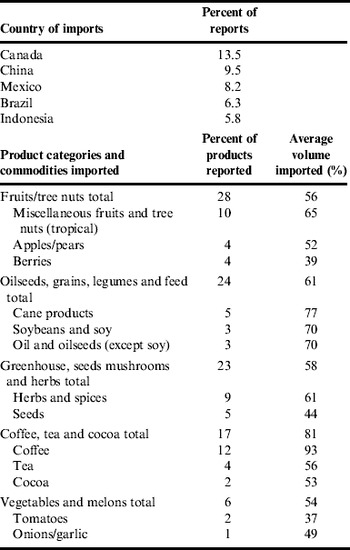
A geographic review of the data reveals that almost half of the organic products imported come from five countries (Table 1). These countries also belong to the top six countries for the importation of all agricultural products in 201119. This relationship between the top countries for importing organic and conventional products suggests that there may be lower transaction costs for organic producers and intermediaries in these countries, as well as a comparative advantage in production systems.
Characteristics of the US organic imports, 2007.

Some of the principal organic products imported in 2007 are those not generally produced in the USA, such as coffee and tropical fruit; for many of these products, most of the volume needed by the handlers is imported (Table 1). The findings also indicate, however, that there are many commodities traditionally grown in the USA that were imported in substantial volume in 2007. Some of these products parallel those imported by conventional handlers, such as off-season fruits and vegetables (e.g., fruit from South America, tomatoes from Mexico and apples from New Zealand). Most notable, however, is the fact that the category of oilseeds, grains, legumes and feed ranks second in the percentage of imports for 2007, and 61% of the volume of these commodities needed by importing firms came from abroad. Within this product category, the average volume of organic soybeans and oil and oilseeds being imported by firms is quite high (70%), with China being a primary source of these products. Other traditional US crops are on the top imports list, including wheat, barley and berries from Canada (also mirroring conventional imports). Herbs and spices (from Europe, southern Asia and Africa mainly) ranked as the third highest individual commodity imported, with the volume of imports (61% of total volume needed) reported by handlers being relatively high. Organic seeds, from Europe and western Asia, were also imported frequently, although the percent of volume imported was reported to be lower (44%) than other products in the product category.
Modeling a Handler's Decision to Import Organic Products
The analysis of organic handlers, and their decision to import products, is based on the concept that the decision by handlers to import organic products has two parts. In the first part, the firm chooses whether or not to import an organic product; whereas in the second part, the firms decide how much of the organic product to import. This decision framework matches nicely with a sample-selection econometric modeling approach, developed by HeckmanReference Heckman20 and described in detail by GreeneReference Greene21, that corrects for the bias that occurs in analyzing non-random samples and purchasing decisions. This analysis accounts for both decisions and the fact that they are interdependent, thus avoiding any bias involved if they were considered separately.
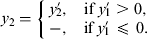
Both parts of the organic handler's decision are modeled as follows: We let y 1 be the outcome of the first decision of whether or not to import, and we say that it is related to a latent, unobservable variable y′1. The observed variable, y 1, takes on a value of 1 if the handler decides to import or 0 if it decides against it. We use y 2 to label the observed outcome from the second part of the handler's decision, the share of the handler's organic product that is imported. Again, we can think of the observed outcome being associated with a latent variable y′2. We observe y 2 only if y 1=1, and in that case y 2=y′2. Modeled more formally, we have the import decision in the first part,
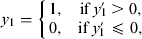 $$y_1 = \left\{ {\matrix{ {1,} & {{\rm if}\,y\prime\hskip-3 _1 \gt 0,} \cr {0,} & {{\rm if}\,y\prime\hskip-3 _1 \leqslant 0,} \cr}} \right.$$
and the import share decision in the second part,
 $$y_2 = \left\{ {\matrix{ {y\prime\hskip-3 _2,} & {{\rm if}\,y\prime\hskip-3 _1 \gt 0,} \cr {{\rm -,}} & {{\rm if}\,y\prime\hskip-3 _1 \leqslant 0.} \cr}} \right.$$
In other words, y 2 does not take on a meaningful value when y′1≤ 0.
The standard practice is to then specify a linear model with additive errors for the two latent variables:
 $$y\prime\hskip-3 _{1i} = {\bi X}\prime\hskip-3 _{1i} {\rm \beta} _1 + {\rm \varepsilon} _{1i} \quad {\rm and}\quad y\prime\hskip-3 _{2i} = {\bi X}\prime\hskip-3 _{2i} {\rm \beta} _2 + {\rm \varepsilon} _{2i}, $$
where i indexes an individual firm, X1 and X2 are covariate vectors that affect the organic importer decision and the import share decisions, and the error terms are correlated and jointly distributed such that (ε1,ε2)∼bivariate normal [0, 0, 1, σ2, ρ]. Modeled this way, the first decision, then importer decision, affects the outcome of the import share decision. More precisely, the expected value of the import share decision is conditional on not just the β2 parameters, but also σ2 and ρ:
 $${\rm \varepsilon} [y_{2i} |y_{2i} = 1] = {\bi X}_{2i}\hskip-5 {\rm \prime}\hskip3 {\rm \beta} _2 + {\rm \rho} {\rm \sigma} _2 {\rm \lambda} ({\bi X}_{1i}\hskip-5{\rm \prime} \hskip3{\rm \beta} _1 ),$$
where λ(X′1iβ1) is the inverse Mills ratio. To estimate this sample selection model, we employ Heckman's two-step approach. In the first step, we estimate the probit equation for y 1 using maximum likelihood to recover estimates for β1, and then use these to recover estimates for λ(X′1iβ1), which can be labeled as λ(X′1iβ1). In the second step, we recover estimates for β2 and βλ=ρσ2 by a least squares regression of y 2 on X2 and λ.
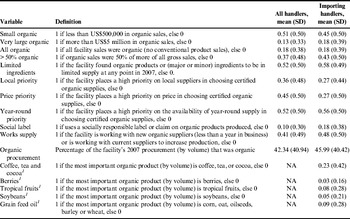
Summary statistics for the variables used in this model are given in Table 2. The variables thought to influence whether or not a firm imports organic products (the first stage or selection-dependent variable) include those related to organic sales, with the assumption that smaller firms may be less likely to import organic ingredients than larger firms, which may have greater procurement needs that cannot be satisfied through domestic supply and/or the already established import channels. The extent of the firm's organic sales (versus total sales) is also thought to influence the choice to import, as well as the percent of total procurement that is accounted for by organic; the assumption here is that those with higher organic procurement needs may be more likely to import. In regard to relationships with suppliers, we hypothesize that those facilities prioritizing local suppliers would be less likely to import organic products, while those prioritizing the availability of year-round supply and price would be more likely. We also expected that those facilities working with current suppliers to increase production and/or new suppliers may be more likely to import, as that might signify a high need for organic ingredients. We also assumed that facilities that used a socially responsible label or claim on their products were more likely to import, as many socially responsible claims are Fair Trade labels for products being produced in the developing countries and thus would be imported into the USA. Finally, we expected that those facilities experiencing limited supplies of a major or minor ingredient would be more likely to import organic products.
Summary statistics of variables used in model.

N for all organic handlers=1049; N for importing organic handlers=442.
1 Only those handlers importing a product can be used to calculate a mean and standard deviation.
Those variables thought to affect the decision regarding how much of the organic product to import included size of organic sales and the amount of a facility's gross sales accounted for by all organic sales. In addition, we assumed that those firms experiencing limited supplies of a needed ingredient would affect the share of product imported. Finally, numerous product variables were included to study whether organic products that are either not produced in the USA (such as coffee and some tropical fruits), have been in limited supply (grains and soybeans) in the past, or are imported at high rates from other countries in the conventional sector (berries) affect the share of that product being imported, in this case positively.
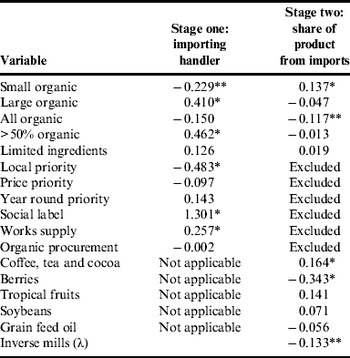
The results of the model are given in Table 3. It should be noted that an alternative to the two-step approach is to estimate both of the modeled decisions simultaneously using maximum likelihood methods. The authors checked results from this method against the two-step approach and found that the parameter estimates for beta1 and beta2 are extremely close. Results from the first step indicate that the size of a facility's organic sales is important in deciding whether a handler imports or not, with smaller facilities less likely to import an organic product, while larger facilities are more likely to import. Facilities with 50% or more of all gross sales accounted for by organic products were also more likely to import, while the variable that represented firms where 100% of sales were organic was not statistically significant. Facilities prioritizing suppliers that are local, not surprisingly, were less likely to import organic products, while prioritizing year-round supplies and prices when choosing a supplier did not make a difference. Facilities using a social label or claim on their organic products were also more likely to import organic products, which is not unexpected since many organic coffee and cocoa products carry Fair Trade labels and these products are high on the list of imported organic products. Finally, those facilities actively working with suppliers to increase organic ingredient supplies or working with new suppliers (less than a year in business) were also more likely to be importing organic products, possibly an indication that they are unable to procure enough supply domestically. Also not significant in the model were the percentage of overall procurement accounted for by organic products, as well as facilities that experienced limited supplies of organic ingredients in 2007.
Results of the model for importation of organic products.

* Denotes significance at the 5% level.
** Denotes significance at the 10% level.
Number of observations: 565; censored observations: 350; uncensored observations: 215; log likelihood=−326.004.
In the second stage, the variable representing size of the facility indicated that higher organic sales were not significant, while the share of organic product imported increased for facilities with lower organic sales. So, although facilities with lower organic sales were less likely to import, once that decision was made, the share they imported was higher. In the first step, while we saw that those with 50% or more of all sales accounted for by organic products were important in the decision to import, this variable was not significant for the share imported, and in fact, the share of the imported product decreased in facilities where all sales were accounted for by organic. Included in the second step were commodity variables for products imported. The share of organic product imported increased for those facilities importing coffee, tea or cocoa, suggesting that these products are primarily obtained through imports, while it decreased for berries, suggesting that imports of berries may make up for seasonal fluctuations or limited supplies. Variables for other commodities—including tropical fruits, which are generally grown outside the USA, soybeans, grain, feed and oilseeds—were surprisingly not significant.
Discussion of Results and Next Steps
Anecdotal evidence suggests that the import of organic products in the USA has grown over the past decade. US consumers and producers have, at times, raised concerns over the increase of imports and the potential loss of markets to non-domestic sources. For some consumers, the act of importing organic food conflicts with what they consider the intentions of organic production and consumption. However, assessing the veracity of these concerns is made difficult by the lack of data, prohibiting research on trade flows of organic products, and farm-level impact.
Organic handlers, the primary importers of organic products into the USA, have various reasons for choosing to import products. The summary results show that many of the products being imported into the USA are products that cannot be produced domestically, including coffee and tropical fruits. On the other hand, some oft-imported commodities are those that can be produced in the USA, such as soybeans, oil/oilseeds, wheat, barley, berries, and herbs and seeds. Conventional versions of some of these products, specifically wheat and berries, are often imported in the USA from Canada. Some other conventional versions of these organic products, such as soybeans, are not traditionally imported. When examined in the light of slow growth in US certified organic acreage in grains and soybeans, these findings suggest that supply shortages may be the motivation for importing these specific products. However, using the Heckman model, we found that importing coffee, tea or cocoa was the only commodity category that influenced the share of product imported positively. Importing berries, on the other hand, influenced the share of product imported negatively. Social labels, such as Fair Trade, positively affected a handler's decision to import; not surprising in that Fair Trade products, by definition, are usually grown outside of the USA.
The summary results also show that organic handlers are procuring almost a half of their imported products from a few countries, including Canada, China, Mexico, Brazil and Indonesia. In the analysis, we did find that those handlers prioritizing local suppliers, not surprisingly, negatively affected the facility's decision to import products. This could be associated with consumer demand for local products. Although consumers seem to be concerned by imports of organic products from China, at least as described by the popular press and by surveyed organic food retailersReference Hodes8, consumer response to imports from other countries seems to be fairly muted. Some recent (yet limited) research does provide some insight into US consumers' view toward organic soymilk, with consumers strongly preferring soymilk ingredients produced in the USA and Canada over soymilk ingredients produced in Brazil, China or IndiaReference Zheng, Li and Peterson22. As noted below, additional consumer research examining preferences for organic foods is needed.
Handlers may also be experiencing limited supplies and high-input costs, and using imports to shore up supply needs or reduce input costs. Our analysis of the data uncovered that although many handlers are experiencing limited supply of inputs, this did not impact a handler's decision to import products. This suggests other reasons for importing, such as input prices, but again, price was not found to be significant in the model. In terms of supply, handlers working with suppliers to increase supply were more likely to import. This could indicate an inability to procure supply domestically, but it could also mean that they are also working to increase supply outside of the USA.
Lastly, and perhaps most significant, size of organic sales was important to both the decision to import and the share imported, with larger firms more likely to import and smaller firms less likely to import. However, once a smaller firm had decided to import, they imported a larger share of their needed inputs. This suggests that the supply chain structure might be an important factor—so that larger firms, which may be more likely to have international supply chains already established, are more likely to import products. But, smaller firms, once they make the decision to import and establish the supply chain, are likely to focus on those supply chains to procure their product.
Given the lack of supply-side policies and support payments for organic production in the USA, and historically slow adoption rates for certified acreage over the past decade, consumer demand for organic products in the USA is likely to continue to increase more rapidly than organic farmland. At the same time, international aid for organic agriculture is growing in developing countries, translating into rapidly increasing organic acreage in these countries. The recent equivalency agreement with Canada, the US's largest agricultural trading partner, will likely greatly impact US trade of organic products. The new equivalency agreement with the EU will also likely expand the trade of organic products further between the two countries. Taken together, these factors suggest that organic imports into the USA will continue at current levels or increase in the future. However, in the absence of analytical research on the international trade of organic products, it is not clear how the policies facilitating international trade of organic products will affect consumer welfare in the USA. The key question at the core of this debate is whether a country (the USA or other countries)—including its consumers and farmers—benefits from increased international trade of organic products. The answer is not straightforward because we do not understand the distribution of consumer preferences for imported organic products, and thus cannot make inferences about the welfare effects of importing organic products.
Thus, when considering a research agenda for the international trade of organic products, one critical research stream needs to address consumer preferences for imported organic products. For example, are consumers generally accepting products that cannot be grown domestically, such as coffee, off-season produce and tropical products? What about products that can be grown domestically, such as wheat, which are generally imported in their conventional versions? Does this differ from products, such as soybeans, that are traditionally produced domestically, but organic versions are being imported? Another issue is whether the US consumers take into account the political or cultural reasons for their choices; for example, are they more accepting of standards from developed countries (such as the EU and Canada) than they would be of those from developing countries (such as China or Latin American countries)? Does distance from the exporting country matter? Finally, do food scares in the conventional sector (such as those in China over the past several years) have an impact on organic imports from those countries?
A good starting place would be a consumer study, most likely requiring an experiment or a stated preference study, so that these specific questions could be addressed. A comprehensive consumer study capturing all aspects of the way people shop for food, in particular, the spatial dimensions that affect food purchasing decisions (e.g., through substitution possibilities between organic and conventional products, as well as among different organic products available) would also be of benefit to understanding consumer preferences and imported food products. For example, consumers may examine several products during each individual shopping trip before making their purchase decision, comparing not only relative prices, but perceived quality and other characteristics such as product origin.
Of course, understanding the impact of imported organic products for the US farms and intermediaries is also important. For example, increased availability of organic products may increase consumer awareness of organically produced food, which may have a positive effect on the farm sector through increased market demand. Thus, greater availability of organic berries and soy products may be beneficial for the US farmers by increasing the market for organic products overall. However, if imported organic products are less costly than domestically produced organic commodities, especially those in short supply at the farm level, unless US farmers can reduce costs to compete on price, imports may have a negative effect on the domestic farm sector. On the other hand, if consumers demand domestic organic products over imported products, how will this affect the farm sector and market?
The questions are likely less complicated for intermediaries. Sitting between the farm and the consumer, these firms will most often select ingredients and products that will yield the highest profits. The prices they can charge depend partly on consumer preferences, so if consumers are willing to pay more for domestically produced products (and if higher profits follow), intermediaries will respond by using such products. If consumers are indifferent to the origin of the organic products they purchase, these firms will generally choose the lowest cost products; in this case, the relative costs will depend on the usual factors such as domestic supply, international supply and transportation costs. Thus, the juxtaposition of the consumer and the farmer will largely determine how the intermediaries respond, and will have an impact on the dynamics of the supply chain and ultimately on aggregate consumer and producer welfare.
Addressing these research questions and needs would greatly enhance our understanding of the organic market and the impacts and dynamics surrounding the import of organic products and ingredients. In addition, the new data from the US government tracking exports and imports of organic products, although limited in the number of commodities tracked, may also shed light on the market and supply chain dynamics in the organic industry. Researchers interested in organic in other countries likely face questions of their own about the impact of organic trade. Multi-country studies that examine consumer and producer impacts of organic trade would provide a foundation for unraveling the differences and similarities that likely exist.
Role of Funding Source. Funding for the organic handler survey and study was provided under competitive funding from the United States Department of Agriculture's Risk Management Agency (RMA). Staff from RMA provided input on survey design, but did not play a role in the collection, analysis or interpretation of the data, or in the writing of this paper.