Introduction
The recent evacuation of New York (USA) hospitals during Superstorm Sandy (2012) highlighted the challenges surrounding hospital evacuations. For advance-warning events, such as hurricanes, the evacuation decision process is particularly complex: the risks and complex logistics of evacuating medically fragile patients are compounded by the high degree of uncertainty around such an event’s predicted strength, location, and timing. The high-stakes evacuation versus shelter-in-place decision is also time sensitive; evacuating too early may put patients at risk unnecessarily, while waiting too long can result in evacuating under less-than-ideal conditions, as was the case for two hospitals during Superstorm Sandy.
One of the factors complicating the New York hospital evacuations was the loss of both utility and backup generator power, but the Superstorm Sandy evacuations were not the first instances when hospitals had to be evacuated without electric power. For example, in 2001, Memorial Hermann Hospital in Houston, Texas (USA) was evacuated after Tropical Storm Allison made landfall and massive flooding occurred. This report describes a modeling study of that evacuation. The authors have developed a computational model that can be used to describe the impacts of a disruption on hospital operations and the adaptations that hospital staff make to continue providing care for patients. The model represents the complex network of hospital services, function, resources, utilities, and consumables required to provide medical care. Understanding this network, its dependencies, and its capacities is critical to assessing the potential impacts of infrastructure disruptions and the types of adaptations that could be required during the evacuation process. The model includes a mathematical framework that enables decision makers to compare patient-care resource requirements with resource availability to determine whether an evacuation is necessary when infrastructure services are lost. If an evacuation is recommended, the model can be used to estimate how long various hospital functions can be maintained given infrastructure status and available stores, how many patients should be evacuated, and which patient types should be prioritized for evacuation to maximize the number of patients receiving adequate, sustainable care.
The model’s use is demonstrated by recreating the evacuation timeline for a scenario designed to resemble the Memorial Hermann Hospital Neurosciences/Trauma Intensive Care Unit (NTICU). The model is further tested through application to a set of similar, but different, hypothetical scenarios in which the assumptions are varied relative to the timing of evacuation, the available resources, and other determining factors.
The remainder of this report is structured as follows: the Report section describes the model and how it was applied to a scenario resembling the 2001 evacuation of Memorial Hermann Hospital NTICU after Tropical Storm Allison made landfall;Reference Cocanour, Allen and Mazabob 1 , Reference Nates 2 the model produces plausible results for these scenarios, and the Report section also describes these results. The Discussion section describes the literature of hospital evacuation models and how the model discussed within expands upon that literature. The report concludes with a summary of findings in the Conclusion section.
Report
In June of 2001, Tropical Storm Allison made landfall near Houston and produced record amounts of rainfall, subjecting Memorial Hermann Hospital to flooding, the loss of electric power from its local utility, and eventually, the failure of its backup generator. These challenging conditions forced hospital staff to adapt in order to continue providing patient care. The hospital eventually ordered an evacuation, evacuating or discharging approximately 600 patients. The loss of power significantly affected the rapidity of the evacuation and resources required to continue caring for patients before, during, and after the evacuation.
Hospital evacuations during, or as a result of, infrastructure outages, like that at Memorial Hermann Hospital, are complicated and challenging. Loss of infrastructure services can initiate a chain of events that can be difficult to manage. The hospital evacuation model described here can track such cascading events and identify staff and operational adaptations that may occur during an evacuation. The model is built on the assumption that a hospital’s primary mission is to provide necessary medical care to all of its patients. This mission exists even when critical infrastructure services to the hospital and surrounding areas are disrupted. The decision to evacuate a hospital in advance of, or following, an infrastructure disruption hinges on the hospital’s ability to provide an adequate level of care for all of its patients throughout the disruption. Configured with the subject hospital’s operational and resource data, the model is used to identify the optimal set of evacuation and resource allocation decisions to provide adequate care to the population of patients over the projected period of disruption. The terminology “adequate care” is used for the situation in which all nominal needs of the patients can be met on a sustainable basis. The term “nonsustainable” denotes a higher-risk situation in which a required element of care cannot be provided. Nonsustainable does not mean that hospital staff is failing to provide appropriate care for their patients. This terminology describes a situation in which the staff will be forced to improvise, and which is not sustainable. Having patients in this situation (or anticipating that patients will soon be in this situation) triggers an evacuation.
The evacuation model is made up of two primary components:
-
1. A patient care hierarchy: the hierarchy represents the complex structure of dependencies of patient care upon hospital operations and resources; and
-
2. A constrained optimization model: this mathematical formulation compares the patient care requirements to the expected resource availability to estimate the hospital’s ability to provide adequate care to its patients throughout the projected duration of infrastructure disruption.
Patient Care Hierarchy
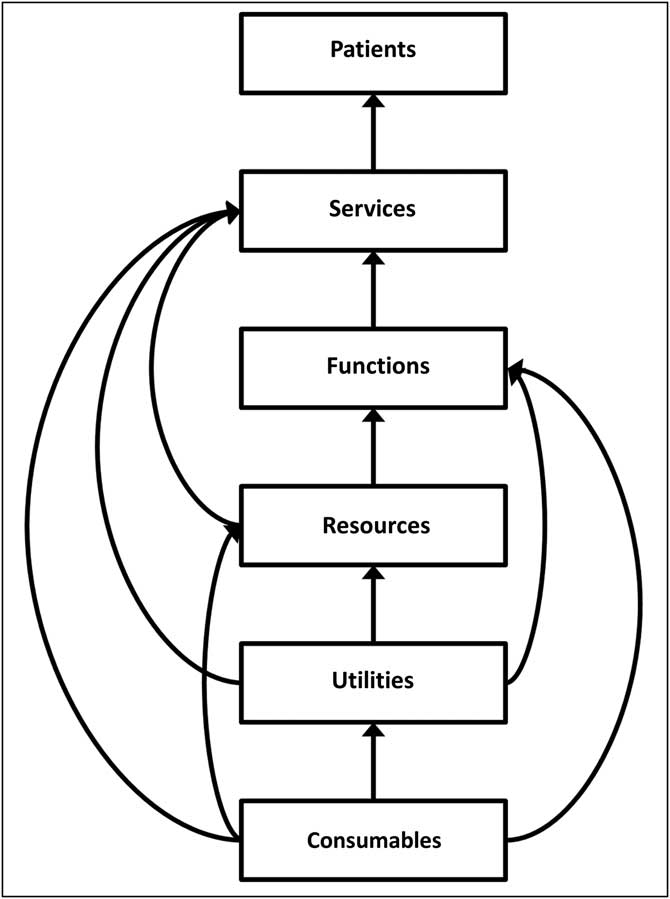
The hierarchy consists of six elements: patients, services, functions, resources, utilities, and consumables (Figure 1). In line with the primary hospital mission of providing adequate patient care, patients occupy the apex of the hierarchy. Multiple patient types (categories) can be represented (eg, intensive care unit (ICU) patient, surgical patient, stable patient, and so forth). Adequate patient care consists of a specified minimum set of service requirements which vary according to the patient category. Services support patient care directly and consist of hospital activities (such as a bed) provided by various hospital departments required to provide medical care to patients (the term “patient bed” constitutes more than the physical bed itself; the term is intended to convey the collection of services that are required to care for a patient). The next level down in the hierarchy, functions, directly supports services. Functions include medical procedures for individuals and non-medical activities that contribute to patient care. Resources, utilities, and consumables are the tangible commodities, equipment, and people required to perform functions and services. Resources and consumables differ in that resources are reusable and consumables are not (ie, after one use, a consumable good is “consumed”). Consequently, depletion and replenishment of consumable stocks are important within the model. Utilities are a special class of resource, critical infrastructure, that includes water, electricity, and communications. The hospital evacuation model is designed to incorporate specifically the consequences of the loss of utilities and infrastructure services on a hospital’s viability.
Hierarchical Relationships among Hospital Care Elements. The arrows can be read as “support treatment of” (in the case of services → patients) or “support production of” (in the lower levels).

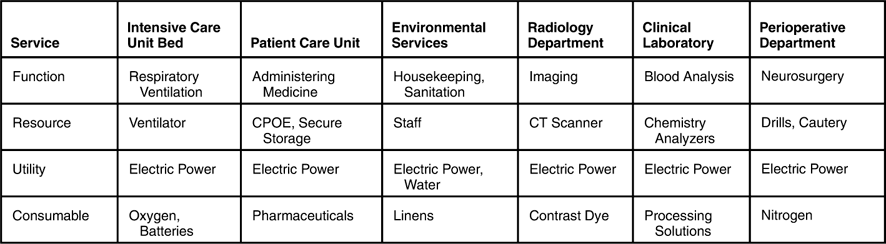
Table 1 contains a listing of example services, functions, resources, utilities, and consumables. Hierarchy elements in a single column generally support the service listed at the top of the column. For example, a patient who requires the ICU bed service may also require the supporting respiratory ventilation function, which typically requires a ventilator resource. The ventilator requires electrical power (utility) and oxygen (consumable) to operate. In another service example, the radiology department provides imaging (function) that requires a CT scanner (resource), electrical power (utility), and contrast dye (consumable). Table 1 lists several other examples of patient hierarchy element groupings. Not intended to be complete or exhaustive, the examples are provided to demonstrate the dependencies among hierarchy elements working together to provide hospital services.
Patient Hierarchy Element ExamplesFootnote a

Abbreviation: CPOE, computerized physician/provider order entry.
a Elements in the same column support the service in the top row of that column.
Loss of utilities can compromise a hospital’s ability to provide patient services. If hospitals do not have temporary alternatives to sustain activities, the disruption of these critical utilities will affect important services needed for patient care. Temporary alternatives, such as backup power generators, represented within the utility level in the model, generally depend upon consumables (ie, generators require fuel and bottled water can partially replace a dependence upon utility water). Because hospitals typically maintain limited quantities of consumables, their ability to sustain adequate patient care over time is determined by their stores of required consumables, the rate of consumption, and at what point in the consumable restocking schedule a disruptive event occurs.
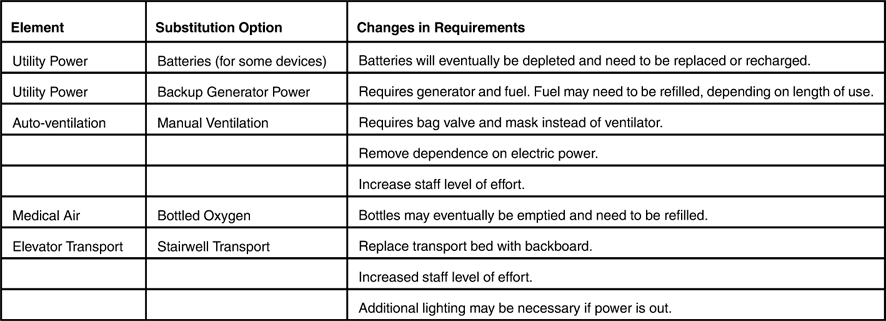
Substitution possibilities exist to help the hospital cope with loss of infrastructure services (Table 2). For example, some medical devices may be able to run using batteries when utility power is lost. The limited capacity of batteries means that they can serve only as a temporary substitute. Backup generators provide another substitution for utility power, but they are dependent upon fuel supplies. If the duration of the power outage exceeds the capacity of fuel stored at the hospital, additional fuel will need to be transported to the hospital. Manual ventilation can substitute for automatic ventilation, but it requires portable oxygen, bag valve and mask, and staff time. Although substitutions provide hospitals with a means for handling disruptions, their use generally presents an alternative set of requirements that must be met.
Examples of Substitutions and Changes in Requirements

The Optimization Model
The model’s resource-constrained optimization formulation is used to address the following questions:
-
1. Can the hospital provide adequate care for its patients in the event of an infrastructure disruption?
-
2. If adequate care cannot be provided for all patients, how many patients need to be evacuated, and which patients should be prioritized for evacuation?
-
3. How long will the evacuation take?
-
4. What resources are required to ensure adequate care is provided for all patients, both those requiring evacuation and those sheltering-in-place?
-
5. What are the primary resource constraints (eg, staff, equipment, and so forth) that have a detrimental effect on patient care and/or evacuation?
In the model, patients are tracked by categories which reflect the level and type of care they require. For example, ICU patients may require respiratory ventilation, nutritional support through feeding tubes, and other care, whereas an orthopedic post-surgical patient may have lesser care requirements (no respiratory ventilation) or different requirements (physical therapy). For the analyses presented here, two patient-care states are considered. Patients are considered to be in an adequate-care state when available quantities of resources, utilities, and consumables meet or exceed minimum requirements. Patients are considered to be in a nonsustainable-care state when requirements exceed availability.
The model is designed to maximize the number of patients in the adequate-care state. For a modeled scenario, the loss of infrastructure service(s) is represented through reductions in the availability of resources, utilities, and stocks of consumables (which may be exhausted or be replenished). To compensate for a loss of infrastructure services, the model searches among defined substitution options to provide required functions and services, making the best use of available resources, utilities, and consumables to maximize patient care.
The model’s representation of substitutions and adaptations is illustrated here using a simple example involving ICU patients requiring ventilation. Under typical conditions, ventilation requires a ventilator, a combination of compressed air and titrated oxygen, and nursing staff to monitor the patient. In the event of utility power loss, the model assumes that backup generator power is provided to critical systems. Operation of the generator requires the use of generator fuel. In the event that backup generation fails (due to disruption conditions or depletion of generator fuel), the model transitions ventilators from generator power to battery power. Without a mechanism for delivery of compressed air to ventilators, ventilation depends on 100% oxygen from either the main reservoir or portable oxygen tanks. If the power outage persists beyond battery capacity and replacement stocks, manual ventilation is required. This adaptation requires an increase in staff resources. When oxygen tanks are depleted, ventilation will rely upon ambient air, potentially resulting in decreased quality of care. At this stage, a patient would be considered to be in a nonsustainable-care state.
Some disruption conditions may necessitate evacuation. Evacuation is represented as a service that requires inputs from functions (eg, either elevators operating or manual in-building transportation), resources (eg, ambulance and staff time), utilities (eg, power for the elevators, if working), and consumables (eg, bottled oxygen). A shift in operations from shelter-in-place to evacuation requires a dramatic change in the overall mix of consumables, utilities, resources, and functions needed, and different constraints may become binding. Vugrin et al provides the complete mathematical details of the optimization model.Reference Vugrin, Verzi and Finley 3
Modeling the Evacuation of a Hospital without Power
The model’s use is demonstrated through the application to a scenario designed to resemble the Memorial Hermann Hospital NTICU evacuation, as described by Nates and Cocanour et alReference Cocanour, Allen and Mazabob 1 , Reference Nates 2 Memorial Hermann Hospital is one of two Level 1 trauma hospitals in Houston. The hospital is part of the Texas Medical Center, the world’s largest medical center. Of the hospital’s 450 adult beds and 150 children’s beds, 200 beds are configured for intensive care. The NTICU has 28 beds.
Tropical Storm Allison made landfall near Houston on June 5, 2001. The storm produced record amounts of rainfall for the city, with more than three feet of rain falling over a 5-day period. As a result of the storm, Memorial Hermann Hospital lost electric power from their local utility at 1:40 am on June 9, 2001. In response, the hospital’s backup generators came online providing emergency power to the hospital. Approximately 20 minutes after the loss of utility power, the bottom two floors of the hospital started to flood (a flood that eventually reached a volume of more than 40 million gallons of water). Flood waters damaged the pharmacy, the main laboratory, the blood bank, the radiology laboratory, and other key hospital facilities rendering them nonfunctional. Even more critically, the flooding submerged the hospital’s electrical switchgear causing the emergency power system to fail and leaving the hospital completely without power by 3:30 am. Plumbing, communications, elevators, and other functions relying on power became nonoperational.
Seventeen critically-ill patients were being cared for in the NTICU when the emergency power system failed. Patient monitoring equipment, mechanical ventilators, suction, local pharmacy supply units, medication-infusion pumps, computers, and other essential equipment lost power. Staff adapted to these challenges in a number of ways. Ventilators, portable monitors, and communication devices operated on internal batteries until they were depleted. As ventilator batteries failed, additional staff members were brought in to perform continual manual ventilation. Additional staff were also brought in to compensate for the loss of wall suction through the manual use of a catheter and syringe.
Roads surrounding the hospital were impassable until 10:00 am. At 10:30 am, the hospital decided to evacuate critical patients, including those that required ventilation. At 2:00 pm on June 9, the decision was made to evacuate the entire hospital. In the absence of functional elevators, NTICU patients were carried down four flights of stairs, on backboards, to the general transfer holding area. Staff and volunteers carried flashlights to provide light while the NTICU patients were transported. Evacuation of the entire hospital was completed by 3:00 pm on June 10.
The hospital evacuation model was applied to a set of scenarios to investigate its utility. The first scenario, resembling the 2001 evacuation of the Memorial Hermann Hospital NTICU, was chosen to demonstrate the model’s ability to recreate the evacuation timeline and events from a real-world occurrence. The second scenario demonstrates the model’s use as a planning capability, investigating different strategies for timing the beginning of an evacuation.
The first scenario is based on the following key assumptions:
-
∙ The ICU has a maximum capacity of 28 patients and a current patient population of 17;
-
∙ Utility power for the hospital and ICU fails at 2:00 am on June 9, 2011;
-
∙ Emergency backup power system fails at 4:00 am;
-
∙ The ICU has 10 patient hours of battery power for ventilators, 50 patient hours of battery power for portable monitors, and 40 patient hours of battery power for communications;
-
∙ Evacuations are prevented by impassable roads surrounding the hospital until 10:00 am;
-
∙ 10 ambulances are available for transport of ICU patients to other hospitals;
-
∙ The ICU is able to evacuate four patients every two hours. This constraint represents the time needed to prepare a patient, to carry the patient on a backboard through multiple stairwells in a dark facility, and for other required activities. It also includes the capacity of receiving hospitals to accept evacuated patients;
-
∙ The simulation extends over a 36-hour period, beginning at 12:00 am, two hours before the utility power fails; and
-
∙ Patient-care components for the ICU patients include:
-
– Services: ICU bed, operating room, pharmacy, clinical laboratory, radiology, blood bank, and evacuation;
-
– Functions: sanitation, automatic ventilation, manual ventilation, mechanical vacuum, housekeeping, manual suction, elevators, in-building transport, automatic monitoring, manual monitoring, communications, and computer systems backup communications;
-
– Resources: nurses, physicians, technicians, other staff, ventilators, bag valve, mask, potable water, nonpotable water, automatic monitors, portable monitors, compressed air delivery, ambulances, and other transport;
-
– Utilities: utility power, generator power, and water lines; and
-
– Consumables: food, pharmaceuticals, nutritional support, medical supplies, bottled water, stored nonpotable water, generator fuel, bottled oxygen, bulk oxygen, blood, intravenous fluids, air tanks, batteries for communications equipment, batteries for monitors, and batteries for ventilators.
-
For this scenario, the model is used to examine the following questions:
-
1. If the ICU is not evacuated, how many patients enter a nonsustainable-care state and for how long?
-
2. If the ICU is evacuated, how long does the evacuation take? Do any of the patients enter a nonsustainable-care state before or during the evacuation?
-
3. During the evacuation, what staffing resources are required?
-
4. How do changes in quantities of ambulances and backup battery supplies affect the evacuation?
In the second scenario, assumptions are modified to reflect how the model can be used for planning purposes. In this scenario, storm conditions (eg, flooding and winds) are expected to worsen and hospital administrators anticipate a possible power failure. This scenario is based on the following assumptions:
-
∙ The hospital anticipates losing all power 12 hours after the start of the simulation;
-
∙ Surrounding hospitals are not expected to evacuate until six hours before the power loss in response to a mandatory evacuation notice;
-
∙ Once surrounding hospitals begin to evacuate, the number of ambulances available for this ICU patient transport decreases from 10 to three. Additionally, the hospitals receiving evacuees from this ICU will only accept two patients per 2-hour period, a decrease from four patients per 2-hour period. (These assumptions are included to reflect the resource competitions that occur among hospitals when a regional disruption, such as a hurricane, causes multiple facilities to evacuate at the same time); and
-
∙ Roads are impassable for the eight hours after the expected power loss, preventing all evacuations.
For this scenario, the model is used to analyze how the timing of an evacuation decision affects the evacuation process.
Results: Scenario 1
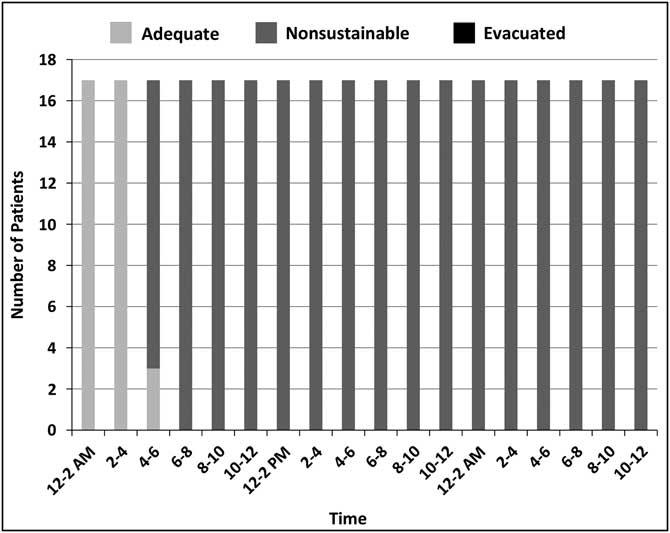
All results for Scenarios 1 and 2 were generated using the software Lingo, Version 14.0 (Lindo Systems Inc.; Chicago, Illinois USA). The number of patients in nonsustainable- and adequate-care states resulting from a hospital decision to shelter-in-place (not evacuate the ICU) are shown in Figure 2. Under this scenario, backup power and batteries for ventilators, monitors, and communications systems delayed some patients from entering a nonsustainable state. When backup generation failed and batteries were depleted, all 17 patients in the ICU were determined to be in a nonsustainable-care state.
State of Patient Care under the Counterfactual Assumption that Evacuation Does not Occur.

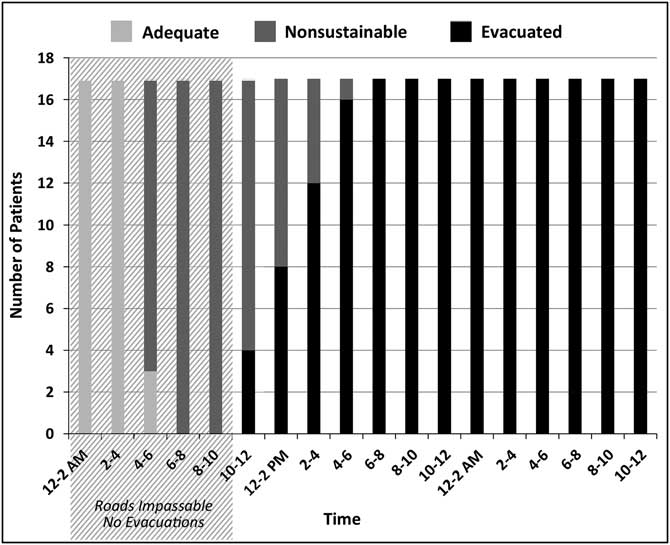
With ICU patient evacuation, the number of patients in nonsustainable- and adequate-care states changes significantly, as shown in Figure 3. Due to impassable road conditions surrounding the hospital, evacuations could not begin until 10:00 am, causing all 17 ICU patients to enter a nonsustainable-care state. Once evacuations commenced, the number of patients in nonsustainable-care states decreased (evacuated ICU patients were assumed to be receiving adequate care elsewhere). The evacuation was completed within eight hours.
State of Patient Care with Evacuation.“Adequate” and “Nonsustainable” describe patients that are currently at the hospital. “Evacuated” refers to patients who have left the hospital and are assumed to be receiving adequate care elsewhere.

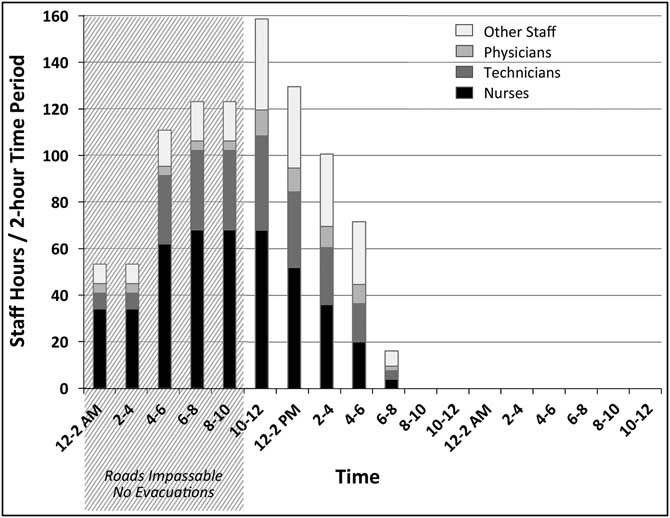
Hours worked by ICU staff, by type, throughout the evacuation process are illustrated in Figure 4. The staff activity shown reflects actions taken for ICU patients that were still in the ICU and not yet evacuated. It does not include the staff activity that may have continued at other hospitals or for staff that stayed with evacuated patients at a different location. Following the loss of utility power, the failure of backup power and the depletion of batteries, automatic ventilation and monitoring could not continue. Consequently, nurse and technician activity requirements increased significantly to provide manual ventilation and monitoring. Physician activity initially increases when evacuation commences to assist with the evacuation process. Other staff activity also increases as personnel are needed to assist in patient transport by carrying flashlights, backboards, and other necessary equipment. As the number of evacuated patients increased and the number of patients remaining in the ICU decreased, activity for all staff categories decreased.
Levels of Staff Activity during Evacuation Scenario.

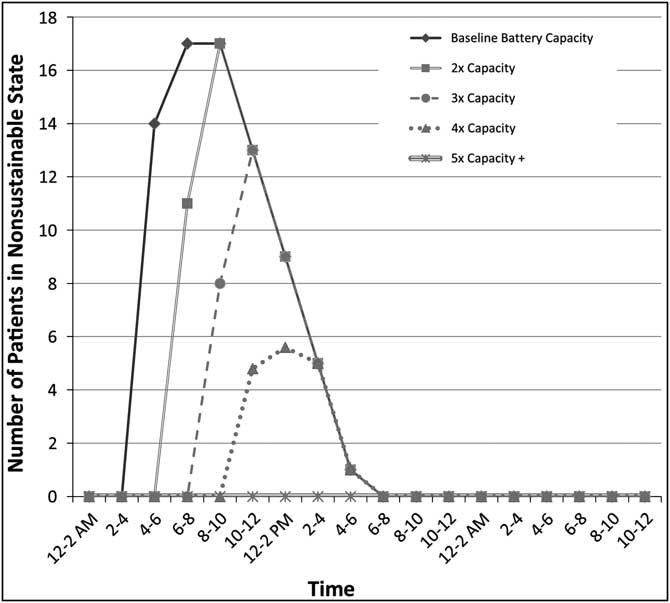
Although increased battery capacity for ventilation, monitoring, and communications does not decrease the time required to evacuate, it can affect the number of patients in a nonsustainable-care state while waiting to be evacuated. The number of patients in a nonsustainable-care state when total battery capacity is increased, relative to baseline resource levels (battery power for 10 patient hours for each function) are shown in Figure 5. Increasing battery capacity had three primary impacts. The increased capacity decreased both the number of patients that entered a nonsustainable-care state and the time spent in that state. In fact, increasing the total battery capacity by a factor of five or more prevented any of the patients from entering a nonsustainable-care state. The combined effect of these two impacts was ultimately a decrease in the risk caused by the power outage. The third benefit, not shown, was a decrease in staff activity requirements. When batteries enabled automatic ventilators and monitors to continue to operate, staff were not required to perform manual ventilation and monitoring. For an extended disruption, this outcome had the benefit of decreasing staff exhaustion.
Number of Patients in a Nonsustainable State under Different Battery Capacities.

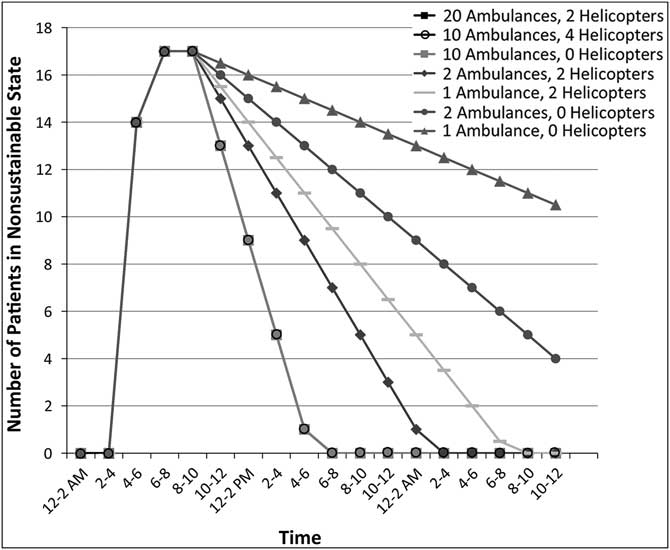
The number of patients in a nonsustainable-care state due to the varied availability of ambulances and transport helicopters for evacuation are shown in Figure 6. When only one or two ambulances were available, the ICU evacuation took more than 26 hours, so the evacuation was not completed within the 36 hour simulation period. The addition of four helicopters increased the rate of evacuation since they had a greater patient capacity and could transport patients to receiving hospitals at a greater distance away and at a faster rate than ambulances could. Adding more ambulances or helicopters beyond the baseline level of 10 ambulances (and no helicopters) did not increase the rate of evacuation.
Number of Patients in a Nonsustainable State vs Transportation Resources. The line corresponding to “10 Ambulances, 0 Helicopters” lies on top of the line for “10 Ambulances, 4 Helicopters” because the corresponding evacuation timelines for the two resource situations are identical.

Results: Scenario 2, Planning for Expected Power Outage
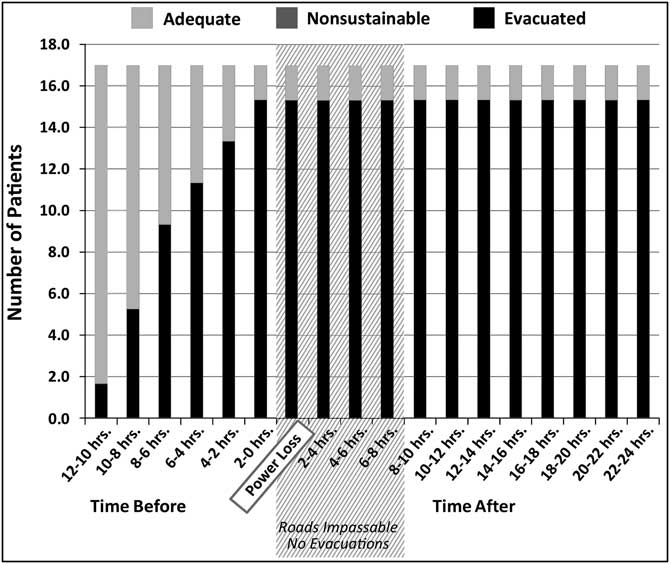
For this planning scenario, the number of patients in nonsustainable- and adequate-care states, and the number of patients evacuated due to a decision to evacuate the ICU at the model-determined optimal time, are shown in Figure 7. In this instance, the ICU evacuation began immediately because the full 12 hours would be needed to complete the necessary evacuations before the roads became impassable. Other hospitals started to evacuate at six hours prior to the expected power loss in response to a mandatory evacuation notice, causing a decrease in the evacuation rate for the subject ICU as hospitals competed for resources. Patients remaining in the subject ICU did not require evacuation since sufficient battery capacity existed to ensure their adequate-care state for the entirety of the simulation.
State of Patient Care When ICU Evacuates in Advance of Other Hospitals. “Adequate” and “Nonsustainable” describe patients that are currently at the hospital. “Evacuated” refers to patients that have left the hospital and are assumed to be receiving adequate care elsewhere. Abbreviation: ICU, intensive care unit.

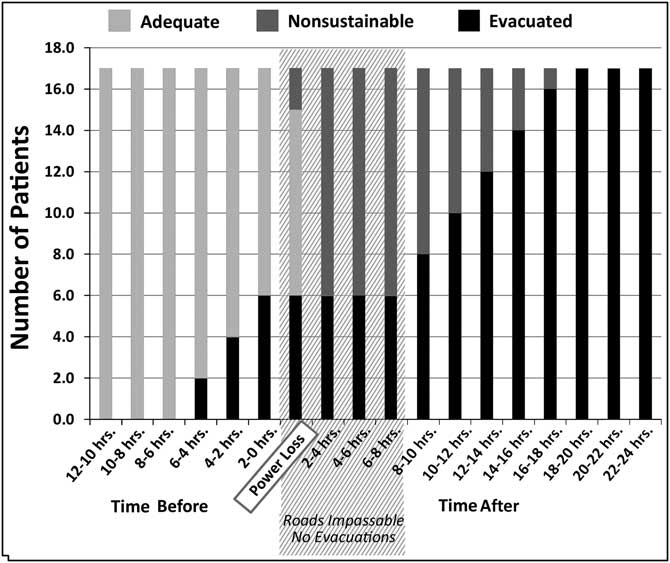
When the ICU delayed evacuations until the mandatory evacuation order, the distribution of patients in either nonsustainable- and adequate-care states, or evacuated, was significantly different, as shown in Figure 8. Evacuation beginning was discontinued for the eight hours after the power loss due to impassable roads around the hospital. When power was lost, the 11 ICU patients not yet evacuated entered a nonsustainable-care state. After evacuations restarted eight hours later, the number of patients in a nonsustainable state decreased as the number of evacuated patients increased.
State of Patient Care When ICU Evacuates at the Same Time as Other Hospitals. After 3 PM, the “Adequate Care” and “Evacuated” lines overlay each other. “Adequate” and “Nonsustainable” describe patients that are currently at the hospital. “Evacuated” refers to patients that have left the hospital and are assumed to be receiving adequate care elsewhere. Abbreviation: ICU, intensive care unit.

The benefits of not only starting to evacuate earlier, but doing so before other hospitals begin their evacuations, can be seen in a comparison of Figures 7 and 8. Resource competition not only lengthened the time required for evacuation, it also increased the number of patients entering a nonsustainable-care state.
Discussion
The effects of the loss of infrastructure services (eg, power, water, and communications) on hospital operations has been documented in several case studies.Reference Cocanour, Allen and Mazabob 1 , Reference Nates 2 , Reference Aghababian, Lewis, Gans and Curley 4 - Reference Redlener and Reilly 10 The Joint Commission (Oakbrook Terrace, Illinois USA) and other hospital-accrediting bodies require hospitals to develop and test emergency plans for responding to these and other potential disruption scenarios (eg, fire, flooding, active shooter, and so forth). Drills and exercises, however, often lack realism, and given the rarity of events such as Superstorm Sandy, most hospital leaders can only speculate about the decisions with which they will be confronted under similar circumstances. In 2010, the US Department of Health and Human Services Agency for Healthcare Research and Quality (Rockville, Maryland USA) released the Hospital Evacuation Decision Guide to provide hospital leaders with guidance on the various factors that should be considered when making hospital evacuation or shelter-in-place decisions.Reference Zane, Biddinger, Hassol, Rich, Gerber and DeAngelis 11
A number of computational models have been developed to support hospital administrators and decision makers with quantitative data to inform planning and evacuations. Talebi and Smith formulate stochastic network models to determine optimal egress and minimum time required for evacuation.Reference Talebi and Smith 12 Taaffe has published extensively on various aspects of hospital evacuation. Taaffe et al propose a simulation model that includes stochastic uncertainty in evacuation task-duration and sequencing to estimate total evacuation time.Reference Taaffe, Johnson and Steinmann 13 Tayfur and Taaffe enveloped a simulation model to evaluate how allocation of resources affects the efficiency and expediency of hospital evacuations.Reference Tayfur and Taaffe 14 Tayfur and Taaffe and Duanmu et al have developed simulation models that determine the impact that traffic and timing have on the time required to evacuate a hospital.Reference Tayfur and Taaffe 15 , Reference Duanmu, Taaffe and Chowdhury 16 Golmohammadi and Shimsak’s model estimates evacuation times by considering three patient categories (walking wounded, less critical, and critical) and how preparation time, transportation time, and staff resource requirements vary for each patient category.Reference Golmohammadi and Shimshak 17 Childers and colleagues proposed a 2-phased modeling approach for prioritizing patients for evacuation.Reference Childers, Visagamurthy and Taaffe 18 The Human Evacuation Transportation Model seeks to minimize shelter-in-place and evacuation risks by calculating optimal transportation strategies for patients that vary according to care requirements and criticality.Reference Bish, Agca and Glick 19 Arboleda et al developed network flow models that represent infrastructure networks’ operation and restoration, as well as the ability of these infrastructures to provide power and other services to hospitals.Reference Arboleda, Abraham, Richard and Lubitz 20
Although each of these models can provide valuable information to emergency planners and hospital administrators, key gaps still exist in this body of hospital evacuation models. For example, the first questions hospital administrators face are: “Should the hospital be evacuated?” and “If so, when should the evacuation commence?” The aforementioned models assume the decision to evacuate has already been made. Additionally, the models generally assume that infrastructure services, such as electric power, are maintained, enabling hospital functions, such as elevators, lighting, and equipment, to continue normal operations. This assumption can cause the models to underestimate both the time and resources required for evacuations conducted when power and other utilities are unavailable. Because the models assume utilities are fully operational, they also do not represent the adaptations (eg, manual ventilation and monitoring, use of alternative water sources, and so forth) that hospital staff must employ to maintain patient care.
Hospital evacuations are challenging events regardless of the precipitating disruption. The loss of critical infrastructure during, or prior to, evacuation can further complicate the process by causing delays, constraining resources, and increasing the overall risk to the patients. Numerical models developed to assist the evacuation process generally do not address the effects of loss of infrastructure services, such as power outages, communications failures, or water contamination. Also, these numerical models generally do not address the issues influencing hospital evacuation decisions, one of the most difficult and critical decisions that hospital administrators might face during a disaster.
This report introduces a new model specifically developed to inform the evacuation decision process when infrastructure services are disrupted, either completely or partially. This work extends the existing body of hospital evacuation models by addressing the issue of whether an evacuation is necessary, incorporating the possibility that infrastructure services and the hospital operations that depend upon them may not be functioning normally, and representing the operational changes and adaptations that staff make to ensure patients continue to receive the best care possible. The model can also be used to identify resource-allocation strategies that facilitate hospital operations during evacuations as well as decrease risks to patients. In addition to beneficial strategies, resource constraints that delay the evacuation process can also be identified using the model. For example, as discussed in the Scenario 1 results, when only one or two ambulances are available for evacuations, they are the limiting resource. However, the availability of 20 ambulances does not increase the evacuation benefit beyond that which 10 ambulances provide; a different factor becomes the limiting constraint and any excess ambulance resources may be allocated to other activities.
In another potential application, the model can be used to inform disaster planning and investments. Scenario 1’s results illustrated that increasing battery capacity for ventilation systems, patient monitors, and communications decreases the number of patients entering a nonsustainable-care state and reduces the amount of time spent in that state. For this scenario configuration, increasing battery capacity to five times the nominal 10 patient hours per device level provides the greatest additional benefit; adding further capacity does not extend that benefit. Consequently, in this simplistic scenario, battery capacity investment can be capped at a given level and additional funding freed for application elsewhere. Results from Scenario 2 demonstrated that the timing of evacuation decisions has a significant impact on the length of time required to evacuate. Furthermore, starting an evacuation in advance of other hospitals competing for the same resources expedites the process at the subject hospital.
The simple example analyses and conclusions documented in this report are not intended to form the basis of general evacuation guidelines. Instead, they illustrate the development and use of customized model parameters representing the system configurations, resources, and processes of a specific hospital or hospital unit (eg, surgical unit or pediatric unit). With such customizations, administrators and staff at the hospitals can utilize the hospital evacuation model to gain insights for specific scenarios of concern, to inform planning and mitigation activities, and to provide situational awareness, adaptation potentials, and other evacuation insights to staff without their having to go through an evacuation.
Future modeling efforts would focus most profitably on the development of model customizations that represent actual hospitals and research to understand how this model can inform “patient surge” models for hospitals. Patient surge models are used frequently by emergency planners to estimate a hospital’s or region’s capacity to deal with a large-scale disaster. These models generally assume that the hospitals will be fully operational. Unfortunately, the same disaster creating the patient surge may also damage infrastructures and/or the hospitals themselves. The model presented in this report could be used in conjunction with patient surge models to take a step towards development of a comprehensive regional hospital network model.
Conclusion
This report describes a modeling study of scenarios exemplifying the 2001 evacuation of the Memorial Hermann Hospital in Houston, Texas. The model has been shown to represent effectively the complex network of functional dependencies required to provide care for patients in an ICU experiencing a total loss of power, as well as to incorporate the effects of staff adaptations to assess the extended time over which adequate care can be provided for the ICU patients. The model’s ability to recreate the evacuation timeline for an actual evacuation, as well as how it could be used in evacuation planning activities to inform evacuation timing decisions, are also illustrated through the analyzed scenarios documented here.