THE debate inspired by Peter Hall and David Soskice’s seminal volume on varieties of capitalism (voc) generated one of the most influential literatures in comparative politics and political economy in recent years, and the introductory chapter by the editors is the foundational statement of the approach.Footnote 1 voc is widely perceived to be the dominant approach to the comparative political economy of the oecd countries.Footnote 2 Scholars in disciplines other than political science, including sociology, geography, and business studies, have also engaged with the issues raised in the debate—both independently and in reaction to the voc literature.Footnote 3
The voc framework focuses on the distinction between two kinds of market economies in which a particular form of economic coordination predominates: liberal market economies (lme), such as Britain and the United States, with market coordination, and coordinated market economies (cme), such as Germany and Sweden, with strategic coordination. Although the literature has spurred great controversy, much of the debate has been limited by its focus on Western Europe, North America, and to a lesser extent Japan and the Antipodes. It remains an open question whether the framework can shed light on market economies in other parts of the world.
Traditionally, developed and developing countries have been studied separately. Two analytical strategies dominate the literature on the political economy of development in political science and sociology. On the one hand, dependency theory and world systems theory focus on the external economic environment and offer a more skeptical analysis of the prospects for economic development, as developing countries are seen as locked into structurally unfavorable positions in the global economy.Footnote 4 These ideas also serve as a justification for import-substituting industrialization (isi) and more selective engagement with the world economy.Footnote 5 On the other hand, the rise of Japan and the East Asian miracle contribute to greater interest in state-led development, including theories of the developmental state that have some affinity with classical development economics.Footnote 6 These literatures present a challenge to development thinking associated with the Washington consensus and to much of neoclassical development economics, which focuses on strengthening markets and minimizing the scope for government failure.Footnote 7
The focus of this review article is on three agenda-setting books that engage with the voc framework in regions not usually covered by the voc literature: Latin America, East and Southeast Asia, and East Central Europe.Footnote 8 They are the most influential and compelling recent book-length studies of capitalist diversity in these regions.
In Hierarchical Capitalism in Latin America: Business, Labor, and the Challenges of Equitable Development, Ben Ross Schneider focuses on Latin America, a region that has inspired important theoretical contributions, such as dependency theory, to political economy.Footnote 9 While extensive research has been published on isi in Latin America as well as on the move to neoliberalism and the subsequent left turn of the early 2000s,Footnote 10 until recently there have been few attempts to incorporate the region into the contemporary comparative capitalism debate.Footnote 11 Schneider develops a novel voc model that constitutes a compelling account of Latin American political economies. East and Southeast Asia, the focus of Andrew Walter and Xiaoke Zhang’s, East Asian Capitalism: Diversity, Continuity, and Change, has received extensive attention in the literature, but much of this research concentrates on the East Asian miracle and the East Asian financial crisis, and is often related to the logic of developmental states.Footnote 12 The analysis of these countries from a comparative institutionalist perspective is surprisingly limited, and most existing analyses focus on Japan.Footnote 13 Walter and Zhang draw on voc theory to develop a typology that allows them to analyze capitalist diversity in East and Southeast Asia. The study of East Central Europe, covered by Dorothee Bohle and Béla Greskovits in Capitalist Diversity on Europe’s Periphery, raises some unique challenges. Because markets played a very limited role until the collapse of communism in 1989–91, these countries are generally viewed as transition economies. While the early literature focused on the political economy of reform, toward the turn of the millennium sociologists began to explore how different elite configurations and class coalitions produced reforms in the 1990s that led to a variety of capitalist systems. The most influential typology of this kind is Lawrence King and Iván Szelényi’s distinction between capitalism from above, below, and without.Footnote 14 Bohle and Greskovits’s important book demonstrates that there is considerable variation in economic arrangements even among the East Central European countries that embraced global markets.
Countries in these three regions have introduced a variety of market reforms in recent decades. Most countries that were once committed to isi policies are now highly integrated into the world economy and are full members of the wto. Although there has not been a uniform rollback of the state, it now plays a very different role than in the golden age of the developmental state (1950–1970s).Footnote 15 Some countries have even joined the oecd—the rich-state club. There has been extensive debate about the contemporary relevance of the developmental state and dependency theory to our understanding of the political economy of development.Footnote 16 The time may have come to consider these economies in relation to broader debates about voc and to bridge the divide between the literatures on developed and developing/transition economies. This article argues that the voc framework provides an excellent starting point for developing a global political economy of capitalism that also incorporates some of the concerns of the classical development literature. It examines what these three seminal books imply about the current state of knowledge about global voc and identifies questions for future research.
The core goal animating this article relates to the question of how global capitalist diversity should be theorized. More specifically, it asks whether the voc framework is a suitable starting point for studying capitalist systems beyond the traditional oecd countries. If so, how does the globalization of the voc framework relate to traditional concerns in the political economy of development, such as the role of the state and external dependency? Do such perspectives imply that a globalized voc framework should be less firm-centered and adopt a different analytical strategy? To what extent can global voc analysis contribute to a better understanding of the key challenges of the global economy, such as economic development in an era of globalization? In this article, I analyze the key voc models identified by these three books, and their distinguishing features. I argue that the books can be seen to represent distinctive approaches to globalizing the study of voc, which I classify as firm-centered, governance-centered, and state-centered. I discuss the trade-offs between these approaches and their contribution to understanding capitalist diversity, but also suggest that these approaches are ultimately complementary, as they address distinct challenges.
The debate surrounding voc is extensive.Footnote 17 Many critics argue that the dichotomous typology of the voc framework is overly narrow and parsimonious. In fact, it may not even capture the full range of political economic systems in the advanced oecd countries because the Southern European countries (including France) are hard to classify as either coordinated or liberal market economies.Footnote 18 Extending the voc debate beyond the traditional oecd countries constitutes a compelling strategy to address these issues and to refine our understanding of capitalist diversity and the voc debate itself.
The debate about voc also features more specific criticisms, and this article focuses on three of them. First, some critics suggest that the voc framework is incomplete given its excessive focus on firms.Footnote 19 Second, some argue that the voc framework is too focused on efficiency.Footnote 20 The emphasis on efficiency relates to the principal research objectives of the original voc volume, as Hall and Soskice seek to demonstrate how different institutional frameworks in the oecd are consistent with economic success over prolonged periods. To the extent that variations in economic performance are considered, they are usually related to the absence of complementary institutions.Footnote 21 While the emphasis on the institutional foundations of comparative advantage is an important insight, a global perspective provides an opportunity to consider the effects of different institutions on economic performance. Indeed, it is hard to examine the effect of institutions on development by looking just at the oecd, which includes relatively successful economies and hence, a relatively limited range of outcomes.Footnote 22 A third set of critics sees the relative neglect of the state as the main shortcoming of the voc framework.Footnote 23 This argument is often combined with a related criticism that suggests that the social and political underpinnings of capitalist systems are underspecified.
I demonstrate that these issues can be addressed by globalizing the voc debate, but it is unclear whether all can be addressed at once. I show that there are trade-offs between the approaches developed in these three books, as each is particularly successful at addressing one of the three criticisms. These trade-offs reflect different analytical strategies that also relate to different forms of institutional analysis.Footnote 24 Schneider’s model is firm-centered and relates primarily to formal institutions, such as ownership, labor market, and corporate governance institutions. It extends core ideas of the voc framework to account for differences in economic performance, which enables voc analysis to move beyond its focus on efficiency. Walter and Zhang’s framework is governance-centered. It goes beyond the firm and integrates a variety of governance mechanisms into the study of capitalist systems. Bohle and Greskovits’s work is state-centered and analyzes the politics of capitalist diversity, which contributes to a better understanding of the social and political embeddedness of market institutons.
The next section discusses how the three books conceptualize capitalist systems beyond the core oecd countries. The section following compares these approaches and illustrates the key strengths and tradeoffs between them in the context of three examples, Thailand, Brazil, and Hungary. The conclusion reflects on the main findings and the broader implications of the analysis for our understanding of voc and economic development.
Global Varieties: How Many?
The voc approach builds on previous contributions to the study of capitalism, such as state traditions, corporatism, and social systems of production schools.Footnote 25 However, the greatest intellectual debt may be to new institutional economics and new institutionalism more generally.Footnote 26 At its core, the voc framework is an institutionalist theory of capitalism based on a relational theory of the firm as the key actor in a market economy. Firms can manage key relationships with employees, financial institutions, and other firms by means of different coordination mechanisms. The main premise of the voc framework is that a certain coordination mechanism tends to predominate in a given economy because of institutional complementarities. As Hall and Soskice define it, “Two institutions can be said to be complementary if the presence (or efficiency) of one increases returns from (or the efficiency of) the other.”Footnote 27 They also argue that clusters of complementary institutions constitute a source of comparative institutional advantage by promoting certain kinds of economic specialization, notably related to incremental innovation in high-quality manufacturing in cmes and rapid innovation in lmes. This framework has two important implications. First, it stresses the importance of studying the relationship between institutions and economic activity. Second, it highlights that there is more than one type of institution that is consistent with economic success, and economies with complementary institutions tend to be more successful than hybrid economies with incoherent institutional configurations.Footnote 28
It is unclear to what extent voc analysis can shed light on capitalism beyond the oecd, as Hall and Soskice did not claim that their theory applied to other parts of the world. And even if the main insights of the voc literature extend beyond these countries, it seems clear that it is not possible to fit all political economies of the world into the binary distinction between liberal and coordinated market economies without very considerable conceptual stretching. The extension of voc analysis to other parts of the world raises important challenges, not least because every political economy has some unique features. In other words, how could an augmented voc model balance descriptive accuracy with the theoretical rigor and parsimony of the original voc framework? There are no easy answers; different theories are useful for different purposes. Andreas Nölke and Arjan Vliegenthart suggest three criteria for identifying a new voc: “(1) the existence of an alternative overall economic coordination mechanism closely related to (2) a relatively stable set of institutions based on marked institutional complementarities, that leads to (3) a set of specific comparative advantages…and a superior economic performance over comparable, but less pure, socioeconomic systems.” Footnote 29 This is a useful benchmark, although the assumption of superior economic performance in the third criterion may be too restrictive if we accept that not all political economies are equally efficient and successful. I argue that it would be more helpful to consider distinctive rather than superior performance. If one views voc as ideal types, then these varieties should be seen as theoretical constructs capturing core logics of economic organization, and it is then an empirical challenge to assess just how closely a particular economy comes to a given ideal type at a particular moment and whether there is change over time.Footnote 30 Empirical analysis can demonstrate the usefulness of the theory as well as the degree to which specific cases conform with or deviate from a specific voc, and with what kind of economic performance they are associated.
The three volumes considered here adopt different strategies for extending the voc framework and analyzing the role of the state in the economy. While they all focus on the relationship between economic activity, economic institutions, and the political underpinnings of market economies, and share the view that there are systematic national differences across capitalist systems, their analytical strategies and emphases differ. I show that each book corresponds to one of the three forms of institutional analysis beyond the study of actual economic transactions that were identified by Oliver Williamson.Footnote 31 First, institutional analysis can focus on the governance of economic action, which includes a variety of governance mechanisms that are typically quite close to market action, such as the nature of contractual or organizational ties. Second, institutional analysis can also analyze formal institutions, such as property relations or regulatory frameworks. In the context of voc, labor market and corporate governance frameworks are also important formal institutions. Third, institutional analysis can additionally focus on an even higher level of generality related to the social embeddedness of economic action, including norms, values, and culture. As Williamson notes, such issues are key concerns of social theory.Footnote 32
Each of the books reviewed here approximates one of these forms of institutional analysis. Schneider’s approach is firm-centered and closest in spirit to the original voc framework, given that firm behavior is also related to a variety of formal institutions, such as ownership and corporate forms, and key regulatory institutions. Walter and Zhang’s approach is governance-centered, as they analyze differences across East and Southeast Asia with respect to patterns of economic governance and the actors shaping it. Bohle and Greskovits’s volume is state-centered and is as an example of Williamson’s third approach, since it focuses on the social and political embeddedness of economic activity.
The following discussion explores in more detail the insights into capitalist diversity provided by these three works.
Schneider: Hierarchical Capitalism in Latin America: Business, Labor, and the Challenges of Equitable Development
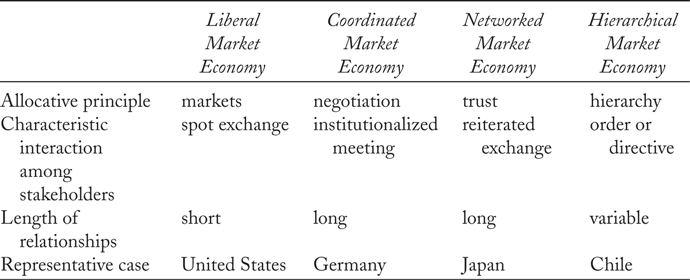
Among the books reviewed here, Schneider’s approach is closest in spirit to the original voc framework. It maintains a focus on firms and market institutions and considers the core building blocks of this approach, such as coordination mechanisms and institutional complementarities. The author proposes two new varieties of capitalism based on distinct logics of coordination: hierarchy and trust. He labels the economies in which these two logics of coordination predominate hierarchical market economies (hme) and networked market economies (nme), respectively. (See Table 1.)

The hme model is the focus of Schneider’s book and is shown to characterize the principal Latin American economies, though the author suggests that it could apply to other countries as well, including Thailand (and possibly elsewhere in Southeast Asia), Turkey, and South Africa (p. 5). In hmes, the main actors are multinational enterprises and diversified business groups that manage economic activity largely by means of hierarchical relationships through which decisions are made at the apex of the business group (often by the dominant figures in an extended family) or at the corporate headquarters of the multinational corporation in the home country.
In nmes, repeated exchange in the context of long-term network relations creates a very different kind of dynamic—not based on bargained adjustment as in cmes, but on implicit long-term contracts or norms, as exemplified by the traditional commitment to lifelong employment and long-term, interfirm network relations in Japan. The nme model is discussed only briefly, and Schneider offers less evidence to demonstrate its applicability, though he views Japan and Taiwan as good examples (p. 29). He also notes that several East Asian economies contain elements of cme, nme, and hme institutions (p. 30).
A key strength of Schneider’s approach is that it is theoretically elegant and parsimonious. Instead of inductively classifying a wide range of institutional arrangements, it proceeds deductively to identify analytically distinct coordination mechanisms based on organizational theory. It shows how institutional configurations reflect complementarities between different institutional domains in the context of a firm-centered view of markets and capitalism (p. 21). This framework also incorporates multinational corporations as key actors, which highlights the importance of globalization and the extent to which developments in hmes depend on decisions of external actors.
Another strength of this approach is its explanatory potential. Schneider convincingly demonstrates that limited incentives to invest in skills and innovation and associated outcomes, such as inequality, growth, patterns of skill acquisition, and corporate governance, relate to these institutions. He shows how an institutional logic underpins these outcomes, in that hme institutions shape incentives and actor strategies. His approach also helps to advance the voc agenda beyond the focus on efficiency, as it demonstrates that institutions can shape performance not only in positive ways, but also adversely. Although the logic of institutional complementarities reinforces strategies and outcomes, many of them, including corporate diversification, are not primarily based on the pursuit of efficiency, but rather on the goal of managing and reducing risk (p. 49). In Schneider’s framework, the logic of complementarities can help to lock in unfavorable outcomes, such as low-skill traps, weak corporate governance arrangements, and high levels of inequality, which make sustainable growth associated with improvements in human development hard to achieve (pp. 90–138). These outcomes can also be understood as manifestations of the middle-income trap, which is common in hmes.Footnote 33
In Schneider’s conceptualization, the underlying politics of capitalism revolves around representation of interests, and the incentives and influence of powerful actors are the main explanation of key outcomes. As in the original voc model, Schneider stresses lock-in effects that contribute to the durability of key institutions and their long-run effects on Latin American political economies. He does not focus on the historical roots of these arrangements, as his emphasis is on understanding continuity and mutual reinforcement. The study of continuity is important, as key corporate forms, such as diversified business groups and hierarchical coordination mechanisms, have largely survived Latin America’s transition to democracy and economic neoliberalism intact (p. 9).
Like many contributions to the study of the politics of voc in oecd countries that show that lmes tend to have majoritarian electoral systems and that cmes tend to have proportional representation (pr) systems,Footnote 34 Schneider puts great emphasis on electoral systems and especially the combination of a strong presidency (elected according to a majoritarian logic) and legislatures elected according to pr in hmes (pp. 141–49). He argues that pr systems facilitate the representation of specific interests, which in the absence of strong encompassing associations of the kind common in European cmes means that individual firms and sectors are often well represented. To account for the influence of these interests, it is essential to consider not only their access to power, but also their strategies and preferences. These actors are generally interested in safeguarding existing privileges and favorable regulations. The most powerful economic actors, notably business groups, have a strong interest in the status quo, as it supports their competitive advantage. Since Latin American presidents rarely enjoy majority support in the legislature, they often make deals with other parties and sometimes with individual legislators (who often represent the interests of specific sectors or firms) to get support for key initiatives.
Nevertheless, despite the overarching emphasis on continuity, Schneider’s account is not deterministic. He considers both actual and potential institutional change. Schneider notes that after 2000, Latin American political economies developed along three distinct paths— continued neoliberalism (Mexico and Chile), nationalist developmentalism (Argentina and Brazil), and left populism (Venezuela and Bolivia) (p. 161). He does not discuss the left-populist path of Venezuela and Bolivia, arguing that these countries have moved toward a form of state or political capitalism beyond the remit of his book, but offers a detailed discussion of the other two trajectories and the prospects for institutional change that might help them escape the low-skill trap. The argument he develops to explain institutional change is complex and contingent, stressing a combination of favorable legacies and luck (rising commodity prices), as well as strategic investments by firms and governments. But globalization is another important factor, as it is primarily global market conditions related to the rise of China and resulting increases in the demand for natural resources that drive these changes by pushing up commodity prices (p. 168). The upshot of the analysis is that a combination of factors could help countries, such as Chile and Brazil, break out of the low-skill trap by investing more in research and development and upgrading technologies. If such changes occur on a larger scale and over a prolonged period, it may be possible to overcome the constraints of the hme model of capitalism in Latin America. Although Schneider notes important differences between Chile and Brazil, he argues that they are the most likely candidates to achieve greater economic success, partly facilitated by increasingly programmatic parties and relatively good governance (p. 162).Footnote 35
Walter and Zhang: East Asian Capitalism: Diversity, Continuity, and Change
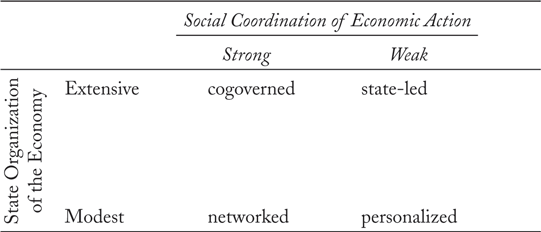
Walter and Zhang’s typology departs from the original voc framework in several respects, most important, by focusing on economic governance. As the editors of this volume, they consider two dimensions of economic governance: social coordination and state organization of the economy. These dimensions capture the degree of involvement of a variety of social actors and the state in the governance of the economy. Although economic activity and firm behavior are expected to follow from the prevalence of these coordination mechanisms, the framework is less firm-centered than the original Hall and Soskice model and Schneider’s model.
Given that both dimensions of economic organization identified by Walter and Zhang can be either high or low, it generates four types of voc based on distinct logical combinations of organizational attributes (see Table 2): state-led, cogoverned, networked, and personalized market economies.Footnote 36 This typology has several distinctive features. First, the authors emphasize the social connections between economic actors, which are different than the kind of institutionalized bargaining between unions and employers’ associations that characterizes strategic coordination in cmes but is rare in East Asia, given the nature of unions and other collective actors there. Second, the authors explicitly incorporate the state into the basic typology of capitalism as a core dimension, although they allow the role of the state in economic governance to vary between high and low. Third, given that their analysis is governance-centered, Walter and Zhang’s framework is well placed to extend the focus beyond the firm and to consider the role of multiple economic governance mechanisms.

Although Walter and Zhang very successfully characterize intraregional variation in their overview chapter (an objective to which Schneider pays more limited attention), their analysis raises several concerns. First, while every classificatory framework involves borderline cases, that Walter and Zhang’s framework centers on dimensions that vary by degree rather than by typological distinctions raises questions about cutoffs between high and low. The cutoff between networked and cogoverned vocs is particularly hard to define, since there is some state involvement in every economy. Schneider’s definition of both Taiwan and Japan as nmes (p. 29) and Walter and Zhang’s view of the former as co-governed and the latter as networked (p. 17) reflect this ambiguity. It may be almost impossible to define specific numerical cutoffs, and Walter and Zhang’s discussion of the typology is couched in terms of general tendencies with many sentences incorporating words like may or likely (p. 18). Such usage reinforces the challenge of identifying how much state involvement is required for an economy to shift from one of these categories to another. To this challenge, one might add the general controversy regarding Japan, which at times is classified as a cme.Footnote 37
Second, the fourth voc Walter and Zhang identify, personalized capitalism, also raises analytical challenges. Since it is characterized by only modest state organization and weak social coordination, economic activity is effectively defined with respect to what it lacks and is almost by default described as personalized. The book identifies a variety of regularities and demonstrates that personalized activity is not idiosyncratic, but rather is shaped by institutions, norms, and specific profit incentives. Yet the authors somewhat underspecify the analytical logic of personalized economic activity. It seems that certain kinds of social ties, such as relational finance or hierarchies within family-owned firms, are essential to the functioning of personalized capitalism (pp. 18–19; see also chap. 4 and 9). Walter and Zhang categorize Thailand as personalized capitalism, while Schneider classifies it as an hme, given the importance of such hierarchies to the Thai economy.
Third, there is some tension between chapters. Although Walter and Zhang classify the financial systems of Indonesia and Malaysia as stateled and Thailand and the Philippines as personalized, Thomas Pepinsky’s chapter proposes different classifications for three out of these four countries. He classifies Indonesia’s financial systems as personalized, Malaysia’s as cogoverned, and Thailand’s as networked (p. 191). Although Pepinsky agrees with Walter and Zhang’s overall classification of these political economies (p. 180), such differences are potentially significant because they also relate to institutional fields within single economies, and a clearer understanding of them could require paying more attention to subnational and sectoral voc (Schneider, p. 22; Walter and Zhang, pp. 270–73).
Extensive subnational and sectoral variation would raise important challenges for theories of institutional complementarities that assume that economic performance is enhanced by complementary labor and financial institutions based on the same logic of coordination. How much can a core institutional domain, such as a financial system, differ from other key institutions of the political economy without undermining the coherence of the system?Footnote 38 In this context, the logic and interrelation of different types of coordination within individual economies warrants further attention, not least because such studies could shed light on the debate about different kinds of complementarities. There is some disagreement in the literature about the economic advantages of coherence and hybridity.Footnote 39 Similarly, the literature also raises the possibility of complementarities that serve other purposes, such as risk minimization or political objectives, as well as the possibility of looser relationships between institutional domains based on synergies or a compensatory logic in which different types of institutions compensate for each other’s weaknesses.Footnote 40 Walter and Zhang’s inductive approach of exploring the evolution of governance mechanisms across different institutional fields is a valuable intermediate step toward a more systematic theorization of complementarities and synergies in these economies.
Despite some variation across chapters, Walter and Zhang develop a helpful overarching framework for understanding the politics of institutional stability and change. Their analysis focuses on three sets of variables: coalitions of interests, state actions and capacity, and policy discourse. This framework analyzes economic institutions as a reflection of the interaction of state actors and other interest groups and where key actors’ power is rooted in both material and ideational factors. For example, they note that political and economic actors may make strategic use of dominant discourse to justify policy reform and weaken opposition to it (p. 24).
The same three factors can be used to study the politics of continuity and change, as it is effectively the balance of forces that determines the degree of institutional change. Walter and Zhang build on recent historical institutionalist research to conceptualize institutional change as gradual, and stress that change rather than stability is the norm.Footnote 41 Individual chapters offer more detailed explorations of these issues. For example, the chapter by Zhang on Northeast Asia focuses on the centrality of dominant interest group coalitions. In Pepinsky’s chapter on financial development in Southeast Asia, he observes that economic institutions have multiple effects—notably, financial development strengthens political elites by fostering economic growth and simultaneously weakens them by empowering other actors. This observation goes to the heart of the debate about the politics of capitalist diversity, namely the degree to which institutions are maintained for efficiency reasons as opposed to other sociopolitical goals. Pepinsky’s analysis demonstrates how sophisticated comparative case studies can illustrate the interaction of different effects and causal processes over time, thereby contributing to varying degrees of stability and change.
Walter and Zhang argue that the four East Asian voc have been remarkably resilient (p. 274) despite considerable institutional change, and note that the politics of institutional change may vary across key institutional domains (p. 277). As the chapter by Mari Sako and Masahiro Kotosaka highlights, there has been more extensive institutional change in Japan’s labor market institutions than in its financial markets in recent decades, but it remains unclear whether this will ultimately lead to systemic change (p. 156). Such differences raise important challenges for theories of institutional complementarities: If there is more change in some areas than others, does it mean that the system loses its overarching coherence (p. 278)? The existing literature suggests different possibilities. Change in one area could trigger changes in another, eventually leading to the emergence of new kind of voc, especially if the process of change originates in an institutional domain that is central to the functioning of political economies like corporate governance.Footnote 42 Another possibility is that some change could be essential for maintaining existing institutional arrangements. Nonetheless, the significance of such processes remains controversial. For example, labor market dualization in cmes can be seen either as underpinning the existing model by enhancing flexibility or as the source of new contradictions and tensions that could ultimately undermine it.Footnote 43
Future research could build on these insights. It would be interesting to learn more about the interactions and relative influence of the three factors identified by Walter and Zhang. For example, it may be worth considering whether the state contributes more to institutional change in state-led and cogoverned voc than in systems where the state plays a more limited role, and whether the discursive dimension matters more in some circumstances, such as economic crises, than others. Such a refinement of Walter and Zhang’s framework could be an important contribution to theories of institutional change.
Bohle and Greskovits: Capitalist Diversity on Europe’s Periphery
In their book, Capitalist Diversity on Europe’s Periphery, Bohle and Greskovits challenge scholarship on capitalist diversity in East Central Europe, much of which has engaged with voc theory in recent years.
Some scholarship seeks to build on classical voc analysis and to identify emerging voc in East Central Europe, though such work also stresses that only a small number of postcommunist economies, notably Slovenia and Estonia, are likely to come close to fitting the Hall and Soskice typology.Footnote 44 Other scholars seek to build new models in the spirit of voc analysis. For example, Stanislav Markus and Martin Mendelski complement the analysis of economic coordination with detailed attention to governance institutions related to the rule of law.Footnote 45 Martin Myant and Jan Drahokoupil proceed more inductively to analyze patterns of global integration and highlight five forms of postcommunist capitalism: foreign investment-based, peripheral, oligarchic-clientelistic, order states, and remittance-based. Footnote 46
The most influential postcommunist voc model is Nölke and Vliegenthart’s dependent market economy (dme) model, which was developed to analyze the East Central European economies of the Czech Republic, Hungary, Poland, and Slovakia.Footnote 47 It resembles Schneider’s hme model, in that it highlights the centrality of foreign direct investment (fdi) and multinational enterprises and how they shape these economies and their institutions, but there are two crucial differences. First, the dme model focuses only on fdi and does not include diversified business groups, as such groups have not developed in the East European postcommunist region on a scale comparable to Latin America. Indeed, one could view the dme model as a special case of an hme in which only one of the two core corporate forms, namely multinational enterprises, is prominent (p. 11). Second, compared to the hme model, the dme model is perceived to be more successful in terms of promoting development. The strategy of attracting fdi could be viewed as an effective way of stimulating growth and structural change, although Nölke and Vliegenthart raise questions about its medium-term viability. It is possible that the dme model will eventually turn out to be less successful because it could be undermined by its own success (if higher wages and costs induce foreign investors to move elsewhere) or because it does not facilitate upgrading and more sustainable growth.Footnote 48
Bohle and Greskovits’s work builds on this early literature on postcommunist diversity, but departs from voc analysis in a more radical way. They attempt to rethink capitalist diversity in postcommunist East Central Europe by basing their analysis on the premise that there is only one core logic of capitalism.Footnote 49 Therefore, the main factors differentiating political economies are political. I classify their framework for understanding capitalist diversity in East Central Europe as a state-centered approach. Building on Karl Polányi’s analysis of capitalism in The Great Transformation, Bohle and Greskovits argue that every state in a capitalist economy faces the core challenge of balancing markets, social cohesion, and political legitimacy (p. 15), and that there are multiple and historically specific ways of doing this,Footnote 50 but it may not be possible to identify such logics purely on theoretical grounds without considering particular countries and historical contexts (p. 15). Like the literature on the developmental state, Bohle and Greskovits’ work identifies variation in the role of the state as the key factor shaping the functioning of economies. In postcommunist East Central Europe, they identify three kinds of political economies.
First, the three Baltic states of Estonia, Latvia, and Lithuania are defined as a relatively pure form of neoliberalism, where social spending and state intervention in the economy are limited. Bohle and Greskovits relate this outcome to the reestablishment of Baltic independence after half a century of wartime occupations and Soviet rule. Given that the majority populations were preoccupied with rebuilding the nation state, they were willing to accept neoliberalism as long as the nationalist social contract was satisfied (pp. 96–137).
Second, the Czech Republic, Hungary, Poland, and Slovakia belong in the category of embedded neoliberalism, in which their neoliberal characteristic is underpinned by more activist social and industrial policies. These policies can be said to embed markets in that they induce populations to consent to neoliberalism and attract foreign investment (pp. 138–81).
Third, the Slovenian political economy is viewed as neocorporatist— the only example of such policy-making in the region (pp. 182–222).Footnote 51 The Slovenian model is based on inclusive and negotiated agreements between the government and key social actors and is associated with relatively egalitarian outcomes that also facilitate growth and investment.
Many aspects of the institutional and policy differences Bohle and Greskovits uncover have some affinity with traditional voc analyses of these countries, including their labor markets and approximate key features of liberal, dependent, and coordinated market economies.Footnote 52 The most important difference between such voc analyses and Bohle and Greskovits’s Polányian framework relates to the role of the state (pp. 16–17, 182). For Bohle and Greskovits, capitalist systems do not reflect institutional complementarities. The emergence of such institutions is viewed as a profoundly political process in which politicians seek to balance a variety of economic objectives and to maintain popular support for existing policies that give markets a free rein or aim to re-embed them in various ways. Each of the three models of capitalism the authors identify is based on a distinct political settlement.
The origins of these models are attributable to three sets of factors. First, Bohle and Greskovits emphasize the central importance of the initial reform choices after the collapse of communism in the early 1990s (p. 80). Decisions by policymakers were unusually significant because institutions were in flux. New institutions were being crafted, and considerable policy autonomy derived from the fact that many conventional interest groups did not exist or were less active than usual. Second, the authors discuss the importance of uncertainty and crisis and imply that policymakers did not have the luxury of devising longterm strategic plans, as they had to respond to shocks and other unexpected events (p. 4). When decision-making during crises and periods of heightened uncertainty happen on a large scale, then the cumulative effect of a variety of crisis management tools on institutional arrangements is considerable. Third, Bohle and Greskovits put great emphasis on the transnational dimension of politics. Although they stress that domestic agency is ultimately the most important determinant of capitalist diversity and judiciously avoid claims suggesting international determinism, they note the influence of international models and the limits to pursuing growth without promoting exports and fdi (p. 82).
The Bohle and Greskovits framework could constitute a more profound challenge to institutional theory in that it shifts the focus from studying stability and change and toward an examination of contradictions and fragility and how such tensions are reconciled at certain moments in time. These models are best understood not as equilibria but, as Bob Jessop terms, fragile “spatio-temporal fixes” that can break down due to economic contradictions or to a loss of political support.Footnote 53 Therefore, support for existing arrangements cannot be taken for granted and must be constantly recreated, which also implies that this analytical framework can be used to study institutional change. Although Bohle and Greskovits describe a variety of pressures and changes, the causal mechanisms underpinning change are not entirely clear. Change seems to result from at least three different processes, including shifts in elite strategies (autonomous or coerced by circumstances, such as the transition from nationalist mobilization to financialized growth in the Baltic States) (p. 228); exogenous pressures (such as the global financial crisis) (p. 223); and endogenous pressures related to exhaustion of previous models (such unsustainable debt levels related to financialization after the crisis) (p. 227). Although each of these explanatory factors is plausible, the authors offer no explicit theory of institutional change, perhaps because they see institutions as inherently fragile and contextually specific.
Comparing the Three Approaches
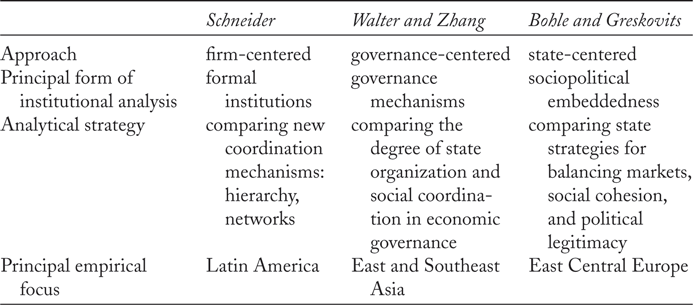
The books by Schneider, Walter and Zhang, and Bohle and Greskovits illustrate distinct strategies for extending and modifying the voc debate. These approaches reflect core ideas of voc scholarship, notably that economic action is embedded in institutions. The main challenge of extending voc beyond the oecd relates to the need to theorize a wider range of economic action and institutions, and as I demonstrate in the overview of the books, the authors approach this task in distinctive ways. (See Table 3.) These differences can be illustrated by briefly discussing three case studies, including an example from each of these regions (Brazil, Thailand, and Hungary) in which the analyses of these frameworks diverge.
Comparing the Three Approaches to Extending the voc Debate

Schneider defines both Brazil and Thailand as hierarchical market economies, which reflects the firm-centered approach that leads him to emphasize the centrality of business groups in both economies. Schneider discusses several influential Brazilian business groups, including Votorantim (a highly diversified conglomerate operating in energy, finance, steel, cement, agribusiness, and other sectors) and the Villares Group (a conglomerate primarily focused on steel and elevators),Footnote 54 and offers a nuanced assessment of their importance to the Brazilian economy in terms of investment and employment across multiple sectors. He argues that Thailand should also be seen as an hme (p. 5), and though he provides less evidence for this case, his assessment is consistent with a significant body of literature on the centrality of business groups to the Thai economy.Footnote 55
But based on Walter and Zhang’s approach these two economies would be classified as different kinds of capitalist systems. They regard Thailand as a personalized market economy, given the weakness of state and social coordination, especially since the 1990s. Social coordination has declined over time, as manifested by a weakening of business associations and, especially, of intercorporate networks in recent decades.Footnote 56
Although Walter and Zhang do not consider countries beyond East and Southeast Asia, Brazil could be classified as a state-led market economy (or possibly a co-governed market economy) based on their typology. This categorization is consistent with other studies that view Brazil, along with China and India, as a “state-permeated market economy,”Footnote 57 or more simply, as a form of state capitalism.Footnote 58 While there is broad agreement that contemporary Brazil does not fit the traditional developmental state model, the coordinating role of the state remains important to the functioning of the economy.Footnote 59 Key examples include state ownership in a few strategic sectors, an active role as a minority shareholder in some firms, and perhaps most important, the centrality of the Brazilian Development Bank as a strategic investor and funder of innovation and internationalization.Footnote 60
The classificatory differences of these countries between Schneider and Walter and Zhang are not contradictory because they are based on different levels of analysis. Walter and Zhang focus on market governance, whereas Schneider focuses on the key market actors and institutions. And, although more research is needed to explore the interconnections between their frameworks, the comparison of these two cases suggests some possible lessons. First, business-group dominance can coincide with different forms of economic governance. This is an important finding, not least since the hme model captures key elements of many political economies across the Global South.Footnote 61 More attention to economic governance could help to distinguish between subtypes and to identify variation within this large category. Second, this comparison also raises questions about the specific logics of interaction between business structure and governance, which are likely to vary across such cases. For example, the Thai case shows that the influence of business actors can be substantial in the absence of coherent state control of the economy, while in the Brazilian case the roles of the state and of business groups could be seen as complementary or mutually reinforcing, as many state policies support domestic business groups. This complementarity of the state and business groups relates to Richard Carney’s suggestion that the state and business groups are hierarchical actors and that state-led and family business group–led market economies could be viewed as two subvarieties of hierarchical capitalism.Footnote 62 But if the role of the state overshadows private business, it raises the possibility of a form of state capitalism that is distinct from an hme. Schneider suggests that such is the case in Venezuela (p. 39).
Schneider’s approach can also be compared to the framework developed by Bohle and Greskovits by considering the dme model. Although their books do not cover the same countries, Bohle and Greskovits see dmes as a special case of hmes dominated by multinational enterprises but without any significant role for business groups (Bohle and Greskovits, p. 11). Schneider also mentions the dme model and suggests that hmes in which the role of business groups is weakening could be converging on the dme model, as seemed to be the case in Argentina around the turn of the millennium (p. 75).
As noted above, the dme model was developed to account for the economic structure of Hungary and other East Central European economies. It analyzes the significant contribution of fdi to exports, growth, and employment in these countries, and highlights the high dependence of the Hungarian economy on foreign investment. It also explores the complementarities between economic institutions and the economic strategies of multinational enterprises that constitute the general context in which any Hungarian government operates and formulates economic policy.Footnote 63
Although Bohle and Greskovits also view foreign investment as central to the functioning of the Hungarian and other Central European economies, they analyze the presence of multinational enterprises as the outcome of the embedded neoliberal policies pursued by the state. Multinationals have responded to positive inducements offered by the state, and strategic use of welfare policies has ensured popular support for this policy regime as well. Therefore, a key strength of the Bohle and Greskovits framework lies in its political account of the emergence of the dependence on foreign investment. Building on the economic transition literature, they show how strategic government decisions have shaped the economy by attracting foreign investment—and thereby respond to Nölke and Vliegenthart’s plea for more research uncovering the class and state configurations leading to the emergence of dmes.Footnote 64 Bohle and Greskovits’s framework also sheds light on the politics of change: given that any institutional arrangement is fragile and support has to be recreated at various times, it opens up the possibility for agency by political leaders who seek to craft new settlements. Since coming to power in 2010, for example, Hungarian Prime Minister Viktor Orbán has built support for a strategy that seeks to attenuate dependency on Western Europe, notably by drawing on a more nationalistic legitimation strategy that contests some aspects of EU and Western influence. On the one hand, this strategy involves promoting domestic capitalists loyal to the regime.Footnote 65 On the other hand, it entails a strategic opening to the East to deepen political and economic ties, especially with Russia and China. Although these initiatives have not fundamentally challenged the overwhelming economic predominance of Western firms and investments, they highlight a different legitimation strategy that changes the political underpinnings of the Hungarian economy and is designed to signal that the government has greater political autonomy.Footnote 66
More generally, this comparison suggests that there are trade-offs between the strategies proposed by these books. While the authors analyze the institutional embeddedness of capitalism, the strategy for extending the voc debate that each adopts has consequences for the kinds of questions they can answer. Each study can be related to different levels of analysis, broadly corresponding to Williamson’s distinction between three forms of institutional analysis that focus on governance (Walter and Zhang); formal rules of the game, such as the nature of property (Schneider); and social embeddedness (Bohle and Greskovits).Footnote 67 It may not be possible to address the three challenges to the voc framework identified above at once, but each book opens up a distinctive research agenda.
First, given its firm-centered approach, Schneider’s book is most faithful to the original voc framework. For Schneider, capitalism and market institutions are best understood as analytically separate from the state (pp. 3–4), which means that it is possible to study the influence of the state and the political sphere on the functioning of the economy, as well as the ways that market institutions constrain politics.
Schneider’s is the most successful of the three books in terms of developing a nuanced theory that can explain variation in economic performance by showing that institutional complementarities can have negative effects in terms of limiting investments in skills and innovation. It also integrates some concerns associated with the literature inspired by dependency theory, namely the contradictory effects of globalization. It highlights the ways in which reliance on fdi can make beneficial contributions to economic growth and can also contribute to locking in certain structural disadvantages that could perpetuate the middle-income trap.
More generally, Schneider’s book also relates to recent debates on economic development that emphasize the importance of institutions to economic growth. A key insight of the voc agenda is that the economic effects of institutions depend on complementary institutions, which means that there are multiple paths to economic success and that institutions cannot necessarily be assessed in the abstract without considering other related institutions. This argument also resonates with ideas advanced by some proponents of the post-Washington consensus within the World Bank that economic success depends on a variety of contextual factors and local conditions.Footnote 68 In a similar vein, Dani Rodrik analyzes successful economic reform as a process of removing binding constraints on growth.Footnote 69 By studying various institutional logics and complementarities, a global voc approach could help to advance this research agenda and to analyze such binding constraints in a more systematic way. Because binding constraints vary across countries, it is essential to study the specific institutional contexts that shape them. A focus on interactions between institutions inherent in the voc tradition could offer opportunities to define and operationalize such contexts in ways that are amenable to comparative study. For example, in hmes there are both supply and demand constraints on skill investments, as neither workers nor employers expect significant returns, though increasing public investment in skills and education could change this calculus. In state-led market economies, the binding constraint is most likely to be related to state action or inaction, as the state plays a crucial role in economic coordination and also in setting expectations.Footnote 70 Future work could develop these ideas by means of systematic comparisons of institutional contexts across different voc, which could also help to refine our understanding of the conditions under which complementary institutions are most likely to be efficiency enhancing and when they are more likely to serve other goals, such as risk minimization or the maintenance of political power.
Second, Walter and Zhang’s approach offers the most fine-grained analysis of economic coordination in that it does not analytically privilege either firms or states, thereby avoiding firm- or state-centeredness. This framework makes it easier to capture empirical variation across cases and to identify subtypes of hmes, as demonstrated in the discussion of Thailand and Brazil. Their volume focuses on the stability and evolution of these governance mechanisms, but it does not systematically relate institutions to comparative economic performance, innovation, or patterns of specialization. Since the book does not systematically theorize institutional complementarities and comparative institutional advantage, more work is needed to relate their models of capitalism to questions of economic performance and growth. Walter and Zhang’s framework is most useful as a complement to Schneider’s and could be used to distinguish between subtypes of hmes. Future work could provide scope for more systematic integration of these frameworks. It would be interesting to explore whether the economic governance mechanisms analyzed by Walter and Zhang can be related to the performance of hmes, for example, by stimulating innovation or skill investment.
Third, harking back to the study of the state in classical development theory and Polányi’s account of embedded markets, Bohle and Greskovits show that capitalist diversity can be theorized as resulting from different state strategies that partly reflect other factors, including geographical proximity to Western Europe and historical factors. State strategies can be expected to shape growth during large-scale transformations, such as the introduction of markets and market-supporting institutions in East Central Europe. While Bohle and Greskovits highlight some trade-offs between growth, macroeconomic stability, and distributional outcomes, their framework implies that the most successful economies (except for the outlier Slovenia) are those that attract the largest stock of foreign investment, especially into the most advanced forms of manufacturing. This insight contributes to our understanding of postcommunist economies, as fdi has certainly shaped their growth performance over the past twenty-five years, but it does not provide a full explanation of the productivity of these investments or even their long-term viability. Questions related to medium-term comparative advantage, upgrading, or innovation receive little attention in Bohle and Greskovits’s book. Their interpretation of postcommunist economic development raises questions about whether foreign investors are likely to stay in these countries or look for new opportunities in lower cost economies.Footnote 71 Would new inducements be necessary and sufficient to attract new investments or to retain preexisting multinationals, or are there other foundations of comparative advantage that relate to the firms’ strategies and sectoral specialization? To what extent can firm performance and strategies be explained by government industrial policy and the promotion of fdi? Although the emphasis on the role of the state in shaping growth strategies has some affinity with the classical developmental state literature, Bohle and Greskovits place greater emphasis on how elites build support for reform strategies. The most important contribution of the book is the comparative historical account of the processes and outcomes of the structural transformation of these postcommunist countries and the diverse ways in which their governments managed to maintain political support for these processes. Although the insights about the political construction of these reform trajectories are important, more research is needed to show how generalizable these pathways are. A similar kind of analysis could potentially be used to analyze the origins of other forms of capitalism, including the hme model. For example, the strategic government responses to the Great Depression in Latin America, including the move toward import-substituting industrialization and the promotion of domestic businesses, could potentially be analyzed by drawing on Bohle and Greskovits’s approach. Given that the Great Depression is widely seen as a critical juncture in Latin American development, an application of Bohle and Greskovits’s framework to this period may provide some further insight into the historical and political roots of the hierarchical market economies analyzed by Schneider.Footnote 72
Conclusion
This article explores three seminal contributions to globalizing the voc debate and identifies three key lessons from the books under review— both for the voc debate and for the study of emerging markets and economic development.
First, the books suggest that the development of a global voc perspective has great potential. If adapted in appropriate fashion, the voc framework can be extended and can shed light on the functioning of capitalism and the structure of economic institutions in the Global South. A global voc approach can offer valuable insights into the political economy of development. It constitutes an exciting research agenda for scholars interested in the Global South, including opportunities to explore institutional variation and its effects on a wide range of outcomes, including growth, inequality, crises, innovation, and development. By going beyond the focus on the traditional oecd countries, a global approach can reinvigorate the voc framework more generally and has methodological advantages. It would allow the literature to consider a wider range of institutions and outcomes, such as output levels, growth, and inequality, as well as within-case variation of a larger number of countries. A global perspective on voc can provide a richer account of a wider range of capitalist diversity, which would contribute to a more nuanced assessment of the success and political underpinnings of the multiple manifestations of capitalist institutions.
Second, the books demonstrate that traditional concerns of the development literature on the developmental state and dependency theory can be integrated into voc analysis. While the state is a key analytical category in Walter and Zhang’s framework and is an important background factor in Schneider’s framework, its centrality is particularly pronounced in Bohle and Greskovits’s work, which focuses on the role of the state in embedding and legitimating capitalism. External constraints are also integral to the arguments in these books. Bohle and Greskovits show how attracting foreign investment is generally a necessary condition of successful postcommunist growth. Schneider’s framework stresses the role of multinational enterprises in hmes and the ways in which they promote investment while constraining development, given that they may perpetuate the middle-income trap due to limited innovation and upgrading.
Third, there are trade-offs between the approaches forwarded in these books. Taken together, the works represent an important advance in our understanding of the global diversity of capitalism, and they address common criticisms of the voc approach relating to the role of the state, excessive firm centeredness, and a limited account of variation in economic performance. Although the three works have different strengths, they can ultimately be viewed as complementary because they do not address the same challenges. Schneider’s firm-centered approach builds on the core strengths of the voc framework and shows how it can be extended to explain other kinds of capitalist systems. Its main strength is that it enables voc analysis to go beyond the efficiency focus by offering a compelling account of the institutional underpinnings of varying degrees of economic success. Walter and Zhang’s approach considers further dimensions of economic coordination, and shows how firms, interest groups, and the state interact in shaping economic governance and the institutional context of economic activity. The main contribution of their approach is that it provides a more finegrained account of numerous governance mechanisms in economic systems, including the state. The main strength of Bohle and Greskovits’s approach involves demonstrating how political processes and state actors can shape the economy, especially during periods of profound transformation, and highlighting the importance of popular legitimacy to maintaining economic institutions. The analysis of these approaches suggests that each of them enriches the voc debate and makes distinctive contributions to it. Given the trade-offs between them, there are no obvious grounds for favoring one over the others, as they are each useful for different purposes. Since firm-, governance-, and state-centered approaches can make distinctive contributions to the understanding of institutions, Williamson’s plea for pluralism in institutionalist research also applies to the global voc debate.Footnote 73
While these books make a significant contribution to our understanding of global voc, they point to several issues that should be explored in future research. First, more systematic analysis of connecting different voc to various economic outcomes, such as growth, sectoral specialization, innovation, and inequality, would be necessary to assess the full potential of global voc to contribute to debates about economic development. Such work would clarify the extent to which institutional arrangements are related to distinctive patterns of economic performance. There may be scope for connecting this literature to recent attempts to integrate Latin America, East Central Europe, and East Asia into the comparative welfare state literature as well.Footnote 74
Second, the theorization of non-oecd voc needs to be further refined. Schneider makes important points in his discussion of the hazards of excessive multiplication of models and of going down an inductive route. Although he argues that his extension of the voc model offers the potential for theoretical closure (p. 22), it is not clear whether his framework exhausts the universe of varieties. Indeed, his own observations about state-dominated or political capitalism could be incorporated into a voc-type model (p. 39), not least given the insights about state coordination of the economy in the Walter and Zhang volume.Footnote 75 It is also important to refine the analysis of undertheorized voc, such as personalized capitalism (Walter and Zhang), which is largely defined with reference to what it lacks (but which Schneider would analyze as an example of the hme model). As noted, differences in economic governance across institutional domains within economies also warrant further study, as they could shed light on the nature and significance of institutional complementarities. Disagreements about categorizing key cases across different frameworks suggest that more research is necessary before we achieve anything approximating a tentative consensus on classifying capitalist systems on a global scale, which is why more comparative analysis of economic governance across multiple institutional fields is an important task for future research.
Third, and perhaps most ambitiously, future studies could explore whether it is possible to bridge the approaches discussed in this article. Given the analytical differences between them, it seems unlikely that a complete merger of these approaches would be desirable, but elements could be used as complements. As I suggest, Bohle and Greskovits’s approach could potentially be applied to other regions to analyze the origin of capitalist diversity, including the political roots of the hme model. Given the dominance of business groups alongside the importance of fdi across much of the Global South, Schneider’s extension of the voc framework could be used to study economic institutions and performance, including the role of the middle income trap, across various regions.Footnote 76 Since understanding both commonalities and differences in economic governance and performance within this group is a very important task, Walter and Zhang’s distinction between different forms of economic governance could be used to distinguish between subtypes of hmes.
In conclusion, this article argues that there are important reasons for embracing the study of global voc and not keeping the study of developing and developed countries separate as a matter of principle. In an increasingly global economy, many challenges, such as managing capital flows, attracting foreign investment, and finding a niche in the global division of labor that harnesses domestic capacities and institutions, are common to most countries. Important differences between the most productive and richest countries in the world and developing countries obviously need to be theorized, but capitalist systems are increasingly interdependent and interconnected in global markets as well as in global financial and production networks. As Schneider demonstrates, growth in Latin America cannot be understood without considering the investment strategies of US multinationals active in the region, and US growth and current account deficits can arguably not be fully understood without considering Chinese surpluses and lending.Footnote 77 This article demonstrates that a global voc framework can shed light on the diversity of capitalist systems across the world, and it highlights three different analytical strategies for extending the debate beyond the oecd and the trade-offs between them.
Acknowledgments
The author would like to thank the three anonymous reviewers and Robert Fannion, Peter Hall, Mircea Popa, and Aleksandra Stelmach for exceptionally helpful feedback on earlier drafts of this article; he is also grateful to Torben Iversen, Dwight Perkins, and Alison Post for useful conversations. The usual disclaimer applies.
Author
Magnus Feldmann is a senior lecturer in politics in the school of sociology, politics, and international studies at the University of Bristol in the United Kingdom. His research focuses on comparative politics and political economy, with a special emphasis on comparative capitalist systems, political regimes, and economic policy-making. Feldmann’s current book project is on capitalist institutions in comparative perspective. He can be reached at m.feldmann@bristol.ac.uk.