Migration flows have visibly altered Spain’s social configuration over the last decade Footnote 1 . In open contrast to similar phenomena occurring in neighboring countries, the rapid increase in the number of citizens coming from abroad has taken place in a relatively short lapse of time. The intensity of the process becomes even more evident when analyzing some figures published by the statistical office of the European Union (Eurostat, 2011). According to these data, Spain was hosting the second highest rate of foreign citizens living in a European country in 2010 (5,663,500), second only to Germany (7,130,900). This sets Spain apart from other countries with a much longer tradition in the reception of immigrants, as for instance the United Kingdom (4,367,600), Italy (4,235,100) or France (3,769,000).
It is true that in Spain this phenomenon has not affected all territories equally. Catalonia, with 1,183,907 foreigners registered, is the Autonomous Community with the highest number of recently arrived citizens (Instituto Nacional de Estadística, 2012). As a consequence of family regrouping dynamics, and also due to other factors, such as the number of births in the host country or political and military conflicts, among others (Vertovec, Reference Vertovec2007), schools have not been left unaffected (Defensor del Pueblo - Ombudsman, 2003). For the last decades, as far as pre-university education in Spain is concerned, the number of students of immigrant origin has moved from 141,916 (2000–01 academic year) to 770,384 (2010–11), representing 9.5% of the overall number of students in the country (Ministerio de Educación, 2011). As was the case with general population, these common dynamics have far-reaching implications for the Catalan educational map, as more than 20% of immigrant students in Spain attend Catalan schools - around 150,000 (Departament d’Educació, 2010).
Despite the diverse origin of immigrant students in Spain, we must stress the fact that most of them (more than 40%) come from Latin America, where various indigenous languages are commonly spoken along with those introduced in colonial times. Although some students may have these other languages as L1, the majority are L1 speakers of Spanish (Spain’s majority and official language). This situation, again, sets the country apart from other countries either in Europe, Canada or the USA.
By and large, immigrant students on arrival in Catalan schools (irrespective of their origin) lack good command of the language of instruction (L2) in Catalonia (Catalan), which shares co-official status with Spanish but has very limited impact beyond the regional borders. This case is particularly relevant as, since the beginning of the 1980s, with the aim of guaranteeing a similar degree of competence in both languages, the educational system was organized on the basis of immersion programs aimed at native Spanish-speaking students. We would like to underline that such programs have played a key role in the revitalization of Catalan in the region, and that they have not been detrimental to the levels of competence in Spanish or other basic curricular abilities (Huguet, Reference Huguet2007).
Against this general backdrop of success Footnote 2 , many researchers advocate for the implementation of immersion programs with immigrant students, in general, and more particularly as regards Latin American students. When it comes to the latter group, the driving principle is rather simple. These programs were successful when implemented with Spanish-speaking students born to migrant families arriving in Catalonia, between the 1960s and 1970s, from other Spanish regions. In the light of these results, nothing should prevent these same programs from succeeding with Spanish-speaking immigrants. However, we would be running the risk of oversimplifying the whole panorama, as using “the same” L1 does not make both groups comparable. In contrast to the situation three decades ago, the areas of the cities where immigrant families live nowadays are characterized by multilingualism, whereas Spanish monolingualism was the general trend back in the 1970s. Moreover, the relocation of native students in schools far away from immigration areas has generated artificial school populations that are more linguistically heterogeneous than they used to be at the time. On the other hand, there is no doubt as to the fact that the attitudes of the population towards Catalan and Spanish at the end of the Franco dictatorship were not the same as those shown by Latin American citizens nowadays (Serra, Reference Serra2010; Vila, Oller, & Fresquet, Reference Vila, Oller and Fresquet2008).
As it happens with regard to students’ general academic work (Alonso-Tapia & Simón, Reference Alonso-Tapia and Simón2012), it is commonly accepted that a favorable stance towards a given language is a necessary pre-condition for effective learning and acquisition (Baker, Reference Baker1992). Based on data from the Catalan context, Huguet, Janés, and Chireac (Reference Huguet, Janés and Chireac2008) analyzed language attitudes towards Catalan and Spanish in a sample of 225 immigrant students in Compulsory Secondary Education. Apart from the large number of Latin American students, other territories were also incorporated into the study: the Maghrib region, Sub-Saharan Africa, Asia, Eastern Europe and the European Union. Several variables were controlled, but here we are mainly concerned with L1 influence: Latin American students privileged their own language over Catalan whilst in the rest of groups the tendency was just the opposite (that is, Catalan was more positively valued than Spanish).
Similar conclusions can be drawn from Lapresta, Huguet, and Janés (Reference Lapresta, Huguet and Janés2010) as far as the impact of home language and geographic origin is concerned. The authors studied language attitudes as deployed in the discourse collected in extensive interviews with 19 native and 16 immigrant students. The analysis showed that those students in the sample who felt positively valued and socially integrated in the region developed more favorable attitudes towards Catalan and Spanish. It is particularly worth highlighting the position adopted by some Spanish-speaking Latin American informants with regard to Catalan. As they were fluent in Spanish, which is also used (and co-official) in Catalonia, they did not perceive the need to learn Catalan. Conversely, they thought other immigrant students, speakers of an L1 other than Spanish, should learn Catalan. They even thought these other students were more capable of learning Catalan than Spanish-speaking Latin American students. Furthermore, there was a common phenomenon affecting most Latin American students in the sample analyzed in the study: whereas they showed very favorable attitudes towards Spanish, the reverse held true towards Catalan. This was also the case of the Maghribian students in our sample, although both groups grounded their views on different arguments. While Latin American students’ identity is discursively articulated around the use of Spanish as their mother tongue (L1), Maghribian students’ attitudes derive from their instrumental perception of Spanish, together with the relatively low functional impact of Catalan on their everyday live in Catalonia.
It is evident that the results we have just offered derive from a generalization. This notwithstanding, we should not forget the heterogeneity (that we could also find in any other human group) inherent to the Latin American community. As we have already pointed out, a higher degree of social integration, along with a better perception of “the other” (from the perspective of both local and immigrant individuals) improves attitudes towards Catalan, which is in turn beneficial for language learning. Vila, Siqués, and Oller (Reference Vila, Canal, Mayans, Perera, Serra and Siqués2009) confirmed this relationship in their research on reception classes for immigrants in Catalonia. The knowledge of Catalan and the extent to which students integrate into schools are closely related, even more so if we consider that language becomes instrumental and acquires its full significance in social interaction. The transfer of abilities generated in an academic context can only consolidate if there exists a continuum of use between academic contexts and social use (Vila, Siqués, & Oller, Reference Vila, Canal, Mayans, Perera, Serra and Siqués2009). This leads us to the difficulties that have arisen when trying to foster the use of Catalan among immigrant students (Galindo, Reference Galindo2008). Besides, these efforts tend to collide with the sociolinguistic characteristics of: 1) city areas agglutinating the vast majority of immigrant population, and 2) the resulting artificial concentrations in some schools, that are eventually avoided by native families (Carbonell, Reference Carbonell2005).
When dealing with proposals that advocate for the implementation of immersion programs with immigrant students (particularly in the case of Latin American students), we should not obviate that such programs are coherent with Cummins’ Linguistic Interdependence Hypothesis (Cummins, Reference Cummins1979). The Hypothesis puts forward the idea that the linguistic abilities developed in a given language (Lx) can be transferred onto any other one (Ly) under certain conditions: 1) enough and adequate exposure to Ly, either in or outside the school, and 2) motivation to learn Ly. As regards Catalan, for example, this would imply instruction in Catalan, which would help students develop reading and writing skills in that language. At the same time it would enable them to develop deeper conceptual and linguistic skills narrowly intertwined with their learning of Spanish, insofar as it is strongly present in society and is also object of instruction. This perspective would imply the existence of an underlying cognitive-academic proficiency, common to all languages (Common Underlying Proficiency - CUP), which facilitates transfer even if certain superficial elements of the language (such as pronunciation and fluency) remain unconnected. Accordingly, this general competence would not affect those elements commonly regarded as linguistic; rather, it points at general aspects governing general language use.
If we agree on the fact that language acquisition takes place in social interaction (Bruner, Reference Bruner1983; Wells, Reference Wells1981), and also that there exist general rules governing language use which are not the sole patrimony of any single language, students may be able to improve their skills by progressing in their command of any given language. Consequently, when learners attend a school where the language of instruction is different from their L1, if provided with enough opportunities to improve their competence in the L2, apart from reaching this goal they will develop their general competence common to both languages. This will be the case if students are also able to use their L1 in social or familiar settings, as this will generate the environments necessary for the transfer of abilities (developed in L2, and vice versa) to take place. In other words, as far as language command is concerned, learning a language favors the development of other languages if they are fostered in all the contexts where they are present (Gass, Reference Gass, Ritchie and Bathia1996; Jarvis & Pavlenko, Reference Jarvis and Pavlenko2008).
Everything said so far applies to languages that are either close or distant in typological terms. In the first case, the transfer operates at both linguistic and conceptual levels, while in typologically distant languages transfer takes place affecting mainly cognitive and conceptual elements, as would be the case with English and Japanese (Cummins et al., Reference Cummins, Swain, Nakajima, Handscombe, Green, Tran and Rivera1984) or Spanish and Náhuatl (Francis, Reference Francis2000) Footnote 3 . In fact, depending on the sociolinguistic situation, according to Cummins (Reference Cummins, Lasagabaster and Sierra2005) we are dealing with five different kinds of transfer of: conceptual elements, metacognitive and metalinguistic strategies, pragmatic aspects, specific linguistic elements and phonological awareness (that is, awareness of the fact that words are made up of different sounds and sound patterns).
Cummins’ proposal has been related to modular approaches (Francis, Reference Francis2002, Reference Francis2004, Reference Francis, Cummins and Hornberger2008) which, in opposition to more holistic perspectives, stand for the existence of specialized mental structures in constant interaction and re-elaboration (Fodor, Reference Fodor1983). Hence we can approach reading as either a global process or, conversely, as consisting of a series of closely intertwined abilities related to phonological knowledge, phoneme-grapheme mechanisms, text processing, etc. The fact that a given individual may have developed certain skills in a language, but not others (non-native pronunciation but advanced narrative abilities, deep knowledge of the grammar of the language but limited lexicon), would confirm the modular structure of the mind (Francis, Reference Francis, Cummins and Hornberger2008). On the other hand, the transfer of knowledge in a given subject, be it taught in one language or another, would explicate the independence between conceptual and linguistic knowledge (MacSwan & Rolstad, Reference MacSwan and Rolstad2005).
Whatever the case may be, we cannot develop here a whole review of the various works that have supported the Linguistic Interdependence Hypothesis. To that end we address the reader to Baker and Hornberger (Reference Baker and Hornberger2001) or to Cummins himself (1996, 2000, 2005, 2008). As regards Catalonia, the Hypothesis has been tested both with native (Huguet, Vila, & Llurda, Reference Huguet, Vila and Llurda2000; Vila, Reference Vila1995) and immigrant students (Huguet, Reference Huguet2008; Oller, Reference Oller2008).
If we focus on these two last studies, it is worth commenting on the fact that the first one (Huguet, Reference Huguet2008) was carried out in a secondary education school, with 121 subjects in the sample (93 native and 28 immigrant students aged 14 to 16), and Romanian, Ukrainian, Bulgarian, Arabic, Spanish, Portuguese and Wolof as the L1s spoken by the students. After analyzing the data obtained in two parallel tests of linguistic competence in Catalan and Spanish, the work focuses on the explicative possibilities of the Hypothesis when it comes to pinpointing the mechanisms at work in the acquisition of new languages by immigrant students in multilingual settings. The analysis carried out seems to indicate that interdependence and linguistic transfer processes do take place, with certain linguistic abilities being more likely to be transferred than others. Precisely, those transferred are located at a deeper level of linguistic competence, in contrast to those found at more superficial levels.
Oller (Reference Oller2008) worked on a sample of 1,141 twelve-year-olds in their last year of primary education in different schools (626 native and 515 immigrant students). There were more than 30 L1s in the sample, and all students participated in Spanish and Catalan competence tests. Among others, the following dimensions were considered in the study: L1, length of stay in Catalonia, family educational level and socio-professional status, sociolinguistic context and rate of immigrant students per classroom. With the analysis of different linguistic skills, and also of the aforementioned variables, the author sought to clarify the establishment of relationships of linguistic interdependence. To that end, it was concluded that there was a direct correlation between knowledge of Catalan and of L1, as the majority of immigrant students had previously developed cognitive-academic abilities in their own languages. They could transfer these abilities to their Catalan competence if given the chance to use their L1s in their immediate social and academic context. Therefore, L1 was considered as an influential factor in the process of acquisition of the vehicular language, as it mediates in the establishment of relationships of interdependence in accordance with the sociolinguistic context and the different abilities involved.
Later analyses of the same data (Oller & Vila, Reference Oller and Vila2011) focused on some linguistic groups of immigrant students in the sample: 221 speakers of Spanish, 44 speakers of Romanian and 131 speakers of Arabic. Drawing on a revision of previous research on learners of English-L2 in the USA (Genesee, Lindholm-Ready, Saunders, & Christian, Reference Genesee, Lindholm-Ready, Saunders and Christian2005; 2006), it was established that Catalan-Spanish (and vice-versa) transfer and relationships of interdependence take place between Latin American students’ L1 and L2. The same applies for L2 and L3 in Romanian or Arabic-speaking students in the sample. Nonetheless, such relationships affect more clearly cognitive-academic skills (linked to written language) than conversational abilities (deployed in oral interaction), all of them in turn framed by length of stay, mother tongue and the corresponding sociolinguist context. Specifically, Latin American students show a higher rate of transfer in writing and reading skills already developed in Spanish, while the process does not apply so clearly in oral abilities due to the lack of opportunities to use Catalan outside the school. Conversely, Romanian-speaking students live in contexts where Catalan is more socially present than Spanish, which helps them develop good levels of oral competence in the former language, which also benefits their reading and writing skills. Lastly, Arabic-speaking students obtain the lowest scores in Catalan and Spanish when compared to other groups Footnote 4 . This can be attributed to either differences in family educational level or to difficulties to use their L1 in formal-academic contexts, as they had spent most of their schooling in Catalonia, where they arrived by 2000. Romanian students, on the other hand, had arrived in the region later in their lives and had already been schooled in their country.
As a summary, the authors conclude by stating that in Catalonia (where Catalan is the vehicular language and Spanish is taught two hours per week)
“additional knowledge of oral Catalan is needed so that, on one hand, recently arrived students can transfer the abilities they have already developed from their languages to Catalan and Spanish (and vice-versa). On the other hand, this will also help students of foreign origin born in Catalonia progress in those abilities linked to written Catalan and transfer them onto Spanish (or vice-versa)” (Oller & Vila, Reference Oller and Vila2011: 19)5.
Against this conceptual background, our research aims at analyzing how Catalan-Spanish (and Spanish-Catalan) interdependence and linguistic transfer processes take place, alongside linguistic ability development, in two groups. Although the groups (native Spanish-speaking students and Spanish-speaking Latin American students) share, a priori, the same language, we should not forget that we are dealing with different varieties of Spanish.
Method
Participants
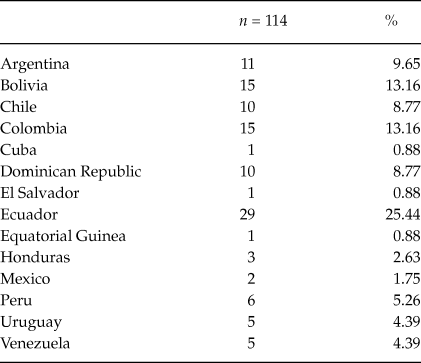
The sample consists of 237 Spanish-speaking students (16 years of age) in their last year of Compulsory Secondary Education in Catalonia. Out of the overall sample, 123 were native students, while the rest (114) were immigrants coming basically from Latin American countries (see Table 1).
Immigrant Spanish-speaking students according to country of origin

We should highlight that all students had previously been schooled either in their home countries or in Catalonia, and that those students who had spent less than three months in Catalonia were excluded from the Latin American group. Overall, the average time of stay in Catalonia was 4.67 years, with a standard deviation of 3.91 years. Taking mother tongue as a criterion (Castilian vs. Latin American Spanish varieties) the Latin American group was selected from a representative and larger sample of students of immigrant origin in Catalan schools. Native students were selected according to L1 (Spanish) in the same schools and academic level. Catalan speakers (L1) as well as bilingual Catalan-Spanish students were also excluded from the study.
Materials
Two tests designed and scaled by the Education Department of the Government of Catalonia were used to evaluate the linguistic abilities (in Catalan and Spanish) necessary to follow schooling in Catalonia. The test analyzed pre-established aspects of language, although a few sections were more open. The tests, parallel in their internal structure, analyze the following dimensions: Oral Comprehension (OC), Morphosyntax (MS), Orthography (ORT), Written Comprehension (WC), Written Expression (WE), Oral Expression Lexico-Morphosyntax (LMS), Oral Expression Information Organization (IO), Phonetics (PhO), Reading Correctness (R-C) and Reading Intonation (R-I). All sections are graded following a scale ranging from 0 to 100 points according to right and wrong answers. Lastly, two scores are obtained: SC1 and SC2. The first score is drawn from the average corresponding to the first five written subtests, carried out collectively. The second score corresponds to the average from all the tests (written and oral, the latter set being implemented individually).
To complete the test an accompanying booklet is required, and the subtests have to be completed in the amount of time allotted for each task. As we have already pointed out, the Catalan and Spanish tests are parallel (their internal structure is equivalent), but activities differ in each case in terms of content, texts, vocabulary, etc. Additionally, all participants answered a questionnaire in order to collect useful information that would let us control certain variables incorporated into the analysis: country of origin, home language, length of stay, etc.
Difficulty indexes, correlations and reliability were calculated by means of the “two halves” technique, widely described in Bel, Serra, and Vila (Reference Bel, Serra and Vila1991). The Pearson’s correlation obtained to measure subtest reliability oscillated in all cases between r = .61 and r = .80.
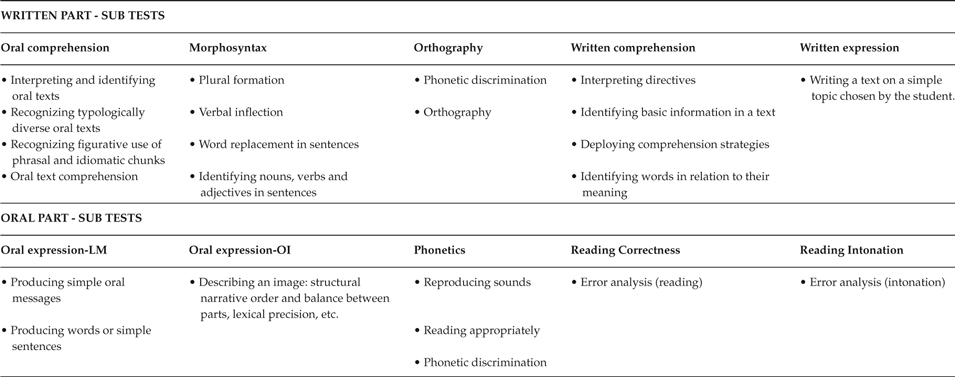
Lastly, we would like to emphasize that the tests used for this study have already been implemented successfully both in the study of traditional bilingual contexts (Huguet et al., Reference Huguet, Vila and Llurda2000; Huguet & González-Riaño, Reference Huguet and González-Riaño2002), as well as in contexts of immigration (Huguet, Reference Huguet2008; Navarro & Huguet, Reference Navarro and Huguet2010). Table 2 gives a summary of the tasks performed in each of the sections of the general tests.
Tasks carried out in the Catalan and Spanish sub-tests

Procedure
After clarifying the aims of our study, local educational authorities suggested the most suitable schools for our work. Once the corresponding authorizations were issued meetings with the different school boards were arranged.
The tests were implemented in May, one month before the end of the school year, by different people specifically trained to carry out the different tasks. All students completed the collective part of the tests in their corresponding classrooms, while the individual part was administered in an office where the interviewer met each student individually.
For the completion of the collective part of each test 75 minutes were required, distributed as follows: Oral Comprehension (15 minutes), Morphosyntax (20 minutes), Orthography (10 minutes), Written Comprehension (15 minutes) and Written Expression (15 minutes). The time employed in the completion of the individual test could vary, but the average oscillated between 15 and 30 minutes for each subject and language. For this reason, and given the lack of previous studies with Latin American students, while the collective tests were implemented with the overall sample, individual tests were applied to all Latin American students (n = 114) and to 20% of native students selected at random (n = 23).
Data analysis
Bearing in mind the quantitative nature of the data obtained, we have mainly used descriptive statistics, ANOVA, correlation techniques and simple regression analysis.
This kind of approach, apart from providing us with a correlation index between the scores corresponding to Catalan and Spanish, helped us define a hypothetical line that determines the relationship between both languages in terms of student performance in the tests. In all cases the statistical treatment was carried out using Statview for Windows (v 5.0.1). The significance level used was .05.
Results
According to the aims posed for the research, in what follows we present our results in two main blocks: a) as regards the description of linguistic knowledge in Catalan and Spanish in Spanish-speaking Latin American students in Compulsory Secondary Education (compared to their native Spanish-speaking peers); and b) with regard to the analysis of processes of Catalan-Spanish (and Spanish-Catalan) interdependence and transfer in both groups of students.
Linguistic knowledge (Catalan and Spanish): Latin American vs. native students
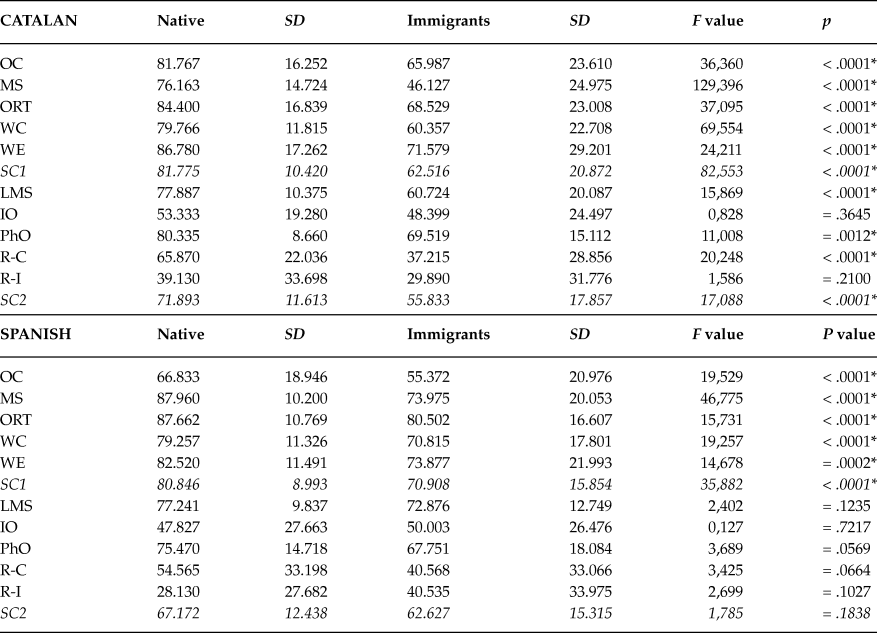
In order to compare linguistic knowledge in both languages, we applied a variance analysis that contrasted the results obtained by native and Latin American students in each of the Catalan and Spanish subtests, also concerning the global indexes SC1 and SC2. Table 3 shows this contrast in scores and its significance level.
Comparison of average scores and standard deviation for Catalan and Spanish (native vs. immigrant students). Sub-tests, global indexes (SC1 and SC2) and significance levels in all cases

As may be observed, both for Catalan and Spanish, in the collective written parts scores were notably lower among Spanish-speaking Latin American students for all subtests and indexes. Of course, this is expressed in the SC1 indexes for both languages: F(1, 235) = 82.553, p < .0001 for Catalan and F(1, 235) = 35.882, p < .0001 for Spanish.
The oral individual part, on the other hand, rendered very different results. Concerning Catalan, two of the subtests [Oral Expression Information Organization (IO) and Reading Intonation (R-I)] do not show significant differences between the groups. However, the fact that the written and oral subtests are considered when calculating SC2 brings about favorable values for native students, F(1, 135) = 17.088, p < .0001. As for Spanish, none of the oral subtests gave significant differences, which implies that they do not appear in SC2, either. In other words, if we refer to SC1 and SC2, taking the standard deviation of the native group as a reference, the average score obtained by Spanish-speaking students of immigrant origin is two standard deviations below in SC1, and one and a half standard deviations below in SC2 for Catalan. The distance is shortened to one standard deviation in the case of SC1 and up to one-half in SC2 for Spanish. This entails the absence of significant differences in this last index in the groups compared.
Lastly, the high value of the standard deviation in almost all subtests in the Latin American group should not be scoffed at when compared to the low values obtained by their native Spanish-speaking peers. Such differences must be interpreted considering that linguistic knowledge in the former group is characterized by its variability and heterogeneity, as opposed to higher homogeneity among native students.
Relationships of linguistic interdependence: Latin American vs. native students
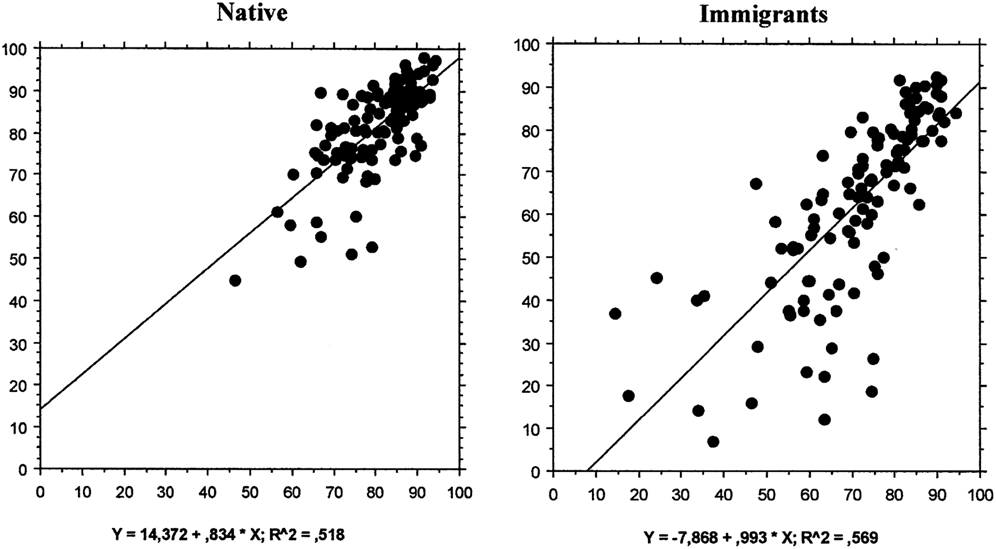
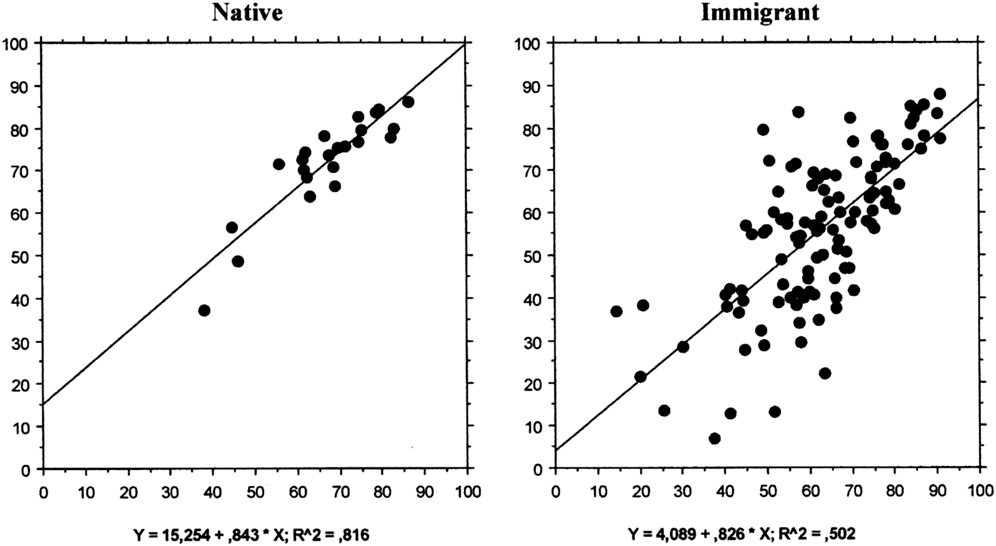
The results of the simple regression analysis contrasting students’ knowledge in Catalan and Spanish, according to both indexes (SC1 and SC2), are shown in Figures 1 and 2. The data for native and immigrant Spanish-speaking students are offered separately.
Regression lines corresponding to native and immigrant Spanish-speaking students (SC1 index).
Note: The abscissa axis (X) presents the values corresponding to Spanish; the ordinate axis (Y) shows the results for Catalan.

Regression lines corresponding to native and immigrant Spanish-speaking students (SC2 index).
Note: The abscissa axis (X) presents the values corresponding to Spanish; the ordinate axis (Y) shows the results for Catalan.

The previous graphs, apart from showing the correlation index between the scores corresponding to knowledge of Catalan and Spanish, also define a hypothetical line determining the relationship between each of the groups in terms of performance.
The final result consists of the correlation indexes r = .720, p < .0001 in SC1 and r = .903, p < .0001 in SC2 for Spanish-speaking native students, and r = .754, p < .0001 in SC1 and r = .709, p < .0001 in SC2 for Spanish-speaking students of immigrant origin. This shows the extent to which transfer of abilities and relationships of interdependence take place. Consonant with the data published by the Generalitat de Catalunya (2006), in the graphs to the left we may observe certain equilibrium in knowledge of both languages among native students. However, the slant and intercepts of the line show slightly higher command of Catalan over Spanish among native students; just the opposite results hold in the case of Spanish-speaking immigrants.
Although the relationship between Spanish and Catalan in native students has been broadly tested (Arnau, Bel, Serra, & Vila Reference Arnau, Bel, Serra, Vila and Laurén1994; Huguet et al., Reference Huguet, Vila and Llurda2000; Vila, Reference Vila1995) there is not a similar tradition of research focusing on students of immigrant origin, even less so when dealing with Latin American students. In this sense, the contrast presented in the paragraph above shows how the results obtained in the native group place these students in the upper end of the hypothetical line, while in the immigrant group certain dispersion takes place.
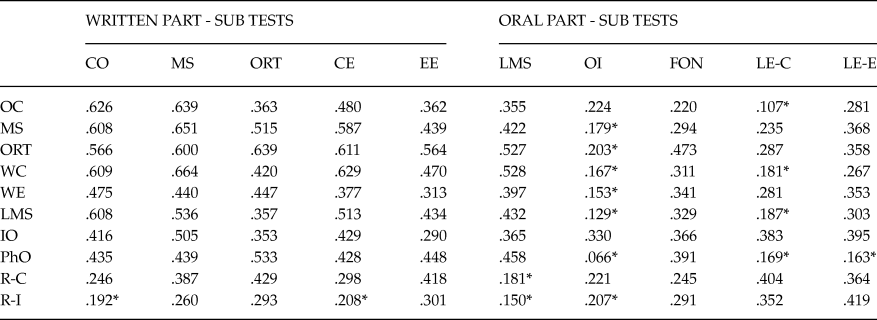
Nevertheless, we should not lose sight of the fact that, as the high correlations obtained show, linguistic transfer and interdependence processes do take place uniformly in Spanish-speaking Latin American students. This last assertion has been corroborated when analyzing the correlation matrix corresponding to the different subtests making up the global test. As may be appreciated in Table 4, the correlation indexes for equivalent Catalan and Spanish subtests are rather high in most tasks, which results in positive significance levels in all cases. More specifically, Fisher’s test showed the following values: OC (r = .626, p < .0001), MS (r = .651, p < .0001), ORT (r = .639, p < .0001), WC (r = .629, p < .0001), WE (r = .313, p = .0007), LMS (r = .432, p < .0001), IO (r = .330, p = .0003), PhO (r = .391, p< .0001), R-C (r = .404, p < .0001) and R-I (r = .419, p < .0001).
Correlation matrix corresponding to all sub-tests in Catalan (files) and Spanish (columns) in Spanish-speaking Latin American students

* Non-significant correlations (p > .05).
From the thorough observation of the previous table another relevant question comes to the surface. If we draw two Cartesian axes separating written and oral texts, we obtain four quadrants where we can identify (moving from one to four) the following interactions: 1) between written tests in Catalan and Spanish; 2) between oral Spanish and written Catalan texts, 3) between Spanish written and oral Catalan tests and 4) oral Catalan and Spanish tests.
After another reading of Table 4 we see that just 16 out of 100 correlations are not significant (p > .05), all of them located in those quadrants where oral tests appear (we do not find this type of interaction in the first quadrant). As we see, the data obtained seem to point at the fact that interdependence and language transfer relationships appear more intensely in written subtests than when oral tests are also considered.
Discussion
We would like to start by highlighting that we have, once more, been able to corroborate the extent to which instruction in a language other than the student’s L1 does not necessarily have a negative influence on transfer processes inherent to the Linguistic Interdependence Hypothesis Footnote 6 (Cummins, Reference Cummins1979). This is the case of native Spanish-speaking students in Catalonia receiving instruction in Catalan (Arnau et al., Reference Arnau, Bel, Serra, Vila and Laurén1994; Huguet et al., Reference Huguet, Vila and Llurda2000; Vila, Reference Vila1995). These results are backed by our research, as we have employed correlational techniques different from those traditionally used in similar studies.
In any case, the main interest of our work has to do with the results obtained by newly arrived Spanish-speaking Latin American students. We believe it is necessary to insist upon the fact that we have by no means tried to draw any judgment value as to the Spanish dialectal varieties spoken either in Spain or America. Yet, our test is evaluating that variety of Spanish spoken in Catalonia, which is where our test has been scaled. This is in accordance with the aims of our research, as it is necessary to clearly establish the level and nature of the linguistic abilities required to be successful in this given setting. Although the language varieties used by all students in the sample fall within the same umbrella term (Spanish), we are well aware that immigrant students have a background different to that of their native Spanish-speaking peers. Most probably, if Latin American students had been tested in some of their own language varieties the results would have been just the opposite.
Bearing this in mind, we have observed that linguistic interdependence and transfer take place in the case of both native and immigrant Spanish-speaking students (Cummins, Reference Cummins1979, Reference Cummins, Lasagabaster and Sierra2005). Now then, despite evidence in the high correlations between the level of competence in Catalan and Spanish in the latter group, they are far from attaining native-like scores in Catalan. In this particular instance, this is reflected in standard deviations from one and a half to two points below, and also in the higher dispersion of scores. This lets us conclude that the level of Catalan in Latin American students is strongly heterogeneous, while it is far more homogeneous in the native group. Obviously, motivation and attitudes towards learning Catalan act as a catalyst in this case (Baker, Reference Baker1992; Huguet, Lasagabaster, & Vila, Reference Huguet, Janés and Chireac2008; Lapresta et al., Reference Lapresta, Huguet and Janés2010).
At any rate, studies mainly carried out in English-speaking countries (Cummins, Reference Cummins1996, Reference Cummins2000) show the extent to which the full development of competences in a new language is a long and complex process. As Cummins says:
“Research studies since the early 1980s have shown that immigrant students can quickly acquire considerable fluency in the dominant language of the society when they are exposed to it in the environment and at school. However, despite this rapid growth in conversational fluency, it generally takes a minimum of about five years (and frequently much longer) for them to catch up to native-speakers in academic aspects of the language” (Cummins, Reference Cummins2000, pp. 34).
Taking up again the results of our study, beyond global data on the interaction between competences in the different languages, we have been able to observe that the positive relationship can also be detected in each of the equivalent sections making up the general tests. Even more so, according to the theoretical framework adopted (Cummins, Reference Cummins1979; Reference Cummins, Lasagabaster and Sierra2005; Reference Cummins, Cummins and Hornberger2008; Gass, Reference Gass, Ritchie and Bathia1996; Genesee et al., Reference Genesee, Lindholm-Ready, Saunders and Christian2005; Reference Genesee, Lindholm-Ready, Saunders and Christian2006; Jarvis & Pavlenko, Reference Jarvis and Pavlenko2008), we can infer that fundamental interdependence processes take place at a cognitive-conceptual level, beyond what is generally regarded as formal and linguistic in nature. We can reach this conclusion thanks to the differences established when contrasting the written tests in isolation (see the first quadrant in Table 4), and with the incorporation of oral tests Footnote 7 to the analysis (rest of quadrants in the same Table). The completion of the written tasks requires the implementation of conceptual elements governing general language use, alongside metacognitive and metalinguistic strategies. The oral tests, on the other hand, are more closely bound to superficial aspects such as pronunciation and fluency (see Table 2). Whatever the case maybe, linguistic closeness between Catalan and Spanish also results in the articulation of many positive relationships in oral tests.
Our results are consistent with the Linguistic Interdependence Hypothesis, also in the case of Spanish-speaking Latin American students in Catalan schools. Nevertheless, we must point out that certain abilities seem to be more prone to transfer than others, which takes us to the need to foster research in this field. Future studies could incorporate larger samples, which might help us identify, among others, which elements from each Lx are relevant, and at which point, in the process of acquisition of Ly. Unquestionably, all this will result in better knowledge on the mechanisms of language acquisition and in more effective educational practices.
This work is part of a larger research project funded by the Spanish Ministerio de Ciencia e Innovación - Subdirección General de Proyectos de Investigación through the research grant EDU2009–08669EDUC.