INTRODUCTION
The main islands of Polynesia are divided into two discrete regions: western Polynesia (e.g., Tonga, Sāmoa) and eastern Polynesia (e.g., Society Islands, Rapa Nui) (Fig. 1). Anthropologists base these regional categories on historical linguistics and shared cultural traits that imply a common history of long-distance exploration and island colonization. This history began with the settlement of the remote Oceanic islands of western Polynesia, followed considerably later by expansion into eastern Polynesia, in one of the geographically most expansive human migrations in history (for recent summaries, see Horsburgh and McCoy, Reference Horsburgh and McCoy2017; Kirch, Reference Kirch2017, pp. 184–211).
(color online) The human colonization of the islands of Polynesia. This map shows the general pattern of pulse-and-pause settlement of the remote islands of Polynesia: (1) movement of Lapita peoples with ancestry in Southeast Asia and New Guinea to the island groups that would become western Polynesia (WP); (2) the dispersal from WP to central eastern Polynesia (CEP); and (3) the settlement of the Polynesian Outliers (PO) in Melanesia and Micronesia from WP, and the settlement of islands of marginal eastern Polynesia (MEP) from CEP. Source: Horsburgh and McCoy (Reference Horsburgh and McCoy2017). Base map: OpenStreetMap.

A third regional category, the Polynesian Outliers, are so named because they lie outside of the Polynesian Triangle (encompassing both eastern and western Polynesia), within portions of Melanesia and Micronesia to the west of the Triangle (Fig. 2). Archaeological evidence suggests that most of the Outliers were likely first settled around the same time as the earliest settlements in western Polynesia (ca. 3000 yr ago) and that their early cultural histories mirror those of their immediate neighbors in Melanesia and Micronesia. However, at some later time, contact with Polynesians, and more specifically the arrival of Polynesian speakers, precipitated significant changes in local culture and language. Such arrival of Polynesian lineages is, for example, well attested in the oral traditions of the Polynesian Outliers of Tikopia and Anuta (Firth, Reference Firth1961; Feinberg, Reference Feinberg1998). Archaeologically, however, the arrival of Polynesians in the Outliers may be more difficult to detect.
Obsidian and volcanic glass sources on the boundary between Melanesia and Polynesia. Stars indicate location of Polynesian Outlier islands.

Here we present new interdisciplinary research on a key proxy for long-distance voyaging, artifacts made from obsidian and volcanic glass, recovered from archaeological excavations on the Polynesian Outlier island of Tikopia. We report here the geologic sources for 572 obsidian and volcanic glass artifacts. These artifacts were originally excavated by Kirch in 1977–1978 (Kirch and Yen, Reference Kirch and Yen1982) and are curated in the Bishop Museum's archaeology collections.
Our larger question is, given new AMS 14C dating for the Tikopia cultural sequence (Kirch and Swift, Reference Kirch and Swift2017), how did the direction and intensity of long-distance voyaging to Tikopia change over time? The island does not have local sources of obsidian or volcanic glass, leading Kirch and Yen (Reference Kirch and Yen1982) to apply specific-gravity density sorting in an initial effort to trace these artifacts to their natural sources (Kirch and Yen, Reference Kirch and Yen1982); subsequently, Spriggs et al. (Reference Spriggs, Bird and Ambrose2010) applied geochemical testing to a small subsample of the Tikopia assemblage. These previous studies identified material coming from sources more than 2000 km away. However, having examined just 15 artifacts (3% of the total assemblage), these studies were limited by small sample sizes and yielded mixed results in terms of source assignment. We were also motivated to conduct a full study of this assemblage by the current paucity of material evidence for voyaging between Polynesian Outliers, such as Tikopia, and the islands of the Polynesian Triangle. Our goal in applying a more comprehensive examination of artifact sourcing was to achieve improved insight into the relationship between these two regions.
SOURCES OF OBSIDIAN AND VOLCANIC GLASS IN THE ISLANDS OF MELANESIA AND WESTERN POLYNESIA
Natural sources of obsidian have been used by people living in the islands of Melanesia since the Pleistocene, ca. 20 ka (Summerhayes, Reference Summerhayes2009). These sources have been referenced in reconstructing movement around the region following the migration of Austronesian-speaking peoples into the area and the rapid discovery and colonization of more remote islands to the east by an archaeological culture called Lapita during the mid-Holocene, ca. 3–4 ka. Few studies have examined patterns of exchange and voyaging within the last 2 ka, an era when some sources became the center of specialized export (see Gaffney and Summerhayes, Reference Gaffney and Summerhayes2019).
The naming conventions used by archaeologists to refer to different sources of obsidian, and to volcanic glasses with a lower silica content, vary and can refer to material by archipelago, island group, island, or specific place names where tool-quality material has been reported (Sheppard et al., Reference Sheppard, Trichereau and Milicich2010). In Melanesia, the four largest geographic categories are: New Britain, Admiralty, D'Entrecasteaux, and Vanuatu. Vanuatu volcanic glass, the closest to Tikopia, comes from two islands in the northern Banks Islands group, Vanua Lava and Gaua Islands, and so it is sometimes referred to as “Banks obsidian,” or it can be referred to by island (Reepmeyer, Reference Reepmeyer2009). The push out into the islands of Remote Oceania by Lapita peoples opened up access to the Vanuatu source as well as two new sources of volcanic glass, one in northern Tonga and another in Sāmoa (Clark and Wright, Reference Clark and Wright1995; Burley et al., Reference Burley, Sheppard and Simonin2011). Here again, naming conventions vary (see Burley et al. [2011] regarding sourcing studies on material from the Tongan islands of Niuatoputapu and Tafahi).
For this study, we considered six possible source areas of raw material. In order of straight-line distance, they are: Vanuatu volcanic glass (230 km), Tongan volcanic glass (1930 km), D'Entrecasteaux obsidian (1990 km), Sāmoan volcanic glass (2080 km), New Britain obsidian (2200 km), and Admiralty Islands obsidian (2680 km). These areas were further divided to allow finer-grained source assignment: D'Entrecasteaux (East and West Fergusson), Admiralty (the Lou and Pam Islands), and Vanuatu (Vanua Lava and Gaua). For a small number of artifacts, we can identify the broader source area, but for a variety of reasons, remain uncertain of the specific local source based on current evidence. In only one case is the source area unknown.
ARCHAEOLOGY OF TIKOPIA
The culture and history of Tikopia are more thoroughly documented than those of any other Polynesian Outlier thanks to the detailed ethnography of Firth (Reference Firth1936, Reference Firth1961) and the archaeological excavations of Kirch and Yen (Reference Kirch and Yen1982). New AMS 14C dates have been used to revise the cultural sequence predating first contact with Europeans in AD 1606 (Kirch and Swift, Reference Kirch and Swift2017). Initial island colonization, during the Kiki Phase, occurred around 3040 cal yr BP (±130 yr). The Kiki Phase is notable for the presence of sand-tempered pottery associated with the early Lapita cultural complex (Green, Reference Green and Jennings1979). The nearest contemporary populations in the Reef-Santa Cruz Islands (Green, Reference Green, Ambrose and Mummery1987; Green and Bird, Reference Green and Bird1989) and the southern end of Vanuatu (Bedford et al., Reference Bedford, Spriggs and Regenvanu2006) are also associated with early Lapita pottery and with the long-distance transport of obsidian.
The transition to the following Sinapupu Phase occurred about 1000 yr later at around 1854 cal yr BP (±214 yr). It is during this phase that pottery in a style similar to that found in the Vanuatu archipelago (Mangaasi style) appears on Tikopia. Based on the sequences of other islands in the region, it is presumed that this was an era of regionalization (e.g., Walter et al., Reference Walter, Jacomb and Bowron-Muth2010), when the local population became self-sufficient and there were fewer long-distance contacts. However, the Sinapupu Phase pottery in Tikopia is clearly of nonlocal origin, and Kirch and Yen (Reference Kirch and Yen1982) inferred that this period was one marked by periodic contacts with islands in the Vanuatu archipelago.
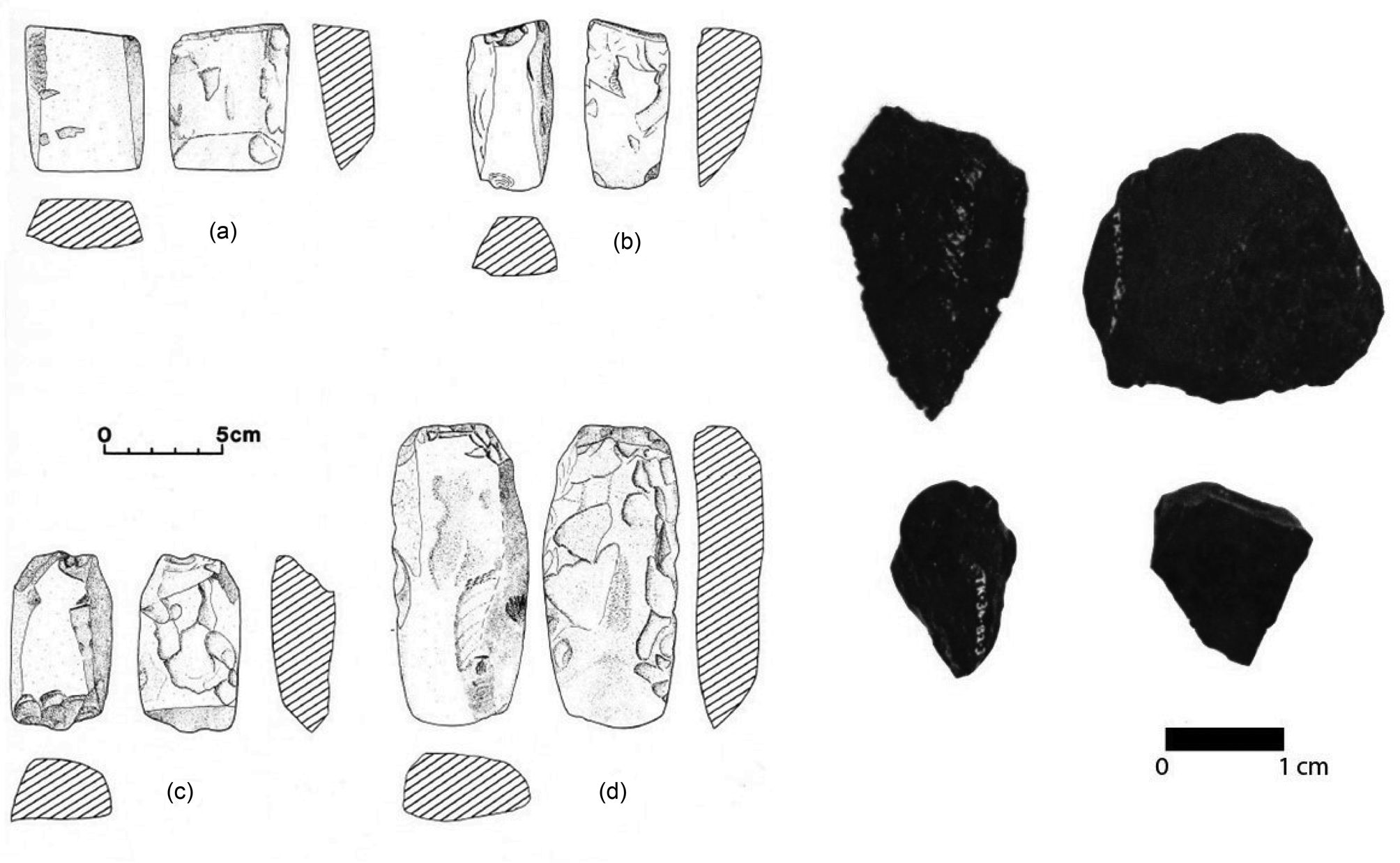
The final period before European contact, the Tuakamali Phase, begins about 1000 yr later, with a transition bracketed to 792–738 cal yr BP. At this time, ceramic use ceased altogether, something that also occurred in western Polynesia and other islands. It is during this phase that western Polynesian–style artifacts (trolling lure points, bone beads) as well as adzes made of Oceanic basalt appear in the Tikopia archaeological record (Kirch and Yen, Reference Kirch and Yen1982; Fig. 3). Initial assessment of the Oceanic basalt adzes found on Tikopia, based on macroscopic characteristics rather than geochemical analysis, suggested a Sāmoan quarry as the most likely source (Kirch and Yen, Reference Kirch and Yen1982; for a recent summary, see Clark et al., Reference Clark, Reepmeyer, Melekiola, Woodhead, Dickinson and Martinsson-Wallin2014).
Examples of nonlocal adzes (left) and obsidian (right) artifacts recovered on Tikopia (after Kirch and Yen, Reference Kirch and Yen1982, figs. 92 and 107).

METHODS
Nondestructive assessment of the geochemistry of archaeological artifacts made of obsidian and volcanic glass was conducted using a Bruker Tracer III SD portable X-ray fluorescence spectrometer. Each sample was bombarded for 300 s through Bruker's green filter (12 mil Al + 1 mil Ti + 6 mil Cu) (McCoy and Carpenter, Reference McCoy and Carpenter2014) with instrument settings of 40 keV at 26 μA. Raw spectral data were calibrated to parts-per-million concentrations with linear regression using a method developed by the University of Auckland specifically for Pacific Island volcanic materials (McAlister, Reference McAlister2019; see Supplementary Materials for details). Eight elements were quantified: Mn, Fe, Zn, Rb, Sr, Y, Zr, and Nb. Approximately one-fifth (n = 119) of the sample was analyzed twice to check analytic consistency, and the results for those specimens were averaged.
To match artifacts to a source, we compared our data with published source data in the western Pacific region (Bird et al., Reference Bird, Torrence, Summerhayes and Bailey1997; Reepmeyer, Reference Reepmeyer2008, Reference Reepmeyer2009; Golitko et al., Reference Golitko, Schauer and Terrell2012; Sheppard et al., Reference Sheppard, Trichereau and Milicich2010; Burley et al., Reference Burley, Sheppard and Simonin2011; Constantine et al., Reference Constantine, Reepmeyer, Bedford, Spriggs and Ravn2015; Mulrooney et al., Reference Mulrooney, Torrence and McAlister2016). Of the 573 artifacts analyzed, one (TOSP-047) returned very low trace element concentrations, suggesting it is a chert; it was excluded from our analyses. Currently, most published data for Melanesian and western Pacific obsidian and volcanic glass sources report only summary information (i.e., means and standard deviations), making it problematic to apply robust multivariate methods; however, bivariate scatter plots proved sufficient to match nearly all artifacts to sources.
RESULTS
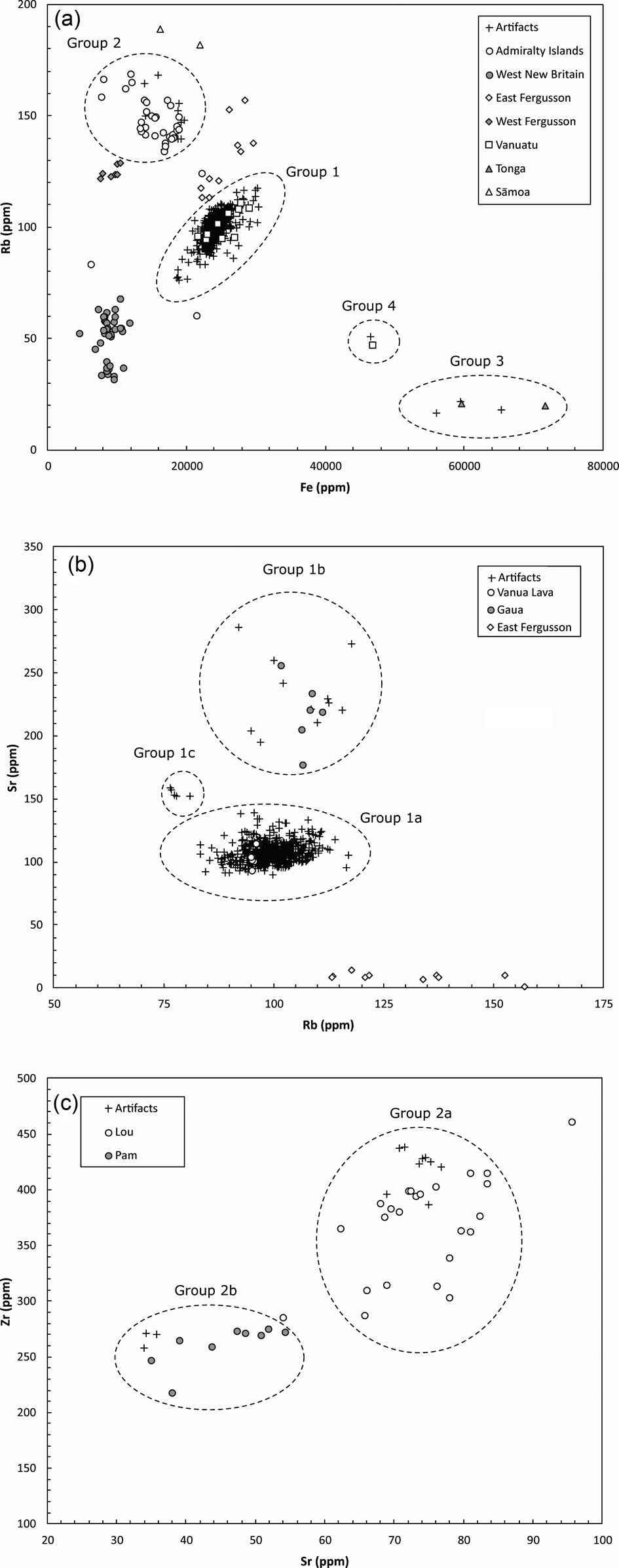
A scatter plot of Fe versus Rb separates several of the potential source groups well and clusters the artifacts into four groups (Fig. 4, Table 1). The majority (group 1) are associated with the Vanuatu source samples (n = 557), while a second group clusters with source samples from the Admiralty Islands (n = 12). Three specimens (group 3) match the Tongan volcanic glass reference data reported by Burley et al. (Reference Burley, Sheppard and Simonin2011), although there are insufficient data to assign our samples a specific source within Tonga. The final specimen (group 4) could be from a rarely used source located in Vanuatu. It plots closest to a reference sample from Tongoa in Vanuatu on the basis of Fe and Rb but has quite different concentrations of Zr and Nb. Comparison with known data from the region does not provide a good match for all combinations of elements for this artifact, therefore, its provenance is unknown.
Matching artifacts to source: scatter plot of Fe vs. Rb showing artifacts and potential sources, separated by island group (A); separation of samples assigned to a Vanuatu source (B); separation of samples assigned to an Admiralty Islands source (C).

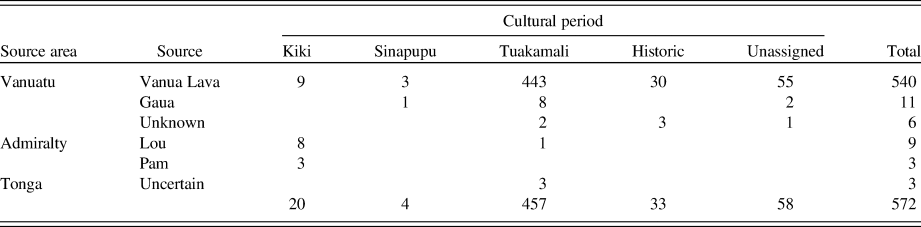
All obsidian and volcanic glass artifacts by assigned source, with specific sources listed where geochemistry allows for assignment.

The group 1 artifacts, which were sourced to Vanuatu, can be assigned a finer provenance on the basis of their Rb and Sr concentrations (Fig. 4B). The majority plot with source material on Vanua Lava, while the remainder form two clusters, one of which is associated with Gaua Island (group 1b). The other (group 1c) forms a distinct grouping close to the Vanua Lava source, but with slightly higher concentrations of Sr; we assign this group to the Vanuatu source area, but cannot define a specific source within that area. Finally, the Admiralty Islands specimens can be further separated into two clusters using Sr and Zr (Fig. 4C), one matching Lou Island (group2a) and the other matching Pam Island (group 2b).
Our results indicate a major reliance on volcanic glass from the neighboring island group of Vanuatu accounting for 97% of artifacts (n = 556 out of 572). The remaining artifacts are obsidians from Melanesia (Admiralty Islands, n = 12), a Polynesian volcanic glass source (Tonga, n = 3), and one artifact from an unknown source (Tables 1 and 2).
All obsidian and volcanic glass artifacts by cultural period, with specific sources listed where geochemistry allows for assignment.

Comparison with previous sourcing results
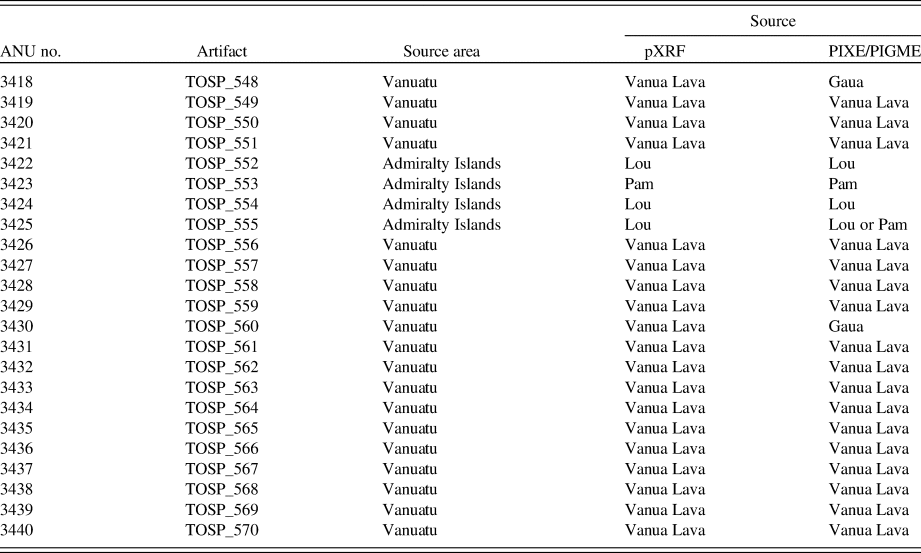
Of the 15 artifacts originally tested by Spriggs et al. (Reference Spriggs, Bird and Ambrose2010) and reanalyzed for this study, our results agree, in that 11 should be assigned to the Vanuatu source area and four to the Admiralty Islands sources, with only slight discrepancies in the finer-scale source assignments. Specifically, we would assign all Vanuatu-sourced artifacts to Vanua Lava, whereas Spriggs et al. (Reference Spriggs, Bird and Ambrose2010) assigned two of these to Gaua Island. Our results for specific sources within the Admiralty Islands agree with the previous study, and in the case of one artifact with no clear source, we specify the Lou source (ANU 3425/TOSP-555) (Table 3).
Comparison of PIXE-PIGME (Proton Induced X-ray (PIXE) and Gamma-Ray Emission (PIGME))(Spriggs et al., Reference Spriggs, Bird and Ambrose201Reference Spriggs, Bird and Ambrose0; Australian National University (ANU)) and portable X-ray fluorescence spectrometry (pXRF, this paper) source assignments.

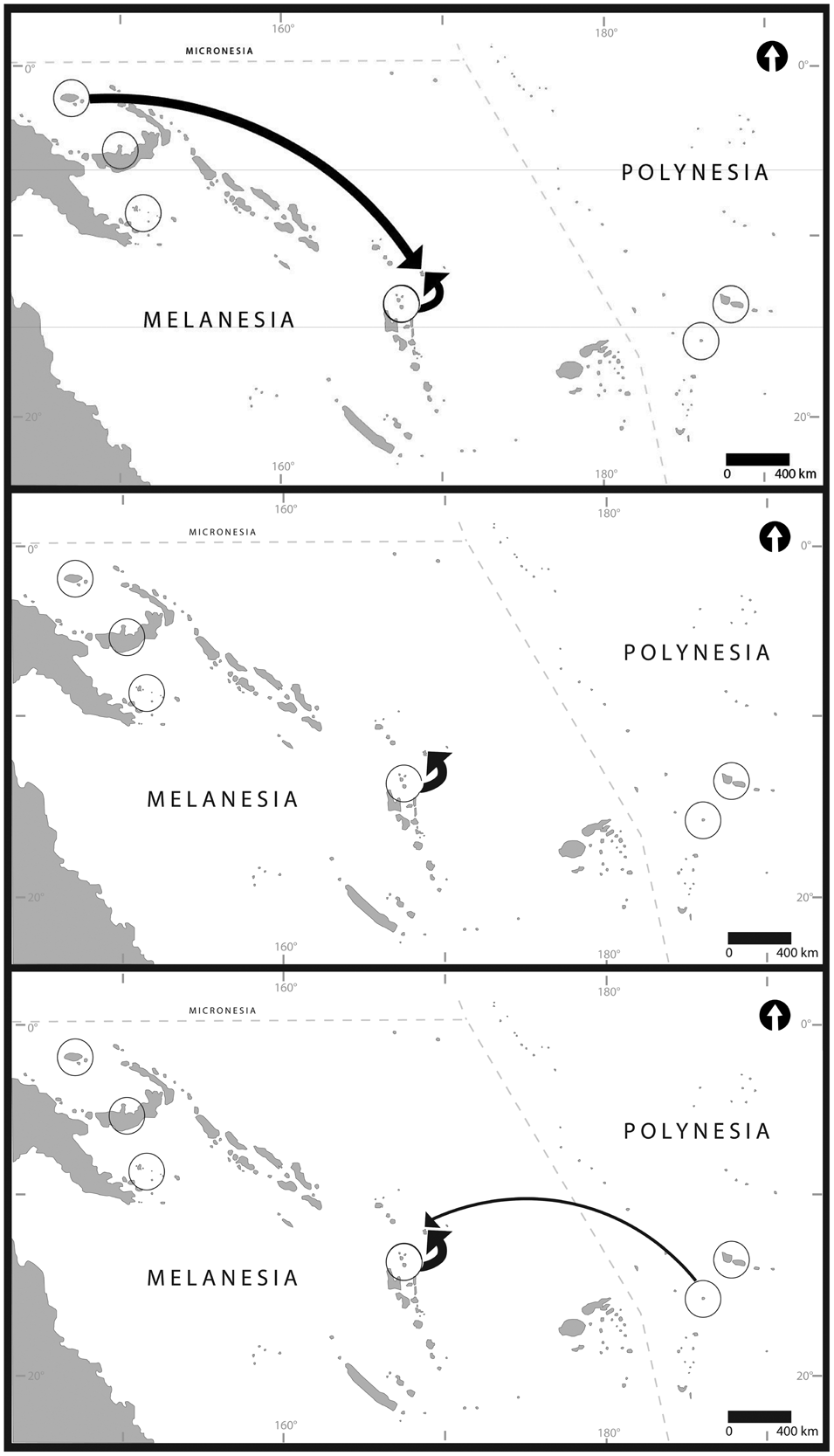
Results by time period
Kiki Phase
While few artifacts can be definitively assigned to the island's earliest deposits, we note that the mix of sources are unlike any other archaeological context on Tikopia (Fig. 5). Admiralty Islands obsidian, found only at the early Site TK-4, accounts for 55% of artifacts, with the remainder from Vanuatu. We note that some of the Admiralty-sourced artifacts were found in situ at depth, while others were recovered in shallow deposits that were disturbed by gardening activity at the site. Site TK-4 was regarded by Kirch and Yen (Reference Kirch and Yen1982) as the earliest occupation on Tikopia.
Imports of obsidian and volcanic glass during: the Kiki Phase from 3040 cal yr BP (±130 yr) to 1854 cal yr BP (±214 yr) (top); the Sinapupu Phase from 1854 cal yr BP (±214 yr) to 765 cal yr BP (±54 yr) (middle); and the Tuakamali Phase from 765 cal yr BP (±54 yr) to European contact in AD 1606 (bottom).

Sinapupu Phase
A small number of artifacts can be definitively assigned to the middle phase (Fig. 5). During this phase, the only source of material is Vanuatu, and obsidian from the Admiralty Islands is no longer present.
Tuakamali Phase
In the third phase, Vanuatu volcanic glass continues to be the preferred source, with a small but significant addition of volcanic glass from northern Tonga (Fig. 4). Tongan material was recovered in good stratigraphic context associated with Tuakamali Phase deposits (Sites TK-1 and TK-35). Tongan volcanic glass accounts for only 0.5% of the total assemblage examined from the island and just 2%–6% of artifacts at Tuakamali Phase sites (Table 2). The pieces are either the same or smaller than artifacts made of Vanuatu volcanic glass from the same context (Table 2).
Unassigned to period
A number of artifacts were not assigned to period due to ambiguity in their stratigraphic context.
DISCUSSION
The earliest phase of Tikopia's cultural history is best known from archaeology, rather than from the evidence of either historical linguistics or genetic analysis of the modern Tikopia population. However, based on the ceramic style of the Kiki Phase pottery along with other evidence available, Kirch and Yen (Reference Kirch and Yen1982, p. 338) argued that the initial settlement of Tikopia was from the west (i.e., Bismarck Archipelago or Solomon Islands), possibly via one or more early Lapita communities on the nearby islands (i.e., Reef-Santa Cruz, Vanuatu) and/or islands to the east (i.e., Fiji, Tonga).
New radiocarbon dating (Kirch and Swift, Reference Kirch and Swift2017) and sourcing data reported here suggest that the initial settlement of Tikopia proceeded in much the same fashion as other islands in Remote Oceania settled by Lapita peoples. Burley (Reference Burley2013, p. 446) has argued that the divide between Fiji and Tonga, which would later separate Melanesia from Polynesia, started early with “separate founder events from central Island Melanesia that are divorced in time by a century or more.” The settlement of Fiji is currently dated to 3050–3000 cal yr BP (Nunn, Reference Nunn, Bedford, Sand and Connaughton2007), with the colonization of Tonga securely dated by high-precision U/Th dating to 2846–2830 cal yr BP (2σ) (Burley et al., Reference Burley, Weisler and Zhao2012, Reference Burley, Edinborough, Weisler and Zhao2015). Settlement of Sāmoa has proven more difficult to pin down, but has recently been argued to have been around the same time as Tonga (Petchey and Kirch, Reference Petchey and Kirch2019). Closer to Tikopia, Lapita settlement in the Reef-Santa Cruz Islands and southern Vanuatu is probably as early as, or slightly earlier than, Fiji. A new estimate for the settlement of Tikopia by Kirch and Swift (Reference Kirch and Swift2017) of 2850 cal BP (±130 yr), however, places initial colonization close to the time when Tonga and Sāmoa were first settled.
The high proportion of Admiralty obsidian in Kiki Phase deposits further supports the interpretation of Tikopia having been settled by a separate founding event from the Bismarck and/or Solomon Islands. In their analysis of a small portion of the obsidians from Tikopia, Spriggs et al. (Reference Spriggs, Bird and Ambrose2010, p. 37) speculated that colonization could have been independent of neighboring islands based on two factors. First, they noted how unusual the presence of Admiralty obsidian was relative to nearby islands. At sites in the Reef-Santa Cruz Islands, immediately to the east, early deposits have both Admiralty obsidian and Vanuatu volcanic glass, but these are rare compared with New Britain obsidian. In southern Vanuatu, New Britain obsidian is again the dominant source, with notable amounts of volcanic glass from Vanuatu, but no Admiralty obsidian reported. Second, they suggest, based on work done by Summerhayes (Reference Summerhayes2009) on the circulation of obsidians in Melanesia and radiocarbon dates available at that time, that perhaps Tikopia was settled slightly later than these groups.
We now have more definitive evidence to link Tikopia's founding populations with the islands of Melanesia during the middle Lapita Phase (3000–2800 cal yr BP). Summerhayes (Reference Summerhayes2009, p. 116) summarized the relevant evidence of obsidian circulation in the Bismarck Archipelago. He noted that, while early Lapita marked the first transport of Admiralty Island obsidian outside its home island group, it only became the dominant source, over New Britain obsidian, in the middle Lapita Phase (3000–2800 BP). At that point, Admiralty Islands obsidian “dominated in the eastern Bismarck Archipelago assemblages of Mussau, New Ireland and the tip of east New Britain, plus the Lapita sites from Buka [Northern Solomon Islands].” The absence of New Britain obsidian, the dominance of Admiralty obsidian, and the new date for initial settlement of Tikopia around 2850 cal BP (a time after other islands had been settled; i.e., Reef-Santa Cruz, Vanuatu, Fiji, and others) suggests direct settlement from island Melanesia. Although possible motives behind the Lapita colonists leaving Tikopia unoccupied when traversing this part of the Pacific remain unknown, it is possible that the small sizes of founding communities made small and isolated islands such as Tikopia unattractive to local islanders, but attractive targets for later migrants into the region from island Melanesia.
A millennium after the initial settlement of Tikopia, there appear to have been substantially fewer long-distance voyages; however, this is based on a small number of lithic artifacts from the Sinapupu Phase deposits. However, the presence of Sinapupu Phase pottery, which is of nonlocal origin and bears strong similarities with the Mangaasi pottery of Vanuatu, argues for some contacts between Tikopia and Vanuatu during the Sinapupu Phase.
The appearance of Tongan volcanic glass in the Tuakamali Phase is significant, in that it corroborates Tikopian oral traditions regarding the arrival of Tongans on the island. The chiefly lineage of Taumako, in particular, traces its origins to Te Atafu, said to have been a Tongan chief who arrived on the island about 12 generations before the Ariki Taumako, who was Firth's informant in 1929 (Firth, Reference Firth1961, pp. 88–89; Kirch, Reference Kirch2018, pp. 288–289). In the generation following Te Atafu, his sons are also reputed to have fought several battles against other invading Tongans, as detailed by Firth (Reference Firth1961, pp. 109–121). These traditions are sufficiently detailed as to leave little doubt that they reflect an actual history of conflict between the indigenous Tikopia and would-be Tongan invaders. In our view, the obsidian and volcanic glass sourcing evidence points to a deliberate expansion of the Tongan state (see also Clark et al., Reference Clark, Reepmeyer, Melekiola, Woodhead, Dickinson and Martinsson-Wallin2014), in an effort to subjugate Tikopia, sometime after around 765 cal yr BP (±54 yr), but before European contact.
Finally, the extremely small quantity of volcanic glass from Tonga suggests that voyaging between western Polynesia and Tikopia was surprisingly infrequent considering the strong influence on local language and culture. In fact, the material basis for Polynesian influence in the Outlier islands, as a group, is so remarkably thin that some scholars have claimed that if not for ethnographic information, Polynesian influence would be undetectable based on archaeology alone (Davidson, Reference Davidson2012). We suggest this is not a failing of archaeology, but evidence for a strategy for the expansion of sociopolitical influence by small groups who left a much smaller footprint behind compared with the island's original settlers, who maintained more regular contacts with their homeland and with neighboring islands.
CONCLUSIONS
We describe the first complete geochemical sourcing of obsidian and volcanic glass archaeological artifacts collected on the Polynesian Outlier of Tikopia. Our findings point to initial settlement followed by continued voyages between Tikopia and an island Melanesian homeland beginning in the middle Lapita Phase. Next, long-distance voyaging became much less frequent and continued to decline. Initial colonization followed by a decline in long-distance voyaging has been found in similar studies of remote islands in the Pacific and likely reflects the growth and greater self-sufficiency of local populations.
Our discovery of a small number of imports of volcanic glass from northern Tonga is significant in two respects. It allows us to more securely date the oversized influence of Polynesians to around 765 cal yr BP (±54 yr). In addition, the extreme rarity of volcanic glass from Tonga suggests infrequent voyages between Tikopia and western Polynesia. We interpret these together as indicative of target voyages associated with a political expansion of the Tongan state in the period before European contact.
ACKNOWLEDGMENTS
We thank Charmaine Wong, Archaeology Collections Manager at the Bishop Museum for facilitating access to the Tikopia collections originally excavated by Kirch in 1977–1978. An early version of this paper was presented by Mulrooney at the 10th International Conference on Easter Island and the Pacific, November 10–16, 2018. This research would not have been possible without the generous help of interns in the archaeology lab of the Bishop Museum and funding support provided by Richard H. Cox and other donors to the Ho‘omaka Hou Research Initiative at the Bishop Museum. We thank David Burley, Aaron Diefendorf, Derek Booth, and two anonymous reviewers for their comments, which greatly improved the article.
SUPPLEMENTARY MATERIAL
Geochemical and archaeological context data are provided here as Supplementary Materials (S1. pXRF Methods Metadata; S2. Geochemistry of Obsidian and Volcanic Glass Artifacts) and available through the Pofatu database (Hermann et al., Reference Hermann, Forkel, McAlister, Cruickshank, Golitko, Kneebone, McCoy, Reepmeyer, Sheppard, Sinton and Weisler2020) hosted at the Max-Planck Institute for the Science of Human History in Jena, Germany.
The supplementary material for this article can be found at https://doi.org/10.1017/qua.2020.38.