Introduction
The title of this essay is meant to be perplexing. Schleiermacher is not known for his treatment of grace, much less for a treatise on grace. Few scholars of Schleiermacher's theology have devoted attention to his doctrine of grace, with two notable exceptions. Karl Barth, in his lectures on Schleiermacher, did not hesitate to thrash his nemesis on this point, although to him it was so obvious that Schleiermacher's understanding of grace was not a Christian doctrine of grace, at least not in the Reformation sense, that he barely felt the need to argue the case. “What kind of God is this,” he asked, “What kind of grace?”Footnote 1 Richard R. Niebuhr, in his apologia for Schleiermacher, which inspired a new age of scholarship on Schleiermacher in America, included a section entitled “Grace and Nature,” but its focus was on the Christmas Eve Dialogue, not Schleiermacher's dogmatic theology.Footnote 2 Neither Barth nor Niebuhr took note of Schleiermacher's more formal, dogmatic treatment of grace—what I am calling Schleiermacher's “treatise on grace”; in the several decades since their influential works, very few have attempted to correct this oversight.Footnote 3 Such neglect by specialists has no doubt contributed to a wider sense that, despite the importance of his The Christian Faith (Glaubenslehre),Footnote 4 Schleiermacher does not merit a place alongside other theologians when it comes to the history of the Christian doctrine of grace. None of the major scholarly books on the history and development of the doctrine of grace include a chapter or section (or even reference) to Schleiermacher's treatment of grace. Schleiermacher himself almost seems to have anticipated this oversight—worse, really, than any criticism—when he asked, “Does my Glaubenslehre in any way fail to give due honor to divine grace?”Footnote 5
The main purpose of this essay is to argue a straightforward but not obvious thesis: Contained in the Glaubenslehre is a treatise on grace—that is to say, a delineated text that treats the subject of grace in a formal, methodical, and thorough manner—and, furthermore, this treatise is of fundamental importance to Schleiermacher's dogmatic system. In coherence and scope, Schleiermacher's treatise is comparable to other, more famous systematic treatments of grace,Footnote 6 and it is especially worthy of attention because it is the first modern systematic treatment of grace. In navigating his way through classical disputes about grace, Schleiermacher tried to formulate an authentically Protestant (“evangelical”) doctrine that respects the natural and historical sciences.Footnote 7 Moreover, this treatise is fundamental to Schleiermacher's mature theology in that it is one of two pillars on which his entire Glaubenslehre is erected (the other pillar being his propositions on Christ), so that his dogmatics cannot be properly understood without careful attention to it. In that sense, the Glaubenslehre could be said to be a Gnadenlehre, since everything in it is an explication of the Christian experience of having been redeemed by Christ, which is an experience of grace. It is also true, however, that Schleiermacher's doctrine of grace is carefully circumscribed. What is not treated within the bounds of his treatise on grace (e.g., preservation, providence, and election) is not, strictly speaking, grace.Footnote 8 Hence, my point in entitling this essay “Schleiermacher's Treatise on Grace” is at least as substantive as it is rhetorical.
A second thesis will undoubtedly prove more controversial: Although Schleiermacher's treatise on grace is couched in polemical, anti-Catholic terms, Footnote 9in actuality it is not antithetical to Catholic views of grace, at least not in the usual ways. My point here is not that Schleiermacher was a crypto-Catholic; aside from being untrue, such a claim would undermine my argument. The point is rather that Schleiermacher showed signs of frustration with how the terms of the debate had almost always been framed in the history of Christian thought, so in his treatise on grace he reframed the issues, in sometimes subtle and sometimes not-so-subtle ways. Despite his own rhetoric, he stepped outside of Protestant-Catholic polemics and developed a Christian doctrine of grace striking in its simplicity and freshness, whatever disagreements one may have with it. Authentically and recognizably Protestant, it nevertheless resonates with certain traditionally Catholic emphases. In reframing the terms of the debate and transcending the polemics, Schleiermacher's doctrine of grace in some ways anticipated the rapprochement between Catholic and Protestant theologians with respect to grace beginning in the 1960's.Footnote 10 At the same time, it is also true that Schleiermacher so reframed the Fragestellung regarding grace—for instance, by removing the Holy Spirit from the workings of grace—that many Protestants and Catholics alike will find much that is foreign in Schleiermacher and so may well be united in their suspicions of him.Footnote 11
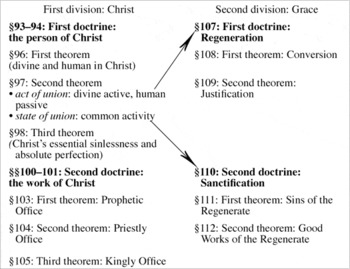
A third thesis helps to explain the second: Schleiermacher's doctrine of grace is based on an analogy (Parellele, Analogie) that he draws between grace and the incarnation. His entire treatise on grace can be read as an explication of the parallels he sees, on the one hand, between conversion and the “act of union” (the incarnation) and, on the other hand, between sanctification and the “state of the union” (the association of the two natures throughout Christ's lifetime; see arrows in Table 1.) Or, as he so compellingly put it, the communication of grace is an extension of the incarnation to all humanity. Schleiermacher's incarnational view of grace should capture our attention. It is startling that it has been overlooked.
What I propose to do in this essay is therefore to identify Schleiermacher's “treatise on grace” and to offer an analysis of it as a treatise—that is to say, on its own and not as an intricate component of Schleiermacher's dogmatic system. The latter task will require some discipline, since there will always be a temptation to explain certain points in terms of the rest of the system. Under “Preliminary Considerations,” I locate the treatise within the larger work and draw on whatever external material might be helpful for understanding Schleiermacher's method. Under “Analysis of the Treatise,” I focus exclusively on the treatise itself, using notes when necessary to refer to other parts of the Glaubenslehre. Readers wishing to go straight to the heart of the matter may choose to proceed directly to the “Analysis.”
Since a thorough analysis of Schleiermacher's treatise on grace would exceed the bounds of a published article, I shall limit my present argument by taking my cues in part from Schleiermacher. I shall devote most of my attention to his discussion of conversion in §108, since it is there that he addresses traditional terminology about grace, sets parameters, and establishes basic commitments. I shall then move directly from conversion to his discussion of sanctification and good works in §112, where he picks up an important thread dropped at the end of §108. This approach will underscore Schleiermacher's insistence that there is no interval between the moment of conversion and the gracious state of the redeemed. I shall omit, except for passing references, his discussion of justification by faith in §109. I do so not because it is unimportant to Schleiermacher (on the contrary!) but because I have already explored it in depth elsewhere.Footnote 12 The present task is to establish that Schleiermacher has a treatise on grace and to highlight its importance and richness by tracing a particular line of argument concerning the “natural activity” of the individual during conversion. This essay is, then, the first installment of a larger project and, hopefully, the beginning of a larger conversation.
Preliminary Considerations
The Place of the Treatise on Grace in the Structure of the Glaubenslehre
To say that the structure of the Glaubenslehre is complex is an understatement, and yet, because it is so bound up with Schleiermacher's method, understanding it can provide a powerful interpretive key for understanding Schleiermacher's theology.Footnote 13 The second part of the Glaubenslehre is entitled “Explication of the Facts of the Religious Self-Consciousness, as they are determined by the Antithesis of Sin and Grace.”Footnote 14 Since Schleiermacher identifies Part Two as the heart of the entire dogmatics and describes Part One (creation, preservation, and the original perfection of the world) as an abstraction from the experience of having been redeemed by Christ, it follows that the second aspect of Part Two (“explication of the consciousness of grace”) is, structurally speaking, the center and foundation of his dogmatics;Footnote 15 methodologically speaking, it is the departure point. We can take this even further if we remember the priority Schleiermacher accords to the first form of proposition—namely, “the state of the Christian as conscious of the divine grace.”Footnote 16 The other two forms of proposition—conceptions of divine attributes and utterances about the world—“are permissible only in so far as they can be developed out of propositions of the first form.”Footnote 17
This leaves us with two candidates for the most elemental, most central doctrinal locus of the Glaubenslehre: the “division” on Christ (§§92–105) and the “division” on grace (§§106–112; see Table 1). Schleiermacher appears to argue for the historical, logical, and objective priority of the former.Footnote 18 Yet, regarding his division on Christ, he also notes, “This exposition is based entirely on the inner experience of the believer; its only purpose is to describe and elucidate that experience.”Footnote 19 Schleiermacher describes that inner experience in the division on grace, or what he rather cumbersomely calls, “The manner in which fellowship with the perfection and blessedness of the Redeemer expresses itself in the individual soul.”Footnote 20 In summary, we have two irreducible, correlative loci that form the heart of the heart (structurally and methodologically) of the Glaubenslehre. Of those two loci, one—the division on grace—has been seriously neglected in the secondary literature.
The Divisions on Christ and Grace: The Two Most Elemental Dogmatic Loci of the Glaubenslehre

The “division” on grace (§§106–112) is, I maintain, nothing short of a treatise on grace. I mean by “treatise” the first definition offered in the Oxford English Dictionary: “A book or writing which treats of some particular subject; commonly (in mod. use always), one containing a formal or methodical discussion or exposition of the principles of the subject.” In §§106–112, Schleiermacher does all this with regard to grace. He treats, in a systematic and thorough manner, the issues traditionally bound up with the doctrine of grace: the nature of grace; kinds of grace; modes in which grace is given and received; forgiveness and repentance; the nature of conversion and a person's state before, during, and after conversion; whether we can prepare ourselves by “doing what is within us”; the nature of faith; the relation of human freedom and divine power; the justification of the ungodly; the attitude and works of the graced Christian; whether we can merit further grace; etc.
Definitions of grace
Since many of Schleiermacher's definitions of grace are given outside the treatise itself, it is appropriate to include an overview of them in this section on “preliminary considerations.” In §63, which serves as an introduction to Part Two, Schleiermacher offers a succinct definition of grace as fellowship with God, which depends on a communication from the Redeemer. Along the way, he offers several other brief definitions of grace. Grace is Christ's “gift” [Gabe] to us of his own “blessing” and “peace,”Footnote 21 the fruit of his all-powerful God-consciousness. Grace is the “state of union” with Christ, “the real possession of blessedness in the consciousness that Christ in us is the centre of our life.”Footnote 22 Grace takes away misery—specifically, the misery of sin.Footnote 23 Grace is the “divine life in us,”Footnote 24 a “specific divine impartation.”Footnote 25 Grace for Schleiermacher is nothing less than our very redemption through Christ.Footnote 26
All of these can be gathered within the basic definition given in §91: “We have fellowship with God only in a living fellowship with the Redeemer, such that in it His absolutely sinless perfection and blessedness represent a free spontaneous activity, while the recipient's need of redemption represents a free assimilative receptivity [Empfänglichkeit].”Footnote 27 While the first clause in this definition (given in italics) is clear enough, the second two clauses would most likely require a considerable amount of explication before gaining the assent of most Christians.Footnote 28 Besides, while this definition could serve very well as a guide to Schleiermacher's understanding of redemption, it does not adequately express what grace is for him.
The essence of his understanding of grace is rather to be found in an analogy he arrives at and then returns to repeatedly. The grace of regeneration is “to be regarded as extending the union of the divine with the human nature.”Footnote 29 In other words, according to Schleiermacher, grace arises immediately out of, and is the continuation of, the incarnation. Conversion, as the beginning of fellowship with Christ and a new relation to God, is explained along the same lines as the account of the supernatural origin of Christ's life: it is a new creation due solely to divine activity. (Justification is “the temporal and particularized continuation of the general act of union begun in the incarnation of Christ.”Footnote 30) Similarly, sanctification, as the life of grace, is explained along the same lines as the state of the union of the divine and human in Christ: it is the divine preservation.Footnote 31
The Mystical Approach
It follows from this basic analogy between the incarnation and grace that Schleiermacher's concerns in his discussion of grace would be much the same as those that he voiced in the development of his Christology. While some of those concerns are age-old, others are distinctly modern in that they reflect the new historical consciousness of the late-eighteenth and early-nineteenth centuries. In describing the person of Christ, Schleiermacher has to find a way to affirm the full humanity of Christ at the same time that he finds expression for the divine in Christ, and he has to do so in a way compatible with modern science, not only with the laws of the natural sciences but also, and most particularly, with the laws of history. What Christ shares with all other human beings is the “pure historicity” of his person.Footnote 32 This means that real development—linguistic, psychological, intellectual, and personal—must be accorded to Jesus.Footnote 33 The difference between Jesus and the rest of humanity, what makes him unique and unsurpassable, is that he had “an absolutely powerful God-consciousness.”Footnote 34 Schleiermacher explains this in terms of Christ's supernatural origin, which was a unique act of creation. Steering a course between the absolutely supernatural and the strictly natural, he characterizes “the entrance of the Redeemer into the world” as “the relatively supernatural.”Footnote 35 Schleiermacher somewhat fleetingly explains, “the beginning of His life was also a new implanting of the God-consciousness which creates receptivity [Empfänglichkeit] in human nature; hence this content and that manner of origin are in such a close relation that they mutually condition and explain each other.”Footnote 36 This notion of receptivity (Empfänglichkeit) is, as we shall see, central to his understanding of grace: it is the same term he uses to describe the state of a person undergoing conversion.
In describing the work of Christ, Schleiermacher is likewise very careful to maintain and respect the historicity of the communication of grace at the same time that he accounts for its divine origin. In two key propositions on Christ's redemptive activity (§100) and Christ's reconciling activity (§101), he introduces what he refers to, interestingly, as his “mystical” approach.Footnote 37 This is the same approach that Schleiermacher will take in his treatise on grace, since these two ideas—the redeeming activity of Christ and how fellowship with Christ “expresses itself in the individual soul”—are really two sides of the same coin, so to speak. The mystical approach steers a course between, on the one side, “magical” views of Christ's redeeming activity (which fail to account for natural and historical causality), and, on the other side, “empirical” views (which reduce Christ's influence to “forms of teaching and example”Footnote 38 and thus reduce grace to natural and historical causality, so that grace is no longer grace). In his introduction to the divisions on Christ and grace, he summarizes his position (note the tight parallel between the incarnation and conversion):
To sum up: in this whole matter we posit, on the one side, an initial divine activity which is supernatural, but at the same time a vital human receptivity [Empfänglichkeit] in virtue of which alone that supernatural can become a natural fact of history. . .. And so, in this whole context, the appearance of the Redeemer in the midst of this natural development is no longer a supernatural emergence of a new stage of development, but simply one conditioned by that which precedes—though certainly its connexion with the former is to be found only in the unity of the divine thought.Footnote 39
Grace, too, is to be understood as something genuinely new—a new creation, a new birth—that nonetheless comes from that which precedes it.
Analysis of the Treatise on Grace
The Structure and Language of the Treatise
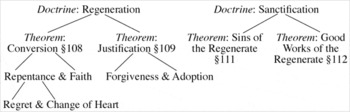
Schleiermacher's treatise on grace comprises two main doctrines (Lehrstück), regeneration and sanctification, each of which comprises two theorems (Lehrsatz; see Table 2, below).
The “Treatise on Grace”

The first point to note about the structure of the treatise is that it is not meant to reflect an ordo salutis (order of salvation). Schleiermacher was keenly aware that some of the fiercest debates over grace had to do with claims regarding the ordo salutis. He was also faced with the problem of the great diversity, hence inconsistency, of positions on this matter in the various confessions and textbooks. Hoping, especially in light of his advocacy of a united Prussian evangelical church,Footnote 40 to overcome intra-Protestant polemics, and desiring also a conceptual clarity that is not overly determinate, Schleiermacher sought other organizing principles. Those principles were experiential, dogmatic, and systematic in character.
The second point to note is that, for Schleiermacher, more important than how the key elements of grace are ordered is their “symmetrical interlocking.”Footnote 41 His concern was that the continuity of the experience of grace, which itself reflects the continuity of divine redemptive activity, be reflected in his dogmatic exposition. Take as an example his treatment of the two main doctrines, regeneration and sanctification. He insisted that they are continuous—indeed, inseparable—in experience. Yet, for the purpose of exposition, they must be treated separately: “Thus, even though treating regeneration and sanctification more or less separately, we begin by bringing out their necessary interconnexion, and the continuity of the divine action through the whole course of the new creation.”Footnote 42 If, due to their “symmetrical interlocking,” it does not really matter which doctrine comes first, why did Schleiermacher start with regeneration? One reason was his desire to carry forth consistently the analogy to the incarnation.Footnote 43 Another reason was stylistic: he believed that smooth transitions were essential. Since regeneration has to do with the turning point of the individual, it ties in better with the previous section at the same time that it anticipates the next.Footnote 44 In other words, placing regeneration first in his dogmatics enhances the systematic presentation, thus lending it further coherence and clarity.
Similarly, the two elements of regeneration—namely, conversion and justification—are “utterly inseparable,” and indeed “must also be regarded as happening simultaneously.”Footnote 45 Conversion comprises repentance and faith; justification comprises forgiveness and adoption. Again, Schleiermacher insists that “the order seems, in view of the symmetry of the definition, a matter of entire indifference; many considerations, however, make it more convenient to begin with conversion.”Footnote 46 It is instructive to take a step back and look at what his ordering achieves (see Table 2). Justification, which Schleiermacher describes as belonging to the “realm of power” rather than to the “realm of grace,”Footnote 47 occupies an important space between conversion and sanctification, distinct yet inseparable from both and also a connecting point between them. Structurally, at least, the justification of the ungodly is, as Calvin put it, “the main hinge on which religion turns.”Footnote 48 Conversion belongs to the realm of grace because it has to do specifically with Christ turning the individual.
Conversion (§108)
Conversion, the beginning of the new life in fellowship with Christ, makes itself known in each individual by Repentance [Buβe], which consists in the combination of regret [Reue] and change of heart [Sinnesänderung]; and by Faith [Glauben], which consists in the appropriation of the perfection and blessedness of Christ. (§108)
So if anyone is in Christ, there is a new creation: everything old has passed away; see, everything has become new! (2 Cor 5:17)Footnote 49
The Leitmotiv for Schleiermacher's exposition of regeneration is 2 Cor 5:17.Footnote 50 In particular, it informs his treatment of conversion, where his primary concern is to explicate the end of the old life and the beginning of the new, and how that occurs. The term “conversion,” in his view, best captures this turning, this reversal. It has two essential moments—repentance and faith—which, once again, are so interconnected as to be inseparable; together, they should be considered as “covering the whole experience of conversion.”Footnote 51 He needs, however, to explain this organization of terms, both because it appears to be a departure from the Protestant confessions and because it results in a noteworthy simplification of terminology about grace.
Schleiermacher begins his discussion of conversion by quoting some of the most authoritative Protestant confessions. It is significant that, rather than simply citing them in a note, he includes quotations from the Augsburg Confession (1530), the Defense of the Augsburg Confession (1530–1531), and the Second Helvetic Confession (1566), as well as from Philip Melanchthon, in the body of his text, just after the main proposition.Footnote 52 In doing so, he clearly aligns himself with classical Protestant teaching on conversion. Schleiermacher acknowledges that his account does not “appear” to conform to the Protestant confessions, but he nevertheless insists, “The general result is identical with our own statement.”Footnote 53 What is more, in his formulation he seeks to correct some of the divergences and inconsistencies in the various confessions; indeed, he uses those very divergences in terminology to justify his own rendition. Despite his protestations to the contrary, his organization of the terms is, in fact, an implicit but unmistakable critique of classical Protestant formulations of repentance and faith. Schleiermacher's exposition of conversion adjusts the tone of the classical Protestant accounts. He amplifies the more positive aspects of the experience of conversion and minimizes the more negative, crisis-oriented aspects.
Schleiermacher includes both repentance and faith, rather than repentance (pœnitentia) alone, under the rubric of conversion, since repentance “has no definite reference to the actual beginning of a new form of life, and also because it sounds very awkward to hear faith (a word that we obviously use in exactly the same sense of the Confessions) reckoned as a part of repentance.”Footnote 54 He wants, in other words, to preserve a Protestant emphasis on repentance (as opposed to a Catholic emphasis on confession), but not let it so inform the entire conversion experience that faith is determined by it; he does not want faith to carry negative associations.
Here we see a constellation of three concerns of Schleiermacher. The first concern is polemical in nature. He clearly sees himself articulating, and thereby defending, a distinctly Protestant view, as opposed to a Roman Catholic view, which, he claims, “does not count faith as an element in conversion.”Footnote 55 The second concern is properly dogmatic. He seeks to redefine and reorganize basic terms in order to bring conceptual clarity to Christian doctrines, which, although central to Protestant faith, have been treated inconsistently in the confessions. Even though he openly describes part of the task of dogmatic theology as critiquing past formulations, in this instance the extent of his criticism of classical Protestant formulations of repentance and faith hardly supports his claim that his view is “identical” to views expressed in the confessions. His third concern is to develop the analogy between our changed life and the incarnation: “For our attitude here cannot be different from that of the human nature of Christ in its act of uniting with the quiescent consciousness of being accepted.”Footnote 56 This requires that he frame repentance and faith differently from how the sixteenth-century Protestant confessions had done so, and that faith in particular be given a more positive (and joyful) character, since the incarnation simply does not have the negative qualities associated with mortification and terror. In substance if not in rhetoric, therefore, not Protestant-Catholic polemics but Schleiermacher's understanding of the incarnation is the engine driving his treatment of conversion.
At issue is the Protestant insight into the radical discontinuity that marks conversion.Footnote 57 There must be a real break from the past, which was commonly expressed in terms of complete passivity on the part of the person being regenerated. Schleiermacher, too, wants to stress this discontinuity, thereby emphasizing the gratuitous nature of conversion. Yet, according to his method and theology, he must also account for some kind of continuity; otherwise, conversion would be unacceptably magical. How can one account for a real change in life, attributed solely to divine causality, which nevertheless respects the laws of nature and hence the historicity of the person? The answer, again, is found in the parallel between the incarnation and conversion. The answer also involves a simplification of terms.
In addressing this very basic issue of the divine initiating act, Schleiermacher has to entertain traditional terminology about grace—countless distinctions and terms—that were employed by medieval scholastics, to some degree by the Reformers themselves, and by seventeenth-century Reformed orthodox theologians.Footnote 58 Not surprisingly, he does not have much use for all the distinctions between types of grace that scholasticism(s) had found necessary to employ in order to clarify certain contentious issues. For instance, Schleiermacher notes that the term prevenient grace is not particularly useful: “the expression is always inexact, since according to our general type all divine grace is always prevenient, and it would be more correct to say ‘preparatory.’”Footnote 59 In the end, he retains only two basic terms: “preparatory grace” and what he refers to variably as “effectual,” “quickening,” or “initiatory” grace, or as a new birth. He also rejects the term cooperative grace, although he does not entirely reject the notion of cooperation. As much as possible, Schleiermacher resists describing grace and justification in terms of a chronological, linear sequence of events; he also avoids establishing a single pattern for all Christians. The only sequence, and therefore the only division, of grace that he admits is a most general one—namely, the “sequence of preparatory and quickening grace.”Footnote 60 Let us begin with the latter, since the former is best understood in terms of it.
1. The Grace of Conversion: “Effectual” or “Quickening” Grace
“Perfect and effectual divine grace,” Schleiermacher says simply, “is seen only in the union of all three”—regret, change of heart, and faith.Footnote 61 Their original coming together can only be a divine act, a new creation, which is conversion. In examining these three elements of conversion, their intricate inner-relations, and their unification, we shall arrive at the core of Schleiermacher's understanding of grace.
For Schleiermacher, in typically Protestant fashion, grace first comes in the form of a confrontation prompted by Christ's self-revelation through the Word. That confrontation, however, is not one of divine judgment acting as a crushing hammer, humiliating the individual and driving her to seek mercy;Footnote 62 rather, as Schleiermacher describes it, it is essentially positive. Christ's “self-imparting perfection confronts [entgegentritt] us in its truth.”Footnote 63 The focus is not so much on the self as it is on Christ, whose “soul-stirring exhibition of Himself to us leads us to abjure utterly our previous condition.”Footnote 64 Christ's goodness—his sinless perfection, blessedness, and self-impartation—arouses in us profound regret (Reue), whereby we abjure our past life.
This conversion-regret differs from other manifestations of regret (e.g., “knowledge of sin given by the law”Footnote 65) in two fundamental ways. Whereas the regret born of the law is more concerned with regret over particulars, conversion-regret has to do with an entire orientation of desire, its “general condition and its deepest cause” of sin. Moreover, whereas the regret born of confrontation with the law brings “death or despair,”Footnote 66 conversion-regret ushers in joy. The regret of conversion is therefore essentially positive, stemming not from Christ-the-judge or God-the-legislator,Footnote 67 but from the sheer goodness and perfection of Christ, which confronts us in its goodness and reorients our desires, creating a new direction of activity. Schleiermacher writes, “true conversion-regret must always eventually arise out of the vision [Anschauung] of the perfection of Christ, and this beginning of regeneration must be due to Christ's redeeming activity.”Footnote 68
Although for some the confrontation of conversion might come as a soul-shattering experience, a destruction of the ego, according to Schleiermacher that is not necessary or even typical. Departing from a traditionally Protestant emphasis, he argues, “the true change of heart, complete because covering all the ground from regret to faith, need by no means invariably spring from a flood of regret that almost wrecks the whole being by its painful feeling [Gefühl].”Footnote 69 He consequently rejects the insistence of the Pietists that “every Christian must be able to point to the very time and place of his conversion.”Footnote 70 If anything, he deems it more difficult than not to isolate such a moment. Schleiermacher's point is psychologically astute. According to him, people have varying capacities for emotion, and while it is tempting to point to dramatic events, those events do not always mark a real change in one's life. Such dramatic events may really be a part of preparatory grace and may even reflect a stage of immaturity, in that they may be dominated by the sensuous more than the spiritual.Footnote 71 His point is also profoundly theological. Insisting that there be an isolatable, identifiable moment is nothing but an “arbitrary and presumptuous restriction of divine grace.”Footnote 72 The gratuitous nature of grace means not only that it is freely given, but also that it works when and how it will.
If Schleiermacher departs from Luther and the confessions in not insisting on the devastating character of the first moment of conversion, he retains a crucial insight of Luther's: conversion redirects our attention from ourselves (incurvatus in se) to Christ. He also retains, therefore, the sola fide, albeit with notable revision. Because the regret of conversion is born of the vision of Christ's perfection, it is inseparable from faith. The rather dry definition of faith in propositional paragraph §108 (“the appropriation of the perfection and blessedness of Christ”) belies the intimacy of the relationship between the believer and Christ in faith that Schleiermacher has in mind. The grace of conversion is the beginning of “existence in living fellowship with Christ.”Footnote 73 In the confrontation with Christ through the power of the Word, Christ grasps “us with his assimilating [aufnehmenden] activity”Footnote 74 and “unites [us] to Himself.”Footnote 75 We are thus drawn into union with Christ, which means that we share in his blessedness. Union with Christ is not the goal of faith but is faith, is given in faith. The “share in His blessedness” is present at the very beginning of faith and increases throughout the course of a life of grace.
This is another reason why the grace of conversion does not result in despair, and why repentance alone does not constitute conversion: the attitude of faith is “originally joyful” and “uplifting.”Footnote 76 The joy of living fellowship with Christ is what distinguishes conversion-regret from other experiences of regret, and Schleiermacher allows that “many and various relations are possible between the pain of repentance and the joy of conscious fellowship with Christ.”Footnote 77 The “certainty of faith” is “an understanding of what union with Christ means” as well as a “delight in that union.”Footnote 78 Faith, then, is at the very center of Schleiermacher's understanding of grace. “Faith alone saves,”Footnote 79 Schleiermacher affirms, because it gives blessedness, because through it one shares in Christ's blessedness.
For Schleiermacher, the close and vital connection between repentance and faith in conversion cannot be overemphasized. Although technically distinguishable, they are “directly interdependent.”Footnote 80 Faith is the mark of true conversion-regret, and no true conversion-regret occurs without faith. To emphasize this deepest connection, Schleiermacher includes a third element, change of heart [Sinnesänderung], as that which “binds regret and faith together and represents the true unity of conversion.”Footnote 81 As the “middle term” or “joining point” [Mittelglied] between regret and faith, change of heart does important theological work for Schleiermacher. First, it acts as a corrective to both Protestant and Catholic approaches to conversion. Protestant thought, he warns, tends to lean too much toward one side of conversion (faith), running the risk of making it an instrumental cause. In explicitly rejecting the customary formula that faith is the causa instrumentalis (instrumental cause) of justification, Schleiermacher sees himself as protecting the original Protestant insight.Footnote 82 “[W]e bring with us nothing,” he avers, “except our living receptivity [lebendige Empfänglichkeit].”Footnote 83 Catholic thought, he thinks, focuses too much on the other side of conversion (repentance) by emphasizing “confession and satisfaction.”Footnote 84 Schleiermacher reminds both theological traditions that faith is not something we do, produce, or in any way cause. In this sense, he emphasizes all the more that grace is a gift and a relationship, and he thereby nudges us further from the chronological, linear view of regeneration as a process.
Second, the placement of “change of heart” ensures the unity between regret and faith, thereby helping to explain both the discontinuity and the continuity between the pre-conversion life and the life of grace. This was at the heart of the polemics between Protestant and Catholics, with Protestants stressing discontinuity. According to Schleiermacher, whereas in both regret and faith there is some “activity of the self,”Footnote 85 in the change of heart the human is inactive—or, as inactive as a living being can be. He describes this as a temporary cessation of activity: “the turning-point must be a twofold inactivity, a state of being no longer active in one direction and not yet active in another.”Footnote 86 He then goes on to explain that “in the spiritually living existence of the subject nothing is left in place of the vanishing activity except its dormant [leidentliche] echo in feeling, and nothing is present in respect of the activity not yet begun except dormant [leidentliche] anticipation of it in desire.”Footnote 87 A little later, Schleiermacher describes this “twofold inactivity” as “desire, in two interconnected forms.”Footnote 88 This desire is none other than the change of heart:
This desire [Verlangen], radiating in two directions, is the change of heart effected by Christ which binds regret and faith together and represents the true unity of conversion.Footnote 89
The choice of the term “desire” is intriguing for many reasons. It is foreign to the Protestant confessions, and it evokes the young Augustine, which is not the Augustine to whom the Reformers appealed.Footnote 90 Schleiermacher's understanding of desire will be explored in greater detail below. For now the important point is that he uses it to explain human relative inactivity during conversion, thereby highlighting the gratuitous nature of the grace of conversion.
And so we return to where we began this section: “Perfect and effectual divine grace is seen only in the union of all three.”Footnote 91 The turning point of conversion occurs through an act of divine grace, which creates something new by effecting and bringing together perfectly regret, change of heart, and faith, so that there is a deep co-inherence of these three, each being complete and full in itself precisely through its interconnection with the others. In order to appreciate the significance of this as a divine initiatory act, it is instructive to consider the state of the individual before the moment of conversion—to consider, that is, the matter of preparatory grace.
2. Preparatory Grace
Like the grace of conversion—indeed, like all grace, according to Schleiermacher—preparatory grace is the work of Christ, and only the work of Christ. He describes the preparatory stage as the “period of hidden life,” when the workings of divine grace are not yet decisive. In this hidden life, “the true life of Christ in us announces itself at first only in weak and intermittent impulses.”Footnote 92 During this preparatory stage there are intimations of the three elements of conversion: occasions of imperfect regret,Footnote 93 experiences of a nascent desire for a change of heart, and a “presentiment of [Christ's] dignity”Footnote 94 or of some kind of inward surrender. Yet these can be deemed no more than “approximations to faith,” since such impulses have neither strength nor unity. So, for example, regrets may be sincere and may be produced by a vision of Christ, but during the process of preparatory grace regret is not yet “a continuous inward movement amounting to the dawn of living faith.”Footnote 95 Moreover, although imperfect regrets or nascent desires may be prompted by a vision of Christ, such visions may merely look “back to the figure and teaching of Christ.”Footnote 96 During the stage of preparatory grace, Christ's influence on us will also prompt good works, which might even become habits, although such good works “are not rooted in the regeneration of the doer.”Footnote 97 In preparatory grace, therefore, the impulses toward the three elements of conversion and toward good works are still external to us.Footnote 98 Christ, working on us through the Christian common life, prepares us for effectual grace by heightening our susceptibility to his Word.
Schleiermacher thus establishes both continuities and discontinuities between preparatory grace and effectual grace. The continuities are threefold: in both cases, grace is the activity of Christ; grace works only in and through the Christian corporate life; and the three elements of conversion (regret, change of heart, and faith) are present. The discontinuities are also threefold: whereas in conversion the three elements are strong, continual, and unified, during preparatory grace they are weak, intermittent, and fragmented; whereas in conversion union with Christ becomes an internal principle for our thoughts, actions, and emotions, during preparatory grace we have not yet experienced union with Christ and so Christ remains an external principle; and finally, whereas at the moment of conversion Christ alone is active, during preparatory grace we remain active in a myriad of different ways (primarily through resistance), although gracious activity is always strictly divine activity.
Still, some of Schleiermacher's language suggests that preparatory grace requires work and effort on the part of the individual. In referring to “approximations to faith,” claiming that “only gradually can each consciousness reach certainty for itself,”Footnote 99 and mentioning the possibility of “habits,”Footnote 100 Schleiermacher seems to suggest that the individual can and should cultivate regret, desire, and faith—as though the consciousness of grace could somehow be trained. In other words, his position on this point appears vulnerable to charges of semi-Pelagianism: the individual can and ought “to do what is in one” (facere quod in se est). Schleiermacher is insistent, however, that preparatory grace is solely the work of Christ. How, exactly, does Christ prepare us for the grace of conversion? How, exactly, is conversion effected? The answer: through the preached Word. This is the extension of the mystical approach he developed in his Christology.
3. Grace and the Word
In both preparatory and effectual grace, Christ works on us through the preached Word. It is in the Word that an intuition of Christ's dignity causes us to surrender ourselves. Here Schleiermacher applies his mystical approach, developed in his Christology, to his doctrine of grace.Footnote 101 In his doctrine on the work of Christ, Schleiermacher explained (in general) how Christ redeems. The issue peculiar to the treatise on grace is, as the title of the division makes clear, precisely how “fellowship with the perfection and blessedness of the redeemer expresses itself in the individual soul.”Footnote 102 Schleiermacher must explain, in a way that respects the historicity of the influence of Christ as well as the historicity of each individual, how Christ redeems individuals, how grace operates on individuals—how, that is, grace is a divine (supernatural) activity that nonetheless works through the nexus of natural causation.Footnote 103 He does this by positing a historical continuity going back to Christ and his disciples. He writes,
These divine workings of grace are supernatural in so far as they depend upon and actually proceed from the being of God in the Person of Christ. At the same time, being historical and formative of history, they are natural in so far as they have a general natural connexion with the historical life of Christ; and in detail each working that establishes a new personality is bound up in its efficacy with the historical totality of Christ's effects.Footnote 104
According to Schleiermacher, Jesus communicated his perfect God-consciousness to his disciples, and that same faith produced in them is produced in us through the preached word: “[O]riginally individuals were grasped by Christ, and now also it is always by an influence of Christ himself, mediated by his spiritual presence in the Word, that individuals are assumed into the fellowship of the new life.”Footnote 105 Schleiermacher insists that faith is effected in us in exactly the same manner as it was effected in Christ's disciples because of the divine power of the Word:
The constant factor is above all the divine power of the Word—taking the expression in its widest sense—by which conversion is still effected and faith still arises. The difference is simply that the self-revelation of Christ is now mediated by those who preach Him; but they being appropriated by Him as His instruments, the activity really proceeds from Him and is essentially His own.Footnote 106
This emphasis on the sacramental power of the preached Word is distinctly Protestant.Footnote 107
As the above analysis indicates, Schleiermacher's view of the communication of grace to individuals is anything but individualistic. The communication of grace necessarily takes place in the corporate life of the (evangelical) church, through the preached word and the sacraments.Footnote 108 Schleiermacher hereby accounts for the historical nature of human persons and communities while also asserting the supernatural. In short, his account addresses both the mediated nature of our relation to Christ as well as the immediate nature of that relationship: “The efficacy of Christ, therefore, consists solely in the human communication of the Word, however only in so far [as] it moves on the Word of Christ, embodying the divine power of Christ himself. . ..”Footnote 109
Thus far, Schleiermacher has stated but not really argued that conversion occurs when the three elements—regret, change of heart, and faith—come together perfectly, that is to say, completely, simultaneously, and suddenly. This new creation, he has insisted, can only be a divine creation. Further explanation, however, is still needed. More precisely, Schleiermacher needs to explain, as he himself puts it, “the contrast between nature and grace [Gegensaz (sic) zwischen Natur und Gnade].”Footnote 110 This he does in the concluding expositional paragraph of §108.
4. Grace and the “Natural Activity of the Subject”
Any full treatment of grace comes inevitably to the question of the role of the human in conversion: Does or can the human person in any way cooperate with divine grace? Schleiermacher concludes §108 with a discussion of the “state of the subject during conversion.”Footnote 111 The specter of the so-called synergist position is palpable in these last three pages, and Schleiermacher appears acutely aware of what is at stake for any Protestant doctrine of grace.Footnote 112 Five times (only one time critically) he cites the Solid Declaration of the Formula of Concord (1577), which rejected “the teachings of the Synergists, who contend that the human being has not completely died to the good in spiritual matters but rather is seriously wounded and half dead.”Footnote 113 Clearly, Schleiermacher wants to distance himself from any recognizable “synergist” view and for the most part claims to be in agreement with the orthodox Protestant position. His accord with the Protestant confessions is not, however, as straightforward as he makes it out to be. Nor is it the case (as his detractors would no doubt like it to be) that, despite his claims to the contrary, he in fact is a synergist because he allows for the cooperation of free will during conversion. Both of these interpretations imply agreement with the conventional terms of the debate, terms that Schleiermacher does not accept.
Three times in the final expository paragraph of §108, Schleiermacher emphatically denies any agency of cooperation on the part of the human person. And three times he qualifies that denial. He begins the discussion saying, “it seems obvious, then, that here no causal agency can be attributed to the person who is being taken up into fellowship.”Footnote 114 Yet he quickly sounds a note of impatience and appears to ally himself with the more moderate position of Melanchthon:
On the other side, if we bear in mind that the converted person—afterwards, in living union with Christ himself, and before that as well, even though in the corporate life of sin—is nonetheless self-active as a rational, sensible individual being [als vernünftig sinnliches Einzelwesen selbstthätig ist], and that in general there can be no living being, not even for a complete moment, wholly devoid of self-activity. . .Footnote 115
In emphasizing that the human is a living being, which for him can only mean somehow active, Schleiermacher rejects the Solid Declaration's axioms that before grace humans are capable only of evilFootnote 116 and that during conversion the individual is nothing more than a log. The Solid Declaration's anthropology, based as it is on a literal interpretation of Genesis, delineates “four distinct, dissimilar conditions”Footnote 117 of human free will: before the fall, after the fall but before conversion, after conversion, and after resurrection. Schleiermacher rejects this anthropology because he deems it untenable in the nineteenth century—with its new understanding of history, to be sure, but also with its biological, psychological, and social insights. He therefore reframes the question: “How does the natural activity of the subject, which certainly exists in the moment of conversion, relate to the influence of Christ evoking faith and the change of heart?”Footnote 118
Schleiermacher's immediate answer is a classically “correct” Protestant one: “[W]e cannot, without abandoning our fundamental assumption, regard the natural self-activity of humans in that moment as cooperation.”Footnote 119 Yet, for a second time, this is followed by a qualification that seems impatient: “Certainly what has already occurred through preparatory grace is thereby cooperating, but this is itself a part of the divine operation of grace and does not belong to the individual's own activity.”Footnote 120 Seeking to deflect possible objections, he cites the Solid Declaration.Footnote 121 Rather than ending the discussion there, with that appeal to authority, he pushes the point further, beyond the pale of classical Protestantism. He notes that cooperation can only mean that divine grace is somehow restricted or conditioned by human activity, and he then concedes that this must be the case,Footnote 122 the reason being that we must be able to give an account of how the Word operates in the individual.
As we have seen, Schleiermacher argues that Christ's grace is mediated through the preached Word. The Word, however, in order to be effective, has to work on something that is capable of hearing it: “For the Word, through which the influence of Christ is mediated, can only accomplish this mediation in so far as it penetrates [eindringt] the person, wherefore the activity of the sense-faculties as well as of the inner functions of consciousness is required.”Footnote 123 Words are not spoken to logs and stones. Schleiermacher concludes, “It follows with good reason that the capacity for this apprehension [of the Word], in so far as the activity of all those functions depend on the free will of the person, must be conferred upon the person in its natural state.”Footnote 124 Schleiermacher again quotes the Solid Declaration, although the passage to which he refers does not in fact support his point. The Declaration grants a modicum of free will to one who is fallen but not yet redeemed: a person can decide whether or not to go to church and hear the sermon.Footnote 125 What Schleiermacher is getting at, however, is something altogether different. In talking about “natural activity” and the “natural state,” he is really talking about the human constitution, not just the human state of sinfulness. Moreover, the human constitution he has in mind has not undergone the ontological rupture of a historical fall.Footnote 126 Schleiermacher, in other words, implicitly affirms some fundamental continuities. Christ works on us as we are.
This affirmation of our basic organic nature and our natural condition calls for another clear Protestant denial. Schleiermacher for the third time insists, “What happens, however, after the Word has penetrated the soul, thereby achieving its aim for the person, here we can concede no natural cooperation on the part of the person.”Footnote 127 This raises another contentious issue in the debates on grace: whether or not we are free at least to consent. Schleiermacher appears to vacillate on this issue. We consent, but our consent nevertheless must “be ascribed only to the antecedent work of grace.”Footnote 128 Likewise, he reaffirms that our natural activity cannot prepare for grace or even consent to grace because it is either resistant or indifferent, but then in the same breath he again describes the surrender to Christ as a form of consent.
Why this apparent back-and-forth on cooperation and consent, two traditional litmus tests for a Protestant view of conversion and justification? Is it a sign that he really is a synergist or semi-Pelagian? The answer, I suggest, does not have to do with which side of the debate he endorses, but rather with his unease about the terms of the debate, particularly on the Protestant side. His frustration is palpable:
Therefore the assumption of a complete lack of relation between one's own activity and the higher influence yields no satisfactory result, and the problem remains of finding a state of activity standing in relation to the influence of Christ, yet which would be neither resistance nor cooperation.Footnote 129
Schleiermacher rejects radical discontinuities because in the natural causal system there has to be some point of connection. He therefore rejects the two standard options of cooperationFootnote 130 or resistance, just as he rejects the simplistic view that humans are either passive or active.
The solution, for Schleiermacher, is not to be found in choosing between untenable options or in hashing out some compromise between them; it is rather to be had in reformulating the terms of the debate by focusing on the Word, through which the grace of Christ is mediated, and on how that Word is apprehended. More particularly, for Schleiermacher the answer resides in our “living receptivity” (lebendige Empfänglichkeit). He calls this the “middle term” or “joining point” (Mittelglied), and he understands it to be organically based, inherent in the very constitution of the human person. It is the “first point of attachment” (der erste Anknüpfungspunkt):
This middle term [Mittelglied]—to which we have recourse in all similar cases, which is a receptive [leidentlicher] state that nevertheless includes that minimum of self-activity, and which belongs to every complete moment—therefore meets the conditions of the problem perfectly; but one entirely vitiates the solution if one further divides it into an active and passive [leidend] receptivity, and wants to allow only the passive to apply in our case, because one must then give an account of yet another simultaneous self-activity, since the same old difficulty returns.Footnote 131
Schleiermacher's choice of the term leidentlich rather than passiv is telling here. His point is to avoid a term that suggests lifelessness, which had been emphasized by Luther and consequently by the Solid Declaration. For Schleiermacher, some minimum of activity, of livingness, is necessarily present in our receptivity. Receptivity is a capacity (not a faculty) for receiving impressions and influences; it is a state or tendency that occurs without consent. Hence, as a response to that which acts upon us, consent in this context is not a rational act of the will but a happy and relieved surrender to the influence of Christ. Not only should receptivity not be divided into passive and active, it cannot be so divided. This is why it is neither a compromise nor an inclination toward one side or the other. Either/Or terms—active or passive, cooperative or non-cooperative—simply do not apply. “Lively receptivity” is at once that which “suffers” (or is acted upon) and that which responds. It is that fleeting, virtually unidentifiable state of the maximal receptivity and minimal activity that a living being with God-consciousness can sustain.
This receptivity is heightened through preparatory grace, so that at the moment of conversion it is not dull, vague, or in any way like a stone. On the contrary, aroused as it is by preparatory grace, it is as though it were brimming. In preparatory grace, Christ through the Word heightens our natural receptivity, bringing us to the point at which we are most receptive, or primed. At that point, the Word grasps us and we apprehend the Word, because the Word has penetrated us and we have been prepared to hear and respond. Conversion, then, is a calling forth, an excitement, an evocation of this lively receptivity that is a constitutive aspect of being human. Schleiermacher explains, “Conversion is none other than the calling-forth of this self-activity which is united with Christ—that is to say, the living receptivity passes over into quickened self-activity.”Footnote 132 Schleiermacher takes care to distinguish this “living receptivity” from “pure passivity” (Passivität).Footnote 133
We have seen Schleiermacher appeal to the notion of a “middle term” or “joining point” before in order to explain a minimum of activity that is not pure passivity. Recall that in §108.2 he described the “change of heart” (Sinnesänderung) as occupying the space—as being the joining point (Mittelglied)—between regret and faith. The change of heart “binds regret and faith together and represents the true unity of conversion.”Footnote 134 And we have also seen Schleiermacher describe the change of heart as desire (Verlangen) radiating in two directions.Footnote 135 Here in §108.6, he identifies living receptivity, too, as desire (Verlangen), this time making more explicit the significance of this designation: “For mere desire is not an act; it is but the anticipatory feeling [Vorgefühl] of an act that may possibly happen if a certain impulse occurs later.”Footnote 136 Whereas in the earlier discussion he was dealing with the elements of conversion (regret, change of heart, and faith) as they are experienced, here he elaborates on desire, delving deeper anthropologically, so to speak, into what makes that experience possible.
It is necessary to quote Schleiermacher at some length, since what he does in the last page of his proposition on conversion is the key to his entire doctrine of grace.
If, however, we trace that element [living receptivity] from this point, where it already appears heightened through the workings of preparatory grace, further back, and ask what the liveliness consists of in its first beginnings, and in what way it differs from passivity [Passivität], we find that it points to the desire for fellowship with God, which belongs to the original perfection of human nature—a desire never entirely extinguished, however much [it is] pushed back to the border of unconsciousness.Footnote 137
This desire, this living receptivity to the Word (the same desire which binds together regret and faith, which is acted upon by grace, and which responds to grace) is a desire for God that is part of our original perfection and remains with us. Again, Schleiermacher affirms another continuity, this time between our original perfection and our present state of sinfulness. He continues,
In establishing this, therefore, as the first point of attachment [Anknüpfungs-punkt] for all divine workings of grace, we exclude only that passivity [Passivität] which is totally incompatible with human nature, by virtue of which the person undergoing conversion should resemble lifeless objects, . . .Footnote 138
At exactly this point in his exposition Schleiermacher cites the Solid Declaration for the last time in §108.Footnote 139 Now it has become abundantly clear why he does not like the terms of the debate: only lifeless objects are passive. Here Schleiermacher departs from the official Lutheran (and, in the united church, Protestant) position. The question is whether with the phrase “we exclude only” he is merely resisting the extreme position of the Gnesio-Lutherans or making a more fundamental move. I maintain that he is doing the latter.Footnote 140
What Schleiermacher is really talking about is the human constitution: “This desire is therefore only the indelible residuum in the human race of that original divine communication, which constitutes [constituirt] human nature, not in and for itself, but rather, only in so far as it is raised up to a decisive power, which forms the contrast between nature and grace.”Footnote 141 The difference in imagery between what it takes to enliven something utterly lifeless and to elicit something already present, even if inchoate, is significant and pertains to the issue of the crisis of the soul. For Schleiermacher, the grace of conversion is indeed a new creation, but not a creation out of nothing. That which inheres in the very constitution of the human person is the desire for God, not necessarily hostility and certainly not lifelessness. Preparatory grace arouses this desire, raising receptivity to lively receptivity, so that when the grace of conversion comes, there is consent in the form of happy surrender.Footnote 142 This view of grace as perfecting and uplifting is not a classically Protestant view, although it does suggest traces of Pietism.
Schleiermacher has thus begun, at the very least, to reframe the question. The reason for this is his analogy between effectual grace and the incarnation. He concludes his proposition on conversion by drawing out this analogy, or parallel:
Indeed the parallel between the origin of the divine life in us and the incarnation of the Redeemer proves itself here. For the susceptibility [Leidentlichkeit] of human nature in that moment was one such living receptivity for an absolutely powerful God-consciousness—a desire, as it were, to be so determined and seized—which [receptivity] was transformed through that creative act into person-forming self-activity; so [in us] this desire is heightened through the self-communication of Christ in conversion to a self-activity constituting a coherent new life.Footnote 143
This “coherent new life” is none other than the life of sanctification, or as he refers to it elsewhere, “the gracious state of the redeemed.”Footnote 144
Schleiermacher does not pick up this thread of the discussion of how “the presupposed receptive state during conversion relates to the subsequent spontaneity in the community of Christ”Footnote 145 until §112, where he addresses the good works of the regenerate. Although the relation between receptivity during conversion and spontaneity afterward is continuous, so that there is no interval between them, in his exposition he must nevertheless first treat justification and its two elements, forgiveness and adoption. For the purposes of the present essay, however, I shall follow the thread unbroken.
Sanctification (§§110–112)
In living fellowship with Christ the natural powers of the regenerate are put at His disposal, whereby there is produced a life akin to His perfection and blessedness; and this is the state of Sanctification. (§110)Footnote 146
[A]nd to clothe yourselves with the new self, created according to the likeness of God in true righteousness and holiness (Eph 4:24).
Schleiermacher, in considering the sanctified life, once again shows impatience with the conventional terms of the debate.Footnote 147 He begins §112 as he began §108—by citing the authority of the Protestant confessions in the body of his text, noting variations in interpretation, and engaging in a little anti-Catholic polemics.Footnote 148 He shows greater agitation, however, with an extreme trajectory within Protestantism than with the presumed Catholic position: “The most remarkable misconception, however, is that which, in the course of this controversy, has led to the extravagant position that good works are injurious to salvation—a position only half-heartedly surrendered.”Footnote 149 His proposition stands in simple contrast to this view: “The good works of the regenerate are natural effects of faith, and as such are objects of divine good pleasure” (§112). Once again, the distinctiveness of Schleiermacher's treatment of this perennial issue is found in his analogy between the incarnation and grace, except that now he shifts his focus from the act of union (regeneration) to the state of union (sanctification):
Allowing ourselves to be taken up into living fellowship with Christ, we are laid hold of by the union of the divine with the human nature in His Person, and consent to this becomes a constant and active will to maintain and extend this union. Anything this will produces is a good work. . ..Footnote 150
Pursuing the analogy, he adds,
The right thing to say is this, that our union with Christ in faith is, though not as completely, yet quite as essentially, an active obedience as His life was an active obedience of the human nature to the indwelling being of God within Him; and our reception into living fellowship with Him is the fruitful germ of all good works in the same way as the act of the uniting was in His case the germ of all redeeming activity. This may also be expressed by saying that the regenerate cannot but do good works in virtue of faith.Footnote 151
In thus describing faith as union with Christ and grounding the life of the regenerate Christian in the life (the active obedience) of Christ, Schleiermacher shifts the framework of how the gracious life of the redeemed should be understood. The life of grace is necessarily a life of increase and progress, which “ever approximates more to pure harmony with the impulse issuing from Christ, and therefore to indistinguishability from Christ Himself.”Footnote 152 There is genuine growth in sanctification. This raises the question, of course, of the degree to which we are active in this growth. Schleiermacher feels obliged to address the familiar questions, although he does so with a definite note of frustration. In this sense, he has only partially reframed the debate; he is still constrained by traditional preoccupations. In quick succession he considers the conventional questions about good works, exposing in his replies the “needless anxiety”Footnote 153 he sees behind each one.
Are good works also free? Even to pose this question is, he thinks, a “vain misunderstanding.”Footnote 154 This is the exact point at which he picks up his discussion (from §108.6) of the role of our living receptivity in relation to grace: “If the whole living receptivity, which is the state of the person undergoing conversion, is clearly a free state, so too is the will for the Kingdom of God arising from conversion a free state, because there is no will without freedom.”Footnote 155 To be continually susceptible to Christ's influence is actively to will the Kingdom of God. In conversion, effectual grace turns our quiescent desire, which had been brought to the point of rest and made susceptible by preparatory grace, into an active will.
To what extent can good works be reckoned to the regenerate person? Such a question, according to Schleiermacher, betrays the very nature of faith, which is union (“a living fellowship”) with Christ.Footnote 156 It follows, then, that “what belongs to Christ in a good work cannot be separated from what belongs to the individual; for this would be to dissolve the fellowship.”Footnote 157 Schleiermacher thus searches for a new “formula” that “will bring out the participation of both.”Footnote 158 He returns to the grace of conversion, which is itself the beginning of sanctification, reminding us that there “Christ alone is active, the individual being merely in a state of living receptivity.”Footnote 159 In one undivided moment, effectual grace changes that lively receptivity into a lively spontaneity, the abiding principle for which is always faith in Christ. Schleiermacher explains,
Hence we must ascribe every moment of active faith to Christ, in so far as, in the analogy, he is that beginning [of sanctification]—that is to say, in so far as in that beginning [i.e., conversion] new life comes into being or increases; in short, in so far as the beginning includes progress. For if we could ourselves make the new life grow, then we could also make it originate. But just as in that turning-point the new person came into being, and the will for the kingdom of God which originated therein is our will, so too is that moment of the activity of faith, in so far as it is the expression of that will implanted within us, also ascribed to us and is our work.Footnote 160
This is not cooperative grace, he insists, because “the fact is not that divine grace is working along with what is a good work of our own, but that divine grace has here been at work from the beginning, and what is its own it effects by itself.”Footnote 161 It is the ongoing work of effectual grace, not another kind of grace. In other words, misunderstandings occur and suspicions about so-called cooperative grace arise when faith is understood as other than a living fellowship with Christ and when a third kind of grace, distinct from effectual grace, is thought to apply to the life of grace. By rejecting any separation of the believer from Christ, of regeneration from sanctification, or of creation from preservation, Schleiermacher believes he has found a way around the debates surrounding “cooperation.”
Does God reward good works? Schleiermacher dismisses this question as “superfluous.”Footnote 162 “The state of grace leaves no room for reward,” he states matter-of-factly; “inward spirit and reward cannot really be related to each other.”Footnote 163 In this regard, he follows the Protestant confessions in rejecting what was perceived to be the Catholic position on merit. That is not to say, however, that for Schleiermacher (or for the Protestant confessions) good works of the regenerate are not objects of divine pleasure; he simply insists that this be properly understood. According to Schleiermacher, it is not the good works in and of themselves that are pleasing to God, for they are always both good and sinful; rather, it is “that element in them which is an activity of faith and an expression of our living fellowship with Christ. Thus it is only the love in our good works that is pleasing to God.”Footnote 164 Here, we find Schleiermacher stepping out of the Fragestellung in an interesting way. First, as we have seen before, he takes the Holy Spirit out of the equation. Good works are not properly understood as the work of the Holy Spirit but as arising out of the living fellowship between Christ and the regenerate Christian, a fellowship possible only within the corporate life of the (evangelical) church. Second, Schleiermacher identifies the basic criterion of good works and of that which is pleasing to God as faith in classical Protestant fashion, but he defines that faith in terms of love—and not only love of neighbor, but also love of God. Schleiermacher links faith and grace to love, which for him is “at once love to men and love to Christ and love to God; while at the same time it is Christ's love working in and through us.”Footnote 165 Such a view is not so far from the Catholic emphasis on caritas.
Conclusion
Returning now to my three theses, I hope it is fair to say that the first thesis (that Schleiermacher does have a treatise on grace worthy of consideration) and the third (that his understanding of grace is based on an analogy with the incarnation) have been argued clearly enough that they need no summary remarks. It is admittedly a different matter with the second thesis, the argument for which has been implicit and intermittent throughout this essay. My contention is that although Schleiermacher's treatise on grace is couched in polemical, anti-Catholic terms, in actuality it is not antithetical to Catholic views of grace, at least not in the usual ways. As we have seen, he did explicitly criticize the position of the “Roman Church” on faith, conversion, and repentance, but he also conceded that comparing the Catechism of the Council of Trent with the Protestant confessions was perhaps unfair.Footnote 166 Also, as we have seen, he knew where the fault lines were and took great care to avoid what he assumed were Catholic views of free will, consent, cooperative grace, and merit.
In his treatise on grace, however, Schleiermacher's energies were in fact much more focused on intra-Protestant polemics and on what he considered to be very problematic claims by the Protestant confessions than on Roman Catholic views. On the one hand, especially in his role as an advocate for the new united evangelical church of Prussia, he tried to reconcile (at least in the sense of contributing some clarity and coherence) competing and divergent claims of the various Protestant confessions. On the other hand, he struggled mightily with the issue of the binding authority of those confessions. As Wyman explains, “He denies that they have binding normative authority; they do not constitute a Protestant magisterium. Yet they must be taken seriously as initial statements of the distinctively Protestant perspective—a perspective that is subject to further development.”Footnote 167 Along these lines, Schleiermacher developed a doctrine of grace that is recognizably Protestant in its emphasis on conversion, in the role it assigns to the preached Word, in its situating the doctrine of grace against the backdrop of sin,Footnote 168 in the care with which it underscores the discontinuities between the unregenerate and the regenerate person, in the centrality it assigns to justification, in its insistence on totally unmerited grace, in its rejection of “cooperative grace,” and of course in its attention to Scripture.
On each of these points, however, Schleiermacher had real reservations with the conventional ways in which the issues had been framed, and he arrived at his own position, in most cases, by refusing to be pushed into an either/or decision. Instead, he stepped out of the polemics (whether intra-Protestant or anti-Catholic) and attempted to change the Fragestellung. This was necessary, he was convinced, because of the new historical consciousness and discoveries in the natural sciences. In thus reframing the Fragestellung, Schleiermacher ultimately developed a doctrine of grace that, while still recognizably Protestant, also has interesting affinities with a Catholic understanding of grace. Eugene TeSelle's distinctions, noted above, may help to illustrate the point. TeSelle argued that in Catholic theology, “grace is not exhausted by its function of overcoming sin. God is gracious not only to man as sinner but also to man as man [sic]”; Catholic theology, in other words, tends to frame grace in terms of the contrast of “nature and grace.”Footnote 169 The same could be said of Schleiermacher's treatise on grace. While he framed his treatise in terms of the antithesis of sin and grace (and he took this seriously, insisting that grace relieves us of the misery of sin), he also described grace in relation to the whole person. In other words, he found it necessary to talk about human nature, not in a static sense but in terms of that living receptivity and desire for God, which is that “indelible residuum in the human race of that original divine communication, which constitutes human nature.”Footnote 170 Schleiermacher's treatise on grace also resonates with Catholic (and Eastern Orthodox) views of grace in the continuities (as well as the discontinuities) that it observes, in its refusal to see the human person as spiritually and morally “dead” before the grace of conversion, in its rejection of a forensic understanding of grace and justification, in its view of grace as uplifting and perfecting, in its understanding of the sanctified life as a life of progress, in its willingness to grant both free will and cooperation (although not “cooperative grace”) to the human subject, in its emphasis on grace as love (not only love of neighbor but also the love of Christ and love of God that transforms the self), and in its fundamental insight that grace necessarily involves a mystical union with Christ.
In all these ways, Schleiermacher, rather than furthering anti-Catholic polemics, actually unwittingly laid out possibilities for a rapprochement between Protestants and Catholics on grace long before most were ready for it,Footnote 171 possibilities which have not heretofore been noticed because of the neglect of Schleiermacher's treatise on grace and its incarnational view of grace.