Constantly fearful about the young republic's fragility following the Revolutionary War, Americans assiduously organized commemorative rituals. Music was essential to these efforts—it gathered community members to commemorate important events through street theater, meeting house exercises, convivial meals, and balls. Although historians have examined early American commemorations, music's place in them has yet to be fully understood.Footnote 1 To clarify how and why Americans used music in these rituals, this article considers the case of Bennington, Vermont. A case study facilitates sustained, detailed attention to local practices that is often impractical in sweeping, but complementary, national surveys.Footnote 2 This Vermont community had an event worthy of commemoration in the 1777 Battle of Bennington. It also left rich commemorative records, for it had a printer, newspaper editor, and songwriter who created and recorded such music through three decades: Anthony Haswell. Haswell (1756–1816) created songs for commemorations, circulated newspaper reports, and printed broadsides and pamphlets of orations and song lyrics. Complementing such accounts written for public consumption are personal perspectives in diary entries of local farmer Benjamin Harwood (1762–1851) and his son Hiram Harwood (1788–1839).
Adding to recent scholarship on music, war, memory, and commemoration, this case study exposes historical antecedents of contemporary, polysemic war commemorations and musical commemorations of the Civil War, practices often spurred by veterans but intended to connect with the public and sustain memories of momentous and gruesome events.Footnote 3 After situating the Battle of Bennington and Haswell's contributions within cross-racial discourse on commemoration and Vermont's early history, three sections elaborate music's contributions to commemorative practices from the 1780s to the 1810s. In early postwar commemorations, Benningtonians used music in mixed-gender gatherings to emphasize gratitude, articulate virtue in gendered terms, educate youths, and represent commemoration as spectacle. Amid growing dissent in the 1790s, community members used music to articulate contemporary politics in terms of the revolutionary past and exhort their male neighbors to take political action. Later, as new generations matured without firsthand experience of the war, locals used music to cultivate stronger ties to the battle. As Bennington illustrates, Americans used music to articulate widespread values, educate younger generations, motivate neighbors to political action in election seasons, and assert political consensus in complex, polysemous commemorations designed for both homosocial and mixed-gender audiences.
Commemoration in the Early Nation
Commemoration is one approach to “historical remembering.” Although “chronicling” involves recording events and their sequential occurrence, as Barry Schwartz elaborates, “commemoration, which is the evaluative aspect of chronicling, celebrates and safeguards the ideal. Commemoration lifts from an ordinary historical sequence those extraordinary events which embody our deepest and most fundamental values.” The events a community deems worthy of commemoration may change and be contested. As Mitch Kachun and Robert E. Cray Jr. have shown, Americans ceased commemorating certain revolutionary events following the war and struggled to commemorate others until political circumstances made it expedient to do so.Footnote 4
Following the war, Americans gathered to commemorate key moments in the nation's fight for independence, physical monuments, abolition of the Atlantic slave trade, and presidents’ birthdays, inaugurations, and deaths. The most regular and widespread commemoration marked the Declaration of Independence. Rituals in Massachusetts, Charleston, and New York commemorated the Battles of Lexington and Concord, the Battle of Sullivan's Island, and the British evacuation from New York in 1783. Other revolutionary commemorations honored General Joseph Warren and the French-American alliance.Footnote 5 Although scholars have often treated such rituals merely as civic festivals, early Americans’ explicit reference to commemoration suggests that these events encompassed additional work related to memory, the act of remembering, and values associated with remembrance.Footnote 6
Oratorical Interpretation of Early Commemoration
American orators reveal how commemoration was conceived in the 1790s and 1800s and why it was practiced. Orators characterized commemoration as a longstanding practice of civilized nations and essential to defining the United States, often as an exceptional republic that could avoid other states’ demise. Commemoration was essential to protecting the republic and American freedoms from threats ranging from foreign aggression to “domestic treason.” The United States’ future depended on proper attention to the past. If Americans ceased commemorating important events, they would succumb to despotism and lose their happiness. Commemoration preserved the nation by preventing Americans from forgetting the lessons of past adversity; instead, through commemoration, they cultivated vigilance, valor, virtue, and gratitude.Footnote 7
Commemoration was a means of shaping Americans’ sentiments. As William S. Archer explained, commemorative practice “is a trachea, conveying into the bosom of a nation, a principle, which puts the noble affections into play; and performs on the general sentiments, an oxidation that affords stimulation and warmth to the national character.” A “spectacle” of people assembled for revolutionary commemoration could “awaken elevated sentiment.”Footnote 8 Observing others could generate sympathy, defined by Samuel Johnson as “Fellow-feeling, mutual sensibility, the quality of being affected by another.” Both women and men cultivated such emotional responsiveness, which they acknowledged spanned races and ranks and grounded human relations.Footnote 9 Commemorations offered fertile ground for responsiveness, as they involved performing, participating in, and observing others engaged in varied activities, such as processions, orations, military exercises, and musicmaking.Footnote 10 Sympathy's observable nature made an individual's unresponsiveness detectable. This expectation for participation was important, for as John Adams's nephew William Smith Shaw explained, unresponsiveness indicated fitness “for treasons, stratagems, & spoils” and reason for distrust.Footnote 11 Unsurprisingly, then, commemoration reports noted citizens who did not participate.Footnote 12
Public displays of sympathy could create an impression of idealized consensus. Local consensus and shared feelings were often stressed in newspaper reports on commemorations. Commentary on the 1798 Boston commemoration of President John Adams's birthday stressed that “One sentiment, one soul, pervaded and inspired every scene and every bosom.” Commemorative texts referred to Americans’ “hearts” and commemoration's impact on them.Footnote 13 Yet widespread reports of “consensus” at local events did not signify national consensus, as national identity formed gradually, with calls for national music recurring only later, in the early 1800s.Footnote 14
In fact, claims of consensus in commemoration coexisted with dissent, which persisted until the first party system's collapse following the War of 1812. As in Britain, US commemorative practices often supported diverse viewpoints amid public claims of harmony.Footnote 15 Even as announcements of national thanksgivings, fasts, and jubilees called Americans to participate with an imagined community in synchronized rituals articulating time on a national scale, they also attracted opposition and criticism.Footnote 16
African American Commemorative Practice
A commemoration's efficacy depended on its consistency with the social environment. As Brad West has stressed, commemoration “favours the interests of elites and the ideologies related to gender, class and race from which they benefit.” Accordingly, commemorations were often planned and enacted by white Americans with limited or no African American participation. African Americans were onlookers and entertainers in commemorations such as those marking national independence, but when they moved outside these roles and mounted processions in the streets on July 4, white men responded with physical violence. Streets and the processions foregrounded in them became contested spaces and practices, and Black involvement became increasingly suspect to white elites as the Haitian Revolution unfolded from 1791 to 1804.Footnote 17
Despite such violence, African Americans played central roles in their own commemorations. From 1808, African Americans commemorated the abolition of the Atlantic slave trade. Using ritual and rhetorical practices legitimated by whites, African American orators commemorated abolition with revolutionary rhetoric and compelling historical narratives. In Philadelphia, Boston, and New York, orators called local “descendants of Africans” to join in “social love” and “see” and “hear” past events to connect with their ancestors’ feelings. Henry Sipkins and Absalom Jones urged ongoing commemorations so the “history of the sufferings of our brethren, and their deliverance, descend by this means to the remotest generations.” African Americans’ oratory on these occasions was praised as “proofs of talents” of “the descendants of the African race.” While these orations emphasized gratitude and sympathy, commemorations were also conceived as “spectacle” capable of generating public interest through street processions with bands.Footnote 18
Some African American commemorations exhorted listeners to partisan political action. Such calls to action were publicized in New York, where free Black men had the right to vote. Commemorative rituals put on by leaders who were actively organizing as the “Electors of Colour” illustrated Black citizenship when citizenship was regulated by states. Reflecting this local understanding, African American orators addressed listeners as “fellow-citizens.” Partisan portions of Joseph Sidney's commemorative oration in January 1809 were valued by white members of the minority political party of the day and reprinted in major newspapers through the spring election season.Footnote 19
Abolition commemorations included hymns and anthems written and performed by African Americans.Footnote 20 Emphasis on religious expression was consistent with practices legitimated by whites, who regularly invoked God as the nation's “Guardian” in commemorative meeting house exercises. White gentlemen like Vermont lawyer Andrew Selden integrated divine praise in new commemorative lyrics fit to psalm tunes and fuging tunes such as Stephen Jenks's “Mount Vernon.”Footnote 21 Similarly, free African Americans like Robert Y. Sidney and potter Thomas W. Commeraw wrote and performed hymns and anthems in abolition commemorations. Sidney's two anthems performed in January 1809 expressed gratitude to God. The first, which alternated between solo, chorus, and recitative sections, proclaimed:
The finale of Sidney's second anthem extended that gratitude to abolitionists:
Echoing Sidney's sentiments, some abolition commemorations, like that in Boston in 1808, gathered Blacks and whites in shared expressions of gratitude and joy. Not only was the orator, Jedidiah Morse, white, but so were some musicians: a notation indicated that “the music, prepared and performed principally by the people of colour, was appropriate and excellent” (emphasis mine). Even as Morse's pronouns “we” and “you” distanced him from his largely African American audience, he called attention to their “sympathizing hearts” and stressed that the events commemorated “cannot fail to fill every good man's heart, of whatever colour, rank or nation, with gratitude and joy.” He confirmed, “We heartily join in your expressions of joy and gratitude to the Author of all good.”Footnote 23 Records of abolition commemorations show how concepts such as sympathy, gratitude, and spectacle pervaded cross-racial discourse. And as clarified through the case of Bennington, commemorations advanced different concepts of freedom and liberty through this shared discourse.
The Case of Bennington, Vermont
Commemoration was a regular practice in Bennington. Among the most important commemorative rituals were those recalling the Battle of Bennington. On August 16, 1777, Americans had defeated a force sent by General John Burgoyne to raid Bennington. The battle occurred in Walloomsac, New York, about ten miles away. The American forces were local, New Hampshire, and Massachusetts militiamen led by General John Stark. They encircled German, Loyalist, British, Canadian, and Indigenous forces drawn from Mohawk, Oneida, Abenaki, Onondaga, Cayuga, Nipissing, and Algonquin communities led by Lieutenant Colonel Friedrich Baum. During the final charge, Baum was fatally wounded. The battle seemed over, but German reinforcements drove the Americans back. American reinforcements arrived under Colonel Seth Warner and the battle continued until dark. The Americans’ victory deprived Burgoyne of about one thousand men, caused the surviving Indigenous forces drawn from Mohawk, Oneida, Abenaki, Onondaga, Cayuga, Nipissing, and Algonquin communities to abandon him, hindered his resupply efforts, and precipitated his surrender at Saratoga. Thus ended his plan to capture Albany, control the Hudson River Valley, and divide the American colonies in two.Footnote 24
Situated at an important north-south, east-west crossroads near New York and Massachusetts, Bennington had one of Vermont's largest populations after the war. Vermont lacked a printing establishment sufficient to print its laws, however, and Anthony Haswell was recruited to set up a printing press. In 1783 he began printing the Vermont Gazette in Bennington. Born in Portsmouth, England in 1756, Anthony Haswell had immigrated at the age of fourteen with his father to Boston. Haswell apprenticed with printer Isaiah Thomas after his first master, a potter, discovered his talent for writing song lyrics before the revolution. Following brief military service in the Revolutionary War, Haswell became a printer. Once settled in Bennington, he became a community fixture as printer, postmaster, and participant in Republican activities. He assisted the needy despite his own financial difficulties, and Isaac Jennings characterized him as “a man of extraordinary industry” distinguished by a “singular unselfishness.”Footnote 25 Benjamin Harwood praised his oratory as “excellent.” As a printer, songwriter, and community organizer, Haswell's musical efforts resembled Maureen McLane's “balladeering,” including “the creation, production, dissemination, embodiment, and performance of song culture in its oral and printed forms.”Footnote 26 Among the latter were broadsides, newspapers, and collections of song lyrics.
Bennington suited Haswell's political leanings. Vermont's character had been shaped in the 1760s by New England settlers seeking religious freedom and economic opportunity. From 1749, New Hampshire Governor Benning Wentworth granted hundreds of town charters, including an eponymous one, on Abenaki lands. While these lands were simultaneously claimed by New York and granted to its wealthy landowners, newcomers migrating from modest Massachusetts and Connecticut families through the 1760s shaped Vermont communities around ideals of “egalitarian communalism” and “corporate harmony.” The 1777 constitution of the independent republic of Vermont incorporated many democratic elements: it omitted property requirements for voting by freemen; specified direct election of the governor, lieutenant governor, and councilors; and abolished adult slavery. Following the Revolutionary War, however, counterrevolutionary impulses took hold and fostered the development of Federalist and Republican parties. White Vermonters, like other white Americans, gravitated towards either Federalist or Republican leaders and newspapers. Fueled by immigration patterns and pre-existing divisions in Vermont politics, southeastern Vermont leaned Federalist, whereas southwestern Vermont, including Bennington, leaned Republican.Footnote 27 As interstate networks of partisan newspapers spurred the formation of imagined national communities, local and regional expression still flourished.Footnote 28
Gratitude, Virtue, and Education
Benningtonians began commemorating the local battle during the Revolutionary War and continued to do so for decades. A subscriber to Haswell's Vermont Gazette bemoaned the commemoration's “empty pageantry” and “indifference” in 1785 when several boys burned themselves firing a musket. In 1788, rather than boys recklessly firing arms, carefully orchestrated rituals brought together men and women, elders and youth in a commemoration marked by “harmony and regularity.”Footnote 29 A requisite feature of commemorations, orderliness was the responsibility of individual participants and committees of arrangement. Committees chose speakers, handled correspondence, announced the location and time of events, and submitted detailed accounts to newspapers. The men entrusted with arranging Bennington's battle commemorations included veterans, longstanding residents, and current or future holders of offices ranging from justice of the peace to governor.
Commemorative music regularly articulated the day's meaning. In 1788, the music included a song and hymn performed during the public exercises. Haswell wrote their lyrics, itinerant singing school teacher Asahel Benham (1754–1803) set them to hymn tunes, and the men and women of the singing school, along with instrumentalists, performed them on the outdoor stage. Local citizens and “gentlemen strangers” from other communities observed, surrounded by the militia outside the meeting house. The hymn tunes reflected the community's investment in Benham as a singing school instructor and extended the use of religious music for expressing revolutionary, political, and national values. Unlike prominent representations of singing as a male, homosocial activity, the commemoration featured public performance of music by men and women together. Women's contributions were highlighted in Haswell's lyrics and the printed account submitted by the committee of arrangements.Footnote 30
Haswell's lyrics articulated central themes of early American commemoration: gratitude and virtue. As orators reiterated, commemoration was marked by a feeling heart and capacity for gratitude. Through the hymn to Benham's “Wallingsford,” the singing school called their community to express gratitude to God; Haswell's lyrics to John Frederick Lampe's (1703–51) “Fairfield” called for “thanks” to the local militia. Through Haswell's lyrics, the singing school stressed virtue as necessary for “each station” and “each class.” Haswell's poetic oration delivered to the militia reiterated the importance of maintaining the virtue of those who had fought before.Footnote 31 Such verses highlighted Americans’ civic virtue in suppressing their personal interests for the benefit of the whole, a quality portrayed as essential for the republic's survival.Footnote 32
Haswell's commemorative lyrics articulated the gendering of virtue. Men in the militia were to defend the community's women, and the “fair” were to praise the community's heroes. Such lyrics not only articulated a masculine heroic ideal and set women as their foil but also contributed to what Sarah J. Purcell has described as “a sentimentalized picture of violence” that obscured war's horrific realities while fostering “consensus around American heroism.” But although Purcell observed that Americans began by commemorating officers in the eighteenth century and only later commemorated ordinary soldiers when Republicans emphasized a “more egalitarian military memory,” Benningtonians did the opposite. They celebrated ordinary local heroes early on and later expanded their commemorations to encompass nationally and locally recognized officers, such as General Joseph Warren, General Richard Montgomery, and General John Stark.Footnote 33
While stressing the gendered nature of virtue, Haswell marked commemoration as spectacle. In performing his song set to “Fairfield,” singing school members directed observers to the arrangement of the light cavalry, light infantry, and artillery as a “hollow square” in a display of the community's military strength and in emulation of their predecessors:
The singers called attention to the commemoration as spectacle, something not only to observe and participate in, but also to observe others participating in, being, as S. Michael Halloran put it, “self-consciously present to each other as well as to whatever it is that has brought them together.” In these verses, Haswell sustained the eighteenth-century privileging of vision over other senses and reflected Americans’ conceptions of how commemoration could cultivate mutual sensibility.Footnote 34
Haswell's music also contributed to the commemoration's didactic function. Following the musket accident, battle commemorations explicitly addressed Bennington's youth, their behavior, and their education. Exams for Clio Hall students were conducted publicly on the commemoration day in the two subsequent years. Benningtonians sought to instill masculine heroic valor and accordingly assigned boys participatory roles such as marching in hierarchically organized processions of male community members and “strangers” from other communities. Young ladies were praised for adding their “dignity and graceful appearance” to the stage. Haswell's lyrical accounts of the battle and fallen heroes outlined ideal behavior for young men. They were to act heroically and defend local women, while “virgins and matrons,” his lyrics explained, were to honor the battle's heroes. Until schoolbooks of the 1810s addressed the nation's history and people, commemorations educated youth through public demonstration of virtue and values. Underlying these practices was the notion that youth could improve the nation, while failing to curb youthful carelessness could weaken it.Footnote 35
Communal singing as featured in 1788 remained part of later battle commemorations. Many of Haswell's subsequent songs were documented as being sung at men's convivial gatherings, which featured new lyrics written to British and American tunes. One such contrafact, penned by Haswell and printed and performed for more than twenty years, was “The Defeat of the British in Bennington Battle, August 16, 1777.” Haswell recounted the battle and honored local heroes in energetic, jovial lyrics set to the eminently singable tune “Malbrook.” This bright, conjunct, sequence-based, octave-range melody was popularized in France and England and used by the first decade of the nineteenth century for singing “For He's a Jolly Good Fellow.” Haswell praised Vermont's “brave Green Mountain Boys” and the militia in “New England's warlike Train.” He incorporated signature references to the communal performance context, noting Lieutenant Colonel Baum's death with “Pass him—and hand the wine.”Footnote 36 Men and women joined in song in other portions of commemorations, such as meeting house exercises. The quality of such singing was appreciated by community members like farmer Benjamin Harwood, who described it on one occasion as “the most melodious and delightful singing I ever heard from the galleries” of the meeting house.Footnote 37
Harder to discern from existing records are the roles played in local commemorations by African Americans. In addition to Vermont's free Blacks, there was a notable Black community in nearby Williamstown, Massachusetts. One possible observer or participant was Ishmael Titus, a Revolutionary War veteran who had fought in North Carolina at Kings Mountain. Another was Lucy Terry Prince (1724–1821), an enslaved woman of Massachusetts who had immigrated to Vermont in 1764 with her husband and regularly traveled from Sunderland to Bennington following his death in 1794. African Americans were part of local life, working and dining with community members like Hiram Harwood and being noted for their preaching and musical abilities.Footnote 38 In commemorations, Black women like Prince would have been most likely to participate in meeting house exercises or outdoor gatherings. In taverns, gathering places for men, African Americans were present as servants and sometimes proprietors. Although records left by Harwood and others suggest that sympathy was generated in both homosocial and mixed gender multisensory rituals, whether it was extended to the community's Black residents remains an important unanswered question.
Articulating Contemporary Politics
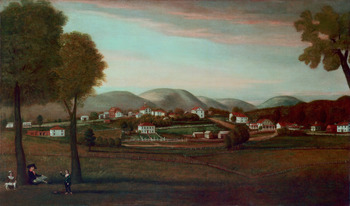
As early postwar commemorations addressed and connected the past and future, subsequent ones also addressed the present through reference to current political events.Footnote 39 Commemorations during the 1790s articulated partisan divisions stemming from George Washington's first term as president. As illustrated through commemorative song lyrics, Federalists adopted a hierarchical vision and saw political participation and guidance as the purview of elites, while Republicans advocated egalitarianism and broader democratic political participation. Federalists pursued a strong federal government, national army and navy, and centralized finances as keys to the nation's success. Republicans supported states’ rights, championed the militia, and saw the nation's success as rooted in the yeoman farmer and, later, manufacturing. While Federalists aligned with Britain, Republicans aligned with France. In Bennington, these divisions were articulated through patterns of settlement and socializing and a protracted legal dispute from 1789. Republicans settled and worked in Bennington's “uphill” area and congregated at the State Arms Tavern opposite the courthouse. “Downhill” was home to Federalists and their gathering places like Dewey's Inn (Figure 1).Footnote 40 Despite modern scholars’ emphasis on the federalism, militarism, and xenophobia fueled by Federalists during John Adams's presidency, recorded commemorations in Bennington demonstrate that Republicans remained steadfast in opposing Federalists even while being persecuted, arrested, and tried for sedition.
View of Bennington by Ralph Earl (1798), featuring the uphill area in the background and the downhill area in the foreground. Bennington Museum, Bennington, Vermont.

Bennington's partisan division was reflected in battle commemorations of the mid-1790s. Republican commemoration organizers guided community members to understand current political events through a partisan lens and through reference to the past. In 1795, “nearly one hundred citizens” enjoyed a meal in the State Arms Tavern's hall and “several hundreds” joined in toasts and songs punctuated by cannon fire. The traditional advance preparation of toasts and Haswell's rapid songwriting enabled an alignment between the political commentary of the toasts and songs. Haswell was known to create lyrics on the spot, such as “Attention My Friends,” written to the tune “Derry Down” in the tavern.Footnote 41
After first honoring “liberty,” the toasts quickly reached the controversy that had erupted over the Jay Treaty in 1795. Negotiated to address US-British conflicts that developed amid larger European power struggles, the treaty neglected key issues, including British impressment of American seamen. Republicans felt that the treaty made Americans British subjects; their toasts called it a “detested instrument” and declared “May the signature of a Washington never entail disgrace upon his country.”Footnote 42 Haswell elaborated this critique in “Jay's Treaty disclosed by Stephens Thomson Mason.” Haswell used the Senate's secret debate leading to the twenty-to-ten vote to ratify to highlight Federalists’ disdain for the public: the Federalists felt that “the rabble had nothing to hear or to view, / Say the twenty, the secret's too sacred for you.” Haswell's lyrics were sung to “Derry Down,” a lilting, conjunct, octave-spanning, minor-mode melody often used to voice political criticism.Footnote 43 Haswell's lyrics praised Mason for leaking the treaty to foster public debate: “’Twas the act of a freeman, who joined with the TEN, / To save us from tyranny, rank us with men.” With “tyranny,” Haswell and the celebrants referred to Americans being subjected to British abuses and kept in ignorance by their own representatives. Performed in the battle commemoration, the song portrayed actions like Mason's as fulfillment of an obligation to uphold the revolutionary generation's virtue, virtue highlighted in Haswell's song for the tenth toast honoring “The day” titled “The Defeat of the British in Bennington Battle, August 16, 1777.”
Republican celebrants connected the 1777 battle to an international context through the fifteenth toast to the United States’ French allies and the accompanying song “France and Freedom: An Ode.” The song recalled France as the United States’ “noble ally” in the Revolutionary War and stressed the countries’ unity in an ongoing transatlantic battle waged by republics against tyranny. The singers rejected “slavery” to a British “despot,” which they saw in the Jay Treaty. The song referenced the liberty cap on display that symbolized the revolutionary alliance and the celebrants’ pro-French stance.Footnote 44 The last of many lyrical references to the ritual context intensified the partisan divide through the exclusionary sung declaration, “He who denies the toast we'll banish from our class.”Footnote 45
With these songs and toasts, Republicans used the battle commemoration to oppose the Jay Treaty by invoking the memory of the French alliance in the Revolutionary War and past US determination to fight British domination. Their first toast to liberty articulated the common denominator they saw between Mason, who fought the treaty, and the battle heroes of 1777. Their commemoration was a rally and prelude to public discussion of the treaty at the courthouse a week and half later, when locals opposed the treaty and selected several men, including Haswell, to write resolutions against it. They sent Haswell as town delegate to a county convention to instruct their congressional representative how to vote.Footnote 46
The partisan rift widened from spring 1798 when Federalists exploited US outrage over French behavior exposed during the XYZ Affair to pass the repressive Alien and Sedition Acts, which were intended to wipe out internal dissent.Footnote 47 Violating the first amendment of the Constitution, the Sedition Act made it illegal to make false or libelous statements about, or to fuel sedition or public animosity against, the government or its officers. The Naturalization Act required immigrants—among the Republicans’ strongest supporters in recent elections—to have fourteen years’ residency to vote. Reflecting a widespread trend, local Federalists and Republicans celebrated July 4 separately in 1798 and 1799, and the local Masonic Lodge, which had gathered men of different political persuasions, folded. Although Federalists strove to silence Republicans and eliminate domestic opposition through the Alien and Sedition Acts, Vermont Republicans were not intimidated. Vermonters reelected outspoken Irish-born Republican congressman Matthew Lyon while he was imprisoned following his arrest under the Sedition Act. Haswell, himself ultimately arrested, charged with seditious libel, convicted, and jailed, remained a community fixture and vocal Republican.Footnote 48
Bennington's Republicans used the battle commemoration in 1799 to attract and tie adherents to their partisan cause.Footnote 49 Haswell was chosen orator and he drew a parallel between British offenses prompting the Revolutionary War and recent Federalist or “tory” offenses following the XYZ Affair. He brought the war and local battle into his listeners’ minds by recalling war scenes vividly in the present tense and asking “Do not our hearts once more respond the feelings they that day experienced?” Haswell connected past efforts to defend liberty to the nation's future and concluded by urging vigilance in the present:
O let us watch our government with a careful but a scrutinizing eye. . . . if at any future time, by the insidious wiles of wicked and designing men, our independence should be endangered, our property rendered insecure, and our substance lavished on courtiers, sycophants, and tools of tyranny, may the spirit of 1777 reanimate our zeal, may we seize the sword as the dernier resort, and live respected or expire at freedom's shrine, establishing the doctrine with our blood, that an oppressed people have the right of resisting their oppressors; and that resistance to tyrants is obedience to God.Footnote 50
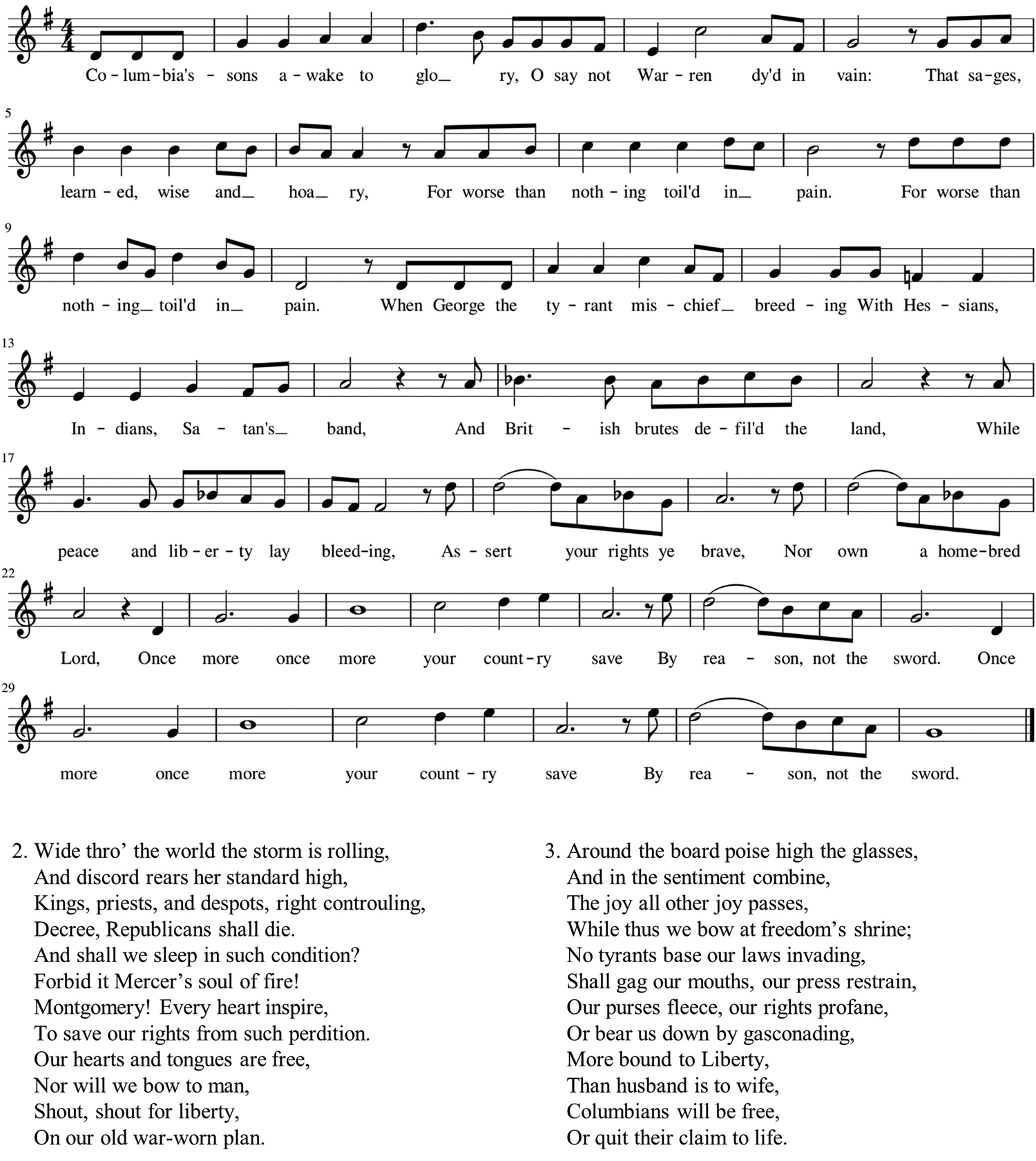
Although lyrics bookending the oration addressed the day and honored those killed in battle, Haswell called for Republican vigilance in song at the State Arms Tavern following a toast to “The people of America, may he who rules in heaven protect them from the machinations of aristocracy and the wiles of monarchy” (Example 1). In “Columbians will be FREE or DIE,” Haswell invoked the Revolutionary War as creating a debt of obligation owed by the living to protect the rights their forefathers and veterans fought and died for; he identified this as reasoned vigilance against a “home bred Lord.” After attacking US emulation of monarchical practices, as seen in the debates over titles in Washington's administration, Haswell made Republicans’ duty explicit in the third verse by rejecting the Alien and Sedition Acts. A ballad account written to “Derry Down” at the tavern detailed other recent Federalist offenses.Footnote 51 By invoking nationally recognized war heroes like Warren, Mercer, and Montgomery, Haswell placed current opposition to Federalist leaders and legislation in a longer, compelling national narrative. By setting his lyrics to the “Marseilles Hymn,” one of several French revolutionary tunes popularized in the United States in the early and mid-1790s, Haswell made Republican domestic opposition in defense of individual liberties part of a larger fight for republicanism as a global cause. The tune's energetic, martial rhythms and triadic leaps underscored Haswell's call for determined opposition. Urging “Montgomery every heart inspire, / To save our rights from such perdition,” Haswell invoked commemoration as a practice that could move Americans to emulate their forebears’ virtuous actions.Footnote 52 He reinforced the importance of feeling in this process through an implicit personal reference in the final verse. In asserting that Americans were “More bound to Liberty, / Than husband is to wife,” Haswell alluded, as his companions were well aware, to his wife Lydia's death in the spring.
Anthony Haswell, “Columbians will be Free or Die.”

Haswell's choice of French music for commemorative contrafact in 1799 is significant, given US attitudes towards France, French immigrants, and immigrants more generally. Fears about immigrants grew during the 1790s, fueled by Federalists who increasingly equated “American” with US birth.Footnote 53 Xenophobia and nativism blended with militarism and repression from 1798 when Federalists capitalized on Americans’ outrage over French political intrigues to pass the Alien and Sedition Acts. Anti-French and anti-immigrant sentiments were incorporated in commemorations and songs in communities like Worcester, Massachusetts and Rochester, New Hampshire.Footnote 54 Targeting Irish immigrants, who were often Republicans, one Federalist songwriter commemorated July 4 with the lines
Considered within such broader Federalist sentiment, Haswell's choice of the “Marseilles Hymn” as his tune epitomized Republicans’ determined opposition despite xenophobia, repressive legislation, threatened physical violence, and possible arrest. Republicans steadfastly opposed Federalist legislation, won state and federal offices, and ultimately prevailed in the presidential election of 1800.Footnote 56
Generational Gaps and Battle Ties
Jefferson's inauguration in early 1801 validated Republicans’ longstanding opposition to Federalism and ushered in massive changes in national leadership. Meanwhile, Bennington experienced significant changes locally. More lawyers and merchants immigrated and strengthened its Federalist contingent. Upwardly mobile Republicans became embedded in commerce and emphasized individual success. By 1802 visitors were commenting on Bennington's moral “degeneracy.” Accounts of later commemorations emphasized the militia's temperate behavior that “evinced to the fathers of the town that they had not degenerated.”Footnote 57
The generational split noted in such commentary was addressed by commemoration organizers. Revolutionary War officers had been dying in the 1790s, and youth born after the war had to learn about it from parents, community elders, texts, and visits to battle sites. Aware of this loss of knowledge and wary of its potential moral impact, organizers used new techniques to create moving commemorations of the Battle of Bennington. Orations increasingly incorporated Baptist voices like John Leland, who in 1809 drew “tears of gratitude from children, who on that day were in their mothers’ arms,” too young to understand the events unfolding. Symbolic decorations excited “lofty and kindling enthusiasm” and combined with other elements to foster “serious and animated demonstrations of gratitude” among participants, including those who had not witnessed the battle and the community's response in 1777.Footnote 58
The generational split also shaped commemorative music. In 1806, Haswell's lyrics written “for the old veterans of Bennington” to the Revolutionary era tune “Liberty Tree” stressed generational differences between young militia and old battle veterans who observed their maneuvers. These veterans included “Colonel Sam” and “Major ’Leazer”—veterans Lieutenant Colonel Samuel Safford (1737–1813) and Major Eleazer Hawks (1747–1827)—as they were affectionately called in another song. Haswell's third verse validated such veterans’ ability to convey “fresh ardor” to the community's youth.Footnote 59
In 1809, reports of two distinct processions stressed the participation and impact of aged veterans. At 11:00 a.m. began a procession of three hundred to four hundred “citizens” in the “federal party;” they were directed by what Benjamin Harwood dismissed as a “Quid committee,” a third political group attracting moderate Republicans and Federalists during the economically devastating Jeffersonian embargo of 1807 to 1809. Federalist newspapers stressed the sight of “many aged patriots and heroes, who were present at the battle” and proudly reported a dissolution of party distinctions. At 12:30 p.m. came a gathering of twelve hundred “Republican Freemen” who, “although they marched in close order,” stretched nearly half a mile. As the Green Mountain Farmer reported, “The enthusiasm which such a Procession excited, headed by Fathers, and Grandfathers—men grown grey in their country's service—is better felt than described.”Footnote 60 Featuring veterans provided a visible, compelling connection to the battle for those born after the war, and their participation validated each partisan commemoration.
Veterans’ impact on participants’ feelings in early nineteenth-century commemorations can be seen in Benjamin Harwood's diary entry for July 4, 1808. When describing Republicans’ activities marked by toasts, songs, and instrumental music, he effused that “several of our revolutionary patriots, gave a few hearty and genuine republican volunteer toasts—which excited a burst of unfeigned joy thro the whole assembly. I never enjoy'd greater satisfaction on such an occasion, than I have this day.”Footnote 61 Aged veterans professing adherence to Republican values—particularly amid challenges to US neutrality, impressment, and seizures of US goods during the Napoleonic Wars—stimulated sincere expressions of political consensus within a larger partisan gathering.
Organizers pursued stronger ties to the battle through their deliberate incorporation of veterans’ voices. A key voice was General John Stark. In 1809 organizers invited Stark to attend the Republican battle commemoration. The octogenarian declined due to his advanced age, but Haswell read Stark's letter to those assembled in the meeting house. Both Federalists and Republicans incorporated Stark's voice in original songs performed at their convivial gatherings.Footnote 62
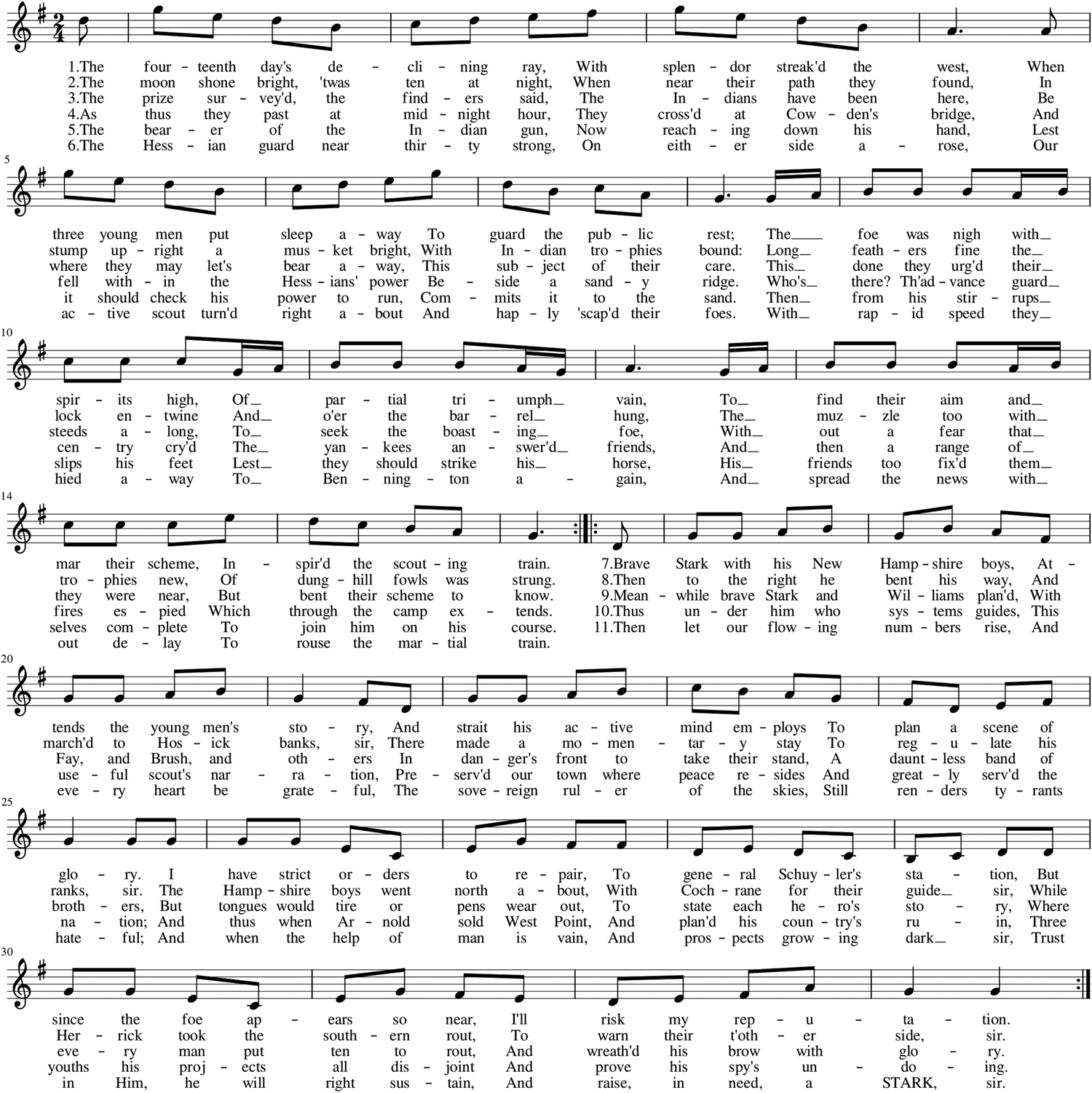
One Republican example was “Stark's General Orders.” Stark's letter had warned, in reference to Federalists, “It is my orders now, and will be my last orders to all my volunteers, to look well to their sentries: FOR THERE IS A DANGEROUS BRITISH PARTY IN THIS COUNTRY, LURKING IN THEIR HIDING PLACES, MORE DANGEROUS THAN ALL OUR FOREIGN ENEMIES.” He referred to Federalists’ domestic opposition and their siding with Britain in the Napoleonic Wars, wars to which Republican leaders had responded with embargo legislation before pursuing war with Britain. At Republicans’ convivial gathering, “Stark's General Orders” set to the tune “Derry Down” elaborated the general's “final order” for vigilance against dangerous, domestic British partisans (Example 2). Haswell and his compatriots called their neighbors to “detect” domestic spies and place them in nooses. Calling for violence against an enemy at home evoked older patriots’ fighting against Loyalists, like those from Hoosick, New York, during the Battle of Bennington.Footnote 63 Older battle veterans’ presence at the gathering only made Stark's caution more compelling.
Anthony Haswell, “Stark's General Orders.”

As Benjamin Harwood's diary reveals, this Republican gathering was impactful. Although Harwood could not afford the public dinner, he stayed around the bowery at the State Arms Tavern: “After the cloth was remov'd I sat down & took a glass of wine with my brethren—the toasts and songs were sentimental & cheering to the soul of every true whig.”Footnote 64 His private commentary illustrates how particular sentiments, company, and expressions were understood by individuals to define “true” Republicans amid increasing domestic and international conflict.
Although songwriters’ logical connections between lyrics, occasion, audience, and tune choice are often clear, more puzzling to modern readers is how claims of consensus in public accounts of commemorations were contradicted by partisan, violent, and exclusionary language in lyrics and orations from the 1790s. Although this language seems to contradict the consensus established through independence and corrupt commemoration with partisan politics,Footnote 65 such a view overlooks how inflammatory rhetoric in commemorations strengthened bonds among partisan adherents. Private accounts like Benjamin Harwood's illustrate how consensus could be reinforced among likeminded political “brethren” through commemorative ritual. Telling is Harwood's entry from July 4, 1809. He traveled eight miles west to Hoosick, New York because there was “much temporizing going on in both parties” in Bennington. He explained, “as I did not desire to sit down at a table on this glorious anniversary of the birth day of our national independence with a gag in my mouth . . . I accordingly left my business and partook of the pleasures of the day at [Benjamin Heartt's tavern at Four-corners], with a small but zealous band of firm democratic republicans.”Footnote 66 After Republicans’ August battle commemoration, he recorded, “Democracy was triumphant this day, I was so happy as to be among the enemies of aristocracy and monarchy—and the friends of the rights of man.”Footnote 67 Harwood rejected pressures to silence his beliefs among more moderate Republicans who aligned with local Federalists when anti-Republican sentiment in New England ran strong during the economically devastating embargo. That local veterans who once united in battle split into dueling 1809 commemorations attests to the idealized nature of community-wide consensus following independence and encourages an alternative reading of reports of consensus as affirmations of requisite order—accomplished among political brethren—that sustained commemorative practice as a valuable political vehicle for the future.
In 1810, Republicans from Bennington County and neighboring areas of Massachusetts and New York began organizing the battle commemoration early. Recognizing the strong link between memory and place, they used location to create a compelling event relevant for multiple generations: they held the commemoration near the battle grounds. An editorial highlighted the location to draw participants: “come and survey the hills of heroes, the northern Thermopylae of America, where the surges of British tyranny were stayed, were broken by the rock of our salvation.” Organizers invited participants to meet at the site of Stark's headquarters between Bennington and Hoosick. From Stark's encampment, they marched to a view of the battleground.Footnote 68 After returning to the encampment site, they participated in a prayer, oration, and a cold collation with toasts and original songs punctuated by cannon fire.
The commemoration's location and music addressed younger generations’ lack of knowledge. Aged veterans pointed out the locations of key events and taught the youth about the battle. These didactic exchanges were singled out among “the groupe of incidents which contributed to make the scene deeply impressive—‘the harvest for feeling.’” Reinforcing the spatial nature of memory, Haswell's song “August ’77,” set to the tune “Scotch Luck” (“There's No Luck about the House”) and then “Yankee Doodle” described battle events so listeners and singers could envision the action and scene (Example 3).Footnote 69 Haswell narrated the battle through moving detail and vivid imagery enhanced by internal rhyme. First focusing on the scouting party, he set the precise scene, time, and setting. In detailing the feather-adorned musket of an Indigenous ally of the British, Haswell created a compelling, racialized image of the enemy. Haswell invited listeners to adopt the veterans’ perspective, taking them over the bridge near the house of late Major James Cowden north of the battle site. Turning then from the ordinary men of the scouting party to General Stark, Haswell shifted from the melody of a Scotch song in the voice of a woman at home whose man has gone off to fight to a tune strongly associated with battle grounds: “Yankee Doodle.” Haswell captured Stark's preparations through a detailed narrative highlighting five individuals’ contributions. To underscore Stark's recent call for vigilance for a multigenerational audience, Haswell referred to a historical “spy” and stressed the role of “youths” in foiling his plans.
Anthony Haswell, “August ’77,” written in two parts to the tunes “Scotch Luck” and “Yankee Doodle.”

Elements of commemoration that highlighted past generations’ perspectives and actions also interpreted contemporary events. The 1810 commemoration guided participants to see the sacrifice of imported goods and international trade through the embargo and subsequent Non-Intercourse Act as extensions of revolutionary sacrifice and virtue. The embargo was challenging to defend not only because it devastated New England economically, but also because it lacked the agency of traditional conceptions of masculine heroism. Leveraging the revolutionary past to address this problem, in 1808 John Leland had called Benningtonians to “bear the burden of the Embargo in the name of Revolutionary patriotism” and to make sacrifices “to preserve the inheritance, which cost our fathers and ourselves fifty thousand lives, one hundred and fifty millions of dollars, many towns, and much substance besides.” When promoting the 1810 commemoration, an editorialist argued that self-reliance on the nation's bounty embodied the “same virtue” and “dignified resistance” seen in the revolution.Footnote 70
Haswell's lyrics elaborated this virtuous interpretation of withdrawal from trade. The embargo was frequently likened by contemporary polemicists to a turtle withdrawing into its shell, but Haswell's commemorative lyrics made self-reliance through efforts like manufacturing homespun clothing an extension of revolutionary era sacrifice and active heroism. In the song “Past, Present and Future,” sung to “Anacreon in Heaven,” Haswell narrated the Revolutionary War in terms that highlighted contemporary comparisons:
“Homespun” encompassed both the potential of US manufacturing, as Haswell's final verse stressed, and virtuous women's contributions to the nation.Footnote 71
Haswell's lyrics intersected with an already substantial print tradition in which women authors asserted female republican identity, defined women's place in political life, and maintained that women could attain virtue, including heroic virtue.Footnote 72 However, through commemorative ritual, Haswell had men voicing these assertions in song. Haswell's “The Voice of Liberty,” written to the energetic British hunting tune “Black Sloven,” stressed contemporary women's extension of revolutionary sacrifice. Reversing common portrayals of women as dependent on men, Haswell cast national male heroes as implicitly dependent on women: “When Hancock was plac'd in the President's chair, / Not a shred from abroad would the patriot wear.” In Haswell's account, Hancock and Washington upheld their values of self-reliance and rejection of foreign tyranny through American women's creation of cloth and clothing. Moreover, Haswell promised women that they too would be remembered as guardians of the nation's freedom:
In these final two verses, Haswell positioned women not as passive objects of beauty, as was common in final verses sung in men's convivial gatherings, but rather as agents capable of heroic sacrifice for the national good who deserved to be remembered by future generations.Footnote 73
Haswell used Stark's voice to reinforce this connection of contemporary women's sacrifice to the revolutionary past. As Stark's letter reminded Benningtonians, and as Haswell had elaborated in “Stark's General Orders” (Example 2), Bennington's women had joined the stand against British invaders in 1777 by repurposing the ropes supporting mattresses to tie prisoners. Lyrics like Haswell's extended longstanding efforts to define women's place in war, commemoration, and national development.Footnote 74
Performed at Stark's encampment site in an elaborate ritual that extended street theater to landmarks and landscape, Haswell's songs recalled momentous events from the past to shape views of and incentivize actions in the present. Through song titles and lyrics, Haswell reinforced the previous week's editorial in the Green Mountain Farmer, which argued that commemoration pertained to the past, present, and future: “The duties [of commemoration] are triune, having always a three-fold reference: a reference to the injunctions of our fathers, our own good, and the welfare of posterity: grateful to our predecessors, just to ourselves, and faithful to our successors: ever remembering, that with this patrimony we are to transmit examples worthy of it, comporting with its benevolence, its spirit, and its general character.”Footnote 75 Domestic manufacturing and purchasing domestic goods, Haswell argued in song, honored past generations’ sacrifices, supported the nation during protracted European conflict, and ensured the nation's freedom from foreign tyranny in the future.
Such messages reached a sizable Republican audience at an important moment. The two groups that mounted separate processions in 1809 were fighting for adherents before fall elections. The protracted embargo had prompted strong anti-Republican sentiment in New England expressed in illicit smuggling and burning Jefferson in effigy. Past commemorations had included participants from the vicinity, but in 1810 people came from thirty to sixty miles away, some on foot. Organized by a large committee that included representatives of Vermont, New York, and Massachusetts, the commemoration drew about three thousand people for the procession. The commemoration even attracted attention in New York City. Using the past to interpret the present, the organizing committee's report submitted to the Green Mountain Farmer likened the journeys of so many from so far away to rallying for battle and elaborated: “The resemblance in another view was equally striking—the enemies of Liberty, now as then, shunned the encampment of Stark and his brave compatriots.”Footnote 76 Using the symbolic location, the writer reinforced earlier positioning of commemoration in opposition to treachery and extended the exclusionary message of Haswell's earlier lyrics.Footnote 77
Conclusion
Tracing Haswell's lyrics over the years illustrates that as themes of gratitude and virtue remained central to commemoration, new strategies made remembrance of the past and understanding its significance for contemporary politics relevant to younger generations. Aged veterans like Stark enhanced partisan calls to action, justified through creative historical narratives. Detailed ballad-like accounts helped listeners visualize past scenes and veterans’ perspectives while educating youth—both girls and boys—about the past and proper behavior and values to ensure the community's health in the future. As Haswell made explicit in the opening song of his 1810 collection for the battle commemoration, “Past, Present and Future,” music provided a powerful means of shaping Americans’ perceptions of the past to urge them to action in the present for outcomes envisioned in the future, compellingly anchored in terms of gratitude, virtue, and memory.
Commemorative song not only promoted these values but also articulated varied understandings of freedom and liberty. Music in some commemorations, such as those of Republicans in the 1790s, prioritized individuals’ rights articulated in the Bill of Rights and freedom from tyrannical government. Music in other commemorations marked one nation's “freedom” from bondage to another, as seen in early Revolutionary War commemorations and partisan commemorations from the 1790s. Music in abolition commemorations reinforced African Americans’ freedom from bondage.Footnote 78 Multiple understandings of freedom and liberty could be promoted because dissent, despite recurring claims of consensus, was a regular feature of early US political life and was enhanced through commemoration.
Haswell was one of many community members who contributed music for local commemorations. Although he served in the army from 1776 to 1777, he apparently had no specific connection through service to the Battle of Bennington. Instead, he was likely motivated by his patriot and republican leanings established before the war, his longstanding belief in song's political power, and his understanding of commemoration's political value. Haswell was not alone in writing songs for his community, including political and partisan songs. Such musicmaking in commemorative ritual was so widely established that it appeared in dramatic productions. Federalists too had community songwriters like Robert Y. Sidney in New York, Jonathan Mitchell Sewall in Portsmouth, and Robert Treat Paine in Boston who contributed lyrics such as “Ode for the Celebration of the President's Birth Day” and “Ode for Independence, 1810” for local commemorations.Footnote 79 As they demonstrated, music was regularly and skillfully shaped by members of other professions and was widely circulated as texts in broadsides, printed orations, poem and song collections, and newspapers. As Bennington illustrates, our understanding of music in the early nation can be enriched through closer study of these sources.