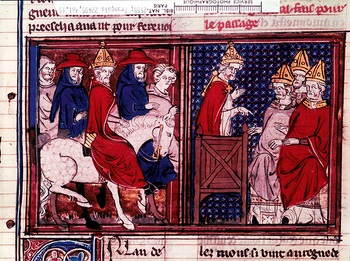
We live in an age where gathering ‘likes’ and ‘followers’ via X (formerly Twitter), Instagram, Facebook, TikTok, YouTube and other forms of simultaneously mass yet also individualised electronic communication have largely supplanted but occasionally still collaborate with the potentially unifying forces of network television, concerts, and charismatic speeches and sermons. It is therefore easy to forget that preaching was the closest equivalent the medieval period had to mass communication, and that the influence of that preaching depended not only on the rhetorical power of the message, but its context and its deliverer.Footnote 1 The garrulous chronicler Salimbene of Parma ascribed one striking crusade appeal, delivered during the crusade against Ezzelino and Alberigo da Romano (c. 1258–60), to the papal legate Ottaviano degli Ubaldini. After hearing news of fresh brutalities committed by Alberigo da Romano, a local ally of the imperial cause, the legate sent a messenger throughout the city of Venice, summoning all the citizens, men and women, to assemble in the spiritual and political heart of their city: the square before San Marco. Lured by the promise of hearing and seeing what they had never witnessed before, the expectant crowd was regaled with an account of the summary execution of twenty-five civic leaders from Treviso and the humiliation of their womenfolk, exiled from the city penniless and half-naked, now paraded before the audience in their destitute and dishevelled state as living evidence of Alberigo’s inhumanity. According to Salimbene, Ottaviano’s audience promptly clamored, ‘Let him die, let that evil man die! Burn him and his wife alive! And destroy all his progeny from the face of the earth!’ After Ottaviano confirmed the popular verdict with a series of liturgically maledictory scriptural citations, the populace, in a call-and-response eerily reminiscent of the fabled reaction of the audience of Urban II’s speech at Clermont (1095) (Figure 1.1), shouted, ‘So be it! So be it!’Footnote 2
Pope Urban II preaches the First Crusade. From the fourteenth-century ‘Li rommans de Godefroy de Buillon et de Salehadin et de tous lez autres roys qui ont esté outre mer jusques a saint Loys qui darrenierement y fu’, Bibliothèque nationale de France, Paris MS 22495, fol.15r.

Perhaps reading or excerpting from a recently issued crusade letter, the legate channelled the populace’s fury and outrage into support for a papally sponsored crusade. Whoever took the cross and went to destroy Alberigo, or sent someone in their place, paying all expenses, would receive a plenary (full) indulgence from all their (confessed) sins by the authority of God, Sts Peter and Paul, and the pope. Men and women, great and small, swarmed to take the crusader’s cross. The chronicler Salimbene of Parma astutely parsed the factors potentially motivating those taking the cross in aid of the crusade effort: the legate was a man of high authority; Alberigo’s wickedness had infuriated the Venetians; ‘those noble men [of Treviso] had been hanged so unjustly’ and their women subjected to ‘shameful dishonor’; and spiritual rewards were on offer. Moreover, following generations of previous crusade preachers, Ottaviano invoked the inflammatory biblical story of the Levite’s wife sexually assaulted and slain by the Benjamites of Gabaah and the ensuing war sparked by his distributing the dismembered fragments of her corpse throughout the tribes of Israel. Now applied to a crusade against fellow Christians, the Old Testament story had long been used as a clarion call to reform Latin Christendom and punish ‘atrocities’ allegedly committed by Muslim or heretical foes in the form of the desecration of individuals or objects dedicated to God: Holy Places, altars, relics, crosses, Christians.Footnote 3 In Ottaviano’s case, the biblical story and its accompanying call for vengeance and purification was welded to an already potent blend of honour, regional and factional rivalry, civic identity, shame, outrage, charity towards the suffering, and a divine commission to God’s chosen people (presumably now the Venetians) to embark upon a Holy War of cleansing vengeance against impenitent ‘devils’. Another papal legate preaching a crusade against Ezzelino da Romano invoked the biblical example of the Maccabees and the life of his audience’s local patron, St Anthony, to urge his listeners to avenge Ezzelino’s alleged heinous crimes.Footnote 4
As Salimbene’s rhetorically vivid reconstructions of crusade sermons suggest, there are multiple methodological issues that inform studies of the preaching of the crusades and crusading pieties. How were sermons constructed, delivered, interpreted and preserved? What were the factors necessary for an appeal to generate support for the crusade in the form of recruits, funds, prayers and liturgies? What role did local circumstances, settings, audiences, and the personality and training of the preacher play in shaping the content and delivery of sermons? After surveying the relationship of preaching to crusade organisation and the many roles fulfilled by those promoting the crusade, this chapter will examine the crucial factors of local pieties and political, economic, social and spiritual contexts that shaped how concepts and practices of crusading were negotiated and enacted. Crusade recruiters played many roles: preacher, confessor, diplomat, dispensator, collector of funds, peacemaker. As crucial intermediaries between supporters (and opponents) of crusading and spiritual and political authorities, they helped to dialogically negotiate the logistics and ideas of crusading and often faced obstacles and criticisms. The chapter concludes by studying some of the sources from which preachers drew materials to craft their homilies (papal letters, treatises and histories, illustrative anecdotes, scriptural commentaries, compilations of preaching materials, the veneration of local saints, the rhythm of local liturgies, religious calendars and readings). It is only by studying these sources that we can begin to understand how preachers drew on existing pieties and religious practices to continually (re)negotiate the concepts and practices of crusading and in turn, how ideas and behaviours associated with crusading interacted with and influenced other forms of piety.
Organisation and Preaching
As the appeals recounted above demonstrate, preaching was a powerful means of recruiting individuals and resources for the crusade effort. Sermons were an essential tool for persuading individuals to take the crusade vow as a legally binding pledge of support for the crusade through personal participation in the planned military campaign, sending or funding a substitute and/or participation in the liturgies, prayers, processions, donations and taxes organised in support of the crusades. Even in the case of semi-independent enthusiasts such as Peter the Hermit (and later demagogues including Eustace of Flay and Fulk of Neuilly), as well as the unlicensed leaders of popular crusades such as the crusades of the pueri (1212) and Pastoureaux (1251), crusade preaching was rarely spontaneous.Footnote 5 A crusade sermon was often the fruition of careful planning, including papal and/or royal correspondence with potential participants and preachers and diplomatic missions intended to sound out potential support for or opposition to a proposed crusade. When formally organising a crusade, popes typically issued letters addressed to preachers, prelates, rulers and/or towns. Intended to be read out in place of a crusade sermon or as a supplement to a preacher’s own customised appeal, these letters typically outlined the specific contemporary events or circumstances which justified the mustering of a crusade and the multiple spiritual and temporal privileges granted to crusaders (including various indulgences) as well as the crusade’s goals, organisational logistics and timelines. However, crusade letters should not be viewed as dictatorial mandates; these missives were often (re)crafted and issued in response to petitioners’ concerns and queries and were also open to reinterpretation and selective usage by their recipients.Footnote 6
From Urban II until Gregory IX, typically bishops and their secular clergy were expected to promote the crusade within their respective dioceses, and some popes went to great efforts to appoint specific individuals known to be effective preachers. Others appear to have adopted this role for themselves even prior to papal authorisation.Footnote 7 Peter the Hermit was credited in some medieval traditions with instigating the First Crusade.Footnote 8 Bernard of Clairvaux played a key role in initiating and preaching the Second Crusade in person and through letters while attempting to rein in the effective, albeit viciously antisemitic, preaching of another Cistercian named Ralph in the Rhineland.Footnote 9 Cardinal Henry of Albano, a former abbot of Clairvaux very nearly elected pope, not only promoted military campaigns and anti-heretical preaching against the heterodox in the Midi but later became the main recruiter for the Third Crusade in France and Germany, while his English Cistercian counterpart, Archbishop Baldwin of Canterbury, embarked on an extensive preaching tour of Wales with royal and papal support, an expedition recorded by the eternally self-promoting Gerald of Wales.Footnote 10 Not all were so enthusiastic. Fulk of Ghent refused all attempts by Jacques de Vitry, including threats of excommunication and a divinely induced illness, to persuade him to accept a commission as a crusade recruiter.Footnote 11 Many, including Oliver of Paderborn, turned to former associates to act as their aides, but it appears that by the 1220s at least some individuals with knowledge of the local situation and dialect were refusing commissions as recruiters. It appears that they did so for fear that their incomes would be denied to them because the travelling necessary to effectively promote the crusade would result in prolonged absences from their own churches.Footnote 12
Some themes of crusade preaching were established from an early date, as evidenced by the influential letter of Eugenius III promoting the Second Crusade (Quantum praedecessores). Eugenius and many other popes and preachers called for the nobility and kings (and later the urban and rural populace) of Latin Christendom to emulate the mighty material and penitential sacrifices of their ancestors on the First Crusade in imitation of Christ and the saints. The goal was the protection or recapture of the sacred regions in which Christ had become incarnate and died to redeem the human race, particularly the Holy Sepulchre in Jerusalem, the memorial of Christ’s Passion. Eugenius evoked core motifs used by Urban II and chroniclers of the First Crusade (the forgiveness of sins, assistance for Eastern Christians, Holy War, the values of contemporary warriors embodied by their crusading ancestors), establishing a pattern for crusade recruiting until Gregory VIII and Innocent III extended the call to crusade participation to the populace at large, refashioning the crusade as an opportunity for penance on both the military and domestic fronts.Footnote 13
This extension was aided by the pastoral expertise of those the papacy appointed to promote the Third and following crusades. While popes continued to depend heavily on the ascetic and centrally organised Cistercian order for preachers, the involvement of Gerald of Wales, Peter of Blois and many other Paris-educated preachers in the Third Crusade signalled the beginning of the influence of Paris-trained theologians on the formation, delivery and preservation of crusade excitatoria. The content and number of crusade promotion materials and recruitment and the nature of the crusade indulgence also was altered and intensified after Saladin’s capture of the relic of the True Cross at Hattin (1187), a disaster that resulted in the first institutionalised liturgy in aid of the crusades.Footnote 14 The Paris-educated Fulk of Neuilly and many of his compatriots were engaged in reform preaching against clerical incontinence, moneylending at interest (usury) and other vices long before the official declaration of the Fourth Crusade by Innocent III in 1198. Some, including Eustace of Flay, claimed direct divine commission through heavenly letters. They may have begun to preach the Fourth Crusade without direct papal commission (perhaps authorised by the bishop of Paris or the Paris-educated papal legate Peter of Capua). They were later given official commissions and granted the ability to draft secular clergymen, canons regular and monks to assist them. Preachers from Paris also worked with Cistercians in promoting the Albigensian Crusade, and their insistence that the poor would prevail where the rich, mighty and corrupt had failed to reconquer the Holy Land, their sense of eschatological imperative, call for moral reform and charismatic preaching techniques would be appropriated by the lay leaders of the crusade of the pueri (1212), who were treated with sympathy by some local ecclesiastics (including one preacher in Paris later promoting the Fifth Crusade) while excoriated by others.Footnote 15 Similar to the pueri, the Pastoureaux of 1251 also claimed direct inspiration from the Virgin Mary or Christ himself, and blamed the clergy and powerful laypersons for the military failure of Louis IX’s first crusade, particularly the mendicant orders. For by the third decade of the thirteenth century, it was the mendicant orders with their tightly knit organisation, educational system and pastoral mission who had become increasingly responsible for promoting various crusades in addition to the eastern crusade, commuting the vows of impoverished or incapacitated crucesignati into money donations, and the collection of crusade taxes, resulting in many attacks on mendicant houses and the Franciscan archbishop of Rouen, Odo Rigaud, after the failure of Louis IX’s first crusade.Footnote 16
Another problem that faced legates and preachers alike was the simultaneous promotion of various crusades in the same region, as illustrated by the registers of Odo Rigaud. Typically crusades to the East received the most universal support and the widest geographical commissioning of preachers, men and money, while other crusades (such as those to the Iberian Peninsula, the Midi, the Baltic or ‘political’ crusades) were promoted in more defined geographical regions. For example, Gregory IX and Innocent IV used the Dominican order to publicise the Baltic Crusade in northern Europe to prevent that effort from diverting crusade resources from the contemporary and competing anti-Hohenstaufen and Holy Land crusades.Footnote 17
One Commission, Many Roles
In addition to their preaching duties, many crusade recruiters were appointed as agents for the enforcement of crusader privileges, or commissioned to redeem (convert into a cash payment), delay or commute (change into another obligation) the vows of crucesignati unfit or unwilling to serve in person at the deadline set for departure. Preachers also became involved in renegotiating deadlines and ports for departure and the collection, handling and payment of crusade monies either to papal agents or individual crusaders. Their queries often directly shaped papal policy in these matters. Appointed to preach the Fifth Crusade, Conrad of Speyer asked Pope Innocent III what to do about men who wanted to take the crusade vow without their wives’ permission and about the unfulfilled vows of those who had pledged to join the temporarily suspended Albigensian Crusade.Footnote 18 The immensely influential Hubert Walter, archbishop of Canterbury, likewise corresponded with Innocent III regarding the delicate matter of commuting, deferring and redeeming the vows of crucesignati in England.Footnote 19 As head of the Praemonstratensian order, Gervase of Prémontré warned Innocent III and Honorius III about the lack of enforcement of crusaders’ rights in France, the need for revised departure deadlines and the provision of individuals suitable for collecting and disbursing vow redemption money and crusade taxes. He was ‘rewarded’ with a commission as one of the new crusade organisers (ordinatores)!Footnote 20 Papal policy in these matters was therefore formulated in direct dialogue with individuals working in the field.
Most general crusade histories and papal letters portray the papacy as firmly at the helm of crusade preparations. Certainly, popes often insisted that crusade letters be read out by the preachers they appointed (and the diocesan clergy) in order to attempt to enforce some coherence of the crusade message. However, papal control over preachers and their message was tenuous at best. The content of the preachers’ sermons varied according to their abilities and their audiences, the context of their sermons and also the shifting nature of the crusade enterprise, even during an individual crusade campaign. While initially preachers appear to have focused on giving the cross to individuals who were expected to participate personally in the military expedition (with any collection of monies as an afterthought), by the Third Crusade the concept of a home front with other potential means of participation in the crusade began to emerge, as did an emphasis on the necessity for reform of self and society as essential for the success of the crusade. When Innocent III, perhaps responding to the activities of Fulk of Neuilly and other preachers and the crusade of the pueri, declared monthly processions and daily prayers in support of the crusade, the installation of offering boxes in churches and that the crusade vow should be extended to whomever wished to take it (regardless of their military suitability or gender) and the crusade vow could be commuted, redeemed or deferred at a later date, the very nature of crusade recruiting was changed. Taking the crusader’s cross became a sign of penitential conversion as much as a legally binding declaration of intent to participate in the crusade, and the message of crusade preaching altered profoundly, the result of a process that had begun with Gregory VIII’s Audita tremendi and the loss of the True Cross at Hattin and Jerusalem itself in 1187.Footnote 21
The widening of possibilities for participation also profoundly altered the role of the crusade preacher. Those commissioned to preach the crusade soon found themselves drawn into the collection of crusade taxes, legacies and donations, and the commutation and redemption of crusade vows. Initially these activities and the giving of the crusader’s cross were separated by a significant period of time, thus preserving the perceived objectivity of the crusade preacher and the intent of crucesignati to fulfill their vows (at least at the time they originally took the crusader’s cross). However, the interval between vow and redemption or donation shrank to a matter of hours or days with Gregory IX’s appointment of the friars as joint preachers, dispensators and tax collectors, a move that led to Matthew Paris’ vitriolic criticism of the friars for ‘selling’ the crusade vow by crossing and then immediately dispensing the unfit from their vows in return for money.Footnote 22 Accusations of irregularities and unforeseen difficulties regarding dispensations also dogged the diocesan clergy and others responsible for preaching the crusade, as the letters of Gervase of Prémontré and Hubert Walter demonstrate. Hubert had to organise an inquest into the unfulfilled vows of crusaders in England, and bishops and their penitential agents were often unsure about papal policies for dispensation and what period of service was required to earn the plenary indulgence.Footnote 23
From the First Crusade onwards, individuals were also accused of ‘deserting’ the crusading army before fulfilling their vows, for there was often no official length of service specified in many sermons or crusade letters, although for certain campaigns, such as the Albigensian Crusade, forty days became the bare expected minimum. In some instances, papal legates excommunicated those who left the crusade army too precipitously or at a time of crisis (such as before reinforcements arrived) or letters were written back to recruiting centres in Europe to force those who had returned home to fulfill or redeem their vows. Missives from the campaign front urged popes and specific preachers to either redeem vows in order to send funds or conversely to force crusaders to fulfil their vows when recruits were lacking.Footnote 24 Both the papacy and preachers could be tarnished by accusations of peculation or embezzlement if those participating in the crusade through donation or physical involvement mistrusted papal or local policy in the usage of money from commutations and redemptions, alms boxes in churches and taxation of the clergy. Popes were often besieged with demands for this money to subsidise kings or nobles who took crusade vows and their contingents of fighters, while humbler crusaders often expected these funds to be disbursed to underwrite their personal participation. Fulk of Neuilly’s reputation as a reformer and crusade preacher was dimmed by the fact that it was unclear where the money he collected for the Fourth Crusade vanished to after the death of Thibaud III of Champagne, while Gervase of Prémontré claimed that impoverished crusaders, angered by the diversion of crusade funds directly to the crusader army in the East (rather than to the subsidy of local crusaders), angrily threw wooden collection boxes out of local churches.Footnote 25
During the Fifth Crusade, rumours carried by returning crusaders that none of the donations gathered by the two main Military Orders were reaching the crusade front crippled their alms-collection efforts until Honorius III ordered all the prelates in Latin Christendom to broadcast the orders’ innocence from their pulpits every Sunday and feast day and assure their flocks that the alms they had donated would earn them eternal life. Honorius deliberately cited newsletters from the legate Pelagius testifying to the orders’ subsidy of thousands of fighters and other poor crusaders in the army before Damietta.Footnote 26 Oliver of Paderborn scrupulously selected co-preachers whom he instructed to give the cross only to those who could aid the Holy Land physically or financially and warned that no physically fit crusader should be allowed to redeem a crusade vow by making a financial contribution. However, Oliver soon had to write his colleague Solomon of Würzburg to rein in two false crusade preachers, Sinrad and Henry, who had obtained fake credentials from the local bishop to commute the vows of sick and poor crusaders, charging ten to twelve marks for the privilege.Footnote 27
When individuals who were not familiar with the area received commissions to commute the vows of the poor and unfit, the unscrupulous seized the opportunity to shirk the financial and physical toll of personal participation in the crusade. One usurer named Gottschalk feigned poverty and commuted his vow for five marks because the dispensator did not cross-check his story, although his neighbours swore he could have easily paid forty. At the local tavern, pilgrims preparing to fulfil their vows were taunted by Gottschalk’s cynical interpretation of sermons that presented the crusade indulgence as a bargain: ‘You fools will cross the sea, expending your possessions and endangering your lives, while for the five marks with which I redeemed my cross, I will earn a similar reward at home with my wife and my money!’Footnote 28
Reformers and crusade preachers used anti-vice preaching to move their audiences to contrition and self-reform manifested in taking the crusader’s cross or giving alms to the crusade. However, their use of relics, the offer of indulgences and calls to almsgiving as a form of penance resembled the methods of other, occasionally unscrupulous fundraisers, and they risked being tainted by this association. Both crusade preachers and roaming fundraisers (quaestores) for monasteries, church-building projects and the military and Hospitaller orders potentially endangered the bond between local parishioners and their parish priest and diocesan clergy. In theory and practice, both groups could threaten the ability of bishops to coerce the publicly sinful or criminal through excommunication and interdict; they might (ab)use their privilege to celebrate mass in interdicted regions, draw the faithful to their sermons and dispense indulgences, and accept alms from sinners normally blocked from access to the sacraments in order to force them to repentance and restitution.Footnote 29
Some preachers may have been tempted to exploit the papally granted power to absolve those who took the cross from penance and excommunication for serious crimes (including arson and violence against clergymen) to levy fines or donations from sinners. Promoters abusing these privileges risked destroying the faithful’s trust in the penitential system and the credibility of clergymen and preachers promising absolution from both excommunication and penance through taking the crusade vow. While preaching the crusade in Frisia in the 1220s, Oliver of Paderborn encountered one such individual, named Herderick, who was misusing his post as a bishop’s official to excommunicate individuals and monastic houses and demand money fines in return for their absolution, which he squandered in dissolute living. The chronicler Emo claimed that Herderick’s activities potentially undermined the ability of local diocesan clergy to absolve the guilty from crimes in return for monetary contributions to the crusade or taking the cross.Footnote 30
However, preachers’ ability to grant such absolution – provided that the potential crusader’s crime had not been heinous, they had made restitution to their victims and had taken the cross with ‘manifest devotion’ – provided a face-saving alternative for those who might otherwise face vengeance from their victims’ relatives or humiliating penitential pilgrimages or processions. The crusade could become a form of conversion manifested by taking the cross and confessing one’s crimes, the satisfaction for which was commuted into the penitential hardships and financial sacrifice implied by participation in the crusade effort – either in person or by proxy. Gerald of Wales noted that many ‘bandits and murderers’ took the cross during the archbishop of Canterbury’s tour of Wales in the 1180s, while the preacher Giles of Loos quashed a local vendetta and converted a gang of robbers whom he personally shepherded on the Fifth Crusade.Footnote 31
Just as accusations of peculation or an overly luxurious lifestyle have brought down many a modern televangelist or politician so, too, it was necessary for crusade preachers to negotiate and maintain a ‘respectable’ image. This might be easier said than done, as preachers had to honour the parameters placed on their dress and lifestyle as secular clergymen or members of religious orders while engaging in activities that necessitated drawing on local hospitality and the maintenance of at least a minimal entourage and funds while travelling. Any discrepancy between message and conduct could be felt keenly by their audiences, as Dominic Guzman, Diego, bishop of Osma, and the Cistercians preaching to convert ‘heretics’ and in support of the Albigensian Crusade in the Midi soon discovered. How could orthodox preachers compete with the austerities of ‘good men’, the Poor of Lyon (‘Waldensians’), Humiliati and other ‘suspect’ groups without being mistaken for them or unwittingly reinforcing heterodox criticism of local clergymen and religious?
Both orthodox reformers and heterodox preachers laid claim to the apostolic image of the impoverished peripatetic preacher of the New Testament, yet for the members of many traditional religious orders (as opposed to the mendicant orders) and secular clergymen, it was considered shameful to beg or engage in preaching outside of their own flock without papal or episcopal permission. Some reformers tried to mitigate mendicant and heterodox apostolic lifestyles, which demanded that the Church’s ministers be shorn of property and incomes and live solely from alms or manual labour. They instead urged clergymen to live moderately, frugally and chastely, to minister to the poor and to maintain church buildings and ornaments to provide the sacraments to their congregations. Papal crusade letters often placed limitations on the number of associates and mounts a preacher could use and urged them to ensure that accounts were kept of crusade funds deposited in locked chests in churches or religious houses (the keys were to be entrusted to reputable men), and to eschew personal gifts apart from food and board. Reformers allowed for the use of money, horses and vestments to maintain dignity of rank and ease of travel, while urging priests and prelates to ensure that their entourages were composed of preachers and theologians rather than entertainers and sycophants. This particular dilemma was partly resolved by the entry of the mendicant orders into the preaching and organisation of the crusades in the early to mid thirteenth century, as the friars were known for their combination of poverty and austerity with mobility and pastoral care.Footnote 32
The success of the specialist touring crusade preachers designated by the papacy and the under-preachers they appointed in turn was also dependent on the cooperation of the local clergy and working relationships and communication between local ecclesiastics and their parishioners. For example, would the crusade letter sent to the local archbishop be recopied and sent to bishops through messengers or through a local council that combined reforming proposals with the organisation of crusade preaching, alms-gathering and taxation? Bishops were often responsible for publicising the privileges and indulgences offered to crusaders through reading papal crusade letters aloud and preaching the crusade (personally or through substitutes) and for mustering the monthly crusade processions and daily prayers for the crusade inserted into each mass from the later twelfth century onwards. These processions, such as that organised by Innocent III in Rome in 1212, combined with the donation trunks placed in every church, created a reforming atmosphere for the home front. The fasting, prayers and processions of the local populace were believed to earn divine favour for the crusade, partial indulgences for the participants and also stocked the spiritual ‘bloodbank’ of merit that funded the indulgences granted to those participating in the crusade. These rituals also helped to symbolically tie the crusade’s indulgences to local churches, saints and devotional practices, assuring crusaders of community support and financial, spiritual and physical protection.Footnote 33
Crusade recruiters, papal legates and local clergymen also often became involved in enforcing the very rights granted in crusade letters to those who took the crusader’s cross – freedom from interest on loans, taxation and military service to their lords, the right to be tried in church courts rather than the courts of the local lord. Yet the cooperation between secular rulers (kings, noblemen, town governments) and local clergymen needed to protect the crusader’s somewhat unusual legal status (which remained in an ill-defined, liminal zone between church and secular courts) was fragile at best. Papal letters called on secular rulers to cooperate in ensuring crusader privileges, but these privileges also endangered the ability of local rulers to protect their legal jurisdictions and lands; war meant military service, loans, tax income and the need to keep public order through trying those guilty of serious crimes or property disputes in secular not church courts. In many regions, secular and religious magnates feuded over who possessed these very rights, putting the touring crusade preacher, judge delegate or local prelate charged with enforcing crusader rights in a very tricky position indeed.Footnote 34
Contexts: Physical and Spiritual
Another challenge facing preachers of the crusade was that the context or setting in which crusade preaching occurred varied immensely. Many sermons were delivered in churches and chapels, but preachers sometimes sent ahead word of their coming so that open-air platforms could be constructed in a field or town square, such as that needed by Bernard of Clairvaux at Vézelay in March 1146. Others targeted dates and places with ready-made gatherings, haunting local tournaments, market days, feast-day festivities, shrine and pilgrimage churches, city squares, marketplaces and large ports, villages and towns. Oliver of Paderborn secretly cancelled one tournament and showed up with a team of recruiters to work the crowds who showed up at the appointed venue, substituting one form of entertainment (and militarism) with another.Footnote 35 John of Xanten preached the crusade at the coronation of Frederick II at Aachen, and over the following several days he and other clergymen oversaw the joint imperial–papal promotion of the Fifth Crusade in Germany as individuals came to prove their newly discovered loyalty to Frederick II by joining him in taking the cross, thus ending the conflict that had embroiled imperial lands during the struggle between Otto IV of Brunswick and Frederick II.Footnote 36 Venues often influenced the message of a sermon; some crusade letters urged preachers to target urban centres and ports and stressed that those who gave money, useful advice or aid would share in the crusade’s partial and plenary indulgences, including those who built or donated ships.Footnote 37 Recruiters often availed themselves of physical props and resonant backdrops. These could include liturgical crosses (often with fragments of the relic of the True Cross embedded in them), other relics, a church with sculptures and/or stained glass whose themes might relate to the preacher’s sermon, a court with tapestries depicting Charlemagne or the Alexander legend. Often sermons were embedded, like jewels in a reliquary, in the rich liturgical and scriptural setting of a particular feast day with its associated processions, hymns, versicles, responses and scriptural readings. Frederick Barbarossa took the crusader’s cross at a key crusade-planning council held on Laetare Sunday (the fourth Sunday in Lent when the verse ‘Rejoice Jerusalem’ was traditionally read), the better to tap the liturgical, prophetic and eschatological resonances of that feast day. Preachers also employed hymns such as ‘Vexilla Regis’ and ‘Salva Crux Sancta’ and repeated appeals to take the cross similar to altar calls at revival meetings – a method heartily recommended in two surviving crusade-preaching treatises: the early thirteenth-century Brevis ordinacio and a later work by Humbert of Romans.Footnote 38
Oliver of Paderborn exploited all these techniques while preaching in the Frisian town of Dokkum in a church dedicated to St Boniface (martyred while preaching to the pagans) on Boniface’s feast day. Oliver chose as his theme a scriptural verse associated with the various cross-centric feast days and the crusade, ‘Far be it from me to glory in cross of Christ’. Multiple individuals present experienced visions of a cross or crucifix in the sky, which was interpreted as a pledge of victory for the upcoming campaign and a clarion call to take the cross, a message Oliver publicised through letters to other recruiters.Footnote 39 Other crusade preachers’ harangues were accompanied by healing miracles, as in the cases of Fulk of Neuilly and Bernard of Clairvaux, a team of anonymous preachers from Marseilles, and a poor woman in England who was cured when she had her relatives carry her to a crusade sermon because she desired the partial indulgence granted to the audience and feared she might be excommunicated if she failed to attend.Footnote 40
We have already seen how the legate Ottaviano exploited the women abused by Alberigo da Romano as a tableaux vivants re-enacted at the spiritual heart of Venice: the Cathedral of San Marco adorned with spolia from the Venetian-crusader sack of Constantinople in 1204. Gerald of Wales proudly recounted how he held a liturgical cross while preaching the crusade with Archbishop Baldwin of Canterbury.Footnote 41 One can only imagine the emotions evoked by a preacher lifting up a liturgical cross containing, in many instances, fragments of the True Cross believed lost at Hattin to Saladin’s forces shortly before his seizure of the site of Christ’s Crucifixion: Jerusalem. Conrad of Montferrat was similarly said to have circulated a painting featuring a Muslim warrior’s horse urinating on the Holy Sepulchre in order to arouse ire and devotion in the West.Footnote 42
Relics, particularly fragments of the True Cross or other objects associated with the Holy Land, were automatic draws for the devout and reinforced preachers’ calls to assist in the recovery of the lands consecrated by the blood of Christ and the martyrs. Preachers for the crusade and other fundraising causes routinely carried relics with them in order to inspire devotion in their audiences. John of Xanten flourished fragments of a miraculous host, probably to stress the doctrine of Christ’s true presence in the Eucharist so central to the anti-heretical crusade and to contemporary crusading liturgy.Footnote 43 For from the time of Gregory VIII onwards (1187), special prayers in support of the crusade were inserted into every mass before the newly consecrated host, and from Innocent III onwards, processions were organised on a regular basis in support of the crusade. Soon partial indulgences were granted to those who attended crusade sermons, gave alms to the crusade and participated in the processions, providing added incentives for audiences.Footnote 44
The mass soon became one of the official contexts for crusade preaching. Men and women prostrated themselves daily during the mass while the clergy sang the psalms, ‘O Lord, the nations have invaded thy inheritance’ and ‘Let the Lord rise up and his enemies be put to flight’, followed by prayers beseeching God to free the land consecrated by Christ’s blood from the enemies of the cross through guiding those signed with the cross to its liberation and their salvation. The priest’s repeated gestures of the cross during the mass and the elevation of an interceding and redeeming Christ concealed in the newly consecrated host signified the unity of the Church Militant on earth with the Church Triumphant in heaven and the Sacrifice of Christ and prayers that helped to free individuals from purgatory. Crusade sermons were often set within or following the mass; its imagery enabled the preacher to merge his and Christ’s voice, proffering the Eucharist, penance and the crusader’s cross as means of participation in and imitation of the present Christ’s redemptive work and suffering. Masses and liturgies for pilgrims or against invaders were merged with rituals for crusaders, which included blessing the pilgrim’s staff, satchel and cloth cross they adopted as tokens of the imitation of Christ that protected them from spiritual and physical enemies. These liturgies included assurances that the prayers of the saints and the mass’ suffrages would help crusaders to attain the remission of sins and eternal life.Footnote 45
Once the mood was set, some preachers also provided pre-primed individuals as a trigger for their audience to take the cross. Sometimes the recruiter himself adopted the crusader’s cross, pledging to serve as a leader in the upcoming spiritual enterprise of the crusade, as did Fulk of Neuilly and Giles of Loos. Probably under pressure from the king and Archbishop Baldwin of Canterbury, Gerald of Wales also agreed to set an example by taking the cross after the archbishop’s sermon in Wales, as did Adhémar, bishop of Le Puy at the Council of Clermont (1095).Footnote 46 Many crusade preachers, including Peter the Hermit, Bernard of Clairvaux and Fulk of Neuilly, were viewed as living saints and audiences swarmed them, treating their clothes and the hairs of mounts they rode as relics, an aura confirmed by healing miracles.Footnote 47 The power of image and gesture may have been as important as what was said: it is clear that many audiences were not versed in the language of the preacher. Although interpreters were sometimes used, they were not always available. Yet in many instances, preachers who were non-native speakers managed to either find interpreters or make themselves understood through other means, as did Jacques de Vitry while preaching in Genoa and his new, notoriously corrupt see of Acre (and other coastal towns in Syria) and Gerald of Wales, who harangued Welsh-speaking audiences in French and Latin.Footnote 48
The Ties that Bind
Once individuals began to come forward, it seems that in some cases, teams of preachers and confessors worked for days to hear confessions, assign penance and then give the cross to individuals who desired it. In other instances, preachers first gave the cross to whomever desired it and individuals later retroactively confessed their sins. Preachers were also aware of the potential pressures exerted on prospective crusaders by their families and neighbours. Many urged their audiences to take the cross without consulting their relatives or told tales of those who became crucesignati (signed with the cross) against the wishes of their domineering spouses and siblings or pleading children. Some mocked those consumed by love of homeland and family as domestic hens or ‘Flemish cows’, accusing those reluctant to participate of being snared in sin, fearing physical suffering, lacking faith or being prone to others’ derision, abuse and bad advice. More sympathetically, recruiters stressed that the crusader’s family could potentially share in the spiritual benefits of their crusade indulgence as a reward for the financial and legal hardship of having an absentee head of the household even before the transferability of the crusade indulgences’ benefits was formally granted in crusade letters.Footnote 49 Recruiters reassured families that God would protect them in the absence of their worldly guardians, as in the case of a woman who went to hear a crusade sermon and left her child in a cradle by the fire, only to find her baby unharmed amid its ashes. In other instances, the family could be leveraged to persuade the head of the household to take the cross. In 1216, after the crusade preacher Jacques de Vitry’s horses were requisitioned by the Genoese for a war against their neighbours, he preached the crusade to the women, old men and young children left behind. When the returning warriors discovered that their families had taken the cross in their absence, they joined the crusade as well.Footnote 50
Despite these dramatic stories, most individuals’ free choice was circumscribed by the needs of their families, their economic and social circumstances, and their social networks. Recruiters often attempted to settle local disputes in order to free powerful noblemen to take the cross and depart on crusade with the assurance that their families and possessions would remain unmolested. Influential individuals not only set a public example by taking the cross, but formed a moneyed, experienced and powerful leadership that encouraged lesser crusaders to take the cross with the assurance of military guidance and financial aid. Domestic peace was an essential precondition for the success of recruiting and a crusade was often the precise means for achieving this peace. While recruiting for a crusade could be crippled by civil wars and revolts, the resolution of these conflicts could be facilitated by a prestigious war against a common enemy that removed the instigators of disputes from the local area for an extended period of time.Footnote 51 The crusade could be invoked to reconcile rebellious barons to kings, as occurred during the reigns of Henry III or Louis IX, or to encourage truces between warring city-states in Italy, as illustrated by the legatine tour of Cardinal Hugolino during the Fifth Crusade and further negotiations in 1227 between the Lombard League and Frederick II.Footnote 52 Some preachers’ efforts were derailed by local conflict. Oliver of Paderborn revisited formerly fruitful recruiting grounds in Frisia, only to find his efforts sabotaged by the murder of a local nobleman travelling in his entourage, which threatened to plunge the region into blood feud and called into question his ability to enforce the papal protection granted to those who took the cross.Footnote 53
The Evolution and Preservation of Recruiting Materials
Just as preachers operated within multiple contexts so, too, the message of the preacher also varied according to these contexts. Some sermons publicised and recruited crusaders or other forms of assistance (donations, redemptions, taxes) for a new or ongoing crusade, while other appeals informed audiences about changing priorities and deadlines or reminded individuals to fulfil their vows. Many sermons were delivered with the intent of cleansing the moral state of Western Christendom so that its sins did not impede the success of the crusade. From Innocent III onwards, crusade sermons also occurred on a regular basis as an accompaniment to the processions organised for the crusade, meaning that the themes of the crusade became interwoven into the liturgical year with its scriptural readings.
The result was a blossoming in forms and genres of crusade recruiting materials. While early supporters of the crusade, including Bernard of Clairvaux, Peter the Venerable, Henry of Albano and Peter of Blois, had compiled treatises and written letters in addition to delivering sermons in support of the crusade, from circa 1187 onwards, preachers assembled a greater quantity and variety of materials to guide their activities. For example, the monastery of Rommersdorf, whose abbot was entrusted with preaching the crusade, copied down multiple crusade letters that contained specific instructions and content useful for preachers in his region.Footnote 54 Preachers traded and pooled useful material, including prophecies, tales of miracles and visions that had occurred during their preaching and illustrative stories (exempla) demonstrating the usefulness of confession and the power of the crusader’s cross to physically and spiritually protect the person and families of those who took it. Recruiters also often received and recorded updated instructions and newsflashes received via letters, by word-of-mouth from travellers, and by attendance at councils and synods held to plan the crusade.Footnote 55
Treatises such as the Brevis ordinacio in England and Humbert of Romans’ De predicatione crucis collated useful material for crusade preachers drawn from biblical exegesis and the salvation story, liturgy, histories of the crusades and other ‘holy’ wars, current events, pastoral materials for confession and preaching, collections of fables and exempla, bestiaries, encyclopedias and hagiography (the lives of the saints) to tie the memory of specific crusaders and their commemoration to the conscious cultivation of religious memory, eschatology, history and crusading memory and devotion.Footnote 56 Recruiters tapped into the family memory, identity and networks, pilgrimage and ties to local religious communities that influenced many individuals’ support for crusading expeditions. Funeral and anniversary sermons, sermons on the most holy dead (the saints) and sermons that outlined the relationship of the Church Militant on earth to the Church Triumphant in heaven, the concept of purgatory and the associated means of aiding the deceased through almsgiving, anniversary masses and prayers were also allied to the idea of a hereditary obligation to participate in the crusade after the model of one’s illustrious ancestors (real or imagined). These practices also supported the assumption that heirs, as potential participants in the religious benefits of the crusade vow taken by the deceased, should fulfil or redeem their dead relations’ crusade vows (or support living crusaders through financial sacrifice and participation in the liturgy, almsgiving and prayers of the crusading home front).Footnote 57
Other model crusade sermons were composed and inserted into collections of sermons intended for training mendicant friars and secular clergy to preach to their audiences. However, as models, these sermons tend to contain ‘universal’ rather than context-specific crusade messages and were almost certainly retouched from their original form, stripped of their contemporary contexts in order to make them timeless or adapt them to preaching for other occasions (unlike crusade letters, which referred to specific circumstances of a crusade campaign). Many of these would have been further reworked by their readers before being delivered to audiences.Footnote 58 A few surviving crusade appeals and treatises retain contemporary allusions, including sermons on recently deceased crusaders (such as those slain at Mansurah during the first crusade of Louis IX) and those applying prophecy and apocalyptic thought to the ‘threat’ of Islam (including the Muslim colony at Lucera protected by Frederick II). A cluster of precisely dateable sermons were originally delivered by Philip the Chancellor and Odo of Châteauroux in support of the anti-heretical crusade of Louis VIII in 1226, although in their surviving written forms they were almost certainly modified to fit the parameters of certain types of sermon collections.Footnote 59
As the crusade became viewed as a form of religious undertaking similar to joining a religious order or confraternity and an expression of domestic devotion, other crusading material, such as the citation of crusaders or members of the Military Orders as ideal penitents in sermons for Palm Sunday, Good Friday and Passion week, found its way into collections of sermons for the liturgical year, including those of Stephen Langton, Odo of Cheriton, Philip the Chancellor and Jacques de Vitry.Footnote 60 Rarer still, some crusade appeals survive in a relatively untouched form as anonymous or author-attributed reports or summaries (reportationes), including several clusters of sermons delivered for the Holy Land, Constantinople and Albigensian crusades in early thirteenth-century Paris.Footnote 61
In order to explain how the crusades originated and what they achieved, preachers turned to biblical exegesis, classical historical models, and prose and verse treatments of more recent history or deeds (gesta), which partook of and often blended the cyclical and linear historical models of the transmission of empire, sin and redemption while looking forward to the eschatological, apocalyptic or prophetic future and the consummation of time at the Last Judgement. The economy of salvation and succession of empires were used to present the Holy Land as Christ’s patrimony, which must be re-won from Muslim powers, to delineate the crusades as a Just War, a defensive response to provocation. The concept appealed to audiences familiar with the drive to protect and hand down earthly patrimonies.Footnote 62
As the geographical arena of crusading expanded, the techniques employed to justify and contextualise the eastern crusaders were applied to other arenas, including the Baltic, the Midi, the former Byzantine Empire, and the Iberian Peninsula. In the Baltic, the imagery of missionary-saints, martyrdom and dowry were employed to rationalise the necessity of crusade and mission.Footnote 63 The mythologised memory of Charlemagne (typified by presentation of his campaign against Islam in the Latin prose account of Charlemagne’s exploits known as the Pseudo-Turpin legend) and the pilgrimage to Santiago da Compostela became powerfully interwoven with holy wars in Iberia.Footnote 64 The anti-heretical campaign in the south of France was rationalised by papal letters invoking the murder of the papal legate Peter of Castelnau and preachers’ and legates’ circulation of tales of heretical blasphemy, atrocities and the desecration of churches and relics.Footnote 65 As Ottaviano’s sermon demonstrates, proponents of crusades against enemies of the papacy also appealed to civic, biblical, crusading and prophetic memory. Adherents of Frederick and his heirs were accused of fostering heretics, facilitating apostasy and persecuting the Church by employing Muslims to attack Christians.Footnote 66
Preachers turned to histories of previous crusades, particularly the First Crusade, and ‘The Song of Roland’ and the Pseudo-Turpin legend for exemplars of crusaders to emulate. The memory of biblical and post-biblical events in the Holy Land was also invoked by preachers and propagandists to explain why it was so worthy of devotion and military defence. These included Jacques de Vitry and Oliver of Paderborn, who drew on histories of previous crusades and biblical exegesis to draft their own narratives of biblical events and itineraries of sacred places and traced the transmission of empires and previous and current crusades while preaching to those participating in the campaigns of the Fifth Crusade. They countered potential reservations regarding Egypt as a fit crusading objective by alluding to earlier expeditions there and by sacralising the region. It was the home of the desert fathers, the destination for the Holy Family’s flight from Herod, the site of Jeremiah’s martyrdom and burial. Jacques de Vitry’s History of the East (Historia Orientalis) was widely copied and inspired future crusade promoters including Humbert of Romans.Footnote 67
In a crusade-preaching treatise written shortly after the capture of Saphet (1266) for the instruction of his order’s members, who with the Franciscans had become increasingly responsible for crusade promotion and finance, the Dominican Humbert of Romans advised potential preachers to educate themselves by learning what the Bible and various historical works taught concerning the Holy Land and crusading. He also encouraged them to study the life and teachings of Muhammad and the growth of Islam. Following his own advice, Humbert selectively repurposed Pseudo-Turpin on Charlemagne, the histories of Fulcher of Chartres and William of Tyre, the Historia Orientalis of Jacques de Vitry and other chronicles. As did other surviving model sermons, Humbert referenced Old Testament heroes (Abraham, Elijah, Matthias, the Maccabees, Moses and Joshua), saints and martyrs (Peter, Paul, Andrew), previous holy wars and more recent crusades to set the Holy Land and crusading within the historical frame of the redemption story. Humbert also situated crusading within the historical transmission of empires from the chosen people of Israel through Rome and Byzantium to Charlemagne to the first crusaders and recent campaigns. He did so to reassure potential participants that their cause was a just defensive war and to counter potential protests that the crusading movement was inherently unethical, rendering participation in it downright deleterious. For even by the later thirteenth century, the image of the First Crusade remained inspiring and pervasive. Humbert urged recruiters to motivate potential crusaders with ‘the examples of those who have gone before’. In nobles’ houses, mighty deeds of revered warriors were lauded in artwork and songs to spur contemporaries to similar deeds; so, too, the exploits of the Militia Christi, the sufferings of Christ and martyrs were painted, preserved in writing and recited by preachers for the faithful to imitate. Humbert appended useful dramatic episodes starring Helena, Constantine, Heraclius, Charlemagne, Peter the Hermit, Urban II, Godfrey of Bouillon and other first crusaders, Bernard of Clairvaux, Louis IX and Frederick Barbarossa, Philip Augustus and Richard I.Footnote 68
Audiences were not only urged to emulate famous crusaders of the past or suffer ignominious shame; they were warned to remember Christ’s Sacrifice for their sake. The need for confession of sins to obtain the various crusading indulgences’ full or partial remission of enjoined penance reminded individuals to weigh past sins and maintain themselves in an appropriately pious state during and after their participation in the crusade enterprise. Preachers turned also to sermons for the liturgical year and certain feasts whose readings and liturgies resonated with and were particularly adaptable to crusading appeals. Lent offered the opportunity to present the crusade as a form of penance and purgation. Advent focused on the redemption of mankind through Christ’s Incarnation and Sacrifice (which the crusader was urged to repay) and eschatological themes (including the conversion of all peoples and the recovery of Jerusalem to precede Christ’s Second Coming). Laetare Jerusalem Sunday and Palm Sunday combined Lenten themes with biblical imagery of the earthly and heavenly Jerusalem and Christ’s impending Sacrifice on the cross commemorated on Good Friday. Pentecostal readings spoke of the conversion of all peoples, and Pentecost-tide was a popular season for fulfilling voluntary or imposed pilgrimages marked also by tournaments, knightings, dances and parishioners processing with offerings to their local cathedral, encouraged by partial episcopal indulgences or the display of local relics. The feasts of the Invention of the Cross (14 September) and the Exaltation of the Cross (3 May) presented Constantine and Helen as proto-crusaders, themes that particularly resonated with audiences after the loss at Hattin (1187) of the relic of the True Cross believed to have been re-won from the Persian Chosroes by the emperor Heraclius. Preachers adapted material from these and other feastdays to promote the crusade by presenting it as the commemoration and emulation of Christ’s salvific Sacrifice on the cross.Footnote 69
Crusade preachers also exploited the visual imagery of crucifixes and depictions of Christ’s Passion in paintings, carving and stained glass as visually gripping images which stirred up appropriate emotions in their audience and acted as aids to memory. Borrowing from the Good Friday and Passion Sunday tradition, they urged their audiences to impress Christ’s Passion on their minds and adopt the crusader’s cross as a sign and seal of their pledge to imitate or repay his sufferings. More than one preacher urged his audience to imagine an animated tableau of the Crucifixion, to offer assistance to Christ as had the Good Thief, Joseph of Arimathea, the Marys and Apostles by aiding the crusade. Other preachers used the villains in the scene – Judas, Pilate and the unrepentant thief – to symbolise those who mocked the religious, took the cross only to dodge their creditors, deserted the crusade campaign, sought promotion or provided evil advice, thereby wounding the crucified Christ. Christ’s cross, symbolised in the cloth cross adopted by would-be crusaders, was the tree of life, a staff that enabled the bearer to vault over purgatory and enter heaven directly after death. Such metaphors dramatically depicted the benefits of the plenary indulgence; the crusader’s cross, like the Tau of Revelations and Ezekiel and the crosses marking out churches, signified the crusader’s dedication to God, legal and spiritual privileges and served as the physical sign of a verbal contract made with God to serve him, similar to the seals or crosses (used in lieu of or supplementary to a signature) that validated contemporary charters. The cloth crusader’s cross also offered potent spiritual and physical protection from demons, fires and childbirth, and should the crusader die, visions assured them that heavenly crosses would hover over or imprint themselves into their martyred flesh as a sign of their immediate entry into heaven.Footnote 70
Sermons for the crusade were almost always delivered within a liturgical backdrop that united the Church Militant on earth with the Church Triumphant in heaven (including the saints, recently martyred crusaders and Christ). Preaching also intersected with relics, liturgy, artwork and architecture. Every church represented the heavenly Jerusalem. Although many sermons were delivered in out-of-doors venues, leaving preachers to craft their own authority and resonances, the pueri of the Children’s Crusade used para-liturgical processions with crosses and banners reminiscent of those held on Palm Sunday, Pentecost, Rogation-tide and other times of crisis, similar to the processions that Innocent III and many of his successors urged all of Christendom to celebrate in aid of the crusade effort.Footnote 71
Crusading remained allied to the cult of relics and Holy Places in the Holy Land, in the former Byzantine Empire and in Latin Christendom. Crusaders took relics with them on campaign and acquired relics to bring back home with them. Such relics embodied not only the memory of the spiritual transformation of an individual’s pilgrimage or participation in a crusade but also the biblical redemption story and the living power of the saints. Transferred relics reinforced the commemoration of the crusade and Holy Land, stimulated recruiting, and could also be a form of soliciting aid or repaying those involved in the promotion of the crusade.Footnote 72 Louis IX famously acquired Passion relics from Baldwin II of Constantinople and dedicated Sainte-Chapelle as an architectural reliquary in preparation for his first crusade; Henry III of England promptly countered by promoting a relic of Christ’s Holy Blood).Footnote 73 In 1215, crusade recruiting was timed to coincide with the coronation of Frederick II and the elevation of the bones of Frederick’s canonised mythological ancestor, the proto-crusader Charlemagne.Footnote 74 Louis VII and Eugenius III chose the Church of Saint-Denis for meetings and sermons held in support of the Second Crusade. A fragment of the True Cross had already been sent to Notre-Dame in Paris from the Holy Land in 1120. Saint-Denis itself offered a plethora of crusading associations as a mortuary for the kings of France, shrine for the sacred Oriflamme brandished in battle by French kings (and supposedly also Charlemagne) and multiple Passion relics, and – it would seem – a newly consecrated stained-glass window cycle lauding the exploits of Charlemagne, Constantine and the first crusaders. Future crusading Capetians, including Philip Augustus and Louis IX, would visit Saint-Denis and adopt the Oriflamme as part of their crusade preparations precisely in order to associate themselves with these relics of the crusading past.Footnote 75
They did so precisely because crusading was overtly linked to the concepts of martyrdom and the cult of the confessor-saints, particularly those associated with the Holy Land or the imitation of Christ’s sacrificial work. Many crusading sermons lauded the saints as emulators of Christ’s redemptive Sacrifice and examples for crusaders to follow in repaying or imitating Christ’s suffering on the cross. Just as Oliver of Paderborn did at Dokkum, promoters routinely invoked saints who had died on the cross or through martyrdom in imitation of Christ as examples for their audience to follow by taking the crusader’s cross: Laurence, Vincent, Stephen, Andrew, Peter, and warrior saints including George, Demetrius and Dionysius. Mary Magdalene was the figure of the ideal penitent, while the Virgin Mary became the symbol of the Incarnation and salvific work of Christ that must be defended against heretical, pagan or infidel attack. In particular, the crusades and missions in the Baltic region were presented as the defence of the dower lands of the Virgin Mary, just as the Eastern crusades were presented as the defence or recapture of Christ’s patrimony.Footnote 76
Many preachers also participated in and entered a dialogue with militaristic culture. Monks and secular clerics were often born into noble families and some were noted poets or troubadours, including Fulk of Marseilles, bishop of Toulouse and promoter of the anti-heretical crusade in the Midi.Footnote 77 Some of the most memorable ‘crusading’ epics or songs were written by ecclesiastics (as were critiques of crusades gone wrong) and used techniques similar to recruiting sermons. Preachers and poets compared famous crusaders to literary, biblical and historical heroes including Roland, Oliver and Charlemagne and exempla featuring the exploits of famous crusaders inserted into crusading sermons served the same commemorative function as Récits in the hall of a local lord or family memories preserved in oral form in aristocratic households. All were intended to shame audiences into emulation of glorious predecessors; people must not be ungrateful in refusing to aid fellow Christians or to repay Christ’s Sacrifice on the cross and to fulfil their duty to God as they would to their lord by aiding him in battle.Footnote 78
Prophecies, signs and miracles appealed to the imminent end of the world and the unpredictability of one’s own death to create a sense of urgency. Preachers actively invoked the prophetic and eschatological future, linking the Incarnation of Christ and his salvific work in Jerusalem to his Second Coming in the same locale: the Holy Places must be regained and all peoples brought into the Christian fold not only to ensure access for Christian pilgrims but as a prerequisite for the coming of the Antichrist and the Last Judgement. Those preaching the anti-Mongol crusades depicted the ‘Tartars’ as agents of the Antichrist, while Odo of Châteauroux highlighted the ‘threat’ of Muslims living in Lucera by situating them within the context of contemporary prophecies.Footnote 79
Sermons were not only preached to recruit individuals in Latin Christendom, but were part of the ritual of the departure of the army (together with liturgical ceremonies such as formal investiture with the cross or the tokens of a pilgrim). Ecclesiastics accompanying the armies busied themselves in delivering sermons that outlined the ever-shifting goals of the crusade, stiffened the army’s resolve and attributed natural disasters and defeat to human error and sin. Clergymen also organised liturgies and prayers, heard final confessions, drafted wills and passed laws regulating the mores of the army. Sermons could commemorate victories such as when the army of the Fifth Crusade captured Damietta and symbolically cleansed the city on the feast day of the Purification of the Virgin Mary, rededicating the main mosque as a new cathedral church. News from the front was also disseminated through sermons at home that urged continued support for the crusade, countered opposition to crusade taxation and drummed up increased alms or recruits when needed by crusading armies.Footnote 80
Many preachers also had to deliver sermons to explain victory or defeat at the conclusion of a crusade and to commemorate the fallen. Recently deceased crusaders were memorialised as martyrs and confessors for the Faith in visions and treatises circulated by preachers and survivors, the visions themselves perhaps modelled on accounts of the First Crusade and soldiers of Charlemagne slain while fighting the ‘infidel’. In letters and hagiographies circulated to preaching centres in Latin Christendom, preachers publicised visions of crusaders ushered into heaven without purgatory in reward for attempting to avenge Christ’s injuries at the hands of the ‘enemies’ of the Christian faith during the Albigensian and Fifth Crusades.Footnote 81 Odo of Châteauroux faced a similar challenge after the disaster at Mansurah. In two sermons presumably delivered to survivors in Acre on the anniversary of the deaths of Louis IX’s brother Robert of Artois and many other crusaders during the king’s first crusade, Odo presented the dead as exemplary martyrs while refuting doubts concerning their sacrifice and salvation. Louis would himself be commemorated as a crusading saint and spiritual exemplar in multiple saints’ lives, liturgies, sermons, readings and masses, and his personal example would be used to pressure French kings to support the papacy during the political crusades.Footnote 82
The Legacy of Crusade Preaching
As crusading persisted throughout the twelfth and thirteenth centuries and beyond, images of crusaders as ideal penitents or as martyrs or confessors became reworked into the daily devotional lives of individuals who never left Latin Christendom. Just as crusading sermons drew on the liturgy and sermons for feasts such as Good Friday and Palm Sunday so, too, the crusade became deliberately linked to domestic devotion. Crusaders or members of the Military Orders were held up as examples of devout penitents or exemplars of how to die a pious death in sermons intended for these and other feast days. The image and commemoration of the crusade became increasingly embedded within the liturgical year and culture of Latin Christendom.Footnote 83
If crusaders were presented as the most holy dead, sermons commemorating them and urging the living to follow their example overlapped with and borrowed naturally from hagiography, the liturgy, readings, processions, relics and sermons associated with the feast days of better-known saints (martyrs and confessors for the Faith) and with the imitation of the original type whom the martyrs desired to emulate: Christ himself. The virtuous dead taught the living to reject the transitory pleasures of the world. Preachers urged their audiences to embody particular qualities expected of crusaders and other penitents eager to earn salvation through their own efforts in life and after death. This required the support of their surviving relatives, who must not defraud the crusade, the deceased and the poor by failing to pay out the donations spelled out in the deceased’s will. There is evidence that by the mid thirteenth century, crusade preachers, including the mendicant orders, were becoming increasingly responsible for the collection of unfulfilled bequests. At the same time, the crusade vow was also increasingly being granted by recruiters to the ill or aged with the expectation that it would be almost instantaneously redeemed or vicariously fulfilled or redeemed upon the cross-taker’s decease by their relatives.Footnote 84
From at least the early thirteenth century onwards, homilies presented the crusade as a way of remembering and assisting the dead in purgatory through taking the crusader’s cross and applying the indulgence to deceased family members. Individuals could also participate in the prayers, processions and almsgiving organised for the crusade (including listening to crusade sermons) in return for partial indulgences. These forms of intercession were believed to assist fighting crusaders through invoking the spiritual and military assistance of Christ and the saints in heaven. The invocation of divine and saintly assistance and the notion that prayers and almsgiving could assist the dead, were present from the origin to the end of the crusade movement, although formal doctrines and theological explanations of the precise mechanisms of indulgences were slow to rationalise living practice. The promise of partial and plenary indulgences offered to participants of all varieties (transferrable to living and deceased family members), while derived partly from traditions of monastic intercession and pilgrimage, meant that the crusades became integrated into the living people’s commemoration of and assistance offered to the dead in purgatory.Footnote 85
Jacques de Vitry’s generation circulated exempla featuring grateful deceased family members appearing to crusaders and thanking them for the indulgences they had earned, which freed them from purgatory.Footnote 86 Yet a lingering unease of how much intercession or devotion was required to escape purgatory remained; crusaders often compulsively sought out additional suffrages to ease the potential purgatorial suffering of deceased crusaders, including masses, alms and bequests in aid of other crusaders. This insecurity regarding the ultimate efficacy of the crusade indulgence even for those who expired on crusade may well have been a by-product of crusade recruiters’ insistence on the necessity of proper intention, motivation and conduct while on crusade. Both in recruiting sermons and harangues delivered during military campaigns, preachers insisted that crusaders must eschew vice, renounce their family, possessions and homeland, be prepared to die for Christ’s sake and maintain themselves in an appropriately penitential frame of mind manifested by frequent confession, communion, almsgiving and refraining from the sexual temptations, dissent, avarice, gambling and other vices that ecclesiastics lamented afflicted the crusading armies.Footnote 87
By the later thirteenth century, the concept of the crusade had become interwoven with domestic devotion in its varied forms, including almsgiving, penance, pilgrimage and the cult of the saints. The crusade had become part of the conception of Christendom and what it meant to be a Christian; it becomes difficult to comprehend one without the other.Footnote 88 While after the fall of Acre (1291), the organisation and direction of crusading shifted, the message and impact of crusade preaching and the prevalence of the image of the crusades in the devotional and chivalric life of Latin Christendom remained. In fact, we have more specific evidence regarding the activities of those preaching in support of the later crusades – their finances, gathering of alms, organisation, printed indulgences – than from earlier periods. Luther’s laments regarding Tetzel’s activities in Germany in support of the anti-Turk Crusade should not overshadow the fact that crusading preaching continued to permeate Europe, in support of one campaign or another, well into the Early Modern era.Footnote 89