Introduction
Suicidal behavior is a major public health issue. Suicide attempts, i.e. self-directed acts carried out with some intent to die but that did not lead to death, and more generally deliberate self-harm, are relatively frequent. In the USA, 0.8% of adults in the community reported a recent suicide attempt (Olfson et al., Reference Olfson, Blanco, Wall, Liu, Saha, Pickering and Grant2017). In France, 0.4% of adults reported a suicide attempt over the last 12 months and 7.2% in their lifetime (Leon, Chan-Chee, & du Roscoät, Reference Leon, Chan-Chee and du Roscoät2019). In a similar survey of adults in England, 6.4% reported lifetime self-harm (McManus, Bebbington, Jenkins, & Brugha, Reference McManus, Bebbington, Jenkins and Brugha2016). In addition to being frequent, suicide attempts are also one of the strongest predictors of future death by suicide (Hawton & van Heeringen, Reference Hawton and van Heeringen2009), multiplying the risk by 60 relative to non-attempters (Christiansen & Jensen, Reference Christiansen and Jensen2007). Longitudinal studies have shown that between 0.7% and 1.6% of people die in the year following self-harm, 3% after 15 years and up to 5.4% at 25 years (Bostwick, Pabbati, Geske, & McKean, Reference Bostwick, Pabbati, Geske and McKean2016; Carroll, Metcalfe, & Gunnell, Reference Carroll, Metcalfe and Gunnell2014; Christiansen & Jensen, Reference Christiansen and Jensen2007; Hawton, Zahl, & Weatherall, Reference Hawton, Zahl and Weatherall2003; Vuagnat, Jollant, Abbar, Hawton, & Quantin, Reference Vuagnat, Jollant, Abbar, Hawton and Quantin2020). Approximately half of those who die from suicide have had a history of self-harm (Cavanagh, Carson, Sharpe, & Lawrie, Reference Cavanagh, Carson, Sharpe and Lawrie2003). The identification of suicidal people, and notably those who have carried out a suicidal act, is critical for suicide prevention and notably in order to implement adequate crisis intervention.
In many places, crisis intervention is first conducted at hospitals where medical, psychological and social resources are available. Guidelines recommend that people who have self-harmed are referred to an emergency department for a comprehensive assessment, specialized care, and adequate post-hospital referral (ANAES, 2000; NICE, 2004, 2011). However, studies have shown that many individuals who deliberately self-harmed in the community do not present to hospital. In a study conducted in England among adolescents aged 12–17 years, only 3.5–12.5% of individuals who self-harmed in the community reported presenting to hospital (Geulayov et al., Reference Geulayov, Casey, McDonald, Foster, Pritchard, Wells and Hawton2018). Female gender and younger age were associated with higher rates of non-presentation. In another British study conducted in schools among 15–16 year olds, only 12.6% of self-harm episodes had been followed by hospital care (Hawton, Rodham, Evans, & Weatherall, Reference Hawton, Rodham, Evans and Weatherall2002). In a study conducted in France among a representative sample of about 40, 000 adolescents aged 17, only one-quarter of those reporting a suicide attempt were hospitalized (du Roscoät, Legleye, Guignard, Husky, & Beck, Reference du Roscoät, Legleye, Guignard, Husky and Beck2016). Regarding adults, a community survey conducted in the United Kingdom among more than 7,500 individuals aged 16 years and over reported that only half (50.1%) of participants said they had sought help after their most recent self-harm episode (McManus et al., Reference McManus, Bebbington, Jenkins and Brugha2016). Geulayov et al. (Reference Geulayov, Casey, McDonald, Foster, Pritchard, Wells and Hawton2018); Hawton, Saunders, & O'Connor (Reference Hawton, Saunders and O'Connor2012); and McMahon et al. (Reference McMahon, Keeley, Cannon, Arensman, Perry, Clarke and Corcoran2014) have described an iceberg effect, with self-harm episodes in the community being far more numerous than hospital-treated self-harm.
The precise evaluation of suicidal behavior prevalence and patient trajectories is important to guide organization of care and resources. In the present study, we aimed at evaluating the level of non-hospital presentation and health care provision following a suicide attempt among adults in the community in a very large sample at a national level. To this goal, we examined responses to a public national phone survey (Baromètre Santé, i.e. ‘Health barometer’) in a representative sample of the adult general population in France, in which suicide behaviors were assessed five times between 2000 and 2017. Overall, more than 100 ,000 people aged 18–75 years were asked about the occurrence of a recent or lifetime suicide attempt and subsequent care. Among them, 6,500 individuals reported a lifetime suicide attempt, which allowed us to assess the level of non-hospital presentation after the act and related risk factors. We also assessed the iceberg effect by age group and gender. To our knowledge, this is the largest study in adults in the community to date.
Regarding findings from previous studies, we hypothesized that a (1) a large number of individuals will not present at hospital following a suicidal act; and (2) will not have any forms of health care follow-up; and following (3) prevalence of self-reported suicide attempts will be higher than hospital statistics.
Methods
Phone survey and interview
The national cross-sectional survey Baromètre Santé, currently managed by Santé Publique France (the National Public Health agency), has been conducted since 1992. Regular waves of assessments, using the same methodology (Richard et al., Reference Richard, Andler, Guignard, Cogordan, Léon and Robert2018), are carried out, each time on new samples, to measure behaviors, health determinants and inequalities among the French population. A two-stage random survey (household and individual) is conducted via a computer-assisted telephone interview (CATI) following random generation of telephone numbers (landline and cell). Five survey waves (2000, 2005, 2010, 2014 and 2017) were merged to build a final sample of 102 ,729 individuals aged 18–75 years old representative of the French-speaking population residing in mainland France. Average refusal rate was 35%. Administration of the full questionnaire to participants currently takes an average of 30 min.
The data were weighted by the number of eligible individuals and telephone lines in the household, based on data from the more recent Employment Survey by the National Institute of Statistics and Economic Studies (INSEE).
Information about mental health, including suicidal behavior since 2000, is collected. The specific following questions are asked: (1) ‘Over the last 12 months, have you thought about suicide?’ (2) If yes, ‘Was it mainly in relation to…’ (possible answers: professional/school/sentimental/family/health/financial/other reasons) (3) ‘Have you thought about how to carry out these ideas?’ (4) ‘Have you talked about this to someone?’ (5) If yes, ‘Who did you talk to?’ (possible answers: health professional/a support group or an association/a member of your family/a friend/other) (6) ‘In your lifetime, have you ever attempted suicide?’ (7) If yes, ‘How many times?’ (8) ‘If it is not too difficult for you, we are going to talk about the last suicide attempt (or the suicide attempt)’: ‘Did this attempt occur over the last twelve months?’; (9) If not, ‘How old were you the last time it happened (or when it happened)?’ (10) ‘Do you consider you have received appropriate support the last time it happened (or when it happened)?’ (11) ‘The last time it happened (or when it happened), did you go to the hospital?’ (12) If yes, ‘After the hospital, have you been followed by a doctor or a psychiatrist/psychologist?’ and if no, ‘Have you been followed by a doctor or a psychiatrist/psychologist?’ (13) ‘Have you talked to someone else other than a doctor or a psychiatrist/psychologist?’ (14) ‘Last time (or when) you attempted suicide, was it for…’ (possible answers: professional/school/sentimental/family/health/financial/other reasons). Data about reasons for the suicide attempt were only collected in 2005, 2010, 2014 and 2017.
The French National Commission for Information and fFeedom (CNIL) approved the survey protocol.
Additional data to investigate the iceberg effect
In order to compare data obtained from the Baromètre Santé to statistics about hospitalized suicide attempts and suicide mortality, two additional data sets were examined. Data about hospitalization following a suicide attempt were extracted from the Programme de Médicalisation des Systèmes d'Information (PMSI), an administrative database routinely collecting information about all hospitalizations in France. The database CepiDC, a National registry on death and causes of death managed by the National Institute for Health and Medical Research (Inserm), was used to obtain data about suicide mortality in France. For both databases, only data from individuals aged 18–75 in mainland France were used to match the Baromètre Santé. For the three sets, we used data from 2014, as mortality data from 2017 are not yet available.
Statistical analyses
Statistical significance was a priori defined by a p-value below 5%. Pearson's Chi-squared (χ2) tests were used to compare proportions (bivariate statistics). Logistic regressions were used to check the existence of possible structural effects related to one or more population characteristics and to quantify the strength of the association between the target variables and the explanatory variables. Univariate analyses were first run for the following variables: time point, gender, age, education level, income level, unemployment, living with someone, urbanization, daily smoking, daily alcohol use, recurring suicide attempt (i.e. more than one suicidal act), delay since last suicide attempt (in years), and age at last suicide attempt. These variables were selected based on their availability (including the fact to be measured the same way) across the five investigated times points of the Barometer Santé. A multivariate logistic regression was then conducted using independent variables significantly associated with hospital non-presentation in univariate analysis at 5%. These associations were assessed by adjusted odds ratios (aOR). As all analyzed variables were significant or close to significance at the univariate level, we included all variables in the multivariate model.
All analyses were conducted with Stata® software (13 version SE).
Results
General description of the sample and suicide attempt prevalence
The surveyed sample sizes were 12 ,588 in 2000, 24 ,602 in 2005, 25, 034 in 2010, 15 ,186 in 2014 and 25 ,319 in 2017 for a total of 102 ,729 individuals aged 18–75 years old.
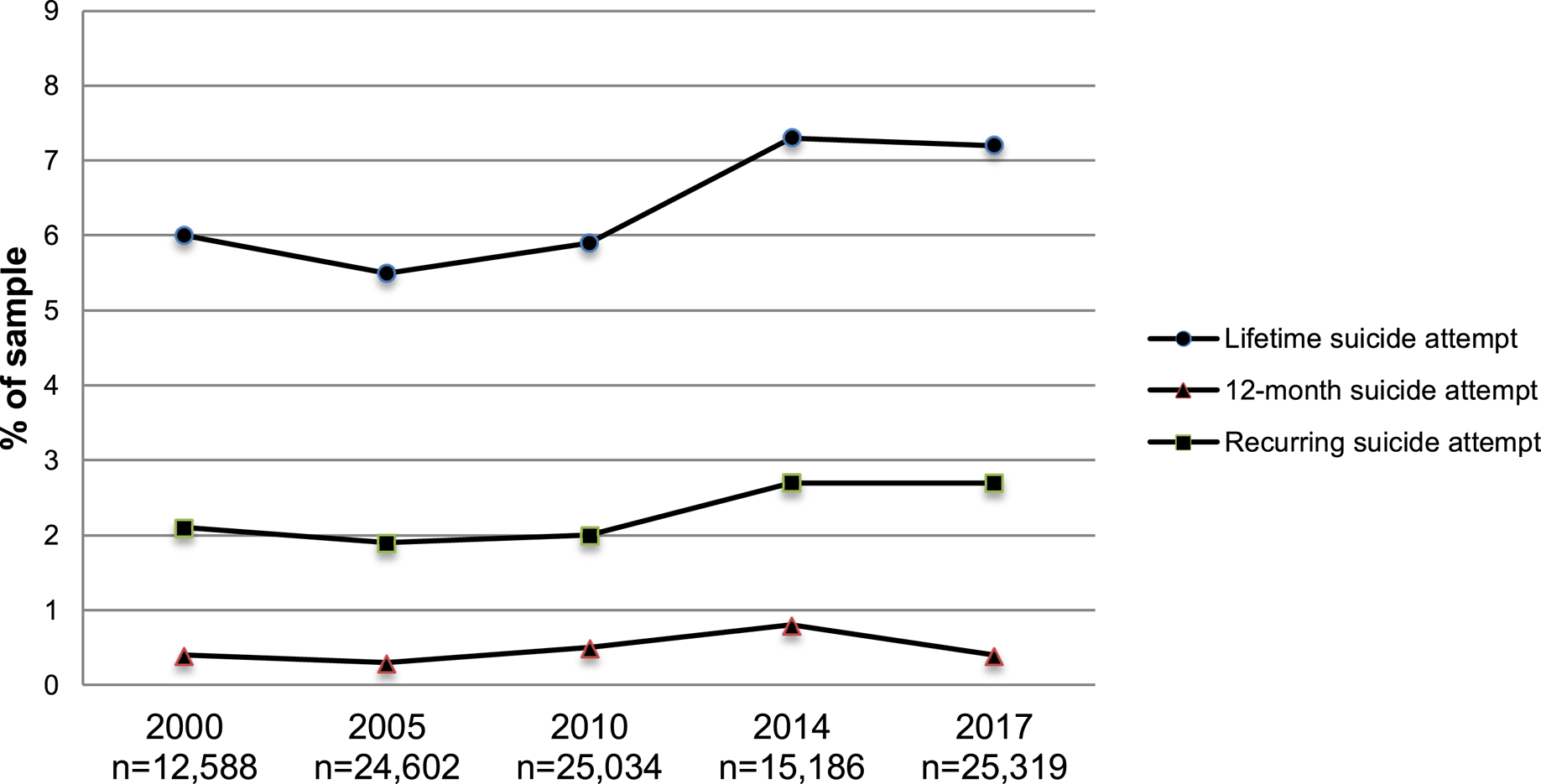
Among them, 6,500 reported a lifetime suicide attempt [6.4% (6.2–6.5) of the total sample], including 418 during the preceding 12 months [0.4% (0.4–0.5) of the total sample] and 2,254 who attempted more than once [2.3% (2.2–2.4) of the total sample and 36.1% of all suicide attempters]. Rates according to survey waves are presented in Fig. 1.
Rates of reported suicide attempt (lifetime, 12 month and recurring i.e. more than one act) at each of the five survey time points.

Among the total sample, a gender effect was noted as expected, with more women than men reporting a suicide attempt for both lifetime (8.7 v. 3.9%, respectively; χ2(1) = 980.2; p < 0.001) and last 12-month (0.5 v. 0.3%; χ2(1) = 24.1; p < 0.001) periods. Women also more often reported more than one suicide attempt (3.2 v. 1.4%; χ2(1) = 371.7; p < 0.001).
Rates of lifetime suicide attempts were lower in those aged 65–75 years than in those aged 18–24 or 25 to 64 years (4.5 v. 5.5 v. 6.8%, respectively; χ2(2) = 116.4; p < 0.001), as were 12-month rates (0.1 v. 0.9 v. 0.4%; χ2(2) = 88.5; p < 0.001), and rates of recurring suicide attempts (1.3 v. 2.2 v. 2.4%; χ2(2) = 63.4; p < 0.001).
Rates of non-hospital presentation and health care contact following the last suicide attempt
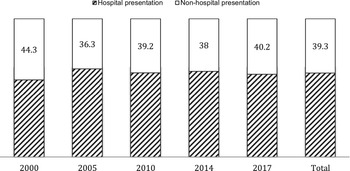
Among the 6,500 individuals with a lifetime history of suicide attempt, 6,229 (95.8%) gave a response about hospital presentation following the last attempt. Over the 2000–2017 period, 39.3% of the total sample of people reporting a lifetime suicide attempt said they did not present at hospital following their last attempt. This proportion was lower in 2005 than in 2000 and 2017 (Fig. 2). This proportion reached 53.4% among those aged 18–24 years v. 38.0 among 25–64 year-olds and 35.6% in 65–75 year-olds (χ2(2) = 59.0, p < 0.001). It was slightly higher in men than in women (42.2 v. 38.1%, respectively; χ2(1) = 9.3, p < 0.05).
Percentage of non-hospital presentation following the last suicide attempt in respondents at the five survey time points and in total.

For those who reported a suicide attempt over the last 12 months, the non-presentation rate reached 41.8% (N = 169).
Among those who declared non-presentation to hospital following their last suicide attempt, 37.7% (N = 945) reported visiting a doctor or a psychiatrist/psychologist after their act v. 67.1% (N = 2591) of those who presented to hospital (χ2(1) = 520.1; p < 0.001). Moreover, 55.6% (N = 1346) of them disclosed their act to someone else other than a doctor or a psychiatrist/psychologist v. 58.6% (N = 2359) of those presenting to the hospital (χ2(1) = 5.4; p = 0.07).
Factors associated with non-hospital presentation following suicide attempts
The reported reasons for the suicidal acts did not differ between those who presented to hospital v. those who did not, with the exception of sentimental reasons (familial: 56.2% v. 56.4%, χ2 = 0.02, p = 0.9; sentimental: 49.6% v. 44.9%, χ2(1) = 8.9, p < 0.05; professional: 11.1% v. 10.6%, respectively, χ2(1) = 0.2, p = 0.7; health: 12.4% v. 10.1%, χ2 = 5.1, p = 0.09).
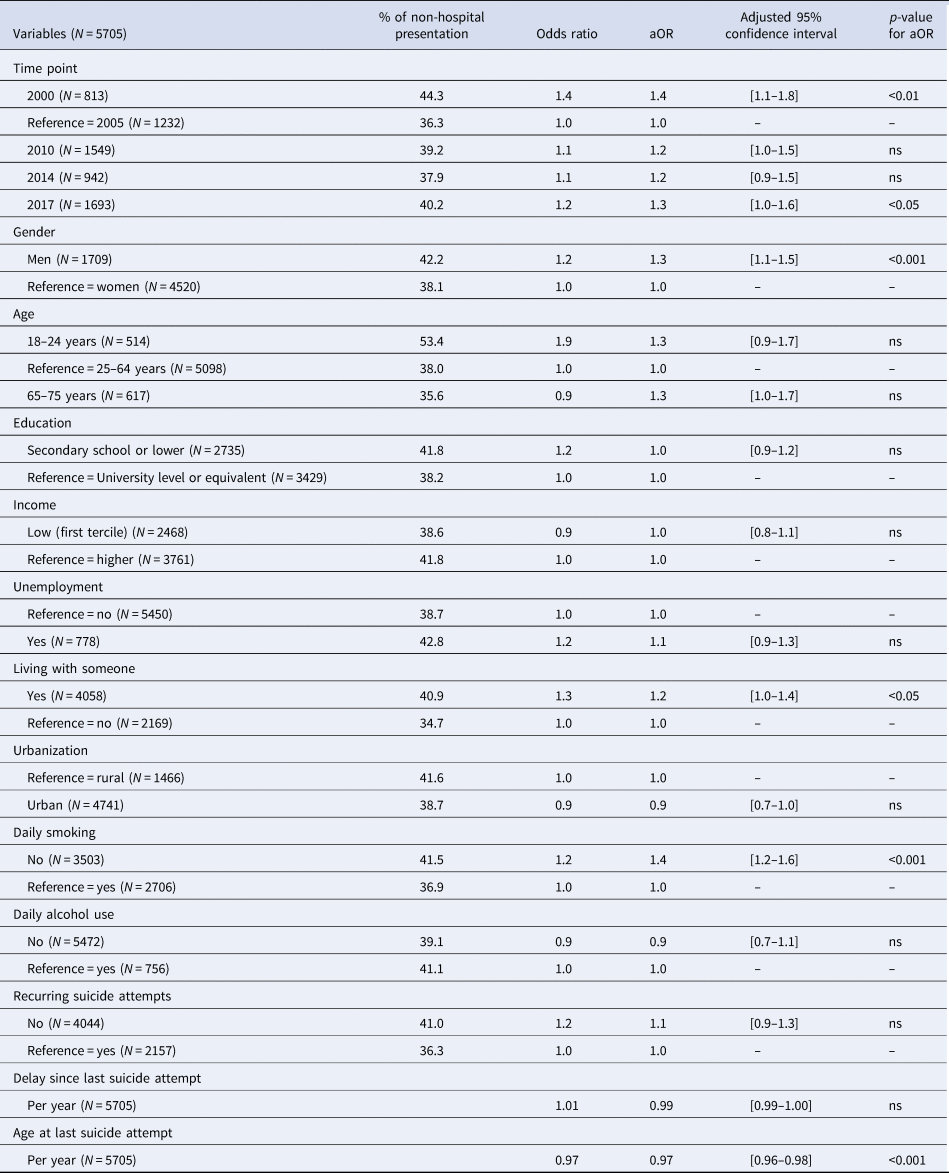
In the total sample, variables associated with higher rates of non-hospital presentation were being male, living with someone, being a non-smoker, and being younger at the time of a suicide attempt (Table 1). Moreover, the proportion of respondents with a suicide attempt who reported not going to hospital was significantly larger in the 2000 and 2017 surveys than in 2005. Finally, there were trends (not significant after adjustment) for greater likelihood of non-presentation in those aged 18–24 years (v. 25–65 years), with a higher education, and who attempted suicide once.
Factors associated with hospital non-presentation in the overall population

ns = non-significant at p = 0.05. All variables were significant or close to significance at the univariate level and therefore included in the multivariate model.
Estimation of the iceberg model of suicidal behavior
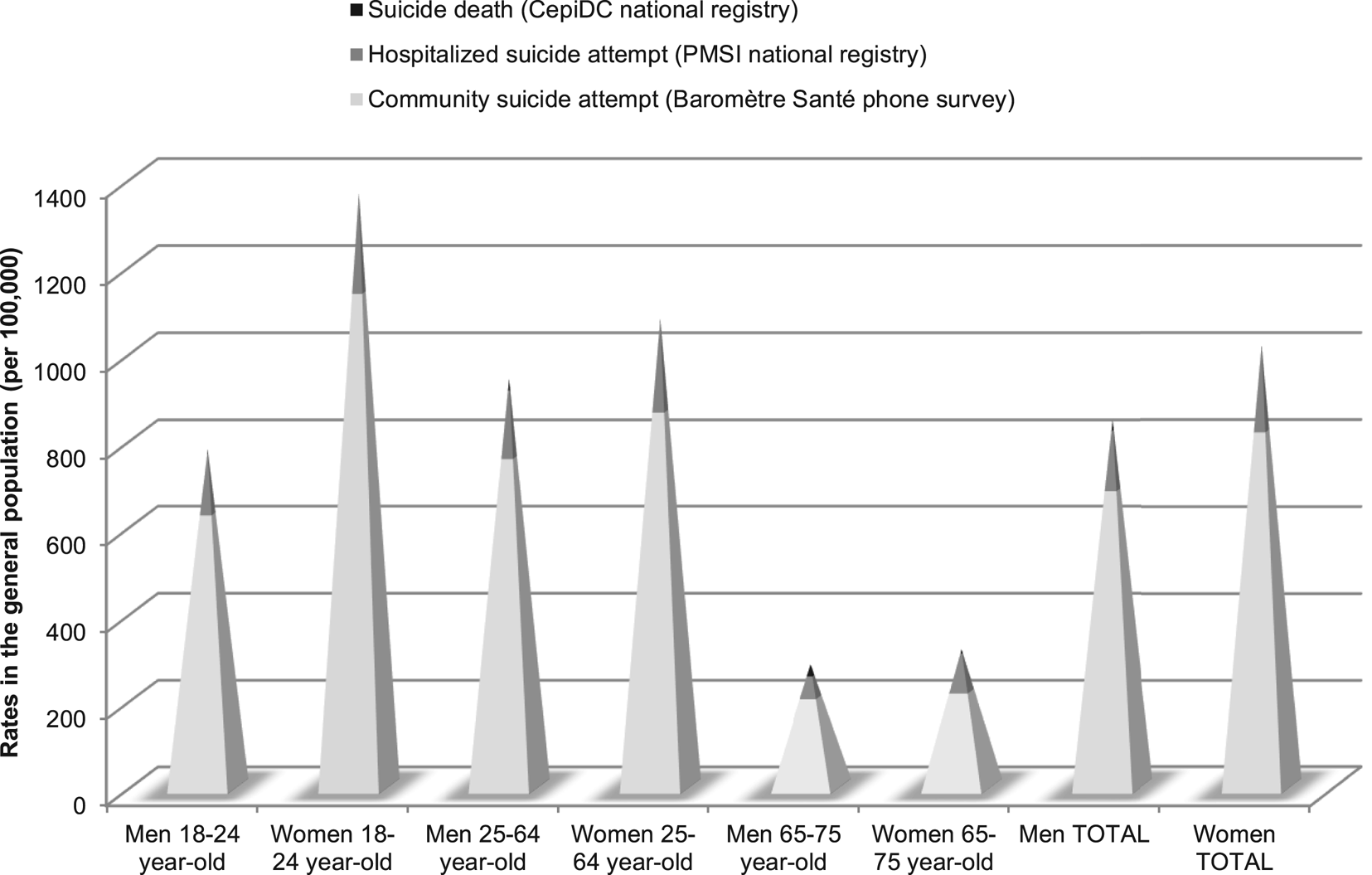
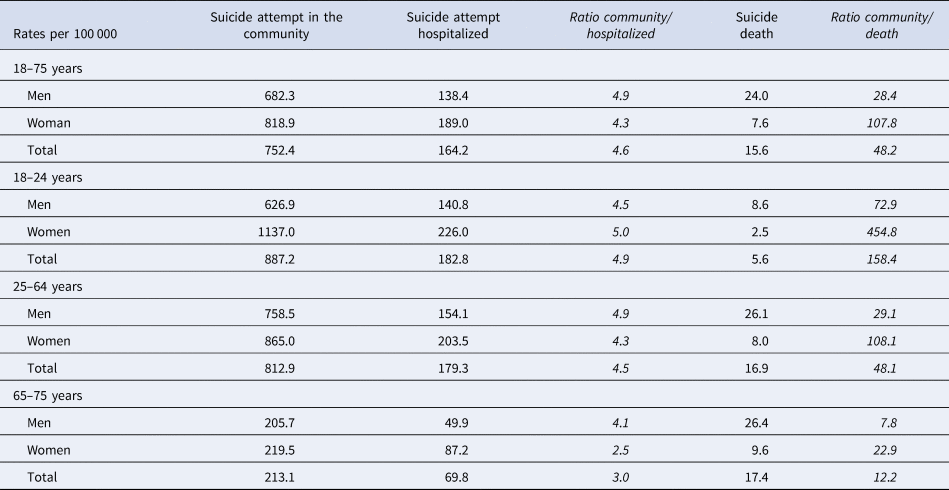
Following previous studies (Geulayov et al., Reference Geulayov, Casey, McDonald, Foster, Pritchard, Wells and Hawton2018; Hawton et al., Reference Hawton, Saunders and O'Connor2012; McMahon et al., Reference McMahon, Keeley, Cannon, Arensman, Perry, Clarke and Corcoran2014), we estimated the iceberg model according to age and gender for the 2014 data (Table 2 and Fig. 3). As expected, this effect was far higher in women than in men overall, and declined with age in terms of both the ratio of suicide attempts in the community to hospitalized attempts and in the ratio of attempts in the community to suicide deaths. The ratio of suicide attempts in the community to hospital suicide attempts was similar for all groups (between 4.1 and 5.0), with the exception of older women (2.5).
Representation of the iceberg effect by age group and gender in France in 2014.
Notes: Rates of suicide attempts in the community (based on Baromètre Santé phone survey), hospitalized suicide attempts (PMSI administrative database) and suicide deaths (CepiDC database) in mainland France in 2014 among 18–75 year-old people.

Rates of suicide attempts in the community (Baromètre Santé phone survey), hospitalized suicide attempts (PMSI administrative database) and suicide deaths (CepiDC database) in 2014, with relative ratios

Discussion
Three main findings emerged from this study. First, this study confirmed in a large representative national sample of adults aged 18–75 years a high proportion of individuals reporting that after their last suicide attempt they did not present to hospital. This proportion reached around 40% in our phone survey, with limited changes over the five assessments conducted between 2000 and 2017. Moreover, only one-third of those not presenting to hospital said they had consulted with a general practitioner, a psychiatrist or a psychologist after their act (v. two-thirds of those presenting to hospital), while a little more than half said that they had disclosed their act to someone else (independently from hospital presentation). Many individuals, therefore, do not benefit from any specialized assessment and follow-up after their suicide attempt. Second, these high rates of hospital non-presentation have a significant impact on prevalence estimation as rates of suicide attempts in this national phone survey were on average 4.6 times higher than those of the national hospital based registry. Of note, this difference is also related to the fact that only about half of all suicide attempters presenting to emergency departments are hospitalized and to an underestimation in hospital registries of the number of suicide attempts due to a frequent lack of coding for self-harm (Chan Chee & Paget, Reference Chan Chee and Paget2017), underlining the importance of community surveys (and coding practice improvement). Third, the figures additionally show graphically the extent of difference in the number of individuals who died by suicide as compared to those reporting a suicide attempt (hospitalized or not), the so-called iceberg effect, found in all age groups and gender. In sum, non-lethal suicidal acts are frequent behaviors, with a large proportion of individuals not seeking any specialized help.
This 40% rate of hospital non-presentations is slightly lower than the 50% reported in a previous community study in individuals aged 16 years and over (McManus et al., Reference McManus, Bebbington, Jenkins and Brugha2016). This may stem from the inclusion in this latter study of adolescents, whose rates of non-presentation are above 85% (Geulayov et al., Reference Geulayov, Casey, McDonald, Foster, Pritchard, Wells and Hawton2018; Hawton et al., Reference Hawton, Saunders and O'Connor2012). We confirmed in the present study that younger age at time of suicide attempt is associated with more non-hospital presentation. However, our study also confirmed that hospital non-presentation is found in adults as well at high levels: 53.4% among those 18–24 year-old, 38.0% in 25–64 year-olds and 35.6% in 65–75 year-olds. Hospital non-presentation should therefore be considered a general issue to address, across age and gender, for the organization of care following a suicidal act.
The reasons for hospital non-presentation following a suicide attempt are unclear. Apart from younger age, we identified being male, living with someone, and being a non-smoker as independent but weak risk factors. Also, there were more reports of sentimental problems as a reason for the act in those who did not present to the hospital. Access to care, which remains relatively easy in France to date with extensive insurance and public hospital coverage, may not be a significant factor in most cases. So, why are many individuals not referred to, or choose not to go to, hospital? Several non-exhaustive hypotheses may be put forward: a cathartic effect of the act of self-harm or the mobilization of help from others following the act (Walker, Joiner, & Rudd, Reference Walker, Joiner and Rudd2001) (this is indirectly supported by the fact that non-hospital presentation is associated with both living with someone and sentimental issues, and half of these individuals disclosed their act to someone); suicidal acts with less medical consequences of the act; the fear of stigmatization; the expectation of a long wait at the emergency department; or the lack of knowledge by general practitioners and urgent medical care service (SAMU) phone lines regarding recommendations to refer to hospital. Finally, suicidal men consult less than women in general, including prior to suicide (Stene-Larsen & Reneflot, Reference Stene-Larsen and Reneflot2019). More investigations will be necessary to clarify the individual and institutional mechanisms in play in non-hospital presentation.
Hospital presentation was associated with a two-fold increased probability of meeting a health care professional after hospital discharge in comparison with non-presentation, underlining the opportunity of care created in general by the hospital presentation. However, approximately one-third of individuals who presented to hospital following a suicide attempt said they did not see any doctor/psychiatrist/psychologist as a second health contact. This observation has been previously reported in different countries (Cooper et al., Reference Cooper, Steeg, Bennewith, Lowe, Gunnell, House and Kapur2013; Shand et al., Reference Shand, Batterham, Chan, Pirkis, Spittal, Woodward and Christensen2018). We do not have sufficient information to clarify this point in France and, again, several hypotheses can be suggested. For instance, some individuals may have chosen not to follow recommendations to see someone after hospital discharge, whether they considered it was not necessary anymore or due to low service satisfaction (Saunders, Hawton, Fortune, & Farrell, Reference Saunders, Hawton, Fortune and Farrell2012; Shand et al., Reference Shand, Batterham, Chan, Pirkis, Spittal, Woodward and Christensen2018). Also, poor service provision in terms of public and private mental health care in some isolated places may have impacted the possibility of implementing a follow-up in the short run (While et al., Reference While, Bickley, Roscoe, Windfuhr, Rahman, Shaw and Kapur2012). The deployment of the new surveillance system VigilanS across France will allow keeping in touch with large population of individuals after hospital discharge through phone calls and postcards (Duhem et al., Reference Duhem, Berrouiguet, Debien, Ducrocq, Demarty, Messiah and Vaiva2018). However, implementation of adequate care services following a suicide attempt needs to be considered to reduce both the risk of re-attempt and suicide death (While et al., Reference While, Bickley, Roscoe, Windfuhr, Rahman, Shaw and Kapur2012), including the development of effective online and other sources of readily available help for people who do not wish/ are unable to seek face-to-face help.
One surprising observation is that, while suicide rates and hospitalizations for self-harm have decreased over the last 20 years in France (Observatoire National du Suicide, 2018), rates of suicide attempts reported in the community remained stable since it was first measured in 2000 by our phone survey. One possibility is that prevention strategies have mainly affected more severe and lethal acts. The lack of information regarding the suicidal means used by respondents to the phone survey prevents us from validating this hypothesis. Another possibility is that people more easily disclose any history of suicide attempt nowadays than some years ago.
Several limitations have to be mentioned. First, no definition of a suicide attempt was given during the phone survey. Some individuals may have therefore considered that some acts were not really suicidal and hence have not reported them. Alternatively, others may have reported non-suicidal acts as suicide attempts. However, we may hypothesize that most acts considered to be significant as ‘suicide attempts’ to the individual being interviewed would have been reported. A second limitation is a recollection bias that could affect both suicide attempts and subsequent care (hospitalization, medical follow-up, etc.) The overall effect of these factors (definition and recollection bias) in terms of non-presentation rates is not known. One last limitation is the lack of information regarding the suicidal means used, which was not collected during the survey.
In conclusion, a large proportion of individuals reported that they did not present to hospital or meet a health professional following a significant suicidal act. This study also highlights the fact that official statistics based on national registries only depicts a small part of suicidal behaviors. Reasons will have to be clarified in order to respond adequately to this population and prevent recurrence.
Financial support
This research received no specific grant from any funding agency, commercial or not-for-profit sectors.
Conflict of interest
All authors have no conflict of interest to disclose.