INTRODUCTION
Among the multiple sources of stress that exist for family caregivers (Fujinami et al., Reference Fujinami, Sun and Zachariah2015), family communication has been identified as an additional and significant stressor that contributes to caregiver burden (Wittenberg-Lyles et al., Reference Wittenberg-Lyles, Demiris and Oliver2012a ). Conflict with other family members can trigger anxiety between cancer patient and family caregiver (Hendriksen et al., Reference Hendriksen, Williams and Sporn2015). Collective caregivers, family members working in dyads to provide care, report higher anxiety and depression than family caregivers working alone (Wittenberg-Lyles et al., Reference Wittenberg-Lyles, Kruse and Oliver2014). Problematic family communication about cancer includes disagreement about family involvement in care and can result in very little communication about cancer (Shin et al., Reference Shin, Cho and Roter2013). Variation and fluctuation among the ways that family members communicate about health has been noted (Davis et al., Reference Davis, Chestnutt and Molloy2014; Koehly et al., Reference Koehly, Peters and Kenen2009; Schuler et al., Reference Schuler, Zaider and Li2014), with the desire to protect each other causing a lack of direct communication and behaviors that limit communication. While it has been suggested that these behaviors are responses to stress (Kim et al., Reference Kim, Kim and Kim2015), it remains unclear how family contexts influence caregiver communication and create varying levels of caregiver distress.
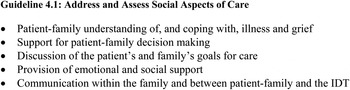
Identifying the patient's and family's strengths, needs, and goals is a key aspect of palliative care. Attending to family communication is part of the social aspect of palliative care, identified as one of the eight domains in the National Consensus Project for Quality Palliative Care (NCP) guidelines for palliative care (National Consensus Project for Quality Palliative Care, 2013). The NCP states that attention to a patient's/family's social care needs requires an understanding of the unique social structure of the family system. The NCP Clinical Practice Guidelines for Quality Palliative Care specify that all palliative care team members are accountable for assessment of the family social structure (see Figure 1). There is a need for tailored caregiver assessment and intervention that takes into account the family context in which caregiver burden is created and sustained (Adelman et al., Reference Adelman, Tmanova and Delgado2014).
Overview of domain 4 of the National Consensus Project for Quality Palliative Care.

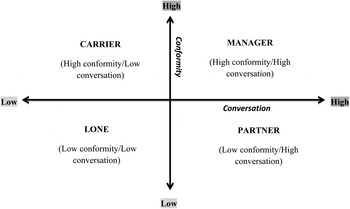
The family context includes family communication patterns, an antecedent to the caregiver's communication during the caregiving experience (Wittenberg-Lyles et al., Reference Wittenberg-Lyles, Goldsmith and Demiris2012b ). We define family caregiver communication as the scope of information sharing and uniformity with other family members during the caregiving experience. According to the family communication pattern framework, there are two dimensions of caregiver communication: conversation and conformity (Fitzpatrick, Reference Fitzpatrick2004). Conversation patterns can consist of either discrete or unrestricted interactions that determine the range of topics (wide or narrow) discussed with other family members. Conformity patterns reveal the attitudes, values, and beliefs as either diverging or aligning with other family members during the caregiving experience. From a combination of high and low conversation and conformity patterns emerges a model of four caregiver communication types: Manager, Carrier, Partner, and Lone (Goldsmith, Reference Goldsmith, Wittenberg and Platt2015; Wittenberg-Lyles et al., Reference Wittenberg-Lyles, Goldsmith and Demiris2012b ). Figure 2 provides a conceptual representation of high and low conversation and conformity in four quadrants, identifying each of the four family caregiver types and their communication patterns.
Conceptual model of family caregiver communication typology.

Manager caregivers develop in families with high conversation and high conformity. The Manager caregiver becomes the family medical expert. The caregiver's research role usurps patient or other family member preferences, and high conversation is bolstered by the caregiver's display of evidence as well as personal credibility. Carrier caregivers emerge from a family characterized by low conversation and high conformity. Relying heavily on the patient to determine caregiving decisions, the role of the Carrier is highly dependent on family obligation to provide care. Partner caregivers come from families with high conversation and low conformity. In these families, the patient is highly involved in the direction of the care but is not an individual actor in the decision-making process. The subject of dying and death is part of the conversations within this family. Finally, Lone caregivers come from families with low conversation and low conformity. In other words, this family type has little shared time or shared experience. This caregiver focuses on hope found in biomedical treatments and sees his or her role as ensuring that one medical task is performed, followed by another.
We have previously found that each family caregiver communication type demonstrates certain communication traits with nurses and healthcare team members (Goldsmith, Reference Goldsmith, Wittenberg and Platt2015; Wittenberg-Lyles et al., Reference Wittenberg-Lyles, Goldsmith and Oliver2012c ) and that caregiver communication types are corroborated by patient/caregiver descriptions of caregiving (Goldsmith et al., Reference Goldsmith and Wittenberg2015). The aim of our present work was to document the communication type of cancer patients' adult family caregivers through self-report and observation from a research nurse. Our objective was to validate a model of family caregiver communication types and ascertain whether or not differences exist in caregiver outcomes across the four caregiver communication types. This information informs development of targeted caregiver interventions complementary to caregiver communication preferences and needs.
METHODS
Our study employed a mixed-methods approach that included qualitative fieldnotes and quantitative self-report to further assess the validity of the model of family caregiver communication types and explore caregiving outcome measures by caregiver types. Data were collected as part of a larger, randomized, controlled trial aimed at assessing the effects of a palliative care intervention among caregivers of poor and underserved cancer patients. Intervention and control group caregivers received standard cancer care services, with intervention caregivers further receiving teaching and support based on a quality-of-life model encompassing physical, psychological, social, and spiritual well-being. The intervention was delivered in person in a clinical setting or over the phone. The study enrolled cancer family caregivers at a comprehensive cancer center in the western United States. The institutional review board approved the study, and participants provided informed consent in written form.
Participants
Caregivers had to be at least 18 years of age and a caregiver for a cancer patient with stage III or IV disease. They also were self-identified as having financial strain related to the disease or treatment. A nurse met with each caregiver to obtain informed consent, and the caregiver was randomized to usual family support or the intervention group.
Fieldnotes
The intervention nurse provided detailed fieldnotes on caregivers from the intervention arm of the larger study immediately following completion of the teaching visits. It is important to note that intervention sessions created an environment conducive to storytelling, and caregivers provided unsolicited narratives about patients' illnesses and their own caregiving experience. Fieldnotes identified the relationship between patient and caregiver, included a genogram depicting the entire family system, and detailed ethnographic notes that summarized the caregiver's family background, experience, patient care concerns, and self-care behaviors. Any lessons learned by caregivers were also noted. Fieldnotes also included caregivers' quotes, written down verbatim during intervention sessions. Descriptive sections of the fieldnotes were from the perspective of the intervention nurse, who had more than 20 years of experience nursing and working with family caregivers.
Caregiver Communication Items
Using family communication patterns theory as a framework, 14 caregiver communication items were developed to measure family conversation (7 items) and conformity (7 items) using a 5-point Likert-type scale ranging from 0 to 4 (frequently, occasionally, rarely, very rarely, never). These items were based on communication characteristics identified in previous work as prevalent family communication patterns in decision making and dependent on the frequency and scope of communication within the family of origin. Some 12 expert judges (9 clinical experts, 3 theoretical experts) were invited to assist in content validation of the 14 items. These experts represented healthcare professionals working in clinical settings and researchers familiar with caregiver interventions and family communication patterns theory, having published in the area of family caregiving and communication. Each reviewer evaluated each item for its relevance to caregiving, potential bias, ambiguity, scaling, appropriateness, interpretability, and ability of the item to measure what was intended. Based on expert feedback, researchers refined items for our study. A median score for self-reported caregiver communication items was employed as the cutoff point for the two subscales (conversation and conformity) to establish high and low patterns and indicate caregiver type.
Caregiver Measures
Caregivers completed the following outcome measures as part of the larger study upon enrollment. The Psychological Distress Thermometer captures caregiver distress over the past week, based on a scale of 0 (no distress) to 10 (extreme distress) (National Comprehensive Cancer Network, 2008). The Skills Preparedness Scale addresses a family caregiver's comfort with various physical and emotional patient needs (Rusinak & Murphy, Reference Rusinak and Murphy1995) and is scored from 0 (not at all prepared) to 4 (very well prepared). The City of Hope Quality of Life–Family instrument measures physical, psychological, social, and spiritual domains of quality of life for the family caregiver, with higher scores indicating a higher quality of life (Ferrell et al., Reference Ferrell, Ferrell and Rhiner1991; Reference Ferrell, Grant and Borneman1999). The Family Inventory of Needs measures the needs of the cancer patient's family and the extent to which those needs are met (Kristjanson et al., Reference Kristjanson, Atwood and Degner1995). As part of the larger study design, caregiver measures were collected at baseline.
Data Analysis
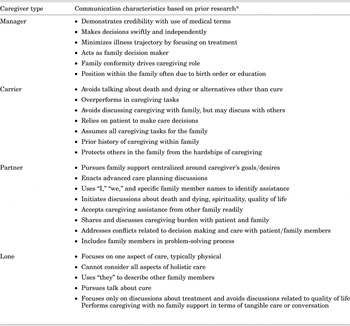
Caregivers were grouped by caregiver type using a mixed-methods approach. First, members of the research team independently reviewed each caregiver's fieldnote summaries, identifying the subject as a Manager, Carrier, Partner, or Lone caregiver by using descriptions of the typology from prior research (see Table 1). Second, mean scores for self-reported family caregiver conversation and conformity items were computed, and caregivers were identified as either low (0–2) or high (3–4) on conversation and conformity and identified as one of the four caregiver types. The purpose of the mixed-methods approach was to compare qualitative coding of the fieldnotes with the results of the quantitative self-reported caregiver responses. Coding authenticity was accomplished through validation by members of the research team, who met to discuss fieldnote coding, compare self-report findings and fieldnotes, and resolve differences through discussion.
Overview of family caregiver communication typology

*Based on prior research (Goldsmith et al., Reference Goldsmith and Wittenberg2015; Wittenberg-Lyles et al., Reference Wittenberg-Lyles, Demiris and Oliver2012a ; Reference Wittenberg-Lyles, Demiris and Oliver2012b ).
A comparison of caregiver self-reported communication items and fieldnote summaries revealed that 4 of the 14 communication items (2 items for conformity and 2 for conversation) did not measure what was intended and were thus removed. Using 10 self-report communication items, caregiver quotes and information recorded in the fieldnotes by the intervention nurse corresponded with high and low conversation and conformity patterns in all but three cases. The three cases were reviewed once again by the intervention nurse and research team, and caregiver type was confirmed through discussion. Finally, descriptive statistical analyses (SPSS for Windows, v. 19) for caregiver communication items and outcome measures were performed. Mean scores were compared between caregiver types.
RESULTS
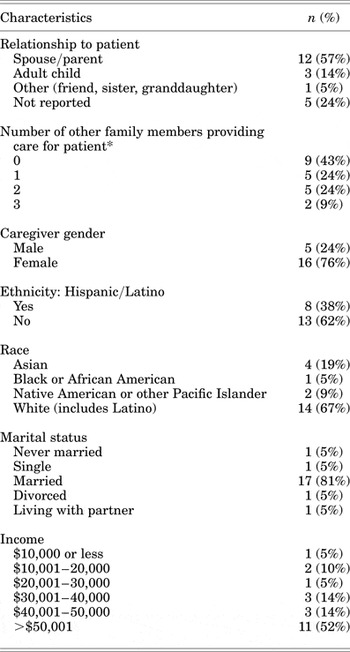
Family caregivers (n = 21) were predominantly Caucasian (67%), women (76%), married (81%), a spouse or parent (57%), with a mean age of 53 (range 33–76), and 52% reported an annual income greater than $50,000 (Table 2). In conjunction with self-report items and fieldnote coding, there was a definitive classification of caregivers into one of four caregiver types, resulting in the following distribution: Manager = 6, Carrier = 5, Partner = 6, Lone = 4.
Summary of caregiver demographics (n = 21)

*Three caregivers reported that they were not the patient's only caregiver.
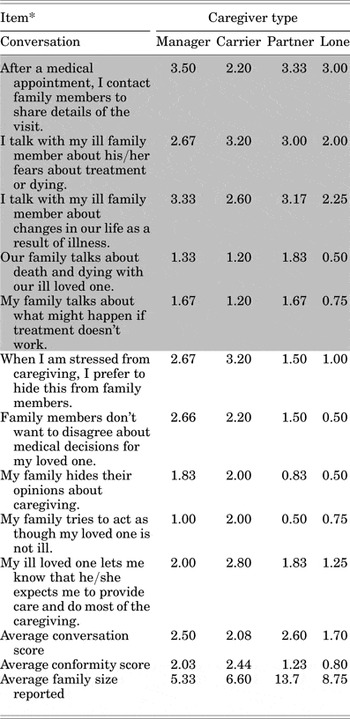
Means for self-reported communication items by caregiver type are given in Table 3, and these scores support the family caregiver communication model. Manager (mean 2.50) and Partner (mean 2.60) caregivers were highest in conversation among the four types, while Carrier (mean 2.08) and Lone (mean 1.70) caregivers scored lower in conversation. Similarly, Manager (mean 2.03) and Carrier (mean 2.44) caregivers scored highest in conformity, with Partner (mean 1.23) and Lone (mean 0.80) caregivers scoring lowest.
Mean scores by family caregiver type on communication items

*Likert-type responses on scale of 0 (never) to 4 (frequently).
Shaded items assess conversation and non-shaded items assess conformity.
Among conversation items with mean scores reflecting high conversation, caregiver self-reports were consistent with the family caregiver communication typology. Manager caregivers scored highest (mean 3.50, 3.33) for relaying information after a medical appointment and talking with the patient about changes as a result of the illness. Carrier caregivers reported highest conversation (mean 3.20) with the ill family member about his/her fears about treatment or dying. Partner caregivers had the highest scores (mean 1.83) across all caregiver types for family talk with the patient about death and dying. With the exception of relaying information to others following a medical appointment, Lone caregivers scored lowest on all conversation items and had the lowest mean conversation item scores overall (mean 0.50).
Variation among caregiver types on conformity, where higher scores indicated higher conformity, was also representative of the family caregiver communication typology. Managers reported highest conformity for hiding caregiving stress (mean 2.67) and family who do not want to disagree about medical decisions (mean 2.66). Across all types, Carrier caregivers reported the highest scores for hiding stress due to caregiving (mean 3.20). Hiding opinions about caregiving from other family members was the lowest-reported conformity score for Partner caregivers (mean 0.05), which was also low for Lone caregivers (mean 0.75). In addition, reported family size by Manager caregivers was smallest among the four types (mean 5.33), in consonance with their tendency to dominate family systems. On the other hand, Partner caregivers reported the largest family size (mean of 13.7 family members), consistent with descriptions of large extended family involvement in problem solving, conflict, and decision making.
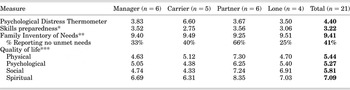
Overall, caregivers in the sample reported low to moderate psychological distress, with an overall mean of 4.40 (see Table 4). The highest distress among all caregiver types was found for the Carrier caregivers (mean 6.60). The lowest reported distress came from Partner caregivers (mean 3.67), who described positive family support in caregiving, and Lone caregivers (mean 3.50), who reported little to no family involvement in caregiving. However, while Partner caregivers overwhelmingly reported that they had no unmet needs (66%), the lowest percentage reporting no unmet needs were Lone caregivers (25%). Still, the needs of the family and the extent to which those needs were met varied little across all four caregiver types (range 9.25–9.51).
Mean scores by family caregiver type for reported outcomes measures

*High scores indicate perceived preparedness.
**High scores indicate more importance.
***High scores indicate higher quality of life.
Carrier caregivers felt the least prepared among all four types (mean of 2.75 on a 4-point scale), while Partner caregivers had the greatest level of preparation (mean 3.56). Quality of life was lowest for Manager and Carrier caregivers. Managers reported the lowest physical quality of life (mean 4.63), while Carriers reported the lowest physical (mean 4.38), social (mean 4.33), and spiritual (mean 6.31) quality of life. Conversely, Partners demonstrated the highest quality of life across all four subscales, with spiritual quality of life ranking highest (mean 8.35).
DISCUSSION
Our study corroborates previous findings and confirms a model of family caregiver communication types, extending the evidence-based knowledge of family caregiver types and communication burden in caregiving. This work adds to the growing literature on family caregivers and their role in patient care, goals of care, decision making, and burden. Patterns identified within each of the four caregiver types were corroborated by findings illustrating variation among caregiver outcome measures, further supporting the impact of family communication on caregiving.
Partner caregivers, emerging from a family climate of high conversation and low conformity, reported low psychological distress, the fewest unmet caregiver needs, the greatest preparation for caregiving, and the highest quality of life in all four domains (physical, psychological, social, and spiritual). Caregivers navigating illness in a family with lower social stress and better relations also presented with high family functioning (Litzelman et al., Reference Litzelman, Kent and Rowland2015). This caregiver type also reported the greatest number of family members, indicating a perception of a robust depth of available family resources. For the Partner caregiver, low distress scores may have reflected an acceptance and ease with conflict/differences within the family.
Lone caregivers, demonstrating low conformity and low conversation, perceived the lowest psychological distress of all caregiver types, reported the highest level of unmet needs, and low levels of quality of life and caregiver preparedness. These findings resonate with similar caregiver research identifying at-risk families in cancer care as demonstrating low communication and low involvement (Schuler et al., Reference Schuler, Zaider and Li2014). The Lone caregiver has little to no interaction with opposing family members, which might explain their low score on distress yet high unmet needs.
Manager and Carrier caregivers reported the most strain overall as well as the smallest perceived family sizes. Both of these caregivers come from high-conformity climates and thus do not openly process conflict within the family structure. The Manager caregivers reported illness information and plans of care to family with regularity, but do not receive and incorporate alternative plans. The Carriers do not share with the family in an effort to protect family roles and reduce burden to others. High conformity relates to lower caregiver outcomes in our study, suggesting that family enmeshment and assimilation increase caregiver burden in the context of illness. Carrier distress was highest among the four types, while the Manager caregiver reported high distress and significant unmet needs. Managers' high distress resonates with recent research on lung cancer patient caregivers, which identified stigma as a key cause for caregivers to avoid emotional support and intervention offered by providers (Mosher et al., Reference Mosher, Given and Ostroff2015). Managers also reported the lowest physical quality of life, and Carriers reported the lowest quality of life in the social, psychological, and spiritual domains. While both of these types appear nested within the context of family, their isolation and low self-care is striking, suggesting the greatest risks for these caregiver types. This is corroborated by research that found high-attachment families at most risk for anxiety and avoidance, which negatively interferes with effective and sensitive care for patient and caregiver (Tsilika et al., Reference Tsilika, Parpa and Zgogianni2015).
Despite the conservative sample size, these demographics mirror the caregiver demographic profile developed by the Alliance on Family Caregiving (Family Caregiver Alliance, 2015). Still, several limitations should be noted. Participants were limited to caregivers who were able to participate in our study. The findings might be skewed by caregivers not as involved in the acute level of care of a patient, or patients at a less advanced stage of cancer. While our study provides insight on underserved caregiving populations and includes minorities, our caregiver sample may represent limited experience based on financial need, as lower-income families have demonstrated a correlation between resources and lower quality of life (Litzelman et al., Reference Litzelman, Barker and Puccetti2013). Additionally, the larger study provided a caregiver intervention as compared to a patient/caregiver intervention, which may have influenced findings.
The findings derived from communication self-report items and each of the outcome measures underscores the need for and reality of the family caregiver, both of which are inextricably woven into all care and treatment decisions. Similar research examining cancer and caregiver outcomes across the trajectory of cancer demonstrate that quality of life decreases while distress increases and preparedness diminishes (Grant et al., Reference Grant, Sun and Fujinami2013). Importantly, changes in emotional stress and distress are consistently tied to a patient's condition (Fujinami et al., Reference Fujinami, Sun and Zachariah2015). These known caregiver outcomes are further informed by caregiver communication patterns and their role in distress and burden. Our research provides the first evidence-based validation for a family caregiver communication typology and its relationship to caregiver outcomes.
Family caregivers of cancer patients are thrust into the position of navigating the increasingly burdensome tasks of making care decisions and delivering care. It is essential that providers strive to identify and deliver communication interventions to assist patients and their family caregivers involved in the cancer journey. Future work should examine caregiver communication types along the cancer trajectory, as well as develop and test clinical practice interventions to support diverse types of caregivers. Caregiver assessment should take into consideration the family system, and future intervention research should consider a family-based approach as opposed to a singular focus on the family caregiver (Wittenberg-Lyles et al., Reference Wittenberg-Lyles, Demiris and Oliver2012a ). The NCP guidelines call for provider resources for family and patient decision making, support in navigating goals of care discussions, provision of emotional and social support, and—notably—communication within the family, and between family and care providers. Uniquely, our model of family caregiver communication types presents a resource for obtaining targeted information to assist providers in addressing these very guidelines.
ACKNOWLEDGMENTS
Supported by “A palliative care intervention for poor and underserved cancer caregivers” grant (number RSG-13-370-01) from the American Cancer Society. The authors wish to thank Ellen Friedmann for her editorial assistance.