


Despite the recent increase of interest in the notion of capital as a set of distinct factors or agents of production, little attention seems to have been devoted to the original formulation of that theory in Part V of Léon Walras's Elements. An effect of the comparative neglect of that part of Walras's work is that while mathematical inquiries have been conducted to ascertain the existence of economical meaningful solution for the equations of exchange and production,Footnote 1 the analysis has not been extended, to the writer's knowledge, to the complete system, including the equations of “capitalization.” It is however submitted in this paper that economic reasoning is sufficient to show the inconsistency between Walras's conception of capital as a set of heterogeneous factors of production, and the equilibrium conditions regarding the rates of return on the different kinds of capital goods. It will also be argued that if—to preserve Walras's notion of capital and avoid conceiving capital as a homogeneous factor—the inconsistency is removed by abandoning Walras's equilibrium conditions for the rates of return, or equivalent ones, the notion of equilibrium thereby postulated would be such as to leave little if any significance to the system.
I.
We may begin by restating briefly Walras's equations of exchange and production, as they result from the analysis of Parts II, III and IV of the Eléments d'Economie Politique Pure.Footnote 2 The symbols are those used by Walras:
Da,Db … quantities of the m consumers’ goods A, B, …, produced and demanded in the economy during a “year”
0t,0t′ … 0p,0p;Footnote 3… 0k,0k′ … quantities supplied for productive use of yearly services of the n resources distinguished in “land capitals” T, T′ …, “personal capitals” P, P′…, producible capital goods K, K′…
pb, pc … pt … prices of consumers’ goods and yearly productive services, expressed in the numeraire A.
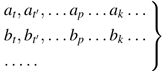 m n) given production coefficients relating to consumers’ goods} A, B…
We have then the following equations expressing the conditions of competitive equilibrium in exchange and production, distinguished in four sets: (1) giving the quantities of consumers’ goods demanded and produced during the year as given functions of the system of relative prices obtainable from the conditions of consumers’ equilibrium; (2) expressing the equality between prices and costs of production of consumers’ goods; (3) expressing the equality between quantities of productive services supplied and demanded for productive use; (4) giving the quantities of productive services supplied for productive use as functions of the system of relative prices (obtainable, together with (1), from the conditions of equilibrium of the individuals):Footnote 4
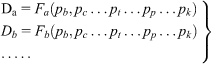
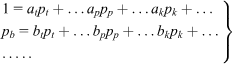
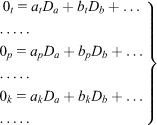
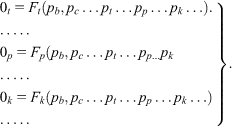
The unknowns appearing in the equations are (2m + 2n − 1), namely the (m + n − 1) prices, and the (m + n) quantities of consumers’ goods and productive services demanded and supplied. Equations (1) – (4), on the other hand, include (2m + 2n − 1) independent equations, since one among equations (3) can be obtained from the remainder of the system. It has been demonstrated that these equations will always admit economically meaningful solutions when some modifications are introduced in conditions (2) and (3).Footnote 5 This result will be assumed in what follows, although the modifications required in (2) and (3) will not be discussed until section IV.Footnote 6
As a description of the economic system, equations (1) – (4) are clearly incomplete, unless we want to refer them to an imaginary economy without “capital,” where all sources of productive services are like persons or natural resources, and cannot be produced like commodities. To take into account the phenomena arising from the existence of produced means of production Walras introduced, from the very earliest version of his theory,Footnote 7 equations determining outputs of capital goods and a “rate of net income.”
To determine that rate Walras refers exclusively to “capital goods proper,” that is, to fixed capital goods as distinct from “land capitals” or “personal capitals;”Footnote 8 capital goods alone among the sources of productive services, being products, are subject to that condition of equality between prices and costs of production by which the rate of net income is there determined. The first step of Walras's argument is a distinction between the “gross” price pk of the yearly service of a capital good K, and the corresponding “net” price, obtained from pk by subtracting a given fraction c of the price Pk of the capital good, for yearly amortization and insurance.Footnote 9 The (yearly) rate of net income obtained from K is then defined by:

In the situation of static equilibrium envisaged by Walras, the prices of the several capital goods and the gross prices of the respective services must be such that the same rate of net income i is obtained from all of them. If there are  kinds of producible capital goods K, K′ …, with given coefficients c, c′ … for amortization and insurance, the condition gives the following
 equations:Footnote 10

The condition that in equilibrium the prices of the capital goods should be equal to their costs of production gives Q more equations:Footnote 11

We may note here that in the theory of capital, as in the theory of production, Walras assumed the coefficients of production, kt … kp … kk …; k′t … k′p … k′k …; … to be given. The same assumption is adopted for most of our discussion. We shall later examine how the conclusions reached on that basis need be modified when technical substitution between productive services is allowed for.
Capital goods of the types K, K′ … will be produced during the year in quantities Dk, Dk′′ … The total value of such outputs must equal yearly gross savings in the economy expressed in numeraire, that is, must equal the excess of yearly gross income over the yearly expenditure on consumers’ goods A, B … That excess can be obtained from the conditions of consumers’ equilibrium as a function Fe of the system of prices, including the rate of net income.Footnote 12

The introduction in the system of the rate of net income i, and of current outputs of capital goods Dk, Dk′ … requires, also, some modifications in the equations of exchange and production. The rate of net income is relevant for individual decisions to demand goods A, B … and supply productive services T … P … K …; i must therefore now be understood to appear as a variable in the functions Fa, Fb … Ft … Fp … Fk … of equations (1) and (4). Further, the quantities currently produced of capital goods give rise to demands for productive services; terms (+ktDk + k′tDk′+ …), (+kt′Dk + k′t′Dk + …), etc., must now be understood to appear on the right of the respective equations (3).
The  unknowns Pk, Pk′ … can be easily eliminated from the system by substituting for them in (7) and (5) the expressions given by (6). Walras's equations of “capital formation” then become:


Expressed in this form, Walras’ s theory of capital introduces in the system  additional unknowns—namely, the current outputs of capital goods Dk,Dk′ … and the rate of net income i—while at the same time adding to equations (1) – (4) the
 new independent equations (A) and (B). Walras argued that the system so completed will determine the additional unknowns together with the previous ones.Footnote 13 Walras’ s arguments in support of that conclusion will be reviewed and criticized in section III. What we intend now is to show that the conclusion is incorrect, and that the equations of capital formation are generally inconsistent with the equations of exchange and production.
II.
The difficulty lies with equations (B). The unknowns appearing in (B) are the rate of net income i, and the prices of productive services. To understand the role played in (B) by service prices, let us assume, for a moment, that gross savings in the system are zero. It follows from equation (A) that all the Dk’s must also be zero (none of the Dk’s can ever be negative). With the elimination from equations (3) of any demand for services arising from production of capital goods, equations (1) – (4) would be sufficient to determine all the unknowns appearing in them, including the prices of all productive services.Footnote 14 We are then left with ℓ equations (B) where only one unknown remains to be determined: the rate of net income. The complete system would be inconsistent. The economic meaning of the inconsistency is clear: on our assumptions, demand conditions for consumers’ goods and supply conditions of productive services are sufficient to determine the prices both of the services of the capital goods and of the services used in producing the capital goods; we cannot expect the two sets of prices so determined to be compatible with one rate of return over costs for all kinds of capital goods. But the only difference between the case just imagined and the general one is that in the latter the Dk’s need not be zero. Will this make it possible to satisfy equations (B) together with the remainder of the system? It is now clear that the answer can be affirmative only if the variations of the Dk’s possible within the system can so affect the prices of the productive services appearing in (B), as to make them compatible with those equations. The dependence of the prices of productive services on current outputs of capital goods is therefore the element on which depends the consistency (existence of solutions) of the complete system.
To analyze that dependence, let us define a subsystem (P) consisting of the equations of exchange and production (1) – (4), plus equation (A) and one among equations (B), for instance the first, relating to capital goods of kind K. We also assume an arbitrary “initial” set of  values of the ratios
 , …Footnote 15 Given the “initial” values of R′, R″…, system (P) is sufficient to determine one “initial” set of values for all the unknowns appearing in it.Footnote 16 If we then insert the “initial” service prices in the
 equations (B) excluded from (P), we can obtain
 rates of return over costs i′, i″ … relating to capital goods K′, K″ …; such rates will generally differ from each other and from the rate of return i determined in (P).
We may pause at this point to note that if some conditions not included in Walras's static system were set to determine the allocation of gross savings among the various kinds of capital goods, the system would be inconsistent. The service prices, as determined by (P) and the additional conditions, could not satisfy equations (B). Walras, however, with a procedure whose correctness we shall later have to question, lets relative capital outputs be determined within his system. We shall now follow Walras in that procedure and ask whether the system can thus be made consistent. The question will be discussed in these terms : whether by appropriate changes in the “initial” values of R′, R″ … the prices of the productive services determined by (P) can be so modified as to equalize the  rates of return i, i″ … defined above.
Changes in R′, R″ … involve a reallocation of productive services in the economy. The effects of it on the prices of services as determined by (P) will depend on the proportions in which the services are used in producing each kind of capital good. If such proportions happened to be the same for all capitals, no change in R′, R″ … could affect the prices of the services, nor the “initial” disparities between i′, i″ … The complete system would be inconsistent.Footnote 17
If, as will generally be the case, the proportions defined above differ, changes in the values of R′, R″ … will, in general, affect the prices of services. The prices of services used in a higher proportion for capital goods whose output has increased relative to other capital outputs will generally rise relative to the prices of services used in a higher proportion for the latter group of capitals.Footnote 18
Let us then modify the “initial” values of R′, R″ … in the same directions in which a competitive market would tend to modify them: in favor of the kinds of capitals having the highest “initial” rates of return. The  rates of return i , i′… will be affected in two ways. One effect will be through the prices of the yearly services of the capital goods (see the left hand members of equations (B)). This effect, however, is as likely to widen as to narrow the “initial” disparities between rates of return:Footnote 19 broadly speaking, the disparities will tend to widen if the kinds of capital goods with higher “initial” rates of return are used more for producing capital goods of their group, than for producing capital goods of the other group. The second effect, instead, is through the costs of production of the capital goods (see the right hand members of equations (B)). The costs of the capital goods with higher “initial” rates of return, whose relative outputs have been increased, will rise relative to the costs of the other capital goods. This will evidently tend to narrow the “initial” disparities between rates of return.
Leaving aside as unlikely the extreme cases where the effect on costs would not be present (equal proportions of capital inputs or zero gross savings) or would be outweighed for at least one capital good by a stronger opposite effect on the price of its service, we must now ask whether, in the generality of cases, changes of relative capital outputs can so affect their relative costs as to equalize the rates of net income. The answer must be negative. If the productive services are not highly specific, the costs of capital goods will hardly be sensitive to changes in their relative outputs. The decisive consideration, however, is that the “initial” disparities between the rates of return can be of any width whatever, depending on the data relating to the capital stocks, whereas the changes in the relative costs of the capitals meet a limit as soon as the outputs of capitals with higher rates of returns come to absorb all gross savings. No further narrowing of the “initial” disparities of returns is then possible, and the complete system has no solution.Footnote 20
To assess the significance of the results of our discussion, we must now return to their simple economic meaning. To determine prices and outputs Walras takes as given the heterogeneous capital stocks available in the economy. We cannot then expect that configuration of capital stocks to be the one most “appropriate” to the production, in the given technical situation, of the outputs required by the preferences of the consumers. If, for instance, “cloth” and “corn” were the only consumers’ goods in the economy, consumers’ equilibrium would give rise to certain demand functions of “cloth” and “corn”; “looms” and “tractors,” to give the same rate of return over costs, should then be available in the economy in certain “appropriate” proportions and not in others. To treat both their quantities as data is to be inconsistent with the equilibrium conditions relating to their rates of return. This is the nature of the inconsistency borne out by the discussion of equations (B).
Were it not for Walras's introduction of relative capital outputs as unknowns of his static system, the inconsistency would assume the obvious form of an excess of independent equations. The procedure adopted by Walras has, however, a deficiency which we must now consider. For it, relative outputs of capital goods are introduced without regard to preserving equilibrium in the future.Footnote 21 Thus, if capital stocks in the given situation happened to be compatible with a solution of the system, we could not be sure that would still be the case in the future, even in the absence of changes in the other data. A hypothesis more in keeping with Walras's general premises would be that an economy in non-stationary equilibrium allocates its current gross savings so as to preserve equilibrium in the future, on some hypothesis as to changes in the other data. But in a system so conceived we would again find an excess of independent equations.
If, on the other hand, we grant to Walras his hypothesis on the allocation of savings, the discussion of equations (B) has shown that the inconsistency remains. Some degree of tolerance may nevertheless appear in the proportions between capital stocks compatible with equilibrium.Footnote 22 For, if we take, to begin with, a configuration of capital stocks compatible with equilibrium, the effect of a larger or smaller stock of any K on its rate of return can, within some limits, be compensated by a fall or rise of its relative costs of production, obtained by a fall or rise of its output relatively to that of K′, K″ … Thus the configuration of capital stocks compatible with equilibrium is defined by “ranges” of values, which tend to narrow down again to single points: (a) the closer the proportions in which services are used to produce the several capital goods; (b) the more substitutable for each other in the system the services used in different proportions to produce different capital goods;Footnote 23 (c) the smaller the amount of gross savings during the period.Footnote 24
The discussion of equations (B) has been conducted on the assumption of given coefficients of production, but its results can be easily generalized to the case of production coefficients to be determined within the system by the additional conditions of minimum costs. If the relative capital outputs were to be determined by conditions relating to the preservation of equilibrium in the future, the inconsistency would still be present in the form of an excess of independent equations. On Walras's hypothesis for the allocation of gross savings, variable production coefficients would tend to affect in two opposite directions the “ranges” referred to above. The “ranges” would be narrowed insofar as the substitutability in the system between the services used in producing the capital goods is increased. The “ranges” would be widened insofar as the increase of substitutability is the one between capital goods services (this increase in substitutability would in fact tend to reduce the changes of the relative prices of capital services resulting from given changes of relative capital stocks).
Thus, whatever the assumptions about the allocation of savings and the production coefficients, the non-existence of solutions but for certain configurations of the capital stocks points to the same basic inconsistency between the notion of a capital supply measured by a set of heterogeneous capital stocks, and the equilibrium condition for the rates of return over costs of the various kinds of physical capital.Footnote 25 It follows that if consistency can be restored to the theory, it must be either by abandoning that notion of capital or by abandoning that condition of equilibrium. The first alternative would require the notion of a “quantity” of capital that can take the form of any kind of physical capital. The difficulties of this notion are well known. Some considerations on the difficulties besetting the other alternative will be developed in the last section of this paper, after a criticism of Walras's arguments as to the consistency of his theory of capital.
III.
Walras did not limit himself to setting forth the equations of capital formation or to counting additional unknowns and equations. In Lesson 25 of the Elements, where Walras purports to show, by the device of the tâtonnements, how the complete system is “in practice solved in the market by the mechanism of free competition,” we can in fact find his arguments for the possibility of satisfying equations (B) together with the other equations of the system.Footnote 26 The argument runs in terms of the dependence of selling prices and of costs of production of capital goods (expressed, respectively, by the left and right hand members of (B)), on capital outputs. A striking change, however, occurs in the content of the argument in passing from the third (1896) to the fourth (1900) edition of the Elements, a change that may offer a key to Walras's initial error. From the earliest version of his theory of capital down to the third edition, Walras considered the selling price of each capital as a decreasing function of its output. As Walras writes in the third edition:
If we increase or decrease the quantity Dk … we decrease or increase appreciably … the price of the productive service K, that is, we decrease or increase appreciably the selling price of that same capital good expressed by the second member [of the corresponding equation (B)].Footnote 27
The idea expressed in this passage, and in similar ones of the earlier editions, is incorrect. As we saw in our discussion of equations (B), the price of the service of a capital good K, if affected, is as likely to rise as to fall with an increase of Dk. By the time of the fourth edition Walras came to realize the error, and in a drastically changed discussion of equations (B) he writes that an increase of Dk “can hardly affect the selling price [of (K)] in any significant degree.”Footnote 28
It may be interesting to speculate about the origin of the earlier error, which appears due to an imperfect realization that outputs of capital goods in the given period can affect stocks only in a subsequent period,Footnote 29 a confusion, perhaps, made easier by the form the tâtonnements in production took in the earlier editions of the Elements.Footnote 30 Two things, however, are of interest for us here. The first is that when Walras initially conceived his theory of capital he thought of the price of the service of a capital good as a decreasing function of the current output of the same capital, and that on such idea he largely relied then for the possibility of satisfying equations (B). The second is that by the time of the fourth edition of the Elements, he had come to realize that the price of the service was not, in general, a decreasing function of the output of the capital good. He then had to recast his discussion of equations (B) so as to shift the entire weight of the equalization between selling prices and costs of production of capital goods on costs of production. But costs of production cannot bear that weight and, but for a second error we shall presently examine, Walras's argument could not have led to a conclusion different from the one we reached in the preceding section.
The second error occurs in the fourth edition, where Walras so interprets the dependence of the prices of productive services on capital outputs:
If we increase indefinitely the prices of all the productive services which are used in the manufacture of a capital good and consequently raise its cost of production, we cause the offer of these services, and therefore the quantity manufactured of that capital good, first to increase from zero and then to fall to zero again (at infinity). In other words, the quantity manufactured of a capital good is a function which first increases from zero and then decreases to zero (at infinity) as the cost of production … increases. It is precisely this law … which enables us to bring the cost of production and the selling pricesFootnote 31 of new capital goods into equality with each other.
Let us examine the first sentence of this passage. Why should the increase there envisaged of the current output of one kind of capital good require an increase of the total supply (for productive purposes) of “all” the services employed in its production? That would be the case only if all the productive services required for that capital were specific to its production, a hypothesis denied not only by the general context of Walras's theory of production but also by what Walras says a few lines below the passage just quoted.Footnote 32 Barring that hypothesis, the services required by the increase in the output of a kind of capital will largely be those freed by decreases of other outputs somewhere in the system. As Walras himself makes clear in the remainder of his discussion, the tâtonnements require that as one capital output increases, other outputs, in particular other capital outputs, decrease.Footnote 33 It is true that, if the proportions in which the services are used for producing the various kinds of capitals differ, the shift of services will generally affect their relative prices. Given then the supply functions Ft, Ft′… Fp … Fk … of equations (4), the total supply for productive use of some of the services required for the capital whose output has increased might rise while the supply of the other services so required might fall. But we shall not have any increase of prices and supplies of “all” services used in the production of that capital good. The hypothesis of elastic supplies of services must not obscure the issue which is essentially one of changes of the relative capital outputs. Once that misunderstanding is removed, all that remains “to enable us to bring the cost of production and the selling prices of new capital goods into equality with each other” is what we have discussed in the preceding section and found wanting.
IV.
By the time of the fourth edition of the Elements, Walras no longer felt comfortable about his theory of capital. In a passage first introduced in that edition, three Lessons after the description of the tâtonnements we have discussed, Walras writes:
… it is not at all certain that the amount of savings … will be adequate for the manufacture of new fixed capital goods proper in just such quantities as will satisfy the last  equations (B).Footnote 34
Here the inconsistency between equations (B) and the remainder of the system is in fact admitted, although various qualifications are added in the rest of the passage. The question is then inevitable: what of the theory whose equations are admitted to be inconsistent?
A comprehensive answer cannot be found in the Elements nor in the work of the younger V. Pareto, who later in his Manuel avoided the problem altogether by dropping the capital equations from the system of general equilibrium.Footnote 35 Walras does, however, provide an indication of what his answer would have been. In an unobtrusive passage, appearing only in the fourth edition, it is stated that, after the tâtonnements, “all the equations of system (B) will be satisfied after the exclusion of those new capital goods which it was not worth while to produce.”Footnote 36 Nothing more is said, but the capital goods “qu'il n'y a pas lieu de produire” are clearly those whose outputs would fall to zero in the course of the tâtonnements without their rates of return over costs having risen to the level obtainable on one or more other kinds of capitals. In other words, Walras suggests that we should “include” in the system only the one or more among equations (B) which, in the situation, give the solution with the highest rate of net income. Walras also suggests that we should let be zero the outputs of the kinds of capitals whose equations (B) are “excluded” from the system: the prices of existing capital goods of such kinds could then be obtained by capitalizing the prices of their services at the rate of net income determined by the system, and would be below what corresponds to their costs of production.Footnote 37 (A way to formalize this procedure is to substitute the signs  for the sign = in (B), while adding the condition of zero output of the capitals for which the sign < holds.)
However, the modification of equations (B) implicitly suggested in that passage raises difficulties that we must now briefly consider. It might indeed be tempting, at first sight, to identify it with an apparently similar modification of equations (2) against which no objections can be raised. As has been argued in recent works, to ensure the existence of solutions of a system of pure exchange and production, we should allow, in the equations, for the notional prices of certain consumers’ goods to be less than costs of production when, even for supplies tending to zero, the demand price to which they tend is insufficient to cover costs.Footnote 38 The problem raised by consumers’ goods, however, clearly differs both in origin and implications from the one raised by capital goods. In the case of consumer goods, the disequality between demand price and cost at zero output is compatible with the notion of equilibrium postulated by Walras's system, since it does not imply that maximizing behavior of individuals in the economy would tend to modify prevailing prices and quantities.Footnote 39 When, however, the disequality between prices and costs refers to capital goods of sufficiently short life, it does imply a tendency in the economy to modify the physical composition of capital, and, with it, prices and quantities. The modification of equations (B) involves, therefore, as opposed to the apparently similar modification of equations (2), a departure from Walras's original notion of equilibrium, and can be accepted or rejected only after an analysis of the new notion of equilibrium.
The new notion of equilibrium would relate to a situation where all the forces of maximizing behaviour are at rest, except for those tending to adapt the existing physical composition of capital to the prevailing conditions. It would therefore relate to a “temporary” equilibrium, in that the second set of forces would be at work to modify the data of the equilibrium achieved by the first set of forces.Footnote 40
The validity of any notion of temporary equilibrium depends on the legitimacy of the underlying assumption about the time taken by the various forces acting in the system to work themselves out to equilibrium. The obvious example of this criterion is provided by the theory of partial equilibrium in the market of a product; a distinction between “short” and “long period” equilibria is then acceptable only so far as, in the production of that commodity, the adjustments to a new equilibrium of the quantities employed of some factors can be expected to take place before appreciable adjustments occur in the quantities employed of the other factors.
In the case of our “temporary” general equilibrium, the underlying assumption is that, in response to given displacements, the adjustments in the markets of products and productive services tend to be carried out before the stocks of capital goods have been appreciably affected by the forces tending to adapt them to the prevailing conditions. The arbitrariness of this assumption becomes evident when we consider that the equilibrium in question requires a uniform price for the same kind of service in whichever firm or line of production it may be employed.Footnote 41 This condition presupposes free mobility of all kinds of services between firms and lines of production. We do not need to insist here on the difficulty of assuming, for many services, free mobility within a period of time short enough not to allow for appreciable adjustments in the physical composition of capital. The essential difficulty arises instead for the services of fixed capitals. The mobility of fixed capitals exists, in a majority of cases, only as the capitals wear out and are replaced, and is therefore inextricably linked with the adjustments in the physical composition of capital necessary to satisfy equations (B).Footnote 42 We have then no reason to expect that the economy, in its adaptation to a given displacement, would tend to approach the prices and quantities determined by the system. All that could be legitimately said is that, through a series of situations of disequilibrium with prices and quantities about which the system cannot provide guidance, since the equations of production and exchange would not be satisfied, a tendency would assert itself towards an equilibrium whose data cannot be known in advance.
It would, of course, be possible to avoid the difficulty of the immobility of productive services by defining them so as to allow for their specificity to particular firms or lines of production, within the time allowed for the adjustments. In such a “short period” analysis, however, the action of the particular market forces postulated by the system is likely to be far outweighed by those other forces that traditional analysis has been able to rule out as “frictions” only on the grounds of its exclusive concern with long-run tendencies. Nor, it would seem, can these latter forces, arising largely from notions inherited from the past of what is “normal,” be reduced to expectations of analogous short period equilibria holding in the future, thus justifying a dynamic analysis aiming to determine—through a series of short-period equilibria—the path of the economy to a situation where the physical composition of capital is one of full equilibrium.Footnote 43
These considerations seem sufficient to suggest that the method hinted by Walras for eliminating the inconsistency from his theory of capital holds out little hope of a fruitful theory. Well known difficulties exclude, on the other hand, the alternative method of conceiving capital as a single magnitude.Footnote 44 Seen in this wider context, the inconsistency of Walras's theory of capital appears as an aspect of the general difficulty vitiating the conception of capital in the theories which envisage distribution as the result of supplies and demands for “factors of production.”
APPENDIX
That the suggestion by Walras discussed in the last section of this paper held out little hope of a satisfactory theory seems indirectly confirmed by what happened to Walras's equations of capital formation in Pareto's work. In this respect the most interesting thing is that while in his Cours d'Economie Politique of 1896 Pareto followed closely Walras's capital equations, those equations disappear from the scheme of general equilibrium in the Manuel d'Economie Politique of 1909, and nothing takes their place.
In the Cours, the theory is the same as Walras's but for a few changes. One such change is that the kinds of fixed capital goods on which net savings are allocated are not clearly identified with all the existing kinds of such capitals.Footnote 45 This caution might perhaps be seen as an anticipation of Walras's later suggestion of letting the outputs of some kinds of capitals be zero. Pareto, however, unambiguously relates the equation corresponding to (A) to net savings and assumes therefore that all existing fixed capitals are being replaced in kind.Footnote 46 On such assumption, no capital output can be zero and no price of existing fixed capitals can remain below what corresponds to costs of production. And, of course, if savings are invested in some kinds only of fixed capitals, we should let the system determine which kinds. A second change is that Pareto includes among the capitals currently produced some “new” capitals, of kinds, that is, other than those already in existence. No explanation is given by Pareto for their introduction, although in the respective equations (B) we find prices for their services that cannot be determined by the system, and that are not in fact included among the unknowns in Pareto's counting of equations and unknowns.Footnote 47
Thus, while the basic elements of the theory of capital of the Cours are the same as in Walras, the exposition is less than satisfactory. Further, Pareto, unlike Walras, does not attempt to demonstrate that the equations of capital formation admit solution. All this might well be due to Pareto's awareness of the unsatisfactory state of this part of Walras's theory of general equilibrium. The absence in the Manuel of any theory of capital formation seems to suggest, on the other hand, that in the intervening years Pareto had convinced himself that the deficiency could not be easily remedied, and the theory had better been abandoned, even at the cost of a considerable weakening of the foundations of the edifice of general equilibrium. In the Appendix containing the essential analytical part of the Manuel the scheme of general equilibrium is given in terms of the transformation by production of “goods” and “services of capitals” A, B …, possessed in given quantities by the individuals, into goods X, Y … , whose demands are obtained from the equilibrium conditions of the individuals.Footnote 48 Now A, B … include, we are told, “goods,” that is, circulating capitals which can be used only once in production, while no items A, B … appear among the outputs X, Y … Should we then conclude that production can take place only for one of the arbitrary time periods to which rates of production are referred? (The same question, of course, holds, mutatis mutandis, for all fixed capitals of limited life whose services are included in A, B …) That replacements of A, B … are not implicitly included among the outputs of X, Y, Z … in spite of the different symbols is shown by the fact that the quantity produced of each “good” X, Y … is determined by the appropriate “ophelimity” functions of the consumers. Outputs of goods or producible resources A, B … could not be determined without introducing just those conditions relating to savings and the rates of return that Pareto avoids in the general equilibrium scheme of the Manuel. That by the time he was writing the Manuel Pareto was well aware that the data relating to heterogeneous capital stocks are incompatible with the equilibrium conditions relative to the rates of returns, is shown, on the other hand, by passages elsewhere in the Manuel, like the following one:
[Free competition] tends to equalize net revenues of capital goods producible by means of saving; in fact, saving is evidently transformed into the capital goods giving the highest revenue, until the abundance of such capital goods reduces their net revenues to the common level.Footnote 49

 . Individual demands de for (E) are taken to be determined by the conditions of consumers’ equilibrium including those relating to a “marginal utility” function of (E):

 rational numbers between zero and infinity. The infinite value of one ratio would mean assuming Dk = 0 and would involve infinite values of all other ratios. In that case the ratios can be defined by using at denominator one of the Dk's larger than zero.
 degrees of freedom in system (P), where the (2m + 2n + l) unknowns of the complete system appear in (2m + 2n + 1) independent equations. When such proportions are defined by arbitrary values of R′, R″ …, system (P) will admit solution as any system of equations of exchange and production.
 series of equalities:

 unknowns Dk, Dk′ … in
 while keeping constant R″, R‴ … we should compare the ratios between each production coefficient of K′ and the coefficient, for the same service, of an output X consisting of K, K″, K‴ … in the proportions defined by R″, R‴ … The increase of R′ will result in a rise of the price of any service T relative to the price of any service T′, when
 (variations of the prices of services not used for the production of any capital good are of little interest, as will become clear). In cases of multiple solutions for system (P), comparison of certain solutions might give price variations for some services, in the other direction, but such exceptions need not be considered in our discussion (compare p. 372, n. 16 (above)). A more important consideration is that a change in any R would somewhat affect the amount of gross savings by affecting the prices and rate of net income on the left of equation (A). To that extent we shall have a rise or fall in the relative prices of services used in different proportion in consumers’ goods processes than in capital goods processes. These effects can be safely ignored in our discussion since they are as likely to widen as to narrow the disparities between rates of return, which are our sole concern here.
 the number of unknowns. Given some hypothesis as to the distribution among individuals of variable capital stocks, the system could determine, given the stock of one kind of capital good, the
 other stocks compatible with equilibrium. That would define the only configurations of stocks for which the system would admit solution, where R′, R″ are determined by additional conditions.


