

Introduction
Traditional people in Africa, Asia, Northern Europe, and the Americas have harvested wild bird eggs for collection or consumption for centuries (Abernethy et al. Reference Abernethy, Coad, Taylor, Lee and Maisels2013, Swamy and Pinedo-Vasquez Reference Swamy and Pinedo-Vasquez2014, Naves Reference Naves2015, Mondretii et al. Reference Mondreti, Davidar and Gremillet2018, FAO/UNEP 2020, Gallo-Cajiao et al. Reference Gallo-Cajiao, Morrison, Woodworth, Lees, Naves, Yong and Choi2020). Similarly, the eggs of megapodes are a popular source of protein in the Pacific region (Dekker Reference Dekker1991, Dekker et al. Reference Dekker, Argeloo and Jepson1995, Jones et al. Reference Jones, Dekker and Roselaar1995, Steadman Reference Steadman, Dekker, Jones and Benshemesh1999, Anderson et al. Reference Anderson, Sand, Petchey and Worthy2010). Megapode populations on several Pacific islands have declined or gone extinct due to the long-term exploitation of their eggs (Johnson and Stattersfields Reference Johnson and Stattersfield1990, Steadman Reference Steadman, Dekker, Jones and Benshemesh1999, Anderson et al. Reference Anderson, Sand, Petchey and Worthy2010, Pangau-Adam and Brodie Reference Pangau-Adam and Brodie2019). Long-term egg exploitation also occurs for the Moluccan Scrubfowl Eulipoa wallacei, an endemic species in the Maluku Islands (White and Bruce Reference White and Bruce1986, del Hoyo et al. Reference del Hoyo, Elliott and Sargatal1994, Dekker et al. Reference Dekker, Argeloo and Jepson1995, Heij et al. Reference Heij, Rompas and Moeliker1997, Heij Reference Heij2001, Heij and Rompas Reference Heij and Rompas2011). The communal nesting behaviour of Moluccan Scrubfowl consists of excavating nest holes along the coast pantai (Dekker and Brom Reference Dekker and Brom1992, Jones Reference Jones1992, Harris et al. Reference Harris, Birks and Leache2014), leaving distinct nest marks that facilitate egg exploitation.
The Moluccan Scrubfowl has two main nesting sites in the Maluku Islands, on the coast of Halmahera Island in North Maluku and on the coast of Cape Maleo on Haruku Island in Central Maluku (Heij et al. Reference Heij, Rompas and Moeliker1997, Dekker et al. Reference Dekker, Fuller and Baker2000, Heij and Rompas Reference Heij and Rompas2011). Historically, egg-harvesting activities have been regulated in both nesting areas to preserve bird eggs’ availability for harvest (Heij et al. Reference Heij, Rompas and Moeliker1997, Heij and Rompas Reference Heij and Rompas2011, Simanjuntak et al. Reference Simanjuntak, Yusniar, Samalukang, Boleu, Mardiastuti, Widyasari and Udin2020). Compared with Halmahera Island, the traditional policy of harvesting bird eggs in Cape Maleo is heavily influenced by the belief of the Kailolo Village residents that their ancestors gave them bird eggs to use (Heij et al. Reference Heij, Rompas and Moeliker1997, Heij Reference Heij2001, Heij and Rompas Reference Heij and Rompas2011, Saiya and Heij Reference Saiya, Heij, Cahyono, Amarlita, Ralahallo and Persulesy2017). Therefore, decisions are made regarding the time for harvesting eggs and the price for selling eggs so that all levels of society benefit from the bird eggs, and it is hoped that the birds will continue to nest. Although egg harvesting is regulated, there have been reports of a decline in the bird population due to a decrease in the number of eggs taken from bird nest sites (Heij et al. Reference Heij, Rompas and Moeliker1997, Heij and Rompas Reference Heij and Rompas2011, Sjafani et al. Reference Sjafani, Hakim, Nurgiartiningsih and Suyadi2015). In the 1990s, Haruku Island yielded an average of 36,000 eggs (Heij et al. Reference Heij, Rompas and Moeliker1997, Heij and Rompas Reference Heij and Rompas2011), but in 2017 only 21,707 eggs were found (Simanjuntak et al. Reference Simanjuntak, Yusniar, Samalukang, Boleu, Mardiastuti, Widyasari and Udin2020). The continued collection of Moluccan Scrubfowl eggs has severe consequences for the survival of the species. On several islands in the Maluku Islands, it has been reported that bird populations are declining, and a significant number of avian nesting sites have been abandoned and are no longer in use (Heij et al. Reference Heij, Rompas and Moeliker1997, Heij and Rompas Reference Heij and Rompas2011). Therefore, since 1994, the International Union for Conservation of Nature (IUCN) has designated the Moluccan Scrubfowl as “Vulnerable” (BirdLife International 2021).
Numerous research reports state that using wildlife species contributes to the extinction of countless native species in many regions of the world (Oyegbami et al. Reference Oyegbami, Soewu, Oyatogun, Ijiwade, Umoh, Babalola and Eniang2018, Bolam et al. Reference Bolam, Mair, Angelico, Brooks, Burgman, Hermes and Hoffman2020, Ceballos et al. Reference Ceballos, Ehrlich and Raven2020). Social values, norms (Chan et al. Reference Chan, Balvanera, Benessaiah, Chapman, Diaz, Gomez-Baggethun and Gpuld2016, Commercon et al. Reference Commercon, Zhang and Solomon2021, Manfredo et al. Reference Manfredo, Berl, Teel and Bruskotter2021), demography, socio-economic status (Royuela et al. Reference Royuela, Parejo, de la Cruz, Geraldes, Costa and Gil2019, Otero et al. Reference Otero, Farrell, Pueyo, Kallis, Kehoe, Haber and Plutzar2020), and alternative livelihoods (Gelcich and Donlan Reference Gelcich and Donlan2015) influence wild species use and conservation. Therefore, the IUCN recommended, specifically for the megapode group, a study to determine the impact of socio-economic factors on population status, habitat, and sustainable use of eggs in this group (Dekker et al. 2000). Moreover, reports on the socio-economic aspects of Moluccan Scrubfowl eggs are limited to studies on egg-harvesting tradition (Heij et al. Reference Heij, Rompas and Moeliker1997, Heij and Rompas Reference Heij and Rompas2011, Tagueha and Liur Reference Tagueha and Liur2020, Simanjuntak et al. Reference Simanjuntak, Yusniar, Samalukang, Boleu, Mardiastuti, Widyasari and Udin2020). We designed this study to examine the traditional practice of harvesting Moluccan Scrubfowl eggs at their nesting sites on Haruku Island and their conservation implications. This study provides information on the socio-economic characteristics of bird egg users, which can be used to assist in planning efforts to conserve the Maluku Scrubfowl population.
Methods
Study site
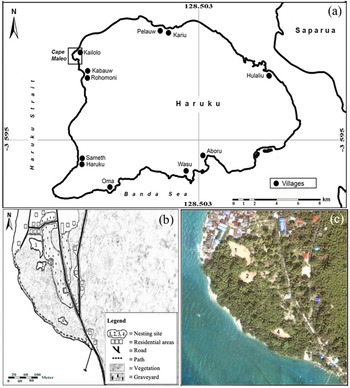
The study was conducted in a community that harvested Moluccan Scrubfowl eggs at nesting sites on Cape Maleo, Haruku Island, Indonesia. Haruku Island is one of the islands in Maluku, Indonesia (3.5670S, 128.4830E) (Figure 1). The people of Kailolo Village have made egg harvesting at Cape Maleo a tradition due to the influence of their traditional beliefs (Heij et al. Reference Heij, Rompas and Moeliker1997, Heij Reference Heij2001, Heij and Rompas Reference Heij and Rompas2011, Saiya and Heij Reference Saiya, Heij, Cahyono, Amarlita, Ralahallo and Persulesy2017). Cape Maleo is an important bird-nesting site in Central Maluku and is located on the island’s north-western coast. Additionally, the proximity of spawning grounds to human settlements facilitates egg collection.
Research location. (a) Map of Haruku Island. (b and c) Sketch and satellite view (google map) of bird nesting site in Cape Maleo with residential areas nearby.

Data collection and analysis
Four Kailolo Village hamlets were surveyed using closed questionnaires with answer options and areas for the productive age group (15–65 years). The productive age group was selected due to their familiarity with the traditional policy of egg collection and their participation in the utilisation of bird eggs. Respondents were chosen using a proportional stratified random sampling technique (Forthofer et al. Reference Forthofer, Lee and Hernandez2016), in which the productive age group was divided into 10 subgroups with a four-year age gap between each subgroup. Using the accidental sampling technique (Forthofer et al. Reference Forthofer, Lee and Hernandez2016), respondents were drawn randomly from each age subgroup. The Cochran equation was utilised to determine the minimal number of respondents required from each age subgroup (Cochran Reference Cochran1977, Adam Reference Adam2020). The following aspects of traditional policies regarding the use and conservation of eggs are discussed: (1) traditional policies governing the harvesting of bird eggs; (2) community participation; (3) policy objectives; (4) reasons for egg harvesting; (5) frequency of egg use; (6) egg-processing methods; (7) the effect of egg harvesting on bird populations; (8) egg protection; (9) adult bird protection; (10) bird habitat protection.
The descriptive analysis of survey data was based on the proportion of respondents who responded positively to each parameter. To illustrate the public’s perspective on the policy of traditional egg use and its implications for the conservation of the Moluccan Scrubfowl population, a graph of the distribution of the percentage of respondents’ responses (Pazzaglia et al. Reference Pazzaglia, Stafford and Rodriguez2016) was created for each parameter.
Results
Social demographics
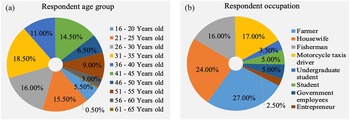
This study enrolled 200 respondents, with a questionnaire return rate of 100%. The age distribution of the respondents ranged from 21 years to 45 years, and the majority were between 31 years old and 35 years old (18.5%) (Figure 2a). All respondents understood and were actively involved in managing the harvesting of Moluccan Scrubfowl eggs at their nesting sites in Cape Maleo. Respondents in this study came from various types of work, namely farmers (27%), housewives (24%), motorcycle taxi drivers (17%), and fishermen (16%) (Figure 2b).
(a) Age and (b) occupation profiles of respondents in the productive age group (15–65 years) in Kailolo Village.

The traditional policy of harvesting Moluccan Scrubfowl eggs
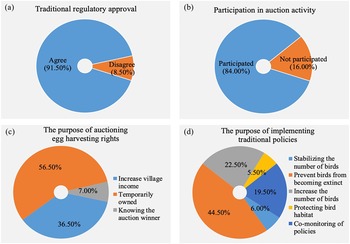
This study found that 91.5% of the community supported the traditional policy of harvesting Moluccan Scrubfowl eggs from their Cape Maleo nests (Figure 3a). Around 84% of community members participated in the open bidding process for the right to harvest bird eggs, demonstrating their agreement (Figure 3b). The auctioning of bird egg rental rights is one of the steps in their traditional policy implementation. Some communities believe that the egg harvesting right implies temporary ownership of the nesting grounds for a certain period (56.5%). In contrast, others believe that the funds raised from the auction increased village income (36.5%) and determined the winner of the auction even though the purpose of the auction had been previously communicated (7%) (Figure 3d). The public’s understanding of the egg-harvesting lease auction contradicts their knowledge of the traditional policy’s primary objective, i.e. protecting birds and their habitat (Figure 3d).
Community perspectives on the traditional policy of harvesting Moluccan Scrubfowl Eulipoa wallacei eggs on Haruku Island: (a) community approval; (b) community participation; (c) objectives of auction activities; (d) objectives of managing the Cape Maleo, Haruku Island nesting site.

Utilisation of Moluccan Scrubfowl eggs
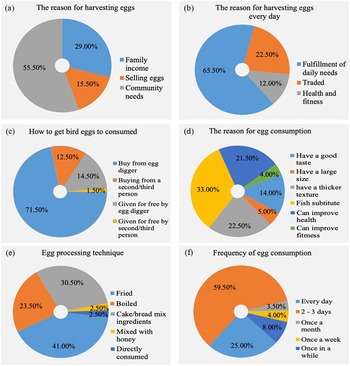
Regarding the utilisation of bird eggs, most of the community supports collecting eggs for their daily needs (55%) and as a source of income for egg-digging families (29%). Others believe that harvested eggs should be sold (15.5%) (Figure 4a). As a result, egg harvesting has to be carried out daily to meet daily nutritional requirements (65.5%), for sale (22.5%), and for health supplements (12%) (Figure 4b). Most eggs are purchased directly from egg diggers (71.5%). In contrast, eggs can be obtained through person-to-person giving or purchased from second or third parties (Figure 4c).
Utilisation of Moluccan Scrubfowl Eulipoa wallacei eggs in Cape Maleo, Haruku Island including (a) reasons for egg harvesting, (b) reasons for daily egg harvesting, (c) egg sources consumed, (d) egg consumption reasons, (e) egg-processing method, and (f) frequency of egg consumption.

The reasons given by the majority of people who consume Moluccan Scrubfowl eggs is that they are a substitute for fish (33%) or have a dense texture (22.5%), because they are believed to be nutritious (21.5%), they taste good (14%), are large in size (5%), and are thought to improve body fitness if consumed raw or mixed with honey (4%) (Figure 4d). Eggs are prepared by frying (41%), baking (30.5%), or boiling (23.5%) (Figure 4e). As much as 25% of people consume bird eggs daily, and 59.5% consume bird eggs once every 1–2 days (Figure 4f). Daily havesting activity means that egg consumption is strongly affected by availability.
Implications of traditional conservation policies for the utilisation of Moluccan Scrubfowl eggs
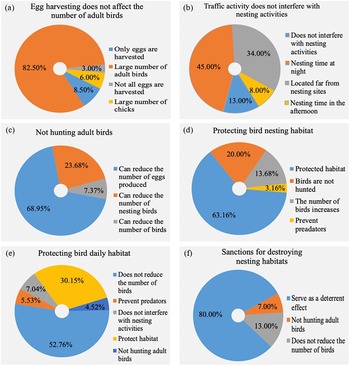
The survey results indicated that the community is opposed to prohibiting or restricting egg collection because it does not affect the number of eggs and bird populations. They believed that the Moluccan Scrubfowl population is still significant (82.5%), adult parents are not used (8.5%), the offspring population is consistently high (6%), and not all eggs are collected (3%) (Figure 5a). Communities also believe that transportation activities do not interfere with the arrival of birds to nest (13%), birds nesting at night (45%), or in the afternoon (8%), and transport routes are far from nesting sites (34%) (Figure 5b).
The views of the community around the bird nesting site in Cape Maleo, Haruku Island on the conservation of Moluccan Scrubfowl. (a) The effect of egg harvesting on adult birds; (b) the effect of activity on nesting behaviour; (c) conservation of adult birds; (d) habitat conservation nesting; (e) daily habitat conservation; (e) sanctioning perpetrators of habitat destruction.

Regarding the presence of adults, the community prohibits hunting to guarantee that eggs are always available (68.95%), birds continue to nest (23.68%), and adults remain stable (7.38%) (Figure 5c). The community believes that bird habitats must be protected to ensure the continuity of nests and daily habitats for birds (63.16%) and to maintain bird populations (52.76%) (Figures 5d and e). Strong support for imposing sanctions on those responsible for destroying bird-nesting habitats or capturing birds reflects the communities’ dedication to protecting bird habitats (Figure 5f).
Discussion
Traditional policy for harvesting the eggs of Moluccan Scrubfowl
Traditionally, the village community has set rules for collecting Moluccan Scrubfowl eggs from their nesting sites at Cape Maleo on Haruku Island. Their policy is based on the belief that their ancestors provided them with bird eggs to use. Therefore, harvesting bird eggs must be governed to ensure that all villagers benefit (Heij et al. Reference Heij, Rompas and Moeliker1997, Heij and Rompas Reference Heij and Rompas2011, Saiya and Heij Reference Saiya, Heij, Cahyono, Amarlita, Ralahallo and Persulesy2017). The traditional policy for managing egg harvesting consists of three stages: (1) auction of the lease of bird egg-harvesting rights; (2) distribution of auction proceeds; (3) actual egg harvest. The egg harvest rights auction is held every 31 March, and all villagers are eligible to participate. The auction winner has the right to collect the eggs from 1 April to 31 March of the following year. At the time of the auction, the selling price of eggs is also determined based on the community’s economic capacity, thus binding on the auction winner. Auction funds are allocated for village operations (25%) and construction or maintenance of village places of worship (75%). Thus, the whole community can feel the benefits of bird eggs (Heij et al. Reference Heij, Rompas and Moeliker1997, Heij and Rompas Reference Heij and Rompas2011, Saiya and Heij Reference Saiya, Heij, Cahyono, Amarlita, Ralahallo and Persulesy2017). The auction winner is tasked with managing nest habitats in Cape Maleo so that birds continue to nest and eggs are always available.
The traditional policy for managing the egg harvest of Moluccan Scrubfowl at Cape Maleo governs only the egg harvest and the maintenance of the nesting habitat of the bird. This traditional policy has a conservation flaw in that it needs to regulate the maximum number of eggs collected or the time of egg collection. At a second nesting site on Haruku Island, just off the coast of Haruku village, traditional policies prohibit egg collection in areas designated as customary protected areas, but harvesting is permitted outside them (Saiya and Heij Reference Saiya, Heij, Cahyono, Amarlita, Ralahallo and Persulesy2017, Simanjuntak et al. Reference Simanjuntak, Yusniar, Samalukang, Boleu, Mardiastuti, Widyasari and Udin2020). In Kao Village on Halmahera Island, the community and government have forbidden the collection of Moluccan Scrubfowl eggs since 2018 to increase the population (Simanjuntak et al. Reference Simanjuntak, Yusniar, Samalukang, Boleu, Mardiastuti, Widyasari and Udin2020). Socio-economic factors, such as the economic benefits to the community and village government, and the social status of the auction winner, heavily influence traditional policies in Kailolo Village. Multiple studies have demonstrated that the role of local institutions and their governance regulations are crucial for the successful conservation of wild species (Cundill et al. Reference Cundill, Bezerra, De Vos and Ntingana2017, Morishige et al. Reference Morishige, Andrade, Pascual, Steward, Cadiz, Kapono and Chong2018).
Utilisation of Moluccan Scrubfowl eggs
Eggs of Moluccan Scrubfowl are collected daily in Kailolo Village due to the implementation of traditional policies. As soon as the birds leave the nest each morning, egg collection activities begin as Moluccan Scrubfowl nests between dusk and dawn. After laying her eggs, the female leaves the nest and does not incubate them, so the only source of heat for egg incubation is the substrate on which the eggs are laid. Abandoned nests and dug nest holes serve as markers for digging up bird eggs.
At the time of harvest, the eggs can be sold directly to nest site visitors, or they can be collected for later sale. Daily egg collection results in a high rate of Moluccan Scrubfowl egg consumption by the community. Priority is always given to the needs of Kailolo Village residents before selling eggs to non-village residents. In addition to being sold, bird eggs are frequently given away for free to those who assist with egg excavation. The sale of bird eggs helps the successful bidder recoup the cost of leasing egg-harvesting rights while providing an income stream for egg collectors. The economic benefits enjoyed by auction winners, egg collectors, and other members of the public continue to support the harvesting of bird eggs. Traditional policies on utilising bird eggs must be considered when developing a conservation programme for Moluccan Scrubfowl, particularly concerning the availability of alternative egg-digging jobs and the economic value of eggs to the community. The availability of alternative livelihoods for user communities is one factor that encourages community participation in wildlife conservation (Gelcich and Donlan Reference Gelcich and Donlan2015, Royuela et al. Reference Royuela, Parejo, de la Cruz, Geraldes, Costa and Gil2019, Otero et al. Reference Otero, Farrell, Pueyo, Kallis, Kehoe, Haber and Plutzar2020). Regarding the use of Moluccan Scrubfowl eggs, the traditional belief that the eggs were given by their ancestors for use, including as a source of income for the community, is the primary obstacle to restrictions or bans on egg collection.
Implications of traditional conservation policies for the utilisation of Moluccan Scrubfowl eggs
There are two divergent points of view regarding applying traditional policies to the conservation of Moluccan Scrubfowl among the people of Kailolo Village. Utilisation of bird eggs is permitted, while adult birds, nesting habitats, and daily habitats must be protected and maintained. Egg collection continues because it is believed that traditional policy will continue to ensure the arrival of birds that lay eggs. The community believes that chicks hatch daily and that egg collection does not impact the number of birds that lay eggs. Contrary to the findings of research conducted on Haruku Island in the 1990s (Heij et al. Reference Heij, Rompas and Moeliker1997, Heij and Rompas Reference Heij and Rompas2011, Simanjuntak et al. Reference Simanjuntak, Yusniar, Samalukang, Boleu, Mardiastuti, Widyasari and Udin2020), the number of egg harvests has decreased by 30.7%, indicating that collecting bird eggs has had a significant impact on the island’s bird population. Egg harvesting reduces the number of eggs that hatch because egg diggers attempt to unearth all nests based on the excavation marks left by the parent bird that laid the eggs. From April 2017 to March 2018, an average of 121 nests were dug daily, indicating the number of eggs obtained (Simanjuntak et al. Reference Simanjuntak, Yusniar, Samalukang, Boleu, Mardiastuti, Widyasari and Udin2020). Even if a few chicks hatch, they originated from a nest that the egg diggers neglected.
Kailolo Village and Haruku Island residents do not hunt adult Moluccan Scrubfowl. This attitude is influenced by the belief that their ancestors gave them bird eggs to use, especially in Kailolo Village. Therefore, capturing adults in nesting sites or forest areas is prohibited. Additionally, hunting adult Moluccan Scrubfowl is prohibited near their nesting grounds on Halahera Island, North Maluku (Simanjuntak et al. Reference Simanjuntak, Yusniar, Samalukang, Boleu, Mardiastuti, Widyasari and Udin2020). Therefore, the protection of the nesting habitat is a component of the traditional egg-harvest management policy in Kailolo Village, as it ensures the arrival of the mother birds and serves as a refuge for the newly hatched chicks. Moluccan Scrubfowl nestlings have been observed flying or running into the surrounding vegetation to avoid predators (Heij et al. Reference Heij, Rompas and Moeliker1997, Heij and Rompas Reference Heij and Rompas2011). This study demonstrated that traditional policies for egg harvesting and utilisation of Moluccan Scrubfowl eggs in Cape Maleo are restricted to adult birds and their habitat. In contrast, egg conservation is not a top priority for the community due to the influence of traditional beliefs regarding the origin of the eggs at the Cape Maleo nesting grounds and their economic value to the community. By collecting bird eggs, the number of eggs incubated to produce chicks decreases, resulting in slower recruitment of new members into the population (Etterson et al. Reference Etterson, Ellis-Felege, Evers, Gauthier, Grzybowski, Mattesson and Nagy2011, Rigby and Haukos Reference Rigby and Haukos2015, Murphy et al. Reference Murphy, Redmond, Dolan, Cooper, Chutter and Cancellieri2020). It is imperative to regulate or even restrict the number of Moluccan Scrubfowl eggs that can be harvested to prevent potential population declines in the long term.
Conclusions
The traditional practice of collecting Moluccan Scrubfowl eggs from their nesting grounds on Cape Maleo, Haruku Island, has significant long-term conservation implications for the bird population. The traditional policy of Haruku Island needs to prioritise the conservation of bird eggs. On the other hand, only adult birds and their habitat are given conservation priority. The primary factor influencing divergent perspectives on the policy is traditional beliefs, which are weighed against the economic well-being of the people and the social standing of those with the right to harvest bird eggs. Haruku Island’s Moluccan Scrubfowl population’s long-term viability is diminished by egg collection. By establishing egg-harvesting quotas and limiting egg-harvesting time, special attention must be paid to conservation efforts for bird eggs. Therefore, conservation programme planning should emphasise the increasing public awareness of the importance of conserving Moluccan Scrubfowl eggs.
Acknowledgements
We are grateful for financial support by the Directorate General of Higher Education, Ministry of Education, Culture, Research, and Technology of the Republic of Indonesia in the form of a scholarship and doctoral research grant to the first author. Special thanks to the government and people of Kailolo Village, as well as to D. Usemahu for their cooperation during field data collection. We appreciate the discussion regarding data analysis and preparation of this manuscript with the Scholl of Life Science and Technology, Bandung Institute of Technology. The procedures employed in this study complied with the laws of Indonesia, where they were carried out. H. E. P. Leimena conceived the study, collected and analysed the data, and wrote the manuscript. A. Sjamidi, and T. S. Syamsudin supervised the research and provided multiple revisions of the writing. All authors read and approved the final manuscript. The data sets generated and/or analysed during the current study are available from the corresponding author upon reasonable request.