INTRODUCTION
The genera Cirolana Leach, 1818 and Anopsilana Paulian & Delamare Deboutteville, 1956 are so close morphologically that the monophyletic status of Anopsilana has been discussed since the second half of the 20th Century. Bruce (Reference Bruce1981, Reference Bruce1986, Reference Bruce1992) and Brusca et al. (Reference Brusca, Wetzer and France1995) have separated these taxa using only one character: the presence in Cirolana and absence in Anopsilana of setae on the lateral and distal margin of the pleopod endopods III–IV. However, this pleopod character found in Anopsilana is shared among other cirolanid genera (e.g. Haptolana Bowman, 1966, Speocirolana Bolivar & Pieltain, 1950, Yucatalana Botosaneanu & Iliffe, 1999, and Kagalana Kensley, 2008, all of which are cave dwellers). Botosaneanu & Iliffe (Reference Botosaneanu and Iliffe1997) suggested as ‘a practical solution of the problem’ (in litt.) that Anopsilana be reduced to a subgenus of Cirolana. Botosaneanu & Iliffe (Reference Botosaneanu and Iliffe2000) considered the description of Anopsilana provided by Brusca et al. (Reference Brusca, Wetzer and France1995) as valid for the new rank of this taxon. Unfortunately, the phylogenetic relationships within the Cirolanidae remain poorly understood, and although this ‘solution’ does not clarify the boundary between Cirolana and Anopsilana, it is, for practical reasons, used in the present paper.
Today, 21 species of Cirolana (Anopsilana) are recognized (Botosaneanu & Iliffe, Reference Botosaneanu and Iliffe2000; Schotte et al., Reference Schotte, Boyko, Bruce, Markham, Poore, Taiti and Wilson2008). Ecologically, these species can be grouped into those truly stygobitic and troglomorphic, occurring in fresh water and anchialine caves (subterranean-adapted, generally without pigmentation, and eyeless), and those found in marine and estuarine waters (non-subterranean, pigmented) (Kensley, Reference Kensley1987; Botosaneanu & Iliffe, Reference Botosaneanu and Iliffe1997, Reference Botosaneanu and Iliffe2000). A total of 11 species of the subgenus Anopsilana are reported from the western Atlantic (Botosaneanu & Iliffe, Reference Botosaneanu and Iliffe2000; Schotte et al., Reference Schotte, Boyko, Bruce, Markham, Poore, Taiti and Wilson2008). The estuarine, pigmented species C. (A.) jonesi (Kensley, Reference Kensley1987) has been reported from Belize, Florida, the Mexican Caribbean, and Venezuela (Kensley, Reference Kensley1987; Camp et al., Reference Camp, Lyons and Perkins1998; Kensley & Schotte, Reference Kensley and Schotte1999; Campos Vásquez, Reference Campos Vásquez2000; Capelo et al., Reference Capelo, García, Pereira, Lasso, Alonso, Flores and Love2004). We report herein the occurrence of C. (A.) jonesi on the Brazilian coast, significantly extending its geographical range in the western Atlantic.
MATERIALS AND METHODS
The material was obtained by hand in May 2007, during the sampling for the project ‘Diversidade de Crustáceos do Sudeste e Sul da Bahia: I. Ambientes Costeiros’, sponsored by the Universidade Estadual de Santa Cruz, Ilhéus, Bahia, Brazil. The specimens were found associated with beds of Crassostrea rhizophorae Guilding, 1828 (Mollusca: Ostreidae) attached to jetties, in two estuarine areas in Santa Cruz Cabrália and Porto Seguro, in salinities of 14 and 16. Drawings were made using a drawing tube. Voucher specimens were deposited in the Crustacea collection of the Museu de Zoologia, Universidade Estadual de Santa Cruz (MZUESC). We compared our material with two specimens of Cirolana (A.) browni (Van Name, 1936) deposited in the Crustacea collection of the Departamento de Oceanografia, Universidade Federal de Pernambuco, Recife, Brazil (DOUFPE).
SYSTEMATICS
Cirolana (Anopsilana) jonesi (Kensley, Reference Kensley1987), male from Santa Cruz Cabrália, Bahia, eastern Brazilian coast (MZUESC#858): dorsal view of the body. Scale bar: 1 mm.

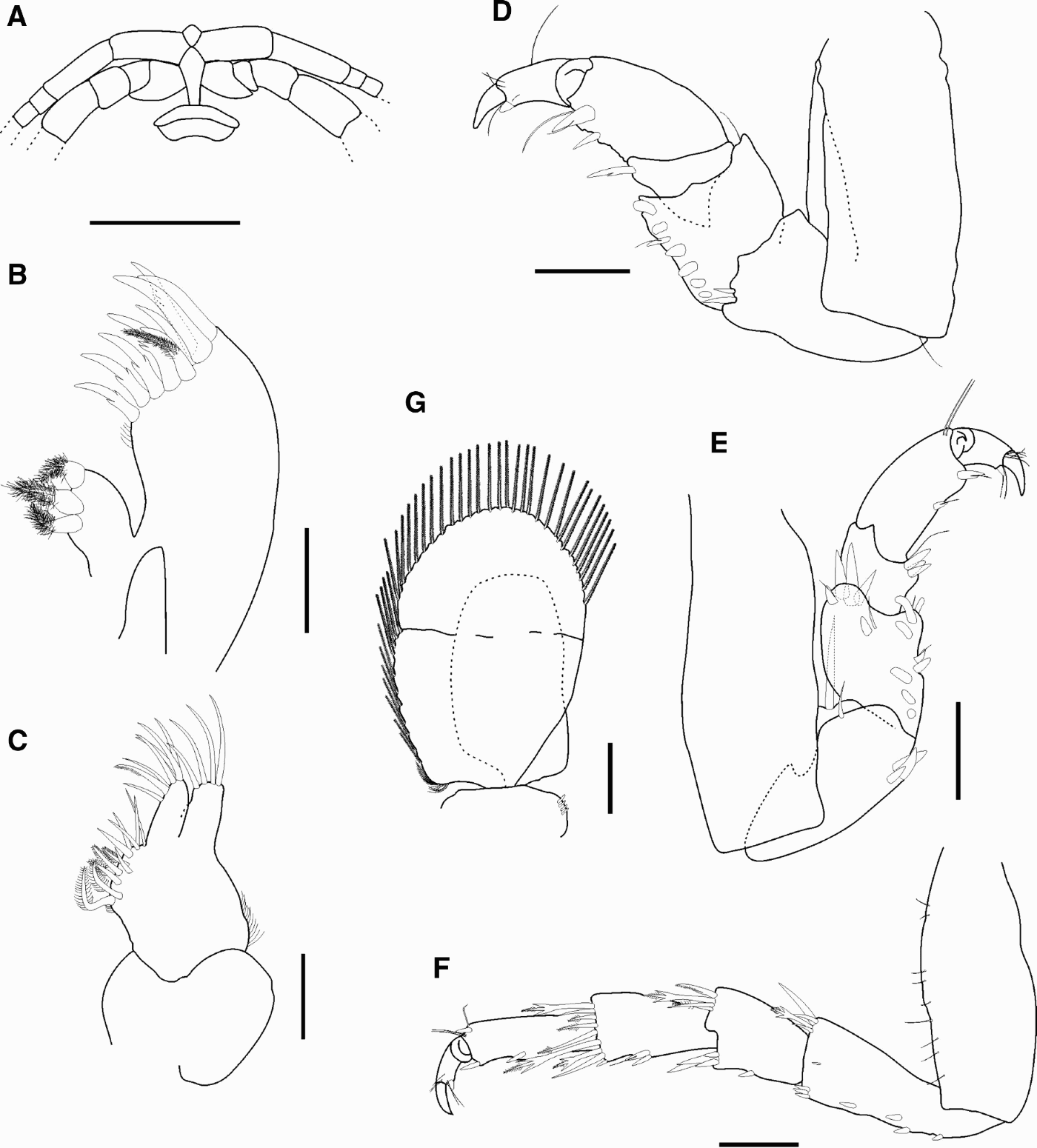
Cirolana (Anopsilana) jonesi (Kensley, Reference Kensley1987), male from Santa Cruz Cabrália, Bahia, eastern Brazilian coast (MZUESC#858): (A) frontal lamina and clypeus; (B) maxilla 1; (C) maxilla 2; (D) pereiopod 1; (E) pereiopod 2; (F) pereiopod 7; (G) pleopod 3. Scale bars: A, 0.5 mm; B, C, G, 0.1 mm; D−F, 0.2 mm.

Anopsilana jonesi
Kensley, Reference Kensley1987: 565, figures 5–6.—Kensley & Schotte, Reference Kensley and Schotte1989: 127, figure 54A–D; 1994: 494, figure 6E; 1999: 701; Camp et al., Reference Camp, Lyons and Perkins1998: 135; Capelo et al., Reference Capelo, García, Pereira, Lasso, Alonso, Flores and Love2004: 57; Martín & Díaz, Reference Martín and Díaz2007: 91.
? Anopsilana jonesi
—Delgado et al., Reference Delgado, Severeyn, Garcia de Severeyn, Reverol and Godoy1998: 47, figure 1; 2000: 379; Campos Vásquez, Reference Campos Vásquez2000: 362 (identity uncertain).
MATERIAL EXAMINED
One male and 1 manca, 16 May 2007, João de Tiba River (16°16′38.8″S 39°01′24.4″W), on Crassostrea rhizophorae beds attached to jetties, salinity 14, Santa Cruz Cabrália, Bahia, Brazil, Coll. G.B.G. Souza (MZUESC#858); 2 mancas, 18 May 2007, Buranhém River (16°27′14.5″S 39°03′49.9″W), on C. rhizophorae beds attached to jetties, salinity 16, Porto Seguro, Bahia, Brazil, Coll. G.B.G. Souza (MZUESC#945).
COMPARATIVE MATERIAL EXAMINED
Cirolana (Anopsilana) browni (Van Name, 1936). 1 male and 1 female, no date available, estuary of Paraíba do Norte River, Paraíba, Brazil, in decomposing wood, Det. M.L. Koening (DOUFPE#161).
TYPE LOCALITY
Sapodilla Lagoon, Sittee River, Belize.
DISTRIBUTION
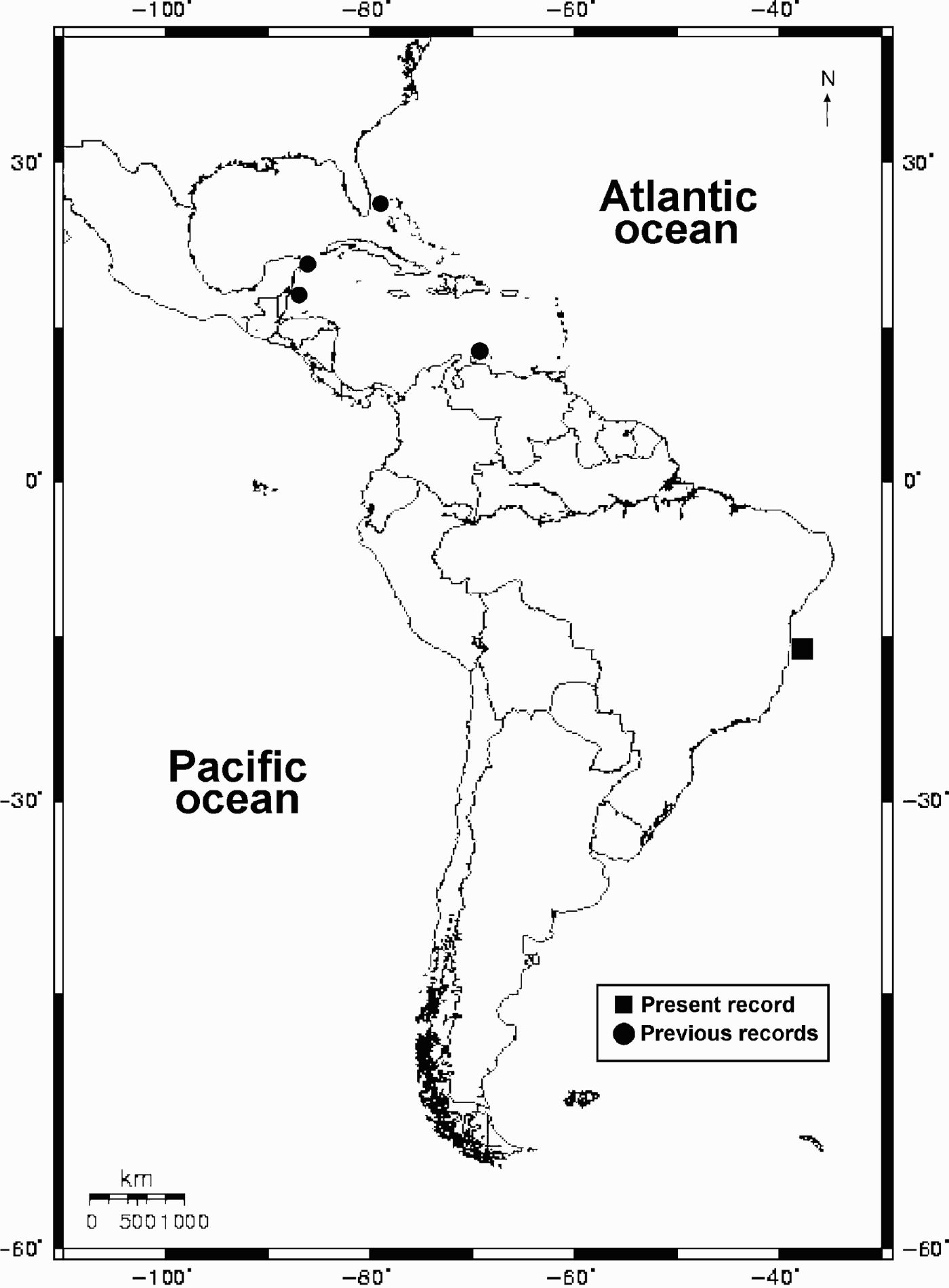
Belize (Kensley, Reference Kensley1987; Kensley & Schotte, Reference Kensley and Schotte1989); Florida (Camp et al., Reference Camp, Lyons and Perkins1998; Kensley & Schotte, Reference Kensley and Schotte1999); Quintana Roo, Mexico (?) (Campos Vásquez, Reference Campos Vásquez2000); Falcón, Venezuela (?) (Delgado et al., Reference Delgado, Severeyn, Garcia de Severeyn, Reverol and Godoy1998, Reference Delgado, Reverol, Godoy, Severeyn and Garcia de Severeyn2000); Orinoco River Delta, Venezuela (Capelo et al., Reference Capelo, García, Pereira, Lasso, Alonso, Flores and Love2004; Martín & Díaz, Reference Martín and Díaz2007); Bahia, Brazil (present study) (Figure 3).
Known range of the cirolanid isopod Cirolana (Anopsilana) jonesi (Kensley, Reference Kensley1987).

ECOLOGICAL NOTES
Cirolana (Anopsilana) jonesi is a shallow-water species (0–1 m), recorded in salinities varying from 10 to 31, in a wide variety of estuarine microhabitats such as: among red mangrove roots, barnacles and mussels attached to mangrove roots, and in rotten wood (Kensley, Reference Kensley1987; Kensley & Schotte, Reference Kensley and Schotte1999), and on Crassostrea rhizophorae beds attached to jetties, in salinities of 14 and 16 (present study). Reported associations with the alga Udotea flabellum (Campos Vásquez, Reference Campos Vásquez2000) and within dead coral rocks (Millepora sp.) (Delgado et al., Reference Delgado, Severeyn, Garcia de Severeyn, Reverol and Godoy1998, Reference Delgado, Reverol, Godoy, Severeyn and Garcia de Severeyn2000) are doubtful because these habitats differ significantly from those where C. (A.) jonesi has been collected.
REMARKS
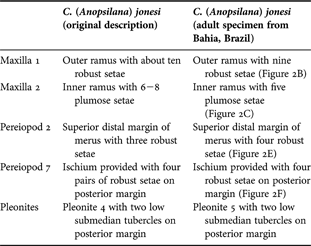
The adult male specimen examined agrees well with the description and diagnosis provided by Kensley (1997). However, our material differs in some features from the original description of C. (A.) jonesi (Table 1). The differences observed are very slight and we interpret them as intraspecific variation. However, the analysis of a larger sample and a comparison with material from other localities is highly desirable in order to determine the nature of this variation.
Morphological differences observed between Brazilian and Caribbean specimens of Cirolana (Anopsilana) jonesi (Kensley, Reference Kensley1987).

The mancas differ from the adult only ontogenetically. The central solid pigmentation on pereionites 1–7 (Figure 1) is also present in the three mancas that we analysed.
Delgado et al. (Reference Delgado, Severeyn, Garcia de Severeyn, Reverol and Godoy1998) reported C. (A.) jonesi from Venezuela. However, the authors gave no morphological account of their material, simply repeating the diagnostic characters provided by Kensley & Schotte (Reference Kensley and Schotte1989). Some important characters such as the tubercles on the cephalon and dorsal region of the pereion, and the spines and setae on the distolateral margin of the uropods and the distal margin of the telson were omitted in the drawings provided (see Delgado et al., Reference Delgado, Severeyn, Garcia de Severeyn, Reverol and Godoy1998, p. 48, figure 1A,B). The size and proportion of the pleonites 4 and 5 are apparently different from those drawings provided by Kensley (Reference Kensley1987) when describing the species. The telson is not broadly triangular as expected for C. (A.) jonesi (Kensley, Reference Kensley1987). The shape of the frontal lamina (see Delgado et al., Reference Delgado, Severeyn, Garcia de Severeyn, Reverol and Godoy1998, p. 48, figure 1B) also differs considerably from the pentagonal shape that has been reported for C. (A.) jonesi (see Kensley, Reference Kensley1987, p. 566, figure 5C; Kensley & Schotte, Reference Kensley and Schotte1989, p. 129, figure 54b; Kensley & Schotte, Reference Kensley and Schotte1994, p. 493, figure 6E; Figure 2A). In other words, the main morphological characters of this species could not be recognized, and therefore this record (as well as that by Delgado et al., Reference Delgado, Reverol, Godoy, Severeyn and Garcia de Severeyn2000) should be considered with caution, until a re-analysis of that material. Another reference for this species from Venezuela is that of Capelo et al. (Reference Capelo, García, Pereira, Lasso, Alonso, Flores and Love2004) (subsequently cited by Martín & Díaz, Reference Martín and Díaz2007). These authors reported C. (A.) jonesi from estuarine habitats in the Orinoco River delta, although they did not provide any morphological account or drawings of their material.
DISCUSSION
Among the 11 species within the subgenus Anopsilana reported from the western Atlantic, three are estuarine: Cirolana (A.) jonesi, C. (A.) browni, and C. (A.) sinu (Kensley & Schotte, Reference Kensley and Schotte1994). These species are morphologically close to others of the same subgenus from the Indo-Pacific and eastern Pacific.
Among estuarine species with a pentagonal frontal lamina, a closer morphological relationship exists between C. (A.) jonesi and C. (A.) willeyi (Stebbing, 1904) (from East Africa to Australia) than with C. (A.) barnardi (Bruce, Reference Bruce1992) (from Australia). Cirolana (A.) jonesi and C. (A.) willeyi share several morphological characters beyond the shape of the frontal lamina, such as: presence of three tubercles on the cephalon and dorsal nodules on pereionite 1, the posterior margin of pereionites 2–7 ornamented, and the similar morphology of pereiopod 1. The differences between these two species are very subtle. The ornamentation on the dorsal posterior margin of pereionites 2−7 and the pleon is clearly more developed and evident in C. (A.) willeyi, forming tubercles that are sometimes acute. The shape of pleopod 5 is also different. Other slight differences are found on the merus of pereiopod 2 (lower margin provided with six robust molariform setae in C. (A.) jonesi versus eight in C. (A.) willeyi), and on the ischium of pereiopod 7 (posterior margin with four pairs of robust setae in C. (A.) jonesi versus five pairs in C. (A.) willeyi).
The amphi-American Cirolana (A.) browni (Brusca et al., Reference Brusca, Wetzer and France1995) has also been reported from Brazil (Coelho et al., Reference Coelho, Koening and Ramos1970; Brasil-Lima & Barros, Reference Brasil-Lima, Barros and Young1998). This cirolanid seems to be more closely related to C. (A.) pustulosa (Hale, 1925), from Australia, and the poorly known C. (A.) lucieae (Barnard, 1940), from South Africa. Cirolana (A.) browni can be easily differentiated from C. (A.) jonesi by the following features: lack of the solid colour pattern on the mid-dorsal region of the pereion, the distally broadly rounded and projecting frontal lamina, and the presence of strong double tubercles on the cephalon and rows of rounded tubercles on the male pereionites and pleonites (Kensley, Reference Kensley1987). On the other hand, Brusca et al. (Reference Brusca, Wetzer and France1995) represented a specimen of C. (A.) browni with a pattern of coloration similar to that described for C. (A.) jonesi (Kensley, Reference Kensley1987; Kensley & Schotte, Reference Kensley and Schotte1989), so this character may be variable and must be considered with care.
Cirolana (A.) sinu, known from the Atlantic coast of Colombia, differs from C. (A.) jonesi mainly in the shape of the frontal lamina, which is rectangular in the former species (see Kensley & Schotte, Reference Kensley and Schotte1994, p. 493, figure 6A). The similarity between C. (A.) sinu and C. (A.) oaxaca (Carvacho & Haasmann, 1984), from the Pacific coast of Mexico, is remarkable. Kensley & Schotte (Reference Kensley and Schotte1994) observed small but constant differences between these two species in the shape of the frontal lamina, in the spination of the uropods, in the number of articles of the antennal and antennular flagellae, in the number of setae on maxilla 2, in the shape of the apex of the pleotelson, and in the general pigmentation pattern, justifying the description of a new species from the western Atlantic. Additional differences, such as in the shape of pleopods 4 and 5 and in the number of spines on the spine row of the mandible, on the anterior margin of pereionite 1, and on the lower margin of the carpus of pereiopod 7, can be found comparing the drawings of C. (A.) sinu provided by Kensley & Schotte (Reference Kensley and Schotte1994) and those of C. (A.) oaxaca provided by Brusca et al. (Reference Brusca, Wetzer and France1995). These taxa may represent a pair of sibling species on either side of the Central American Isthmus (Kensley & Schotte, Reference Kensley and Schotte1994).
The existence of species complexes, common in all major marine groups and habitats (see Knowlton, Reference Knowlton1993), has been raising some difficult taxonomic problems. The occurrence of cryptic speciation has been recognized in several groups of isopod crustaceans, based on morphological and/or molecular data (e.g. Held, Reference Held, Huiskes, Gieskes, Rozema, Schorno, van der Vries and Wolff2003; Bruce, Reference Bruce2004a, Reference Bruceb; Held & Wägele, Reference Held and Wägele2005; Raupach & Wägele, Reference Raupach and Wägele2006; Raupach et al., Reference Raupach, Malyutina, Brandt and Wägele2007; Brökeland & Raupach, Reference Brökeland and Raupach2008). In the family Cirolanidae, for example, the so-called Cirolana ‘parva-group’ is known to harbour about 30 species of exceedingly similar appearance (i.e. cryptospecies), with many hitherto undescribed species (Bruce & Bowman, Reference Bruce and Bowman1982; Bruce Reference Bruce1986, Reference Bruce1994, Reference Bruce2004a). According to Bruce (Reference Bruce2004a), it seems very probable that in the future the identity of species of this group will need to be confirmed using molecular data. Because of their high degree of similarity, the widely disjoint C. (A.) jonesi and C. (A.) willeyi could represent a case of convergent morphological resemblance. Although only a few cases of establishment of translocated populations of cirolanid isopods are known by now (see Bruce, Reference Bruce2004a), if one of these species were accidentally introduced into the range of the other, they could be easily confused in case of inaccurate identification.
It is difficult at present to assess the pattern of distribution of this species, but we believe that Cirolana (Anopsilana) jonesi possibly has a continuous distribution in the western Atlantic, from Florida and the Mexican Caribbean to the Brazilian Zoogeographic Province. The huge gap in the species distribution, from Venezuela to the Bahia coast, is probably due to the lack of collections in estuarine microhabitats.
ACKNOWLEDGEMENTS
We are indebted to the Universidade Estadual de Santa Cruz, Ilhéus, Bahia, Brazil, for financing the Project ‘Diversidade de Crustáceos do Sudeste e Sul da Bahia. I. Ambientes Costeiros’. To Dr Janet W. Reid and Dr Kim R. Larsen for assistance with the English text. P.A. Coelho thanks FAPEAL/CNPq for a DCR (Desenvolvimento Científico Regional) scholarship. Special thanks are due to an anonymous referee for the suggestions that improved the manuscript.