Introduction
Sudden cardiac death remains an important late-term complication of surgically repaired tetralogy of Fallot despite a large body of literature aimed at both primary and secondary prevention. Invasive diagnostic electrophysiology study with programmed ventricular stimulation is a sensitive and specific means of identifying patients at risk and also provides a pathway for the identification of potential re-entrant ventricular tachycardia circuits and treatment with catheter ablation. Reference Khairy, Landzberg and Gatzoulis1,Reference Moore, Seki, Shannon, Mandapati, Tung and Fishbein2 However, the sensitivity and specificity of the test may be significantly altered if different congenital heart centres apply different procedural methods in the conduct of these studies. How consistently the indications, methods, and interpretation of electrophysiology study results are applied in different centres remains an unanswered question.
We conducted a survey of Pediatric and Adult Congenital Electrophysiology Society members to define variances in practice regarding the use of electrophysiology studies with programmed ventricular stimulation for patients with repaired tetralogy of Fallot.
Methods
This Institutional Review Board-exempt cross-sectional study was designed for clinicians who care for paediatric and adult tetralogy of Fallot patients. Our sixteen-question survey was distributed digitally to members of the Pediatric and Adult Congenital Electrophysiology Society in January 2022. Survey responses were recorded using RedCAP and qualitatively analysed. Survey questions assessed respondents’ scope of practice, indications and methods for performing electrophysiology study, and interpretation of study results for patients with repaired tetralogy of Fallot. Surveys that had less than two questions completed were excluded.
Specific survey prompts did not provide a mechanism by which the interpretation of an electrophysiology study could vary depending on the indication for the study, but a free text box was included for respondents to provide additional comments and clarification.
Results
Forty-seven responses were collected over four weeks, a response rate of approximately 16%. Of the respondents, 91% identified as paediatric electrophysiologists and 6% as adult electrophysiologists. Most practice in a children’s hospital setting (54%) and/or academic medical centre (49%). Thirty-seven respondents from eleven countries reported their primary institution, with two respondents from the same institution, and the majority of respondents from institutions in the USA (73%). The majority (87%) had no age restrictions to their practice.
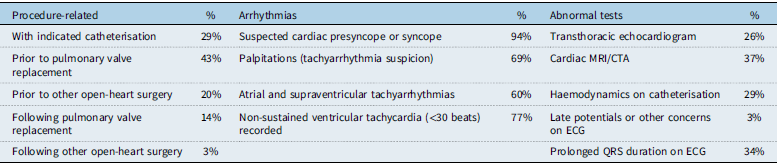
Seventy-five percent of respondents reported more than 100 electrophysiology procedures (of all types) performed at their institution per year. The indications for electrophysiology studies in repaired tetralogy of Fallot patients are summarised in the (Table 1). The most common reported indications for electrophysiology studies in patients with repaired tetralogy of Fallot were documented or suspected arrhythmias: palpitations suspicious for a tachyarrhythmia (69%), suspected cardiac syncope (94%), documented supraventricular tachycardia (60%), and nonsustained ventricular tachycardia (77%). Fewer than 50% of respondents considered other indications for electrophysiology studies (Table 1).
Indications for diagnostic EPS with programmed ventricular stimulation by percentage of respondents

EPS = electrophysiology study; CTA = CT angiography; ECG = electrocardiogram.
Methods employed in performing diagnostic electrophysiology studies with programmed ventricular stimulation in this population also varied by respondent. Most respondents reported using ventricular extrastimulus testing (91%), isoproterenol (83%), electroanatomic three-dimensional mapping (69%), and burst ventricular pacing (63%). For sedation, the majority of providers use general anaesthesia (84%) rather than conscious sedation (16%).
Respondents defined a positive electrophysiology study as the induction of sustained monomorphic ventricular tachycardia (94%), sustained polymorphic ventricular tachycardia (69%), ventricular fibrillation requiring defibrillation (66%), or nonsustained ventricular tachycardia (23%) (Figure 1).
Respondents’ definition of a ‘positive’ EPS. EPS = electrophysiology study.

Respondents were asked whether they use a formal process for determining if electrophysiology study is indicated in repaired tetralogy of Fallot patients at their institution. Of those who responded, 85% did not have a formal algorithm or process map for determining the indication for electrophysiology studies; however, 79% believed it would help them care for these patients. Finally, three respondents commented on using an individualised approach to the indications and interpretation of electrophysiology study, depending on the patient’s presentation.
Discussion
Sudden cardiac death has long been recognised as a devastating late-term complication of patients who underwent surgical repair of tetralogy of Fallot. Reference Gatzoulis, Balaji and Webber3,Reference Zeppenfeld and Wijnmaalen4,Reference Cohen, Khairy, Zeppenfeld, Van Hare, Lakkireddy and Triedman5 Significant effort has been expended over decades to fully understand risk factors for sudden death in tetralogy of Fallot and to develop risk stratification to implement appropriate preventative measures. Reference Cohen, Khairy, Zeppenfeld, Van Hare, Lakkireddy and Triedman5,Reference Khairy, Aboulhosn and Gurvitz6
This cross-sectional survey of Pediatric and Adult Congenital Electrophysiology Society members indicates there a is lack of uniform practice regarding the indications used by different centres to recommend diagnostic electrophysiology studies and the methods utilised to perform electrophysiology studies, including anaesthesia care plans, pacing protocols, pharmacological stimulation with isoproterenol, and 3D mapping. Moreover, there is a lack of uniform practice regarding how the results of electrophysiology studies are interpreted. Institutional practices and clinical judgement remain fundamental to how electrophysiology studies are applied for risk stratification in the care of patients with repaired tetralogy of Fallot.
Perhaps the most illuminating finding in this survey is the lack of a formal algorithm or process map at most centres, which could be used to aid in addressing procedural indications, along with a relative consensus that it would be helpful to have such an algorithm or process map in place. Although prior work investigates the use of risk scores in patients with repaired tetralogy of Fallot, Reference Khairy, Harris and Landzberg7,Reference Ghonim, Gatzoulis and Ernst8,Reference Mayourian, Sleeper and Lee9 differences in the various study and scoring methods have made it a challenge to widely implement them. Reference Kakarla, Denham, Ishikita, Oechslin, Alonso-Gonzalez and Nair10 To adopt a suitable algorithm or process map for this patient population, a strong consensus based on a detailed review of the literature is needed, as well as the capability to implement the algorithm or process map across the span of congenital heart centres.
This study is limited by the survey design, which is subject to recall bias, and a low response rate of Pediatric and Adult Congenital Electrophysiology Society members, which may introduce selection bias. Finally, comments from respondents indicated these clinical decisions are nuanced and often vary on a patient-to-patient basis. This survey was conducted in 2022, and no follow-up was performed on any changes in practice at the time of this publication.
Despite these limitations, there is a lack of uniformity in practice relating to the use of diagnostic electrophysiology studies for risk stratification in patients with repaired tetralogy of Fallot. We propose that guidelines for the performance and interpretation of diagnostic electrophysiology studies to stratify sudden death risk in repaired tetralogy of Fallot patients based on expert consensus amongst Pediatric and Adult Congenital Electrophysiology Society members would be helpful to standardise practice across a variety of centres and patient populations.
Supplementary material
The supplementary material for this article can be found at https://doi.org/10.1017/S1047951125000113
Financial support
This research received no specific grant from any funding agency, commercial, or not-for-profit sectors.
Competing interests
The authors have no relevant conflicts of interest, financial or otherwise.
Ethical standards
The authors assert that all procedures contributing to this work comply with the ethical standards of the US ‘‘Common Rule’’ and with the Helsinki Declaration of 1975, as revised in 2008, and have been exempted from review by the Providence Institutional Review Board.