BACTERIA-ACANTHAMOEBA INTERACTIONS
Free-living amoebae play a versatile role in the environment and on human/animal health, due to their ability to capture prey such as bacteria and regulate microbial densities, act as a vector and/or reservoir for bacterial pathogens, and to cause serious human/animal infections. However, not all bacteria act as dormant aliens but some have the ability to influence the outcome in their favour and/or evade predation. Here, we discuss multifaceted bacterial-amoebal interactions. Biological interaction is an action that occurs between two organisms, affecting both the organisms. When describing interaction, the two-way effect is essential, as opposed to a ‘one-way’ causal effect. Bacterial-amoebal interactions can be (i) mutual relationships, where both organisms benefit from the association, or (ii) parasitic relationships, where one organism benefits at the expense of the other. For instance, residing within amoebae has been suggested as the ‘training ground’ during evolution of intracellular bacterial pathogens (Molmeret et al. Reference Molmeret, Horn, Wagner, Santic and Kwaik2005), whereas bacteria fulfil nutritional needs of amoebae. Ideally, mutualism should be favoured as it benefits both the species, but evolutionary evidence suggests that there always are selfish species who do not contribute to the relationship, but take advantage of cooperation from others (Hamilton, Reference Hamilton1964; Maynard, Reference Maynard1964; Williams, Reference Williams1966; Dawkins, Reference Dawkins1976), leading to a survival contest. Being small, bacteria have developmental advantages, i.e. survival under limited resources, rapid reproduction, possible evasion from predators by being too small to capture, and sheer enormity in numbers that possibly opposes ecological extinction pressures. In contrast, natural selection generally favours large organisms that prey on smaller organisms. Here, we discuss the need and impact of bacteria-Acanthamoeba interactions and debate the question: who is the beneficiary in bacteria-Acanthamoeba interactions?
WHY DO BACTERIA AND ACANTHAMOEBA NEED TO INTERACT?
When it comes to the survival of a given species on this planet, it's a ‘dog-eat-dog world’ and there is no concept of ‘charity’. The mere co-existence of two species in a given environment is an insufficient cause to interact. Without a delicate balance, one species may be at the mercy of the other and/or in danger of extinction. In the majority of cases, organisms interact over food. For example, organisms may interact in an antagonistic manner to compete for the same food supply, or they may interact to support each other's nutritional requirements, or they may interact to avoid death or being eaten by other organisms, and then there is the ‘predator-prey’ relationship. Historically, bacteria-Acanthamoeba interactions have been described in the context of the predator-prey relationship, where amoebae feed on bacteria to fulfil their nutritional requirements and in doing so, regulate bacterial populations in the environment (Rønn et al. Reference Rønn, McCaig, Griffiths and Prosser2002), and bacteria were considered as the ‘unlucky devil’ falling prey to the microbial grazer with no or little gain from this relationship. Likewise, this led to the hypothesis that Acanthamoeba interacts, principally, with widely distributed Gram-positive bacterial species. On the contrary, several lines of evidence have shown that Acanthamoeba preferentially feeds on Gram-negative bacteria, such as Escherichia coli and Enterobacter aerogenes but not Gram-positive bacteria, despite the abundance of the latter in the environment (reviewed in Khan, Reference Khan2009). Research over the last few decades has uncovered the mysteries of convoluted interactions of ecologically significant bacteria and ecologically important amoebae. Although Acanthamoeba is shown to interact with widespread spore-forming bacteria such as Bacillus anthracis (Dey et al. Reference Dey, Hoffman and Glomski2012), and thermophilic Sulfolobus spp. (Iqbal et al. Reference Iqbal, Siddiqui and Khan2013), by and large, Acanthamoeba interactions are predominantly observed with non-spore-forming bacteria (reviewed in Khan, Reference Khan2009). Thus, it is hypothesized that a limited ability of non-spore-forming bacteria to survive hostile conditions may have led to their evolutionary need to associate with a hardy host and/or a biological reservoir to remain viable intracellularly in the face of harsh conditions, while the use of amoebae by bacteria as a ‘training ground’ to learn to evade phagocytic killing and become an intracellular human pathogen is a secondary event. The evolution of one species to live inside another is a remarkable adaptation and consistent with the fundamental principle of natural selection to favour cooperation. In a landmark observation of Rowbotham (Reference Rowbotham1980), it was shown that Legionella pneumophila can survive intracellularly in Acanthamoeba. The ability of L. pneumophila to resist grazing by Acanthamoeba suggested their long co-evolutionary history combined with a series of adjustments ensuring bacterial survival and that grazing resistance may have influenced evolutionary gain of bacterial pathogenicity. The impact of such interactions is that (i) amoebae act as an environmental niche that provides sanctuary to the pathogenic microbes, (ii) Acanthamoeba may be a source of superbugs, and (iii) amoebae may play a role in transmission of superbugs to humans and animals. Hence, there is a need to study convoluted interactions of bacteria and amoebae, in the light of evolution and functional aspects impacting health.
WHO IS THE BENEFICIARY IN BACTERIA-ACANTHAMOEBA INTERACTIONS?
Acanthamoeba consumes bacterial species in the environment to fulfil its nutritional requirements (Rodriguez-Zaragoza, Reference Rodriguez-Zaragoza1994), harbour bacteria as endosymbionts (Proca-Ciobanu et al. Reference Proca-Ciobanu, Lupascu, Petrovici and Ionescu1975), farm bacteria for its longevity (Brock et al. Reference Brock, Douglas, Queller and Strassmann2011), and through interactions with bacteria, may enhance its virulence and pathogenicity (Larkin and Easty, Reference Larkin and Easty1990). In contrast, bacteria infect and lyse amoebae (Drozanski, Reference Drozanski1956); reside intracellularly as an endosymbiont (Proca-Ciobanu et al. Reference Proca-Ciobanu, Lupascu, Petrovici and Ionescu1975), exploit amoebae as a reservoir (Krishna-Prasad and Gupta, Reference Krishna-Prasad and Gupta1978), survive harsh conditions by remaining intracellular within amoebal cysts, acquire pathogenicity and virulence by intra-amoebal growth (King et al. Reference King, Shotts, Wooley and Porter1988; Barker and Brown, Reference Barker and Brown1994; Susa et al. Reference Susa, Hacker and Marre1996; Cirillo et al. Reference Cirillo, Falkow, Tompkins and Bermudez1997), and enhance bacterial resistance to antibiotics as observed in amoeba-passaged L. pneumophila that were 1000-fold more resistant to the activities of rifampicin and ciprofloxacin (Barker et al. Reference Barker, Scaife and Brown1995).
It is the gain of virulence or pathogenicity that has received significant attention of microbiologists and clinicians in free-living amoebae during the last few decades. For example, the emergence of superbugs such as methicillin resistant Staphylococcus aureus (MRSA) (Eriksen and Erichsen, Reference Eriksen and Erichsen1963; Kagan et al. Reference Kagan, Martin and Stewart1964), antibiotic resistant Mycobacterium tuberculosis causing multiple drug-resistant tuberculosis (MDR TB) (CDC, 1991), and extensively drug-resistant tuberculosis (XDR TB) (CDC, 2006), or antibiotic-resistant enterobacteriaceae producing New Delhi metallo-beta-lactamase (NDM-1) (Yong et al. Reference Yong, Toleman, Giske, Cho, Sundman, Lee and Walsh2009).
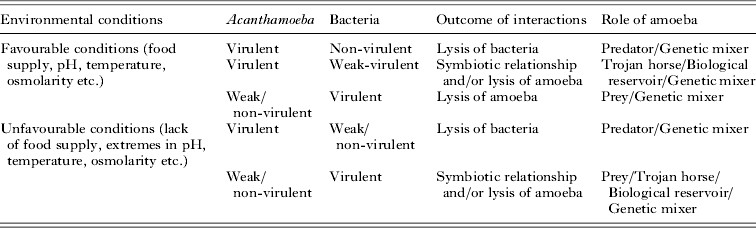
Additionally, the potential role of an amoeba as an environmental ‘genetic mixer’ for microbes has resulted in a paradigm shift in our view of attributing virulence/pathogenicity/resistance to a given species. The terms ‘pathogenicity’ and ‘virulence’ have been used interchangeably to describe enhanced ability of bacteria or amoebae to produce infection. Pathogenicity refers to the ability of an organism to cause disease. Here, we use the word ‘ability’ to represent the genetic component(s) of the pathogen. Commensal organisms lack the inherent ability (genetic component) to cause disease. Moreover, despite possession of such genetic elements, disease may not be a certain outcome as it depends on various factors of the pathogen, the host and the environment. Virulence refers to the degree of pathogenicity of an organism and it is determined by several factors including the ability of the pathogen to multiply within the host, toxin production, invasiveness, resistance to biotic and abiotic factors, and cellular structures of the organism, indicating genetic origin of virulence. Because the basis of virulence or pathogenicity of an organism is in its genetic makeup, the loss or gain of this property must also be associated with genetic exchange(s). Gene transfers between bacteria have been reported in the evolution of pathogenic strain and species, however gene transfer from bacteria to amoebae and vice versa are less well elucidated (Asadulghani et al. Reference Asadulghani, Ogura, Ooka, Itoh, Sawaguchi, Iguchi, Nakayama and Hayashi2009; Whitaker et al. Reference Whitaker, McConkey and Westhead2009; Thomas and Greub, Reference Thomas and Greub2010; Colson et al. Reference Colson, de Lamballerie, Fournous and Raoult2012; Clarke et al. Reference Clarke, Lohan, Liu, Lagkouvardos, Roy, Zafar, Bertelli, Schilde, Kianianmomeni, Bürglin, Frech, Turcotte, Kopec, Synnott, Choo, Paponov, Finkler, Heng Tan, Hutchins, Weinmeier, Rattei, Chu, Gimenez, Irimia, Rigden, Fitzpatrick, Lorenzo-Morales, Bateman, Chiu, Tang, Hegemann, Fromm, Raoult, Greub, Miranda-Saavedra, Chen, Nash, Ginger, Horn, Schaap, Caler and Loftus2013). Recent studies have shown that Acanthamoeba encodes 15 455 compact intron-rich genes, a significant number of which are predicted to have arisen through inter-kingdom lateral gene transfer (Clarke et al. Reference Clarke, Lohan, Liu, Lagkouvardos, Roy, Zafar, Bertelli, Schilde, Kianianmomeni, Bürglin, Frech, Turcotte, Kopec, Synnott, Choo, Paponov, Finkler, Heng Tan, Hutchins, Weinmeier, Rattei, Chu, Gimenez, Irimia, Rigden, Fitzpatrick, Lorenzo-Morales, Bateman, Chiu, Tang, Hegemann, Fromm, Raoult, Greub, Miranda-Saavedra, Chen, Nash, Ginger, Horn, Schaap, Caler and Loftus2013). Lateral gene transfer-derived genes from Bacteria, Archaea and viruses were predicted to be encoded in the genome Acanthamoeba suggesting their role in the biology of Acanthamoeba (Clarke et al. Reference Clarke, Lohan, Liu, Lagkouvardos, Roy, Zafar, Bertelli, Schilde, Kianianmomeni, Bürglin, Frech, Turcotte, Kopec, Synnott, Choo, Paponov, Finkler, Heng Tan, Hutchins, Weinmeier, Rattei, Chu, Gimenez, Irimia, Rigden, Fitzpatrick, Lorenzo-Morales, Bateman, Chiu, Tang, Hegemann, Fromm, Raoult, Greub, Miranda-Saavedra, Chen, Nash, Ginger, Horn, Schaap, Caler and Loftus2013). But how does simple co-culturing of amoebae and bacteria over a few generations facilitate gene transfer, and in tandem affect their virulence/pathogenicity remains incompletely understood. Considering bacteria as the benefactor of enhanced virulence/pathogenicity in amoebae, the likely possibilities are (i) horizontal gene transfer from bacterial genome into amoebae and its presence as extra-chromosomal DNA in amoebae, (ii) horizontal gene transfer from bacterial genome and its incorporation into amoebal genome, (iii) horizontal transfer of bacterial extra-chromosomal genetic element(s) such as plasmids/phages into amoebae as extra-chromosomal DNA, (iv) horizontal transfer of bacterial extra-chromosomal genetic element(s) and its incorporation into amoebal genome or (v) no exchange of genetic material, but bacteria simply remain intracellular of amoebae and produce virulence factors such as toxins etc. to aid virulence/pathogenicity of amoebae. In the absence of any evidence of genomic incorporation, it may prove to be a transient gene/organism transfer that may reverse upon altered external conditions resulting in loss of the infectivity. Unless there is a permanent virulence gene transfer into the amoebal genome, should the virulence/pathogenicity be attributed to the benefactor, i.e. bacteria/plasmids/phages, instead of the amoeba? In such cases, strategies to combat amoebal infections should not simply be pathogenic microbe-specific but precise virulence factors and mobile genetic elements should also be targeted. Similar tactics may explain introduction of amoebal genetic sequence(s) or its extra-chromosomal DNA into bacteria to enhance bacterial virulence/pathogenicity. The ability of bacteria to exhibit intra-amoebal growth may enhance genetic exchanges further (Greub and Raoult, Reference Greub and Raoult2004). Based on this, it can be hypothesized that bacteria that use amoebae as a biological reservoir, i.e. bacterial reproduction intracellular of amoebae, exhibit greater genetic exchanges, compared with bacteria that use amoebae as a vector/Trojan horse. Overall, Acanthamoeba and bacteria are involved in highly complex interactions, the outcome of which is dependent on the virulence properties of amoebae, virulence of bacteria, and the environmental conditions that may be beneficial to Acanthamoeba or bacteria or may result in the development of a mutual relationship (Table 1). We are only beginning to uncover the mysteries of these convoluted interactions. In addition to the role of amoebae as environmental genetic mixers, below is a limited view of our understanding of the role of amoebae in their interactions with bacteria, which is undoubtedly destined to change with further research.
The outcome of amoebal-bacteria interactions is dependent on the virulence properties of amoebae, bacteria or the environmental conditions

ACANTHAMOEBA AS A BACTERIAL PREDATOR
As described above, amoebae consume bacteria to fulfil their nutritional requirements. In doing so, amoebae are responsible for phagocytic elimination of up to 60% of the bacterial population in the environment, and play an important role in the regulation of bacterial density in nature and nutrient cycling, thus contributing to the functioning of ecosystems (Rosenberg et al. Reference Rosenberg, Bertaux, Krome, Hartmann, Scheu and Bonkowski2009). Acanthamoeba as a predator primarily refers to non-invasive bacteria that are used as a food source for Acanthamoeba with little counter threat to the amoeba itself. Bacteria are taken up by phagocytosis, followed by their lysis in phagolysosomes. Here, the term ‘phagocytosis’ is referred to the amoeba-driven processes leading to uptake of bacteria, as opposed to bacterial-mediated invasion. This difference has been described experimentally using two isolates of E. coli (Alsam et al. Reference Alsam, Jeong, Sissons, Dudley, Kim and Khan2006). Both the neuropathogenic E. coli K1 and the non-invasive E. coli K-12 exhibited intracellular presence but only K1 survived within amoebae, on the other hand K-12 were lysed with little counter threat to amoebae. Thus K-12 are prey for amoebae and should be considered as members of this group while K1 are using amoebae as a sanctuary and are included in the subsequent groups.
Interestingly, even for the non-invasive bacterial species, Acanthamoeba exhibits selectivity in phagocytic uptake. For example, using an experimental model system, the effects of grazing by Acanthamoeba on the composition of bacterial communities in the rhizosphere of Arabidopsis thaliana were studied (Rosenberg et al. Reference Rosenberg, Bertaux, Krome, Hartmann, Scheu and Bonkowski2009). Although this may not be a representative example of amoebal grazing activity in other habitat types, the results of this particular study revealed that bacterial abundance was strongly reduced by amoebae. The decrease in numbers was most pronounced in Betaproteobacteria and Firmicutes. In contrast, Actinobacteria, Nitrospira, Verrucomicrobia and Planctomycetes increased, while other groups, such as Betaproteobacterial ammonia oxidizers and Gammaproteobacteria did not change in abundance (Rosenberg et al. Reference Rosenberg, Bertaux, Krome, Hartmann, Scheu and Bonkowski2009). Acanthamoeba treatment resulted in positive feedback on plant growth (Rosenberg et al. Reference Rosenberg, Bertaux, Krome, Hartmann, Scheu and Bonkowski2009). The basis of amoebal selectivity of non-invasive bacterial species is not clear and may include size and morphological characteristics, or biochemical properties. For instance, it is shown that there is requirement of an optimal size for phagocytosis in Acanthamoeba. Using polystyrene and polyvinyltoluene latex beads uptake by Acanthamoeba, it was shown that latex beads 1·305, 1·90 and 2·68 μm in diameter were ingested individually, while latex beads 0·557, 0·264, 0·126 and 0·088 μm in diameter are accumulated at the surface of the amoeba and are only phagocytosed when many beads were present (Korn and Weisman, Reference Korn and Weisman1967). However, there is cell-cycle independence of phagocytic uptake. By employing flow cytometry using fluorescently labelled latex microbeads, Avery et al. (Reference Avery, Harwood and Lloyd1995) discovered that phagocytotic activity was approximately 3-fold higher in the largest (oldest) than in the smallest (newly divided) cells of Acanthamoeba castellanii and showed some evidence of periodicity. At no stage in the cell cycle did phagocytosis cease. Binding and phagocytosis of beads were also markedly influenced by culture age and rate of rotary agitation of cell suspensions. Saturation of phagocytosis (per cell) at increasing bead or decreasing cell concentrations occurred at bead/cell ratios exceeding 10 : 1. This phenomenon was explained as a result of a limitation of the vacuolar uptake system of A. castellanii, as no saturation of bead binding was evident (Avery et al. Reference Avery, Harwood and Lloyd1995). Subsequent to particle uptake, Acanthamoeba have the ability to distinguish vacuoles containing digestible and indigestible particles. Bowers and Olszewski (Reference Bowers and Olszewski1983) have shown that the fate of vacuoles within Acanthamoeba is dependent on the nature of particles, latex beads vs food particle. Vacuoles containing food particles are retained and digested, while latex beads are exocytosed, upon presentation of new particles. Biochemical properties of bacterial surface elements such as capsule, lipopolysaccharide, outer membrane proteins, peptidoglycan (repeating disaccharide backbones of N-acetylglucosamine (NAG) and β-(1-4)-N-acetylmuramic acid (NAM)), and other components of the bacterial surface play an important role in amoebal grazing (Alsam et al. Reference Alsam, Jeong, Sissons, Dudley, Kim and Khan2006; Humann and Lenz, Reference Humann and Lenz2009). The concept of taste buds in Acanthamoeba as demonstrated by its ability to differentiate food particles vs non-food particles/toxins is interesting. So the question arises, if something can taste, can it smell too? This is not a novel idea. Bacteria are well known to use quorum sensing to communicate with other bacteria. Is it possible that the presence of small molecules/chemokines enhance bacteria-Acanthamoeba interactions? Moreover, the likely presence or absence of an array of glycosidases, amidases and endopeptidases to degrade and/or recycle glycans and amino acids may also determine Acanthamoeba preference of bacterial diet. Further research is needed to precisely determine the basis of Acanthamoeba selectivity of bacterial species as a food source and regulating bacterial density as well as release of mineralized nutrients that are otherwise retained in bacteria, in the environment to impact the ecosystem.
ACANTHAMOEBA AS BACTERIAL TRANSMISSION VEHICLES OR TROJAN HORSE
Bacteria that possess the ability to resist amoebal killing can be divided into two groups: (i) bacteria that remain intracellular without multiplying, and (ii) those which reproduce inside amoebae. For the latter, an amoeba is described as a biological reservoir and is discussed in the subsequent section (Greub and Raoult, Reference Greub and Raoult2004). The ability of bacteria to resist killing but not multiply may suggest bacterial requirement to survive harsh environmental conditions, e.g. during transmissions from one host to another and to learn strategies to evade immune phagocytes, hence this process is most likely bacterial-driven, especially under harsh conditions. Bacterial communication with Acanthamoeba in this category is more like of an invader (using invasion(s)) to force its entry into an amoeba that unlikely favours the host. Once bacteria latch onto host tissue such as nasal mucosa, lung epithelial cells, or gut mucosa, bacteria must resist the innate defences as well as cross the biological barriers to produce disease. In such cases, Acanthamoeba may act as a ‘Trojan horse’ for bacteria. For example, recent studies have shown that Burkholderia cepacia (a causative agent of lung infection) remains viable within Acanthamoeba but does not multiply (Marolda et al. Reference Marolda, Hauroder, John, Michel and Valvano1999; Landers et al. Reference Landers, Kerr, Rowbotham, Tipper, Keig, Ingham and Denton2000). Essig et al. (Reference Essig, Heinemann, Simnacher and Marre1997) have shown similar findings using Chlamydophila pneumoniae (causative agent of respiratory disease). The term ‘Trojan horse’ is used to describe bacterial presence inside Acanthamoeba as opposed to ‘carrier’ which may be mere attachment/adsorption to the surface. Overall, this group includes bacteria that resist amoebal killing and amoebae are used to (i) survive harsh environmental conditions, (ii) facilitate bacterial transmission and (iii) may evolve strategies to evade the vertebrate immune system.
The ability of Acanthamoeba to resist harsh conditions such as extreme temperatures, pH, osmolarity, especially during their cyst stage suggest their usefulness as bacterial and possibly viral vectors. In particular, Acanthamoeba cysts are notoriously resistant to chlorine (a key and sometimes the only compound in cleaning water systems) (Khan, Reference Khan2009). This poses clear challenges in eradicating intracellular bacterial/viral pathogens from public water supplies especially in developing countries.
ACANTHAMOEBA AS BIOLOGICAL RESERVOIR FOR BACTERIA
The ability of Acanthamoeba to act as bacterial reservoir has gained the most attention (Greub and Raoult, Reference Greub and Raoult2004). This is due to the fact that the majority of these bacteria have the ability to use amoebae as safe havens are human pathogens of major importance, such as L. pneumophila, E. coli O157, Coxiella burnetii, Pseudomonas aeruginosa, Vibrio cholerae, Helicobacter pylori, Listeria monocytogenes and Mycobacterium avium (reviewed in Greub and Raoult, Reference Greub and Raoult2004; Khan, Reference Khan2009). This property of Acanthamoeba is particularly important as these bacterial pathogens not only survive intracellularly but multiply within Acanthamoeba, which may help them to achieve a critical progeny to (i) transmit throughout the environment, (ii) evade the host defences, and/or chemotherapeutic drugs and (iii) reproduce in sufficient number to produce disease. Upon the switch to favourable conditions, the increasing bacterial densities lyse their host amoebae and infect new amoebae or produce disease. It is important to indicate that the virulence determinants responsible for bacterial invasion of Acanthamoeba, their intracellular survival, i.e. inhibition of phagolysosomes formation or growth at acidic pH, and escape from Acanthamoeba vary between different bacterial species and depend on the virulence of a bacterial isolate (Greub and Raoult, Reference Greub and Raoult2004).
Overall, the outcome of amoebae-bacteria interactions is dependent on the virulence properties of amoebae, bacteria or the environmental conditions. When the environmental conditions are favourable (for example food supply, pH, temperature, osmolarity etc.) and virulent Acanthamoeba interacts with non-virulent bacteria, lysis of the bacteria occurs. The amoeba is a ‘predator’ in these interactions. On the other hand, when virulent Acanthamoeba interacts with weak-virulent bacteria; a symbiotic relationship occurs or amoeba lysis can occur. The role of the amoeba in this type of situation is of a ‘Trojan horse,’ and/or ‘biological reservoir’. On the contrary, if a weak/non-virulent amoeba interacts with virulent bacteria, lysis of the amoeba occurs. In this case the amoeba is a ‘prey’. Conversely, when the conditions are unfavourable (lack of food supply, extremes in pH, temperature, osmolarity etc.) and virulent Acanthamoeba interacts with weak/non-virulent bacteria, lysis of bacteria occur. In these types of interactions, the role of the amoeba is ‘predator’. In the opposite scenario, when weak/non-virulent Acanthamoeba interacts with virulent bacteria, a symbiotic relationship may occur or there may be lysis of the amoeba. Here the role of the amoeba is either ‘prey’, ‘Trojan horse’ and/or ‘biological reservoir’.
In summary, amoebae have the ability to act as bacterial predators, as bacterial transmission vehicles or Trojan horses, biological reservoirs, and in all these types of interactions Acanthamoeba may allow exchange of genetic materials and act as genetic mixers for bacteria. This diverse role of amoebae, and the concept of a pathogen within a pathogen, are thought provoking. In this context, the role of Acanthamoeba as an environmental sanctuary for bacterial/viral pathogens, and possibly facilitating genetic exchanges affecting their virulence, and contributing to microbial survival in harsh environmental conditions along with aiding their transmission to susceptible hosts, is of immense concern to human and animal health. Future studies will determine the role of amoebae in the evolution of superbugs, which may help us identify novel preventative and/or therapeutic strategies. As we are fast approaching a pre-antibiotic era, our comprehensive understanding of the biology of these organisms in the environment should help us identify possible ways to prevent infection or learn to co-exist. We particularly emphasize developing plans to co-exist, as our attempts to wipe out a given species for the benefit of human species have proven to be a short-lived approach.
ACKNOWLEDGEMENTS
The authors are grateful for the kind support provided by The Aga Khan University, Pakistan.
CONFLICT OF INTEREST
None to declare.