


How does the threat of becoming a victim of terrorism affect voting behavior? Are voters more likely to support parties that favor extending greater concessions to terrorists in order to avoid further violence, or are they more likely to vote for parties that oppose concessions, and that favor more aggressive policy towards the perpetrators? These questions have direct implications for conflict resolution, as well as for understanding and assessing the effectiveness of terrorism as a political tool. The existing literature that focuses primarily on the actual exposure to terrorism has been mixed, with some studies suggesting that terrorism leads voters to be more accommodating of terrorists’ demands, and others showing a hardening of attitudes (a rightward shift) in the electorate.
Our study improves on the existing studies in several ways. We explore the effect of a particular method of terrorism—being in the range of rocket fire. In the context of the Israeli-Palestinian conflict, rocket launchers are confined to the Gaza Strip and therefore the effect of rockets depends on the maximum distance that these rockets can travel from Gaza. We show that the rockets’ range is exogenous to the Israeli political circumstances, and is determined by the availability of rocket technology and launching expertise in Gaza. This allows us to assess the effect of rockets’ threat on voting. Specifically, we explore the variation in the range of rockets from 2001 through 2009, and show that voters who reside in the range are more likely to vote for right-wing parties. We estimate that the effect of being in the rockets’ range is an increase of 2 to 6 percentage points in the right-wing vote-share, and this implies additional 2 to 7 seats in the Israeli Knesset (parliament) out of 120 for the right-wing bloc, if all voters in Israel were within the rockets’ range.Footnote 1
We also unpack changes in different subsets of the right-wing bloc, as well as changes in vote-shares of specific parties. We find that within the right-wing bloc, rocket range primarily affects the nationalistic parties (rather than religious or Jewish-sectarian parties that are also considered to be right-wing). Furthermore, we show that incumbent parties are not punished by voters for allowing the range of rockets to expand. Instead, right-wing parties gain additional votes in localities that are within the range when the incumbent is from a non-right-wing bloc, and the Likud party gains additional votes within the rockets’ range also when it runs as the incumbent. This finding supports the explanation that right-wing parties, and in particular nationalist parties (Likud), have a valence advantage over others when it comes to dealing with security challenges. We present evidence that this finding is not due to the “rally round the flag” effect because other incumbents do not experience such an increase in their vote-shares.
TERRORISM, VIOLENCE, AND POLITICAL BEHAVIOR
Previous Work
How does living under the threat of terrorism affect voting? This question is related to three strands of extant literature: (1) the effect of violence on political behavior, (2) the strategic nature of terrorist - government interactions, and (3) retrospective voting and issue ownership.
Existing studies explore various effects of violence and terrorism. While Pape (Reference Pape2003) suggests that terrorism, and in particular suicide bombings, are effective against democratic voters who pressure their governments to provide concessions to terrorists, Abrahms (Reference Abrahms2006, Reference Abrahms2012) questions the overall effectiveness of terrorism as a political strategy. Many papers assert that terrorism and counterterrorism lead to cycles of violence (Haushofer, Biletzki, and Kanwisher Reference Haushofer, Biletzki and Kanwisher2010; Jaeger and Paserman Reference Jaeger and Paserman2008). However, others provide evidence that some forms of counterterrorism might be effective in reducing further insurgent violence (Lyall Reference Lyall2009), or in curbing future terrorist attacks (Benmelech, Berrebi, and Klor Reference Benmelech, Berrebi and Klor2010a ).
Looking at the Israeli-Palestinian context, Berrebi and Klor (Reference Berrebi and Klor2008) use the variation in Palestinian suicide terrorism across time and space to argue that attacks shift Israeli voters toward right-wing parties that are less supportive of granting political concessions to Palestinians. They estimate that one suicide attack within three months before an election increases right-wing parties’ vote-share in the targeted locality by 1.35 percentage points. Moreover, suicide attacks increase the support for the right-wing bloc beyond those localities in which they take place. Gould and Klor (Reference Gould and Klor2010) use a similar identification strategy to make a more nuanced argument: while terrorism increases the vote-share of right-wing parties, it also shifts the entire political spectrum to the left, thereby making voters and parties more supportive of accommodating Palestinian political demands. Yet both Berrebi and Klor (Reference Berrebi and Klor2008) and Gould and Klor (Reference Gould and Klor2010) only examine fatalities from suicide terrorism. However, fatalities from suicide terrorism could influence electoral behavior through one of two channels. (1) Casualties caused by terrorism or war can have a strong effect on voting. Previous research shows that support for war, and the incumbents in office, are sensitive to fatalities (Kibris Reference Kibris2011) and the context in which they occur (Gelpi, Feaver, and Reifler Reference Gelpi, Feaver and Reifler2006). Additionally, the political psychology literature suggests that exposure to violence influences intergroup attitudes (Canetti-Nisim et al. Reference Canetti-Nisim, Halperin, Sharvit and Hobfoll2009) and political conservatism (Bonanno and Jost Reference Bonanno and Jost2006). (2) Terrorism can also strike fear into a targeted populace (Huddy, Feldman, and Cassese Reference Huddy, Feldman, Cassese, Crigler, MacKuen, Marcus and Neuman2007), and affect voting through the fear of future attacks rather than past casualties. By only looking at suicide terrorism, it is unclear whether shifts in the electorate are due to casualty aversion, or the fear that terrorism creates. Using rocket attacks from Gaza, which caused relatively few casualties but provoked widespread fear (IICC 2009), we are able to isolate the effect of fear over terrorism on voting behavior.
Outside the Israeli-Palestinian conflict, Kibris (Reference Kibris2011) finds that Turkish nationalistic parties’ vote-shares increase following fatal attacks by Kurdish insurgents against police targets. However, in the case of Spain, Bali (Reference Bali2007) and Montalvo (Reference Montalvo2011) show that the 2004 Madrid bombings mobilized opposition voters and shifted the electoral map to the left against an unpopular foreign policy.Footnote 2 Several studies suggest that political responses to terrorism might be mediated by psychological variables. For instance, Canetti-Nisim et al. (Reference Canetti-Nisim, Halperin, Sharvit and Hobfoll2009) find that exposure to terrorism leads individuals to adopt more exclusionary attitudes towards minorities. Especially relevant to the current study, Zeitzoff (Reference Zeitzoff2013) shows that residents living in localities with high exposure to rockets from Gaza show more altruism to their ingroup than those in low exposure localities. Other studies are less sanguine, finding that rocket exposure is associated with increased adolescent violence and aggression (Henrich and Golan Reference Henrich and Golan2013). Habituation to terror can also shape voters’ behavior. Becker and Rubinstein (Reference Becker and Rubinstein2011) show that reduction of services and goods purchased in Israel during the Second Intifada occurred only among occasional consumers, since regular users of such services are able to adjust their behavior. Numerous other studies draw a connection between war-time, nationalism, and patriotism (Baker and Oneal Reference Baker and Oneal2001; Skitka Reference Skitka2005). Huddy, Feldman, and Cassese (Reference Huddy, Feldman, Cassese, Crigler, MacKuen, Marcus and Neuman2007) show that perceptions of threat post-9/11 were more likely to favor aggressive military actions. Finally, Abramson et al. (Reference Abramson, Aldrich, Rickershauser and Rohde2007) connect George W. Bush’s 2004 presidential election win to his ability to appear to be a strong leader, an especially important factor considering the import US voters placed on combatting terrorism. This is also confirmed by Oates, Kaid, and Berry (Reference Oates, Kaid and Berry2009), who find that fear was an important component of Bush’s campaign in 2004 that projected Bush as a safe and secure leader for troubled times.
Review of these studies suggests that exposure to terrorism might increase, decrease, or have no effect on electoral support for right-wing parties. What complicates this question even further is the strategic nature of terrorist-government interactions. Powell (Reference Powell2007) shows that both terrorists and governments choose actions that maximize their utility, given their expectations regarding the other side’s actions. Terrorists choose the targets and the timing of their attacks strategically. For example they may try to derail peace talks (Kydd and Walter Reference Kydd and Walter2002), trigger government response that would facilitate terrorist recruitment (Bueno de Mesquita and Dickson Reference Bueno de Mesquita and Dickson2007), or maximize government concessions (Lake Reference Lake2002; Pape Reference Pape2003). Thus, they target those populations that are more likely to respond in the desired manner, either by voting for right-wing parties (if terrorists’ goals are to “spoil” talks or facilitate recruitment), or by voting for left-wing parties (if terrorists’ goals are to extract concessions). Governments, who are motivated to protect against attacks as well as to increase their vote-shares, are also strategic in their response to terrorism, and protect targets to minimize the overall expected impact of attacks (Powell Reference Powell2007).Footnote 3 Thus, in equilibrium, terrorist attacks might have no effect on voting, or they might strengthen public support for the incumbent.
Finally, previous research on electoral behavior can illuminate how terrorism affects voting. Theories of retrospective voting suggests that voters evaluate candidates based on their past performance and achievements in areas such as economic policy (Fiorina Reference Fiorina1978; Kiewiet and Rivers Reference Kiewiet and Rivers1984). Alternatively, Petrocik (Reference Petrocik1996) and Wright (Reference Wright2012) argue that some parties have an advantage in certain areas, and they tend to benefit when their issues become salient. In the Israeli context, Schofield and Sened (Reference Schofield and Sened2005) and Arian and Shamir (Reference Arian and Shamir2008) argue that right-wing political parties enjoy a valence advantage on security issues. In the context of conflict and terrorism, there is evidence that incumbents lose electoral support following attacks and casualties, as expected if the retrospective voting theory is correct (Gelpi, Feaver, and Reifler Reference Gelpi, Feaver and Reifler2006; Karol and Miguel Reference Karol and Miguel2007; Gassebner, Jong-A-Pin, and Mierau Reference Gassebner, Jong-A-Pin and Mierau2008; Bali Reference Bali2007; Montalvo Reference Montalvo2011). However, Berrebi and Klor (Reference Berrebi and Klor2008) and Koch and Tkach (Reference Koch and Tkach2012) find that in Israel incumbents are not punished for suicide attacks, and the right-wing bloc increases vote-shares regardless of the incumbent’s political affiliation, in accordance with the valence theory.
Using Rocket Range to Understand Terrorism
In this article we provide several contributions to understanding the connection between terrorism and voting. First, the nature of rockets and the circumstances of their use allow us to circumvent the problem of strategic targeting. Palestinians who fire rockets are confined to Gaza, and the impact of their attacks depends on rocket technology that determines the range and accuracy of their rockets.Footnote 4 Thus, at any given point in time, those within the rockets’ range are threatened not because they are perceived to be attractive targets, but because this is how far rockets can reach. Within the range, the targets of rocket attacks are strategically chosen. However, due to limited accuracy and varying launching skills, everyone within the range has some likelihood of being hit. Crucial to our purpose is that selection into the range is not driven by strategic considerations, but by availability of technology and the constraint to launch rockets from within Gaza. In fact, we show that those residing within the range do not differ substantially from those living outside the range, and we attribute the difference in voting behavior to being threatened by rockets. This is an improvement over existing studies, both in the Israeli context as well as beyond, that so far focus on the impact of those terrorist attacks whose targets are not determined by a random choice.
Second, by examining the range rather than the actual targeting, we argue that experiencing an attack is not necessary to influence voting, and that voting could be also affected by the mere threat of being a target. Focusing on threat (living in the range of fire) is also closer to the view of terrorism as a strategy that seeks to instill fear in a target populace, rather than to destroy the opponent militarily (Abramson et al. Reference Abramson, Aldrich, Rickershauser and Rohde2007).
ROCKET FIRE FROM GAZA
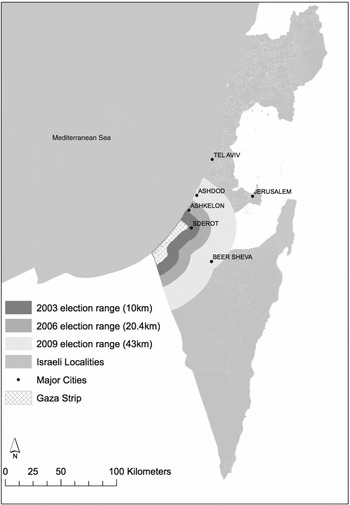
Since 2001, areas of southern Israel have been under a continual threat of ballistic weapons (mortars and rockets) launched by a variety of militant groups in the Gaza Strip.Footnote 5 Following the Israeli disengagement from Gaza in 2005, and the ascension of Hamas, there was a dramatic increase in rocket fire and range (IICC 2009). Whereas initially rockets could reach up to 4 km into Israel, by the 2003 election the range extended to 10 km, and continued to double between elections. As shown in Table 1, by 2009 14% of Israeli population was within the range of rockets. Figure 1 depicts the map of areas within the range of rockets during this period.
Rocket Ranges, 2003–2009 Elections

Population in Range of Rockets

The rockets employed by Palestinian groups are not usually aimed at military targets, but are fired in the general direction of cities and towns (Fisher Reference Fisher2006). Further emphasizing their randomized nature, Hamas explicitly chose a production strategy to increase the number of rockets at the expense of their accuracy (IICC 2009). Most of the rockets fired into Israel have been of the locally manufactured Qassam, with a range of approximately 10 km (IICC 2009). Longer range, Grad and Grad-2 rockets (20- and 40-km range, respectively) have been fired less frequently. These rockets are smuggled into Gaza through tunnels underneath the border with Egypt, or via the sea. During the 2012 Gaza Conflict, Hamas used its longer range Fajr-5 rockets to strike Tel Aviv and Jerusalem for the first time (Bronner Reference Bronner2012).
According to the Israel Security Agency’s (ISA) annual reports, there were 4,735 mortar and 4,561 rocket attacks from 2001 through 2009.Footnote 6 The direct physical result of rocket fire has been far less lethal than that of suicide attacks: from 2001 through 2009, rockets have resulted in 32 fatalities, all of whom were civilians.Footnote 7 Almost half of all fatalities occurred in the town of Sderot that has been targeted by rockets more than any other locality. Despite their relatively low lethality, rockets have had a profound psychological impact on residents within the range. For example, Berger, Gelkopf, and Heineberg (Reference Berger, Gelkopf and Heineberg2012) estimate that 43.5% of students in 7th and 8th grade in Sderot, within range since 2001, are suffering from post-traumatic stress disorder (PTSD)—a rate that is much higher than the rate prevalent in the general population. In addition, Henrich and Golan (Reference Henrich and Golan2013) find that children who reside within the range are more likely to commit acts of violence. PTSD, anxiety, and depression have also been diagnosed among adults within the range (Berger and Gelkopf Reference Berger and Gelkopf2007; Diamond et al. Reference Diamond, Lipsitz, Fajerman and Rozenblat2010). Aside from their psychological impact, rockets have also imposed large economic costs on residents and communities. Municipalities within the range are facing fiscal challenges (Yagna Reference Yagna2010), and at times of a higher likelihood of attacks (for example, following assassinations of Palestinian military activists), schools and kindergartens remain closed, and this imposes additional costs on families. The economic costs of rockets also affect the national government since it has to allocate resources to compensate those whose property is damaged by the rockets. In some cases, compensation is paid even if there is no physical damage, usually to make up businesses for losses due to the uncertain security situation.Footnote 8
Initially, the public and the political leaders perceived rockets as a minor nuisance, partly because of the unprecedented wave of suicide attacks in the early 2000s that targeted major Israeli cities. Conversely, the rockets initially only affected peripheral communities in the vicinity of Gaza, resulting in relatively little damage and few casualties. After 2003, suicide attacks had tapered off. At the same time, the range of rockets, their accuracy, and lethality, as well as the number of attacks have increased.Footnote 9 Rubin (Reference Rubin2011) suggests that the shift in public attitudes towards rockets began with the first rocket fatality in June 2004, and by late 2005 rockets were perceived as an important challenge that needs to be addressed.Footnote 10
In response to the rocket fire, the government has initiated a public campaign to inform residents within the range about the threat.Footnote 11 Localities within the range have been connected to an early warning radar system that activates a siren whenever it detects a rocket launch from Gaza. The siren is heard not only in a locality where a rocket ultimately falls, but also in a cluster of nearby localities. Moreover, the Israeli Defense Forces hold special drills in localities within the range, and distribute flyers to inform residents about how to behave in the case of a rocket attack. These actions suggest that residents within the range are aware of the threat also if their locality is not directly hit.
Within the range, authorities also provide shelters for pedestrians and fortify public and residential buildings (Rubin Reference Rubin2011).Footnote 12 This is a further indication that residents within the range are aware that they can be hit by rockets, even if their locality has not been directly attacked in the past. The Home Front Command posts on its website the updated map of ranges, and locality-specific information, such as the amount of time that residents have to find shelter once they hear sirens.Footnote 13
A major component of Israel’s response to rockets has been the development and the deployment of the Iron Dome missile defense system that is designed to intercept rockets fired from distances of 4–40 km. The development of this system has received a high level of public attention and very generous funding that indicate that the rockets’ threat is perceived as important.Footnote 14 In addition to the defensive measures, Israel has been involved in high-risk offensive operations in Gaza which it justified by referring to the threat of rockets.
DATA AND VARIABLES OF INTEREST
Range of Rockets
Our main explanatory variable is Range i, t that indicates whether a locality is within the range of rockets one day before elections.Footnote 15 Being in the range depends on two factors: the maximum distance that a rocket can travel from Gaza, and locality’s distance from Gaza.
The information on rockets’ range comes from the Israel Defense Forces and Home Front Command websites. To determine whether a locality is within the range of rockets, we used ArcGIS to calculate the shortest distance between a locality and the Gaza perimeter. A locality is considered to be within the range if one day before election that distance is less than or equal to the rockets’ range. Some localities, mostly regional councils, are composed of discontinuous units. We consider such localities to be within the rockets’ range if the minimum distance between all units composing a locality and Gaza perimeter is less than or equal to the rockets’ range.Footnote 16 In the Robustness Checks section, we examine alternative measures of distance.
Voting
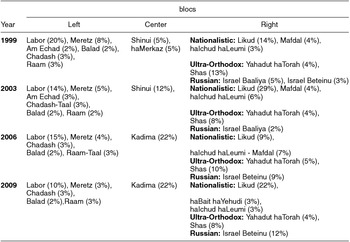
Voting data are available from the Israel Social Sciences Data Center (ISDC) at The Hebrew University of Jerusalem.Footnote 17 We classify Israeli parties into left-wing, centrist, and right-wing blocs using the classification proposed by Arian and Shamir (Reference Arian and Shamir2008), and similar to Schofield and Sened (Reference Schofield and Sened2005) (see Table 2). These blocs differ with respect to their positions on the Israeli-Palestinian issue: right-wing parties are less willing to provide concessions to Palestinians than centrist and left-wing parties.
Parties in Political Blocs (Vote-Shares in Parentheses)

Our main dependent variable is RightShare i, t that measures the right-wing bloc’s vote-share in locality i in election t (1999, 2003, 2006, and 2009).Footnote 18 In addition, we examine vote-shares of nationalistic, religious ultra-orthodox parties, Russian immigrants’ parties, as well as vote-shares of Likud, Labor, and Shas parties. We calculate vote-shares by dividing the number of votes a bloc, a subset of a bloc, or a party received by the number of valid votes in a locality in a given election. Vote-share variables are continuous, and range from 0 to 1.
We focus on vote-shares as our dependent variable for two reasons. First, they reflect voting behavior, and are therefore directly relevant to understanding how terrorism threat affects voters. Second, Israel has a highly proportional representation system, with vote-shares closely corresponding to seat-shares in the parliament. Thus, they not only represent changes in voting behavior, but also have direct implications for government composition and policies.
Control Variables
We control for a broad set of variables that can affect voting. First, we include locality-level time-varying demographic attributes available from the Central Bureau of Statistics: population size (logged), median age, ratio of males to females, and the share of Jewish population in a locality. We use a one-year lagged value of these variables. In addition, we control for the share of Jewish population with family origin in Asia, Africa, and in the former Soviet Union because previous research shows that these groups of voters are more likely to support right-wing parties (Berrebi and Klor Reference Berrebi and Klor2008). Locality-level data on residents with origin in Asia and Africa are available from the 1995 and 2008 censuses, whereas similar data on the share of residents with origin in the former Soviet Union was recorded only in the 1995 census. We therefore use the 1995 values of these three variables in specifications without locality fixed effects.Footnote 19
To control for local economy, we include standardized locality mean wage adjusted for inflation using 2006 as the base year.Footnote 20 Education can also affect voting, and we control for the share of high school graduates among residents who are 17–25 years old in each locality-year.Footnote 21
Migration could pose a problem if population composition within the range changes over time. We control for population movement in and out of localities by including the net migration divided by locality’s population.Footnote 22
Previous studies demonstrate that other forms of terrorism, and in particular suicide attacks, affect voting (Berrebi and Klor Reference Berrebi and Klor2008; Gould and Klor Reference Gould and Klor2010). We, therefore, control for the logged number of local fatalities due to suicide attacks three months prior to an election. We obtain information on local fatalities by combining data from Benmelech, Berrebi, and Klor (Reference Benmelech, Berrebi and Klor2010b ) and Getmansky (Reference Getmansky2011).
In addition to the broad set of locality-level time-varying controls, we include locality fixed effects that account for observable and unobservable time-invariant locality characteristics, such as distance to border, distance to Gaza, or to the West Bank, distance to the center, topography, and whether a locality is a regional capital. In specifications without fixed effects, we explicitly control for some of these attributes.
Finally we include year dummies to control for secular trends that affect all localities in a given year, such as the national economy, quality of electoral campaigns, leaders’ characteristics, and events related to the Israeli-Palestinian conflict that influence Israel as a whole.
EMPIRICAL STRATEGY
Econometric Model
Our goal in this article is to identify the causal effect of being in the range of rockets on voting. We estimate the following linear model:
 \begin{equation}
Right Share_{i,t} \!=\!\alpha {\times} Range_{i,t} {\,+\,}\bm{\beta {\times} (X_{i,t-1})} {+} \gamma _t\,{+}\,\mu _i\,{+}\,\varepsilon _{i,t},
\end{equation}
where RightShare i, t is the vote-share of right-wing parties in locality i in election t, Range i, t is a binary indicator of whether locality i is within rockets’ range one day before election t, and X i, t − 1 is a vector of lagged time-varying locality-level controls, as explained above. γ t is an election year dummy that captures secular trends, μ i is the locality fixed effects, and ε i, t is the locality-clustered robust error that captures unobserved determinants of voting in year t.Footnote 23
The coefficient α identifies the effect of being in the range on right-wing parties’ vote-share. We expect α to be positive and statistically significant if localities within the range have a higher right-wing vote-share than localities outside the range, conditional on X i, t − 1 , μ i , and γ t . A negative and statistically significant α would imply that localities within the range of rockets are less supportive of right-wing bloc, and more supporting of centrist or left-wing parties. An α coefficient that is statistically not significant would imply that being in the range of rockets does not affect voting.
Is Rockets’ Range Exogenous to Voting?
We use the variation over time in the range of rockets to explore the effect of being in the range on voting. Given that time invariant locality-level characteristics, such as distance to the Gaza Strip remain constant, and controlling for time-varying locality attributes, we study how voting is affected by being in the range of rockets. Our key identification assumption is that the range of rockets is exogenous to voting. Essentially, we assume that localities come into the range of rockets for reasons that are unrelated to their anticipated voting behavior. To investigate this assumption, we examine whether observable variables that are known to be correlated with voting also determine whether certain localities are within the range of rockets. If localities within the range are similar to those out of the range, then any differences in voting can be attributed to living in the range of rockets. Assessing similarity between within- and out-of-range localities is also important to minimize extrapolation bias (King and Zeng Reference King and Zeng2006).
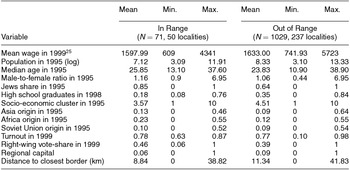
Table 3 presents the summary statistics of the various variables we use to compare localities within and outside the range.Footnote 24
Summary Statistics of Pretreatment Variables

Overall, the distributions of these variables is very similar across within- and out-of-range localities. For many variables (gender ratio, share of immigrants from the former Soviet Union, the mean wage, presence of a regional capital, and turnout in 1999) localities within the range have similar localities that are out of the range. Some variables, however, have nonoverlapping areas. Localities within the range are less populous than those outside the range, and their median age is higher, implying fewer children than in localities outside the range. Localities within the range have higher shares of residents with family origin in Asia and in Africa, and a lower share of high school graduates. Furthermore, localities within the range have higher right-wing vote-shares in the 1999 election and they are on average closer to the border than localities outside the range, but not by much.
It is important to note that even those variable that do not completely overlap have a broad range of common support, implying that for many localities within the range there are similar localities outside the range. Notwithstanding, in the robustness checks section, we drop observations with nonoverlapping values (outside of common support) to make sure our results are not driven by outliers.
RESULTS
Main Results
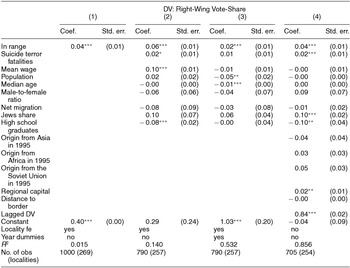
Table 4 presents the effect of being in the range on right-wing parties’ vote-shares. Column 1 reports the results of an OLS model with locality fixed effects. The estimated effect is a 4-percentage-point increase in the right-wing vote-share within the range (95% confidence interval is a 3–5-percentage-point increase). In column 2, we add time-varying controls, and the estimated effect of being in the range of rockets is now a 6-percentage-point increase in the right-wing vote share (95% confidence interval now is a 5–9-percentage-point increase). We add year dummies in column 3, which is our main specification as in Equation (1). The estimated effect of being in the range drops, but it is still positive and significant: being in the range adds 2 percentage points to the right-wing vote share (95% confidence interval is a 0.4–3-percentage-point increase). The fourth column presents the results of a lagged dependent variable model without locality fixed effects and year dummies.Footnote 26 In addition to the time-varying control variables, in this model we also control for Jewish voters’ origin, whether a locality is a regional capital, and distance to the closest border.Footnote 27 The estimated effect is an increase of 4 percentage points in right-wing vote-share in localities within the range (95% confidence interval is a 2–6 percentage-point increase).
The Effect of Being in the Rockets’ Range on Right-Wing Parties’ Vote-Shares

* p < 0.10; ** p < 0.05; *** p < 0.01.
Notes: Each column estimates a linear panel regression of locality right-wing vote-share on whether a locality is within rockets’ range.
Based on several alternative model specifications, our main results suggest that being in the range of rockets increases locality right-wing vote-share by 2–6 percentage points (95% confidence interval is a 0.4–9-percentage-point increase). Israel is a proportional representation system with a single district. The electoral threshold in 1999 and 2003 elections was 1.5% of the popular vote, and it was raised to 2% in 2006 and 2009 elections. The Israeli parliament (Knesset) has 120 seats that are allocated to parties that pass the electoral threshold proportionately to each party’s vote-share. Accordingly, a seat in the parliament requires 0.8% of votes.Footnote 28 Thus, an increase of 2–6 percentage points in the right-wing parties’ vote-shares implies additional 2–7 seats for the right-wing bloc, if all voters were within the rockets’ range.
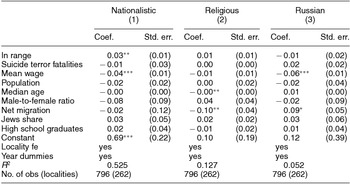
Table 5 presents the effect of range on components of the right-wing bloc. Nationalistic parties add 3 percentage points to their vote-share in localities that fall within the range of rockets (95% confidence interval is 0.3–5 percentage points). Religious parties gain 1 percentage point, but this result is not statistically significant. Parties of immigrants from the former Soviet Union lose 1 percentage point, but this result also falls short of statistical significance.
The Effect of Being in the Rockets’ Range on Right-Wing Parties’ Vote-Shares

Notes: * p < 0.10; ** p < 0.05; *** p < 0.01.
Column 1 estimates a linear panel regression of locality’s nationalistic vote-share on whether a locality is within rockets’ range. Column 2 estimates a linear panel regression of locality’s religious vote-share on whether a locality is within the rockets’ range. Column 3 estimates a linear panel regression of locality’s vote-share of parties associated with immigrants from the former Soviet Union on whether a locality is within the rockets’ range.
Looking at the effect of being in the range on individual parties, we find that Likud (the largest right-wing party) gets an additional 2 percentage points in localities that are within the rockets’ range (95% confidence interval is 1–3 percentage points). This is similar to the effect of being in the range on nationalistic and right-wing parties. Labor (the main left-wing party) and Shas (the main religious party) experience a minor increase and decrease in their vote-shares in localities within the range, respectively, but these effects are not statistically significant.Footnote 29
Does the Effect of Rockets Depend on the Party in Power?
There are several possible explanations why localities within the range have higher right-wing and nationalistic vote-shares. First, following the retrospective voting theory, support for these parties might increase because voters punish non-right-wing parties for exposing them to rockets. Indeed, the incumbent party in 2006 and 2009 elections was centrist (Kadima), and this might explain the increase in right-wing vote-share.
Second, right-wing vote-share might also increase because these parties enjoy a valence advantage on the security dimension. If the valence theory is correct, expansion of the rockets’ range would increase the salience of security issues, and benefit right-wing parties that are perceived to be more competent in matters of security.
To explore the conditional effect of rockets’ range on right-wing vote-share, we include a dummy variable RightPMt that is equal to 1 if the incumbent is from the right-wing bloc, and 0 if otherwise. We also include an interaction term: Range i, t × RightPMt that is equal to 1 if locality i is within the rockets’ range one day before election t and the incumbent is from the right-wing bloc, and it is equal to 0 otherwise. We estimate the following model:
 \begin{eqnarray}
Right Share_{i,t} \eqcellsep = \eqcellsep \alpha Range_{i,t} + \delta _1 RightPM_t+ \delta _2 Range_{i,t} \nonumber\\
\eqcellsep\eqcellsep\times RightPM_t\,{+}\,{\bm {\beta (X_{i,t-1})}} \,{+}\,\gamma _t\,{+}\,\mu _i+\varepsilon _{i,t}.\nonumber\\
\end{eqnarray}
The effect of being in the range under a right-wing incumbent is equal to α + δ2.Footnote 30
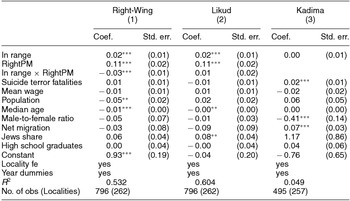
Column 1 in Table 6 reports the effect of rockets’ range on right-wing vote-share. The coefficients of the constitutive terms (Range i, t , RightPMt ) and the interaction term are statistically significant at 95% confidence level. Similarly to previous findings, right-wing vote-share in localities within the range is 2 percentage points higher than beyond the range when the incumbent is non-right-wing (95% confidence interval is 0.6, 3 percentage points). The interaction term, however is negative: adding the two coefficients suggests that right-wing parties lose 0.5 percentage points in localities within the range when the incumbent is from the right-wing bloc. This result, however, is not statistically significant, implying that when there is a right-wing incumbent, there is no difference in right-wing vote-share within and out of the range.Footnote 31 Overall, the marginal effect of being in the range, conditioning on the incumbent’s affiliation, is a 1-percentage-point increase in right-wing vote-share (this result is significant only at 90% confidence level). In light of this, we conclude that right-wing parties gain additional votes within the rockets’ range only when the incumbent is from a non-right-wing bloc. When the incumbent is right-wing, these parties also do not achieve substantial gains, as they do under non-right-wing incumbents. However, they are also not punished by voters.
The Effect of Being in the Rockets’ Range on Vote-Shares Conditional on Incumbent

Notes: * p < 0.10; ** p < 0.05; *** p < 0.01.
Each column estimates a linear panel regression of vote-shares on whether a locality is within range, conditional on the incumbent.
Column 2 presents the effect of rockets’ range on Likud vote-shares, conditional on the incumbent’s affiliation.Footnote 32 Under a non-right-wing incumbent, there is a 2-percentage-point increase in Likud vote-share within the range (95% confidence interval is 0.5, 3 percentage points). The overall marginal effect of Range i, t on Likud vote-share, conditioning on the incumbent, is a 2-percentage-point increase (95% confidence interval is 0.8, 3.7 percentage points). Thus, Likud experiences a similar increase in its vote-share within the range, regardless of who the incumbent is. Unlike the entire right-wing bloc, Likud’s vote-shares increase also under a right-wing (Likud) incumbent. Even though the interaction term is not significant, the overall effect (α + δ2) is positive and similar to the effect when the incumbent is from a non-right-wing bloc. It is important to note that this model includes year dummies, and therefore controls for secular trends that affect all Israeli localities, thereby isolating the local effect of being in the range on voting.
This result is consistent with the assertion that Likud, as a right-wing party, has valence when it comes to security problems. However, this might also be consistent with the “rally round the flag” effect, and a possible tendency of voters to support the incumbent party, especially when confronted with security challenges. Therefore, in column 3 we also examine the effect of rockets’ range on Kadima party’s vote-shares when Kadima was the incumbent.
Kadima was founded as a centrist party before the 2006 election, and ran in 2006 and 2009 elections. The incumbent in these elections was also from Kadima.Footnote 33 Since Kadima’s vote-shares are available only for elections in which Kadima is an incumbent, there is no need to include RightPMt and the interaction term (they drop out because there is no variation in RightPMt during these years). Results in column 3 suggest that expansion of rockets’ range does not affect Kadima’s vote-shares: The coefficient is negative, but substantively small, and statistically not significant at acceptable significance levels. Thus, unlike Likud, Kadima did not gain votes within the range when it ran as an incumbent.
These results lead us to the following conclusions: First, there is no evidence that incumbents are punished within the rockets’ range: right-wing parties did not lose votes in the 2003 election, and Kadima did not lose votes in the 2006 and 2009 elections. Second, right-wing parties gain votes within the range when the incumbent is non-right-wing. Moreover, Likud gains additional votes even when they are run as an incumbent. This cannot be interpreted as rally round the flag since Kadima’s vote-shares within the range do not increase when Kadima is in power. Instead, we view these findings as partially consistent with the valence argument: whereas Likud enjoys valence when it comes to security problems even when these problems emerge during Likud’s time in office, right-wing bloc as a whole gains votes only under a non-right-wing incumbent.
Robustness Checks
Using Table 3 we identify areas of nonoverlap between localities within and beyond the rockets’ range. We reestimate our baseline specification (column 3 in Table 4), and drop those observations that are outside of common support. This reduces the number of localities to 132.
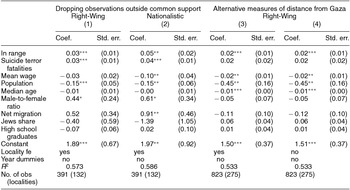
The results in Table 7 are substantively similar to our previous findings. Column 1 reports the effect of being in the range on right-wing vote-share, controlling for time-varying locality-level characteristics, as well as locality fixed-effects and year dummies. The result is positive and statistically significant, and suggests that localities within the range experience a 3-percentage-point increase in the right-wing vote share. Column 2 similarly estimates the effect of being in the range on nationalistic parties’ vote-share, and finds that it increases by 5 percentage points. These tests show that our results regarding the effect of being in the range of rockets on voting do not depend on incomparable samples: in fact, when we omit localities that are outside common support, the point estimate becomes larger.
Robustness Tests

Notes: * p < 0.10; ** p < 0.05; *** p < 0.01.
Columns 1 and 2 report results of a linear regression of right-wing and nationalistic vote-shares, respectively on whether a locality is within rockets’ range, after dropping observations outside common support. Columns 3 and 4 report results of a linear model of right-wing vote-share on whether a locality is within the rockets’ range using alternative measures of distance. In column 3, distance is measured from Gaza perimeter to locality’s center. In column 4, distance is measured from Gaza perimeter to locality’s perimeter, and 5 km are subtracted from rockets’ range to accommodate launching from within Gaza. Robust standard errors clustered at locality level are in parentheses.
Since we study the effect of being in the rockets’ range, it is important to make sure that our findings are robust to different methods of measuring distance from Gaza. Column 3 in Table 7 shows the results using the distance between the Gaza perimeter and the locality’s center (rather than the locality’s perimeter as before). In column 4, we subtract 5 km from the range to account for the possibility that rockets are not launched from the Gaza perimeter, but from areas within Gaza.Footnote 34 The results in columns 3 and 4 in Table 7 are very similar to our previous results (compare to column 3 in Table 4), suggesting that our findings do not depend on a specific method of measuring distance or on assuming that rockets are launched from the closest point within Gaza to Israel.
Are the Results Driven by the Intensity of Targeting?
One of the contributions of this article is to show that voting behavior could change due to the threat of being hit, and not necessarily following actual attacks. As we show in the previous sections, rocket fire has been far less lethal and far less successful at hitting inhabited places than suicide attacks. Nonetheless we detect a substantively significant effect on voting. Given that localities within the range are not substantially different from localities outside the range, we believe that this effect is driven by the threat of future attacks rather than by the intensity of past exposure to rockets.
Unfortunately, locality-level data on rocket hits are not publicly available due to the concern that they could be used to improve rockets’ accuracy. Nonetheless, we can use our data to demonstrate that this effect is not driven by direct targeting. For this purpose, we drop the town of Sderot from our sample and repeat our tests. As mentioned above, Sderot has been disproportionately targeted by rockets, and has absorbed half of the fatalities caused by rocket attacks. We show that our results do not change if we exclude Sderot, and thus are not driven by this exceptional case. The results of this test are available in the online Appendix (see Tables B.1). The results of this test confirm our main findings. What matters to voters is not how many times they have been targeted, but whether they are in the range or not in the range—which people are made objectively aware of by government officials.Footnote 35
Is Turnout Affected by Rockets?
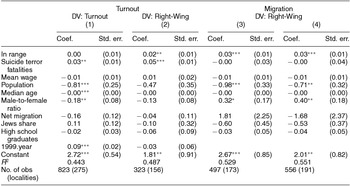
One potential explanation for the increase in the right-wing vote-share is that the composition of the electorate changes. For example, it is possible that left-leaning voters become less likely to vote when threatened by rockets, or right-leaning voters become more likely to vote. If this is true, then the changes in right-wing vote-shares are not driven by changes in voters’ positions, but by changes in the composition of the electorate. To investigate this possibility, in Table 8, column 1, we report the effect of being in the rockets’ range on turnout, using locality-level time-varying controls and fixed effects, as well as year dummies. These results suggest that the effect of rockets’ range on turnout is substantively marginal and statistically not significant. Localities that come into the range do not differ with respect to turnout from localities that are outside the range.
Ruling Out Turnout and Migration Explanations

Notes: * p < 0.10; ** p < 0.05; *** p < 0.01.
Columns 1 report results of a linear regression of turnout on whether a locality is within rockets’ range. Columns 2 and 3 report results of a linear regression of right-wing vote-share on whether a locality is within rockets’ range. Column 2 examines only those localities with above median turnout ( > 69%), and column 3 those localities with below median migration. Column 4 uses a sample in which we assume that all incoming residents are right-wing, and all outgoing resident are left-wing Robust standard errors clustered at locality level are in parentheses. All regressions include fixed effects and year dummies.
This, however, does not rule out the possibility that coming into the range simultaneously affects both the right-leaning and the left-leaning voters, such that the overall turnout remains the same, even though the composition of the electorate changes. To address this possibility, we reestimate our main specification using a subset of localities with turnout greater than 69% (the median turnout). In these localities, the majority of eligible voters vote. Therefore any difference in right-wing vote-shares must be due to voters changing their positions, and not changes in the composition of the electorate (i.e. a turnout effect). Column 2 in Table 8 is similar to the results we report in other specifications: being in the range of rockets increases the right-wing vote-share by 2 percentage points.
Are the Results Affected by Migration?
Another potential problem could be that the composition of residents changes when a locality enters the rockets range. Left-leaning residents might choose to leave and move out of the range, while right-leaning residents might choose to move into these localities to demonstrate their patriotism. In our estimations so far, we control for the net migration (incoming residents–outgoing residents). This, however, does not address the possibility that right-leaning and left-leaning residents might be moving simultaneously in and out of localities, respectively, such that the overall migration net is low despite changes in population composition.
To address this possibility, we use data on incoming and outgoing residents in each locality-year.Footnote 36 First, we reestimate our main specification using localities in which the number of incoming and outgoing residents is below the median in each category (lowest 50%).Footnote 37 Very few people move in and out of these localities, and any changes in vote-shares are therefore likely to be not due to migration, but due to changes in preferences. Column 3 in Table 8 presents the results of our main specification (comparable to column 3 of Table 4). These results suggest that among localities that experience low migration, those within the range have a 3-percentage-point higher right-wing vote-share than those out of the range.
Second, we create a new variable that conservatively estimates the number of right-wing vote-share in each locality, assuming that all incoming residents are right-leaning, and all outgoing residents are left-leaning.Footnote 38 This is a very strong assumption that allows us to estimate the lowest possible right-wing vote-share in a locality given that migration could pose a problem. We then reestimate our main specification using this conservative estimate as the dependent variable. Column 2 in Table 8 shows that the effect of range on this conservative estimate of right-wing vote-share is still positive and statistically significant: localities within the range experience a 3-percentage-point increase in the right-wing vote-share compared to localities that remain beyond the range.Footnote 39
SUMMARY AND IMPLICATIONS
Summary
In this article, we are asking how the threat of being targeted by terrorists affects voting behavior. We answer this question by focusing on the effect of being in the range of rockets fired from the Gaza Strip on voting in 2003–2009 Israeli parliamentary elections. We provide evidence that localities in the range of rockets are very similar to localities that are not in the range, and therefore the difference in voting is due to being in the range.
Our findings suggest that entering the rockets’ range substantially affects voting and increases support for the right-wing bloc, and especially for nationalistic parties. We find that right-wing vote share is 2–6 percentage points higher in localities that are within the range. We attribute this finding to the valence advantage that right-wing parties in Israel have with respect to security threats. Consistent with the valence explanation, we find that right-wing parties are not punished by voters, and in some cases even gain additional votes in localities that become part of the range during right-wing parties’ term in office. We demonstrate that these results are driven by being in the range, and do not depend on actual targeting, and on changes in the composition of the population and the electorate. Furthermore, we show that our results are robust to various model specifications, and different methods of defining and measuring the range.
Implications
Our finding that the threat of terrorism leads voters to support right-wing parties provides a plausible mechanism for why some conflicts endure: voters who are threatened with violence elect candidates who are less willing to make concessions. This further reduces the bargaining range between conflict participants, and decreases the chances of reaching a negotiated solution. Our results also provide empirical support for theories that posit that hard-line groups may use violence and the reaction it engenders to foment conflict, and discredit more dovish actors (Kydd and Walter Reference Kydd and Walter2002; Bueno de Mesquita and Dickson Reference Bueno de Mesquita and Dickson2007).Footnote 40
Our project is also related to recent studies on the efficacy of terrorism from the perspective of the terrorists (Abrahms Reference Abrahms2006 Reference Abrahms2012). If the terrorists’ goal is to scare a population into accepting the terrorists’ demands, our article suggests that this might be counterproductive. However, if the goal is to ensure conflict between the two sides, and marginalize doves on both sides, then it may be effective.Footnote 41 By using the randomized threat of rockets from Gaza, our study avoids issues of endogeneity—nonrandom selection of targets and strategic interaction between terrorists and targeted government—that limit the interpretations of previous empirical studies.
In addition to finding that voters within the range harden their attitudes towards the perpetrating group, we also detect an interesting incumbency effect. Rather than punishing incumbents who hold office during increases in the threat of rockets, our findings show that voters turn to the right-wing Likud party regardless of incumbency (and they do not punish right-wing parties even if the range expanded during their term in office). This finding parallels recent work that suggests voters choose parties who they feel “own” issues (such as the case of right-wing parties and security in Israel) (Wright Reference Wright2012). This has serious implications for bargaining and negotiations—violence leads to hard-line parties coming to power, making settlement less likely and future violence more likely.
We argue, perhaps counterintuitively, that the nature of the threat from rockets’ range provides a generalizable mechanism for how violence influences political behavior in other conflicts. Previous studies find that exposure to violence affects voting and political preferences (Berrebi and Klor Reference Berrebi and Klor2008; Gould and Klor Reference Gould and Klor2010), but that this effect dissipates if violence increases beyond a certain threshold, as the targeted population accepts high levels of violence as part of life (Jaeger et al. Reference Jaeger, Klor, Miaari and Paserman2012). If violence has diminishing returns in its impact on political preferences, then most of the substantial effects will manifest with violence that does not inflict a large number of casualties, like in the case of suicide attacks. Despite the number of rockets that have been launched into southern Israel, there have been relatively few casualties. Furthermore, the localities that are within the range in 2001–2009 have not been major targets of suicide bombings or other forms of terrorist attacks. We argue that the focus on threat and low levels of lethality is more relevant to understanding the broader impact of terrorism (e.g., in the US and Europe)—where most people are threatened by, rather than directly exposed to, the violence. This focus on the effect of rockets’ range differentiates our studies from purely retrospective studies of violence (Bellows and Miguel Reference Bellows and Miguel2009; Kibris Reference Kibris2011), as voters are weighing their past exposure and fear from future exposure (Huddy et al. Reference Huddy, Feldman, Taber and Lahav2005). Given the stated goal of terrorism to instill fear in a target populace (Abramson et al. Reference Abramson, Aldrich, Rickershauser and Rohde2007), this is a cleaner measure of the effect of terrorism.
Our research also has serious policy implications. Previous research on terrorism and political behavior has mostly focused on suicide terrorism. This research is unable to adjudicate on whether the main effect of terrorism on political behavior operates through casualty aversion or through living under threat. Using data on the range of rockets from Gaza, we show that merely being in range of terrorism, and not necessarily experiencing a high number of casualties, is sufficient to have a strong influence on voting. This implies that governments face a significant trade-off. Do they take every effort to warn residents and emphasize the wider level of threat, thereby fanning the effects of terrorism, or do they seek to reduce perceptions about threat and provide mechanisms for coping? This question may depend on the political affiliation of the leaders, with right-wing politicians showing a preference to increase the warnings over terrorism and heighten the threat level, rather than dampen it down (and left-wing politicians the opposite).Footnote 42
Finally, our findings also add nuance to other studies of indiscriminate violence, such as Lyall (Reference Lyall2009) who finds that randomized artillery shelling in Chechnya reduces insurgent attacks through intimidating the targeted population. Conversely, we find that randomized threat of violence increases hardline attitudes. Taken together, these findings suggest that the effect of violence (indiscriminate or otherwise) may be context dependent. We conjecture that the targeted actors’ military strength moderates this relationship. Israel is a stronger military actor compared to Hamas. Conversely, the Chechen rebels were weaker compared to the Russian army. Exposure to violence thus may harden the populace of a targeted stronger military actor, leading them to be more willing to fight. Yet, it may lead the populace of the weaker actor to favor withdrawal, and concessions to the perpetrating actor. Given the role of civilian victimization in several recent conflicts—Syrian Civil War, US drone strikes in Pakistan, and post-Mubarak violence in Egypt—this hypothesis deserves further scrutiny.
Supplementary materials
To view supplementary material for this article, please visit http://dx.doi.org/10.1017/S0003055414000288







Comments
No Comments have been published for this article.