WIVES AND DAUGHTERS (1864–66) has been called “the most neglected novel of its century,” indeed the “most underrated novel in English” (Lerner 7, 27). In the thirty-odd years since Laurence Lerner made these claims in the introduction to a Penguin Classics edition of Elizabeth Gaskell's last and greatest work, several writers have striven to rectify this oversight. In biographies and thematic studies, note has been taken of Gaskell's formal innovation in Wives and Daughters in relation to her earlier work, particularly the striking effacement of the narrator (Lansbury) and ways in which the novel displays awareness of fictionality and storytelling (Lansbury, Schor, D'Albertis). Wives and Daughters has usefully been compared with novels by Jane Austen and Charlotte Brontë in the way it embodies techniques and concerns of the genres of comedy of manners and Bildungsroman, and with novels of George Eliot, particularly Middlemarch, for the way it anatomizes a whole society (W. A. Craik 208; Uglow 583–84; Morris xi). Equally satisfying to readers who discern substance and purpose in Gaskell's effortless storytelling are recent discussions that take Gaskell seriously as a thinker (not, that is, a systematic thinker, but a thinker-in-fiction, like her contemporaries Dickens and Thackeray): for example, Hilary Schor and Deirdre D'Albertis analyze systems of knowledge in Wives and Daughters, paying particular attention to the novel's use of themes centered on classification and natural history and to ways the novel distinguishes women's knowledge and concerns from those of men.
So rich is the tapestry Gaskell weaves in her “Every-day Story” that, as W. A. Craik notes, “[i]t is not possible to point out a main theme in Wives and Daughters” (208). However, as the novel's title suggests, the trope of classification is central to its meaning. And, reading through the lens of classification, it is possible to trace a different pattern from those previously remarked, a pattern in which social class figures more prominently than gender and in which science and classification, far from providing “an ominously totalizing vision of social order” (D'Albertis 140), play a more complex, and positive, role.
Wives and Daughters, like Middlemarch, is set in a time of transition; the novel's “main action runs roughly from 1827 to 1830” (Uglow 580).1
Text references for Wives and Daughters are to the 1969 Penguin Classics edition.
One of the dilemmas of this transition period that still resonated in the 1860s was how to understand social class, the system that, ushered in by the growing industrial and urban economy, was coming to replace the traditional system of rank. Jenny Uglow has said that Gaskell's “is a fiction of ideas, acting out the dilemmas that preoccupied her time” (x). In
Wives and Daughters, Gaskell puts the town of Hollingford under a microscope in order to dramatize both the difficulty and the necessity of classifying people correctly. Gaskell juxtaposes the discourse of natural history and the discourse of social class as she tells the story of Molly Gibson's awakening into adult life in Hollingford and love for Roger Hamley. The trope of classification implicitly connects scientific and social themes of
Wives and Daughters, which meet in the person of Roger, second son of Squire Hamley of Hamley Hall. Before Roger and the teen-aged Molly meet, however, the novel's first two chapters, in a kind of prologue, adumbrate the themes that will unfold as Molly grows, particularly themes of social class and how people know each other and are known.
Gaskell's narrator points out on the second page of Wives and Daughters that the story takes place before the passing of the first Reform Bill (36; ch. 1). (The novel was published shortly before the second Reform Bill was passed.) This information comes in the context of introducing Lord and Lady Cumnor and their manor house, whose great park abuts the little town of Hollingford, “where a very pretty amount of feudal feeling still lingered” (36; ch. 1). The gregarious Lord Cumnor has impulsively asked Mr. Gibson–“the doctor of the neighborhood”–to send his little girl to the upcoming festivities at the manor house (39; ch. 1). Mr. Gibson is a Scottish country surgeon with a “thistly dignity which made every one feel that they must treat him with respect” (70; ch. 4). Unlike his predecessor, Mr. Gibson moves freely in Hollingford society; Molly's invitation to the manor house party signals that she will, too. In a society shifting imperceptibly but inexorably from rank to class as a way of understanding where people fit, Gibson, like several prominent characters in the novel, is of liminal status. His title is “Mr.”, not “Dr.”, a title reserved for physicians; but his manner demands and obtains respect.2
As I have discussed elsewhere, distinctions of rank and class were not as strongly marked in Scotland as in England in the late eighteenth and early nineteenth centuries (Boiko, ch. 1). Further, as is now well established, both Scottish medical education and Scottish doctors in the early nineteenth century were strong proponents of the kind of radical politics that aimed to overturn superstition and idle aristocrats and to promote a middle-class ethos.
Making rounds with her father, Molly is sitting on her pony when Cumnor notices her or, rather, her-and-her-pony, for the Earl is more attentive to the pony than the girl. (It seems that my lord and lady do not see the inhabitants of Hollingford very clearly in general: shortly before this same fête day they are astonished to learn that there are not one but two women by the name of Browning who visit the school for laboring girls set up by Lady Cumnor [41; ch. 1].)
As the gala day dawns, twelve-year-old Molly can hardly contain her excitement at the prospect of visiting the manor house, known as the Towers. Narrating the episode in the manner of a fairy tale, Gaskell leads us to believe, with Molly, that her encounter with great folk will be a transforming event. Initially Molly is awed by the grandeur of the house and the beauty of the gardens but soon, amidst the greenhouses and hothouses, she feels stifled. Wandering the grounds she loses her way, grows weary, and falls asleep under a tree. She is awakened by the voice of a woman who “at first sight Molly thought she was the most beautiful person she had ever seen” (46; ch. 2). Her rescuer is Hyacinth Clare Kirkpatrick, a former governess at the manor, who will later marry Molly's father. Clare (as she is called by the Cumnors) proves to be neither fairy godmother nor wicked stepmother. She is not unkind, but she is self-absorbed, as we instantly glean when she eats the reviving lunch intended for Molly and then, after putting the headachey girl to bed in her own room, forgets all about her. While shepherding Molly around the Towers, Clare tells her that her deceased husband, Mr. Kirkpatrick, “was only a curate, poor fellow; but he was of a very good family, and if three of his relations had died without children I should have been a baronet's wife” (51; ch. 2). It would have been hard for Clare to find an interlocutor less interested in such tantalizing contingencies than Mr. Gibson's girl, unless it were the doctor himself. When Molly finally wakes, she is miserable. The carriages have left; she must socialize with elegantly dressed gentlemen and ladies and, it appears, spend the night at the Towers, where she is deeply uncomfortable. In the event she is rescued by her father, to whom she confesses, “Oh, I do hope I shall never be a lord or a lady” (59; ch. 2). Molly's day among fine folk has fizzled. Although Molly will later enjoy herself in society at the Towers, with this episode Gaskell gently makes the same point Dickens made a few years earlier with Pip's more extended and grotesque experiences at Satis House: happiness is not to be found in being swept, Cinderella-like, into the upper ranks of society.
Still, as the dramatic manner of their first meeting suggests, Hyacinth Clare Kirkpatrick Gibson will play an important role in Molly's life and in Gaskell's narrative: she is a vivid foil whose “superficial and flimsy character” sets off Molly's own strong character and bedrock values (175; ch. 12). Clare's eye is perpetually on the main chance; such interior life as she has consists mainly in arranging and rearranging folk on the rungs of an imaginary social ladder. She is practically obsessed with hereditary status. When she marries Mr. Gibson, one of the few books she brings to her new home is a tome on the peerage in which she studies the Duchess of Menteith's connections (316; ch. 25), bringing to mind another mother fascinated with aristocratic connections, Belinda Pocket in Great Expectations. Like Matthew Pocket's wife, Clare tries to classify everyone according to an increasingly irrelevant system, and much of the novel's comedy springs from her failed attempts at reading the true worth and true relationships of her neighbors. The novel's lighter moments include her misguided matchmaking attempts on her daughter Cynthia's behalf and her fawning over Lady Harriet, unmarried daughter of the Cumnors. This comedy mingles with a more rueful irony when we see Clare's inability to reckon the true worth of Mr. Gibson, Molly, and the Hamleys.
Roger Hamley, on the other hand, is a keen observer. The younger son of the local squire, he is a naturalist who collects specimens and contributes articles to scientific journals. When Lord Hollingford recommends Roger for an award that will support him on a voyage to Africa, he notes that besides “much acquired knowledge” Roger has “great natural powers of comparison, and classification of facts; he ha[s] shown himself to be an observer of a fine and accurate kind…” (410; ch. 33). It is Roger who rescues Molly the next time she collapses under a tree, on the grounds of Hamley Hall, when she is in tears over her father's plans to wed Clare.
Reading this scene in counterpoint with the earlier one illuminates the novel's structure: unlike Clare, who puts Molly to bed hungry in the Towers and lets her oversleep, Roger offers Molly comfort and advice; he takes her hand when she stumbles. After dinner he brings out his microscope and shows her “the treasures he had collected in his morning's ramble,” and Molly is “refreshed by a new current of thought” (155; ch. 10). We see that it is not Clare but Roger who will be Molly's mentor (172; ch. 11). He values reading and studying, typical Bildungsroman tasks in which even Molly's father has been remiss in encouraging her.3
Unlike Gaskell's own father, who encouraged her to study and thought that women should be intellectual companions for their husbands (Uglow 41), Gibson says he is “not sure that reading or writing is necessary” for a woman (65; ch. 3), a point of view decidedly atypical for a man of Gibson's background. The doctor seems to be indulging his sarcastic side when he makes this statement, yet he does seem concerned that “too much” learning might spoil his daughter's “mother-wit.”
His moral compass is truer than Clare's: he not only offers well-intended sermons on thinking of others first and hoping for the best, but he does as he preaches, acting kindly and generously toward Molly, his father, his brother, and his brother's widow. And his keen powers of observation are precisely what Molly needs to develop, as she is brought into a wider circle of acquaintance and at the same time subjected to her stepmother's narcissism and her constant (mis)evaluations of her neighbors. As Coral Lansbury has said, “Roger not only loves the country, but he understands it, and he teaches Molly to have the same awareness of the life around her” (193). Lansbury refers here literally to plant and animal life, but, as her wording suggests, this power of observation extends for Molly to all the life around her, including the human. If Roger's advice is sometimes “only comparatively right,” as when he counsels Molly to be unselfish (W. A. Craik 217), and if he mistakes his own best interest in matters of the heart, he is nevertheless the novel's hero, and he is thoroughly identified with natural history and its methods. The naturalists whose works Roger reads and offers to Molly provide clues that, like the letter in Poe's story, have been in view all along yet overlooked–clues to the way we are to read the detailed markers of social class with which Gaskell fills
Wives and Daughters. Tracking these clues, along with Gaskell's character descriptions, brings the discourse of class in mid-Victorian literature, itself always in sight and always hard to see, more clearly into view: it shows how
Wives and Daughters is aligned with such mid-Victorian works as
Great Expectations,
John Halifax, Gentleman, and
Self-Help in writing a discourse of class that finds distinction in character rather than inheritance or money.
Text and Context: Natural History
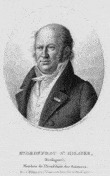
THE SIGNIFICANCE OF HUBER, Cuvier, and Geoffroy (see Figure 9), the natural historians whose work Roger Hamley studies and responds to, has been obscured by the light of Charles Darwin, the novel's great, if unnamed, scientific presence. Particularly since the publication in 1983 of Gillian Beer's study of nineteenth century fiction, Darwin's Plots, Darwin's career and evolutionary theory have been fertile ground for scholars of Victorian literature. And it is easy to see why recent Gaskell scholars have emphasized links to Darwin and the ideas of Origin of the Species in their treatments of Wives and Daughters. As has often been noted, Gaskell was distantly related to the great man and occasionally met him socially; she even named him in a letter outlining the novel to her publisher, George Smith: “‘Roger is rough, & unpolished– but works out for himself a certain name in Natural Science,–is tempted by a large offer to go round the world (like Charles Darwin) as naturalist’” (qtd. in Lansbury 194–95).4
See also Uglow (219, 397, 560–61) and Gérin (277) on Gaskell's connection to Darwin. D'Albertis emphasizes the resemblance between Darwin and Roger (215, n. 2).
Further, elucidating Darwinian themes in
Wives and Daughters gives Gaskell's thought the sheen of the cutting edge, a sheen understandably to be desired by scholars who saw Gaskell's reputation gather dust far too long as that of a pleasant lady novelist. Finally, the novel does lend itself to a Darwinian interpretation in certain regards. For example, among the plot's many “comically ironic reversals” (Morris xi) are the characters and fates of Osborne and Roger Hamley. Osborne, the languid elder brother, is no fit heir, as the novel makes clear with repeated emphatic distinctions between him and the resourceful and hardworking Roger. In this pattern demonstrated by the Hamley family D'Albertis, for example, reads Darwin's notions of natural and sexual selection as a way of explaining the “radical uncertainty of inherited traits and possessions” (141). In D'Albertis's reading, Darwinian theory also provides a context for understanding the theme of nature vs. nurture that pervades the novel, the social climbing of Mr. Preston, and even the contrasting heroines, Molly and Cynthia (141–50).
Anonymous, Geoffroy St. Hilaire (1772–1844). Etching. Courtesy of the Burndy Library, Dibner Institute for the History of Science and Technology, Cambridge, MA.
In addition to Darwin, Gaskell knew personally a number of engineers and scientists, including naturalists, through her husband, William.5
See especially Uglow (559–61).
Her husband helped organize the meeting of the British Association for the Advancement of Science in 1861, when “scientific discoveries were still topics of general conversation” (Uglow 560). Gaskell made Job Legh in
Mary Barton (1848) a naturalist, and she put engineers and engineering at the center of
Cousin Phillis (1863). Thus it is reasonable to attribute an interest in scientific theories to Gaskell, and reasonable to attribute to her awareness of Darwin's theories in particular.
Wives and Daughters began to appear serially in the
Cornhill in 1864, giving Gaskell ample time to become familiar with Darwin's ideas on evolution. But, as is by now well known, evolutionary theory did not make a sudden appearance on the Victorian stage in 1859 with the publication of
Origin of the Species. Robert Chambers's popularizing 1844 book,
Vestiges of the Natural History of Creation, was a sensation. Moreover, the views of the French naturalists Lamarck, Cuvier, and Geoffroy had made their way back to Edinburgh in the late 1820s, as students returned from Paris to teach at the eminent Scotchish medical school. While some of the ideas promulgated by these French naturalists, such as Lamarck's doctrine of inherited characteristics, proved false, there was much in the thought of all three that anticipated Darwin's scheme of evolution. Samuel Smiles began attending classes at Edinburgh University in 1829, during his surgeon's apprenticeship, shortly after Darwin left Edinburgh. One of Smiles's instructors, John Fletcher, was a “passionate advocate” of Geoffroian science (Desmond 75). In his
Autobiography, Smiles describes Fletcher as “a most profound lecturer” and observes that, “[w]hen the works of Darwin afterwards came out, I felt that Fletcher had long before expounded very much the same views; or, at all events, had heralded his approach” (35). (Smiles's intent here is not to debunk Darwin, whom he greatly admired, but to point up the sophistication of Edinburgh medical education.) Thus, when Darwin's
Origin was published and when Gaskell was writing
Wives and Daughters, a largely materialist discourse concerning the evolution of life had been intellectually fashionable for more than thirty years–a discourse strongly linked with the ideology of progress and social reform at the University of Edinburgh and in Paris.
This discourse of evolution was part of a wider discourse of natural history. Natural history as an eighteenth-century way of understanding order –taxonomy–is contrasted by Foucault, in The Order of Things, with natural history in the nineteenth century, when “it became possible to replace natural history with a ‘history’ of nature” (275). Foucault sees classification as the methodology of naturalists giving way in the nineteenth century to comparative anatomy. That is, the exhaustive naming project of classic Linnaean taxonomy, in which plants and animals were classified according to four rigid and arbitrarily chosen variables, was supplanted by the study of the function of organs and the relations of surface and interior parts of organisms. Language was no longer treated as though it were transparent, and a new awareness that organisms and species have a history permeated the field. In Foucault's scheme, the turning point in this shift in “fundamental codes” is the work of Georges Cuvier (1769–1832), whose four-volume Le règne animal (The Animal Kingdom) was published in 1817. (A five-volume second edition of Cuvier's masterwork, which Lord Hollingford admiringly says Molly is “up in,” was published in 1829, the approximate time of the novel's action (339; ch. 26).)
Foucault's analysis of the codes of natural history and the ways they are aligned with other aspects of (mostly French) thought in the eighteenth and nineteenth centuries is, as we expect with Foucault, many-layered. I mention it here for two reasons: first, because it attests to the importance of natural history in Victorian intellectual culture; and second, because the role of classification in his scheme, somewhat simplified for the purposes of contrast, has been taken up by scholars in a way that can be misleading. Foucault himself reminds us that his analysis is not a history of ideas or of science, but an exploration of the “space of order” in which such “knowledge was constituted” in the eighteenth and nineteenth centuries (xxi–xxii). But in recent commentary on Wives and Daughters, Foucault's historical epistemology has obscured the history of science that is pertinent to patterns of meaning in the novel. Thus both Schor and D'Albertis, in their studies of Gaskell, seem to suggest that classification, the “obsession” of the eighteenth century (Schor 184), is incompatible with evolutionary theory (D'Albertis 137)–that it has become intellectually irrelevant, even disreputable, by the time Gaskell writes Wives and Daughters. To the extent that Gaskell's novel makes use of classification as a narrative method and an emblem of science, they suggest, it is only to overturn it in favor of Darwin's more variegated and indeterminate way of ordering nature (Schor ch. 6; D'Albertis ch. 5).6
Both Schor and D'Albertis align scientific discourse and its pursuit of order–classification–with maleness and patriarchy. Their larger purpose involves showing how women's “irrational” discourse– “gossip” (Schor) and “dissembling fictions” (D'Albertis)–critiques and subverts the male penchant for order. While I am linking Schor and D'Albertis here in their use of Darwinian theory and the ways they view classification, their interpretations of the novel differ significantly.
But classification is not coterminous with the Linnaean system of taxonomy, nor did classification fade away as a meaningful scientific activity in the nineteenth century, as Foucault might seem to suggest when he says that from Cuvier on “the project of a general taxinomia disappears” (268).
Natural history and classification were not solely the concern of the academy in early- and mid-Victorian Britain. Natural history – collecting beetles and butterflies, shells and seaweeds–was an extremely popular leisure activity throughout Gaskell's life and career. Both a Handbook of British Flora and a shilling handbook on the Common Objects of the Country were published in 1858, the year before the Origin of the Species appeared. Common Objects, by a Rev. J. G. Wood, sold 100,000 copies within a week (Allen 124).7
Allen points out that the split between professional and amateur in the life sciences did not become pronounced until the 1870s, when the influence of the German university system increasingly made itself felt in Britain (see 162–63 and ch. 9 passim). Even then, amateur naturalists abounded in England.
(Allen notes for comparison that Smiles's
Self-Help and Mrs. Beeton's
Book of Household Management, published the following year, sold around 20,000 copies during their first year in print.)
The Magazine of Natural History was published semi-monthly from 1828 until 1840, when it merged with another scientific journal (Allen 86). In addition to mid-Victorian periodicals such as the
Magazine of Zoology and Botany and the
Entomologists' Weekly Intelligencer (Allen 86, 73), the output of high quality popular books was extraordinary. Jardine's
Naturalist's Library, running to forty volumes in all, appeared from 1833 to 1845 at a relatively low price;
A Popular History of British Seaweeds “fully liv[ed] up to its title, for it ran to a third edition” (Allen 87, 116). In 1815 the first volume of the “influential” and “unusually attractive”
Introduction to Entomology was written by the Rev. William Kirby, who had already written a monograph on English bees, and William Spence; this highly popular work “passed through several editions by the time the third and fourth volumes were ready to be added in 1826” (Allen 90). Allen emphasizes that many of these works, particularly Kirby and Spence's, were highly engaging and very well written, a point to which he attributes the conversion of many young people from “listless and transient” collecting to serious pursuit (91).
This brief catalogue reminds us that Roger Hamley's youth coincides with a time when the popular study of natural history was flourishing in Britain. When Molly tells the puzzled Miss Brownings that Roger wanted her to notice how many bees she saw, and “to notice the difference between them and flies,” for there were “more than two hundred kinds of bees in England,” the outspoken Miss Browning remarks “Bees, child! What do you mean? Either you or he must have been crazy!” (184; ch. 13). But given the tremendous popularity of reading about and collecting species of insects and plants during the time when Wives and Daughters is set, Roger's loaning Molly Huber's book and making her a present of a wasps' nest are not as eccentric as they appear to Molly's friends and, perhaps, today's reader. Roger's advice to Molly makes it apparent that classifying was part of the popular study of nature in the nineteenth century, however much it may have been an archetypal eighteenth-century epistemology. In Foucault's scheme classification is associated with the museum, a confined and inert space, in contrast with history, which endlessly ramifies and which literally cannot be pinned down. This notion of the museum, invoked in Schor's rich discussion of Wives and Daughters (205ff), is perhaps best exemplified by Mr. Transome in Eliot's Felix Holt: an old man who has become as desiccated as his specimen insects. While the museum trope has proved useful in Victorian studies, we should not let it obscure the fact that classifying is an activity, a process. It is a kind of intellectual work, whether undertaken as mental exercise or in the hope of adding to the sum of human knowledge. As we shall see, classification as work plays an important role in Gaskell's analysis of social class.
Be it for personal or public gain, the pursuit of natural history was, as Allen convincingly demonstrates, an inherently social activity. Gaskell demonstrates this, too, in the way she portrays the relationships between Roger Hamley, Mr. Gibson, and Lord Hollingford, and even Roger and Molly. Roger is already a serious student of nature when the novel's main action begins. When he stumbles upon Molly crying under the ash tree, he is carrying his “wet sling-net” full of insect specimens he has just collected; he is looking “with those bright keen eyes of his” for a rare wildflower, which could well be Molly herself, though it takes the young naturalist a good while to recognize her as such (148; ch. 10). We soon discover that not only does Roger participate in the popular British pastime of collecting specimens, but he also participates in the discussion of the new French ideas on anatomy. Roger, Gibson, and Hollingford, though born into different classes, are friends and more or less equals in the “European Republic of learned men” (68; ch. 4). As a dinner guest of the newly-married Gibsons, Roger “was exceedingly interested in what Mr. Gibson was telling him of a paper on comparative osteology in some foreign journal of science, which Lord Hollingford was in the habit of forwarding to his friend the country surgeon” (306; ch. 24). When Roger later publishes a paper supporting Geoffroy's views, Gaskell imagines the French scientist visiting Lord Hollingford and desiring to make the acquaintance of the young naturalist whose paper “had already attracted the attention of the French comparative anatomists” (343; ch. 27).8
Gaskell consistently spells the French scientist's name “Geoffroi,” which is more typical of French orthography but in this case incorrect.
Roger Hamley and Geoffroy St. Hilaire
NOT ONLY WAS THE PURSUIT OF NATURAL HISTORY a social activity, but the ideas of the leading naturalists in the 1820s and '30s came to have social meanings that went far beyond the notebook and laboratory, none more so than Geoffroy St. Hilaire, whose ideas Roger defends. The image of classificatory systems as rigid and not equal to representing real world relations, as evoked by D'Albertis and Schor, suggests the Linnaean system–that is, one with large intervals between species. Geoffroy, whose views Roger advocates, saw classificatory method in a new light. It was not about “divisions and ruptures,” but, rather, about a chain of relations: “General classification had no merit, in his eyes, apart from the negative merit of not breaking the natural rapprochement, the direct connections of species” (Larousse 8: 1181, my translation).
Geoffroy is the overlooked clue to understanding the role of classification in Wives and Daughters. The 1969 Penguin edition fails even to identify Geoffroy in an endnote, while the 2001 edition identifies him by saying that he is mentioned by Darwin in the preface to the Origin of the Species and that Gaskell met his son in 1855 (665, n. 4). If it is hard for twentieth- and twenty-first-century readers to imagine Geoffroy in any light but that dispersed by Darwin's reputation, early- and mid-Victorians who kept up with literature and science would have automatically linked his name with that of Cuvier, and would have recognized him in his own right for, as George Henry Lewes put it, a “noble life, and a doctrine large in its conception [and] fruitful in its results” (160).
Etienne Geoffroy St. Hilaire was born in 1772 into a good family with little wealth (Lewes 161). It was Geoffroy, already installed alongside Lamarck as a professor at the Museum of Natural History in Paris's Jardin des Plantes, who called Cuvier from obscurity in 1794 to join him on the faculty (Lewes 164–66). As this date suggests, the beginnings of Geoffroy's career coincided with the Terror following the French Revolution. In his 1854 profile of the “Life and Doctrine of Geoffroy St. Hilaire,” Lewes recounts Geoffroy's heroics on behalf of his professors of natural history. The men were priests and in great danger. The young Geoffroy waited eight hours one night on a ladder propped against a prison wall, rescuing twelve men from “massacre” before being shot at himself (163–64). In 1798 he joined Napoleon's danger-filled expedition to Egypt (Lewes 167). In the summer of 1830, at the zenith of his career, even though he “gloried in the Revolution” Geoffroy again saved a cleric, giving the Archbishop of Paris asylum from the mob (Lewes 173). His debate with Cuvier was conducted at the Académie's weekly meetings from mid-February to April 5, just a few months before the Revolution of 1830. The debate was seen by the likes of Goethe and Balzac as “a major event in French intellectual history”; indeed, Lewes says, for Goethe it “completely overshadowed…the importance of the Revolution itself” (Appel 175; Lewes 171). Geoffroy died in 1844 at the age of 72, “a popular hero,” says Toby Appel in The Cuvier-Geoffroy Debate: “Nearly two thousand people attended the ceremony at Père Lachaise cemetery,” including leading figures from the worlds of science, literature, art and medicine (188).
Cuvier, in lecturing on Le Règne Animal, had connected anatomy–previously a mere “adjunct of medicine”–with natural history; he provided the framework for a new field of zoological study, comparative anatomy (Appel 4, 7). He posited four basic plans of organization in the animal kingdom–vertebrate, articulate, mollusk, and radiate–with no transitions between plans. Although Cuvier's system was sophisticated and powerful, for him species remained static or fixed (Lewes 172). In contrast, Geoffroy developed the idea of “unity of composition,” namely, that “throughout the infinite variety of organic forms there runs one principle of composition: that there is one type underlying all diversities” (Lewes 176). He explained this unity by means of a theory of homologies or “analogues” (Lewes 173). That is, he looked neither to the forms nor functions of parts but to the connections between parts–the “‘resemblances,’ or constant relations of structure” (Appel 4; Lewes 177). Geoffroy “proposed to take comparative anatomy beyond description and classification and, by the process of abstraction to make it truly ‘philosophical’” (Appel 4).
The debate between Cuvier and Geoffroy was prompted by the latter's claim that invertebrates progressed to vertebrate form by way of the cephalopods; Cuvier did not believe in such links or passages. As Appel has demonstrated, the meanings of the debate were multiple, with some of them developing in the decade after the debate as Geoffroy continued to publicize his ideas with Sunday evening salons and copious writing (Appel 176–78). It is this debate, which produced an “immense” sensation in Europe (Lewes 173), that Roger Hamley appears to enter on Geoffroy's side. Lord Hollingford tells Molly that Roger's recently published article “had excited considerable attention, as it was intended to confute some theory of a great French physiologist” (339; ch. 26). The “great French physiologist” was undoubtedly Cuvier: a few pages later Gaskell tells us that Roger's paper advocated Geoffroy's views; that's why the Frenchman wants to meet Roger at Lord Hollingford's (343; ch. 27). Gaskell also suggests that Lord Hollingford's views are very similar to Roger's (343; ch. 27).
Why would Gaskell align Roger and Lord Hollingford with the views of Geoffroy? Not, we can safely say, because of their views on cephalopods. To this extent, Enid Duthie is correct when she says that “the exact nature of Roger's views as a naturalist is unimportant” to Wives and Daughters (33); Gaskell is not concerned with the details of the debate.9
Duthie notes that Geoffroy's “fundamental idea was the unity of all animal life,” but she doesn't explore what that might mean in Wives and Daughters; rather, she relates it to “emergent Darwinism” (32).
If Gaskell read Lewes on Geoffroy, which it is likely she did given that the article appeared in the
Westminster Review, she read an account of the scientist's life that was already highly moralized. Lewes paints Geoffroy as both a hero and an attractive man, one who was deeply committed to science and a faithful friend, as Roger Hamley was a faithful friend in trying circumstances to his brother Osborne. Cuvier was “cold” and “logical,” while Geoffroy was “intuitive and impetuous” (Appel 6). Although he was a Protestant, Cuvier was associated with the Catholic elite by way of the Académie; he favored government by expert administrators and feared the mob (Appel 9). By contrast, the sympathies of Geoffroy, a Deist, were with the people. The “considerable support Geoffroy received” in the months leading up to both the debate and the revolution, Appel says, “can be attributed in part to the association in the public mind between Geoffroy's view of nature and the liberal ideology of the 1830 Revolution” (9). Further, Cuvier stood in the public mind for the new generation of science professionals, while Geoffroy insisted on keeping science linked to philosophy and to life (Appel 7). “In short,” says Appel, “by championing Geoffroy, the underdog in the debate, one could protest the advent of modern professional science, its loss of scope and relevance, and the elitist institutions that perpetuated it” (177).
In addition, Cuvier and Geoffroy differed in their take on scientific method, a point that played a large part in the controversy: Cuvier was a strict empiricist, while for Geoffroy, “[f]acts were only the building blocks of science; the essence…was ideas” (Appel 6–7). Thus many of their contemporaries, including Goethe, who was of Geoffroy's party, interpreted the debate as being between facts and ideas, or analysis and synthesis (Appel 7).10
Appel remarks that both scientists held what we would now see as extreme positions in the debate (3). The debate was most commonly interpreted as being between teleology (function) and morphology (structure, or the relationship of parts to whole). Appel argues that the ways the next generation of comparative anatomists reconciled the two positions advanced zoological thought and “played an important and, until recently, overlooked role in the development of Darwin's thought” (5).
In the event, Cuvier was judged to have a better command of anatomical detail and logic, and Geoffroy's speculative doctrine of the unity of composition was rejected, in part because he could not adequately explain it (Appel 3, 5; Lewes 184). Lewes himself points out that Cuvier was clearly right on the particular question of cephalopods that sparked the debate (172). Yet Geoffroy's “philosophical anatomy,” the study of the relations among anatomical structures in animals, “became an integral part of biological science in France and Britain” (Appel 3).
After Cuvier's death in 1832, Geoffroy reached out to the public. His writing now had less and less to do with research and more to do with promulgating his romantic vision of “a progressive, Newtonian universe” (Appel 176). As academic scientists turned away from Geoffroy, he attracted writers and political activists to his views. Geoffroy believed that “[t]he gradual perfection of animal structure was followed by a gradual perfection in the moral development of man. The history of man…was that of the progressive development of humanity from darkness to intelligence” (Appel 185).11
Geoffroy was a thinker in the grand French style (Appel 186). The ideas he propounded in the 1830s were speculative in two senses: he went beyond the available evidence when he insisted that “there was only one set of laws in nature for organic and inorganic bodies, for physiology and psychology” (Appel 179); and he left the realm of evidence altogether in his speculations on God, progress, and moral perfection.
Appel observes that “Geoffroy's universe, created by God and continually evolving to an ever great perfection, presented a welcome alternative to the traditional religious world-view, an alternative that offered the possibility of social reform” (176). Geoffroy's beliefs sound strikingly similar to the Unitarian creed in which Gaskell was steeped (Uglow ch. 1; Lansbury ch. 1), and begin to suggest why she would make Geoffroy the cornerstone of Roger's career as a naturalist.
Geoffroy's public relations campaign was a great success. Among those who came to his salons and took up his cause were Balzac, George Sand, and the historian Edgar Quinet. Geoffroy was depicted by his followers as “a philosopher dedicated to unraveling the mysteries of nature for the common man” (Appel 9). He adopted “the role of an outcast” and was in turn supported by men and women who were dedicated to changing the establishment (Appel 186). Balzac referred to Geoffroy and the debate in two of his novels of the 1830s (Louis Lambert and Un grand homme de province à Paris) (qtd. in Appel 175). He dedicated the second edition of Père Goriot (1842) “‘To the great and illustrious Geoffroy Saint-Hilaire as a tribute of admiration for his labors and his genius’” (qtd. in Appel 175). In the foreword to La comédie humaine (1842), “Balzac's most widely read discussion of the debate, Balzac explicitly modeled his conception of ‘social species’ on Geoffroy's doctrine of unity of composition,” and he declared that Geoffroy had “triumphed” in the debate with Cuvier (Appel 191).
Gaskell's Comparative Anatomy
THUS GEOFFROY'S PHILOSOPHICAL ANATOMY offered Gaskell a model for social classification that was understood in literary and intellectual circles in England and France to be progressive. It was a model based on Geoffroy's well known republican sympathies and his belief in the moral development of humankind–on the personal, social, and professional values Geoffroy stood for–more than his specific scientific doctrines. Gaskell's method clearly parallels the work of comparative anatomy signaled by references to Le Règne Animal. The author herself points up this analogy and at the same time makes a joke at her own expense when Molly says to Lady Harriet, the character who stands most in the relation of a novelist to the others, “‘your ladyship keeps speaking of the sort of–the class of people to which I belong as if it was a kind of strange animal you were talking about…’” (196; ch. 14). In particular, Gaskell gives us in Wives and Daughters a striking number of detailed physical descriptions of male characters. Most notable are the repeated comparisons of Roger Hamley and his elder brother, Osborne. Squire Hamley himself remarks that Osborne “takes after his mother” and “has a girl's delicate face…and hands and feet as small as a lady's,” while “no one who sees [Roger] in the street will ever think that red-brown, big-boned, clumsy chap is of gentle blood” (106; ch. 6). While Osborne and Roger exemplify the random variability of heredity, they may also be seen to represent, respectively, the fossil animals of social caste and the living species. Gaskell, whose wit is justly famous for its delicacy, would not make the point so baldly; she makes it, rather, through patterns of repetitions and emphases. Osborne is “beautiful and languid-looking,” “frail,” and his blue eyes have “a cold, weary expression in them” (202–03; ch. 14). Roger, by contrast, has a “kind, pleasant smile” (204; ch. 14) and athletic vigor: he enters the Miss Brownings' home “flushed with exercise, his white teeth showing pleasantly in the courteous bow and smile he gave to all around” (200; ch. 14).
Gaskell links a great many of her descriptions of male characters explicitly to social class. The squire, before his ironic comparison of his sons' appearance, says “I doubt if a stranger, to look at me, would take me for a gentleman, with my red face, great hands and feet, and thick figure” (106; ch. 6). The narrator dryly informs us that Mr. Gibson “had not an ounce of superfluous flesh on his bones; and leanness goes a great way to gentility”; his “complexion was sallow, and his hair black,” and these traits in themselves were “a distinction” (69–70; ch. 4) Mr. Preston, Lord Cumnor's land agent, “was very handsome and knew it.…with…a figure rendered easy and supple by the athletic exercises in which his excellence was famous, and which had procured him admission into much higher society than he was otherwise entitled to enter” (188; ch. 13). Lord Hollingford, a serious amateur scientist, is “a tall ungainly man,” “clumsy,” and “shy” (68; ch. 4).
It is important to note that while Gaskell performs her comparative anatomy on the citizens of Hollingford, she does not do so in order to reinscribe the traditional categories of rank. Rather, she ironizes the markers of social rank even as she observes them so precisely. One way she does this is by demonstrating that physical characteristics can be misleading in the social realm just as they are in the animal kingdom, where a fly may be mistaken for a bee (184; ch. 13). So Gaskell looks at behavior alongside physical characteristics in classifying her specimens, just as a naturalist would: if Roger is clumsy, he is also courteous, affable, and kind. Preston is handsome, smartly dressed, and athletic, but not above taking advantage of the teen-aged Cynthia's impecunity to try to blackmail her into marriage. While attention to behavior makes it possible to classify more accurately, it also complicates the process enormously (and often, amusingly), since physical and behavioral traits may point to different classes. Thus, for example, Clare is repeatedly surprised by her new husband, whose entrée to the Cumnor family causes her to mistake his values. When she banishes him from the dining room at their newly-fashionable but inconveniently late dinner because he insists on eating bread and cheese, he readily acquiesces: the kitchen is closer to the stable-yard and eating there will be more efficient. Baffled, Clare replies, “‘Really, Mr. Gibson, it is astonishing to compare your appearance and manners with your tastes. You look such a gentleman, as dear Lady Cumnor used to say’” (214; ch. 15). The gentleman Lady Cumnor and Clare refer to is the gentleman as traditionally defined, by rank. “Rank is a great distinction” says Clare to Molly pettishly and somewhat tautologically when she fears the girl is becoming “democratic” like her father (678; ch. 58). But in the scheme of the novel the statement is not as tautological as it seems, for Molly and the reader are learning that rank and its traditional signs, particularly physical elegance, are not the most important distinctions to make.
Gaskell's comparative anatomy joins the discussion of the idea of the gentleman that was most intense in the 1850s and early 60's, “the period when the spirit of middle-class reform was making its challenge felt within the aristocratic framework of English institutions” (Gilmour 92). In his classic study, The Idea of the Gentleman in the Victorian Novel, Robin Gilmour notes that because it was a moral, as well as social, category, and because of its social ambiguity, the category of “gentleman” was “open to debate and redefinition in a way that the concept of the aristocrat was not.…It was the subtle and shifting balance between social and moral attributes that gave gentlemanliness its fascination” (3–4). The ambiguities inherent in the idea of the gentleman served the middle classes well from the beginnings of the industrial revolution to the 1860s–particularly because the idea contained at once a “principle of exclusion” and an “ideal of courtesy, which involved treating all men with equal respect” (Gilmour 9). Dinah Maria Mulock Craik's didactic 1857 novel, John Halifax, Gentleman, is built upon the repeated iteration of these two seemingly opposed principles. A prime example is a scene at a party in which the wealthy Richard Brithwood pulls rank on the novel's eponymous hero, who earns a respectable living in a trade. Craik emphasizes that the boorish Brithwood, “with all his broad acres, could never be…a gentleman” (180; ch. 17). And the self-possessed young John Halifax replies to Brithwood's taunting:
“Sir, you forget that whatever we may have been, tonight we meet as equals.”
“As guests in the same house–most certainly, for the time being, equals” (181).
Ursula, soon to become Mrs. Halifax, then says to Brithwood: “Cousin, in my presence this gentleman shall be treated as a gentleman. He was kind to my father” (181). The identity of the true gentleman is at stake in Wives and Daughters, just as it was in Craik's novel, in Great Expectations (1861), and in the last chapter of Self-Help (1859), which is titled “Character: The True Gentleman.” Gaskell in Wives and Daughters joins with Craik, Dickens, and Smiles in dramatizing values of conduct over inherited rank and its (unstable) physical signs and appurtenances; it is gentlemanly conduct, not literal social rank, that matters. In this discourse the newly various middle classes define themselves over against not the working class but the aristocracy. They ally themselves with the aristocracy as gentle but distinguish themselves from the material signs of aristocracy and certain aristocratic behaviors, particularly idleness, intemperance, and roguery toward women. In essence this discourse sidesteps the traditional system of rank; it recognizes only two classes: gentlefolk and everyone else.
In emphasizing and ironizing the physical traits associated with gentility, Gaskell builds on a common trope of fairy tales and novels, the misguided equation of beauty with goodness. This familiar theme percolates quietly through Wives and Daughters: at first sight, as noted above, Molly thinks Clare the most beautiful person she has seen. She is disabused that same day of any notion that Clare's character matches her appearance, but it takes her father rather longer to do so. When Roger visits Molly at the Miss Brownings, she thinks to herself, “‘I would rather never be married at all…than marry an ugly man–and dear good Mr. Roger is really ugly; I don't think one could even call him plain’” (200; ch. 14). (Of course, anyone who's heard more than a few fairytales or read more than a few novels can tell from this little speech that Molly and Roger are intended for each other.) At the same time Roger, the otherwise keen observer, senses virtues in Cynthia based on the flimsiest evidence: “I don't think one could be deceived in that face,” he tells a skeptical Molly (285; ch. 21). The one thing that binds Clare and Roger, apart from Molly and Cynthia, is their susceptibility to physical beauty. When Roger first meets Molly, he sees only “a badly-dressed, and rather awkward girl…” (119; ch. 8). Just as a beautiful appearance does not guarantee virtue or amiability in a lover, it does not guarantee true gentility; equally to the point, the lack of beauty does not reliably correlate with the lack of virtue, amiability, or gentility.
To make appropriate distinctions in either case, Gaskell seems to imply, one needs the kind of vision Lewes imputes to Geoffroy–an anatomy that is “philosophic, or transcendent, because transcending the vision of the eye, it ha[s] the vision of the mind, seeing what the eye alone [can] never see” (Lewes 180). This kind of vision would be able to see, for example, something that Ruskin missed in his famous chapter defining the gentleman, “On Vulgarity” in volume 5 (1860) of Modern Painters (Gilmour 86).12
Gilmour calls this “one of the two great non-fictional definitions of the gentleman in the period” (86). The other, of course, is Cardinal Newman's, first enunciated in 1852 in the work later published as The Idea of a University (Gilmour 88).
Ruskin believed in good breeding in a literal way, “as coming of a good stock and ‘purified’ by moral habit” (Gilmour 86–87); while he emphasized many of the same qualities as other writers on gentility, he also believed that “[a] gentleman's first characteristic is that fineness of structure in the body, which renders it capable of the most delicate sensation.” Further, for Ruskin “the sign of nobleness is not in…rightness of moral conduct, but in sensitiveness” (qtd. in Gilmour 87). As Gilmour notes, both Thackeray with Dobbin in
Vanity Fair (1848) and Dickens with Pip emphatically separate “fineness of ‘make’ and the capacity for fine feeling, Dobbin being given a lisp and clumsy feet, and Pip his coarse hands and blacksmith's arm” (88). Gaskell, like Thackeray and Dickens, insists that right conduct trumps birth or “fineness of make” as the mark of gentility in the way she apportions ungainliness and “fineness of make” among her characters, thoroughly breaking down any systematic correlation of fine physique and gentility. For example, Gaskell employs another trope that would have been familiar to her readers, mapping physical awkwardness onto men of science, namely Roger and Lord Hollingford; “the leaders of the scientific world,” the narrator tells us, are “odd-looking, simple-hearted men” (70; ch. 4). But she also makes the Squire, who has no head for science, coarse featured, while Gibson, who contributes to scientific journals, is lean and handsome, which signals that her purpose is not simply to reproduce a stereotype.
If physical elegance is not the sign of the gentleman as defined by the new middle classes, what is? Character, as Smiles asserts in the final chapter of Self-Help: “The crown and glory of life is Character. It is the noblest possession of a man, constituting a rank in itself, and an estate in the general good-will; dignifying every station, and exalting every position in society” (314). Further, “Riches and rank have no necessary connection with genuine gentlemanly qualities. The poor man may be a true gentleman–in spirit and in daily life” (327). Smiles's statement distinguishing “riches and rank” from gentlemanliness could have served as an epigraph to novels such as John Halifax, Gentleman, published two years before Self-Help, and Great Expectations, which Dickens began publishing in All the Year Round in 1860. Indeed, it is striking how similar the formulation of this idea is in these three works; we can see why Gilmour settles on the 1850s and '60s as the time when the middle class discourse on the gentleman was at its most intense. Of course, the idea looks somewhat different in the different works–hammered home in Craik's schematic novel, a bright thread in the complex weave of mystery, adventure and theatrically heightened family life in Great Expectations. In Wives and Daughters, “[c]haracter, above all within family,…is Gaskell's central concern” (Easson xviii). But in Gaskell's “Every-day Story,” for all its plenitude of generic conventions, the weave is altogether subtler than in these earlier works.
Gaskell's concern with character so thoroughly permeates Wives and Daughters that it is not possible (nor perhaps advisable) to catalog here all the ways in which it does so. We have already seen that courtesy and kindness, thinking of others, are important. In addition, like Craik, Smiles, and Dickens, Gaskell foregrounds a willingness to work. If members of the middle class, all of whom need to work for a living, want to be seen as gentlefolk, then not only the practical value but also the cultural value of work needs to be reinforced. If assertions such as Smiles's that every station and position can be dignified, and that even poverty is no bar to gentility, were to be believed, they needed to be embodied. In Wives and Daughters, as in many other contemporary novels, the middle class discourse of gentility contrasts “true” gentility with the idleness that was the prerogative of the aristocracy. The value of work is demonstrated especially in Mr. Gibson's care for his patients, which not only helps them but also helps him to forget his own troubles; for Gibson, as for Smiles, that other Scotch surgeon, work is not only respectable but curative (365; ch. 29). But Gibson's work ethic is a point of contention with his new wife, who can't understand why he must cut meals short and miss social events to visit patients. “I think your dear papa might have put off his visit to Mr. Craven Smith for just this one evening,” Clare says to Molly–to which Molly, used to accompanying her father on his daily rounds, replies with a touch of her father's sarcasm, “Mr. Craven Smith couldn't put off his dying” (209; ch. 15).
As the character most infatuated with the aristocracy and most attentive to traditional signs of rank, Clare helps focus the novel's examination of the value of work. When she was a widowed governess to Lady Cumnor's daughters and then mistress of her own girl's school, Clare hated having to work. “I wonder if I am to go on all my life toiling and moiling for money? It's not natural,” Clare thinks. “Marriage is the natural thing; then the husband has all that kind of dirty work to do, and his wife sits in the drawing room like a lady” (131; ch. 9). Clare, in other words, espouses the class philosophy of much popular fiction. With her usual subtlety, Gaskell introduces this interior monologue in a scene that engages our sympathy for Clare's struggles. But the irony of Clare's being put out when her new husband makes his rounds is pointed. Like Pip waiting for his legacy, Clare values idleness, the conventional mark of gentility. The contrast between work and idleness represented by Gibson and Clare parallels the contrast between the Hamley brothers, which extends beyond their physical appearance. Osborne, heir to Hamley Hall, is several times described as “languid”; he is “too indolent to keep an unassisted conscience,” a comment by the narrator that drives home the link between effort and character (397; ch. 32). Osborne, though flawed, isn't bad, but he embodies the escapist class ethos of fairy tales and novels of fashion. In his aristocratic, languid ways he is reminiscent of Lord Ravenel in John Halifax. Osborne says he's willing to work, but he manages only to write some poems that do not observe very accurately the flowers they praise. His premature death from heart disease dramatizes the point that, despite birth order and physical appearance, the hard working and unpretentious Roger, not Osborne, is the true gentleman. Lord Hollingford, who is of higher hereditary status than the Hamleys–he will succeed his father as Earl–is nonetheless linked with Roger, rather than Osborne, in the book's scheme of values: the “scientific acquirements” of the clumsy lord are “considerable,” thus reinforcing the notion that it is what you do, not what you inherit or possess, that counts (68; ch. 4).
The naturalists of Wives and Daughters, real and fictional, help us to read this discourse of class as character because naturalists were well known to be prodigious workers. The output of all the naturalists named in the novel was enormous, Geoffroy's particularly so in the 1830s (Appel 179). Among his works was “a biographical account of Buffon,” the great French naturalist who wrote 44 volumes in 55 years beginning in 1749 (Appel 179; Allen 34). Although Buffon's output was extraordinary, his assiduousness seems the rule rather than the exception for both academic and amateur naturalists. Huber, the Swiss naturalist whose work Roger loans to Molly, catalogued bees all his life, even after going blind (Larousse 9: 425).13
Huber's wife, who helped him with his work, was named Aimée, the name Gaskell assigns to Osborne's French wife.
(Of course, bees are themselves emblems of industry, and society.) Throughout the Victorian era amateur naturalists were known for feats of perseverance and endurance that seem by turns admirable, comical, and masochistic.
14 See especially Allen, ch. 4, “The Victorian Setting.” Two such lives were chronicled at length by Smiles: Life of a Naturalist: Thomas Edward (1876), about a shoemaker and autodidact naturalist, and Robert Dick, Baker of Thurso, Geologist and Botanist (1878). Edwards and Dick were active from the 1830s until their deaths.
Roger, as the first European to trek through the Arracuoba district of Africa (498; ch. 41), seems destined to follow in this tradition.
The mid-century discourse regarding such concepts as gentility and the true gentleman in which Gaskell participated was generated by the middle classes in order to establish their position “in a society which was, and remained for most of the nineteenth century, dominated by the land-owning aristocracy” (Gilmour 2). This discourse of gentlemanliness, much of which was disseminated in novels, was important not only to members of the middle class who wished to assert their social and political equality with all gentlemen of whatever rank; it was important as well to all who would understand their own place and that of their neighbors. The wide variety of people who could claim to be genteel–from skilled artisans and clerks to lawyers and engineers–combined with the new mobility brought by railways to make reiterated definition necessary. It may be ultimately true that “[g]entlemanliness, as reworked by the Victorians, was readily assimilable by the professions, old (doctors, lawyers) and new (civil servants, even engineers)” (Savage 326). But even among the professions, this assimilation required a process of definition and representation. Mr. Gibson may exchange news on the latest scientific papers with Lord Hollingford, but the young surgeons of Pickwick Papers, not so many years earlier, were drunken and insolvent scamps. A handsome bachelor like Mr. Preston, who moves from one property of the Cumnors to another, is a puzzle to be decoded: is he a gentleman or not? He might well be, even with his personal vanity (in which he rivals Clare, who will not even allow her daughter to attend her wedding to Gibson lest the dazzling girl show her mother up). But he does not have the habit of courtesy, either to a slightly befuddled Squire Hamley or to Cynthia, whom he tries to blackmail into marriage. Savage points out that “[t]he Victorian conception of gentlemanliness derived from older traditions reshaped to accommodate social change,” and for the first time “gentlemanly conduct” as understood in the chivalric ideal was not merely “an obligation of rank” but in itself a mark and definition of rank (325–26). This is precisely where Preston goes wrong: he imagines himself becoming a gentleman in the older system of rank, in which clothing and horseflesh count more than behavior; he does not understand that courtesy, truthfulness, and disinterest are now the very definitions of gentlemanliness.
There was a literary as well as a social context to prompt reiterated definitions of gentlemanliness, namely, the earlier literary discourse of gentility. This included escapist novels of the Parlour and Railway Libraries, in which “[t]he unspoken implication is that prosperity and a certain social position are necessary to make life interesting and happy…The lucky man is he who is born with enough money to free him from work– he is the gentleman”; and the novels of fashion, or the Silver Fork sub-genre, widely popular from 1825 to 1850, which publicized “the latest styles in airs and graces thus pushing a cycle of new distinctions” (Dalziel 152–3; Rosa 14).15
Rosa quotes here from an 1829 Westminster Review article that lamented the popularity of these novels.
As if to pointedly distinguish
Wives and Daughters from these sorts of works, Gaskell has Gibson tell Molly with his customary irony that Cynthia is “at school in France, picking up airs and graces” (156; ch. 10). Gaskell, Craik, Smiles, and Dickens, as different as their works appear aesthetically, were united in writing a discourse of gentility intended to counter the shallow and materialistic class discourse of so much popular fiction. We see it in the repeated assertions that while John Halifax is a tradesman, he is equally a gentleman. We see it in Pip's self-mockery via his dandified servant and Trabb's boy, and in his belated recognition of Joe Gargery as a “gentle Christian man” (Dickens 463; ch. 57). We see it in Smiles's concern that readers not be left with the impression that “getting ahead” is all that matters. Likewise, we see it in Gaskell's many ironic references to gentlemanly physique and manners.
16 Gilmour points out that in a chapter in North and South (1855) titled “Men and Gentlemen,” Gaskell seems to question the whole notion of gentility: “‘A man to me is a higher and a completer being than a gentleman…I am rather weary of this word “gentlemanly,” which seems to me to be often inappropriately used,’” he quotes the mill owner Mr. Thornton as saying. Thornton goes on to praise the words “man” and “manly” as simpler and preferable locutions (Gilmour 85). The rejection of the language of gentility is the other side of the coin in the discourse of gentlemanliness: when relations between working and middle classes are in questions, reformers such as Gaskell and Smiles often chose the Arnoldian “manly” as the preferred term; when relations among the middle classes, or between the middle classes and the aristocracy are at issue, the discourse of the true gentleman moves to the fore. Note that even Thornton, in the quote above, implies that there is a correct way to use the term gentleman.
Readers have profitably traced the influence of a great many novels in Wives and Daughters. One previously unremarked influence is Theodore Hook's Fathers and Sons, a popular novel of 1842 that catered to readers looking for escape. This specimen of 1840s novels that emphasize changing manners and the Regency dandy (Gilmour 56) is centered on two half-brothers who are rough prototypes of Osborne and Roger: the elder, George, is a dandy who keeps a French-educated mistress and child; the younger brother, Frank, has “taken honours at Oxford,” loves science, and is just and honorable, “a perfect gentleman” (Hook 3, ch. 1; 319, ch. 20). Hook organizes his plot and themes around family relationships and dandy “values”–the club, dissipation, a woman on the side–as, later, Gaskell would organize her plot and themes around family relationships and the values of the true gentleman. Hook even employs a satiric version of taxonomy: the second chapter of Fathers and Sons opens with a discussion of “the genus Dandy.” He classifies types of dandies by their rungs on the social ladder, observing that “If dandies were merchant ships, George would have been in class B at Lloyd's” (14; ch. 2), and refers often to George as a Dandy belonging to Class B. Moreover, in an extended passage Hook invokes natural history to underwrite his contention that there is no equality in nature: “But take the whole course of natural history–is there anything like a republicanism in the construction of animals, touching their uses, their sagacity, their figures, their instinct? Is a toad the equal of a race-horse?” (241; ch. 16). He scoffs at the notion of the “universality of the rights and privileges of mankind,” “because, although men and women may be universally constructed alike (each in their kind), the disparity of their qualities and qualifications is too evident to require a moment's consideration” (241). He likens two servants to a racehorse and toad in intellect–no matter that his “race-horse” is a villain.
The use to which Hook puts natural history is precisely opposite to the use Gaskell makes of it. As we have seen, by identifying Roger Hamley with Geoffroy St. Hilaire, Gaskell identifies her hero with republicanism and progressivism. Geoffroy linked men with animals not metaphorically but literally; he “insisted on the continuity of man with the animals” and “contested the common practice of placing man in a separate order of mammals from the primates” (Appel 185). Gaskell's comparative anatomy of the citizens of Hollingford simultaneously classifies people according to the new middle class idea of the gentleman and emphasizes what connects gentlefolk, such as behavior that is courteous but unfussy and a willingness to work, rather than what might be seen to separate them, such as the trappings of wealth or hereditary titles. Because it derives from character, not wealth or social status, the class of gentlefolk is potentially limitless; it can conceivably include everyone, just as Gaskell's narrative structure and voice create a democracy of dignity and individuality. Like Geoffroy's transcendental anatomy, with its language of chains of relations and rapprochement, Gaskell's comparative anatomy classifies at the same time that it emphasizes continuity and reconciliation.
Unfinished Business: Molly Gibson as Heroine
“CLASSIFICATION,” LEWES SAYS IN HIS PROFILE OF GEOFFROY, “is a subjective mode of intelligibly conceiving the objective multiplicity of animals. Nature produces no classes. Nature has no Types…” (187–88). This understanding of classification, already a commonplace when Lewes wrote in 1854, underwrote a social philosophy emphasizing what connects men rather than what separates them. As there was, for Geoffroy, “in essence only a single animal, there was likewise but a single form of humanity” (Appel 192). Yet to say that every act of classification is subjective was not to say that classification serves no purpose, that it had become a vestigial activity. On the contrary, this awareness suggested that people have to become more attentive, even skeptical, toward the criteria they use when classifying, be it vertebrates or townspeople.
In Wives and Daughters Mr. Preston, in particular, exemplifies the need to classify people carefully. Preston (whose original “class” is unknown, as is Gibson's) is meant precisely to indicate that at a time when so many were rising in status, it was easy to mistake the sign–the good horse, the “point device” riding attire–for the real thing, a gentleman: it was easy for his new neighbors and the man himself to mistake. When Molly confronts Preston and demands that he return Cynthia's letters, he realizes that “no gentleman, no honourable man, no manly man” would tolerate behavior such as his own (532–33; ch. 44).
It has been said that “there are some kinds of knowledge, including some kinds of self-knowledge, that can only be acquired by looking at things from two or more points of view at once.”17
This statement by Bernard Harrison is quoted in Paulson (202–03).
Preston achieves self-knowledge precisely when he is faced with Molly's point of view. Shortly after the main action of the novel begins Molly makes an extended visit to Hamley Hall; later, she stays with her mother's old friends the Miss Brownings in town; finally, she is invited to stay at the Towers, to recuperate her strength and join a party of visitors that includes Roger. In these visits and additional stays at Hamley Hall, Gaskell literally changes Molly's point of view in order to enlarge her understanding; Molly is continually looking at things from (at least) two points of view at once. Gaskell builds here on a theme she stated explicitly in
Mary Barton, a book in which sympathy between the classes is a central concern. After most of that novel's events have played out, the factory owner Mr. Carson and Job Legh, the weaver and naturalist, have a long talk. Legh concludes by saying to Carson: “You say, our talk has done no good. I say it has. I see the view you take of things from the place where you stand” (456; ch. 37). As she learns others' secrets and observes others in relation –the Hamley brothers to each other and to their father; Clare and Mr. Gibson to each other; Cynthia to Roger and her other suitors–Molly's understanding of character grows. Gaskell the novelist, like a good naturalist, devotes a great deal of attention to nuances, down even to the difference between being called Clare or Hyacinth. But in putting Hollingford society under a microscope, she emphasizes that many of the details by which an individual might be classified don't signify on their own. For character to be understood, a person has to be known in relationship to others, just as in Geoffroy's philosophic anatomy it is not the parts but the connections between the parts that form the basis for classification. Gaskell gently directs our attention to this way of knowing when she has the Squire remark that a “stranger” wouldn't see him as a gentleman and that “no-one who sees [Roger] in the street will ever think” the lad is “of gentle blood” (106; ch. 6).
What has Molly, whose story after all this is, to do with Gaskell's themes of classification, the new system of social class, the true gentleman? It is true that the complex of values that underlay the new discourse of gentility centered on male behavior, as in the original chivalric ideal. Women may have been “peripheral” to these codes of behavior (Savage 326), yet they were implicated in them and had a role to play in choosing husbands for themselves and their daughters. Clare spends a great deal of time getting it wrong–calculating the merits of Osborne and Roger based on their appearances and on incomplete information. Roger “is but a loutish young fellow, to my mind,” she says (218; ch. 16)–only to swiftly revise her opinion when it appears that Osborne is likely to die young. She precipitates Cynthia's troubles with Mr. Preston because, as Cynthia later tells Molly, “[w]e might not say we were poor” (518; ch. 43). She marries Mr. Gibson “principally because she [is] tired of the struggle of earning her own livelihood” (159–60; ch. 11) and then fills their daily lives with chafings and misunderstandings. Molly, on the other hand, has inherited a “quiet sensible manner” from her father (686; ch. 59) and has an instinctive recognition of the importance of character: although she is initially attracted to Osborne's physical beauty and finds Roger ugly and clumsy, she finds she likes Osborne better when he drops his fine airs and speaks more simply and feelingly (243; ch. 18). And she is “indignant at what she consider[s] Mrs. Gibson's obtuseness to so much goodness and worth” in Roger (390; ch. 31).
Molly has remained seemingly oblivious to class since her unhappy first visit to the Towers, which is credible given her father's position. She seems to have no concern for herself regarding where she fits; she just follows her heart. Some critics have found Molly to be too passive to be a satisfying heroine; Lerner, for example, who praises the book with faint damns throughout his introduction, finds Molly too conventional to be interesting (25). But she is far from passive or conventional for a young lady of her time. Unlike Clare who, ironically, is supposed to be helping Molly learn how to behave like a lady “of quality” (164; ch. 11), Molly flies in the face of convention several times. She speaks her mind to Lady Harriet, she rides in haste to Hamley Hall to comfort the Squire when she hears of Osborne's death, she stays at the Hall to nurse Aimée with no female chaperone present. Most daringly, she confronts Mr. Preston, who “forgot himself for an instant in admiration of her. There she stood, frightened, yet brave, not letting go her hold on what she meant to do, even when things seemed most against her…” (533; ch. 44). Molly actually plays the chivalric gentleman on Cynthia's behalf, risking her own reputation. This point is reinforced ironically by the chapter title– “Molly Gibson to the rescue” (ch. 44) and again when Lady Harriet, who herself flouts conventional behavior several times in the novel, restores Molly's reputation in Hollingford. “Only remember, Miss Phoebe,” Harriet says to the gentle spinster, “it's you and I against the world, in defense of a distressed damsel” (581; ch. 49). Of course, what it meant to be a lady was a hugely vexed question in itself. What is evident in Wives and Daughters is that Clare, in clinging to a false gentility and superficial notions of gentlemanliness and lady-likeness, has forfeited much of her humanity. (This is made particularly clear in the fine BBC televised production of the novel, in which Francesca Annis is pitch-perfect as Clare.) By contrast Molly, with her growing powers of observation and her “great power of loving” (389; ch. 31), has helped a great many characters recognize their common humanity– from Lady Harriet, who stops satirizing the Miss Brownings at Molly's insistence and makes common cause with them on Molly's behalf, to Squire Hamley, who is persuaded to accept Osborne's French wife, thereby restoring warmth and family to Hamley Hall.
As the story of the young lovers is resolved, Molly and Cynthia escape Hollingford and its fealty to the traditional system of rank. Both girls will end up in London, married to men in the professions that anchor the new middle class–Cynthia to a lawyer, Molly to Roger, who becomes a professor (707; Conclusion).18
Gaskell died shortly before Wives and Daughters was completed. Frederick Greenwood, Gaskell's Cornhill editor, provided a Conclusion to the novel, explaining what was known of Gaskell's plans for the ending, including Roger's profession.
The ending Gaskell had originally intended for
Cousin Phillis, the novella immediately preceding
Wives and Daughters, had Phillis using “technical sketches” to drain marshland: “she unite[d] male knowledge with female love” (Uglow 552). It seems likely that Gaskell would have similarly linked Molly in some way with Roger's scientific interests in her conclusion to
Wives and Daughters.
19 The BBC production takes perhaps too great a leap of imagination in ending with an exhilarating shot of Roger and Molly (in pants and a shirt) happily surveying a wild landscape, but is plausible in imagining that Gaskell would have Molly collaborate in some way with Roger.
In his introduction, Lerner says that “science in Wives and Daughters…has no effect on social or personal relationships. There is no hint of industrialism…science is tamed: the book is aware–but not fully aware–of change” (23). Clearly, Lerner and other readers were looking in the wrong place for science and its effects. Missing the scientific and cultural meanings of Geoffroy's philosophic anatomy, Lerner sees no science to speak of and no change. D'Albertis, on the other hand, reading through the double lenses of Foucault and Darwin, has discovered the darkness of “Darwin's definition of the ‘Struggle for Existence,’” which she believes “rules out…an optimistic account of social change in Gaskell's text” (219, n. 18). In fact, even Darwin saw the essential struggle for life as being about “interdependence or endurance as much as battle” (Beer, Darwin's Plots 93). But a different idea of evolution–Geoffroy's idea, which stressed the connection of each with each, and the progress of all–underlies the social vision of Wives and Daughters. A discourse of class based on character, leavened with irrepressible humor, is Gaskell's literary counterpart to the natural history of Geoffroy.