Introduction
Cannabis is one of the most commonly used psychoactive substances worldwide (Winstock et al., Reference Winstock, Barratt, Maier and Ferris2018). In some areas studied, over the past two decades there have been significant changes in the patterns of cannabis use characterized by increased prevalence of use among adults, decreased perception of harm among adolescents, and unintended prenatal and childhood exposure (Hasin, Reference Hasin2018). Despite a decline in the perceived harm of cannabis, several adverse health consequences, including neuropsychiatric sequelae, have been linked to regular and heavy cannabis use (Volkow et al., Reference Volkow, Baler, Compton and Weiss2014). The rapidly evolving landscape of cannabis use in the background of changing medical and recreational marijuana laws necessitates clarifying the existing uncertainties regarding the causal impact of cannabis exposure on these adverse health outcomes.
Cannabis produces central nervous system effects by activating brain cannabinoid receptors (CB1Rs). Several studies have examined the behavioral and cognitive consequences of exposure to cannabis, its principal constituent cannabinoid delta-9-tetrahydrocannabinol (THC), and other CB1R agonists (Broyd et al., Reference Broyd, van Hell, Beale, Yucel and Solowij2016; Volkow et al., Reference Volkow, Swanson, Evins, DeLisi, Meier, Gonzalez, Bloomfield, Curran and Baler2016). In both animals and humans, CB1R agonists such as THC are known to acutely impair several aspects of neurocognitive function, including attention, verbal learning, memory, and psychomotor function (Crane et al., Reference Crane, Schuster, Fusar-Poli and Gonzalez2013). While similar deficits have been noted with chronic cannabis exposure, whether these deficits persist or recover completely with abstinence has not been conclusively determined (Broyd et al., Reference Broyd, van Hell, Beale, Yucel and Solowij2016; Scott et al., Reference Scott, Slomiak, Jones, Rosen, Moore and Gur2018). Similarly, CB1R agonists have been shown to induce acute psychotic-like symptoms in healthy individuals, and cannabis exposure, especially during adolescence has been implicated as a risk factor for the development of schizophrenia (reviewed in Tikka and D'Souza, Reference Tikka, D'Souza, Ivan and Susan2019). The existing evidence suggests that both the acute and chronic effects of cannabis are dose-related and related to the THC content of cannabis. Thus, in experimental studies, the cognitive and psychotomimetic effects have been clearly shown to be related to the dose of THC (Sherif et al., Reference Sherif, Radhakrishnan, D'Souza and Ranganathan2016). Similarly, higher potency (higher THC content) cannabis is more strongly associated with psychosis outcomes (Tikka and D'Souza, Reference Tikka, D'Souza, Ivan and Susan2019; Di Forti et al., Reference Di Forti, Morgan, Selten, Lynskey and Murray2019a). Another important constituent of cannabis is the non-psychoactive cannabinoid, cannabidiol (CBD). The results of observational (Morgan and Curran, Reference Morgan and Curran2008; Morgan et al., Reference Morgan, Schafer, Freeman and Curran2010), experimental (Englund et al., Reference Englund, Morrison, Nottage, Hague, Kane, Bonaccorso, Stone, Reichenberg, Brenneisen, Holt, Feilding, Walker, Murray and Kapur2013; Solowij et al., Reference Solowij, Broyd, Greenwood, van Hell, Martelozzo, Rueb, Todd, Liu, Galettis and Martin2019), imaging (Borgwardt et al., Reference Borgwardt, Allen, Bhattacharyya, Fusar-Poli, Crippa, Seal, Fraccaro, Atakan, Martin-Santos, O'Carroll, Rubia and McGuire2008; Bhattacharyya et al., Reference Bhattacharyya, Morrison, Fusar-Poli, Martin-Santos, Borgwardt, Winton-Brown, Nosarti, CM, Seal, Allen, Mehta, Stone, Tunstall, Giampietro, Kapur, Murray, Zuardi, Crippa, Atakan and McGuire2009), and treatment (Leweke et al., Reference Leweke, Piomelli, Pahlisch, Muhl, Gerth, Hoyer, Klosterkotter, Hellmich and Koethe2012; McGuire et al., Reference McGuire, Robson, Cubala, Vasile, Morrison, Barron, Taylor and Wright2018) studies suggest that CBD may offset the effects of THC and may even have antipsychotic-like effects. Therefore, the ratio of THC and CBD content of cannabis may influence the consequences of cannabis.
Previous attempts to study the consequences of cannabis exposure do not adequately address the confounding effects of co-morbid substance use/misuse and psychiatric disorders. While some studies have attempted to control for these confounders statistically, there are limitations to this approach. First, the potential number of different types of drug exposures can be many and can vary significantly within a sample. Second, in a sample with multi-drug exposure, complex interactions among the drugs themselves and with other subjective variables could contribute to the outcome. For example, some drugs (e.g. nicotine in tobacco) are known to enhance some aspects of cognition (Campos et al., Reference Campos, Serebrisky and Castaldelli-Maia2016), and other drugs (e.g. stimulants) have been linked to psychosis outcomes (Curran et al., Reference Curran, Byrappa and McBride2004). Therefore, the effects of these drugs might confound the effects of cannabis. Third, the moderating effects of age of first use, use during adolescence, cumulative dosage, and duration of cannabis exposure on negative outcomes need further study. While some groups have studied samples with very early and heavy users (e.g. Solowij et al., Reference Solowij, Yücel, Respondek, Whittle, Lindsay, Pantelis and Lubman2011; Yücel et al., Reference Yücel, Lorenzetti, Suo, Zalesky, Fornito, Takagi, Lubman and Solowij2016), most of the existing literature on the effects of cumulative dose is based on samples with a relatively narrow range of cannabis exposure, and, furthermore, studies conducted in an era when cannabis was less potent (4% v. 12% to 17% THC today) (ElSohly et al., Reference ElSohly, Mehmedic, Foster, Gon, Chandra and Church2016; Chandra et al., Reference Chandra, Radwan, Majumdar, Church, Freeman and ElSohly2019), and, consequently, may not extrapolate to modern-day cannabis users. The study of subjects with heavy cannabis exposure has the potential to amplify the link, if any, between cannabis exposure and outcome, and be more directly relevant to the more potent cannabis available today. Likewise, the study of samples with very early exposure to cannabis has the potential to amplify the link, if any, between early exposure and outcome.
To isolate the effects of cannabis exposure and address the above-mentioned limitations in the existing literature, we studied a unique population for whom cannabis is central to their way of life. It is used for enlightenment, social bonding, medicinal uses, and rituals. Importantly, they are forbidden from using other substances, including tobacco and alcohol. They typically use cannabis by smoking, though they also use it, to a much lesser extent, in other forms, including tea and tinctures. Their use of cannabis is heavy and chronic, and in some instances may begin very early (even in utero). Thus, cannabis use in this population begins earlier and is heavier than observed in existing studies with other populations. The study participants were predominantly of African ancestry, spoke English, and lived throughout the country (i.e. they were not confined to living together in a commune/ghetto). They worked in a wide range of jobs (e.g. laborer, truck driver, university academic).
Methods
Regulatory approvals
The study was approved by the Institutional Review Boards of Yale University School of Medicine and the University of the West Indies.
Study design and sample selection
Using a case control approach, individuals belonging to a group with heavy cannabis use who were prohibited from using any other substances, heretofore referred to as ‘cases,’ were compared with controls who did not use cannabis, alcohol, or drugs and were matched by age (±5 years), gender, ethnicity, and educational attainment (±2 years). The groups were both English-speaking, were from the same geographical area of origin, and shared similar cultural values, beliefs and lifestyle with the cases, except for their use of cannabis. Written informed consent was obtained for study participation. The precise location of the study is not disclosed to preserve the confidentiality of the group. Cases were recruited through a member of the group who served as a liaison between the investigators and group members. Controls were recruited by word of mouth and advertisements. Subjects were excluded for low IQ (National Adult Reading Test score less than 70); a lifetime diagnosis of any substance abuse disorder (other than a cannabis-related disorder in cases); and clinically significant medical or neurological problems that might interfere with the assessments or the interpretation of data.
Assessments
Demographic details, history of medical and psychiatric illnesses were collected with a semi-structured questionnaire (D'Souza et al., Reference D'Souza, Sewell and Ranganathan2009). Cannabis use pattern was measured using the Scale Assessing Lifetime Cannabis Use (SALCU), a 27-item scale developed in our laboratory that comprehensively evaluates multiple domains of use pattern, including age of onset, duration of use, most severe use pattern, recent use pattern, attempts to quit, and lifetime cumulative cannabis exposure in standard joint equivalents (described in D'Souza et al., Reference D'Souza, Cortes-Briones, Creatura, Bluez, Thurnauer, Deaso, Bielen, Surti, Radhakrishnan and Gupta2019). The presence of psychiatric disorders, and exposure to alcohol, tobacco, and other drugs of abuse were assessed using the Structured Clinical Interview for DSM-IV (SCID) (First and Gibbon, Reference First, Gibbon, Hilsenroth and Segal2004).
A long-held view is that psychosis exists along a continuum. According to the Quasi-Dimensional Model which is heavily influenced by the work of Meehl (Reference Meehl1989), psychosis phenomena range from aberrant personality characteristics (i.e. magical thinking) to clinically significant psychotic symptoms observed in psychotic disorders (i.e. delusions). The Schizotypal Personality Questionnaire (SPQ) is considered as a measure based on the quasi-dimensional model. Attenuated psychosis-relevant phenomena were measured with SPQ, a 74-item scale that assesses also assesses nine subdimensions of schizotypy (Raine, Reference Raine1991). The validity and utility of the SPQ in cross-cultural research (Fonseca-Pedrero et al., Reference Fonseca-Pedrero, Debbane, Ortuno-Sierra, Chan, Cicero, Zhang, Brenner, Barkus, Linscott, Kwapil, Barrantes-Vidal, Cohen, Raine, Compton, Tone, Suhr, Muniz, Fumero, Giakoumaki, Tsaousis, Preti, Chmielewski, Laloyaux, Mechri, Lahmar, Wuthrich, Laroi, Badcock and Jablensky2018) and specifically in a Caribbean population has been demonstrated (Barron et al., Reference Barron, Swami, Towell, Hutchinson and Morgan2015).
Cognitive dysfunction is a core feature of schizophrenia (Green, Reference Green1996; Hughes et al., Reference Hughes, Kumari, Soni, Das, Binneman, Drozd, O'Neil, Mathew and Sharma2003) which includes deficits in learning and recall, attention, working memory, and executive function (Heinrichs and Zakzanis, Reference Heinrichs and Zakzanis1998; Keefe et al., Reference Keefe, Bilder, Harvey, Davis, Palmer, Gold, Meltzer, Green, Miller del, Canive, Adler, Manschreck, Swartz, Rosenheck, Perkins, Walker, Stroup, McEvoy and Lieberman2006). Cognitive dysfunction is also considered an intermediate phenotype of schizophrenia; unaffected first-degree relatives of individuals with schizophrenia show similar deficits but of lesser severity. Cognitive function was assessed using Cogstate® battery (Cogstate-Research, 2017) that included 13 tests measuring attention, psychomotor speed, working memory, executive function, verbal learning, visual processing, visual learning and spatial memory, and social emotional cognition. The tasks utilize language and culture-neutral stimuli (playing cards) and test administration was computerized; thus, it was standardized. In a smaller subsample (subsample B), verbal memory and sustained attention, two cognitive domains reported to be most consistently impaired by cannabis (Broyd et al., Reference Broyd, van Hell, Beale, Yucel and Solowij2016), were tested with the Hopkin's Verbal Learning Test (Brandt, Reference Brandt1991) and the Continuous Performance Test (Cornblatt et al., Reference Cornblatt, Risch, Faris, Friedman and Erlenmeyer-Kimling1988), respectively.
Based on our experience with double-blind, randomized, placebo-controlled laboratory studies of THC in healthy volunteers and individuals (n > 400) who use cannabis (D'Souza et al., Reference D'Souza, Perry, MacDougall, Ammerman, Cooper, Wu, Braley, Gueorguieva and Krystal2004, Reference D'Souza, Braley, Blaise, Vendetti, Oliver, Pittman, Ranganathan, Bhakta, Zimolo, Cooper and Perry2008a, Reference D'Souza, Ranganathan, Braley, Gueorguieva, Zimolo, Cooper, Perry and Krystal2008b, Reference D'Souza, Fridberg, Skosnik, Williams, Roach, Singh, Carbuto, Elander, Schnakenberg, Pittman, Sewell, Ranganathan and Mathalon2012; Ranganathan and D'Souza, Reference Ranganathan and D'Souza2006; Carbuto et al., Reference Carbuto, Sewell, Williams, Forselius-Bielen, Braley, Elander, Pittman, Schnakenberg, Bhakta, Perry, Ranganathan and D'Souza2011; Cortes-Briones et al., Reference Cortes-Briones, Skosnik, Mathalon, Cahill, Pittman, Williams, Sewell, Ranganathan, Roach, Ford and D'Souza2015a, Reference Cortes-Briones, Cahill, Skosnik, Mathalon, Williams, Sewell, Roach, Ford, Ranganathan and D'Souza2015b), the acute cognitive effects of THC peak within the hour after exposure and quickly trail-off. To minimize capturing the acute effects of cannabis, cognitive testing in cases was conducted hours after last use of cannabis. Cognitive testing was conducted after other study procedures were carried out including obtaining consent, collecting demographics, as well as informal and other assessments, which lasted up to 2 h. During this time subjects were unable to use cannabis. Furthermore, some cases had self- (e.g. overnight) or other-imposed (e.g. workplace prohibitions) drug-free periods that were evident from the lifetime cannabis use questionnaire.
Data analysis
The data were analyzed with SPSS version 24. Demographic and clinical variables were summarized and compared for differences between cases and controls. Total SPQ scores and the scores on nine different dimensions were calculated. Cognitive test data from individual tests were summarized. A composite cognitive score was calculated for each subject as described in the data analysis guidelines (Cogstate-Research, 2017). This involved standardization of the test scores using sample means and standard deviations per test, multiplication with a correction factor for direction of inference, and averaging the test scores across tests per subject. Further mean composite scores were obtained per group. Each variable was tested for normality using measures of skewness and kurtosis divided by their standard errors respectively. Demographic variables that deviated from normal distribution were summarized with medians and interquartile ranges (IQR). Total score on SPQ and the composite cognitive score from the Cogstate® battery were the primary outcome variables of interest and were tested for group difference using null hypothesis significance testing with Student's t test. Group differences in the SPQ subdomains and unstandardized cognitive test scores on each cognitive test were measured, and effect sizes for the between group differences were calculated using Cohen's d (Cohen, Reference Cohen1988).
Results
The sample consisted of 15 cases and 12 matched controls. The mean (s.d.) age of the cases and controls were 45.4 (±13.01) years, and 39.1 (±15.45) years, respectively. The sample was predominantly male with one and two female participants among the cases and controls, respectively. The cases and controls were comparable with respect to gender distribution, ethnicity, educational attainment, income, and employment status. None of the participants had a history of major mental illness or had consulted a mental health provider. There was no history of current use of alcohol or tobacco in either cases or controls.
All cases were currently using cannabis; 9 of 12 controls were cannabis-naïve, and, in the remaining three, last exposure was remote (average >10 years). The most common route of consumption was in the form of smoking joints; in some cases, participants consumed tea or edible preparations. The self-reported mean (s.d.) age of onset of cannabis use was 18.23 (5.75) years. The earliest self-reported use of cannabis was 9.5 years of age. Ten of 10 out of 15 subjects (66.6%) reported initiating cannabis use prior to 18 years of age. Ten of 15 (66.6%) cases had consumed cannabis every day and the remaining five on the majority of the days over the past month. The median (IQR) cumulative lifetime exposure to cannabis was 29 848 (34 746) joint equivalents among the cases over mean duration of ~25 years, which is equivalent to >1000 times per year. Amongst controls, the three individuals with cannabis exposure had a lifetime median cumulative exposure of three joints.
Attenuated psychosis symptoms
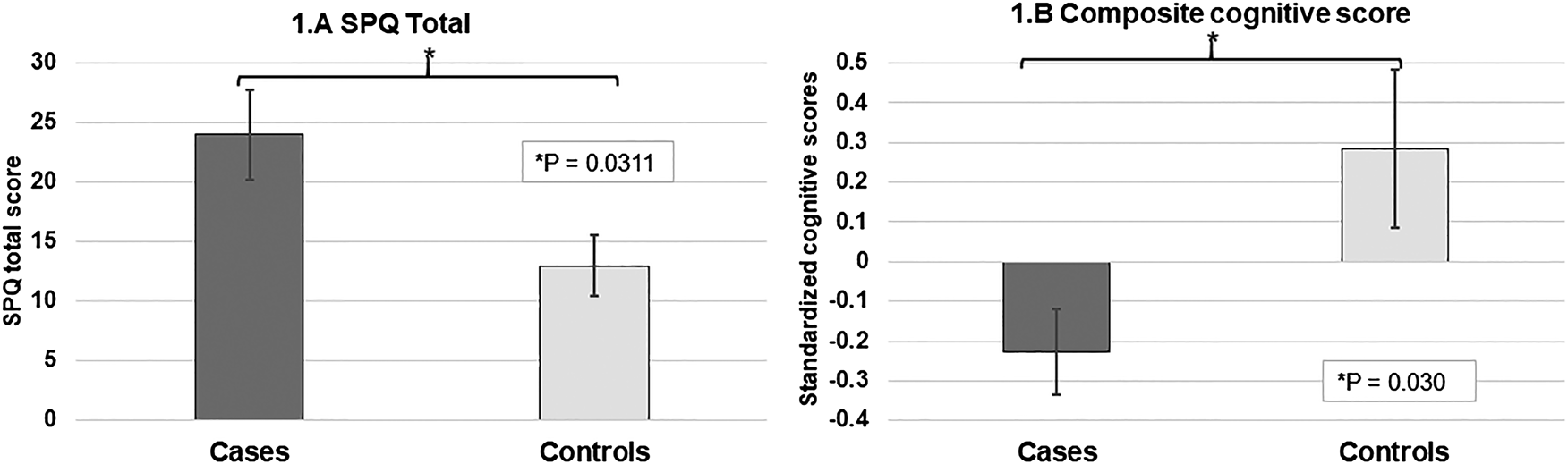
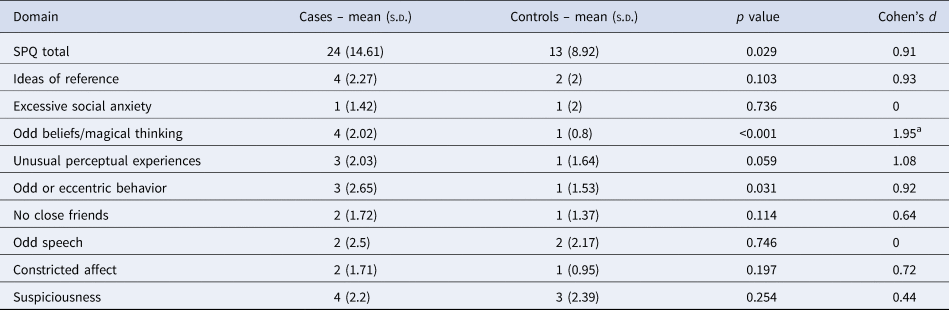
The mean (s.d.) total SPQ score in cases was 24 (14.32), and that of the controls was 13 (8.92), reflecting a statistically significant difference between groups p = 0.03 (Fig. 1a). Among the nine SPQ subdomains, cases had marginally significant higher mean scores compared with controls on the subdomains of odd beliefs, and magical thinking, unusual perceptual experience, and odd and eccentric behavior (Table 1).
Bar graphs presenting the between group differences in the primary outcomes: (a) mean total SPQ scores and (b) mean composite cognitive scores in nine cases and seven controls. The bar graph and error bars represent mean scores ±2 × s.e..

SPQ total scores and subdomain scores between cases and controls

a Indicates scores that were significantly higher in cases compared with controls at Bonferroni-adjusted α value 0.0055 for SPQ subscale scores.
Cognitive function
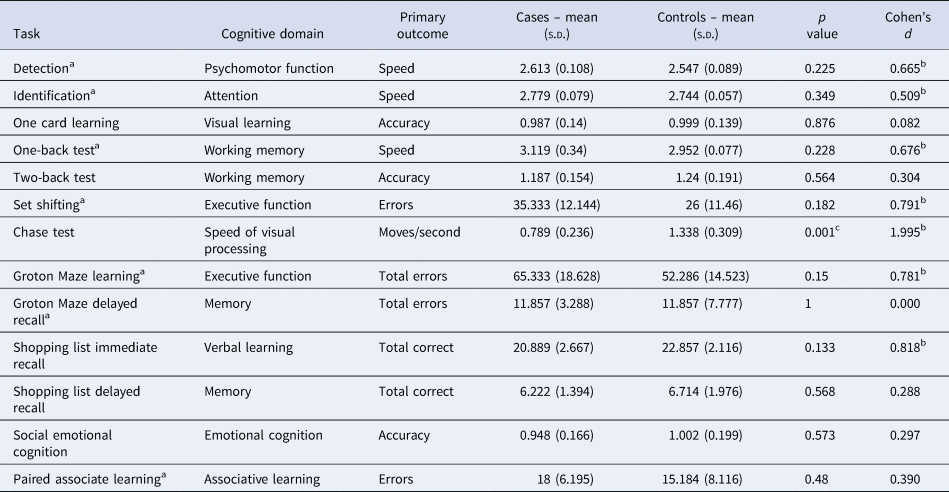
The Cogstate battery was administered to a sample of nine cases and seven controls (subsample A). The remainder of the sample underwent testing on a brief cognitive battery that tested verbal learning and sustained attention (subsample B). Overall, cases performed worse than controls on all cognitive tasks. On the composite cognitive score, a global measure of cognitive function, cases performed significantly worse than controls (Fig. 1b). As described in Table 2, moderate to large effect sizes for between group differences were noted in the Detection Test (attention), Identification Test (psychomotor speed), One Back Test (working memory), Set Shifting Test (cognitive flexibility), Chase Test (visuo-spatial processing), and Shopping List Test (memory). Similar effects were noted on tests of attention (continuous performance test) mean (s.d.) total hits for cases = 62.67 (9.84), controls = 77.6 (5.98), t(8) = 3.06, p = 0.01, Cohen's d = 1.83 and verbal learning (Hopkin's Verbal Learning Test) total immediate recall mean (s.d.) cases = 23.89 (3.44), controls = 28 (3), t(8) = 2.32, p = 0.045, Cohen's d = 1.27 in subsample B. There was no difference between the two groups in delayed recall.
The cognitive performance difference between the groups in effect sizes

a Tests where lower mean scores indicate better performance.
b Tests showing moderate to large effects in group difference.
c p value Chase test is less than the Bonferroni-adjusted α value 0.0038.
Longitudinal testing of verbal learning in a subgroup (n = 4) conducted 6 years apart revealed a small decline in mean (s.d.) total immediate recall scores between the two timepoints 22.25 (3.96) v. 21.75 (2.28).
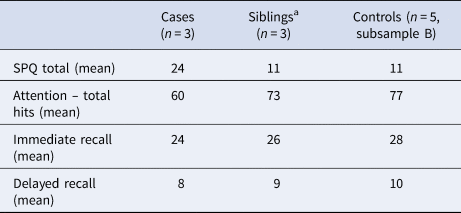
To control for other potential confounding variables, we also studied siblings of cases who had not adopted the same lifestyle. Sibling controls offer the advantage of being matched to cases across many important biopsychosocial variables including genes, upbringing, socioeconomic status, parenting, education, and nutritional status. Only three siblings agreed to participate. Cases scored higher than their siblings on the SPQ, whereas SPQ scores in siblings and controls were comparable. Similarly, cases performed worse than their siblings on the tests of verbal memory and attention (Table 3).
Comparison of a subsample of cases to sibling-controls and unrelated control sample

a Data from three cases and their respective siblings in comparison with five controls from subsample B.
Discussion
The goal of this study was to examine measures of attenuated psychosis and cognitive test performance in individuals with chronic, heavy, and early cannabis exposure isolated from the confounding effects other drugs or alcohol on measures of psychosis and cognition. Cases demonstrated significantly higher attenuated psychotic symptom scores and significantly worse cognitive test performance than matched controls. The magnitude of the group differences was of moderate to large effect size.
Since the groups were closely matched for area of origin, language, age, education, and lifestyle, but not for cannabis use, the results suggest that one explanation for group differences may be related to cannabis exposure, and, importantly, cannabis exposure that is isolated from other drug/alcohol exposure. There was no evidence suggesting that the cases were exposed to other environmental factors that could account for worse cognitive test performance or higher scores of schizotypy. The results of this study lend support to the findings of other studies on cannabis exposure, which did not control for the effect of other drug/alcohol exposure. The findings of this study are relevant to the evolving liberalization of cannabis laws, which are expected to result in an increase in the rates of regular cannabis use (Hasin et al., Reference Hasin, Saha, Kerridge, Goldstein, Chou, Zhang, Jung, Pickering, Ruan, Smith, Huang and Grant2015).
Cannabis has been identified as a risk factor in the development of psychotic disorders such as schizophrenia (Di Forti et al., Reference Di Forti, Quattrone, Freeman, Tripoli, Gayer-Anderson, Quigley, Rodriguez, Jongsma, Ferraro, La Cascia, La Barbera, Tarricone, Berardi, Szoke, Arango, Tortelli, Velthorst, Bernardo, Del-Ben, Menezes, Selten, Jones, Kirkbride, Rutten, de Haan, Sham, van Os, Lewis, Lynskey, Morgan, Murray and Group2019b), but this occurs only in a small minority of those exposed. As an extension of the psychosis continuum hypothesis, it is possible that cannabis may increase the risk of psychosis along a continuum. Thus, it is conceivable that, among the exposed, a much larger proportion of individuals experience an attenuated psychotic syndrome and this hypothesis is supported by previous population-based studies (Davis et al., Reference Davis, Compton, Wang, Levin and Blanco2013). Consistent with this, we noted higher schizotypal scores in cases compared with controls, with elevated scores in the ‘odd beliefs and magical thinking,’ ‘unusual perceptual experience,’ and ‘odd and eccentric behavior’ subdomains. Several studies have observed a similar association between cannabis use and higher schizotypy scores, but many of these studies did not control for other drug/alcohol use (Skosnik et al., Reference Skosnik, Park, Dobbs and Gardner2008; Eren et al., Reference Eren, Dilbaz, Önder Sönmez, Turan, Gündüz and Turan2017). There is also some support for a causal influence of early cannabis exposure on later emergence of schizotypal symptoms during adulthood (Anglin et al., Reference Anglin, Corcoran, Brown, Chen, Lighty, Brook and Cohen2012).
In the current study, the largest differences in cognitive functions between the two groups were in visual processing, verbal learning, executive function, working memory, and psychomotor function. These findings most likely reflect the residual cognitive effects of cannabis, that exist in the backdrop of transient effects that are related to acute intoxication. The current findings are mostly consistent with a recent systematic review according to which the domains of verbal learning and executive function were most affected by cannabis (Broyd et al., Reference Broyd, van Hell, Beale, Yucel and Solowij2016). The extreme degree of cannabis exposure (cumulative dose and duration) in our sample may explain the more generalized involvement of cognitive domains, extending beyond verbal learning, and executive function, observed in this study.
Cases manifested measurable cognitive deficits in the moderate to large effect size range that were present beyond the immediate period of acute intoxication. These findings would suggest that cognitive deficits associated with heavy use of cannabis might impact daily functioning beyond the period of intoxication and should caution against the regular and heavy use of cannabis for either recreational or medical purposes. This study was not designed to determine whether the cognitive deficits observed are reversible (i.e. with abstinence from cannabis). It may be argued that if cannabis users have cognitive deficits related to cannabis, and if they continue to use cannabis, then whether the cognitive deficits are reversible is not very relevant. Or stating this another way, whether the cognitive deficits are reversible should not detract from the public health implications of heavy, chronic cannabis users attempting to function with cognitive deficits.
There are some merits and limitations to be considered in interpreting the results of this study. Although the sample size was small, the group differences were large enough to be observed. The cross-sectional study design does not allow one to determine with certainty whether the group differences in cognitive test performance and schizotypy are attributable to cannabis exposure or to pre-existing differences. However, the findings of higher schizotypy and worse cognitive test performance in cases compared with their siblings with whom they share many important variables, suggest that cannabis exposure or some other risk factor associated with group membership, rather than pre-existing differences (e.g. family history) contribute to the group differences observed. Only experimental studies, which are neither feasible nor ethical, could provide conclusive evidence to attribute causality to cannabis. Conducting an observational study in this population, controlling for many variables except for cannabis exposure, provided a unique opportunity to estimate the effects of very heavy cannabis exposure in the absence of confounders.
We estimated active, but not passive, exposure to cannabis using a standard, reliable and well-validated approach that relied on retrospective self-report. Thus, the estimated total lifetime exposure in this study was incomplete. Cases were reportedly using sinsemilla, a potent form of cannabis. However, due to the existing regulations and logistical challenges, samples of cannabis used by cases could not be tested for THC or CBD content.
The uniqueness of the population may also limit the generalizability of the results. The population is mostly (97%) consisted of persons with partial or total African descent, and English is their main language, as reported by the Statistical Institute of the country. Thus, inferences drawn from Afro-Caribbean populations may generalize more readily to populations of African descent. Therefore, results of Caribbean studies may have relevant implications for countries (e.g. the U.S.A.) where African-Americans, together with native-Americans and mixed-race adults, are more likely than Caucasians to have a diagnosis of cannabis use disorder (Wu et al., Reference Wu, Zhu and Swartz2016).
The cross-sectional nature of the study limits our ability to make causal inferences. However, we retested four cases on two separate occasions 6 years apart. While the small number of subjects studied longitudinally does not allow for any conclusions about the trajectory of changes, the direction of change in cognitive function indicated cognitive decline with continued heavy cannabis use in this small sample. Cognitive testing was carried out after a period of self-reported abstinence. The investigators clinically assessed each subject for acute intoxication or withdrawal. However, given the community's reservation in providing biospecimens for research, we could not corroborate self-reported use with toxicological measurements. Further, any prolonged residual effects of acute intoxication on the cognitive test outcomes cannot be completely ruled out. To account for family history of psychosis, attempts were made to engage siblings of cases who themselves were not part of the fold, but only three siblings agreed to participate. The findings this subsample (n = 3) of cases and their siblings suggest that cannabis exposure rather than family history contributes to the higher schizotypy and worse cognitive performance observed in cases (Table 3). Finally, due to the challenges involved in engaging the community in the study and the cultural differences regarding the participation of women in research, the sample was predominantly male.
The findings of the study address a need raised by the U.S. National Academies of Sciences Engineering and Medicine (NASEM) of prioritizing research on effects of cannabis use in at-risk or under-researched populations, such as heavy cannabis users (National Academies of Sciences, 2017). The study accounts for the confounding effects of other drugs (including tobacco [nicotine]) and alcohol (Van Dam et al., Reference Van Dam, Earleywine and DiGiacomo2008) exposure by group selection rather than the statistical approaches used in previous studies. Many studies conducted thus far have used samples of young college students – who may have higher cognitive reserve and thus, may be able to compensate for negative consequences of cannabis and therefore, underestimate the cognitive deficits related to cannabis. Relative to previous studies, the magnitude of cannabis exposure in the present sample allows for a stronger characterization of a dose–response relationship. Finally, as exposure to cannabis is a product of frequency and dose (THC content), the higher frequency of use in our sample which results in greater exposure may be more relevant to current day cannabis than studies done when cannabis was less potent.
In conclusion, the findings of this study suggest that early, chronic, heavy and, importantly, isolated cannabis exposure, is associated with attenuated psychosis symptoms and cognitive dysfunction. The findings in this unique but small sample warrant replication in a larger and longitudinal study of this or a similar population to more fully understand the cognitive and behavioral effects of chronic, heavy, early cannabinoid exposure without the confounding effects of other drugs.
Acknowledgements
The authors would like to acknowledge Ms. Michelle Carbuto, Mr. Jadon Knight, and Ms. Halle Thurnauer for their assistance in data collection.
Financial support
The study was funded by NARSAD Independent Investigator Award to DCD by the Brain Behavior Research Foundation. SG is partly funded by NARSAD young investigator award by the Brain and Behavior Research Foundation.
Conflict of interest
None.
Ethical standards
The authors assert that all procedures contributing to this work comply with the ethical standards of the relevant national and institutional committees on human experimentation and with the Helsinki Declaration of 1975, as revised in 2008.