Introduction
The genus Dicraeus Loew (Diptera: Chloropidae) is one of the more easily recognised genera of Nearctic Chloropidae, based on a combination of morphological characters including: distinctive wing venation with a long R2+3 vein, a broad subshiny gena, and usually enlarged male genitalia. The genus is primarily Old World in distribution, with most described species in the Palaearctic region, although there are also described species in the Afrotropical, Australasian, and Oriental regions (Nartshuk Reference Nartshuk1967, Reference Nartshuk2000; Deeming Reference Deeming1979; Kanmiya Reference Kanmiya1983; Ismay Reference Ismay1984). Sabrosky (Reference Sabrosky1950) revised the North American Dicraeus, recognising six species in the region. Beaulieu and Wheeler (Reference Beaulieu and Wheeler2001) recorded the Palaearctic species D. fennicus Duda in eastern North America, bringing the Nearctic total to seven species.
Larvae of Dicraeus whose habits are known are phytophagous, feeding in seed heads of grasses (Poaceae) (Deeming Reference Deeming1979; Ferrar Reference Ferrar1987; Nartshuk Reference Nartshuk2000; Walkowski Reference Walkowski2001, Nartshuk and Andersson Reference Nartshuk and Andersson2013). Some of the recorded host plants of Dicraeus species are cultivated as cereal crops and thus some of the species are considered pests. Females of some species (not recorded in the Nearctic) have a sclerotised, laterally compressed, knife-like ovipositor that is apparently modified for oviposition into plant tissues.
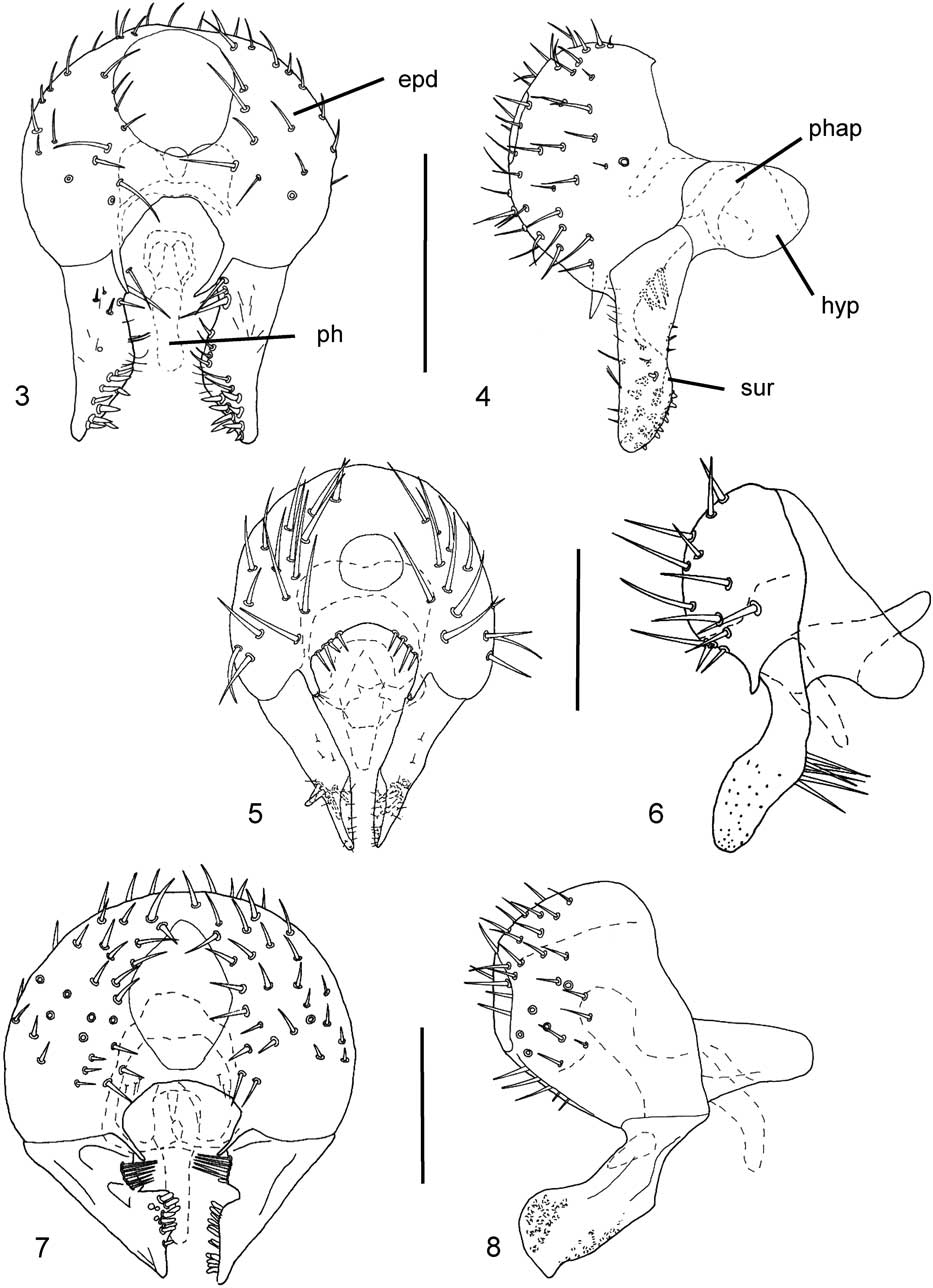
The known species richness and geographic distribution of Dicraeus in North America have increased since the last revision of the genus (Sabrosky Reference Sabrosky1950). In this paper we revise the Nearctic Dicraeus, including the description of one new species and the first Nearctic record of the Palaearctic species Dicraeus vagans (Meigen).
Materials and methods
Types and other specimens cited in this study are housed in the following collections: California Department of Food and Agriculture Collection, Sacramento, California, United States of America (CDFA); Canadian National Collection of Insects, Ottawa, Ontario, Canada (CNC); Lyman Entomological Museum, McGill University, Ste-Anne-de-Bellevue, Québec, Canada (LEM); San Diego Natural History Museum, San Diego, California, United States of America (SDMC); United States National Museum of Natural History, Smithsonian Institution, Washington, District of Columbia, United States of America (USNM).
Genitalic dissections were made by snipping off the male abdomen and heating it in 85% lactic acid in a microwave oven for two intervals of 15 seconds each separated by a cooling period of at least one minute. Dissected abdomens are stored in microvials with glycerin, pinned under the source specimens.
Morphological terminology follows Cumming and Wood (Reference Cumming and Wood2009).
Genus Dicraeus Loew, Reference Loew1873
Dicraeus Loew, Reference Loew1873: 51. Type species: Dicraeus obscurus Loew (now a junior synonym of Dicraeus raptus (Haliday)).
Parastia Pandellé, Reference Pandellé1898: 18. Type species: Oscinis raptus Haliday.
Oedesiella Becker, Reference Becker1910: 146. Type species: Oedesiella discolor Becker.
Oxyapium Becker, Reference Becker1912: 250–1. Type species: Oxyapium longinerve Becker.
Dicraeinus Enderlein, Reference Enderlein1936: 186. Type species: Eutropha ingrata Loew.
Paroedesiella Anonymous, in Imperial Institute of Entomology 1937: 394. Type species: Oscinis styriacus Strobl.
Eudicraeus Nartshuk, Reference Nartshuk1967: 426. Type species: Dicraeus rossicus Stackelberg.
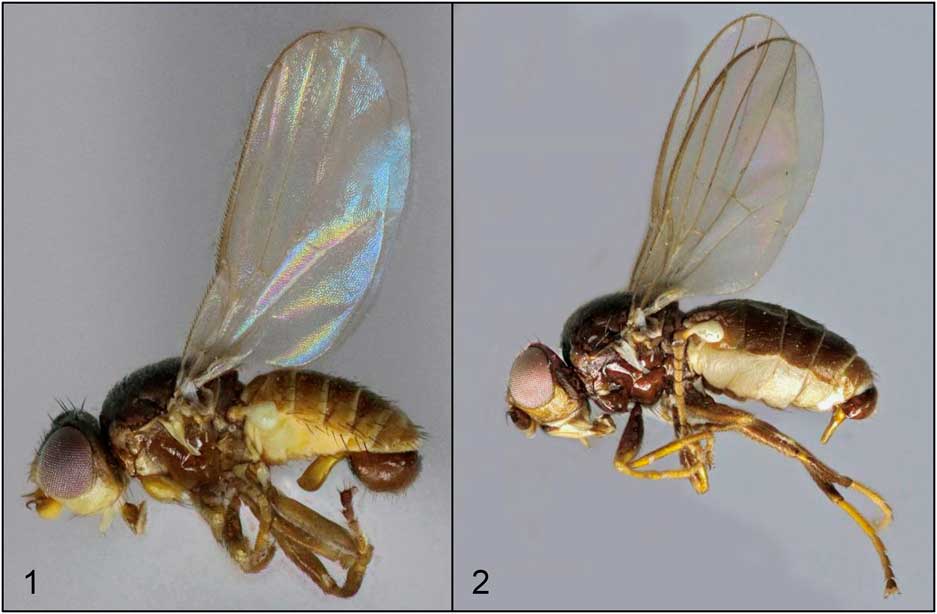
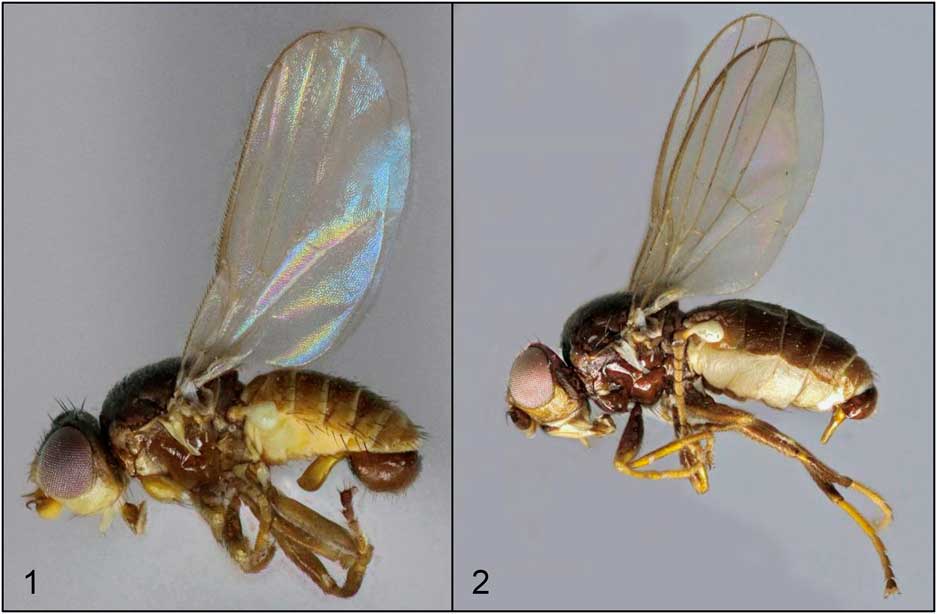
Diagnosis. Specimens of Dicraeus can be distinguished from other Nearctic Chloropidae by the following combination of characters: ocellar bristles reclinate, convergent to cruciate (rarely parallel); gena microscopically striate, at least 0.2 times eye height (Fig. 1); wing with C usually reaching M1+2, rarely ending halfway between R4+5 and M1+2; R2+3 long, second costal sector usually more than 2.5 times length of third (Fig. 2); male genitalia usually large, with prominent epandrium and surstylus (Fig. 1).
Habitus views. 1. Dicraeus fennicus, male (length of specimen: 1.6 mm). 2. Dicraeus incongruus, male (length of specimen: 1.4 mm).
Description. Total length 1.2–3.0 mm. Overall colour black, brown, or black and yellow. Frontal triangle microtomentose, sometimes sparsely so, sometimes partly bare and shiny. Frons dull, interfrontal setulae usually long and distinct, single row just lateral to margin of frontal triangle, 4–6 fronto-orbital setae, progressively longer posteriorly, posteriormost fronto-orbital usually lateroclinate and significantly longer than others, ocellar setae convergent or cruciate, erect or reclinate, postocellar setae cruciate, inner vertical seta inclinate, outer vertical seta lateroclinate, postocellar and vertical setae similar in length. Eye bare or with sparsely short setae, round or long oval. Gena broad, 0.2–0.4 times eye height, microscopically striate and subshiny dorsally, often rugose and shiny ventrally, postgena well developed, vibrissa present, single row of distinct genal setae, long peristomal setae posteroventrally. Face with weak carina dorsally. First flagellomere small, rounded or slightly angulate anterodorsally, arista bare or micropubescent, proboscis and palpus small.
Scutum microtomentose with short, evenly distributed setulae, scutal setae: 1 postpronotal, 1 anterior notopleural, 1–2 posterior notopleural, 1 postsutural dorsocentral, 1 postsutural intra-alar, 1 postalar. Scutellum short, rounded, with 2 pairs of marginal setae. Thoracic pleurites mostly bare. Legs long; male femoral organ a patch of 5–6 short setulae; ventral midtibial spur present; tibial organ long, narrow, oval, with 1–2 rows of setulae along length. Wing broad, clear, veins pale brown; C usually reaching M1+2, rarely ending halfway between R4+5 and M1+2; R2+3 long, second costal sector more than 2.5 times length of third (rarely 2.0–2.5 times length of third) (Fig. 2). Halter pale.
Abdominal tergites broad, with long setae laterally; abdominal sternites small, narrow.
Male genitalia: epandrium often swollen, large; hypandrium closed posteriorly; surstylus well developed, sometimes greatly enlarged and complex; cercus small.
Female genitalia: telescoping, tergites and sternites 7 and 8 reduced; cerci in Nearctic species fleshy, setulose, separate, variable in length; cerci laterally compressed in some Nearctic species.

Male genitalia. 3. Dicraeus curtisi, posterior. 4. Dicraeus curtisi, lateral. 5. Dicraeus elongatus, posterior. 6. Dicraeus elongatus, lateral. 7. Dicraeus fennicus, posterior. 8. Dicraeus fennicus, lateral. epd, epandrium; hyp, hypandrium; ph, phallus; phap, phallapodeme; sur, surstylus. Scale bars=0.2 mm.

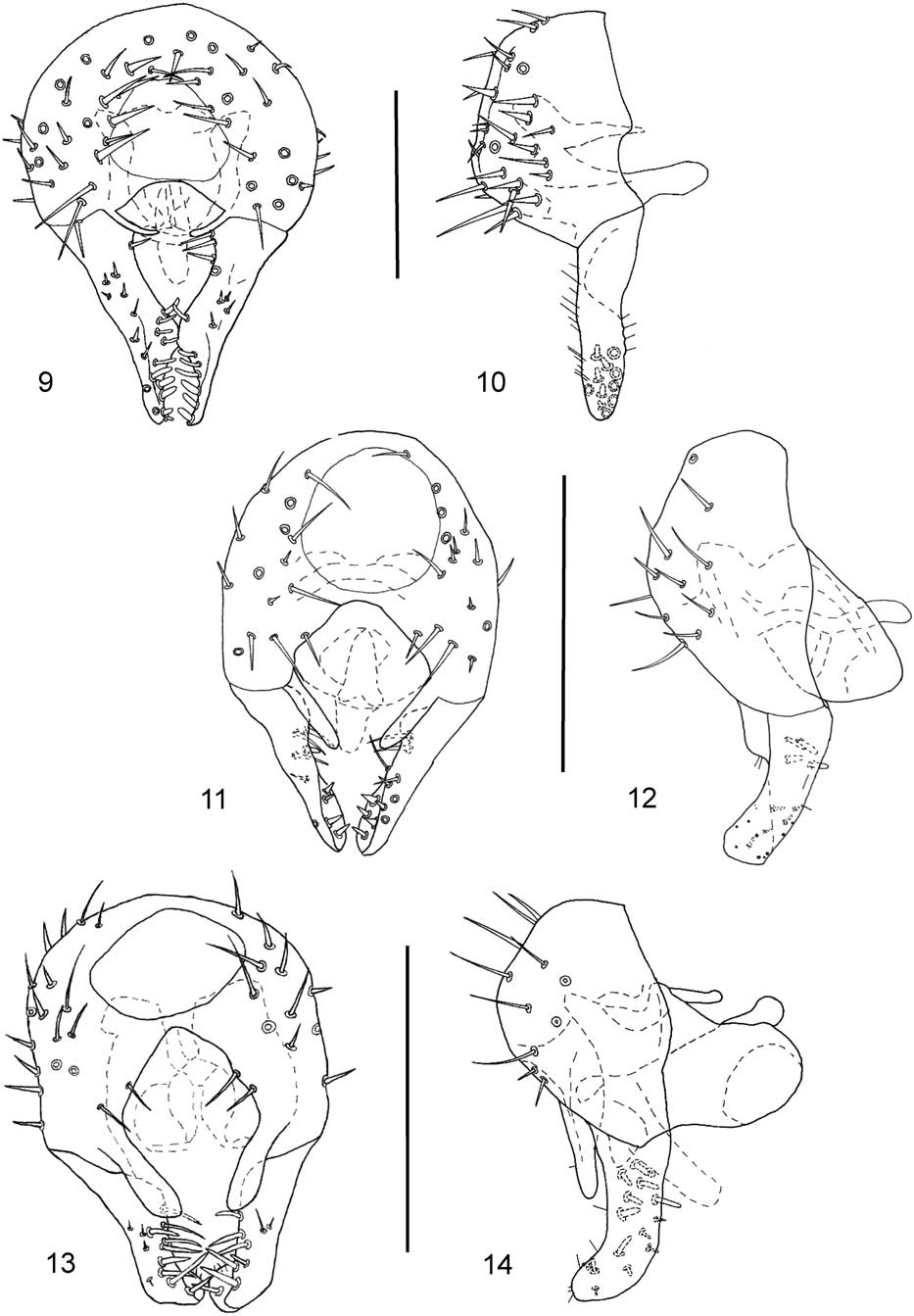
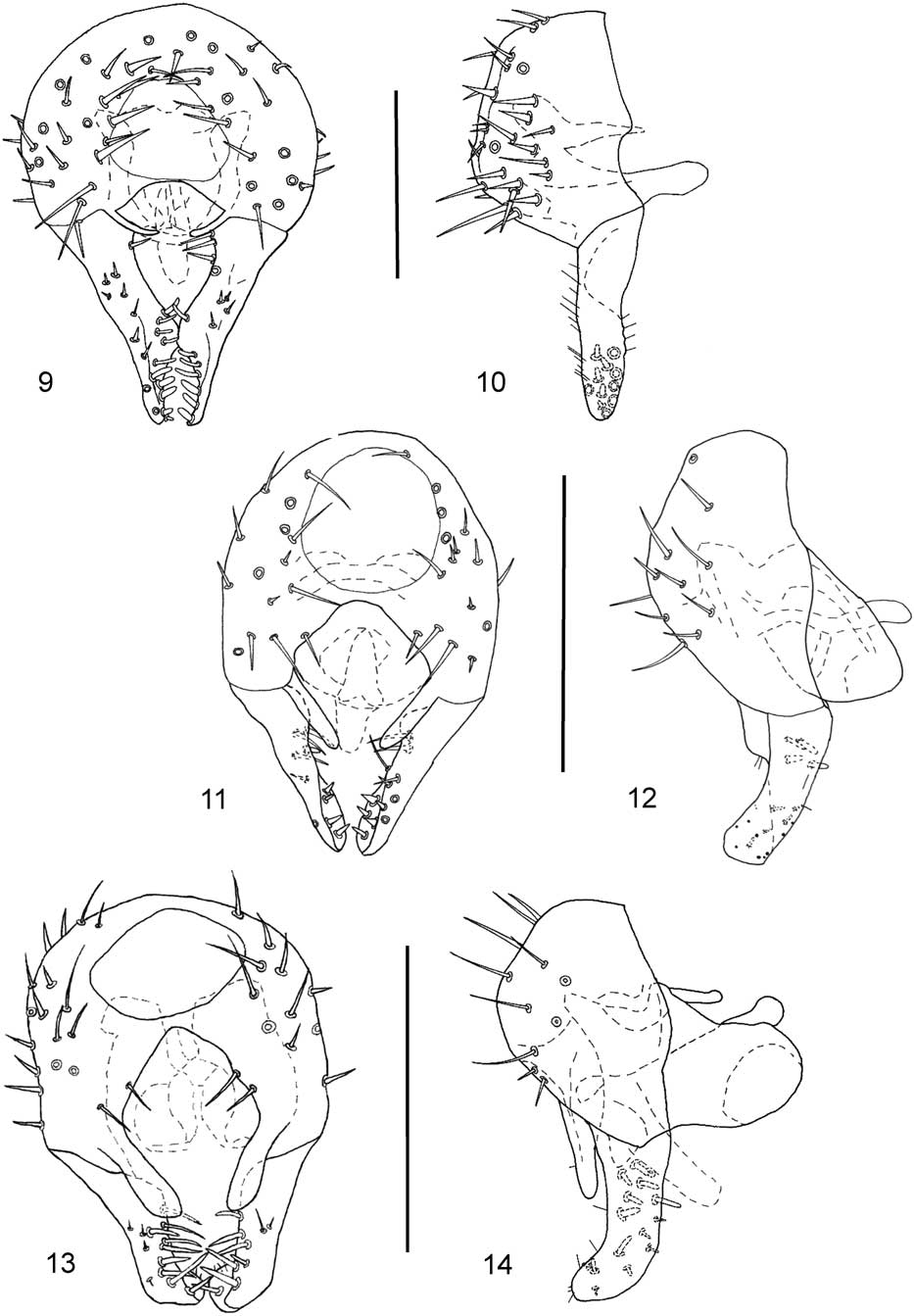
Male genitalia. 9. Dicraeus incongruus, posterior. 10. Dicraeus incongruus, lateral. 11. Dicraeus ingratus, posterior. 12. Dicraeus ingratus, lateral. 13. Dicraeus tibialis, posterior. 14. Dicraeus tibialis, lateral. Scale bars=0.2 mm.
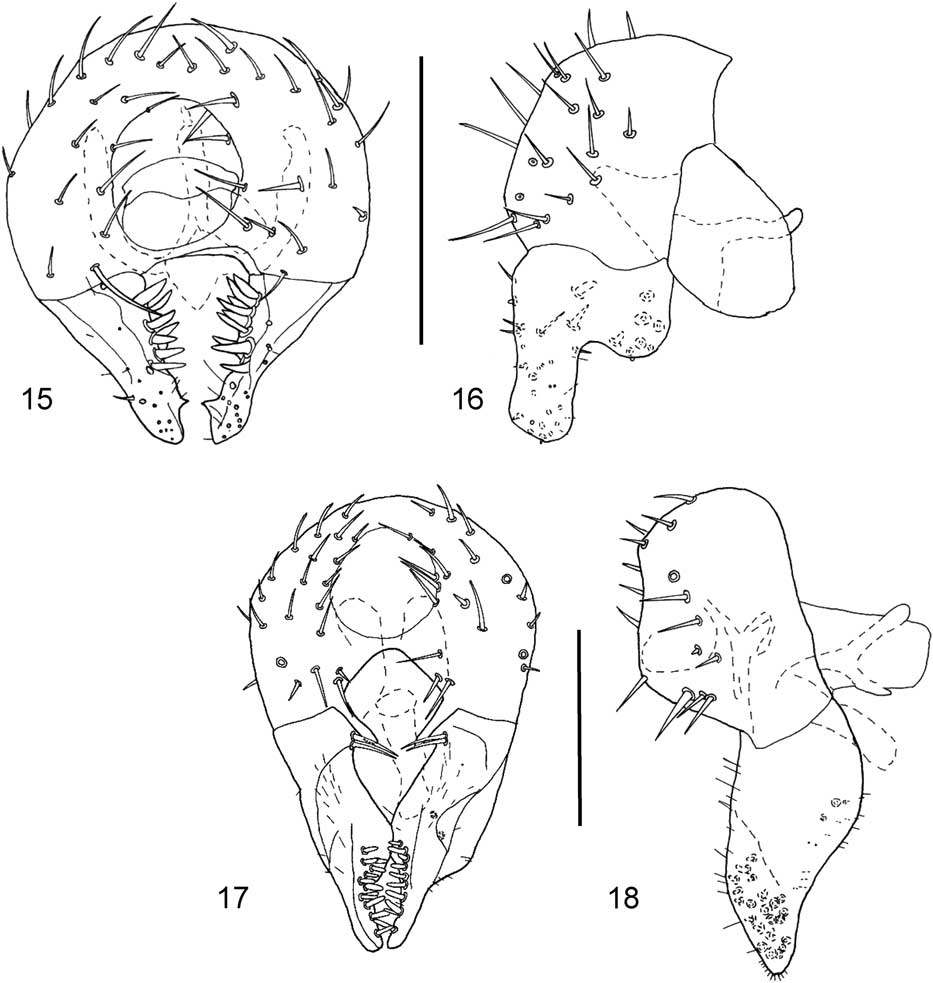
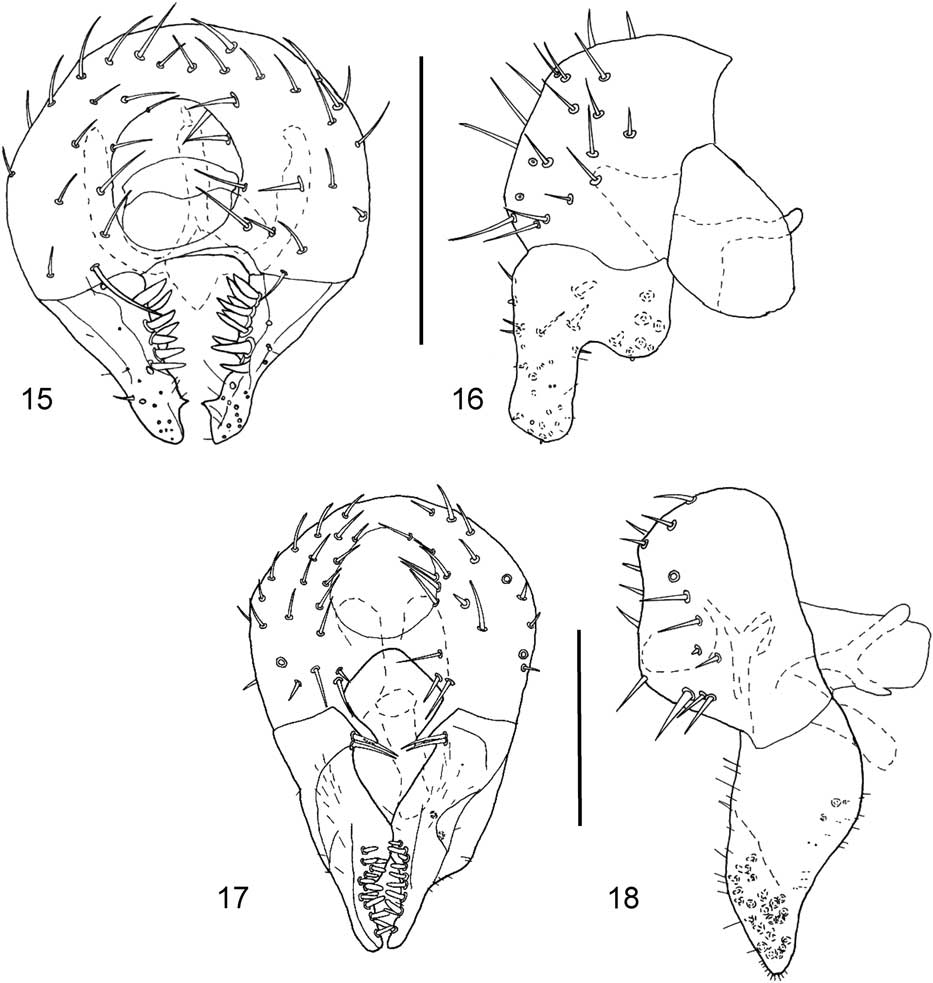
Male genitalia. 15. Dicraeus vagans, posterior. 16. Dicraeus vagans, lateral. 17. Dicraeus wilburi, posterior. 18. Dicraeus wilburi, lateral. Scale bars=0.2 mm.
Dicraeus curtisi Barrie and Wheeler, new species
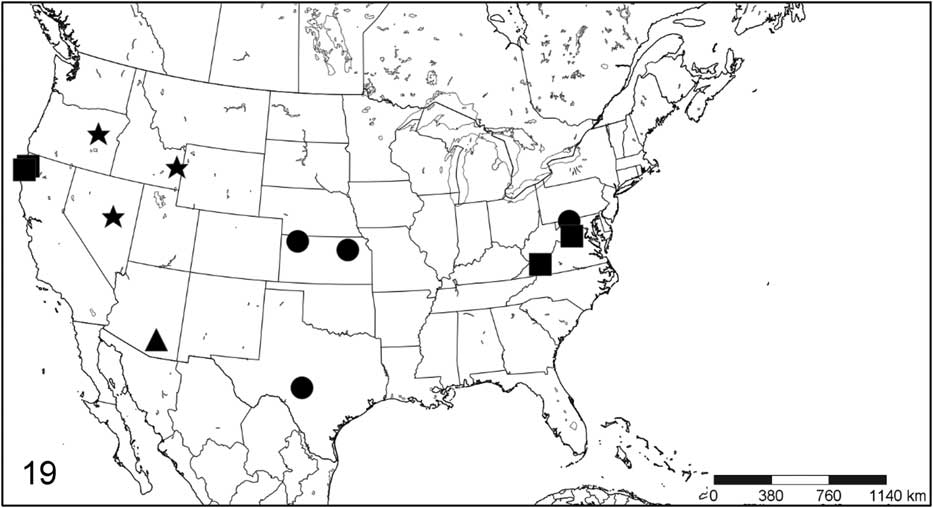
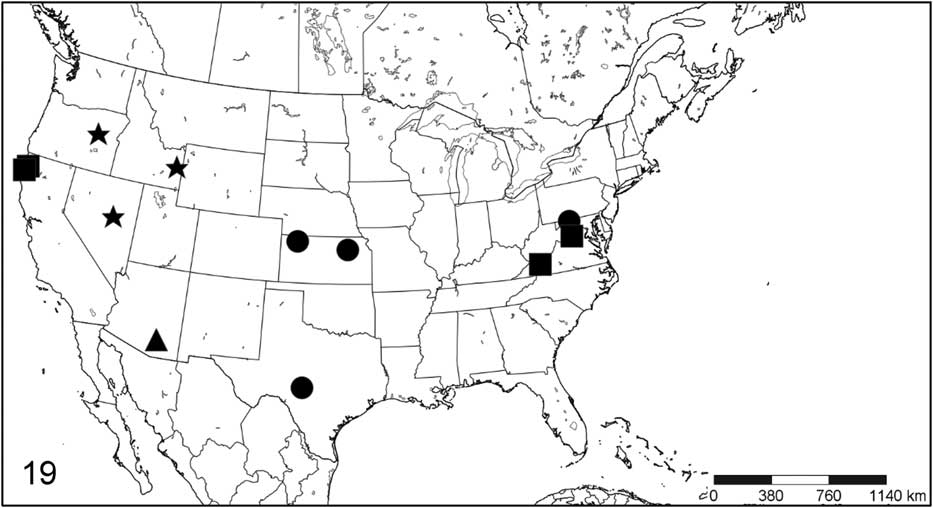
Figures. 3, 4, 19.
Nearctic distribution of Dicraeus curtisi (stars), D. elongatus (triangle), D. vagans (squares), and D. wilburi (circles).
Type material. Holotype ♂: labelled “Dumphy Nev/Eureka Co./VI-17 1952/EI Schlinger Collector” (USNM). Paratypes: same data as holotype (3♂, 5♀, USNM); Idaho: Bonneville Co., 23mi W Idaho Falls, 17.vii.1975, G.E. Bohart, on Crepis (3♂, 1♀, USNM); Oregon: Grant Co., Fields Crk. Rd., 25.vi.1952 (1♂, USNM).
Description. Total length 1.7–2.7 mm. Head yellow except occiput, orbit posterior to eye, clypeus, frontal triangle black; frons sometimes slightly darker posteriorly. Frontal triangle sparsely microtomentose, sometimes with shiny spots lateral to posterior ocelli, 0.6–0.9 times length of frons, dark interfrontal setulae contrasting with yellow frons; occipital setulae not evident. Genal height 0.3–0.4 (rarely 0.2) times eye height, rugose shiny portion narrow anteriorly, broad posteriorly, vibrissal angle >90°. Antenna yellow (males) or with dorsoapical margin of first flagellomere dusky (females), arista black; palpus yellow.
Thorax black, scutum microtomentose, subshiny, 1 anterior and 2 posterior notopleural setae; scutellum microtomentose, with sparse dorsal setulae in addition to marginal setae; thoracic pleurites shiny except for sparse microtomentum anteroventrally and posterodorsally on anepisternum, ventrally on katepisternum, dorsally on anepimeron and posteriorly on meron. Leg colour variable; fore coxa yellow; femora often partly dusky or black; hind tibia often black; tarsi darker distally. Wing hyaline; veins brown. C extending to M1+2; ratios of costal sectors 1:2, 2:3, 3:4 are as follows: 0.6–0.8, 2.8–3.7, 1.3–2.1; distance between crossveins rm and dm-cu 1.5–2.0 times length of dm-cu. Halter white.
Abdomen yellowish brown to dark brown, sometimes with vague darker medial stripe dorsally; sometimes vague pale band proximally on tergites.
Male postabdomen (Figs. 3–4): epandrium black, rounded, higher than long in lateral view, wider than high in posterior view; surstylus yellow, simple, elongate and narrow in lateral view, slightly longer than height of epandrium; hypandrium closed posteriorly; basiphallus sclerotised and hourglass shaped; cercus small, straight, projecting ventromedially; phallapodeme sclerotised, laterally flattened; phallic guide indistinct; phallus membranous.
Female cercus black, setulose, subshiny, separate.
Etymology. The species name is a patronym in honour of Curtis Sabrosky, who made a significant contribution to our knowledge of Nearctic Dicraeus, and Chloropidae in general.
Remarks. Dicraeus curtisi is known so far from three states in the intermontane west of the United States of America, between the Rocky Mountains and the Cascade Range and Sierra Nevada (Fig. 19). The four paratypes from Idaho were collected from Crepis Linnaeus (Asteraceae), although there is no indication as to whether they were reared from larvae or simply swept or aspirated from the plant. Because known larvae of Dicraeus are feeders in Poaceae (see Discussion), it seems unlikely that these specimens were reared from a species of Asteraceae.
Dicraeus elongatus Sabrosky, Reference Sabrosky1950
Figures. 5, 6, 19.
Dicraeus elongatus Sabrosky, Reference Sabrosky1950: 55. Type locality: Summerhaven, Arizona, United States of America.
Type material. Holotype ♂: Arizona, Summerhaven, Santa Catalina Mts, 7700 ft, 15.viii.1934, I. Moore (SDMC, not examined).
Other material examined. United States of America: Arizona: Catalina Mts., Hitchcock Hwy mile 27, 12.viii.1958 (1♂, USNM).
Description. Length from frons to scutellum 1.5 mm. Head yellow except medial two thirds of occiput, dorsal third of orbit posterior to eye, frontal triangle black. Frontal triangle 0.6 times length of frons, posteriorly shiny and smooth, microtomentose anteriorly and on ocellar tubercle. Frons with sparse, weak interfrontal setulae anteriorly and lateral to frontal triangle; occipital setulae weak and sparse; genal height 0.3 times eye height, rugose, shiny ventral portion almost as high as microstriate upper portion; vibrissal angle >90°. Antenna yellow, first flagellomere slightly darker dorsoapically, arista black; palpus yellow.
Scutum sparsely microtomentose, subshiny, brown medially, postpronotum, notopleuron, yellow triangular patch medial to postpronotum and supra-alar region yellow, 1 anterior and 2 posterior notopleural setae; scutellum microtomentose, brown with yellow median dorsal portion, with sparse dorsal setulae in addition to marginal setae. Thoracic pleurites yellow except anepisternum with narrow ventral brown spot, and katepisternum and meron mostly brown. Legs yellow, hind tibia infuscate on middle portion, all tarsi infuscate distally. Wing hyaline, veins brown; C extending to M1+2, ratio of costal sectors 1:2, 2:3, 3:4 are as follows: 0.7, 3.0, 1.7; distance between crossveins rm and dm-cu 3.0 time length of dm-cu. Halter white.
Abdomen yellow.
Male postabdomen (Figs. 5–6): epandrium higher than long in lateral view, height slightly less than width in posterior view; surstylus relatively simple, curved posteriorly, then ventral part directed ventrally, surstylus slightly shorter than epandrium height; hypandrium closed posteriorly; basiphallus sclerotised, slightly conical, wider distally; phallus membranous; phallapodeme sclerotised, laterally flattened; phallic guide indistinct; cercus short, narrow, directed medioventrally and slightly posteriorly.
Female unknown.
Remarks. Some characters of the holotype were damaged and Sabrosky (Reference Sabrosky1950) was uncertain about the state of some characters such as the orientation of the ocellar setae. The non-type specimen examined was in better condition. It was collected at the type locality and corresponded in all aspects to the original description of D. elongatus.
Dicraeus fennicus Duda, Reference Duda1933
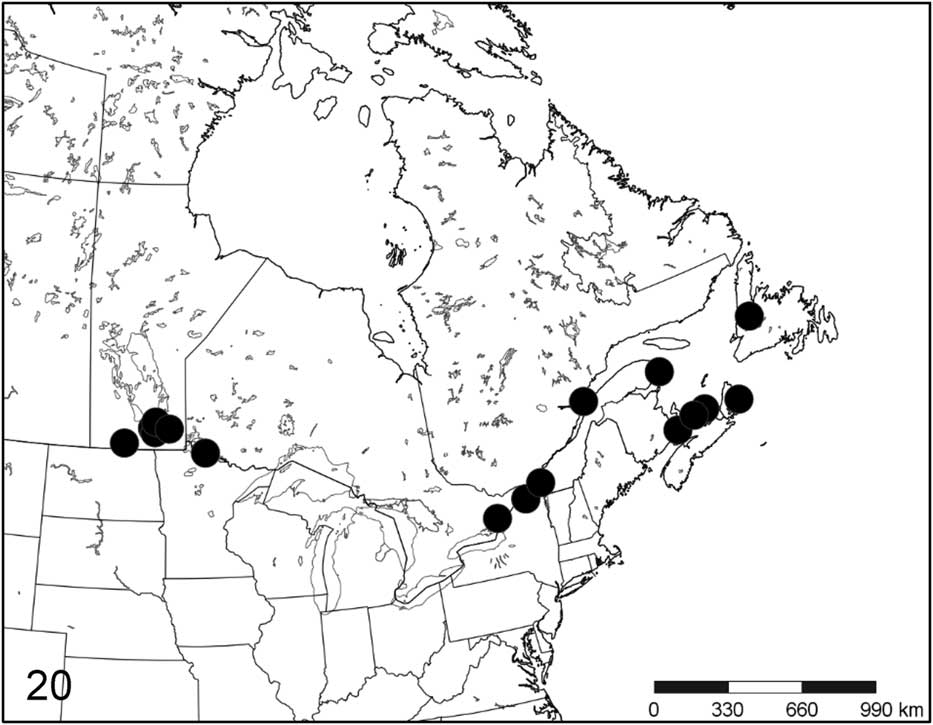
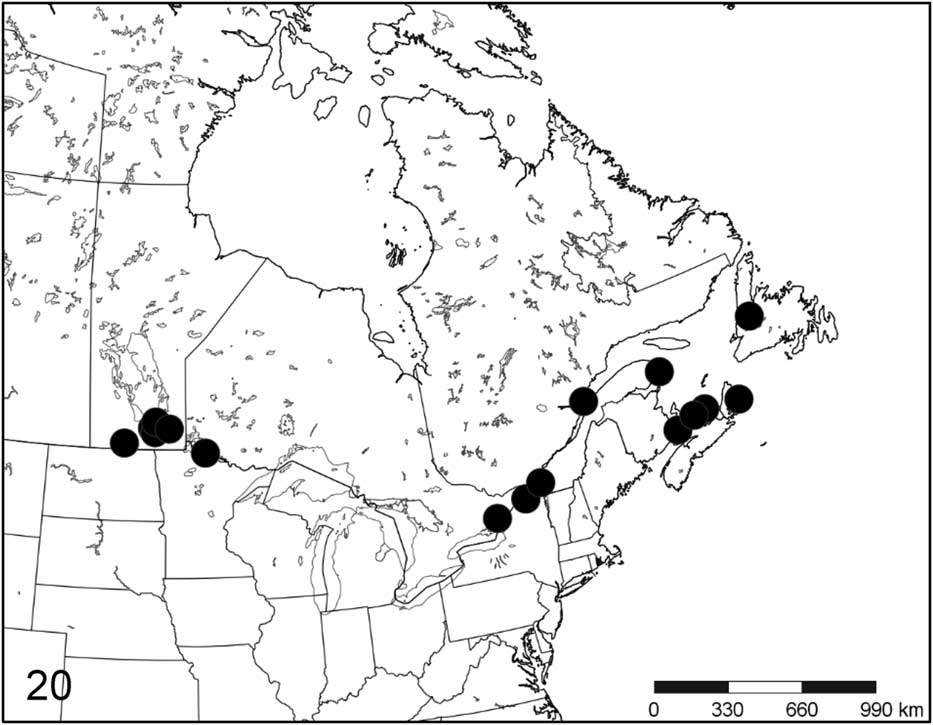
Figures. 1, 7–8, 20.
Nearctic distribution of Dicraeus fennicus.
Dicraeus styriacus fennicus Duda, Reference Duda1933: 67. Type locality: Pori, Finland.
Material examined. Canada: Manitoba: St. Boniface, 200–300 m, 17.vi.1972, N.L.H. Krauss (1♂, USNM); Winnipeg, St. Charles Rifle Range (49°54.6'N, 97°20.5'W), Arrowhead block, sweep in tallgrass prairie, 30.vi.1999, S. McMillan (1♂, 1♀, LEM); Winnipeg, St. Charles Rifle Range (49°54.6'N, 97°20.5'W), Arrowhead block, sweep in tallgrass prairie, 7.vii.1999 (1♂, LEM); St. Charles Rifle Range (49°54.2'N, 97°20.3'W), sweep in tallgrass prairie, 26.vi.1998, P. Bouchard (1♂, 1♀, LEM); St. Charles Rifle Range (49°54.6'N, 97°20.3'W), Go Back Prairie, sweep in tallgrass prairie, 18.vi.1999, S. Boucher (1♂, 1♀, LEM); near LaSalle, La Barriere Park (49°43.2'N, 97°10.7'W), sweep oak savanna, 13.viii.1999, V. Crecco (1♂, LEM); 10 km E Glenora, Pembina River, 7.vii.1992, T.A. Wheeler, sweep vegetation along river (1♂, LEM); 20 km W Selkirk, Oak Hammock Marsh, 4.vii.1992, T.A. Wheeler, sweep sedge at pond margin (10♂, 11♀, LEM); 4 km E Ste. Rita, Highway 15 at Brokenhead River, 9.vii.1992, T.A. Wheeler, sweep sedge and grass along shore (2♂, 6♀, LEM); New Brunswick: Sackville, near Mount Allison University (45°53.9'N, 64°22.5'W), sweep old garden in vacant lot, 19.vii.2002, J. Forrest and T. Wheeler (4♂, 1♀, LEM); Newfoundland and Labrador: Deer Lake, vii.1967, N.L.H. Krauss (1♂, 3♀, USNM); Nova Scotia: Sydney, vii.1967, N.L.H. Krauss (1♂, 2♀, USNM); Ontario: Finland, S of Caliper Lake, 10.vii.1992, T.A. Wheeler, sweep sedge at beaver dam (1♂, LEM); 9 km SE Chaffey’s Locks, Lake Opinicon Road (44°30’42”N, 76°23’47”W), sweep field by road, 19.vi.2010, J. Mlynarek (8♂, 9♀, LEM); Prince Edward Island: Eglinton Bay, sweep vegetation, 20.vii.1996, N. deVille (1♂, 1♀, LEM); Charlottetown, vii.1967, N.L.H. Krauss (1♂, USNM); Québec: Ile Bonaventure (48°30'N, 64°10'W), 3 km from Côte de Percé, sweep grass, 28.vii.2000, A. Thibault (1♂, 2♀, LEM); same data except H. Varady-Szabo (2♂, LEM); Îles Penchées, Les Escoumins (48°22'N, 69°22'W) sweep Juncus Linnaeus (Juncaceae), Lathyrus Linnaeus (Fabaceae) on sand beach, 1.viii.2001, M. Giroux (10♂, 6♀, LEM); Lac St. Francois National Wildlife Area, Marais Fraser (45°02.40'N, 74°28.03'W), Carex Linnaeus (Cyperaceae) meadow, sweeping F2c, 19.vi.1999, F. Beaulieu (1♂, LEM); same data except (45°02.37'N, 74°27.73'W), sweeping F3a, 11.vi.1999 (1♂, LEM); St-Bruno, Parc National du Mont-St-Bruno (45.5518°N, 73.3470°W), 26.vi–4.vii.2011, yellow pan, old field, C. Barrie (1♂, 2♀, LEM).
Palaearctic: Belgium: Flanders: Wetteren (51°00'N, 03°53'E), sweep ditch beside Scheide River, 3.vii.2000, S.E. Brooks (1♂, LEM); France: Le Clapet, near Matignon, sweep in saltmarsh - marshland, 3.vii.1995, M. Pollet (2♂, 4♀, LEM); Russia: Leningrad Oblast: Luga, 14.vii.1955 (1♀, USNM); Leningrad Oblast, 11.vii.1958, ex Agropyron repens Linnaeus (Palisot de Beauvois) (Poaceae) (1♂, 1♀, USNM); [locality illegible] (1♂, USNM).
Description. Total length 1.4–2.3 mm. Head yellow except clypeus, occiput, orbit posterior to eye (sometimes continuing ventrally) black, frons darker yellow-brown posteriorly. Frontal triangle black, except for yellow anterior apex, microtomentose, subshiny, 0.5–0.8 length of frons; dark interfrontal setulae contrasting with yellow frons. Occipital setulae not evident. Genal height 0.2–0.4 times eye height, rugose shiny lower portion distinct, broader posteriorly, vibrissal angle >90°. Antenna yellow, first flagellomere darker on upper lateral surface and dorsoapically, more extensive in females, arista black; palpus yellow.
Thorax black, scutum microtomentose, dull, postpronotum and notopleuron slightly paler, 1 anterior and 2 posterior notopleural setae. Scutellum microtomentose, with sparse dorsal setulae in addition to marginal setae. Thoracic pleurites bare, shiny except for sparse microtomentum anteroventrally and posterodorsally on anepisternum, ventrally on katepisternum, dorsally on anepimeron and posteriorly on meron. Leg colour variable, fore coxa usually yellow (sometimes partly infuscate), fore and mid leg yellow; fore and mid femora infuscate all but distally; hind femur and middle of hind tibia infuscate; tarsi yellow with distal tarsomeres darker. Wing hyaline; veins brown; C extending to M1+2; ratio of costal sectors 1:2, 2:3, 3:4 are as follows: 0.5–0.8, 3.0–4.9, 1.2–2.6; distance between crossveins rm and dm-cu 1.6–2.7 times length of dm-cu. Halter white.
Abdomen brown, sometimes paler proximally, especially on syntergite 1+2.
Male postabdomen (Figs. 7–8): epandrium large, bulbous, black, and mostly microtomentose; higher than long in lateral view; wider than high in posterior view. Surstylus large and yellow, recurved posteriorly; in posterior view, epandrium higher than surstylus. Hypandrium closed posteriorly; basiphallus sclerotised, hourglass-shaped with constriction elongate; phallus membranous; phallapodeme sclerotised, laterally flattened; phallic guide indistinct; cercus short, narrow, directed medioventrally and slightly posteriorly.
Female cercus short, black, setulose, separate.
Remarks. Dicraeus fennicus is widespread in Europe, but is now known to be Holarctic, having been recorded from Québec by Beaulieu and Wheeler (Reference Beaulieu and Wheeler2001). This species is widespread in southern Manitoba through eastern Canada (Fig. 20). The earliest Nearctic specimens we have seen are from 1967, primarily in eastern coastal areas, which suggests that D. fennicus may have been recently introduced from Europe by human activity.
Dicraeus incongruus Aldrich, Reference Aldrich1918
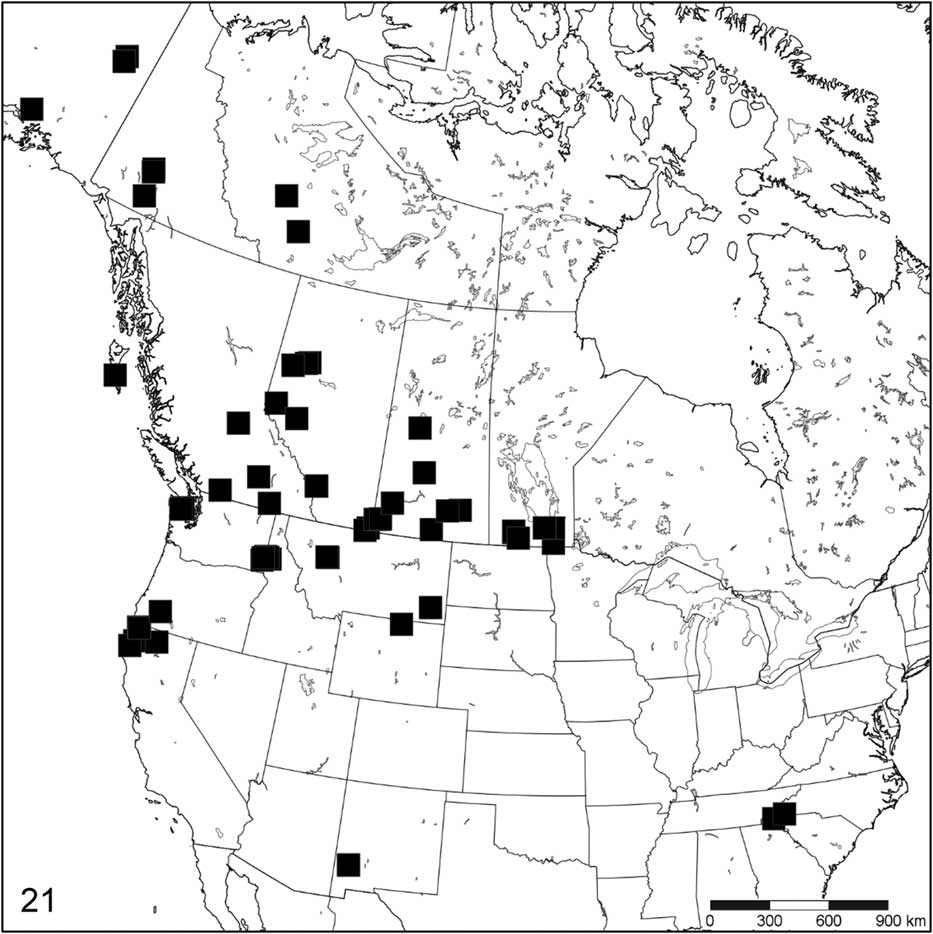
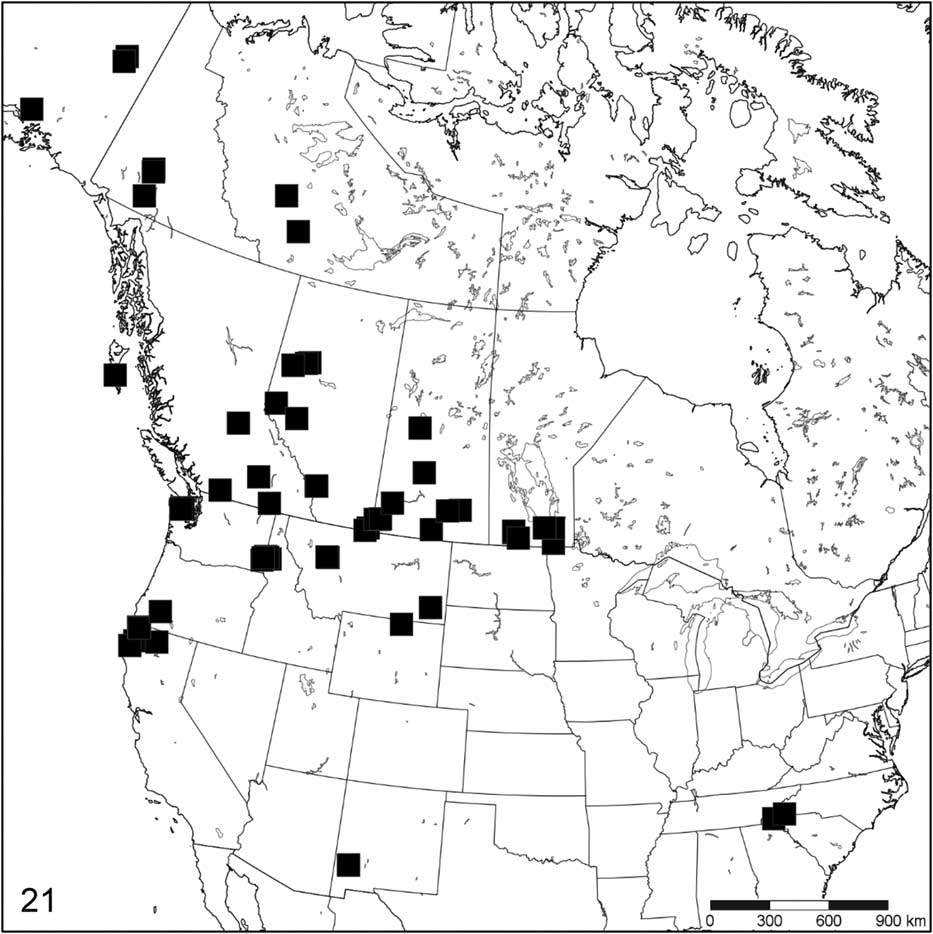
Figures. 2, 9–10, 21.
Nearctic distribution of Dicraeus incongruus.
Dicraeus incongruus Aldrich, Reference Aldrich1918: 339. Type locality: Treesbank, Manitoba, Canada (see Remarks).
Dicraeus kirgisorum Nartshuk, Reference Nartshuk1968: 259. Type locality: southern shore of Issyk Kul, Kyrgyzstan.
Type material. Lectotype ♂ (by present designation): “PARATYPE No. 1198 / Treesbank, Man. N. Criddle, July 23, 1915 / Dicraeus incongruus Ald Para- type” (CNC); Paralectotypes: Canada: Manitoba: same collecting data as lectotype (1♂, 2♀, CNC, 24♂, 39♀, USNM); United States of America: Idaho: Moscow (2, USNM); Potlatch (1, USNM); Montana: Powderville (1, USNM); Utah: Emigration Canyon (1, USNM) (Idaho, Montana, Utah specimens not examined) (see Remarks).
Other material examined. Canada: Alberta: Kananaskis, Sheep River Provincial Park, 7 km W Sandy McNabb campground (50°38.9'N 114°37'W), sweep open forest and field, 28.vii.2003, S. Boucher (2♂, LEM); Kananaskis, Sheep River Provincial Park, 7 km W Sandy McNabb campground (50°38.9'N 114°37'W), sweep open forest and grasses, 28.vii.2003, V. Dion (2♂, LEM); Kananaskis, Sheep River Wildlife Sanctuary, 3 km W Sandy McNabb camp (50°39.1'N 114°33.8'W), sweep grass at roadside, 28.vii.2003, S. Boucher (1♀, LEM); near Sheep Creek Provincial Park (54°00.5'N 119°06.7'W), sweep along Highway 40, 22.vii.2003, S. Boucher, V. Dion (2♀, LEM); 15 km E Onefour, Sage Creek (49°09'N, 110°15'W), sweep sedges along creek, 10.vii.2000, Crecco and Wheeler (1♂, 1♀, LEM); 15 km E Onefour, Sage Creek (49°09'N, 110°15'W), sweep dry prairie/Artemisia Linnaeus (Asteraceae) (5♂, 1♀, LEM); Dunvegan, N shore of Peace River, sweep vegetation along shoreline, 12.vii.1997, T.A. Wheeler (3♂, 2♀, LEM); Dunvegan, N shore of Peace River, sweep grasses along agricultural field, 14.vii.1997, T.A. Wheeler (1♀, LEM); Dunvegan, N shore of Peace River, sweep south facing grass slope, 14.vii.1997, T.A. Wheeler (4♂, 8♀, LEM); Dunvegan, N shore of Peace River, sweep south facing grass slope, 14.vii.1997, S. Boucher (4♂, 4♀, LEM); Dunvegan, N shore of Peace River, 12.vii.1997, S. Boucher (1♂, 1♀, LEM); Peace River, NE side of Peace River, sweep south facing grass slope, 13.vii.1997, T.A. Wheeler (2♂, 1♀, LEM); same data except NE side Peace River (2♀, LEM); 4 km SE Grimshaw, sweep margin of agricultural field, 13.vii.1997, T.A. Wheeler (1♀, LEM); Dunvegan (55°55'25''N, 118°35'40''W), sweep vegetation along shore of Peace River, 19.vii.2003, T.A. Wheeler (2♂, LEM); Dunvegan (55°55'25''N, 118°35'40''W), sweep base of south facing grass slope near campground, 20.vii.2003, V. Dion (1♂, LEM); Dunvegan (55°55'25''N, 118°35'40''W), sweep base of south facing grass slope, 20.vii.2003, S. Boucher (1♂, LEM); Dunvegan (55°55'25''N, 118°35'40''W), sweep grassy field near campground, 20.vii.2003, V. Dion (1♂, LEM); S of Onefour (49°00.7'N, 110°26.6'W) Malaise trap, 14–16.vii.1997, J.E. O'Hara (1♂, LEM); Obed, 26.vii.1939, P. Rock (1♀, CNC); British Columbia: Queen Charlotte Islands, Moresby Island, Sandspit, 0–50 m. vi.1978, N.L.H. Krauss (3♂, 3♀, USNM); Silver Lake, Hope, 2.vii.1968, W.W. Wirth (1♀, USNM); Likely, 9.vii.1938, G.S. Walley (1♂, CNC); Robson, 7.vii.1950, H.R. Foxlee (1♂, CNC); Robson, 16.vi.1947, H.R. Foxlee (1♂, 5f, CNC); Robson, 1–20.vii.1949, H.R. Foxlee (1♂, 4♀, CNC); Robson, 13.vi.1948, H.R. Foxlee (1♂, 1♀, CNC); Robson, 5.vi.1947, H.R. Foxlee (1♂, CNC); Robson, 23.vi.1952, H.R. Foxlee (1♀, CNC); Robson, Trinity Valley, 29.vi.1936, H.B. Leech (1♂, CNC); Manitoba: 5 km N Gardenton, Tallgrass Prairie Preserve (49°10.71'N, 96°40.76'W), sweep prairie at roadside, 6.vii.2000, T.A. Wheeler (4♂, 1♀, LEM); Winnipeg, St. Charles Rifle Range (49°54.2'N, 97°20.3'W), sweep in tallgrass prairie, 10.vii.1998, P. Bouchard (1♀, LEM); Winnipeg, St. Charles Rifle Range (49°54.2'N, 97°20.3'W), sweep in tallgrass prairie, 8.vii.1998, P. Bouchard (1♂, LEM); Winnipeg, St. Charles Rifle Range (49°54.6'N, 97°20.5'W), Arrowhead block, sweep in tallgrass prairie, 14.vii.1999, S. McMillan (1♀, LEM); Treesbank, N. Criddle, 13.vii.1915, swept from grass (2♀, USNM); Treesbank, 23.vii.1915, N. Criddle (1♂, 2♀, CNC); Treesbank,13.vii.1915, N. Criddle (2♀, CNC); Aweme, 19.vii.1916, N. Criddle (2♂; 2♀, CNC); Baldur, 20.vii.1926, N. Criddle (1♀, CNC); Northwest Territories: Fort Wrigley, McKenzie River, 23.vii.1922, C.H. Crickmay (1♂, 1♀, CNC); Fort Simpson, McKenzie River, 6.viii.1922, C.H. Crickmay (2♂, 2♀, CNC); Saskatchewan: Cowan Dam Provincial Recreation Site (54°11'48''N 107°27W), sweep vegetation near road, 22.vii.2003, T.A. Wheeler (1♀, LEM); 6 km N Willow Bunch, Willow Bunch Lake, (49°28.8'N, 105°39.2'W), sweep saline vegetation at lake margin, 9.vii.2000, Crecco and Wheeler (2♂, LEM); Cypress Hills Provincia Park, West Block, (49.64602°N, 109.5154°W), 1266 m, sweep, 10.vii.2012, J. Mlynarek (1♂, 2♀, LEM); Cypress Hills Provincial Park, West Block, 48 km S Maple Creek (49.61042°N, 109.84502°W), sweep pasture, 10.vii.2012, J. Mlynarek (1♀, LEM); Cypress Hills Provincial Park, West Block, east boundary (49.6718°N, 109.4615°W), sweep, 5.vii.2012, S. Rochefort, A. Solecki (2♂, 4♀, LEM); Indian Head, 9.vii.1929, K. Stewart (4♂, 2♀, CNC); Roadene, vii.1928, K.M. King (1♂, CNC); Regina, 16.vii.1975, M.G. Maw, swept ex foxtail barley (Hordeum jubatum Linnaeus; Poaceae) (1♂, CNC); Saskatoon, 20.vii.1926, K.M. King (1♀, CNC); Yukon Territory: Klondike Highway S of Carmacks, Montague Road House, sweep roadside vegetation, 3.vii.1997, T.A. Wheeler (10♂, 3♀, LEM); Klondike Highway 15 km S Carmacks, Nordenskiold River, sweep along river edge, 29.vi.1997, T.A. Wheeler (2♂, 2♀, LEM); Klondike Highway, 15 km S Carmacks (61°58.2'N, 136°12.2'W) sweep vegetation at roadside, 19.vii.1998, T.A. Wheeler (1♂, 1♀, LEM); Alaska Highway 13.1 km W Takhini River (60°49'N, 135°58'W), sweep vegetation in roadside meadow, 27.vi.1997, T.A. Wheeler (1♂, LEM); United States of America: Alaska: Circle, 25.vi.1948, S. Lienk (2♂, 3♀, USNM); Circle City, 14 mi. S, 18.vii.1948, C.O. Esselbaugh (1♂, 1♀, USNM); Palmer, 31.v.1944, J.C. Chamberlin (1♂, USNM); California: Humboldt County, Redwood National Park, Schoolhouse Peak, 936 m (41.15°N 123.88°W), sweep meadow, 2.vi.2009, J. Mlynarek (2♀, LEM); Humboldt County, Arcata Marsh (40.86°N, 124.09°W), sweep tidal marsh, 4.vi.2009, S. Boucher (2♀, LEM); Siskiyou County, FR-17, 10 km N Mount Eddy (41.4184°N, 122.5128°W) 1372 m, sweep open forest, 8.vi.2009, J. Mlynarek (1♀, LEM); Del Norte County, French Hill Road, Camp Six Lookout (41.8304°N 123.8769°W), 1157 m, sweep meadow, 3.vi.2009, S. Boucher (1♂, 2♀, LEM); Del Norte County, French Hill Road, Camp Six Lookout (41.8304°N 123.8769°W), 1157 m, sweep forest edge, 3.vi.2009, J. Mlynarek (2♀, LEM); Del Norte County, Smith River National Recreation Area, Panther Flats Campground (41.84°N, 123.93°W), sweep meadow near river, 1.vi.2009, S. Boucher (1♀, LEM); Del Norte County, 1 km N Upper Coon Mountain (41.8197°N, 123.8686°W), 1176 m, sweep meadow, 3.vi.2009, S. Boucher (5♂, 7♀, LEM); Del Norte County, 1 km N Upper Coon Mountain (41.8197°N, 123.8686°W), 1176 m, sweep meadow, 3.vi.2009, J. Mlynarek (8♂, 5♀, LEM); Del Norte County, Upper Coon Mountain (41.8116°N, 123.8676°W), 1210 m, sweep open slope, 3.vi.2009, J. Mlynarek (3♂, 2♀, LEM); Del Norte County, Upper Coon Mountain (41.8116°N, 123.8676°W), 1210 m, sweep meadow, 3.vi.2009, S. Boucher (2♂, 3♀, LEM); Idaho: Avon, 26.vii.1912 (2♀, USNM); Moscow Mountain, 4.vii.1915, A.L. Melander (1♀, USNM); Montana: Lewis and Clark County, Lewis and Clark National Forest near Cyanide Mountain (47.4109°N, 112.7116°W), 1601 m, sweep alpine, 7.vii.2010, A. MacLeod, T.A. Wheeler (2♂, 1♀, LEM); Lewis and Clark County, Lewis and Clark National Forest, Wolf Lake campground (47.4286°N, 112.7936°W), 1792 m, sweep alpine meadow, 7.vii.2010, T.A. Wheeler (1♂, LEM); New Mexico: Grant County, Cherry Creek Campground, 14 mi. N Silver City, 7400', 15–16.viii.1993, J.E. O’Hara, Malaise (1♂, 1♀, LEM); Grant County, approximately 20 mi. N Silver City, Meadow Creek, 7100' (32°57.2'N 108°10.3'W), 14.viii.2007, M. Giroux (1♀, LEM); North Carolina: Macon County, Wayah Bald (35.1805°N, 83.5607°W), 1625 m, sweep near summit, 20.v.2008, M. Forrest (4♂, 2♀, LEM); Macon County, Wayah Bald (35.1805°N, 83.5607°W), 1625 m, sweep near summit, 20.v.2008, T.A. Wheeler (1♂, LEM); Haywood Co. Pisgah National Forest, Sam Knob, 1724 m (35.32671°N, 82.89052°W), sweep grassy meadow (SAM S1) 19.v.2008, M. Forrest (1♂, LEM); Oregon: Douglas County, 33 km E Canyonville, Three C Rock Picnic Area (42°52.94'N, 122°53.24'W) 340 m, 22.vi.2008, C. Borkent, CJB08-16 (1♂, 1♀, LEM); Washington: Olympic National Park, Elwha River, 6.vii.1968, boggy forest, W.W. Wirth (1♂, 2♀, USNM); Olympic National Park, Hoh River, rain forest, 7.vii.1968 (2♂, 2♀, USNM); Union Flat, 16.vi.1916, A.L. Melander (2♂, 1♀, USNM); Pullman, A.L. Melander (1♀, USNM); Wyoming: Sheridan, vii, C.W. Metz (2♀, USNM).
Description. Total length 1.2–3.0 mm. Head black except anterior margin of frons, face, and upper part of gena dark yellow; frontal triangle microtomentose, subshiny, 0.6–0.8 times length of frons, interfrontal setulae indistinct against dark frons.Occipital setulae not evident. Genal height 0.2–0.3 times eye height; rugose shiny ventral portion narrow anteriorly, broad posteriorly, black, contrasting with dark yellow microstriate upper portion; vibrissal angle >90°. Antenna black, sometimes pedicel paler and first flagellomere paler; palpus black or grey.
Thorax black, scutum microtomentose, dull, 1 anterior and 2 posterior notopleural setae; scutellum microtomentose, dull, with sparse dorsal setulae in addition to marginal setae; thoracic pleurites shiny except for microtomentum on anepisternum and anepimeron dorsally, katepisternum ventrally and meron, thoracic pleurites sometimes more extensively microtomentose. Leg mostly black, fore femur frequently pale distally; fore tibia frequently pale. Wing hyaline, veins brown; C extending to M1+2; ratio of costal sectors 1:2, 2:3, 3:4 are as follows: 0.6–0.9, 1.8–4.2 (2.5–4.2 in most specimens, rarely 1.8–2.5), 1.1–3.1; distance between crossveins rm and dm-cu 1.1–2.6 times length of dm-cu. Halter white, stem sometimes slightly infuscate.
Abdomen brown to black.
Male postabdomen (Figs. 9–10): epandrium black, microtomentose, higher than long in lateral view, wider than high in posterior view; surstylus brown, elongate in lateral view, higher than epandrium; hypandrium closed posteriorly; basiphallus sclerotised, smooth hourglass shape; phallus membranous; phallapodeme sclerotised, laterally flattened; phallic guide indistinct; cercus short, narrow, directed medioventrally and slightly anteriorly.
Female cercus separate, black, subshiny, setulose.
Remarks. Aldrich (Reference Aldrich1918) did not designate a holotype in the original publication. The four syntypes in CNC bear “Paratype” labels but these were apparently affixed in error subsequent to the original description. Sabrosky (Reference Sabrosky1950) also referred to the type series of D. incongruus as “paratypes”, but did not mention a holotype. We have designated one male syntype in CNC as the lectotype to fix the identity of the species.
Most of the Nearctic records of Dicraeus incongruus are western, except for the disjunct records from high elevations in the Appalachian Mountains in North Carolina (Fig. 21). This is similar to the disjunct Nearctic distribution of D. vagans, except that D. incongruus is much more widespread in the west.
Dicraeus ingratus (Loew, Reference Loew1866)
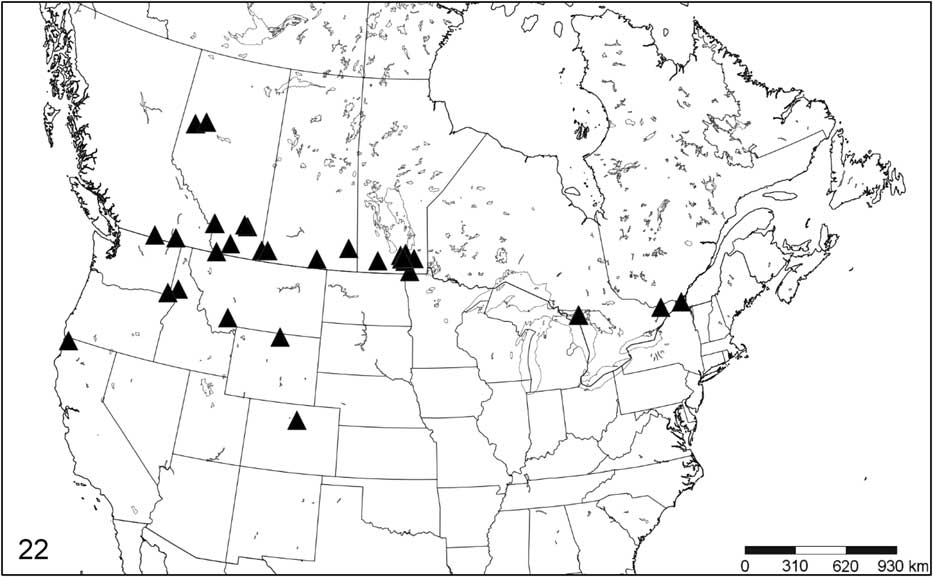
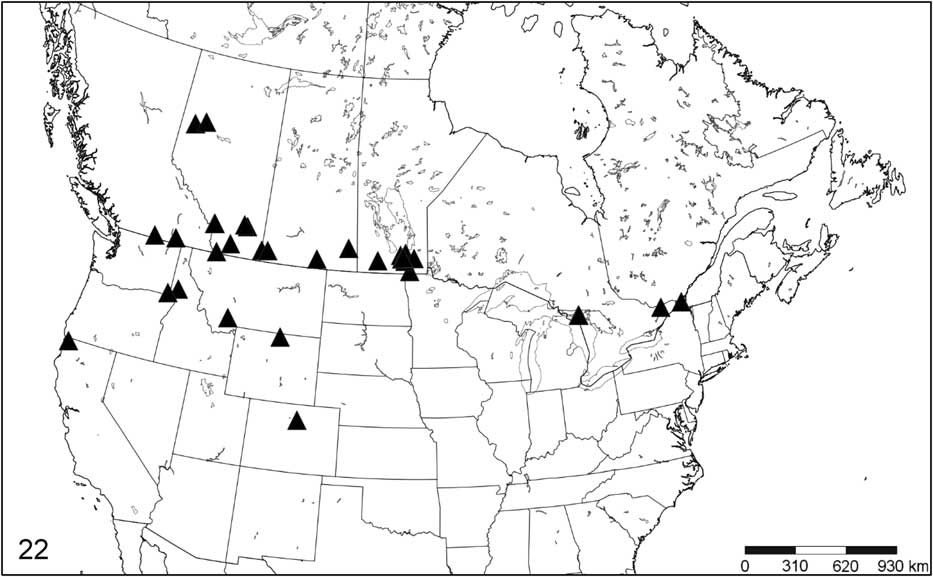
Figures 11–12, 22.
Nearctic distribution of Dicraeus ingratus.
Eutropha ingrata Loew, Reference Loew1866: 26. Type localities: Poznań and Wałbrzych, Poland.
Material examined. Canada: Alberta: Kananaskis, Sheep River Provincial Park, Big Horn Rest Area, 7 km W Sandy McNabb campground (50°38.9'N, 114°37'W), sweep open forest/field, 28.vii.2003, V. Dion (5♂, 3♀, LEM); Kananaskis, Sheep River Provincial Park, Big Horn Rest Area, 7 km W Sandy McNabb campground (50°38.9'N, 114°37'W), sweep open forest/field, 28.vii.2003, S. Boucher (9♂, 18♀, LEM); Kananaskis, Sheep River Wildlife Sanctuary, 3 km W Sandy McNabb campground (50°39.1'N, 114°33.8'W), sweep grass at road side. 28.vii.2003, S. Boucher (6♂, 8♀, LEM); Kananaskis Country, 3 km W Sandy McNabb camp (50°39.130'N, 114°33.785'W), sweep grasses S side of Highway 546, 28.vii.2003, V. Dion (8♂, 5♀, LEM); Dunvegan, N shore of Peace River, sweep grasses at edge of agricultural field, 13.vii.1997, T.A. Wheeler (1♀, LEM); Dunvegan (55°55'25''N, 118°35'40''W), sweep base of south facing grass slope near agricultural field, 21.vii.2003, V. Dion (1♀, LEM); Dunvegan (55°55'25''N, 118°35'40''W), sweep vegetation along shore of Peace River, 19.vii.2003, T.A. Wheeler (1♂, LEM); Dunvegan (55°55.39'N, 118°35.74'W), sweep south facing grass slope at dusk, 19.vii.2003, S. Boucher (2♀, LEM); Red Deer River, NW Dinosaur Provincial Park (50°50.5'N, 111°36.5'W), 6–9.vii.1997, J.E. O'Hara, Malaise trap (1♀, LEM); 4 km SE Grimshaw, sweep margin of agricultural field, 13.vii.1997, T.A. Wheeler (2♀, LEM); Lethbridge, 27.vi.1968 W.W. Wirth, alkali pond (1♂, USNM); Lethbridge, 25.vi.1956, E.E. Sterns (1♀, CNC); Waterton Lakes National Park, 1–5.vii.1980, H.J. Teskey (1♀, CNC); Emerson Bridge Regional Park (50.91317°N, 111.89067°W), sweep, 4.vii.2012, J. Mlynarek (1♂, LEM); British Columbia: Robson, 23.vi.1952, H.R. Foxlee (1♂, 1♀, CNC); Robson, 13.vi.1952, H.R. Foxlee (1♂, CNC); Robson, 18.vi.1952, H.R. Foxlee (1♂, CNC); Robson, 8.vii.1947, H.R. Foxlee (1♀, CNC); Robson, 13.vi.1948, H.R. Foxlee (1♀, CNC); Oliver, 18.vi.1963, J.R. McGillis (1♂, CNC); Manitoba: 1 km E Stuartburn (49°08'N, 96°44.7'W), sweep vegetation along roadside, 12.vi.1999, V. Crecco (4♀, LEM); 1 km E Stuartburn (49°08'N, 96°44.7'W), sweep vegetation along roadside, 12.vi.1999, S. Boucher (1♀, LEM); 10 km W Gross Isle, 4.vii.1992, T.A. Wheeler, sweeping sedge along stream (1♀, LEM); 20 km W Selkirk, Oak Hammock Marsh, 4.vii.1992, T.A. Wheeler, sweep sedge at pond margin (5♂, 1♀, LEM); near Lasalle, La Barriere Park (49°43.2'N, 97°10.7'W), sweep in oak savanna near river, 15.vi.1999, T.A. Wheeler (2♀, LEM); near Lasalle, La Barriere Park (49°43.2'N, 97°10.7'W), sweep vegetation near river, 15.vi.1999, S. Boucher (1♂, 2♀, LEM); Aweme, Criddle farm (49°42.5'N, 99°36.1'W) sweep grasses near house, 13.vi.1999, J. Perusse (3♀, LEM); 20 km E Anola, Brokenhead River (49°53.1'N, 96°22'W) sweep along river edge, 10.vi.1999, S. Boucher (1♀, LEM); Winnipeg, Beaudry Provincial Park (49°51.5'N, 97°28.6'W) sweep disturbed meadow near Assiniboine River 18.vi.1999, T.A. Wheeler (1♂, 1♀, LEM); Winnipeg, St. Charles Rifle Range (49°54.6'N, 97°20.3'W), Go Back Prairie, sweep in tallgrass prairie, 18.vi.1999, S. Boucher (2♀, LEM); Winnipeg, St. Charles Rifle Range (49°54.6'N, 97°20.3'W), Go Back Prairie, sweep in tallgrass prairie, 16.vi.1999, T.A. Wheeler (1♂, LEM); Winnipeg, St. Charles Rifle Range (49°54.6'N, 97°20.5'W), Arrowhead block, sweep in tallgrass prairie, 11.vi.1999, S. Boucher (2♂, LEM); Ontario: Manitoulin Island, 10 km W Gore Bay (45°53'N; 82°34'W), malaise trap in grassland alvar, 5.viii.1996, P. Bouchard (1♀, LEM); Manitoulin Island, 10 km SW Gore Bay (45°52'N, 82°31'W), Malaise trap in grassland savanna alvar, 18.vii.1996, P. Bouchard (1♂, LEM); Ottawa, Uplands Airport, 21.vi.1990, J.M. Cumming (1♂, CNC); Ottawa, 8.vi.1986, J.M. Cumming (1♀, CNC); Québec: Ste-Anne-de-Bellevue, Stoneycroft Pond (45°25.8'N, 73°56.4'W), sweeping grass, 20.vi.2000, H. Varady-Szabo (1♂, 1♀, LEM); Ste-Anne-de-Bellevue, Stoneycroft Pond (45°25.8'N, 73°56.4'W), sweeping grass, 20.vi.2000, J. Forrest (7♂, 9♀, LEM); Ste-Anne-de-Bellevue, Stoneycroft Pond (45°25.8'N, 73°56.4'W), sweep near pond, 2.vii.1999, T.A. Wheeler (1♀, LEM); Saskatchewan: 8 km W Ogema (49°33.2'N, 105°01.4'W), sweep dry prairie along roadside, 9.vii.2000, V. Crecco and T.A. Wheeler (1♂, 3♀, LEM); Cypress Hills Provincial Park, West Block (49.6387°N, 109.99395°W), 1178 m, sweep, 10.vii.2012, J. Mlynarek (1♂, 2♀, LEM); Cypress Hills Provincial Park, West Block, east boundary (49.6718°N, 109.4615°W), sweep, 5.vii.2012, A.M. Solecki (2♀, LEM); Whitewood, swept ex grass, 28.vi.1979, M.G. Maw (1♀, CNC); United States of America: California: Del Norte County, 1 km N Upper Coon Mountain (41.8197°N, 123.8686°W) 1176 m, sweep meadow, 3.vi.2009, J. Mlynarek (1♂, LEM); Colorado: 4–5 mi. N Boulder 5500', 13.vi.1961, C.H. Mann (4♂, 4♀, CNC); Idaho: Peck, 12.vi.1936, by stream, C.B. Philip (1♂, 3♀, USNM); Montana: Madison County, 15 mi. SE Virginia City, 13.vii.1982, S.E. Cummings, sweep pasture (1♂, USNM); Wyoming: Asotin County, Fields Spring State Park, 10.vi.1980, G.C. Steyskal (1♂, USNM); Sheridan County, Big Horn National Forest (44.7995°N, 107.3675°W), 2240 m, sweep low alpine, 3.vii.2010, A. MacLeod, T.A. Wheeler (2♂, 1♀, LEM).
Palaearctic: Russia: Kursk Oblast, 9.vi.1959 (1♂, 2♀, USNM).
Description. Total length 1.6–2.5 mm. Head black except anterior margin of frons, face, gena dark yellow, frons dark brown, contrasting with black frontal triangle. Frontal triangle microtomentose, subshiny, 0.6–0.9 times length of frons, interfrontal setulae indistinct against dark frons. Occipital setulae not evident. Genal height 0.1–0.3 times eye height, rugose shiny lower portion slightly darker than microstriate upper portion, vibrissal angle >90°. Antenna black, pedicel slightly paler, sometimes first flagellomere with paler spot ventrally on medial side; palpus black or grey.
Thorax black, scutum microtomentose, dull, 1 anterior and 2 posterior notopleural setae. Scutellum microtomentose, dull, with sparse dorsal setulae in addition to marginal setae. Thoracic pleurites shiny except for sparse microtomentum anteroventrally and posterodorsally on anepisternum, dorsally on anepimeron, ventrally on katepisternum and on meron. Legs mostly black except some or all femora sometimes paler, some or all tibiae sometimes dark only in middle and dark yellow at ends, tarsi paler. Wing hyaline, veins brown; C ending about halfway between R4+5 and M1+2; ratio of costal sectors 1:2, 2:3, 3:4 are as follows: 0.6–0.9, 2.3–4.2, 1.1–1.9; distance between crossveins rm and dm-cu 1.0–2.1 times length of dm-cu. Halter white.
Abdomen pale brown to black, sometimes paler basally on tergites.
Male postabdomen (Figs. 11–12): epandrium small, black, subshiny, higher than long in lateral view, slightly higher than wide in posterior view; surstylus small, brown, recurved posteriorly; hypandrium closed posteriorly; basiphallus sclerotised, hourglass-shaped; phallus membranous; phallapodeme sclerotised, laterally flattened; phallic guide indistinct; cercus short, narrow, directed ventromedially.
Female cercus black, subshiny, setulose, laterally flattened, separate.
Dicraeus tibialis (Macquart, Reference Macquart1835)
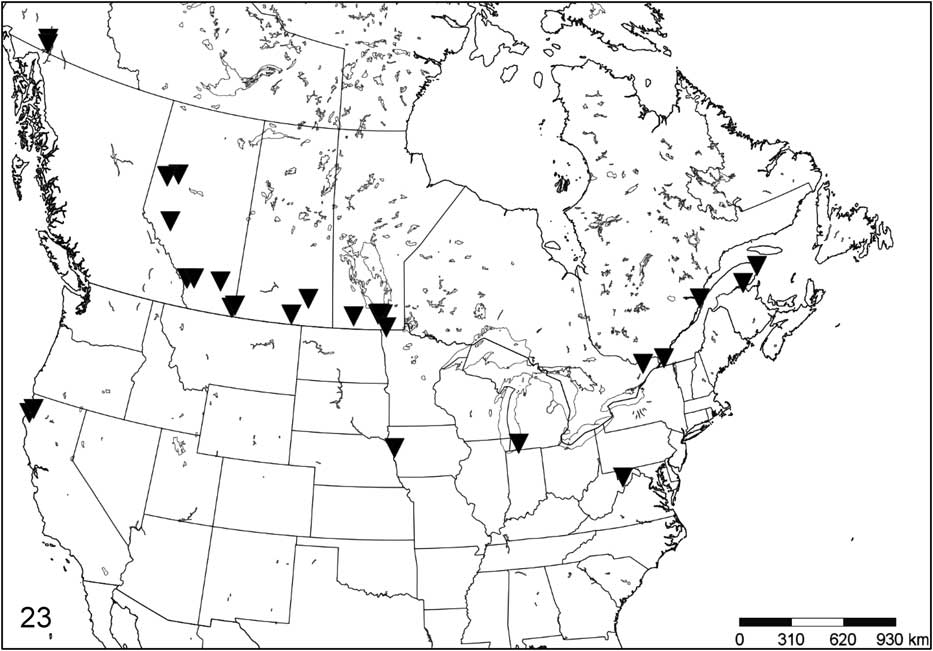
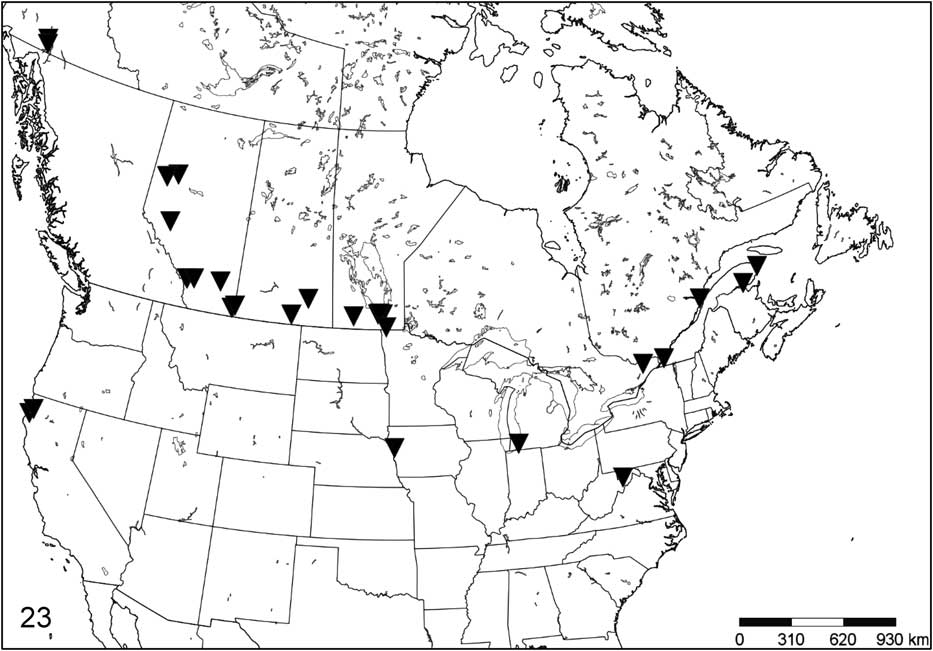
Figures. 13–14, 23.
Nearctic distribution of Dicraeus tibialis.
Oscinis tibialis Macquart, Reference Macquart1835: 602. Type locality: “Du nord de la France”.
Oscinis pallidiventris Macquart, Reference Macquart1835: 600. Type locality: “Du nord de la France”.
Oscinis bipunctata Macquart, Reference Macquart1835: 601. Type locality: “Du nord de la France”.
Oscinis rufimana Macquart, Reference Macquart1835: 601. Type locality: Bordeaux, France.
Oscinis rufiventris Macquart, Reference Macquart1835: 601. Type locality: France.
Oscinis flavimana Macquart, Reference Macquart1835: 603. Type locality: France.
Chlorops fulviventris Meigen, Reference Meigen1838: 392. Replacement name for Oscinis rufiventris Macquart (preoccupied).
Oscinis abdominalis Zetterstedt, Reference Zetterstedt1848: 2661. Type locality: Gotland, Sweden.
Material examined. Canada: Alberta: 4 km SE Grimshaw, sweep margin of agricultural field, 13.vii.1997, T.A. Wheeler (2♀, LEM); 4 km SE Grimshaw, sweep vegetation at edge of wheat field, 13.vii.1997, S. Boucher (1♂, LEM); Kananaskis Country, 3 km W of Sandy McNabb camp, (50°39.130'N, 114°33.785'W), sweep in grasses S side of Highway 546, 28.vii.2003, V. Dion (1♀, LEM); Kananaskis, Sheep River Wildlife Sanctuary, 3 km W Sandy McNabb camp (50°39.1'N, 114°33.8'W), sweep grass at road side, 28.vii.2003, S. Boucher (1♂, 1♀, LEM); Kananaskis, Sheep River Provincial Park, Big Horn Rest Area, 7 km W Sandy McNabb camp (50°38.9'N, 114°37'W), sweep open forest/field, 28.vii.2003, V. Dion (4♀, LEM); Kananaskis, Sheep River Provincial Park, Big Horn Rest Area, 7 km W Sandy McNabb camp (50°38.9'N, 114°37'W), sweep open forest and field, 28.vii.2003, S. Boucher (2♂, 1♀, LEM); Dunvegan (55°55'25''N, 118°35'40'W), sweep vegetation along shore of Peace River, 19.vii.2003, T.A. Wheeler (4♂, 3♀, LEM); Dunvegan (55°55'25''N, 118°35'40''W), sweep base of south facing grass slope near agricultural field W of bridge, 21.vii.2003, S. Boucher (1♀, LEM); Dunvegan (55°55'25''N, 118°35'40''W), sweep base of south facing grass slope near campground, 20.vii.2003, V. Dion (1♀, LEM); Dunvegan (55°55.39'N, 118°35.74'W), sweep south facing grass slope at dusk, 19.vii.2003, S. Boucher (1♂, 1♀, LEM); Dunvegan, N shore of Peace River, sweep grasses at edge of agricultural field, 13.vii.1997, T.A. Wheeler (7♂, 9♀, LEM); Dunvegan, N shore of Peace River, sweep grasses along agricultural field, 14.vii.1997, T.A. Wheeler (3♂, 4♀, LEM); Dunvegan, N side Peace River, 11–25.vii.1995, S. Boucher, pantraps in grasses (1♀, LEM); Dunvegan (55.92543°N, 118.59856°W), sweep S facing grass slope, 29.vi.2012, A.M. Solecki (1♀, LEM); Dunvegan (55.92543°N, 118.59856°W), sweep S facing grass slope, 1.vii.2012, S. Rochefort (1♀, LEM); Route 41, S of Cypress Hills Provincial Park (49.49087°N, 110.2547°W), sweep, 4.vii.2012, A.M. Solecki (1♀, LEM); Red Deer River NW of Dinosaur Provincial Park (50°50.5'N, 111°36.5'W), Malaise trap, 9–12.vii.1997, J.E. O'Hara (1♂, 2♀, LEM); Red Deer River NW of Dinosaur Provincial Park (50°50.5'N, 111°36.5'W), Malaise trap, 6–9.vii.1997, J.E. O'Hara (1♂, 5♀, LEM); Okotoks, Sheep River, 27.vi.1968, W.W. Wirth (1♂, USNM); Obed, 26.vii.1939, P. Rock (1♀, CNC); Manitoba: St. Boniface, 200–300 m. 17.vi.1972, N.L.H. Krauss (3♂, 4♀, USNM); Winnipeg, Beaudry Provincial Park (49°51.5'N, 97°28.6'W), sweep disturbed meadow near Assiniboine River, 18.vi.1999, T.A. Wheeler (1♀, LEM); Winnipeg, St. Charles Rifle Range (49°54.6'N, 97°20.5'W), Arrowhead block, sweep in tallgrass prairie, 14.vii.2000, V. Crecco (1♀, LEM); Aweme, Criddle farm (49°42.5'N, 99°36.1'W) sweep grasses near house, 19.vi.1999, J. Perusse (1♂, LEM); 1 km E Stuartburn (49°08'N, 96°44.7'W) sweep vegetation along roadside, 12.vi.1999, V. Crecco (2♀, LEM); Ontario: 6 km W Hagar (46.47°N, 80.48°W) sweep river edge at rest area, 29.vi.2007, J. Mlynarek (1♀, LEM); Ottawa, near Uplands Airport, 21.vi.1990, J.M. Cumming (1♂, CNC); Québec: Gaspé, Forillon National Park Cap des Rosiers (48°50'N, 64°12'W), sweep grass, 6.viii.2000, H. Varady-Szabo (1♀, LEM); Gaspesie, New Richmond (48°11.6'N, 65°49.1'W), sweep field, 3.viii.2001, V. Dion (1♂, LEM); Tadoussac, Lac de l'anse à l'eau, sweep along margin, 26.vi.2001, H. Varady-Szabo (1♂, LEM); Ste-Anne-de-Bellevue, Stoneycroft Pond (45°25.8'N, 73°56.4'W), sweeping grass, 13.vi.2000, H. Varady-Szabo (1♀, LEM); Ste-Anne-de-Bellevue, Stoneycroft Pond (45°25.8'N, 73°56.4'W), sweeping grass, 20.vi.2000, H. Varady-Szabo (6♂, 4♀, LEM); Ste-Anne-de-Bellevue, Stoneycroft Pond (45°25.8'N, 73°56.4'W), sweep near pond, 2.vii.1999, T.A. Wheeler (1♀, LEM); Ste-Anne-de-Bellevue, Stoneycroft Pond (45°25.8'N, 73°56.4'W), except sweeping grass, 5.vii.2000, J. Forrest, #10: 30 sweeps (1♀, LEM); Ste-Anne-de-Bellevue, Stoneycroft Pond (45°25.8'N, 73°56.4'W), except sweeping grass, 5.vii.2000, J. Forrest, #4 (2♀, LEM); Ste-Anne-de-Bellevue, Stoneycroft Pond (45°25.8'N, 73°56.4'W), except sweeping grass, 13.vi.2000, J. Forrest, #2 (1♀, LEM); Ste-Anne-de-Bellevue, Stoneycroft Pond (45°25.8'N, 73°56.4'W), except sweeping grass, 20.vi.2000, J. Forrest (1♀, LEM); Saskatchewan: 8 km W Ogema (49°33.2'N, 105°01.4'W) sweep dry prairie along roadside, 9.vii.2000, V. Crecco and T. Wheeler (2♀, LEM); Indian Head, 8.vii.1929, K. Stewart (1♀, CNC); Cypress Hills Provincial Park, West Block (49.6387°N, 109.99395°W), 1178 m, sweep, 10.vii.2012, J. Mlynarek (1♂, LEM); Yukon: Whitehorse, 2000–2200 ft. vii.1970, N.L.H. Krauss (1♂, 2♀, USNM); S Klondike Highway, 18.2 km S Alaska Highway, Robinson Roadhouse (60.44839°N, 134.84961°W), sweep, 9.vii.2012, A.M. Solecki, T.A. Wheeler (1♂, 1♀, LEM); United States of America: California: Humboldt County, Arcata Marsh (40.86°N, 124.09°W) sweep tidal marsh, 4.vi.2009, S. Boucher (8♂, 15♀, LEM); Humboldt County, Redwood National Park, Schoolhouse Peak, 936 m (41.15°N, 123.88°W) sweep meadow, 2.vi.2009, S. Boucher (1♀, LEM); Humboldt County, Redwood National Park, Schoolhouse Peak, 936 m (41.15°N, 123.88°W) sweep meadow, 2.vi.2009, J. Mlynarek (1♂, LEM); Iowa: Woodbury County: 3 mi. ESE Holly Springs (42°15'N, 96°2'W), loess, Hill. 13.vi.1970, R.R. Pinger (1♂, USNM); Michigan: Benton Harbor, 17.vi.1941, Butzbach, orchard sweep (2♂, 3♀, USNM); East Lansing, 18.vi.1948 (1♂, USNM); West Virginia: Hampshire County, Nancy Hanks Memorial, 2.vi.1985, G.F and J.F. Hevel (1♀, USNM).
Palaearctic: Macedonia: Prespa Geul, Otesevo. 9–21.vi.1955, R.L. Coe., B.M.1955-460 (3♂, 2♀, USNM).
Description. Total length 1.8–2.8 mm. Head black except frons anterior to frontal triangle, face, gena yellow. Frontal triangle sparsely microtomentose, subshiny, sometimes with shiny spots lateral to posterior ocelli, 0.4–0.8 times length of frons, interfrontal setulae sparse, weak. Occipital setulae not evident. Genal height 0.2–0.3 (rarely 0.4) times eye height, rugose shiny lower portion not contrasting with microstriate upper portion; vibrissal angle >90°. Antenna with pedicel yellow, first flagellomere black laterally and apically, yellow spot covering most of medial surface, arista black; palpus yellow.
Thorax black; scutum microtomentose, subshiny; 1 anterior and 1 (usually) or 2 posterior notopleural setae; scutellum microtomentose, dull, with sparse dorsal setulae in addition to marginal setae. Thoracic pleurites shiny except for sparse microtomentum anteroventrally and posterodorsally on anepisternum, dorsally on anepimeron, ventrally on katepisternum and on meron. Legs usually black with apex of fore and mid femur, fore tibia and all tarsi dark yellow, legs sometimes with more extensive yellow. Wing hyaline, veins brown; C extending to M1+2 or sometimes fading out just before M1+2; ratio of costal sectors 1:2, 2:3, 3:4 are as follows: 0.7–0.9, 2.0–3.7 (2.5–3.7 in most specimens, rarely 2.0–2.5), 1.5–2.3; distance between crossveins rm and dm-cu 1.5–2.5 times length of dm-cu. Halter white.
Abdomen yellow; sometimes with light brown bands, or brown with at least two basal abdominal tergites yellow; sometimes with brown spot laterally in yellow band.
Male postabdomen (Figs. 15–16): epandrium black, subshiny, small, higher than long in lateral view, wider than high in posterior view; surstylus short, recurved posteriorly, brown; hypandrium closed posteriorly; basiphallus sclerotised, faintly hourglass shaped; phallus membranous; phallapodeme sclerotised, flattened laterally; phallic guide indistinct; cercus short, narrow, directed ventromedially.
Female cercus black or brown, subshiny, setulose, laterally flattened, separate.
Remarks. Dicraeus tibialis is widespread in the Palaearctic and Nearctic regions. It is unusual in that the number of posterior notopleural setae varies from 1–2 within the species (two is usual in Dicraeus). Although the number of posterior notopleurals is frequently considered an important key character in distinguishing genera in Chloropidae, the fact that the number varies in multiple genera, as well even within a species in the case of D. tibialis, makes it less reliable as a defining character on its own.
Dicraeus vagans (Meigen, Reference Meigen1838)
Figures. 15–16, 19.
Chlorops vagans Meigen, Reference Meigen1838: 389. Type locality: Baiern, Germany.
Oscinis xanthopygus Strobl, Reference Strobl1909: 290. Type locality: Sevnica, Brežice, Ormož (Slovenia); Jaring (?Austria).
Material examined. United States of America: California: Humboldt County, Redwood National Park, Schoolhouse Peak, 936 m (41.15°N, 123.88°W) sweep meadow, 2.vi.2009, S. Boucher (9♂, 4♀, LEM, CDFA); Humboldt County, Redwood National Park, Schoolhouse Peak, 936 m (41.15°N, 123.88°W) sweep meadow, 2.vi.2009, J. Mlynarek (10♂, 5♀, LEM, CDFA); Humboldt County, Arcata Marsh (40.86°N, 124.09°W) sweep tidal marsh, 4.vi.2009, S. Boucher (4♂, LEM); Virginia: Skyline Drive on Blue Ridge Mountains, 3–4.vi.1975, long grass meadows and scrubby woodland, B.J. Harrington, P.S. Broomfield, B.M. 1975-392 (1♂, USNM); West Virginia: Bluefield, 17.vi.1970, G. Steyskal (1♂, USNM).
Palaearctic: France: Seine et Oise, Rueil-Malmaison, 21.v.1954, R.D. Burks (1♂, USNM); United Kingdom: Cornwall, Trebullett, 18.vi.1976, 30.vi.1985, K.A. Spencer (2♂, 2♀, USNM).
Description. Total length 1.9–2.7 mm. Head yellow except occiput, dorsal part of orbit posterior to eye, frontal triangle black. Frontal triangle sparsely microtomentose, subshiny, sometimes with shiny spots lateral to posterior ocelli, 0.5–0.8 times length of frons, dark interfrontal setulae contrasting with yellow frons. Occipital setulae more evident ventrally. Genal height 0.2–0.4 times eye height, rugose shiny portion distinct anteriorly, broader posteriorly, vibrissal angle >90°. Antenna yellow, first flagellomere sometimes infuscate laterally and dorsoapically, especially in females, arista black; palpus yellow.
Scutum black, microtomentose, postpronotum, notopleuron, and small spot at posterolateral corner of scutum yellow, 1 anterior and 2 posterior notopleural setae. Scutellum black, microtomentose, with sparse dorsal setulae in addition to apical setae; thoracic pleurites yellow except anepisternum anteroventrally, anepimeron anteriorly, and most of katepisternum and meron brown; pleurites shiny except katepisternum microtomentose ventrally. Legs yellow; sometimes fore femur with infuscate spots; often all tibiae at least lightly infuscate, especially hind tibia; knees and sometimes distal ends of tibiae yellow; infuscation on hind tibia sometimes more pronounced on lateral side; tarsi darker distally. Wing hyaline, veins brown; C extending to M1+2; ratio of costal sectors 1:2, 2:3, 3:4 are as follows: 0.6–0.7, 3.0–4.5, 1.4–2.2; distance between crossveins r-m and dm-cu 1.9–2.6 times length of crossvein dm-cu. Halter white.
Abdomen yellow with extensive, medial vague brown stripe dorsally, sometimes wider near base of abdomen and/or narrowing near apex; or, abdomen almost entirely pale brown; sometimes paler yellow band present at base.
Male postabdomen (Figs. 15–16): sternite 8 swollen, paler yellow than rest of abdomen, often with brown median spot; epandrium, small, subshiny, black or brown with pale stripe from dorsal side of anal opening to dorsal margin of epandrium, higher than long in lateral view, wider than high in posterior view. Surstylus yellow, shiny, bilobed in lateral view with posterior lobe longer, height slightly less than epandrium height. Hypandrium closed posteriorly; phallus membranous; basiphallus sclerotised, slight hourglass shape, wider distally; phallapodeme simple, flattened laterally; phallic guide indistinct; cercus indistinct and completely fused with epandrium.
Female cercus black, shiny, setulose, separate, long and narrow.
Remarks. We found minor differences between Nearctic and Palaearctic specimens of Dicraeus vagans. In Nearctic specimens the yellow on the thorax is more extensive and contrasts more with the black, and the male surstylus has a shorter, broader posterior lobe (in lateral view) and stouter spines on the median surface of the anterior lobe. These differences may be within the range of variation of a single species, and examination of molecular sequence data would be required to determine whether the Nearctic material should be treated as a distinct species from Palaearctic D. vagans.
The Nearctic distribution of Dicraeus vagans is disjunct, with most of the specimens collected from coastal northern California, and two specimens from the southern Appalachian Mountains (Fig. 19).
Dicraeus wilburi Sabrosky, Reference Sabrosky1950
Dicraeus wilburi Sabrosky, Reference Sabrosky1950: 61. Type locality: Manhattan, Kansas, United States of America.
Type material examined. Holotype ♂: “Manhattan/VI-4-33 Kas”; “C.W.Sabrosky/Collector” United States of America: Kansas: Manhattan, 4.vi.1933, C.W. Sabrosky, Type #59358 (USNM); Paratypes: United States of America: Kansas: Manhattan, 4.vi.1933, C.W. Sabrosky (6♂, 6♀, USNM; 1♂, 1♀, CNC).
Other material examined. United States of America: Kansas: Creek County, 12 mi. W, 5 mi. W of Columbus, 8–9.vi.1976, Gary F. Hevel (1♂, USNM); Texas: Llano River, Kimble County, 23.v.1972, W.W. Wirth (3♂, 1♀, USNM); Llano River, Kimble County, 23.v.1972, W.W. Wirth, Malaise trap (1♀, USNM); West Virginia: Great Cacapon to Largent, 2–3.vii.1977, W.W. Wirth, Malaise trap (2♂, 2♀, USNM).
Description. Total length 1.9–2.3 mm. Head black except frons anterior to frontal triangle, face, gena, clypeus yellow. Frontal triangle brown or black, sparsely microtomentose, subshiny, 0.6–0.9 times length of frons, interfrontal setulae sparse, weak, contrasting with yellow anterior portion of frons. Occipital setulae not evident; genal height 0.2–0.3 times eye height, rugose shiny lower portion distinct, broader posteriorly. Antenna yellow, first flagellomere yellow (males) or sometimes with slight infuscation dorsoapically (females), arista black; palpus yellow.
Thorax black; scutum microtomentose, dull, 1 anterior and 2 posterior notopleural setae. Scutellum microtomentose, dull, with sparse dorsal setulae in addition to marginal setae. Thoracic pleurites bare, shiny except for sparse microtomentum anteroventrally and posterodorsally on anepisternum, ventrally on katepisternum, dorsally on anepimeron and posteriorly on meron. Legs, including fore coxa, yellow, hind femur and tibia darker, tarsi darker apically. Wing hyaline, veins brown; C extending to M1+2; ratio of costal sectors 1:2, 2:3, 3:4 are as follows: 0.6–0.8, 3.0–4.5, 1.1–2.0; distance between crossveins rm and dm-cu 1.6–2.5 times length of dm-cu. Halter white.
Abdomen brown, sometimes with vague yellow band basally.
Male postabdomen (Figs. 17–18): epandrium black, subshiny, higher than long in lateral view, wider than high in posterior view; surstylus large, yellow, elongate without strong curves, height subequal to epandrium height; hypandrium closed posteriorly; basiphallus sclerotised, faintly hourglass-shaped; phallus membranous; phallapodeme sclerotised, laterally flattened; phallic guide indistinct; cercus short, narrow, directed ventromedially.
Female cercus black, subshiny, setulose, separate.
Remarks. In addition to the type specimens examined, Sabrosky (Reference Sabrosky1950) described additional paratypes from Michigan and Connecticut, United States of America (not examined in this study). Although the confirmed records of D. wilburi are all south of the known Nearctic distribution of the externally similar D. fennicus, the latter species may continue to expand its range southward into the northern United States of America. Male specimens of the two species are easily distinguished by genitalic characters, but females are more difficult.
Species removed from Dicraeus
Notaulacella aberrans (Sabrosky, Reference Sabrosky1950) new combination
Dicraeus aberrans Sabrosky, Reference Sabrosky1950: 56. Type locality: Alamogordo, New Mexico, United States of America.
Remarks. Sabrosky (Reference Sabrosky1950) described Dicraeus aberrans from a single male specimen from New Mexico. Although Sabrosky assigned the species to Dicraeus based primarily on the long vein R2+3, he considered it an aberrant species based on several morphological characters by which it differed from other Dicraeus species. These characters include: proclinate, divergent ocellar bristles (rare in Oscinellinae); a narrow gena; one anterior and one posterior notopleural setae with the anterior conspicuously stronger; distinctive wing venation with a long narrow cell dm and crossvein r-m in the basal third of cell dm; and small male genitalia with short, incurved surstyli. All these characters are consistent with the genus Notaulacella Enderlein, previously known only from South and Central America, and we transfer Dicraeus aberrans to Notaulacella as the first Nearctic species of that genus.
Discussion
Most of the described species of Dicraeus are in the Old World, especially in the Palaearctic. Deeming (Reference Deeming1979) described four new species from Africa, Ismay (Reference Ismay1984) described eight new species from “New Guinea and New Ireland”, and there are additional undescribed species from Australia (T.A.W., unpublished data), which suggests that the genus is likely more diverse than currently recognised in the Old World tropics. The New World fauna is species-poor by comparison. Five of the Nearctic species (D. fennicus, D. incongruus, D. ingratus, D. tibialis, and D. vagans) are Holarctic and three (D. curtisi, D. elongatus, and D. wilburi) are endemic, primarily in the western United States of America. Despite examination of several thousand Chloropidae from Central and South America and the Caribbean region, no Dicraeus species are yet known from the Neotropical region (T.A.W., unpublished data).
Some authors (e.g., Nartshuk Reference Nartshuk1967) divide Dicraeus into subgenera based on the morphology of the male genitalia. However, other authors have questioned the importance of those characters in defining subgenera and suggested that female ovipositor morphology may be more important (Deeming Reference Deeming1979; Kanmiya Reference Kanmiya1983). None of these divisions of Dicraeus were based on explicit phylogenetic analyses, and were generally based on consideration of a subset of the world species. In addition, there are also species unplaced to subgenus by previous authors. A subdivision of Dicraeus into subgenera would be premature until the world fauna is better described and a comprehensive phylogenetic analysis has been conducted.
Host associations of Dicraeus species are better documented for the Palaearctic species, including some of the Holarctic species treated in this paper. Nartshuk and Andersson (Reference Nartshuk and Andersson2013) summarised the natural history of northern European Dicraeus species, all of which are seed feeders in Poaceae. Dicraeus fennicus feeds on multiple species of Elymus Linnaeus (Poaceae) and Elytrigia Desvaux (Poaceae) in Europe (there are no Nearctic rearing records). Dicraeus ingratus and D. tibialis feed on Bromus Linnaeus (Poaceae) in Europe, and D. tibialis has also been recorded from Helictotrichon Besser ex Schultes and Schultes (Poaceae). Dicraeus vagans in Europe has been reared from Arrhenatherum Palisot de Beauvois (Poaceae) (Nartshuk and Andersson Reference Nartshuk and Andersson2013). Most of the Nearctic specimens examined in this study did not have host plants noted on the data labels, and the few that did were swept from the identified plants, which is insufficient evidence to assume that the larvae developed in that host species.
Acknowledgements
The authors thank Jeff Cumming (CNC) and Lucrecia Rodriguez (USNM) for loans of material. Access to national and state parks in California was facilitated by Steve Gaimari, Peter Kerr, and colleagues at CDFA. Comments from Brad Sinclair and two anonymous reviewers improved the manuscript. Funding was provided by a Natural Sciences and Engineering Research Council of Canada (NSERC) Discovery Grant to T.A.W. and a NSERC Undergraduate Student Research Award to C.L.B.