Implications
The economic importance of stillbirth in terms of calf losses and subsequent impaired productive and reproductive performance has been evaluated. Costs associated with stillbirth were estimated at US$ 938 per case. The loss of the calf (71%), dystocia (8%) and culling and replacement expenses (6%) were the most important components of the financial losses. Although loss of the calf is the major economic cost of stillbirth in Iran, there are additional costs associated with reduced fertility and survival of the cow which should be considered when evaluating possible management options to reduce the incidence of stillbirth.
Introduction
Stillbirth is commonly defined as the death of a calf that occurs just before, or during parturition or within 48 h of birth, after at least 260 days of gestation (Berglund et al., Reference Berglund, Steinbock and Elvander2003). Over recent decades, the incidence of stillbirth, as for other reproductive disorders, has been increasing. For instance, the incidence increased from 6.2% to 10.1% for heifers and from 2.5% to 5.5% for Swedish Holstein breeds from 1982 to 2002 (Berglund et al., Reference Berglund, Steinbock and Elvander2003), whereas in Danish Holstein cows, the incidence increased from 1.7% to 6.9% from 1985 to 2002 (Hansen et al., Reference Hansen, Misztal, Lund, Pedersen and Christensen2004). A study in Iran showed that 6% of the calves born die within 48 h of birth (Atashi, Reference Atashi2011).
Stillbirth is an economically important trait on dairy farms. This reproductive disorder imposes financial losses through increased replacement costs and decreased revenue by reducing productive and reproductive performance (Maizon et al., Reference Maizon, Oltenacu, Gröhn, Strawderman and Emanuelson2004; Bicalho et al., Reference Bicalho, Galvao, Cheong, Gilbert, Warnick and Guard2007). Therefore, knowledge of the consequences of, and the economic losses associated with stillbirth can help the producer when making management decisions.
In addition to the loss of a calf, stillbirth has a significant effect on productive and reproductive performance of dairy cows. For example, stillbirth significantly reduced 305-day milk yield (Mangurkar et al., Reference Mangurkar, Hayes and Moxley1984; Bicalho et al., Reference Bicalho, Galvao, Cheong, Gilbert, Warnick and Guard2007; Atashi et al., Reference Atashi, Zamiri and Sayyadnejad2011) and was correlated with an increased risk of developing metritis and of retained placenta (Correa et al., Reference Correa, Erb and Scarlett1993; Emanuelson et al., Reference Emanuelson, Oltenacu and Gröhn1993), an increase in the number of inseminations in primiparous cows (Moss et al., Reference Moss, Lean, Reid and Hodgson2002), an increase in the culling rate due to lower milk production and poor reproductive performance (Mangurkar et al., Reference Mangurkar, Hayes and Moxley1984), and a decreased probability of conception (Maizon et al., Reference Maizon, Oltenacu, Gröhn, Strawderman and Emanuelson2004). In addition, reproductive disorders such as stillbirth negatively affected fertility traits such as days to first breeding and conception relative to the reference group (Maizon et al., Reference Maizon, Oltenacu, Gröhn, Strawderman and Emanuelson2004).
There are many studies on the consequences of stillbirth at the individual cow level in developed countries (e.g. Maizon et al., Reference Maizon, Oltenacu, Gröhn, Strawderman and Emanuelson2004; Bicalho et al., Reference Bicalho, Galvao, Cheong, Gilbert, Warnick and Guard2007). However, these differ from country to country and from farm to farm which is related to factors such as management, hygiene levels, and climatic factors. Despite well-known effects associated with stillbirth, the economic importance of stillbirth has been rarely studied (e.g. Bellows et al., Reference Bellows, Ott and Bellows2002).
In order to provide dairy farmers a management tool to measure the consequences of and control the stillbirth, the objectives of the present study were: (1) to define productive and reproductive consequences of stillbirth and (2) to develop a model to estimate economic losses resulting from the stillbirth applicable to dairy farming in Iran.
Material and methods
Farms and data collection
This study was conducted with data from a sample of nine large Holstein dairy farms from two regions (Isfahan and Khorasan) of Iran where most of the large dairy farms are located. The criteria for selection of farms were: (1) farm size (farms with more than 700 dairy cows were included, (2) use of Modiran (Livestock Management Software) as the dairy farm record database and (3) the availability of good records (calf data as dead or alive, calf sex, single or twin calving and dystocia scored on a two-point scale). All of the participating farms in this study operated under similar management including regular veterinary services, heat synchronization, artificial insemination, cow performance monitoring and vaccination. All cows were raised in intensive production systems with free stall barns and fed a balanced total mixed ration and a similar ratio of forage to concentrate but with different proportions of a range of feedstuffs (corn silage, alfalfa, dehydrated beet pulp, ground barley and corn grain, soybean meal, canola meal, cotton seed, cotton seed meal, corn gluten meal, extruded soybean, fish meal, protected fat powder) and supplements (sodium bicarbonate, salt, macro- and micro- minerals, vitamin and feed additives). Lactating cows were milked three times per day.
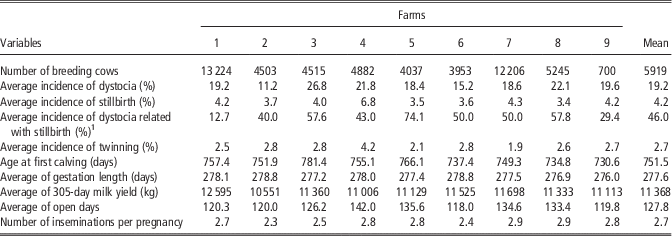
Calving records from March 2008 to December 2013 comprising 160 410 calving records of 53 265 cows were included in the final data set. Information for individual calving events including herd identification, sire and cow identification, parity, season of calving, age at first calving (AFC), length of pregnancy, 305-day milk yield, fat and protein percentages, open days, number of inseminations as well as incidence of stillbirth, twining and dystocia were included in the data set. Editing was performed to ensure reliability and consistency for the statistical analysis; therefore, records associated with ambiguous calving dates, incorrect evaluation dates, AFC outside 19 to 38 months, 305-day milk yield outside 2500 to 18 000 kg, pregnancy period outside 260 to 295 days, days open outside 30 to 300 and number of inseminations per conception outside one to nine were excluded from the analysis. Following these edits, a total number of 110 765 records were eligible for statistical analysis. A summary of the data is given in Table 1.
Characteristics and descriptive statistics for the nine farms in the study

1 Percentage of cows experiencing dystocia due to stillbirth which is equal to the percentage out of all stillborn calves that are associated with a dystocia event.
Stillbirth was defined according to whether or not the calf was dead at birth or died within 24 h after birth after at least 260 days of gestation. The stillbirth incidence was expressed as probability of incidence during a lactation as a binomial trait (1=stillbirth and 0=no stillbirth). Calving seasons were defined as spring (April through June), summer (July through September), autumn (October through December) and winter (January through February). Age of first calving of an individual cow was calculated as the interval between the birth date and the date of first calving. Cows were categorized as primiparous and multiparous according to their lactation number.
Statistical analyses
Estimation of productive and reproductive consequences of stillbirth
Statistical procedures were conducted using SAS/STAT 9.1 (Statistical Analysis Systems Institute 2002: SAS Institute Inc., Cary, NC, USA). A linear mixed model (PROC MIXED) was used to analyze the potential effects of stillbirth on lactation milk production traits and reproductive performance with class statements for herd, calving year and season, parity, sex of calf, stillbirth, twinning and dystocia. The population data set was analyzed based on primiparous, multiparous and as an overall model. The statistical model used for analyses was:
 $$\eqalign{ {y_{{ijklmnopqr}}} {{\equals}\ \mu {\plus}Herd_{i} {\plus}Parity_{j} {\plus}Cyear_{k} {\plus}Season_{l} } \cr \quad{{\plus}Sex_{m} {\plus}\beta _{{1n}} {\times}AFC_{{ijn}} {\plus}} {\beta _{{2o}} {\times}PRG_{{ijo}} {\plus}STB_{p}} \hfill \cr \quad{{\plus}Herd_{i} {\times}STB_{p} {\plus}Cyear_{k} {\times}STB_{p} {\plus}Parity_{j} } \cr \quad{{\times}STB_{p}{\plus}} {Herd_{i} {\times}Parity_{j} {\plus}Anim_{q} {\plus}e_{{ijklmnopqr}} } \hfill \cr (1)$$
where y ijklmnopqr is the dependent variable (305-day milk yield, fat and protein percentages as production traits, days open and number of inseminations per conception as reproductive performance); μ the overall mean; Herd i the fixed effect of herd i; Parity j the fixed effect of parity j (only for multiparous and the overall model); Cyear k the fixed effect of kth year of calving; Season l the fixed effect of lth season of calving; Sex m the fixed effect of mth sex of calf; β 1n regression coefficient of observations on AFC as a covariate; β 2o the regression coefficient of observations on pregnancy gestation length (PRG) as a covariate only for reproductive performance; STB p the fixed effect of calf delivery status (two categories, normal or stillborn); Anim q the random effect of animal (primiparous or multiparous cow); e ijklmnopqr the random residual effect with mean 0 and homogenous variance σ 2. All two-way interaction effects (herd by parity, herd by STB, parity by STB and calving year by STB) were significant and included in the model for milk production traits only. For the reproduction traits, herd by parity and calving year by STB interactions were not significant and were excluded from the model. For all statistical analyses, significance was declared at P<0.05 and trends at P⩽0.10. Residual diagnostics did not indicate any concern with respect to departure from the statistical assumption of normality.
Economic calculations
Economic data were provided by farmers via a questionnaire or estimated by cost and revenue modeling. The questionnaire was administered to each herd and included 10 questions relating to economic parameters such as milk sale price, average price of new-born calf, replacement heifer price, price per kilogram of live weight of culled cow, milk production cost, costs of veterinary and labor services and drug and treatment services. Questions related to veterinary services were completed via a face-to-face interview with veterinarians. Managers were requested to give their best answers which were finally discussed with specialists working in the area before including them in the analysis. Data sources used for deriving economic input parameters were based on the marketing circumstances of Iran in 2012. The currency used in Iran is the rial. However, costs and prices expressed in US dollars based on an exchange rate of 1 US $=30 000 Iranian rial.
The following model was used to calculate costs due to stillbirth:
 $$\eqalignno{ & \hskip-1.4pc {\rm Stillbirth} \ {\rm cost}\,\left( {{\rm \,\$\,} \ {\rm per} \ {\rm case}} \right) \cr \quad{\equals}\,{\rm reduction \ in \ milk \ production \ revenue} \cr & {\plus}{\rm costs} \ {\rm of} \ {\rm veterinary} \ {\rm services}{\plus}{\rm the} \ {\rm cost} \ {\rm of} \ {\rm labor} \cr & {\plus} {\rm costs} \ {\rm due} \ {\rm to} \ {\rm the} \ {\rm reduction} \ {\rm in} \ {\rm fertility} \cr & {\plus}{\rm the} \ {\rm additional} \ {\rm replacement} \ {\rm costs} \ {\rm due} \ {\rm to} \ {\rm stillbirth} \cr & {\plus}{\rm the} \ {\rm losses} \ {\rm due} \ {\rm to} \ {\rm calf} \ {\rm mortality}{\plus}{\rm cost} \ {\rm due} \ {\rm to} \ {\rm dystocia} \cr & {\plus}{\rm cost} \ {\rm due} \ {\rm to} \ {\rm cow} \ {\rm mortality}{\rm .} $$
The reduction in milk production costs ($/case) was calculated as profit of milk ($/kg) multiplied by the reduction in milk produced during the 305-day lactation period (kg/case). Costs of veterinary services ($/case) were calculated as duration of veterinary services per stillbirth multiplied by cost of veterinary services ($/h). Cost of labor ($/case) was calculated as duration of labor services per stillbirth (h) multiplied by cost of labor services ($/h). The fertility costs ($/case) were calculated as the longer open days (days/case) multiplied by the cost of an extra open day ($/day). The methodology presented by Cabrera (Reference Cabrera2012) for the economic value of a cow was used to calculate cost of an extra day open under different production circumstances of the nine studied farms. The cost of a day open was defined as the decreased cow value in a traded market between 2 successive days when a cow does not become pregnant. The model assumed a farmer-predefined reproductive culling policy in the future of a cow and its replacements that could be more realistic than an optimal culling policy. Economic factors used in this calculation were milk income, feed cost, calf income, non-reproductive culling cost, mortality cost, reproductive culling cost and reproductive costs that were most likely to change across the life of a cow. The details of the calculation were presented in our previous study (Mahnani et al., Reference Mahnani, Sadeghi-Sefidmazgi and Cabrera2015).
The replacement cost due to stillbirth (premature culling; $/case) was calculated as the proportion of cows culled due to stillbirth×cost of culling. The value of culling was estimated according to the methodology proposed by Dorshorst et al. (Reference Dorshorst, Collins and Lombard2006) and has been shown in details in our previous study (Mahnani et al., Reference Mahnani, Sadeghi-Sefidmazgi and Cabrera2015). Losses due to calf mortality ($/case) were calculated as:
 $$\eqalignno{ & {\rm Average} \ {\rm price} \ {\rm of} \ {\rm a} \ {\rm male} \ {\rm calf}{\times}{\rm number} \ {\rm of} \ {\rm dead} \ {\rm male} \ {\rm calves} \cr & \quad \qquad\qquad{\plus}{\rm the} \ {\rm average} \ {\rm price} \ {\rm of} \ {\rm a} \ {\rm female} \ {\rm calf} \cr \qquad\qquad\quad{\times} {\rm number} \ {\rm of} \ {\rm dead} \ {\rm female} \ {\rm calves} $$
The dystocia cost due to stillbirth occurrence ($/case) was calculated as a proportion of cows that experienced dystocia because of stillbirth×cost of dystocia. The economic value of dystocia was estimated according to a modified methodology described by Amer et al. (Reference Amer, Simm, Keane, Diskin and Wickham2001) including losses in milk yield, decreases in fertility (measured as greater number of days open), cow deaths and involuntary culling, as well as farm labor and veterinary costs where stillbirth was excluded to avoid double counting. Cost resulting from cow mortality ($ per case) was calculated as probability of the cow dying due to stillbirth×the average price of an adult cow.
Results and discussion
Descriptive statistics
A summary of descriptive statistics of the studied farms is presented in Table 1. The average rate of stillbirth was 4.2% (range from 3.4% to 6.8% at farm level). The reported rate of stillbirth was lower than that reported in United States (Meyer et al., Reference Meyer, Berger, Koehler, Thompson and Sattler2001) and previously in Iran (Atashi, Reference Atashi2011). Previous research showed that the incidence of stillbirth has been increasing in most developed countries (e.g. United States and Denmark; Meyer et al., Reference Meyer, Berger, Koehler, Thompson and Sattler2001; Berglund et al., Reference Berglund, Steinbock and Elvander2003; Hansen et al., Reference Hansen, Misztal, Lund, Pedersen and Christensen2004), whereas the trend showed a decline in Iran (Atashi Reference Atashi2011). The difference can be mainly explained by the value of the calf which is relatively high in Iran, and hence incentivizes management practices to reduce the incidence of stillbirths. There are three contributors to stillbirth: (1) death just before calving, (2) death during calving caused by calving difficulties and (3) death in the 1st days after calving (up to 24/48 h). The quality of management (assistance and care during and after calving) can impact on the incidence of stillbirths.
On larger dairy farms, with relatively low calf prices, the care around calving is often limited and that might be a reason of increased stillbirth in developed countries. The overall rate of dystocia was 19.2% of cows in the present study (range from 11.2% to 26.8% across farms). The overall incidence of dystocia associated with stillbirth was 46.0% (range of 12.7% to 74.1% across farms). On average, 2.7% of cows gave birth to twins (range of 1.9% to 4.2%). The farm average 305-day milk yield was 11 368 kg (range of 10 551 to 12 595 kg). Also, the farm averages for open days, number of inseminations per conception, and age at first service across farms were 127.8, 2.7 and 751.5 days, respectively.
Productive consequences of stillbirth
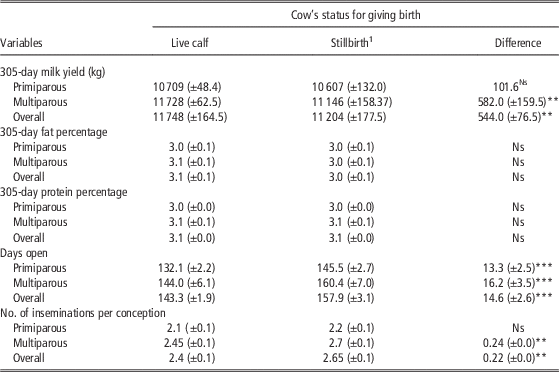
Estimated least squares means for the effect of stillbirth on productive traits are presented in Table 2. The effects are shown for primiparous and multiparous cows separately and for all cows (overall). The least square means from the mixed linear model indicated that stillbirth significantly reduced (P<0.05) 305-day milk yield in multiparous cows by about 5% (582.0±159.5 kg/cow per lactation) and in all cows (i.e. overall) by 544.0 (±76.5) kg/cow per lactation, although milk production in primiparous cows was not impacted by stillbirth (<1% difference, P⩾0.05) (Table 2). The losses can partially be due to dystocia. In practice, separation of the impacts is not possible statistically. Because there is a cause-effect relationship between dystocia and stillbirth events. In general, our results were in agreement with previous reports that found lower milk production in cows with stillbirths (Mangurkar et al., Reference Mangurkar, Hayes and Moxley1984; Atashi et al., Reference Atashi, Zamiri and Sayyadnejad2011; Atashi, Reference Atashi2011). Stillbirth did not influence the 305-day fat and protein percentage in either primiparous or multiparous cows (Table 2), which contrasts with Atashi et al. (Reference Atashi, Zamiri and Sayyadnejad2011) where the fat and protein percentages were significantly reduced by stillbirth. However, in another study on a Holstein dairy farm in Isfahan, Atashi (Reference Atashi2011) reported no significant change in the milk fat percentage from stillbirth. Inconsistencies across studies can be partially explained by different statistical models and databases used in the studies.
Estimated least squares means (±SE) for the effects of stillbirth on production and reproduction performance of 9 farms studied

Ns=not significant.
*P<0.05, **P<0.01, ***P<0.001.
1 Stillbirth was defined as death of a calf that occurs just before, during, or within 24 h from parturition.
2 Estimated least square means differences.
There are concerns about the association between stillbirth and poor cow performance. In this respect, stillbirth may influence cow performance through a cascade of effects or it is possible that there are some causes that impact both calf mortality and the dam’s poor performance (Mangurkar et al., Reference Mangurkar, Hayes and Moxley1984). As stillbirth incidence rate is higher for primiparous cows, it is expected that stillbirth incidence significantly reduced the milk yield for cows in first parity (Bicalho et al., Reference Bicalho, Galvao, Cheong, Gilbert, Warnick and Guard2007). However, the present study found that the negative productive effects associated with stillbirth were smaller and non-significant for primiparous cows compared with multiparous cows. Several factors may be responsible for these results. For example, twinning, as a causal factor for stillbirth (Silva del Río et al., Reference Silva del Río, Stewart, Rapnicki, Chang and Fricke2007) is higher in multiparous cows (Cady and Van Vleck, Reference Candy and Van Vleck1978; Silva del Río et al., Reference Silva del Río, Stewart, Rapnicki, Chang and Fricke2007) which in turn leads to a reduction in milk production (Chapin and Van-Vleck, Reference Chapin and Van Vleck1980). In addition, higher-producing cows had greater reduction in milk yield due to health disorders such as mastitis (Rajala-Schultz et al., Reference Rajala-Schultz, Grohn, McCulloch and Guard1999) and this may also be the case for cows producing stillborn calves.
Reproductive consequences of stillbirth
Stillbirth had significant effects (P<0.001) on reproductive performance (Table 2) in terms of days open (14.6±2.6 days/cow per lactation, P<0.01), but less so for inseminations per conception. Overall, our results showed that a case of stillbirth increased days open. In the present study, stillbirth significantly increased the number of inseminations per conception for all cows (Table 2). Multiparous cows that gave birth to stillborn had an increased number of inseminations per conception by 0.2 (±0.0)/cow per lactation compared with cows that gave birth to live calves. However, the number of inseminations per conception was not influenced by stillbirth in primiparous cows (Table 2). Bicalho et al. (Reference Bicalho, Galvao, Cheong, Gilbert, Warnick and Guard2007), using a Cox proportional hazards model, found a 26-day increase in days open for cows that had stillbirths compared with cows that had live calves, whereas El-Tarabany (Reference El-Tarabany2015) reported a difference of 49 days (198 v. 149). In that study, stillbirth also resulted in an increase of 2.1 average inseminations per parturition. Several reports (e.g. Stevenson and Call, Reference Stevenson and Call1988; Correa et al., Reference Correa, Erb and Scarlett1993) suggest that cows experiencing stillbirth are at a higher risk for some postpartum disorders, such as dystocia, prolapsed uterus, retained placenta, metritis and displaced abomasums that can lead to increased calving interval and decreased pregnancy rates. In practice, therefore, productive and reproductive consequences related to stillbirth could be more complicated if other disorders caused by stillbirth were included in the analysis.
Economic losses due to stillbirth
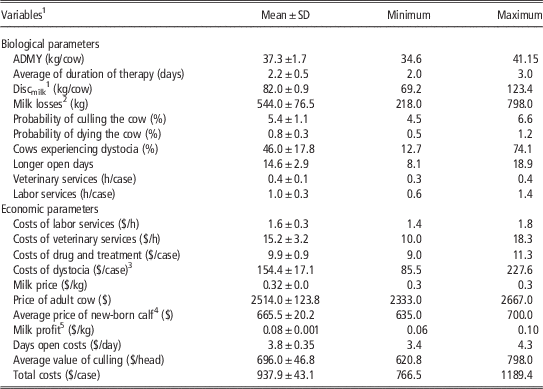
Biological and economic default inputs used to estimate different cost components and total stillbirth costs are presented in Table 3 as mean±SD, minimum and maximum. The difference across herds in biological parameters such as reduction in milk yield and reproductive performance due to stillbirth resulted in a large variation in total cost of stillbirth. The greatest variation was associated with reduced milk yield during 305-day lactation (range of 218 to 798 kg across the nine farms). The financial losses due to stillbirth averaged US$ 938 per case (range of US$ 767 to US$ 1189 across farms) (Table 3). In the United States, costs associated with stillbirth were estimated to be around US$ 27 million to $132 million per year for dairy producers (Meyer et al., Reference Meyer, Berger, Koehler, Thompson and Sattler2001; Bellows et al., Reference Bellows, Ott and Bellows2002). We found no study discussing stillbirth cost per case in dairy cattle. However, there are several papers regarding development breeding goals that reported economic values for stillbirth as a trait in genetic selection index in term of a given currency per percentage per cow per year (e.g. Amer et al., Reference Amer, Simm, Keane, Diskin and Wickham2001; Cole and VanRaden, Reference Cole and VanRaden2010; Sadeghi-Sefidmazgi et al., Reference Sadeghi-Sefidmazgi, Moradi-Shahrbabak, Nejati-Javaremi and Amer2012). In those studies, only the opportunity cost of the new-born calf was considered in economic evaluation to drive partial economic values for selection indexes, but meanwhile to avoid double count the effects of dystocia. The objective of the present study was to quantify all costs associated with stillbirths. Therefore, our results are not directly comparable with those in analyses that were designed for different purposes.
Estimated production and economic parameter used to estimate losses resulting from stillbirth for the nine studied dairy farms of Iran

ADMY=average daily milk yield.
1 Discmilk=average amount of discarded milk calculated as ADMY (kg per cow)×infection period in which milk discarded (DT, days).
2 Milk losses are the reduction in 305 d milk production and equal to differences in least squares means of stillborn cows and cows with normal calving.
3 In the estimation of dystocia cost, stillborn calf value was not considered.
4 Calculated as weighted arithmetic mean assuming that 52% of stillbirths were male calves.
5 Milk profit=milk sale price−milk production cost (including feed costs and labor, breeding, insurance, veterinary services and drug and overhead expenses).
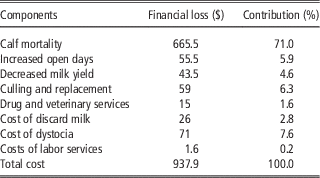
The main contributing factors in losses associated with stillbirth are presented in Table 4. Accordingly, the most important factor affecting monetary value of stillbirth was the loss of calves (71.0%). Dystocia (7.6%), and the culling and replacement (6.3%) expense were the next most important costs due to stillbirth.
Contribution of different components to estimate financial losses of stillbirth for the nine studied dairy farms of Iran

Conclusion
Results of this study showed that loss of a calf was not the only cost associated with stillbirth, and that it accounted for ~71% of the total costs. Therefore, subsequent impaired productive and reproductive performance of cows should be considered in economic evaluations. The model we have proposed to calculate stillbirth costs could be used to estimate economic losses for stillbirth in other production circumstances, where farm production and economic data might be scarce.
Acknowledgments
The authors wish to express the gratitude to all farmers who submitted data for this study, and to Mehdi Safahani-Langeroudi and Alireza Aghatehrani (respectively, FKA and Fodeh Sepahan Agriculture and Animal Husbandry, Isfahan, Iran) for their assistance with this study. Special thanks are extended to Peter Fennessy (AbacusBio Limited, Dunedin, New Zealand) and to two anonymous reviewers.