Introduction
Liriomyza trifolii (Burgess) is an extremely polyphagous, widespread pest insect in many agricultural crops, vegetables and ornamentals and is one of the most economically significant pests in the world (Stegmaier, Reference Stegmaier1968; Spencer, Reference Spencer1973; Parrella, Reference Parrella1987; Kang, Reference Kang1996; Lei et al., Reference Lei, Zhu and Zhang2007a,Reference Lei, Yao, Zhu and Wangb). It originated from South America and has become a serious economic pest in many field crops, vegetables and ornamental crops in North America and around the world (Spencer, Reference Spencer1973; Parrella, Reference Parrella1987). Punctures caused by females during feeding and oviposition can result in a stippled appearance on foliage, especially at the leaf tip and along the leaf margins (Parrella et al., Reference Parrella, Jones, Youngman and Lebeck1985). However, the major form of damage is the mining of leaves by larvae, which results in destruction of leaf mesophyll. The irregular mine becomes noticeable a few days after oviposition and gradually becomes wider and longer as the larva matures. Both leaf mining and stippling can depress greatly plant photosynthesis, and extensive mining could cause premature defoliation or complete desiccation. Wounding of the foliage caused by feeding and oviposition punctures also allows entry of bacterial and fungal pathogens, causing plant diseases (Zitter et al., Reference Zitter, Tsai, Harris, Harris and Maramorosch1980; Parrella et al., Reference Parrella, Robb and Bethke1983). The presence of unsightly larval mines and adult punctures in the leaf palisade of ornamental plants can further reduce crop value (Parrella et al., Reference Parrella, Jones, Youngman and Lebeck1985).
Recently, L. trifolii leafminers appeared as major pests in cotton in many countries, including India, causing severe yield reduction when cotton plants are young (Jeyakumar & Uthamasamy, Reference Jeyakumar and Uthamasamy1996), Israel (Yathom, Reference Yathom1989) and Turkey (Gencsoylu, Reference Gencsoylu2003). Sharma & Pampapathy (Reference Sharma and Pampapathy2006) found significant differences in leaf damage caused by L. trifolii among different cotton varieties and genotypes, but did not find differences in leafminer damage between transgenic and non-transgenic cotton varieties. In the US, L. trifolii were found as a pest on cotton in the early 1900s, first in Texas and then in other southern states (Webster & Parks, Reference Webster and Parks1913). Palumbo (Reference Palumbo1992) observed severe damage caused by L. trifolii and L. sativae Blanchard on cotton in Yuma, Arizona in 1991. Recently, Liriomyza leafminers gradually became a concern on young cotton plants in south Texas. Our preliminary field survey revealed that more mines were found on non-Bt than Bt cottons and more on younger plants or in early season than on older plants or in mid- and late season. However, cotton foliar damage caused by Liriomyza species on non-Bt and Bt cottons and its feeding, oviposition, development and survival on Bt and non-Bt cottons have not been investigated and reported in the literature.
The objectives of this study were to determine the effects of non-Bt and Bt cottons on feeding, oviposition and longevity of L. trifolii adults and the development and survival of its immature stages and to determine the occurrence, damage and selectivity of L. trifolii on several non-Bt and Bt cotton varieties or traits under field conditions in south Texas.
Materials and methods
Laboratory study
Cotton plants
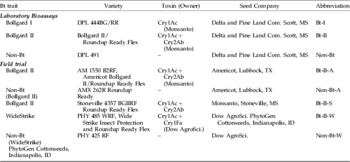
Bt and non-Bt cotton traits and varieties used are listed in table 1. Cottons were seeded in 10-l plastic pots in a greenhouse under 28–32°C and the natural light of the spring and summer seasons. Three plants were grown in each pot. The fully expanded terminal cotton leaves in 4–5-leaf stages (younger plants) and 8–9-leaf stages (older plants) were used in all experiments.
Bt and non-Bt cottons used in the laboratory and field experiments for Liriomyza trifolii.

Liriomyza trifolii
Liriomyza trifolii mines (larvae) were originally collected from an onion field at Pharr, Texas (26.19°N, 98.19°W) in February 2007. The leaves with larvae were allowed to pupate in small cages in an insectary. Green bean (Phaseolus vulgaris L.) was used as the host plant for the laboratory colony. The green beans were seeded in plastic pots (2-l capacity) in a greenhouse with 2–3 plants per pot, and plants with 5–7 leaves were placed in wooden screen cages (70×60×60 cm) in an insectary at 25±2°C, 50–70% RH and 14:10 (L:D) h. Puparia were collected, and newly emerged adults (<12 h) were sexed and used in all appropriate experiments.
Choice test
The three cotton traits, Bt-I, Bt-II and non-Bt (table 1), at two growth stages, 4–5- and 8–9-leaf stages, were used in this test. Three fully expanded terminal leaves, one from each of three plants for each trait, were detached. Each leaf was inserted with the petiole down in a water-filled vial. The leaves were placed 20 cm apart in an equilateral triangle arrangement on the bottom of a clear plastic cage (37.5×27.5×12.0 cm). A total of ten L. trifolii adults (five females and five males) were released into each cage. The frequency of landing and visiting of L. trifolii adults on each cotton leaf were observed at 8:00, 10:00, 12:00, 14:00 and 16:00 h for 30 minutes each. All adults that landed on each leaf for >10 s were recorded regardless if they landed more than once. All adults remained in the cages for 48 h, and then were removed. The cotton leaves with punctures that were either caused by host feeding, oviposition, or both, were counted. Oviposition or valid eggs oviposited by L. trifolii could not be determined immediately. Instead, number of valid eggs oviposited on each leaf was determined after larvae hatched and showed feeding evidence with tiny mines on the leaves. This was done by inserting the leaves with punctures individually into plastic test tubes (2.4 cm in diameter and 9.3 cm in length) filled with water. Number of eggs was counted after larva hatching with visible feeding signs. The leaves were continuously maintained and monitored until the larvae pupated or died. The puparia were collected and then were monitored until adults emerged or the puparia died. Each treatment had at least twenty replications.
No-choice test
Cotton plants at 4–5- and 8–9-leaf stages were evaluated. A fully expanded terminal leaf with petiole at the 4–5- or the 8–9-leaf stages was detached from Bt or non-Bt cotton plants and was immediately inserted into a foam cup (240 ml) filled with water through a hole in the center of a plastic lid (11.5 cm in diameter). A piece of cotton wool was wrapped around the petiole to hold the leaf and prevent flies from entering the cup. A one-litre clear, plastic cup cage, each with a 9-cm opening on top, screened with nylon net and a corked access hole (1.2 cm in diameter) on the side was used to release flies. A female and a male couple of L. trifolii emerged within 12 h were placed in the cup cage with one Bt or non-Bt cotton leaf. The cotton leaves were replaced with new leaves at 48 h intervals until the female died. The leaves with feeding and oviposition punctures were maintained to assess numbers of feeding punctures, numbers of oviposition punctures (eggs), duration of larval development and survival, and pupation as described in the choice test. The puparia were monitored until adults emerged or the puparia died.
Field study
The field experiment was conducted at the USDA South Farm; The Kika de la Garza Subtropical Agricultural Research Center is located in the heart of the Rio Grande Valley of Texas (26°08′N and 97°57′W). The six Bt and non-Bt cotton traits used are listed in table 1. The cottons were planted on 7 March 2007. The six cotton varieties were arranged in a randomized complete block design with three replications. Each field plot had four rows, and each row was approximately 150-m long. Investigation of occurrence and damage of leafminers in the field started on 12 April 2007. Ten plants were randomly selected from each plot; and numbers of infested plants, mined leaves per infested plant and mines per infested leaf were counted. Some leaves with leafminer larvae were collected in paper bags, which were brought back in the laboratory; and emerged adults were identified as L. trifolii.
Data analysis
Numbers of feeding punctures, valid eggs, numbers of pupae and longevity of females were analyzed using the analysis of variance (ANOVA), and means were compared using the least significant difference test (LSD) at P=0.05 (SAS Institute, 2007). The percentage of eggs in feeding punctures, survival of larvae and emergence rates of adults among the three cotton varieties were computed. The values of 0 and 100% were transformed by 1/(4n) and 1–1/(4n), respectively, where n is the number of plants sampled from each plot; and, then, the percentages were transformed by arcsine square root before analysis of variance (ANOVA) (Gomez & Gomez, Reference Gomez and Gomez1984). Means were separated using LSD test at P=0.05 (SAS Institute, 2007), and untransformed data are presented.
Results
Choice test
Frequencies of adults on cotton leaves
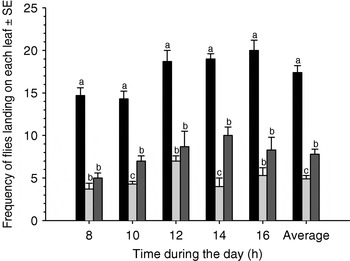
As shown in fig. 1, significantly more flies were found on the non-Bt cotton leaves than on the two Bt cotton leaves at all five observations (F=22.89; df=2, 6; P=0.0016–0.0001), as well as the average frequencies of adults that landed on the cotton leaves over the five observation periods (F=22.89; df=2, 6; P=0.0016–0.0001). Fewest numbers of flies were found on Bt-I cotton leaves during two of the five observation periods and in the overall average of landing frequencies.
The frequency of Liriomyza trifolii adults landed on non-Bt cotton (non-Bt), Bollgard I (Bt-I) and Bollgard II (Bt-II) cotton leaves per 30 min in a choice test. The same letters over each three-bar group indicate the three means do not differ significantly (P>0.05, LSD Test) (■, Non-Bt; , Bt-I;
 , Bt-II).

Feeding punctures
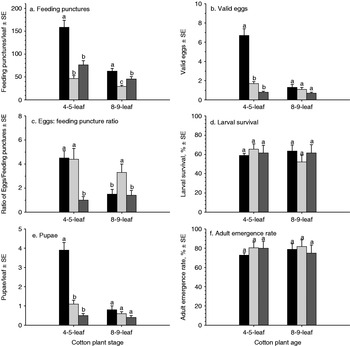
Liriomyza trifolii adult females also made significantly more feeding punctures (FP) (including the ones with eggs) on non-Bt cottons than on the two Bt cottons on both younger and older plants (on younger plants: F=29.15; df=2, 57; P<0.0001; on older plants: F=11.59; df=2, 57; P=0.0001) (fig. 2a). On younger cotton plants, there were no differences between the two Bt cotton traits, whereas on older plants, less FP were found on Bt-I cottons than those on Bt-II cottons. There were again more FP on younger plants than those of older plants in all three cotton traits (F=6.82–34.78; df=1, 38; P=0.0050–0.0001).
Feeding, oviposition, survival, pupation and emergence of Liriomyza trifolii on non-Bt cotton (non-Bt), Bollgard I (Bt-I) and Bollgard II (Bt-II) cottons at two development stages in a no-choice test. The same letters over each three-bar group in the same development stage indicate the three means do not differ significantly (P>0.05, LSD Test) (■, Non-Bt;, Bt-I;, Bt-II).

Oviposition and larval hatching
Oviposition by L. trifolii females was shown in fig. 2b. More eggs were found on non-Bt cotton leaves than on Bt cotton leaves on younger plants (F=56.50; df=2, 57; P<0.0001), but those were not significantly different among the three cotton traits on older plants (F=2.00; df=2, 57; P=0.1450). On younger cotton plants, percentages of eggs in total FP were not significantly different between non-Bt and Bt-I cotton leaves, but significantly lower on Bt-II leaves (F=20.10; df=2, 57; P<0.0001) (fig. 2c). On older cotton leaves, percentages of eggs were greater on Bt-I cottons than on non-Bt and Bt-II cotton leaves (F=11.17; df=2, 57; P=0.0001) with no difference between the latter two traits. More eggs were found on younger non-Bt and Bt-I cottons than those of older plants (F=4.32–53.67; df=1, 38; P=0.0444–0.0001), whereas no difference was found between younger and older Bt-II plants (F=0.31; df=1, 38; P=0.5816).
Larval survival, pupation and adult emergence
Larval survivals of L. trifolii were not significantly different on Bt and non-Bt cottons on either younger or older cotton plants once the larvae hatched (F=0.20–0.28; df=2, 38–49; P=0.7551–0.81.83) (fig. 2d). More larvae pupated on non-Bt cotton leaves than on Bt cotton leaves on younger plants (F=49.39; df=2, 57; P<0.0001), whereas no differences were found on older plants (F=1.50; df=2, 57; P=0.2327) (fig. 2e).
On younger cotton plants, more larvae pupated on non-Bt cotton than on the two Bt cotton traits (F=49.39; df=2, 57; P<0.0001) with no difference between the two Bt cotton traits, whereas on older cotton plants, larval pupation was not different among the three cotton traits (F=1.50; df=2, 57; P=0.2327) (fig. 2e). More pupae were found on younger than on older plants in non-Bt and Bt-I cotton traits (F=6.89–49.15; df=1, 38; P=0.0127–0.0001), whereas no difference was found between younger and older Bt-II cotton traits (F=0.39; df=1, 38; P=0.5372). Percentages of adults emerged were also not significantly different among the three cotton traits (F=0.07–1.59; df=2, 27–61; P=0.2124–0.9314) and between younger and older plants (F=0.01–0.43; df=1, 16–41; P=0.5172–0.9916) (fig. 2f).
No-choice test
Feeding punctures
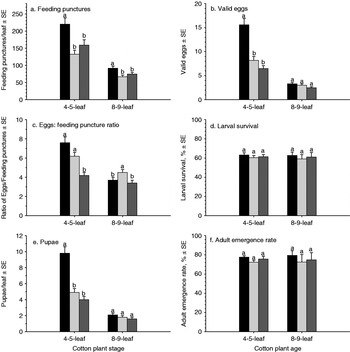
Feeding punctures of L. trifolii are rounded and appear as white speckles on the upper leaf surface. L. trifolii adult females made significantly more FP on non-Bt cotton leaves than on the two Bt cotton leaves on younger and older cotton plants (on younger plants: F=8.48; df=2, 59; P<0.0006; on older plants: F=6.06; df=2, 61; P=0.0040), with no differences between the two Bt cotton varieties (fig. 3a). There were more FP on younger cotton plants in all three cotton varieties than those of older plants (F=27.99–5.61; df=1, 38–41; P=0.0050–0.0001).
Feeding, oviposition, survival, pupation and emergence of Liriomyza trifolii on non-Bt cotton (non-Bt), Bollgard I (Bt-I) and Bollgard II (Bt-II) cottons at two development stages in a choice test. The same letters over each three-bar group in the same development stage indicate the three means do not differ significantly (P>0.05, LSD Test) (■, Non-Bt;, Bt-I;, Bt-II).

Oviposition and larval hatching
Liriomyza trifolii oviposited eggs in a small percentage of the feeding punctures. The eggs were not directly counted but were counted when larval feeding was evident and visible with an assumption of 100% egg survival. L. trifolii females oviposited more eggs on non-Bt cottons than on Bt cottons when plants were younger (F=25.13; df=2, 59; P<0.0001), but those were not significantly different in all three cotton varieties when plants were older (F=1.94; df=2, 61; P=0.1528) (fig. 3b). Percentage of eggs in total FP was highest on non-Bt cottons, followed by that in Bt-I cottons and the least in Bt-II cottons (F=13.32; df=2, 59; P<0.0001) when plants were younger (fig. 3c). In contrast, Bt-I cotton leaves had a higher percentage of eggs than non-Bt and Bt-II cotton leaves (F=4.55; df=2, 61; P=0.0143). There were more eggs on younger cotton plants for all three cotton varieties than those of older plants (F=36.85–53.57; df=1, 38–41; P<0.0001). Similarly, the percentages of eggs were greater on younger cotton plants in all three cotton varieties than those of older plants (F=4.4–33.62; df=1, 39–41; P=0.0416–0.0001).
Larval survival, pupation and adult emergence
There were no significant differences in larval survival on Bt and non-Bt cotton leaves once the larvae hatched on either younger or older cotton plants (F=0.18–0.41; df=2, 59–61; P=0.6629–0.8368) (fig. 3d). However, more larvae pupated on non-Bt cotton leaves than on Bt cotton leaves on younger cotton plants (F=26.64; df=2, 59; P<0.0001), whereas no differences were found on older plants (F=1.51; df=2, 61; P=0.2298) (fig. 3e). There were no significant differences in adult emergence on either younger or older cotton plants in all three cotton varieties (F=0.27–1.59; df=2, 59–61; P=0.2124–0.7658) (fig. 3f).
Adult longevity
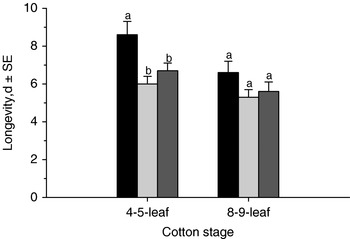
Liriomyza trifolii adults lived longer when feeding on non-Bt cottons than on Bt cottons of younger cotton plants (F=5.97; df=2, 59; P=0.0044) with no differences between the two Bt cotton varieties, whereas there were no such differences among the three cotton varieties on older cotton plants (F=1.67; df=2, 61; P=0.1973) (fig. 4).
Longevity of Liriomyza trifolii adults emerged from non-Bt cotton (non-Bt), Bollgard I (Bt-I) and Bollgard II (Bt-II) cottons at two development stages in a non-choice test. The same letters over each three-bar group in the same development stage indicate the three means do not differ significantly (P>0.05, LSD Test) (■, Non-Bt;, Bt-I;, Bt-II).

Field study
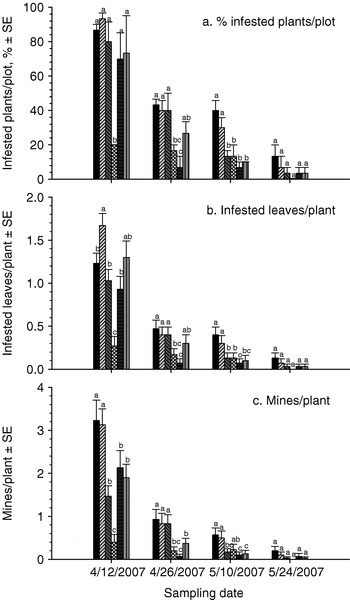
Liriomyza trifolii infestation varied greatly among the six cotton varieties and sampling dates or cotton developmental stages, and the infestation gradually decreased with the growth of cotton plants (fig. 5). On 12 April 2007, when cotton plants were at the 4–5-leaf stage, the percentage of plants infested with at least one mine among the cotton varieties were not significantly different except Bt-II-A, in which only 20% of plants were infested (F=4.78; df=5, 12; P=0.0123) (fig. 5a). Numbers of leaves with mines differed among the six varieties (F=10.47; df=5, 162; P<0.0001) (fig. 5b). Most mined leaves were found in Non-Bt-A and Bt-I, while the latter is also grouped with Non-Bt-W, Bt-II-W, and Bt-II-S and Bt-II-A had the least. Numbers of mines per plant deferred among the cotton varieties (F=12.31; df=5, 162; P<0.0001) (fig. 5c). The two non-Bt varieties had the most mines, followed by Non-Bt-W, Bt-II-W and Bt-II-S, the intermediate, and Bt-II-A, the least.
Infestation of Liriomyza trifolii on six cotton varieties under field conditions (USDA South Farm, Weslaco, 2007). All cotton traits or varieties are listed in table 1. The same letters over each three-bar group in the same development stage indicate the three means do not differ significantly (P>0.05, LSD Test) (■, Non-Bt-W; , Non-Bt-A;
 , Bt-II-W;
 , Bt-II-A;
 , Bt-II-S;
 , Bt-I).

On 26 April 2007, when cotton plants were at the 7–9-leaf stage, the percentage of plants infested were different among the cotton varieties (F=5.41; df=5, 12; P=0.0078) (fig. 5a). The two non-Bt varieties, Bt-II-W and Bt-II-A had the highest infestation rates, followed by Bt-II-S, and Bt-I had the lowest rates of infestation. Numbers of leaves differed among the six varieties (F=4.68; df=5, 162; P=0.0015 (fig. 5b) with a similar pattern of differences as those for plant infestation. Numbers of mines per plant differed among the cotton varieties (F=3.20; df=5, 162; P=0.0087) (fig. 5c); the two non-Bt varieties and Bt-II-W had the most mines, Bt-II-S had the least and Bt-I and Bt-II-A were in-between.
Cotton plants grew up to 10–12-leaf stage on 10 May 2007. The two non-Bt varieties had higher rates of mined plants than the four Bt varieties (F=7.80; df=5, 12; P=0.0018) (fig. 5a). The two non-Bt varieties also had more mined leaves than the four Bt varieties (F=2.79; df=5, 162; P=0.0191 (fig. 5b). Of the Bt varieties, Bt-I had the least mined leaves, followed by Bt-II-S, and Bt-II-W and Bt-II-A had the most. More mines were found on non-Bt cottons than on Bt cottons with a few exceptions (F=3.45; df=5, 162; P=0.0054). Data sampled on 24 May 2007 showed that infestation of L. trifolii was not significant different among all cotton varieties when cotton plants were at the 13–14-leaf stage (fig. 5a–c).
Discussion
Our data clearly demonstrated that L. trifolii adults were able to distinguish between Bt cottons and non-Bt cottons. The results indicated that they were more often present on non-Bt cotton leaves and preferred to feed non-Bt cotton leaves to Bt cotton leaves in both a choice test among non-Bt and Bt cotton varieties and a no-choice test in which a single variety was offered. In addition, they oviposited more eggs while they were feeding on non-Bt cotton leaves than on Bt cotton leaves, and the proportion of viable eggs to feeding punctures on non-Bt cotton by L. trifolii were similar to that (15%) on chrysanthemum (Parrella et al., Reference Parrella, Allen and Marishita1981).
The preferences of feeding and oviposition of L. trifolii adults to non-Bt cotton leaves could be affected by the attractant in non-Bt cottons and the deterrents by the Bt cottons. Host selection by Liriomyza species differs from other herbivorous insects because the larva of leafminers is unable to move between leaves or plants, and the choice of host is made solely by adult female (Parrella, Reference Parrella1987; Wei et al., Reference Wei, Zhu and Kang2006). It is possible that the leafminers made the choices between non-Bt and Bt cottons based on plant volatiles from the cotton leaves. Zhao & Kang (Reference Zhao and Kang2003) found that adult L. sativae selectively responded to plant odors from the host plants (kidney bean, cucumber and tomato) compared with non-host plant (creeper and Chinese rose). Yan et al. (Reference Yan, Xu, Bengtsson, Witzgall and Anderson2002, Reference Yan, Bengtsson, Anderson, Ansebo, Xu and Witzgall2004) analyzed the volatiles from two transgenic Bt cotton varieties (GK12 and GK 97) and their parental non-Bt variety (Simian 3) and found that volatile components in Bt cotton and regular cotton were almost the same except for the absence of a sesquiterpene and a minor unknown compound in regular cotton, and the concentrations of α-pinene and β-pinene in Bt cotton were relatively higher than those in regular cotton. These results indicate that the volatiles unique to Bt cottons may play a critical role in repelling herbivores from Bt cottons.
Bt transgenic cottons are targeted to manage lepidopteran pests, not dipteran pests, such as leafminers (Sharma & Pampapathy, Reference Sharma and Pampapathy2006). As a non-target insect pest, L. trifolii had no significant differences in leaf damage between the non-transgenic hybrid and the transgenic hybrid with Bt cry1Ac gene, but significant differences in leaf damage do exist among the genotypes tested (Sharma & Pampapathy, Reference Sharma and Pampapathy2006). However, our data clearly show that leaf damages, especially the numbers of leaf mines per plant, between the two non-Bt cottons were generally not significantly different over the three sampling dates and were significantly lower than those of the Bt cottons. Effects of Bt cotton on oviposition of several lepidopteran species differed from having no deterrent effects to Heliothis virescens (F.) (Torres & Ruberson, Reference Torres and Ruberson2006) and Pectinophora gossypiella (Saunders) (Liu et al., Reference Liu, Tabashnik, Dennehy, Carriere, Sims and Meyer2002), to deterring oviposition to H. armigera (Wang et al., Reference Wang, Xu, Feng and Zhang2003) and Sylepta derogate F. (Liu et al., Reference Liu, Yang, Lu, Kang, Yu, Chen, Wu and Wan2005). Although feeding and oviposition stimulants of leafminers were scarcely studied, chemicals functioning as deterrents were identified from several host plants of leafminer. It has been shown that chemicals produced by plants could deter feeding and oviposition of L. trifolii, including those from hybrids of tomato and wild tomato deterring feeding (Hawthorne et al., Reference Hawthorne, Shapiro, Tingey and Mutschler1992) and those from cucurbits and peppers deterring oviposition (Kashiwagi et al., Reference Kashiwagi, Horibata, Mekuria, Tebayashi and Kim2005a,Reference Kashiwagi, Horibata, Mekuria, Tebayashi and Kimb; Mekuria et al., Reference Mekuria, Kashiwagi, Tebayashi and Kim2005, Reference Mekuria, Kashiwagi, Tebayashi and Kim2006; Dekebo et al., Reference Dekebo, Kashiwagi, Tebayashi and Kim2007; Kashiwagi et al., Reference Kashiwagi, Mekuria, Dekebo, Sato, Tebayashi and Kim2007).
Our data show that L. trifolii performed better on younger plants than on older plants in feeding and oviposition in the laboratory and overall plant infestation under field conditions both on non-Bt and Bt cottons. These results are similar to those reported in the literature. Jeyakumar & Uthamasamy (Reference Jeyakumar and Uthamasamy1996) and Srinivasan et al. (Reference Srinivasan, Viraktamath, Gupta and Tewari1995) found that leafminers generally cause sever damage only in the early stage of cotton crop growth. The results of the field trial were similar to the results obtained from the laboratory study. The field data also indicated that the leafminers could cause serious damage during the early stage of cotton growth, and the damage would be gradually reduced with the growth and aging of cotton plants. Although transgenic Bt cotton is engineered to expre ss δ-endotoxin proteins in almost all parts of the plant (Perlak et al., Reference Perlak, Deaton, Armstrong, Fuchs, Sims, Greenplate and Fischhoff1990), the efficacy of transgenic Bt cotton against target pests varies with plant age (Greenplate et al., Reference Greenplate, Penn, Mullins, Oppenhuizen, Dugger and Richter2000; Wu et al., Reference Wu, Guo, Greenplate and Deaton2003; Kranthi et al., Reference Kranthi, Naidu, Dhawad, Tatwawadi, Mate, Patil, Bharose, Behere, Wadaskar and Kranthi2005), plant part or structure (Chen et al., Reference Chen, Wu, Zhou, Huang and Zhang2000; Kranthi et al., Reference Kranthi, Naidu, Dhawad, Tatwawadi, Mate, Patil, Bharose, Behere, Wadaskar and Kranthi2005). It seems to be a common phenomenon that the efficacy is relatively high in early growing season but declines significantly during late season for most commercialized Bt cotton varieties (Greenplate et al., Reference Greenplate, Penn, Mullins, Oppenhuizen, Dugger and Richter2000; Xia et al., Reference Xia, Xu and Guo2005). It has been found that the condensed tannin content in terminal leaves continually increased from the seedling (<1%) to the boll stage (10%), and the increased tannin content was closely related to the maturity, decrepitude and lignification of cotton tissues (Wu & Guo, Reference Wu and Guo2000a,Reference Wu and Guob). The cotton phenolics and condensed tannins in older plants might deter L. trifolii through feeding and oviposition. Bethke & Parrella (Reference Bethke and Parrella1985) found that L. trifolii would spend shorter periods and less time during leaf puncturing on plant leaves with repellent or antifeedant effects.
It is understandable that Bt cotton did not affect the larval and puparial development and survival and emergence of L. trifolii because the Bt toxins were not targeted to dipteran pests. However, our data showed that the longevity of L. trifolii adults was significantly shorter when feeding on the two Bt cotton varieties than on non-Bt variety when cotton plants were at the 4–5-leaf stages but there were no such differences on other cotton plants. The toxicity of Bt toxins on dipteran flies needs to be investigated further.
Acknowledgements
We thank J. Martinez, Y.M. Zhang and L. Li (Texas AgriLife Research) and J. Alejandro, J. Caballero, L. Leal and J. Yarrito (KSARC-ARS-USDA) for technical assistance. This article was submitted for publication with the approval of the Center Director of Texas AgriLife Research and Extension Center at Weslaco, Texas A&M University System and the Head of the Department of Entomology, Texas A&M University, College Station, Texas. This research is also partially funded by the National 973 Project (Grant no. 2002CB119000) and the National 11th Five-years Project (2006BAD08A17) of China.