Introduction
The southern pine beetle, Dendroctonus frontalis Zimmermann (Coleoptera: Curculionidae: Scolytinae), remains one of the most economically significant insect pests of forestry in the pine-growing portions of the southeastern United States of America, Mexico, and Central America, and its impact is expanding northwards along the eastern coast of North America due to climate change (Lesk et al. Reference Lesk, Coffel, D’Amato, Dodds and Horton2017; Dodds et al. Reference Dodds, Aoki, Arango-Velez, Cancelliere, D’Amato, DiGirolomo and Rabaglia2018). Intensive research on the beetle’s semiochemistry from the 1960s through the 1980s was stimulated by the possibility that release of small amounts of benign chemicals could reduce beetle-caused losses (Vité Reference Vité1970). However, scientists quickly became aware of issues that would limit the efficacy and applicability of such technology (Vité Reference Vité1970; Coulson et al. Reference Coulson, Oliveria, Payne and Houseweart1973a; Vité and Francke Reference Vité and Francke1976). The topic has received far less attention from researchers in the past two decades. Two anti-attractant semiochemicals (verbenone and 4-allylanisole) were developed operationally and received EPA registrations (United States Environmental Protection Agency 1999, 2001) as bioinsecticides for southern pine beetle management. However, neither has been adopted in practice. In contrast, significant technological successes have been achieved with southern pine beetle attractants. These are used for monitoring the beetle’s populations and range expansion (Dodds et al. Reference Dodds, Aoki, Arango-Velez, Cancelliere, D’Amato, DiGirolomo and Rabaglia2018) and for forecasting outbreaks and their intensity (Billings Reference Billings2011b).
This article is not a comprehensive review of the literature on basic science and application of semiochemicals in southern pine beetle management, and the reader is directed to other recent publications (Strom and Clarke Reference Strom and Clarke2011; Sullivan Reference Sullivan2011, Reference Sullivan2016). Instead, we critically review past efforts at development of semiochemical tools for the beetle’s management, assess the present state of this technology, and discuss impediments to future technology development. Although our discussion is limited to southern pine beetle, many issues raised are applicable to the development of semiochemical management tools for other bark beetle pests. The review is divided into sections that provide general background to southern pine beetle management and chemical ecology, describe and discuss successes and failures in application of semiochemicals for the beetle’s management, and evaluate where knowledge gaps and practical impediments challenge progress.
Southern pine beetle infestation dynamics, management, and chemical ecology
In the southern United States of America, landscape disturbances caused by southern pine beetle normally occur as spatially discrete infestations, or “spots,” consisting of continuous zones of killed, dying, and newly infested trees, that often are surrounded by broad areas of uninfested forest (Schowalter et al. Reference Schowalter, Pope, Coulson and Fargo1981; Ayres et al. Reference Ayres, Martinson and Friedenberg2011). If not controlled, spots may grow to encompass new trees at rates of a few to dozens – in extreme cases, hundreds – per week (Hedden and Billings Reference Hedden and Billings1979; Clarke and Billings Reference Clarke and Billings2003). Southern pine beetle spot infestations typically are initiated in the spring (Coulson et al. Reference Coulson, Flamm, Wagner, Rykiel, Sharpe, Payne and Lin1985; Ayres et al. Reference Ayres, Martinson and Friedenberg2011; Martinson et al. Reference Martinson, Ylioja, Sullivan, Billings and Ayres2013) and often start in single trees or small groups of trees weakened by lightning strike (Hodges and Pickard Reference Hodges and Pickard1971; Coulson et al. Reference Coulson, Hennier, Flamm, Rykiel, Hum and Pa1983). They may continue to accumulate infested trees along their margin throughout the summer and early fall (Thatcher and Pickard Reference Thatcher and Pickard1964; Franklin Reference Franklin1970). Multiple small spots may coalesce. This pattern of mortality accumulation, in which all trees along a growing front or “head” are killed and mortality builds continuously during the growing season, is generally not observed in other aggressive Dendroctonus sp., and mortality from those species is typically more evenly dispersed and accumulates in an area over successive years rather than months (Roe and Amman Reference Roe and Amman1970; Safranyik et al. Reference Safranyik, Shrimpton and Whitney1974; Wood Reference Wood1982; Mitchell and Preisler Reference Mitchell and Preisler1991; Borden Reference Borden1993; Shore et al. Reference Shore, Safranyik, Hawkes and Taylor2006). In the northeastern United States of America, southern pine beetle infestations may not form distinct boundaries between attacked and unattacked trees; rather, they may be more diffuse with dispersed mortality occurring around the periphery of the infestations (Dodds et al. Reference Dodds, Aoki, Arango-Velez, Cancelliere, D’Amato, DiGirolomo and Rabaglia2018).
Because southern pine beetle spot growth may persist for months, there is a large window of opportunity for reducing further growth (Billings Reference Billings2011a). Within growing spots, trees at immediate risk to beetle attack are those located closest to trees that are being mass-attacked and thus are identified easily (Gara and Coster Reference Gara and Coster1968; Johnson and Coster Reference Johnson and Coster1978). Spots typically expand in a single direction (generally downwind) at any one time (Coster et al. Reference Coster and Hicks1978), and tree-protection efforts can be targeted at trees in the anticipated direction of spot movement. Hence, direct control of southern pine beetle has focussed on suppression of growth of individual spots (Billings Reference Billings2011a) or protection of individual, high-value trees threatened by a growing spot head.
Two recommended and widely used strategies for suppressing the beetle’s infestations currently exist. They are the cut-and-remove strategy, in which infested trees and a buffer of apparently uninfested trees in the direction of spot growth are felled and salvaged, and the cut-and-leave strategy, where timber is felled similarly but is left on site in the opening created by the cut (Billings Reference Billings2011b). Cut-and-remove is the preferred suppression method because beetles in the infested trees are eliminated from the forest, the value of the felled timber can be recovered, and the cleared opening facilitates regeneration while also reducing wildfire risk. However, in recent years, cut-and-leave applications in the southern United States of America have increased due to the loss of outlets for the timber. Cut-and-leave treatments have been successful in the areas of southern pine beetle–range expansion that lack commercial infrastructure for harvesting and processing trees (Dodds et al. Reference Dodds, Aoki, Arango-Velez, Cancelliere, D’Amato, DiGirolomo and Rabaglia2018).
The efficacy of these two strategies is substantially derived from the semiochemical-driven dynamics of spot growth. Beetle spots expand through a process called “switching,” in which the aggregation pheromone plume associated with mass-attacked trees triggers attack initiation on – and switching of attack focus to – immediately adjacent, healthy trees (Renwick and Vité Reference Vité1970). As a consequence, elimination of trees with pheromone-producing beetles can be sufficient to stop infestation growth even if trees with developing and emerging brood are left in place (Gara Reference Gara1967; Clarke et al. Reference Clarke, Salom, Billings, Berisford, Upton, McClellan and Dalusky1999). Without nearby sources of aggregation pheromone, brood emerging from infested trees typically disperse rather than mass-attack uninfested trees next to the spot (Billings and Pase Reference Billings and Pase1979; Cronin et al. Reference Cronin, Turchin, Hayes and Steiner1999). Although trees being mass-attacked are left onsite in cut-and-leave treatments, felling can cause rapid reductions in production of aggregation attractant by the attacking beetles (Vité and Crozier Reference Vité and Crozier1968), and felling of both mass-attacked and buffer trees disrupts normal pheromone plume movement due to the forest canopy being opened (Thistle et al. Reference Thistle, Peterson, Allwine, Lamb, Edburg and Strom2005).
Semiochemicals for manipulating southern pine beetle
Development of semiochemical management tools for bark beetles has focussed on compounds that either attract or inhibit attraction of the flying insects. A third class of semiochemicals (termed “multifunctional”) acts as either attractants or attraction inhibitors at either low or high concentrations, respectively (Rudinsky Reference Rudinsky1973a; Borden Reference Borden1995), and the desired effect is obtained by adjusting the release rate. However, because airborne concentrations decrease with distance from the point of release, high rates of multifunctional-type semiochemicals can enhance attraction within the wider area while reducing attraction at or near the point of release (Sullivan and Mori Reference Sullivan and Mori2009).
Dozens of semiochemicals have been discovered that can influence the behaviour of southern pine beetle and thus have potential as management tools.
Attractants
As with other aggressive bark beetles, southern pine beetle must attack en masse in order to overcome host defences and reproduce in otherwise healthy trees (Christiansen et al. Reference Christiansen, Waring and Berryman1987; Raffa et al. Reference Raffa, Phillips and Salom1993), and semiochemicals from both the beetles themselves and the host trees mediate mass attacks. These compounds cause beetles to concentrate their attacks on individual trees and, as attack numbers and semiochemical levels increase, initiate attacks on nearby trees (Borden Reference Borden1974; Geiszler et al. Reference Geiszler, Gallucci and Gara1980; Sullivan Reference Sullivan2016). The aggregation pheromone for southern pine beetle consists of the female-released attractant frontalin and the male-released synergist endo-brevicomin (Renwick and Vité Reference Renwick and Vité1969; Sullivan et al. Reference Sullivan, Shepherd, Pureswaran, Tashiro and Mori2007b). The frontalin–endo-brevicomin combination is synergised by volatile compounds within the host’s defensive resin, which is expelled copiously in vigorous pines at the beetles’ entrances (Kinzer et al. Reference Kinzer, Fentiman, Page, Foltz and Vité1969; Pureswaran and Sullivan Reference Pureswaran and Sullivan2012). Although they are strong attractant synergists, resin odours alone are unattractive to the beetle (Billings Reference Billings1985), and little evidence exists of a primary attractant for pioneer southern pine beetle (Payne Reference Payne1986). Female beetles also produce large quantities of the attractive synergist trans-verbenol; however, its effect is redundant with host odours (Payne et al. Reference Payne, Coster, Richerson, Edson and Hart1978a; Shepherd and Sullivan Reference Shepherd and Sullivan2018). endo-Brevicomin is a potent attractant synergist (Vité et al. Reference Vité, Billings, Ware and Mori1985; Sullivan et al. Reference Sullivan, Shepherd, Pureswaran, Tashiro and Mori2007b) but is classified as a multifunctional pheromone for southern pine beetle because it can strongly reduce beetle attraction at high release rates (Salom et al. Reference Salom, Billings, Upton, Dalusky, Grosman and Payne1992).
Anti-attractants
Southern pine beetles also produce attraction inhibitors that may function as antiaggregation pheromones that signal that attack densities have rendered the host substrate unsuitable for further colonisation (Byers Reference Byers1989; Borden Reference Borden1997; Ross and Niwa Reference Ross and Niwa1997; Seybold et al. Reference Seybold, Bentz, Fettig, Lundquist, Progar and Gillette2018). Anti-attractants released by southern pine beetle include numerous oxygenated monoterpenes, with verbenone and myrtenol occurring in greatest abundance (Renwick et al. Reference Renwick, Hughes and Ty1973; Sullivan Reference Sullivan2005; Pureswaran et al. Reference Pureswaran, Sullivan and Ayres2006). Oxygenated monoterpenes associated with the beetle’s host colonisation also have nonbeetle origins, including both spontaneous and microbial oxidation of monoterpenes in host resin (Brand et al. Reference Brand, Bracke, Markovetz, Wood and Browne1975, Reference Brand, Bracke, Britton, Markovetz and Barras1976; Hunt et al. Reference Hunt, Borden, Lindgren and Gries1989; Sullivan et al. Reference Sullivan, Pettersson, Seltmann and Berisford2000). In this context, they may signal decrepitude and unsuitability of colonised or decaying hosts (Byers et al. Reference Byers1989). Southern pine beetles also produce nonmonoterpene attraction inhibitors acetophenone and 2-phenylethanol (Sullivan Reference Sullivan2005; Sullivan et al. Reference Sullivan, Dalusky, Wakarchuk and Berisford2007a). Other sources of anti-attractant semiochemicals for the beetle include host tree species (e.g., resin constituents 4-allylanisole and myrcene; Hayes et al. Reference Hayes, Strom, Roton and Ingram1994; Munro et al. Reference Munro, Gandhi, Barnes, Montes, Nowak and Shepherd2020) and nonhost tree species (Dickens et al. Reference Dickens, Billings and Payne1992; Sullivan et al. Reference Sullivan, Dalusky, Wakarchuk and Berisford2007a; Shepherd and Sullivan Reference Shepherd and Sullivan2013).
Successes and failures in semiochemical technology development for southern pine beetle
Attractants for monitoring
The most successful and widespread use of semiochemicals in management of southern pine beetle has been their deployment in traps for detecting cryptic populations and forecasting damage.
Operational lures and traps
The three-component combination of frontalin, endo-brevicomin, and host resin monoterpenes is the current, recommended operational lure for southern pine beetle trapping in the United States of America (Dodds et al. Reference Dodds, Aoki, Arango-Velez, Cancelliere, D’Amato, DiGirolomo and Rabaglia2018; Mooneyham Reference Mooneyham2019). This lure has seen two significant improvements since its original development in the late 1960s, namely, the inclusion of devices with an elevated release rate (grams per day) of host odours in the mid-1980s and of devices with a low release rate of endo-brevicomin in the 2000s (Billings Reference Billings1985; Sullivan et al. Reference Sullivan, Shepherd, Pureswaran, Tashiro and Mori2007b). The beetle produces almost solely the (+)-enantiomer of endo-brevicomin and predominantly (–)-frontalin (Payne et al. Reference Payne, Richerson, Dickens, West, Mori and Berisford1982; Sullivan et al. Reference Sullivan, Shepherd, Pureswaran, Tashiro and Mori2007b); however, for both compounds, the much less costly racemic blend has activity similar to the predominant enantiomer (Payne et al. Reference Payne, Richerson, Dickens, West, Mori and Berisford1982; Sullivan and Mori Reference Sullivan and Mori2009; Sullivan et al. Reference Sullivan2011) and is used in the operational lure. It is recommended that the endo-brevicomin device be placed several metres from the trap to maximise the synergistic effect of the endo-brevicomin on the attractant in the trap (Sullivan and Mori Reference Sullivan and Mori2009; B.T.S., unpublished data) while reducing unwanted bycatches of endo-brevicomin–attracted species whose presence complicates sample handling (Shepherd and Sullivan Reference Shepherd and Sullivan2017). Until recently, the recommended host odour component for the operational lure had been turpentine, a resin distillate, from the host species Pinus taeda Linnaeus (Pinaceae). However, due to difficulty in obtaining this material, this component has changed to a 2:1 combination of host monoterpenes alpha-pinene and beta-pinene, which typically are the two dominant resin monoterpenes of the southern pine beetle’s preferred hosts (Mirov Reference Mirov1961). alpha-Pinene and beta-pinene individually are synergists of the aggregation pheromone (Staeben et al. Reference Staeben, Sullivan, Nowak and Gandhi2015; Munro et al. Reference Munro, Gandhi, Barnes, Montes, Nowak and Shepherd2020); however, the superiority of this particular compound pairing and ratio has not to our knowledge been demonstrated. Inclusion of additional host odour components (e.g., 4-allylanisole; Munro et al. Reference Munro, Gandhi, Barnes, Montes, Nowak and Shepherd2020) and adjustment of their enantiomeric composition (e.g., favouring the (+)-enantiomer of alpha-pinene (Staeben et al. Reference Staeben, Sullivan, Nowak and Gandhi2015)) might further increase lure potency. Due to the risk of the operational beetle lure producing spillover attacks on adjacent pines (Vité Reference Vité1970), it is recommended that monitoring traps be placed approximately 23 m from the nearest susceptible pine and at even greater distances when the beetles are abundant.
The most common trap design used operationally for southern pine beetle detection and monitoring is the 12- or 16-unit black multiple-funnel trap (Lindgren Reference Lindgren1983). However, a range of trap designs (e.g., funnel, slot traps, and cross-vane traps) have all proven effective for trapping the beetle (Moser and Browne Reference Moser and Browne1978; McCravy et al. Reference McCravy, Nowak, Douce and Berisford2000; Munro et al. Reference Munro, Gandhi, Barnes, Montes, Nowak and Shepherd2020). McCravy et al. (Reference McCravy, Nowak, Douce and Berisford2000) found Theyson slot traps (Niemeyer et al. Reference Niemeyer, Schröder and Watzek1983) to be similar in effectiveness to 12-unit funnel traps for trapping southern pine beetle; however, to our knowledge, multiple-funnel traps have not been directly compared to other designs. Traps with low reflectance (dark in shade) are superior to lighter ones, but the beetles show no preference among dark colours (Strom et al. Reference Strom, Roton, Goyer and Meeker1999; Strom and Goyer Reference Strom and Goyer2001).
Operational use of monitoring traps
Baited funnel traps currently are used in the southeastern United States of America as part of a region-wide survey being conducted cooperatively by federal and state agencies each spring to estimate the likelihood of southern pine beetle outbreaks during the following summer (Billings and Upton Reference Billings and Upton2010; Billings Reference Billings2011b). The resulting county-scale forecasts allow forest managers to make advance preparations, including earlier execution and greater frequency of aerial spot detection surveys, for handling coming outbreaks. Traps are distributed widely, with one to three traps allotted per county (1 500 km2 average area) for a 6-week interval coinciding with the beetle’s annual dispersal flight (Sullivan et al. Reference Sullivan, Brownie and Barrett2016). Counts are made of both southern pine beetle and the predator Thanasimus dubius (Fabricius) (Coleoptera: Cleridae), which also responds to the lure (Vité and Williamson Reference Vité and Williamson1970). These counts and the numbers of infestations during the previous year have been used to estimate beetle population trends, as well as the abundance of infestations (ranked as low, medium, or high) for the coming summer (Billings and Upton Reference Billings and Upton2010). Comprehensive analyses of forecast accuracy for the first two decades of the survey verified the programme’s utility but indicated shortcomings. For example, state-level forecasts were 85% correct when they were for low spot abundances but only 32% correct when they were for high spot abundances for the years 1987–2005 (Billings and Upton Reference Billings and Upton2010). An updated model and revised sampling procedures are being implemented to increase accuracy and precision in predicting spot abundances. Additional data types may be derived from the trap catches and prove useful for forecasting outbreaks; this possibility is currently being explored. For example, during the years 2016 and 2017, traps in outbreak areas had a significantly higher proportion of male beetles in their catches than did traps in non-outbreak areas (McNichol Reference McNichol2018). The trapping interval was recently extended from four to six weeks to better capture the spring flight; however, this period can last several months (Sullivan et al. Reference Sullivan, Brownie and Barrett2016). Because of this, the catches cannot provide phenological data. Baited traps have also been essential tools in delineating the extent of this insect’s recent range expansion into the northeastern United States of America in response to climate change (Lesk et al. Reference Lesk, Coffel, D’Amato, Dodds and Horton2017; Dodds et al. Reference Dodds, Aoki, Arango-Velez, Cancelliere, D’Amato, DiGirolomo and Rabaglia2018).
Attractants for direct control
Several different strategies have been explored experimentally for using attractant semiochemicals for reducing pine mortality, but none has shown promise as an operational management tool.
Aggregation disruption
Southern pine beetle attacks must be concentrated on a limited number of trees within a spot; otherwise, attack densities may be insufficient to overcome host defences. The aggregation attractant allows the beetles to maintain the required focus. Releasing synthetic aggregation attractant over a broad area would presumably disrupt this semiochemical targeting of single trees. Vité et al. (Reference Vité, Hughes and Renwick1976) attempted this in a single southern pine beetle spot: rice soaked with frontalin and alpha-pinene was dispersed aerially within the spot head and among surrounding trees to saturate the atmosphere with aggregation attractant. The treatment, surprisingly, caused attacks to intensify, and tree mortality was not reduced. A modification of this approach aims to attract beetles away from the spot head into portions of the spot with previously colonised trees. In experiments where aggregation attractant–releasing devices were attached only to killed trees and nonhost species in the zone behind the growing infestation head, flying beetles were successfully redistributed away from the spot head and into an area where they were presumably harmless (Richerson et al. Reference Richerson, McCarthy and Payne1980). The technique appeared efficacious in slowing or stopping spot growth when local spot densities were low, but it was unable to control spots during severe outbreaks (Payne et al. Reference Payne, Kudon, Walsh and Berisford1985a,b). It is possible that, when local beetle population levels are high, recruitment of dispersing beetles into the spot by the synthetic attractant negates its value in redistributing beetles within the spot.
In a third approach, attractants are used to redirect beetle spot growth towards stands of hardwoods, forest openings, or other host-free areas adjacent to the spot head and thereby cause spot collapse. This tactic was used in federal wilderness areas in Texas, United States of America, to protect neighbouring private lands (S.R.C., unpublished data). However, this strategy would be applicable only to spots with compact heads and in close proximity to pre-existing barriers to spot growth. Urban forests, where distributions of susceptible pines are patchy and surrounded by host-free areas, may be ideal for this technique. Spot redirection also has potential for turning spot growth away from high-value areas such as endangered species habitat or other landowner’s pine stands. Caution is advised, however, because of the potential for increased recruitment of beetles from outside the spot.
Trap trees and trap-out
Semiochemical baits may be used to reduce local insect pest populations and damage by luring pests to traps or insecticides or by concentrating them in host material that is either treated with insecticide or subsequently destroyed (Borden et al. Reference Borden, Chong and Fuchs1983; El-Sayed et al. Reference El-Sayed, Suckling, Wearing and Byers2006, Reference El-Sayed, Suckling, Byers, Jang and Wearing2009; McCullough et al. Reference McCullough, Poland and Lewis2016; Negron et al. Reference Negron, Cain, Cadenhead and Waugh2019). In experimental trials, healthy pines adjacent to those being mass-attacked in a southern pine beetle infestation were baited with aggregation attractant and simultaneously treated with the herbicide cacodylic acid (Coulson et al. Reference Coulson, Oliveria, Payne and Houseweart1973b). The goal was to concentrate attacks on trees where reproduction would fail (Copony and Morris Reference Copony and Morris1972; Coulson et al. Reference Coulson, Oliveria, Payne and Houseweart1973b, 1975). However, these trees were not sufficiently effective sinks for attacking beetles, and spot growth was not reduced (Coulson et al. Reference Coulson, Oliveria, Payne and Houseweart1973a).
One of the authors (B.T.S.) recently performed a pilot trial for using mass trapping within a spot to suppress spot growth. Funnel traps (3 m length) were suspended from 4–5 m height among trees with larval-through-adult–brood stages and were baited repeatedly along their length with frontalin- and host odour–release devices. Two low release endo-brevicomin devices were positioned among vacated trees and 8–10 m from the traps. We believed that we might address shortcomings of previous attempted, attractant-based redirection methods by (1) removing attractant-redirected beetles from the spot entirely, (2) using a more potent – and thus more competitive – lure (i.e., one that included a high release rate of host odours and displaced endo-brevicomin devices; Billings Reference Billings1985; Sullivan and Mori Reference Sullivan and Mori2009), and (3) releasing attractant across more of the range of heights preferred by southern pine beetle for flight and attack (Gara et al. Reference Gara, Vité and Cramer1965; Coster et al. Reference Coster, Payne, Hart and Edson1977b). In addition, a sieve was placed over the traps’ collection cups, thereby allowing the beetles to pass through but stopping predators from being captured (Ross and Daterman Reference Ross and Daterman1998). Although these traps removed tens of thousands of southern pine beetles, the spot growth rate increased rather than decreased. A severe outbreak was occurring at the time, with many spots having received cut-and-leave treatment; we suspect that the high quantities of attractant from the traps recruited beetles dispersing from these controlled spots (Cronin et al. Reference Cronin, Turchin, Hayes and Steiner1999).
Anti-attractants for direct control
Successful mass attack requires response to the aggregation attractant; therefore, semiochemicals that inhibit this response have been explored for suppressing southern pine beetle spot growth and for protecting individual trees from colonisation. Among identified anti-attractants for southern pine beetle, only brevicomin, 4-allylanisole, and verbenone have been the focus of extensive efforts towards developing a control technology.
Brevicomin
Both the endo- and exo-isomers of brevicomin can reduce southern pine beetle response to attractant-baited traps (Vité and Renwick Reference Vité and Renwick1971; Payne et al. Reference Payne, Coster, Richerson, Edson and Hart1978a). In an attempt to disrupt spot growth, devices releasing endo- and exo-brevicomin were distributed regularly through the head of a growing spot and on adjacent, uninfested trees (Payne et al. Reference Payne, Coster and Johnson1977). This reduced beetle landings on trees but failed to redistribute beetles away from the spot head. Attachment of endo- and exo-brevicomin devices at 2-m intervals vertically along the boles of uninfested trees adjacent to the spot head reduced southern pine beetle landings, but the treatment did not protect the trees from attack (Payne and Richerson Reference Payne and Richerson1979; Richerson and Payne Reference Richerson and Payne1979). Moreover, landings, attacks, and reproduction by the competing bark beetle species Ips avulsus (Eichoff) (Coleoptera: Curculionidae) were increased by these brevicomin treatments (Richerson and Payne Reference Richerson and Payne1979; Payne and Richerson Reference Payne and Richerson1985), suggesting that competitive displacement of southern pine beetle by the less aggressive species could cause spot collapse. This potential technology was never developed, possibly due to the unappealing prospect of significant tree mortality due to Ips attacks occurring before spot collapse.
4-Allylanisole
This phenylpropanoid is a common secondary plant compound and a minor component (typically 1–10%) of the resin volatiles of southern pine beetle host pines (Mirov Reference Mirov1961; Bookwalter et al. Reference Bookwalter, Riggins, Dean, Mastro, Schimleck, Sullivan and Gandhi2019). Walking beetles are repelled by 4-allylanisole applied to the substrate, and devices releasing 4-allylanisole can reduce the beetle’s responses to attractant-baited traps (Hayes et al. Reference Hayes, Strom, Roton and Ingram1994; Strom et al. Reference Strom, Roton, Goyer and Meeker1999). In initial studies, trees at immediate risk of southern pine beetle attack due to lightning strike or proximity to beetle activity appeared to be protected by releasers of 4-allylanisole attached along the bole (Strom et al. Reference Strom, Goyer and Hayes1995; Hayes et al. Reference Hayes, Meeker, Foltz and Strom1996), and 4-allylanisole was patented as a biorational insecticide (Hayes et al. Reference Hayes, Strom, Roton and Ingram1995). However, in a subsequent study, no reduction of beetle-caused mortality was observed when the bole was treated with microencapsulated 4-allylanisole (either sprayed or applied within projectiles) or 4-allylanisole release devices (Strom et al. Reference Strom, Clarke and Shea2004). In this test, trees were rendered susceptible to southern pine beetle attack by treatment with either aggregation attractant or a biocide. There has been no further development of 4-allylanisole for control of the beetle.
Both brevicomin and 4-allylanisole, which were investigated as tree protectants because of their anti-attractant effects in traps, were subsequently found to be attractant synergists for the southern pine beetle at least under certain conditions (Vité et al. Reference Vité, Billings, Ware and Mori1985; Sullivan et al. Reference Sullivan, Shepherd, Pureswaran, Tashiro and Mori2007b; Pureswaran et al. Reference Pureswaran, Hofstetter and Sullivan2008; Sullivan and Mori Reference Sullivan and Mori2009; Munro et al. Reference Munro, Gandhi, Barnes, Montes, Nowak and Shepherd2020). Presumably, unknown or unappreciated attractant effects in compounds applied for tree protection could undermine some of their benefits; however, there is no evidence that brevicomin and 4-allylanisole failed as tree protectants for this reason.
Verbenone – basic knowledge
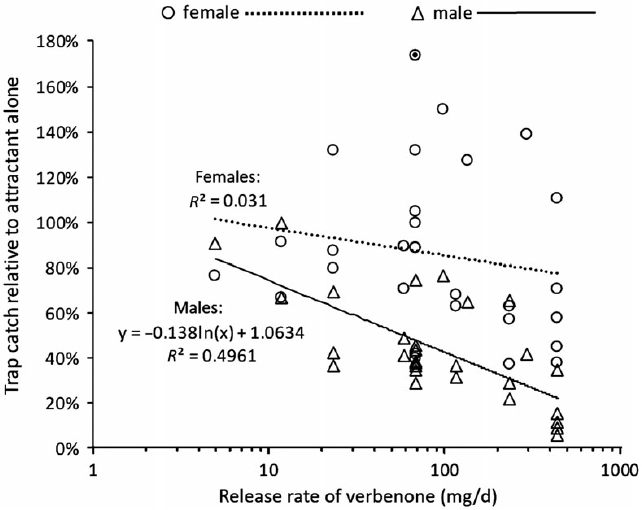
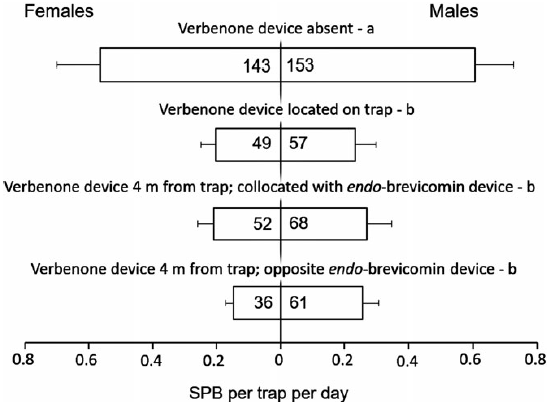
The oxygenated monoterpene verbenone has received more attention than any other semiochemical for control of southern pine beetle. It is present in large quantities in newly emerged males (Renwick Reference Renwick1967), and they release it when they join a female in her gallery (Pureswaran and Sullivan Reference Pureswaran and Sullivan2012). It reduces response to synthetic attractants both in field (Renwick and Vité Reference Renwick and Vité1969; Payne et al. Reference Payne, Coster, Richerson, Edson and Hart1978a) and laboratory (Rudinsky Reference Rudinsky1973b; McCarty et al. Reference McCarty, Billings, Richerson, Payne and Edson1980) assays, and it is thought to function as an antiaggregation pheromone (Smith et al. Reference Smith, Salom and Payne1993). Some laboratory bioassays indicated that verbenone is a multifunctional semiochemical because it increased arrestment responses by walking beetles to frontalin at low concentrations but reduced responses at high concentrations (Rudinsky Reference Rudinsky1973b; McCarty et al. Reference McCarty, Billings, Richerson, Payne and Edson1980). Additionally, southern pine beetle attacks have commonly been noticed around points of application of verbenone treatments on trees that were otherwise unattacked (S.R.C., personal observation). However, limited evidence from controlled field studies exists for the multifunctionality of verbenone. Of 29 experimental treatments – varying in release rate and enantiomeric ratio of verbenone and in composition of the attractant – that have been reported in challenge tests of verbenone (Fig. 1; full explanation in the next paragraph), significant enhancement of attraction was detected only once (Salom et al. Reference Salom, Billings, Upton, Dalusky, Grosman and Payne1992). In a study by one of the authors (B.T.S.), reduction of the beetle’s responses to attractant-baited traps was similar whether a verbenone-releasing device (a BeetleBlockTM pouch; Synergy Semiochemicals, Delta, British Columbia, Canada) was co-located with the attractant releaser or was located 4 m away (Fig. 2; procedure described in Supplementary Materials 1). This result shows that the operational verbenone device does not act as an attractive synergist when located several metres from a source of southern pine beetle attractant, as occurs with high-rate release devices of the multifunctional-type pheromone component endo-brevicomin (Sullivan and Mori Reference Sullivan and Mori2009; Sullivan Reference Sullivan2016; B.T.S., unpublished data). Another encouraging inference from these data is that the anti-attractant effects of a verbenone release device can occur over a sufficient radius (i.e., at least several metres) to influence responses to potentially many adjacent trees.
Effects of release rate of verbenone devices on southern pine beetle response to attractant-baited traps. Plotted data are from multiple experiments reported in three sources (Payne et al. Reference Payne, Coster, Richerson, Edson and Hart1978a, Salom et al. Reference Salom, Billings, Upton, Dalusky, Grosman and Payne1992; Sullivan et al. Reference Sullivan, Dalusky, Wakarchuk and Berisford2007a). Points represent mean response to a single treatment within a multi-treatment experimental trial that also included an attractant-only control. The y-axis variable is response to the treatment divided by response to the control. Tests were performed at different times during summer and fall, in different locations, and with attractant lures that differed substantially in release rate and composition of the host component (i.e., alpha-pinene or turpentine) of the attractant lure. The enantiomeric composition of the verbenone ranged approximately from 17 to 69% (+). Regression lines are drawn for a log-linear dose-response relationship, which is common for bark beetle responses to semiochemicals. A significant correlation between verbenone dose and change in response to attractant was detected only for males (hence the female function is not shown). The filled circle is the only instance where beetle attraction was reported as significantly increased by verbenone.

Effects of displacement of a verbenone device on southern pine beetle catches in attractant-baited funnel traps. Traps were placed into uninfested, mixed pine and hardwood stands and baited invariably with frontalin and turpentine devices that were placed directly on the trap, as well as with an endo-brevicomin device located 4 m horizontally from the trap. A verbenone-releasing polyethylene pouch device was either absent, on the trap itself, at the same location as the endo-brevicomin device, or 4 m from the trap but opposite the endo-brevicomin device. Integers are the total catches by each treatment. Treatments associated with the same lowercase letter did not differ significantly in catches of the sexes summed (Tukey test; α = 0.05). See Supplementary Materials 1 for details.

To summarise all findings from published attractant-challenge trapping experiments with verbenone (Payne et al. Reference Payne, Coster, Richerson, Edson and Hart1978a; Salom et al. Reference Salom, Billings, Upton, Dalusky, Grosman and Payne1992; Sullivan et al. Reference Sullivan, Dalusky, Wakarchuk and Berisford2007a), we analysed across studies the relationship between change in catches caused by a verbenone device and the release rate of the device. Data were included only if verbenone was the sole agent used to challenge the attractant, and verbenone enantiomers (whose ratios varied among trials) were summed to obtain the release rate. We thereby obtained 29 data points. This analysis indicated that inhibition of male attraction increases with increasing release rates of verbenone (from 5 to 450 mg/day; Spearman rank order correlation; r = −0.655, P < 0.001, n = 29; Fig. 1). Mean reduction in catches across all studies was significantly greater for males than for females (56% (94% maximum) versus 14% (62% maximum); paired t-test, t = –6.599, df = 28, P < 0.001), and female response was not significantly correlated with the concentration of verbenone (Spearman correlation; r = –0.27, P = 0.156, n = 29). These results indicate that, across the broad range of conditions for the different trials, verbenone has very limited ability to reduce attraction of the sex that first invades the host (i.e., females) and initiates the mass attack. Also, an 80% or greater reduction in male response to a strong attractive source may require verbenone release that is greater than 400 mg/day.
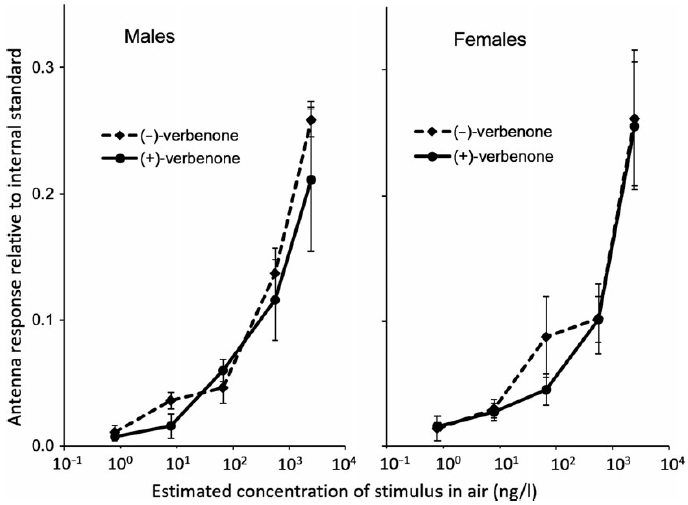
This analysis did not account for the enantiomeric composition of verbenone used in the trials, which varied considerably. Enantiomeric composition can strongly influence bark beetle responses to semiochemicals (Vité et al. Reference Vité, Billings, Ware and Mori1985; Seybold Reference Seybold1993), and variability exists in southern pine beetle production of and response to the enantiomers of verbenone. Newly emerged male beetles contain an average ratio of 36% (+)-verbenone to 64% (–)-verbenone, with some geographic variation (Grosman et al. Reference Grosman, Salom, Ravlin and Young1997); however, paired males may produce mostly the (+)-enantiomer (unpublished data from Sullivan Reference Sullivan2005). Some published trapping trials indicate that (+)-verbenone is a stronger attraction inhibitor than its antipode, but others do not (Salom et al. Reference Salom, Billings, Upton, Dalusky, Grosman and Payne1992). Our experiments with a coupled gas chromatograph–electroantennographic detector, which was fitted with an enantiomer-discriminating gas chromatograph column, indicate similar olfactory sensitivities to both enantiomers of verbenone by both males and females (methods are described in Supplementary Materials 2; Fig. 3). The effect of the enantiomeric composition of verbenone on tree protection and spot suppression has not been examined in a controlled study; however, devices releasing 34%, 66%, or 89% of the (–)-enantiomer all demonstrated ability to reduce spot growth (Payne et al. Reference Payne, Billings, Berisford, Salom, Grosman, Dalusky and Upton1992; Clarke et al. Reference Clarke, Salom, Billings, Berisford, Upton, McClellan and Dalusky1999). Therefore, existing data do not strongly indicate either verbenone enantiomer as having greater biological importance or likelihood of efficacy in southern pine beetle management.
Gas chromatography–electroantennographic detection analyses of southern pine beetle olfactory responses to a dilution series of the enantiomers of verbenone. Analyses were performed on a chiral gas chromatography column that provided wide separation of retention times and an expected purity of the enantiomers that was greater than 99% during exposure. Pairwise t-tests between responses to enantiomers at each dose failed to find a statistically significant difference in either sex (P ≥ 0.13). See Supplementary Materials 2 for details.

Verbenone for spot suppression
Verbenone has been the primary semiochemical investigated for suppression of southern pine beetle infestations. Rather than replacing the two main methods of spot suppression (cut-and-remove and cut-and-leave), verbenone was intended for use in areas where tree felling was restricted. Two applications were developed: verbenone-only and verbenone-plus-felling (Payne et al. Reference Payne, Billings, Berisford, Salom, Grosman, Dalusky and Upton1992; Clarke et al. Reference Clarke, Salom, Billings, Berisford, Upton, McClellan and Dalusky1999). For the verbenone-only treatment, all trees currently under attack and a buffer of uninfested trees around the spot head were treated with verbenone. In the verbenone-plus-felling treatment, all currently infested trees were felled towards the infestation centre, and a buffer of uninfested trees around the spot head was treated with verbenone. Pilot investigations of these techniques (1986–1987, in eastern Texas) indicated mean reductions in spot growth of 87% for verbenone-plus-felling (six spots) and 62% for verbenone alone (eight spots) (Payne et al. Reference Payne, Billings, Berisford, Salom, Grosman, Dalusky and Upton1992). In a more extensive study conducted in Texas, Georgia, and Virginia, United States of America, in 1995–1997, treatment methodology was standardised for operational use. A table providing the number of releasers to be deployed was developed for both treatments, based on the number of currently infested pines and the average diameter (Clarke et al. Reference Clarke, Salom, Billings, Berisford, Upton, McClellan and Dalusky1999). The buffer for verbenone-only treatments was a minimum of 12 m or three rows of trees past the last infested tree, and 8 m or two rows of trees for the verbenone-plus-felling treatments. When using these guidelines, mortality did not expand beyond the treated buffer in 86% of spots treated with verbenone and felling and in 69% of spots treated with verbenone alone (21 and 45 treated infestations, respectively; Clarke et al. Reference Clarke, Salom, Billings, Berisford, Upton, McClellan and Dalusky1999). All untreated infestations continued to expand, with 22 of 28 spots adding one or more new trees per day. However, these methods of using verbenone for spot suppression presume that the spot head has clear boundaries and direction of growth, as these conditions are needed for assigning trees to either cutting or verbenone treatment. Infestations in the northeast United States of America may not develop an identifiable area of expansion (Dodds et al. Reference Dodds, Aoki, Arango-Velez, Cancelliere, D’Amato, DiGirolomo and Rabaglia2018), thereby limiting the utility of this treatment.
The techniques developed for operational use involved deployment of a verbenone pouch – a sealed polyethylene bag containing an absorbent pad – loaded with 5 mL of a 34% (+)-verbenone: 66% (–)-verbenone mixture. This enantiomeric ratio was selected in order to reproduce that present in newly emerged male southern pine beetles (Grosman et al. Reference Grosman, Salom, Ravlin and Young1997). The devices had a target verbenone release rate of approximately 100 mg/day, which is a higher rate than that released from an average pine under southern pine beetle attack (Salom et al. Reference Salom, Billings, Upton, Dalusky, Grosman and Payne1992), and lasted 40–50 days in the field. Pouches were affixed to pines at 4–5 m height to keep the devices out of human reach and to maximise verbenone concentrations at the height at which the beetles’ flight and initial attack principally occurs (Gara et al. Reference Gara, Vité and Cramer1965; Coster et al. Reference Coster, Payne, Hart and Edson1977a,b). A specially developed hammer, called the “Hundle hammer”, with an extended handle allowed personnel to secure pouches with nails at these heights.
However, implementation of verbenone as an operational beetle treatment was stymied by several developments. The verbenone pouch registered with the United States Environmental Protection Agency for use in bark beetle control had labelling that was tailored for use against western bark beetle species and contained a lower percentage of (+)-verbenone than had been used during development of the operational protocol for southern pine beetle. Additionally, the product label limited deployment of pouches to 60 per acre per year, a number which would be adequate only for small southern pine beetle infestations, according to application rates provided in Clarke et al. (Reference Clarke, Salom, Billings, Berisford, Upton, McClellan and Dalusky1999).
The partial success of spot-growth reduction with attractants suggests that the effectiveness of verbenone treatments might be improved by implementing a push–pull tactic (Lindgren and Borden Reference Borden1993; Borden et al. Reference Borden, Birmingham and Burleigh2006; Cook et al. Reference Cook, Khan and Pickett2006; Eigenbrode et al. Reference Eigenbrode, Birch, Lindzey, Meadow and Snyder2016). This tactic would redirect beetle aggregation away from the spot head into less favourable areas in the spot through a combination of attractants deployed among colonised or abandoned trees and inhibitors deployed at the infestation head. An initial pilot study of three infestations indicated that inclusion of the pull element did not improve the effectiveness of verbenone-only treatment (Payne and Billings Reference Payne and Billings1989). Billings et al. (Reference Billings, Berisford, Salom and Payne1995) tested this tactic successfully, but further field trials are needed before operational use can be recommended. Inclusion of endo-brevicomin, which was absent in the aforementioned studies, as part of the lure for the pull component of this technique might improve results. However, use of a more powerful attractant may lead to unwanted attacks on trees in the vicinity of the lures or to recruitment of beetles from outside the spot, as discussed earlier in this paper.
An alternative technology for applying verbenone for spot suppression is Specialised Pheromone & Lure Application Technology (SPLAT; ISCA Technologies Inc., Riverside, California, United States of America). This technology consists of a semi-solid wax matrix infused with semiochemicals that can be applied with a caulk gun as dollops or lines to branches and the trunks of trees (Mafra-Neto et al. Reference Mafra-Neto, de Lame, Fettig, Munson, Perring and Stelinski2013). The semiochemicals are released from the applied material at a controlled rate. The product SPLAT-Verb, which uses (–)-verbenone, has been successfully tested for protecting lodgepole pine from attack by Dendroctonus ponderosae Hopkins, the mountain pine beetle (Coleoptera: Curculionidae) (Fettig et al. Reference Fettig, Munson, Reinke and Mafra-Neto2015). However, SPLAT-Verb treatment did not reduce southern pine beetle responses to a trap baited with attractant. A revised formulation, SPLAT-SPB, which has 95% (+)-verbenone, significantly decreased southern pine beetle catch in attractive traps (S.R.C., unpublished data). Initial field trials for infestation suppression have so far been inconclusive (S.R.C., unpublished data). The major expected benefit of SPLAT-SPB over the earlier pouch technology is greater ease of application.
Verbenone for protection of individual trees
High-value trees such as nest trees of red-cockaded woodpeckers, Leuconotopicus borealis (Vieillot) (Piciformes: Picidae), and urban landscape or yard pines have received particular attention as targets for single-tree protection from southern pine beetle with verbenone. Red-cockaded woodpecker is an endangered species that nests in cavities in living pines and pecks resin wells around the cavity to protect their young (Conner and Rudolph Reference Conner and Rudolph1995; Conner et al. Reference Conner, Saenz, Rudolph, Ross, Kulhavy and Coulson2001). Active loblolly pine (P. taeda) and shortleaf pine (P. echinata Miller) (both Pinaceae) nest trees are apparently preferentially attacked by southern pine beetle, with 2–40% killed annually during an outbreak in Texas (Conner et al. Reference Conner, Saenz, Rudolph and Coulson1998).
However, verbenone has not shown efficacy in protecting individual trees from mass attack by the beetle. Verbenone releasers spaced regularly lengthwise and encircling the boles of healthy pines located near the head of a growing infestation failed to reduce beetle landings, gallery densities, or beetle-caused mortality (Richerson and Payne Reference Richerson and Payne1979). A limited trial was conducted in Texas and Louisiana, United States of America, to determine if verbenone pouches could protect nest trees of red-cockaded woodpecker from southern pine beetle attack, but four of the six treated trees were killed (S.R.C., unpublished data). The reason for these failures is suggested by trapping studies that have shown that even very high release rates of verbenone do not deter a significant portion of the beetles (Fig. 1). Attacks by undeterred beetles may produce adequate aggregation attractant to negate the deterrent effects of verbenone, or local beetle densities may be sufficiently high that attacks by the undeterred beetles are adequate to kill the tree. Use of semiochemicals to protect urban pines is also problematic. These pines are usually widely spaced, so it is difficult to predict which trees are at greatest risk even when infestations are near. Systemic insecticides have been developed that can protect pines for multiple years (Grosman et al. Reference Grosman, Clarke and Upton2009), and, as such, systemic insecticide treatments offer many advantages over semiochemical methods, which are limited by the short lifetime of release devices (generally less than two months).
Verbenone for protection of stands
In general, use of attraction inhibitors to protect entire stands from bark beetle infestation has met with mixed results, and greater efficacy has been observed for species that produce fewer generations per year (e.g., mountain pine beetle) and during periods of low to moderate population levels (Amman et al. Reference Amman, Thier, McGregor and Schmitz1989; Shea et al. Reference Shea, McGregor and Daterman1992; Borden et al. Reference Borden, Chong, Earle and Huber2003; Progar et al. Reference Progar, Blackford, Cluck, Costello, Dunning and Eager2013; Perkins et al. Reference Perkins, Jorgensen and Rinella2015). Protecting stands from the western pine beetle (Dendroctonus brevicomis Hopkins) (Coleoptera: Curculionidae) has been difficult: this species produces up to four generations per year and has required the combination of verbenone with nonhost volatiles to achieve satisfactory levels of stand protection (Fettig et al. Reference Fettig, McKelvey, Dabney and Huber2012). Seven or more overlapping generations of southern pine beetle can occur each year in the southern United States of America, where damage from this pest historically has been concentrated (Birt Reference Birt2011). In those areas, extended periods occur during which emerging and dispersing beetles are continuously available; this impedes semiochemical-based stand protection efforts once infestations are established. The distribution of attacked trees on the landscape and the spatial and temporal aspects of tree-mortality accumulation associated with southern pine beetle differ greatly from those associated with mountain pine beetle, and semiochemical control strategies applicable to mountain pine beetle may not be relevant to southern pine beetle management. With mountain pine beetle, stands that have high probability of future mortality can be identified by the presence of mortality within the stand from the previous year. Verbenone-releasing devices can be distributed across such stands before beetle flight in order to reduce further attacks and mortality. In contrast, southern pine beetle spots are commonly initiated by a spatially unpredictable phenomenon (i.e., lightning; Hodges and Pickard Reference Hodges and Pickard1971; Flamm et al. Reference Flamm, Pulley and Coulson1993), and the appearance of new spots has limited relationship to locations of existing or controlled spots (Fitzgerald et al. Reference Fitzgerald, Coulson, Pulley, Flamm, Oliveria, Swain and Drummond1994). Thus, the barriers to identifying and prioritising stands that would benefit from treatment generally preclude semiochemical-based stand protection in the case of southern pine beetle. In the beetle’s northern range extremes, fewer generations per year occur, mortality accumulation is more dispersed, and mortality tends to continue in the same stands for multiple years (Dodds et al. Reference Dodds, Aoki, Arango-Velez, Cancelliere, D’Amato, DiGirolomo and Rabaglia2018). Because of this, semiochemical-based stand protection shows greater promise for northern southern pine beetle populations. This possibility merits study.
Verbenone – prospects
As already discussed, verbenone treatment of individual trees does not reduce southern pine beetle landings, attacks, or mortality. This suggests that the behavioural mechanism underlying spot suppression by verbenone is not strictly inhibition of attraction and attack and that unknown behavioural influences likely are also at play. Due to these gaps of knowledge about verbenone, proposed improvements to verbenone-based spot suppression methods are largely based on conjecture and anecdotal field observations. Development of verbenone into a widely used management tool for southern pine beetle may require a far deeper understanding of how the compound functions in host colonisation and infestation growth.
Obstacles to progress in research, development, and application
Obstacles – attractants
One goal set forth in early research on attractants for southern pine beetle was the synthesis of an attractive target for beetles that could compete with – and preferably out-compete – natural sources of attractant (Vité Reference Vité1970). Presumably, if a baited trap was a superior attractive target to an attacked tree, mass attacks on adjacent trees would not be induced accidentally and traps could be effective population sinks for beetles. However, subsequent lure improvements appear to have increased, rather than decreased, the risk of traps inducing spillover attacks on adjacent trees (authors’ observations). This shortcoming is a barrier to the development of attractant-based technology for southern pine beetle control and limits the stand compositions and host densities where monitoring traps can be deployed safely. The inability of synthetic lures and traps to compete with natural attractive semiochemical sources may have several causes.
Attractant composition
Synthetic lures, including the recommended operational lure for southern pine beetle, may lack important, undiscovered attractive semiochemicals produced by mass-attacked trees. Since the 2000s, investigation of undiscovered semiochemicals – both attractants and attraction inhibitors – for the southern pine beetle has been aided by coupled gas chromatography–mass spectrometry and gas chromatography–electroantennographic detection, in particular (Sullivan Reference Sullivan2005; Shepherd and Sullivan Reference Shepherd and Sullivan2013; Niño-Domínguez et al. Reference Niño-Domínguez, Sullivan, López-Urbina and Macías-Sámano2015; Niño-Domínguez et al. Reference Niño-Domínguez, Sullivan, Lopez-Urbina and Macías-Sámano2018; Munro et al. Reference Munro, Gandhi, Barnes, Montes, Nowak and Shepherd2020). Using this latter method, compounds within odour blends isolated from natural sources are separated and assayed individually for their capacity to stimulate the antenna of the target insect (Bjostad Reference Bjostad1998). Typically, odour blends produced by natural sources (such as a mass-attacked tree) of bark beetle attractant are highly complex and contain potentially hundreds of compounds at widely varying concentrations (Sullivan Reference Sullivan2005; Shepherd and Sullivan Reference Shepherd and Sullivan2013; Niño-Domínguez et al. Reference Niño-Domínguez, Sullivan, López-Urbina and Macías-Sámano2015). Gas chromatography–electroantennographic detection is a rigorous means for detecting olfactory stimulants (ostensibly the only compounds capable of being semiochemicals) within such mixtures, and subsequent behavioural bioassays can be limited to just a subset of compounds. To date, the method has been used to screen for southern pine beetle olfactory stimulants produced by emerged beetles, attacking beetles, attack entrances, frass, and host resin (Sullivan Reference Sullivan2005; Shepherd and Sullivan Reference Shepherd and Sullivan2013; Niño-Domínguez et al. Reference Niño-Domínguez, Sullivan, López-Urbina and Macías-Sámano2015, Reference Niño-Domínguez, Sullivan, Lopez-Urbina and Macías-Sámano2018; Munro et al. Reference Munro, Gandhi, Barnes, Montes, Nowak and Shepherd2020). The sensitivity and thoroughness of this chemical-detection approach has enabled identification of dozens of olfactory stimulants, and thus potential semiochemicals, for the beetle. However, many southern pine beetle olfactory stimulants identified via this method have not yet been investigated behaviourally for either attractive or inhibitory effects. Additionally, there may be semiochemicals not detected using this method because their chemical properties (e.g., thermal lability) make them unsuitable.
Attractant quantity
Lure release rates and proportions among the semiochemical components ostensibly influence a lure’s capacity to compete with natural attractive sources. Semiochemical release has been quantified from individual southern pine beetle gallery entrances (Pureswaran and Sullivan Reference Pureswaran and Sullivan2012), and thus lure release rates can be estimated as numbers of “attack equivalents.” Commercial devices for the operational southern pine beetle lure release 5–12 mg/day of frontalin and 0.1–0.5 mg/day of endo-brevicomin (B.T.S. data), which equals pheromone release from 103 to 104 newly established beetle entrances (Pureswaran and Sullivan Reference Pureswaran and Sullivan2012). Given that hundreds to thousands of attacks occur on southern pine beetle–colonised pines (Coulson et al. Reference Coulson, Pulley, Foltz and Martin1976; Fargo et al. Reference Fargo, Coulson, Pulley, Pope and Kelley1978), the lures probably duplicate one to several mass-attacked trees in their release of pheromone. This suggests that the lack of competitiveness of these lures cannot be attributed to insufficient release of these compounds. However, the proportions of the pinene component in the operational lure (which is released at 1–5 g/day) relative to the pheromone component are an order of magnitude lower than those detected from beetle attacks; therefore, they may represent an unnatural presentation of the aggregation signal (Pureswaran and Sullivan Reference Pureswaran and Sullivan2012).
High rates of bark beetle aggregation pheromone components released from a target such as a trap or tree may render surrounding sources of attractive semiochemicals or uninfested trees relatively more attractive, even while increasing attraction to the target (Tilden et al. Reference Tilden, Bedard and Lindahl1983; Schlyter et al. Reference Schlyter, Byers and Löfqvist1987). For southern pine beetle, this effect has been demonstrated both for endo-brevicomin and frontalin (Vité Reference Vité1970; Sullivan and Mori Reference Sullivan and Mori2009). This phenomenon no doubt helps drive host switching (as described above) and spot growth. Without field experimentation, it may not be possible to select release rates that maximise desired effects of an attractant while keeping risk to the surrounding forest at acceptable levels. Rate adjustment is further complicated because current, local beetle population densities appear to influence the risk of spillover attacks, and these densities often cannot be gauged in advance.
Non-semiochemical cues and signal presentation
Several studies show that attraction of southern pine beetles is greatly increased if semiochemical attractants are accompanied by a dark, vertical silhouette that provides a visual stimulus similar to that produced by the host tree (Gara et al. Reference Gara, Vité and Cramer1965; Strom et al. Reference Strom, Roton, Goyer and Meeker1999; Strom and Goyer Reference Strom and Goyer2001). No thorough studies of how dimensions of the visual target (diameter, height) influence response by the beetle have been undertaken. However, the funnel traps typically used operationally differ conspicuously in dimensions from host trees, and this may make them relatively less attractive to the beetles.
Furthermore, the spatial distribution of semiochemical emission from an attacked tree differs greatly from that of commercial lures and traps. Because release devices are relatively small and are deployed singly, a baited trap releases semiochemical typically from a single point, although the resulting plume is diffused somewhat by the trap body (Lindgren Reference Lindgren1983). This spatially concentrated semiochemical release differs greatly from that of an attacked tree, which has many discrete points, each of which releases semiochemicals at a low rate across the surface of the bole. A more dispersed release may increase attraction (Tilden et al. Reference Tilden, Bedard and Lindahl1983). Furthermore, southern pine beetle flight and attacks on the host are concentrated at 3–5 m height (Gara et al. Reference Gara, Vité and Cramer1965; Coster et al. Reference Coster, Payne, Hart and Edson1977a,b), whereas traps used operationally for the beetle are deployed less than 3 m above ground level.
Local environment and semiochemical background
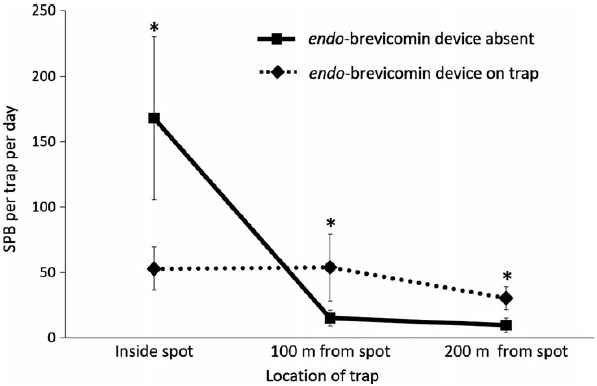
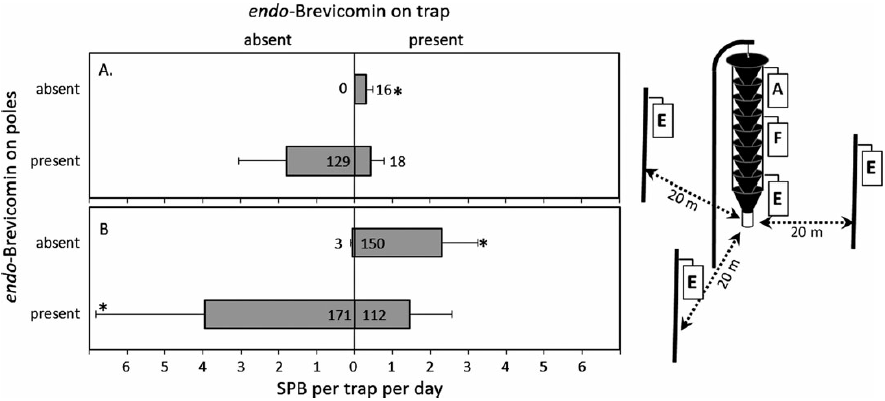
The attractiveness of a lure may be influenced by naturally occurring semiochemicals in the environment. At a single release rate, endo-brevicomin enhanced responses to traps baited with attractant (frontalin and turpentine) outside of active infestations but reduced responses inside (Sullivan et al. Reference Sullivan2011; Fig. 4). This effect may be due to semiochemical background – specifically, a background of beetle-produced endo-brevicomin – present inside infestations but absent outside, as suggested by an unpublished experiment (see Supplementary Materials 3 for a description). In trials in uninfested stands, addition of an endo-brevicomin device to attractant-baited traps either increased or decreased beetle catches, depending on whether a trio of 20-m-distant endo-brevicomin release devices (a source of endo-brevicomin background) was absent or present, respectively (Fig. 5). The multifunctional dose-response curve associated with endo-brevicomin may have caused this effect (Sullivan Reference Sullivan2016). The endo-brevicomin released from the trio of devices may have produced a low, synergistic concentration at the trap, whereas the additional amounts released by the device added to the trap could have increased the endo-brevicomin concentration above an optimally attractive level. These observations suggest that specific lure compositions may be more or less competitive in the presence of different local population densities of southern pine beetle and the ambient pheromone concentrations they may generate. Furthermore, unknown qualities of the semiochemical milieu could produce misleading results in semiochemical tests with this and other bark beetles, and semiochemical responses observed in one context may not occur in another context where application is desired.
Differing effects of endo-brevicomin devices on southern pine beetle catches in attractant-baited funnel traps located either inside or outside active beetle infestations. Individual funnel traps were baited with frontalin and turpentine and alternately had one or no endo-brevicomin devices attached. The data are combined from eight infestations each in Georgia and Mississippi, United States of America. An asterisk indicates that catches with or without endo-brevicomin differed significantly at the indicated location (α = 0.05). Data are derived from Sullivan et al. (Reference Sullivan2011), Table 2.

Catches of southern pine beetle in funnel traps baited with frontalin and alpha-pinene and varying in two factors: (1) presence of an endo-brevicomin device attached to the trap, and (2) presence of an endo-brevicomin background from three endo-brevicomin devices surrounding the trap at 20-m distance. Trials were performed either with a relatively higher (trial A: 2–5 mg/day) or lower (trial B: 0.3–0.7 mg/day) release of endo-brevicomin from the devices attached to the trap itself (the release from the 20-m-distant devices was invariant, 2–5 mg/day). Trials were at the same site but at different dates for trials A (19 April to 8 May 2013) and B (8 to 28 May 2013). Release devices in the schematic diagram are frontalin (F), alpha-pinene (A), and endo-brevicomin (E). The integers adjacent to or inside bars indicate total beetles trapped by the treatment. An asterisk indicates significantly different catches due to the presence or absence of the endo-brevicomin device on the trap (α = 0.05). The large error bars are due to variation in catches among blocks. Experiments were in uninfested mixed pine/hardwood forests in southwestern Mississippi. See Supplementary Materials 3 for details.

Obstacles – anti-attractants
Extensive laboratory and field experiments over the past 50 years have identified numerous compounds that can reduce southern pine beetle response to attractants. However, extensive efforts to develop tree-protection and spot-suppression technologies with these compounds have not yielded a management tool receiving significant use. At least two major obstacles hinder development of southern pine beetle management technology with anti-attractants.
Complexities of semiochemical function
Past research has shown that semiochemicals can have complex and subtle influences on behaviour of this and other bark beetle species that may not be readily discovered or characterised. However, understanding these influences may be essential to technology development. In southern pine beetle and other bark beetles, behavioural effects of attraction-modifying semiochemicals have typically been established with “challenge”-type trapping experiments. Challenge tests contrast catches among attractant-baited traps when a subset is amended with releasers of candidate attraction modifiers (Reeve and Strom Reference Reeve and Strom2004; Fettig et al. Reference Fettig, Dabney, McKelvey and Borys2006; Strom et al. Reference Strom, Smith and Brownie2013). A candidate that reduces catches is inferred to have the potential to protect trees because response to aggregation attractant is critical for beetle colonisation of healthy hosts. Trap challenge tests are appealing because they can be performed quickly, do not require that trees be killed, and produce statistically robust data sets. Fourteen anti-attractant semiochemicals for the southern pine beetle have been identified with challenge tests (Sullivan Reference Sullivan2011).
However, challenge tests neither distinguish true repellents from attraction reducers nor show whether the candidate could deter landings occurring randomly or when not mediated by olfactory attraction. These tests may provide an overly simplified view of semiochemical activity, and reliance on them likely has delayed recognition of key properties of southern pine beetle semiochemicals. For example, challenge tests alone do not elucidate the spatial effects of a semiochemical, which may be critical information for effective application. endo-Brevicomin can inhibit the beetle’s response to attractant at its point of release but synergise responses to sources of attractant up to tens of metres away (Sullivan and Mori Reference Sullivan and Mori2009; B.T.S., unpublished data); therefore, a semiochemical characterised as an anti-attractant in challenge tests (as endo-brevicomin was; Payne et al. Reference Payne, Coster, Richerson, Edson and Hart1978a,b; Salom et al. Reference Salom, Billings, Upton, Dalusky, Grosman and Payne1992) could inadvertently put surrounding resources at greater risk if deployed for protecting trees. Furthermore, aspects of the environment and methodology of challenge tests can yield conflicting results. As already discussed, endo-brevicomin can synergise response to attractant outside of southern pine beetle infestations but inhibit attraction inside an infestation, and presence of endo-brevicomin background (Fig. 5) and variation in trap spacing (Sullivan and Mori Reference Sullivan and Mori2009) can produce similar activity “reversals.” Once discovered, the influence of variables such as location and spatial distribution of semiochemical sources can be determined with additional experiments. However, the above evidence indicates sufficient characterisation of the activity and biological function of a candidate control semiochemical may require substantially more sophisticated and resource-intensive experimentation than typically has been applied to this problem.
Also, it is likely that important variables governing activity of anti-attractants for southern pine beetle have yet to be discovered. In challenge tests, 4-allylanisole was shown to inhibit the beetle’s response to attractant-baited traps (Hayes et al. Reference Hayes, Strom, Roton and Ingram1994; Strom et al. Reference Strom, Roton, Goyer and Meeker1999), whereas more recent tests indicate it acts as a potent attractant synergist (Munro et al. Reference Munro, Gandhi, Barnes, Montes, Nowak and Shepherd2020). These two sets of challenge studies differed in a variety of aspects, but ongoing investigations have failed to reproduce the earlier-reported inhibitory effects of 4-allylanisole, and several hypotheses regarding causes for the contrasting results have been ruled-out (B.T.S., unpublished data). Likewise, the simultaneous success of verbenone as a spot suppressant but failure as a tree protectant defies simple explanation. The functions of semiochemicals in southern pine beetle biology may be much more complex than envisioned during the early period of semiochemical research; this complexity reduces the near-term prospect for an efficacious, reliable semiochemical technology to control the beetle.
Difficulties with tests of spot suppression
In the development of southern pine beetle spot suppression technology, the experimental unit of replication is a single spot and treatment of dozens of spots is necessary to evaluate a semiochemical treatment. Collection of data from individual spots is time-consuming and labour-intensive. Availability of spots for experiments may be limited due to annual variability in location, intensity, accessibility, and expanse of outbreaks, and permission for experiments may be difficult to obtain. Managers of the national forests where experimentation generally occurs typically prefer to aggressively control spots through cuts, particularly when they threaten private lands or high-value resources such as red-cockaded woodpecker colonies. Untreated spots for use as experimental controls are necessary but understandably disliked; however, sophisticated models for predicting spot growth can be used as a partial substitute for untreated control spots (Stephen and Lih Reference Stephen and Lih1985; Coulson et al. Reference Coulson, Feldman, Sharpe, Pulley, Wagner and Payne1989). The high levels of replication needed for evaluating efficacy of spot-suppression techniques slows technology improvements because every proposed modification (e.g., adjustments to height, densities, and tree characteristics for deployment of verbenone devices) must receive the same, copious replication before recommendations are altered.
Conclusions
Research on southern pine beetle semiochemical attractants has resulted in management technologies that are widely used and have unquestionable value (i.e., trap lures for forecasting and detecting beetle populations). In contrast, extensive efforts to develop semiochemical-based spot-suppression and tree-protection technology for the beetle have, to date, failed to generate a management tool that has been adopted in practice, and achievement of this goal will require extensive additional work. A long list of anti-attractants for the species now exists, but most of these semiochemicals have received little, if any, investigation as resource protectants, due in part to their sheer number. Verbenone still shows much potential for being adopted operationally as a spot suppressant, and the barriers to this goal are surmountable despite being significant. Geographic variability in southern pine beetle population dynamics likely deserves greater attention in future research: semiochemical management technologies may be more applicable in the southern states, where past research has been focussed, compared to the northern limits of the insect’s range, where relevant aspects of its population dynamics appear to differ. Independent efforts at development of semiochemical management are advisable in the northeast United States of America.
Acknowledgements
We are grateful to Dr. Cavell Brownie for providing assistance with the statistical analyses, Dr. William Shepherd for performing electroantennograms, and JoAnne Barrett for providing field assistance and collecting data from insect samples.
Supplementary material
To view supplementary material for this article, please visit https://doi.org/10.4039/tce.2020.67.