1. INTRODUCTION
Every public outrage, every theft, robbery or depredation, every obstruction, nuisance, or breach of cleanliness, and every imposition or overcharge in articles under the cognizance of the police act, are deemed public offences, and are prosecuted by the inspectors of the wards [under the authority of the police judge]. The examination of the offender and witnesses are in this [Edinburgh police] court taken instanter, and viva voce; and the sentence pronounced is immediately executed.Footnote 1
Writing in Picture of Edinburgh (1806), local author John Stark paid homage to the efficiency and scope of the city's recently established police court. Edinburgh's example was quickly followed by other major urban centres, which, like Scotland's capital, established police courts under local police legislation.Footnote 2 These courts came to be integral to the smooth running of towns, urban order and the development of the Scottish criminal justice system. From their inception, police courts dealt with more business, prosecuted more cases and punished more offenders than any other centre of justice in the country. They were the principal local courts before which people were likely to be summoned and interact with the law, and were instrumental in bringing about a massive increase in the number and type of crimes that were dealt with and punished in a summary manner.
Scholars of criminal justice history in England have in recent years given greater attention to chronicling summary courts' rise to prominence in administering the criminal law. Explanations for this phenomenon in the eighteenth century have identified the important role played by Sir John Fielding in the London Bow Street magistrates' court; men of property's mounting concerns with crime; the belief that magistrates were corrupt and ‘trading in justice’; and the impact of stipendiary magistrates and police offices in London in 1792.Footnote 3 Studies of nineteenth-century criminal law have pointed to legal and administrative changes to improve the efficiency of court procedure; the reclassification of what constituted indictable crime; and the removal of juveniles from the higher courts.Footnote 4 The evolution and expansion of summary justice has also been viewed as a product of the emergence of the ‘policeman state’, changes in middle-class perceptions of violence and appropriate masculine conduct, and the judicial system's growing preoccupation with ‘civilising’ the lower orders and safeguarding urban order.Footnote 5
However, as Clive Emsley has pointed out in a recent review of criminal justice history in Britain, more research needs to be carried out on nineteenth-century police magistrates' courts, especially their formative development in the early nineteenth century.Footnote 6 Many of the studies which chart the rise of summary justice in England focus not on police courts per se, but instead connect it to wider developments within the criminal justice system following major judicial reforms from the 1840s onwards.Footnote 7 Those studies that have given attention to magistrates' courts have, with the odd exception,Footnote 8 been very much London-centred.Footnote 9 This is, to some extent, understandable given London's importance in an English context, the development of the Bow Street magistrates' court from the 1750sFootnote 10 and the employment of stipendiary magistrates under the 1792 Middlesex Justice's Act.Footnote 11 However, it has left notable gaps in historians' understanding of the development of police courts in other parts of the United Kingdom.
This is no more evident than with the experience of Scotland. In an intriguing study of the ‘genius’ of Scots Law, Lindsay Farmer argues that summary justice arose not just as a means of ‘avoiding the legal technicalities and formalities associated with the common law’, but also as a desire to move from a judicial system concerned with local territory and sovereignty to one preoccupied with procedure and order.Footnote 12 A few other studies have made fleeting reference to the expansion of police courts and their significance,Footnote 13 but, to date, Farmer's legal history remains the only significant work to provide an overview of the development of formal summary criminal procedure in nineteenth-century Scotland.Footnote 14
This article seeks to address this neglect. It charts the rise, structure and practice of Scottish police courts in their crucial formative years, c.1800 to 1833, paying attention not just to the legal influences, but also to exploring for the first time the wider economic, social and administrative contexts which were so significant to their development and character. Moreover, the article examines how civic tensions and the rise to prominence of a new class of businessmen contributed to the evolution of police courts and their institutional structures. It argues that men of property intertwined civic imperatives with their own moral and economic interests in order to effect reform and defend their own position, status and influence. Behind the rhetoric of ‘public protection’ and the ‘common good’ that underlay police courts' evolution and expansion were the private needs and aspirations of public men. By ‘public men’ we mean men of property who were, in many cases, active in some capacity in civic life. This was by no means a homogeneous body. It included civic leaders in town councils and magistracies (most of whom were drawn from business backgrounds), leading figures in Scottish legal circles, and large business owners who were on the fringes of, or were aspiring to, public life in civic circles.Footnote 15 It also included the committees of local landowners and burgesses who were consulted in the framing of local police legislation.Footnote 16 Although often in conflict with one another over civic administration and the distribution of power within council circles, the article argues that public men had much in common when it came to restructuring the growing urban environment and reconceptualising urban order in line with their values, needs and perceptions. It also contends that the discourse, structure and practice of police courts initially threatened, then reflected and safeguarded social and institutional hierarchies at a time when civic boundaries were being challenged in other public spheres.
In addressing these themes, the article highlights hierarchies between men of property as an important sphere in shaping the evolution of summary justice. This is important, as to date studies have tended to give priority to the experience of the lower orders in terms of how summary courts made an impact on everyday life, provided a forum for community participation as ‘people's courts’, and helped maintain social relations by resolving working-class disputes and providing ‘a poor man's system of justice’.Footnote 17 David Philips' 1980 essay, ‘The institutionalization of law enforcement in England, 1780–1830’, is one of the few studies to observe the importance of hierarchies between urban elites and the middling ranks in this period.Footnote 18 However, although thought provoking, and in many ways ahead of its time in the importance it attaches to masculine hierarchies, Philips' essay is concerned primarily with showing how police development in London was hindered by the threat that full-time police forces posed to the power and authority of the ruling elite.Footnote 19 As this article reveals, the structure and practice of police courts could, in some cases, challenge magisterial authority, but they were also important vehicles for strengthening and extending it, as well as reflecting tensions in civic governance.
2. MAGISTERIAL JUSTICE IN THE LATE EIGHTEENTH AND EARLY NINETEENTH CENTURIES
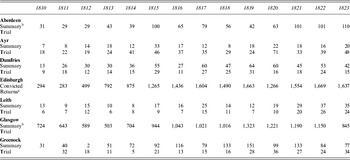
In the late eighteenth century, sheriff courts and burgh courts were the most important legal forums for administering local justice. Justice of the peace courts, barony courts and admiralty courts also dealt with some criminal matters, but their jurisdictions were limited to a narrow category of offences and their roles within the criminal justice system were fairly minor.Footnote 20 Sheriff and burgh courts had far-reaching judicial powers and were the principal inferior courts for dealing with statutory and common law offences. More serious criminal cases – which included serious assault, rape, grand larceny and murder – were tried under solemn procedureFootnote 21 before juries in either sheriff courts or the High Court in Edinburgh (or one of its circuit courts). Less serious offences – which included petty theft, assault and breach of the peace – were brought before either sheriffs in sheriff courts or magistrates in burgh courts. As Table 1 shows, the volume of criminal cases prosecuted in burgh and sheriff courts was fairly low. This mirrored male prosecutions and male committals to trial per head of population in higher courts that were much lower than in England in the late eighteenth and early nineteenth centuries.Footnote 22
Return of the number of persons charged with criminal offences and committed to gaol in Scotland, 1810–1823Footnote a

Summary, in execution on summary process; Trial, for trial before jury.
a The returns cover committals from sheriff, burgh and high courts.
b The summary and trial returns appear to be one and the same. Summary returns include cases before the sheriff and burgh courts.
c Edinburgh's returns listed the convicted criminal figures only. These returns will include prisoners sent to Edinburgh for trial in the High Court of Justiciary.
Source: ‘Return of the number of persons charged with criminal offences in England and Wales, Ireland and Scotland, 1822–1823’, British Parliamentary Papers, 1825 [197], XXIII, 523, 1–36.
Scots were more likely to be brought before the local church court than a secular one in the late eighteenth century.Footnote 23 Formal legal action was often the last resort. Summary justice usually took the form of non-custodial punishments such as whipping and banishment, both of which were popular because they were cheap and did not incur legal or aliment costs.Footnote 24 It was also common for local fiscals and magistrates not to prosecute suspects in custody under warrants so long as the latter agreed to leave the burgh, which ensured that the level of recorded crime was much lower than the actual level of crime committed.Footnote 25 Parish discipline was frequently exercised face to face rather than through bureaucratic means, with both neighbours and magistrates often relying upon the ancient form of civil protection known as ‘lawburrows’ to settle disputes.Footnote 26 The ‘Return of the number of persons charged with criminal offences in Scotland’ – produced in 1825 by Parliament and reflective of London's growing interest in criminal justice matters in the United Kingdom as a whole – illustrates both the pragmatic, cost-effective approach taken by magistrates and fiscals and the limitations of summary jurisdiction under the unreformed burgh court structure. Between 1810 and 1823, 580 suspects were charged with criminal offences and committed to the local gaol for trial in the burgh of Dundee, of whom almost half were liberated by the order of magistrates without having been tried.Footnote 27 Just 82 persons were tried in a summary manner by magistrates and convicted. The remaining suspects were either transmitted to other gaols to await trial, disposed of according to law, or liberated on finding caution.
There were a number of reasons why so few crimes were ever brought before the courts. Culture and tradition were important. Even though heritable jurisdiction had been abolished in 1747 following the failed Jacobite rising, Scots, according to Cameron, continued to have a mindset that was geared towards informal, local, ‘rough’ justice that privileged ministers over justices.Footnote 28 Furthermore, the geographical challenges that victims had to face in bringing forward a prosecution were greater than in most parts of England and were likely to have deterred many from reporting crimes. With the exception of the larger burghs, Scottish communities were more isolated than and often had inferior infrastructure to English towns, which made getting access to fiscals, magistrates and legal courts difficult and potentially costly if the time involved in doing so resulted in the loss of pay. Also, most towns relied upon a few town officers, part-time, amateur constables and, during periods of heightened tension, the ancient system of watching and warding to deal with day-to-day crime and order. With the exception of Edinburgh, full-time, salaried watch forces were not introduced in Scottish towns until the late eighteenth and early nineteenth centuries, which was later than in most English provincial centres. Behavioural differences might also have played a part in accounting for variation between the two countries, with the slower rate of urban expansion in Scotland and the pervasive influence of Godly Discipline being cited by at least one penal reformer to explain what he perceived to be the comparative orderliness of Scottish towns compared with England.Footnote 29
However, probably of most significance in explaining the low level of criminal prosecutions in the local Scottish courts was the central place of public prosecutors within the criminal justice system and the precarious state of burgh finances. The overwhelming majority of criminal prosecutions were undertaken by the public prosecutor under the authority of the lord advocate in the crown office in Edinburgh (usually for indictable crimes tried before the High Court and circuit courts) and procurators fiscal in the sheriff and burgh courts.Footnote 30 These were all professionally trained legal men of significant social status and influence – and, in the case of the lord advocate, the government's chief legal officer in Scotland. However, financial considerations and constraints often deterred fiscals and justices from pursuing formal, legal action. Prosecutions in local burgh courts were very much at the discretion of procurators – themselves appointed by magistrates – who would often base their decision on whether or not to prosecute on the likelihood of conviction or payment of legal fees.Footnote 31 Procurators were extremely cautious of bringing forward criminal prosecutions in the inferior courts as it could take many months for their expenses to be reimbursed.Footnote 32 The cost of criminal prosecutions in the High Court and circuit courts, and criminal prosecutions involving juries in sheriff courts, were met by the Crown, but those which were dealt with in a summary manner (that is, without both juries and formal written pleadings) in burgh courts were to be defrayed from local funds which were often inadequate. As a result, burgh procurators and magistrates prosecuted only a small number of crimes so as not to burden the public purse with high legal costs.Footnote 33 Indeed, the capacity for many burghs to finance criminal prosecutions became especially strained in the late eighteenth and early nineteenth centuries given the heavy tax burden that had been imposed on them to finance the Napoleonic wars. This was a frequent gripe for Scottish authorities and a significant reason why a number of them started to look seriously at finding new ways of financing municipal services by raising a new police tax (see below).Footnote 34 In a number of instances, legal costs had to be met by men of property through voluntary subscription due to a paucity of burgh funds.Footnote 35 That money weighed heavily on the minds of local officials was illustrated in the 1830s by John Dunlop, Sheriff of Lanarkshire, who claimed that ‘the burgh fiscal … in Paisley, has not a sufficient interest to burden his constituents with the expense of criminal prosecutions within the burgh, where no fine can be expected’.Footnote 36
There were also legal, institutional and procedural constraints within burgh courts that kept criminal prosecutions fairly low. In seeking to invest wider judicial powers in the hands of sheriff courts at the expense of hereditary sheriffs, the 1747 Heritable Jurisdiction Act absorbed many burgh court judicial powers.Footnote 37 Also, although burgh courts had the judicial authority to deal with many offences in an informal and summary manner, criminal prosecutions for more serious offences often had to be conducted according to formal criminal procedure.Footnote 38 To pursue a criminal prosecution was expensive, convoluted and time consuming: it consisted of a whole raft of written pleadings, including libels, summonses, warrants, declarations and proofs.Footnote 39 Many courts simply did not have the judicial capacity to dispose of a high number of criminal cases and infringements of local bye-laws in a fast, efficient and cost-effective manner. In 1807, a Committee of Police Commissioners in Edinburgh revealed not just the difficulties involved in securing convictions in the city prior to the establishment of the local police court in 1805, but also the problems in administering justice in Glasgow, where the summary powers acquired under the city's first police act had been fairly limited:
the great evil complained of in the old system under the magistrates was, that the most worthless vagabond, who could raise a few shillings to advocate his cause, might escape punishment; as it must be obvious that the funds, even of the city of Edinburgh, might have been inadequate to the daily and enormous expense attending the discussion of every suspension and advocation that might be offered of their sentences; and your committee are well informed, that the delay and trouble of bringing offenders to justice is reckoned the greatest error of the [1800] Glasgow Police Act.Footnote 40
Coming just two years after the establishment of the local police court, the committee's sentiments are likely to have been influenced by the raised expectations and standards that accompanied reform, as well as perhaps being advanced as a way to validate the change in judicial practice. Nonetheless, they highlighted the problems that burgh courts faced in dealing with crime and the changing mindset of civic leaders.
Similar concerns were echoed both in other parts of the country and in higher courts. As William Davey, Assessor of the Glasgow police and burgh courts, informed the 1839 Law Commission, there was an ‘aversion to commit for trial, in order to [secure] a higher punishment, unless the case is of serious amount, or attended with some aggravation’.Footnote 41 Even with serious cases, the challenges involved in securing convictions were a major obstacle to legal action. In the higher courts – to which fiscals and magistrates remitted more serious cases – judges stringently adhered to formal process. In the early nineteenth century, between 10 and 20 per cent of cases before justiciary courts were dropped because of irregularities and insufficient evidence – a costly disincentive to criminal prosecution for all but the strongest cases.Footnote 42
The challenges involved in bringing offenders to justice were further exacerbated by the fact that magistrates were unpaid and, according to local council records, unable to devote sufficient time and energy to criminal justice matters.Footnote 43 Unlike London, where stipendiary magistrates were introduced in 1792, in Scottish towns they were all unpaid. This was very much in keeping with the Scottish civic tradition – espoused most famously in Adam Ferguson's An Essay on the history of civil society (1767) – which endorsed public service as a key aspect of male virtue.Footnote 44 However, the ideal did not always match the reality. In 1779, in discussing whether or not to introduce police reform, councillors in Glasgow complained that ‘it has of late years been found not only difficult to get respectable citizens to accept the office of magistracy, but also that those in that office cannot give that close attention to the police of the city for the detection of persons guilty of crimes and offences therein as is requisite’.Footnote 45 Most magistrates came from business backgrounds and in reality often could not give their full intention to hearing pleas, determining disputes and administering statutory, criminal and common laws in their local courts, as they admitted in the same council meeting.Footnote 46 Even if they could, there was the further problem of accommodating and paying for the maintenance of those in custody and prisoners. Gaol and Bridewell accommodation was extremely limited in Scottish towns and greatly restricted magistrates' capacity to prosecute crime. In 1785, magistrates in Glasgow highlighted this, complaining that ‘it has hitherto been impracticable to put the law in execution for want of a proper place of confinement’.Footnote 47
Underlying such constraints was the ethos of the early-modern Scottish criminal justice system. As in other parts of the United Kingdom, it was not the intention of the legal system to prosecute all offences. Civic elites and the Scottish legal profession adopted a pragmatic approach to administering the law – increasing the number of criminal prosecutions and taking a tough stance against offenders during periods of heightened unrest, and adopting a more informal, lenient approach when anxiety waned and social relations improved.Footnote 48 This was a system of discretionary justice that procurators, judges, magistrates and sheriffs valued, as it was cost effective, strengthened their control over the judicial system and society, and helped buttress their status and position as governing men.Footnote 49 However, it was also a system that was unsuited to rapidly expanding urban centres and the needs and interests of commercial elites. As the next section examines, the expanding business classes were looking for greater certainty of prosecution and legal protection in the late eighteenth century in response to wider intellectual, social and economic changes.
3. TOWARDS REFORM
Unsurprisingly, it was in the larger, expanding towns such as Glasgow that discontent at the level of protection that burgh courts provided for private property first emerged. Much of this emanated from those in business and commercial circles who were on the fringes of, or were excluded from, council office and who used the issue of law and order to discredit the self-selecting nature of civic representation and magistrates' handling of municipal affairs.Footnote 50 Local landowners, burgesses and the merchants' and trades' houses – who represented the city's mercantile and manufacturing classes – conducted a sustained campaign for the introduction of a police system in the late eighteenth century.Footnote 51 This was prompted in part by a perceived rise in property crime and urban disorder,Footnote 52 but it was also indicative of the business communities' growing preoccupation with better protecting commercial transactions and private property. Glasgow was a thriving centre of commerce and industry in the late eighteenth century and its business leaders were seeking to introduce new ways to safeguard their interests. Testament to this was the establishment in the city of the world's first chamber of commerce in 1783, which, interestingly, was pioneered by the famous London police magistrate and reformer, Patrick Colquhoun, who served also as lord provost in his native Glasgow between 1782 and 1783.Footnote 53 However, business leaders could not agree on who should control the new police model: the emerging middle ranks and trade incorporations refusing to concede further power and money to unaccountable councillors, and civic leaders resisting the establishment of an independently elected police commission that would rival their own authority. As magistrates noted, giving commissioners police powers would be ‘of most dangerous consequence to the liberty of the citizens … [as it would equate to] creating forty-eight new magistrates with a jurisdiction equal if not superior to what the present magistrates have right to exercise’.Footnote 54 What was at stake, however, was the principle of magistrates' authority as guardians of law and order. As in other Scottish cities, political infighting among men of property would paralyse police reform for many years.Footnote 55
Nonetheless, the discourse which emanated from the ensuing debates highlighted that businessmen were increasingly looking to seek legal redress through criminal prosecution and no longer perceived existing arrangements as safeguarding their needs. In discussing a 1792 police bill, the trades' house requested that a clause be inserted in the bill to make provisions for the refund of expenses of successful private prosecutions. It argued that new ways were needed to ensure that more public resources would be made available to prosecute offenders to ensure that ‘delinquents [would] … be brought to justice upon the public expense’.Footnote 56 It complained that ‘Inhabitants have in past times been put frequently to great trouble and expense in searching for goods stolen from them and in bringing delinquents to punishment.’Footnote 57 In the ensuing debates, the merits of ‘preventative policing’ were espoused – which, significantly, was deemed to involve bringing more offenders before the courts to deter others.Footnote 58 The new style of policing that was being advocated was symbolic of a wider intellectual change in favour of certainty of prosecution that would come to define the ethos of the criminal justice system which evolved in the nineteenth century.
Similar views were expressed in other towns and resulted in new approaches. Aberdeen's 1795 Improvement Act made provisions for ‘defraying the charges of apprehending, prosecution and subsisting criminals’.Footnote 59 Glasgow, however, did not acquire a police act until 1800 – and even then, it retained its existing burgh court structure with fairly limited summary powers. More serious criminal cases were tried in the town clerk's office (the burgh court) according to formal criminal procedure. Minor offences – usually involving those in which small fines of one to five shillings, or short prison sentences, were likely to be imposed – were dispensed with in a summary manner in the ‘police office’.Footnote 60 However, in the subsequent local police acts of 1807 and 1821 the police office's summary powers were expanded significantly and it quickly established itself as the busiest centre of justice in Scotland.Footnote 61 Local historian James Cleland estimated that ‘as police cases averaged nearly two persons, it is supposed that, including the witnesses, 20,000 appeared before the magistrates’ in the police office in 1819.Footnote 62 Increasingly, the term ‘police office’ gave way to ‘police court’, highlighting the court's growing role and status in civic affairs.Footnote 63 Its capacity to deal with the burgeoning volume of cases was further facilitated by the appointment in 1804 of advocate, James Reddie, to the position of town clerk. Unlike clerks in other towns, he was to devote his energies full time to municipal affairs, which was symbolic of the strengthening resolve of the civic elite – defined here as councillors, magistrates and town fiscals – to improve the local burgh machine's capacity to deal with criminal affairs.Footnote 64
Similar initiatives were introduced in other large towns and were underpinned, and to some extent fuelled, by press reports of a perceived rise in property crime and a strengthening resolve among men of property to protect their own interests. In 1805, manufacturers in Dundee successfully prosecuted in the burgh court 18 offenders for stealing and resetting linen. According to the local newspaper, the convictions had encouraged the manufacturers ‘not to compromise with such criminals in the future’.Footnote 65 Instead, they resolved to form an association and create a fund for the protection and punishment of all offenders.Footnote 66 This was indicative of a growing intolerance among employers to the customary practice of workers appropriating goods as part of their income.Footnote 67 What was once widely tolerated as a perquisite was from the late eighteenth century onwards increasingly criminalised.Footnote 68 This tougher stance, and reformulation of employer–employee relations, on the part of the former not only symbolised a slackening of ties between worker and manufacturers in the industrial city, but also suggested a growing unwillingness to settle cases outwith the judicial system. Men of property were now looking to the courts rather than informal sanctions as a means of deterring and punishing offenders and validating their position for future employment relations.
This collective action on the part of employers was followed by a plethora of voluntary law enforcement initiatives by manufacturers, merchants and shopkeepers to better safeguard shipping interests and commercial goods in the economically depressed post-Napoleonic years, as fears of a rise in property crime escalated.Footnote 69 Criticism of magisterial management of civic affairs became more frequent from men who could not access representation on the town council. This highlighted a new group of middle-rank men's concerns about their experience of justice as plaintiffs and their capacity to rely on the law to reflect their concerns. According to many reports and letters in the Dundee, Perth and Cupar Advertiser, it was extremely difficult to secure a criminal prosecution in the burgh.Footnote 70 The cries for change were firmly embedded in, and linked to, growing demands for a new system of police administration, which included municipal provisions for lighting, paving and cleaning funded by a wider group of urban inhabitants, as well as the appointment of full-time watch forces to relieve middle-class male householders of their traditional obligation of watching and warding. As in Glasgow and Edinburgh, there was a sustained and bitter campaign by the middle ranks and the local press for the establishment of a directly elected police commission with tax-raising powers to oversee the management of a wide array of municipal services, including a police force and court.Footnote 71 Middle-class media spoke for their readership, echoing their self-interested preoccupations with certain types of crimes and victims. As the Dundee, Perth and Cupar Advertiser commented in 1815: ‘Some of the most respectable and inoffensive citizens have been knocked-down, cruelly beat, and plundered, at an early hour in the evening, and sometimes at their own doors.’Footnote 72 Middle-rank concerns highlighted a perceived rise in property crime, theft from the local port, and public safety fears that affected them.Footnote 73 In 1823, magistrates called for the introduction of a local police act with powers for a summary police court on the basis that:
the increase in crime in the burgh and its suburbs rises in a great degree from the inefficiency of the police; from the want of power in the local magistracy for the suitable punishment of the lesser crimes; and from the expense and delay attendant on the judicial procedure. … It would tend very much to the advantage of the burgh and the surrounding district, and to the preservation of peace and good order, if an Act of Parliament were passed for removing the evils before referred to, and more especially for establishing a Court of Police, having the powers necessary for the suitable and summary punishment of the lesser crimes, and appointing Commissioners for raising and applying the funds necessary for the proper watching, paving, cleansing and lighting the burgh and suburbs.Footnote 74
The above quote was typical of the way in which the justification for reform was portrayed as being synonymous with the common good. The following year, the 1824 Dundee Police Act made provision for both an elected police commission and a police court.
The introduction of police courts in Glasgow (1800), Edinburgh (1805) and Dundee (1824) was matched by similar developments in other burghs, including Paisley (1806), Greenock (1810), Calton (1819) and Aberdeen (1829). The nature of adoption, however, was not uniform. Some cities, such as Glasgow and Aberdeen, established new police courts that were distinct from, but continued to coexist with, burgh criminal courts, with the latter playing an increasingly restricted role in criminal affairs. The judicial lines between them were often blurred – with the seriousness of the crime or offence determining whether a case was dealt with in the police court or tried in the burgh court. In other towns, including Leith and Inverness, burgh criminal courts assumed responsibility for prosecuting and punishing breaches of statutory regulations enshrined in police legislation. Such burgh courts, however, were increasingly referred to in contemporary reports as, and effectively became, police courts given that the bulk of their day-to-day business, judicial powers and, in some cases, authority was constituted under police legislation.Footnote 75 By the 1830s, police courts had effectively replaced burgh courts as the main centres of urban justice in all of the major Scottish cities.Footnote 76
In some towns, the case for reform was given added stimulus by the Act of Adjournal of 1827. Introduced by central government, and applying to the whole of Scotland, the statute standardised rules for the trial of petty delinquencies in sheriff and burgh courts and obliged fiscals to follow detailed and costly legal procedure.Footnote 77 Under the statute, all cases tried in the burgh criminal court were to be under criminal libel, which further increased the time, trouble and expense involved in prosecuting offenders. As D. D. Black, Town Clerk of Brechin, noted in 1835:
The necessary expenses of trying petty offenders under the Act of Adjournal is so heavy that the magistrates acting under it find themselves in the awkward situation of either awarding a fine disproportionate to the crime or to the circumstances of the offender, or of charging the town's funds with pounds of expense incurred in fining a criminal a few shillings. … so many questions have been mooted since the Act … came into operation, that the magistrates of Brechin have latterly declined trying almost any case: and for the last two years no criminal cause has been tried in the Bailie Court of Brechin, except the paltry summary cases alluded to.Footnote 78
Indeed, the 1829 Aberdeen Police Act introduced clauses regarding the creation and constitution of the police court, in the words of A. Cadenhead, the local fiscal, for the express purpose of circumventing the ‘tedious nature of procedure pointed out by the Act of Adjournal’.Footnote 79
However, as in other towns, there were other motivations behind reform. In all the major urban centres that established a new court structure, the justification for change was moral, economic, civic and personal, often intertwined. Much of the discourse surrounding reform centred on the benefits it would bring to whole communities and the better ordering of the built environment. Magistrates argued that they needed greater powers to enforce new, and, in many cases, existing police regulations that sought to safeguard and improve the physical structure and public health of towns. Many burghs had acquired improvement legislation in the late eighteenth century, but few had made provision for the more effectual disposal of cases in a summary manner.Footnote 80 Magistrates frequently complained about the problems involved in keeping streets lit, clean and safe without a quick and efficient mechanism for disposing of offenders.Footnote 81 Establishing police courts to ensure that offenders who breached municipal bye-laws would be summoned before magistrates was thus presented by civic leaders as a response to the limitations of the existing municipal machine and its capacity to meet the raised expectations of comfort, safety and security in the early nineteenth century.
There was also a degree of paternalistic moral projection about the benefits of summary justice for offenders. Local justices argued that it would reduce the likelihood that those who were accused of crimes would suffer hardship by being confined in gaols whilst they awaited trial. Archibald Alison, the Sheriff of Lanarkshire, captured this sentiment in 1833:
Jury trial is of inestimable importance in all political cases, and in all cases whatever where a grave sentence, decisive of the prisoner's fate … is to be pronounced; but in small cases, where imprisonment only, or fine, is to be the result … it may well admit of doubt, whether a privilege introduced for his benefit does not too often practically become an aggravation of his sufferings.Footnote 82
Civic authorities presented the benefits of summary justice as a moral responsibility in their role as civic fathers and protectors of the weak.Footnote 83
However, underlying the rhetoric of the common good were middle-class concerns about the urban poor, industrial masses and the financial implications of trying to control them. The first few decades of the nineteenth century witnessed massive demographic change, strained industrial and social relations, cyclical high unemployment and escalating concerns with crime.Footnote 84 The transition to a free-market, capitalist economy resulted in widespread misery for many workers. Scottish urban economies simply did not have the capacity to absorb in regular employment the thousands of migrants who poured into them at a relentless rate. Living standards for many of the lower orders deteriorated markedly. Outbreaks of political radicalism and popular protest became more common and crime was widely reported and perceived to be on the increase.Footnote 85 The number of cases prosecuted in the High Court of Justiciary rose steadily to the 1840s, although whether this represented a real increase in crime or simply a growing willingness to prosecute is impossible to say.Footnote 86 What is more certain is that middle-rank perception of crime and the urban poor changed. Both were increasingly perceived as a threat to social stability unless disciplined and controlled. In Commentaries on the laws of Scotland respecting crimes (1844), Baron Hume specifically linked calls for the expansion of summary procedure with wider societal efforts to discipline unruly urban populations: ‘Such a privilege of sharp and summary coercion had been thought material to the quiet of those places, and the safety of their inhabitants, otherwise so much exposed to the evil practices of the many dissolute and profligate persons, who have their haunt and resort in towns.’Footnote 87
Others attributed the need for summary justice more directly with industrial and commercial expansion. In the 1839 fourth report by Her Majesty's Law Commissioners – one of a series of law reports commissioned by government over the course of the nineteenth century to look into the workings of the Scottish courts and legal system – George Thompson, Town Clerk, and Thomas Lees, Procurator Fiscal of Musselburgh, called for magistrates to be given additional summary powers ‘because from the increase of manufactories in the burgh, instances of dissipation and rioting are considerably on the increase’.Footnote 88 In the flourishing port of Greenock, magistrates acquired additional police powers largely to safeguard private property and commercial transactions. As the local fiscal informed the 1839 Law Report: ‘it will at once be perceived that the Acts in which the police clauses have been introduced have been constructed more with a view to advance the commercial interests of the town than to frame a comprehensive code of Police Law’.Footnote 89 This was very much in line with Scottish Enlightenment rhetoric, much of which was preoccupied with how jurisprudence could be employed to promote economic interests.Footnote 90 Indeed, there was a growing body of opinion in legal and government circles that saw economic progress, industrial expansion and crime as going hand in hand. As Frederick Hill, Inspector of Prisons in Scotland, noted in 1850: ‘there cannot, of course, be an increase in wealth in the country without an increase, other things being equal, in the temptations to crime’.Footnote 91
Urban, industrial expansion not only brought new work practices, strained social and employer–employee relations and altered middle-rank perceptions of the poor, it also significantly weakened the influence and importance of church courts over large sections of society.Footnote 92 These courts continued throughout the nineteenth century to impose Godly Discipline on congregationalists who sinned, but many more were effectively excluded from religious control due to demographic, fiscal and cultural pressures.Footnote 93 Many of the lower orders were unable to attend church due to high pew rents and the failure of church provision to keep pace with population growth. Moreover, church courts, it has been claimed, discriminated against the working class, imposing a foreign set of social, cultural and moral values on them, which alienated large sections from organised religion.Footnote 94 The church's hold over public morality and behaviour of a significant proportion of the industrial masses in the nineteenth century was eroding. It would leave a vacuum which the police and police courts would attempt to fill.
The remit of police court business would come to tackle not just many of the problems that church courts were facing in attempting to impose discipline but also the challenges of securing convictions in higher courts. Expanding the capacity of summary justice through police courts meant that urban populations could be more effectively controlled than was possible in higher courts where formal legal procedure often had to be followed. The fact that police courts were relatively unencumbered by old rules, traditions and legal structures greatly extended magistrates' capacity to regulate the behaviour and morality of the lower orders. The absence of formal, written pleas in police court proceedings was especially attractive for magistrates when it came to dealing with vagrancy. This was arguably the biggest problem that civic leaders faced in Scotland's rapidly expanding urban centres, as changing farming practices and industrial expansion combined to push and pull migrants to nearby towns and cities on an unprecedented scale. Summary justice in police courts was not only a fairly cheap and cost-effective way of dealing with the urban poor, it also allowed for ‘suspicious characters’ – loosely defined to cover anyone found in the street who could not give a satisfactory account for themselves – to be apprehended without any evidence that they had committed an offence. This was a major reason behind the introduction of Edinburgh's police court and, why, as the next section examines, the court's jurisdiction was criticised for vesting too much power in police hands.Footnote 95
Indeed, money weighed heavily on the minds of civic leaders when it came to establishing police courts. In many burghs and counties, fiscals were, until the mid-nineteenth century, paid fees on a case-by-case basis rather than an annual salary. Some of the larger burghs from the late eighteenth century onwards paid fiscals a modest allowance with further remuneration from fees,Footnote 96 the merits of which were extensively debated by law commissioners and civic and rural leaders.Footnote 97 Under the local police legislation, however, senior police officials were often charged with bringing forward prosecutions in the public interest in police courts – the expense of which was to be defrayed by a new police tax.Footnote 98 This made sound financial sense, probably explaining why the police filled this function. It relieved the burgh of having to pay fiscal fees, and other public officials, on a case-by-case basis at a time when magistrates were seeking to expand the volume of summary prosecutions.Footnote 99 Moreover, magistrates also recognised that greater summary powers would help finance the provision of new municipal services given the increased revenues that would be accrued from imposing a greater volume of fines.Footnote 100 ‘Observations on a Glasgow police bill’, published anonymously in 1807, highlighted the financial advantages of reform, noting that:
it might be advisable to appoint a special Procurator Fiscal, for the purpose of prosecuting all offences against the Police Act, and that all fines and forfeitures arising from such offences, or inflicted on persons taken up by the Servants of the Police, shall, after defraying legal expenses, compose part of police funds. In this way the City funds would be relieved of a considerable annual expense, and the Procurator Fiscal of the Burgh not so much overloaded with criminal business.Footnote 101
Indeed, a subsequent anonymous report claimed in 1806 that £1,272 had been raised in petty fines in the Glasgow police office, which it contended was nearly equal to the annual cost of criminal prosecutions.Footnote 102 The way in which magistrates administered justice provides further evidence of the importance of money in shaping judicial thinking: of the 10,629 people who were convicted in the Glasgow police court between 1833 and 1835, almost two-thirds were fined, whilst just over a third were imprisoned.Footnote 103 As in the eighteenth century, financial considerations and self-interest were never too far from the thoughts of magistrates and men of property when it came to administering the law.
Although the social composition of Scotland's cities was not uniform during the eighteenth and nineteenth century, and the business classes often clashed over the management of local government, in each case, different groups within the city had both shared and distinct interests. It is interesting, and perhaps revealing, that the issue of whether to establish police courts appears to have provoked little heated debate among men of property. Unlike the discord over whether or not to vest police management in new elected commissions, discussions on the proposed police courts were recorded sporadically in the local press and municipal records. Moreover, they tended to be submerged within wider, protracted political struggle between civic leaders, legal figures, and the rising mercantile and manufacturing elites on how the new model should be financed and managed. There was often disagreement as to what form the structure should take and who should serve in it, as both had implications for the power, status and influence of public men, but little on the desirability of courts themselves. Discussion over the possible impact that police courts would have on the liberty of citizens was fairly short lived and exposed more the political infighting that existed between civic and legal men rather than any genuine concern for the rights of the urban population. This suggests that men of property were in broad agreement as to the desirability of establishing a new court structure. Indeed, as the next section examines, the judicial structure of the police court would, after initially threatening the civic hierarchy, come to reflect and reinforce distinctions between men of property.
The desire for a new court structure, therefore, exposed shared concerns among householders and the civic elite for their safety, their property and the smooth operation of commerce. Men of business and the propertied wanted a court that would prosecute suspects quickly and manage their concerns and aspirations about the growing urban environment at little cost to themselves. Presenting the challenges that such men faced as being civic rather than private ones was a convenient way of spreading the financial burden of paying for law and order whilst strengthening arguments for greater intervention into the lives of urban inhabitants. Tellingly, the creation of a new machinery of police in Scottish towns was accompanied by a plethora of petitions from poorer wards requesting exemption from assessment as well as criticism that municipal services were not being directed at poorer communities where it was most needed.Footnote 104 All were rejected. Civic and police leaders had a narrow, self-serving concept of what constituted the common good when it came to the delivery of services, but an all-embracing, communal one when it came to paying for them.
4. THE STRUCTURE OF THE POLICE COURT, c.1805–1833
In the opening ceremony of the Edinburgh police establishment and court in 1805, John Tait, Superintendent of Police, underlined the principles of public service on which the new court structure was presented:
To conduct an Establishment of Police, is therefore, an important, and reflection tells us, that it must be an arduous task. But I here declare, that no considerations of personal labour, no consideration of personal safety, shall deter me from performing, so far as my abilities may reach, the duties which I may conceive to be attached to the situation which I am now to hold.Footnote 105
The rhetoric of self-sacrifice that was promoted was very much in keeping with eighteenth-century notions of neoclassical governance and civil society on which the police model was established, but its creation had profound and far-reaching implications for public men. Superintendent Tait was not only the head of the police establishment; he was also appointed judge in the police court. Six ward inspectors, appointed by police commissioners, were given the responsibility of bringing forward prosecutions before the superintendent in the police court. The 1805 Edinburgh Police Act saved and reserved to the lord provost, magistrates, sheriffs and justices, the civil and criminal jurisdiction they had always enjoyed in their own courts, but the powers that were concentrated in the superintendent and the ward inspectors were, in many ways, unprecedented. They struck at the heart of traditional magisterial judicial authority by empowering a new type of man to bring forward police prosecutions and administer justice.Footnote 106
The rationale behind the structure of the court was partly pragmatic. Commissioners argued that vesting police powers in the judge was necessary in order to bring offenders to justice quickly and inexpensively.Footnote 107 It was also partly political. The court's establishment was shrouded in a wider conflict between a conservative political, legal elite, who sought to retain as much control over police affairs as possible, and whig reformers intent on introducing greater accountability in council circles. Framed by the ‘highest tories’ in Edinburgh, many of whom were drawn from legal circles,Footnote 108 the court's constitutional framework reflected the powerful influence of lawyers and advocates in Edinburgh.Footnote 109 Its hierarchy challenged the authority of the businessmen who made up the unpopular, self-selecting town council and magistracy, and exerted legal influence over police affairs by making the superintendent accountable to the newly established Edinburgh Police Commission.Footnote 110 The latter, in its formative years, was dominated by leading legal figures, many of whom were named as ex officio representatives, although ex officio places were also reserved for magistrates and leading figures from the city's public bodies.Footnote 111
The constitutional structure of the police court soon provoked trenchant opposition both from Edinburgh's middling ranks and public men in civic circles. In 1806, a letter from the anonymous Civis to Henry Erskine, the Lord Advocate, concerning the court, revealed the social basis of the discontent. In it, Civis identified that ‘extreme dissatisfaction prevails throughout this metropolis … among the intelligent, the decent, and the most respectable citizens of Edinburgh’.Footnote 112 One of a number of local correspondences which criticised the superintendent's role as both police chief and judge,Footnote 113 the letter condemned the superintendent's power for being ‘extravagant’, ‘unconstitutional’Footnote 114 and tantamount to ‘legal tyranny’.Footnote 115 Discontent was also voiced at the absence of appeal against the judge's decisions, ‘the creation of new and arbitrary offences’ and the undefined nature of many of them – such as vagrancy, begging and acting in suspicious circumstances. The latter, it was claimed, gave the superintendent ‘the function of a legislator as well as a judge’.Footnote 116 Also condemned was the practice of allowing 50 per cent of fines levied in the police court to be given to officers ‘as a stimulus to their exertions’, as it provided a financial incentive for policemen to commit perjury. In the same year, a report by the city's ‘Merchant Company, Incorporations, and other Public Bodies’ condemned the structure of the police court and recommended placing unpaid magistrates – rather than a paid superintendent – at the head of the court.Footnote 117 It was an appeal to long-held notions of civil society on which urban Scotland was governed, but it was also indicative of the discontent that existed in civic circles over the threat that the constitution of the police court posed to men in public life.
However, the claims relating to the judge's powers were overstated. The superintendent was, in theory, accountable to police commissioners and could imprison offenders for two months only.Footnote 118 Moreover, only inspectors could prosecute under the 1805 Police Act, not the superintendent. Nonetheless, there was clearly confusion surrounding the court's constitutional structure, with commissioners themselves in 1807 expressing concern that ‘it is very difficult to state what that check ought to be, as it appears that the general commissioners have no authority over him in his judicial capacity’.Footnote 119 What lay behind the thirst for reform was not so much the challenge the new court posed to the liberty of the general populace, but rather the creation of an untapped legal power and its challenge to the civic and legal elite's status as governing men.Footnote 120
The perceived lack of adequate checks and balances over the superintendent, coupled with claims of corruption involving him and senior officers,Footnote 121 heralded significant constitutional reform to the police court and the re-establishment of magisterial judicial authority under the terms of the 1812 Edinburgh Police Act. The act was framed after a general meeting of the ‘Public Bodies of the City of Edinburgh’ to concert measures for obtaining a more efficient system of police.Footnote 122 After much dialogue between civic and legal men, it was agreed that magistrates and justices be placed at the head of the police court and that judicial and prosecutorial powers be separated.Footnote 123 The superintendent was entrusted with the position of police prosecutor – but, significantly, he was now to be appointed by, and subject to the authority of, the lord provost, the lord president of the Court of Session and the sheriff depute of the county.Footnote 124 Justice and legal officials were back at the heart of civic government.
Interestingly, the appointment of magistrates and justices at the head of the police court appears to have provoked little opposition, but vesting control of the superintendent in the hands of just three prominent civic and legal figures rather than elected commissioners was strongly criticised in local press reports. As an anonymous letter to The Scotsman in 1817 noted: ‘A great object, too, seems to have been, to exclude the inhabitants, as much as possible, from all control, direct or indirect, over the police system.’Footnote 125 There was particular resentment that the superintendent was entrusted with bringing forward police prosecutions. This was a contentious issue, as the position of fiscal was extremely important – not least as the fiscal enjoyed tremendous discretion when it came to deciding whether or not to bring a case before magistrates in the police court.Footnote 126 In 1821, Alexander Ponton, solicitor at law, and procurator fiscal for the burgh court of Edinburgh, highlighted the concern that existed over the superintendent's role as fiscal in the police court. He proposed establishing a Society for the Protection of Private Property to bring forward prosecutions against crimes such as theft, robbery, swindling, forgery and embezzlement of goods or money, which ‘merit a higher punishment than the police can inflict’.Footnote 127 His sentiments were further evidence of the desire to better safeguard private property in the city, but they also belied a strong element of self-interest and loss of status on his part. This was not lost on The Scotsman; it not only suggested that the establishment of this society was ‘unnecessary and absurd’ as existing arrangements were more than adequate, but also that Mr Ponton sought to profit from an increase in the number of criminal prosecutions.Footnote 128 The proposal and the response it stimulated were indicative of the tension that existed between public men over the structure of the police court and the fact that its creation, for some of them, had implications for their power, position and income.
In a few other burghs, the new police court structure also initially challenged existing power structures, but in different ways. In Dundee, hostility towards the town council was so entrenched that mercantile and manufacturing elites insisted that magistrates in the new police court be drawn from the police commissioners who represented the eleven wards of the police district (each ward electing two commissioners).Footnote 129 The property qualification for the position of commissioner was fixed at £10, which ensured that only a certain type of man was eligible to pass judgement in the court. Nonetheless, it brought to prominence a new type of man who hitherto had been excluded from the civic and judicial affairs of the city and established a new governing class based on the value of property. The membership of Dundee Police Commission in its formative years included large mill-owners, such as William Brown and James Tawse, with very few members being returned who had links with the local corporation.Footnote 130
However, in other towns, police courts from the outset reflected, reinforced and, in many ways, strengthened magisterial authority at a time when their position as guardians of the community was being challenged by the introduction of elected police commissions. The latter gave new men of wealth a voice and power base in public life which otherwise was denied to them before burgh reform in 1833, but in most towns the traditional civic authorities clung firm to their privileged position as judges in the new police court structure. According to the evidence presented to the 1839 law commissioners, judicial powers were reserved to magistrates in the overwhelming majority of police courts, including in Glasgow.Footnote 131
Moreover, unlike in the Scottish counties, where full-time, salaried justices from legal backgrounds were becoming more common from early in the nineteenth century, police court magistrates continued to be unpaid and drawn predominantly from business backgrounds. There was a growing body of legal opinion which advocated the need for fully trained legal men to take charge of criminal trials in summary courts,Footnote 132 reflecting to some extent developments in many English towns where stipendiary magistrates had been introduced in the early 1800s.Footnote 133 However, in Scotland, legislative provision would not be made for stipendiary magistrates until the late nineteenth century, which helped restrict the office to a certain type of ‘independent’ man.Footnote 134 The civic men who performed magisterial tasks without remuneration were extremely resilient to change and the growing discourse of professionalism.
As the final section examines, police courts also helped extend magisterial authority over the working class in the form of the crimes that were brought before them in the name of public interest and in terms of the level of discretion afforded them as governing men.
5. THE PRACTICE OF THE POLICE COURT, 1805–1833
Magistrates had always enjoyed wide-ranging discretionary powers in burgh courts, but criminal trials were normally tried according to the formal procedure subject to the power of common law. In police courts, however, all cases were to be tried in a summary manner. The jurisdiction of police courts was limited to minor common law and police offences enshrined in local police acts,Footnote 135 but the absence of formal written pleadings and the speed with which justice was administered gave magistrates powers of discretion over a large number of crimes. Indeed, an anonymous letter, published in The Scotsman in 1817, strongly criticised magistrates for seeking to further extend their discretionary powers – which they achieved in framing the local 1817 police bill.Footnote 136 Many cases were determined solely at the discretion, and by the authority, of the magistrates. Police court judges would often use their authority as governing men to dismiss, admonish or reprimand those before them without pursuing the case, especially if the offence was deemed trivial and the detention suffered previous to trial sufficient punishment for the offence.Footnote 137 Rather than imprison first-time juvenile offenders in the Tolbooth or Bridewell, William Davey, the Assessor of the Glasgow police court, confessed that magistrates often adopted:
a very loose mode of administering criminal justice … [which involved] … remanding a party … and delaying sentence till another diet, at which he is brought up and discharged; the confinement which he has, in that way, intermediately undergone, being implied as punishment for the offence.Footnote 138
The discretionary powers that magistrates enjoyed in police courts were particularly significant, as the range of powers, and the number of people who were subject to them, increased significantly as the first half of the nineteenth century developed. Local police legislation extended the types of crimes that were classified as ‘police offences’ – some of which, as the above example of Edinburgh illustrated, were not clearly defined and which conveyed upon magistrates even greater powers. Magistrates might have conceded to middle-class demands for an elected police commission in order to acquire the statutory tax-raising powers needed to fund urban improvements, but the wide-ranging discretionary powers that police courts placed in their hands made local justices as important as commissioners and senior police officers to law enforcement. Police legislation also extended judicial boundaries – and, by definition, magisterial judicial authority – over larger territories and a wider percentage of the expanding urban population. According to A. Cadenhead, Procurator Fiscal of Aberdeen, the 1829 Aberdeen Police Act extended the judicial authority of magistrates ‘in several places considerably beyond what is termed the town’.Footnote 139 By the 1830s, magistrates were the lynchpin of the Scottish criminal justice system, handling far more cases in police courts than either sheriffs or High Court judges. In Glasgow, 16,109 offences were recorded in the police court returns between 1833 and 1835 inclusive – the higher courts would deal with, at most, a few hundred cases in any given year.Footnote 140
According to Douglas Hay, in the eighteenth century the English aristocracy valued their discretionary judicial powers and capacity to hand down death sentences and pardons, as these helped them to maintain their position as a governing class by reinforcing paternal authority.Footnote 141 The experience of the Scottish police courts was less dramatic than the English ‘Bloody Code’: the fixed codes of fairly moderate penalties enshrined in police legislation restricted magisterial modes of punishment to 2 months' imprisonment and 10 pound fines. Indeed, magistrates sometimes lamented the limited powers of punishment they had at their disposal.Footnote 142 Nonetheless, there was recognition that police courts had the capacity to strengthen magisterial power and status within communities. In giving evidence to the 1839 Law Report, James Johnston, Town Clerk of Irvine, highlighted this:
were magistrates enabled more speedily, and less expensively, to try and punish minor offences in their own bounds, it would tend greatly to establish and strengthen their authority, and would be a powerful means of keeping down crime in their respective jurisdictions, and at much less trouble and expense than at present, both to parties concerned and to the public at large.Footnote 143
Magistrates also employed discretionary powers in order to reinforce their patriarchal authority and the need for deference in those brought before them. In 1832, The Police Intelligencer, or Life in Edinburgh, reported a number of attacks on Police and Board of Health officials who attempted to take cholera patients to the hospital. In passing sentence, Bailie Crichton made a point of noting that the contrition shown by the offenders was key to them receiving lenient punishment:
The Magistrate said that such conduct as the defenders had been guilty of could not be tolerated. Nothing could be more absurd and rediculous [sic] then [sic] ignorant, misled and ungrateful wretches attempting to frustrate the attempts of the humane exertions of the Managers of the Board of Health to allay that direful enemy which so deeply interests every individual. He intended to punish the defenders severely as an example to others, but as they had shewn some contrition for what they had done, he would fine them in the lowest possible sum, five shillings.Footnote 144
At the same time, magistrates were in part dependent upon police courts – in terms of prosecutions, convictions and fines gained – for their own status as useful civic authorities. In 1840, The Aberdeen Journal published a report on the 33 offences which had come before the Banff court since its creation (13 of which were for breach of the peace and 11 for leaving dung on streets after the prescribed hours). The paper noted that 24 cases had resulted in fines and that 60 vagrants and intoxicated people had been taken off the streets: ‘The public will thus see that the Commissioners and their officers have not been quite so idle since their appointment as those who are not conversant with the details of the business may have been apt to imagine.’Footnote 145 The creation of police courts therefore provided a means to judge the status of governing men as authoritative operatives of public service.
Police courts were multi-faceted and served a variety of purposes. They intertwined the economic and civic imperatives of magistrates, senior police officials and men in other branches of public life. In their formative years, police courts sought to alleviate middle-rank anxieties concerning their capacity to maintain their own lives, businesses and principles. They prosecuted minor frauds, thereby playing their part in ensuring the stability of commercial transactions in the Scottish city. Magistrates and fiscals also sided with employers to defend business interests when industrial relations were strained. In prosecuting three men in the Aberdeen police court in 1840 for obstructing operatives of local machinery during an industrial dispute, the fiscal remarked: ‘It was not to be endured that operatives were to interfereir [sic] and dictate to their employers what wages were proper to be given, and to hinder those who were inclined to work at the offered wages from going to their work.’Footnote 146 The sitting magistrate seemed more sympathetic to the workers' plight, but recognised ‘the necessity that existed for a general reduction of wages’. He subsequently fined them – money, which in all likelihood, would have been hard for the men to find.Footnote 147
Police courts also provided a fast, efficient and cheap form of justice for property offences – which were the most common crimes prosecuted after assault/breach of the peace – and were an integral part of evolving intellectual discourse on the merits of preventative policing in safeguarding personal property. Hailing the recently established Edinburgh police court, the Edinburgh Advertiser in 1805 captured the new ethos of the time in Scotland's capital: ‘In many instances, the punishment in the Court of Police has taken place within 12 hours, and in most cases within 24 hours of the time of the committing of the crime, which ought certainly to have a considerable effect in preventing future offences.’Footnote 148 Moreover, police courts expanded the civic elite's notion of the safe, secure and healthy cityscape by administering justice against those deemed guilty of breaching cleansing and public health laws. In Paisley, breach of police regulations (most of which related to the built environment) accounted for more than half of the 5,792 cases (with commissioners' desire to prosecute these cases perhaps being indicative of the fact that they were responsible for collecting police fines only, not criminal ones). These prosecutions were also symbolic of the business community's growing preoccupation with regulating public streets and spaces in order to remove obstacles to commerce and suppress illegal street trading.Footnote 149 Procurators zealously clamped down on obstructions and nuisances, deliverymen who blocked public and commercial thoroughfares, and illegal market traders. The 5,508 sentences passed in the Glasgow police court for the year 1830 included 701 for contravention of the Carters Act, 332 for encumbering the streets with articles for sale, and 81 for using false and deficient weights.Footnote 150
As police courts matured and cemented their place in public life, their powers were extended to provide more protection for vulnerable groups, including juveniles and victims of domestic violence.Footnote 151 When John McGonach appeared before the Gorbals Police Court in July 1829, charged with being drunk and disorderly and striking his wife, Bailie McLellan, the Police Reports recorded, said:
this was a most distressing case, and he was sure, that there was not a person in court, who did not sympathize. We have before us a well-doing virtuous woman, joined with a cruel husband, – a woman willing to do well, provided she is allowed peace and quietness, and I am sure, said he, from the modesty of this woman, matters must have gone a great length before she complained.Footnote 152
This indicated much about the magistrate's expectations of appropriate femininity, constituted by the alleged victim's perseverance, modesty and forbearance in the face of male violence and unreasonable action. These were precisely the qualities that made her worthy of middle-class men's protection. Oversight of such cases provided police courts with a particular moral remit and a justification of civic paternalism to the men who governed them.
However, while the judicial remit of police courts was wide, this should not disguise what their main role was – to impose discipline on, and to try to control the behaviour of, a predominantly working-class clientele. Civic men presented the police court function as being concerned with the common good,Footnote 153 but behind the rhetoric were implied social distinctions and assumptions anticipating what police courts would do and how civic men viewed themselves. Superintendent Tait, in his speech to mark the opening of the Edinburgh Police establishment, highlighted this:
I shall be sorry indeed to be obliged to sink those in the inferior ranks of life still lower, by inflicting punishments of a degrading nature. And I shall regret still more to be obliged to apply the punishments which naturally belong to the inferior ranks, to those in a higher class. But I am bound by the sacred oath which I have taken, to discharge my duty as my conscience dictates, and that my conscience tells me that I am to look not to persons, but to crimes.Footnote 154
Others were more forthright and explicit in expressing their views. In his letter to Henry Erskine, the Lord Advocate (1806) concerning the Edinburgh police court, Civis distinguished ‘the intelligent, decent, and most respectable citizens of Edinburgh … [from the] the vulgar, who might be supposed to be incapable of duly appreciating the value of a political institution … [and] … the profligate, who might be thought averse to an authority which was constituted for the suppression of their iniquities’.Footnote 155
As this quote makes clear, civic men used police courts to regulate the morality of the lower orders. Although limited, the powers of the Edinburgh police court were, according to the lord provost, ‘sufficient to give an essential protection to virtue, in every situation, and to give check to vice and profligacy, in whatever rank of life they may be found’.Footnote 156 Police courts, in many ways, filled the vacuum that had been created by church courts' weakening influence over the behaviour of the lower orders, especially in the rapidly expanding industrial centres where church provision failed to keep pace with population growth and check the rise in immorality. Superintendent Tait alluded to this in delivering his inaugural speech to mark the opening of the Edinburgh Police establishment, noting: ‘Much of the virtue of a nation depends upon the exertions of Police, in preventing crimes, in suppressing them in their advanced progress, especially in the Metropolis, which must always greatly influence, and may I say, even regulate the morals of the country, to which it belongs.’Footnote 157 As Table 2 shows, much police court business concerned public order offences. In Edinburgh, breach of the peace/drunk and disorderly accounted for just under one-third of all offences brought before the court in 1835, with assault, theft and police regulations accounting for just under one-fifth.
Police Court offences, 1833–1835 inclusive
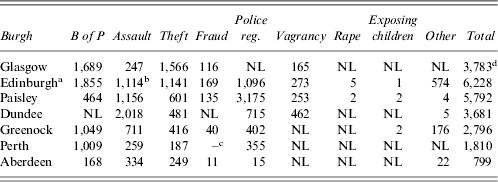
B of P, breach of the peace; Police reg., breach of police regulations; NL, not listed.
a All of the above returns for Edinburgh relate only to 1835.
b The assault returns for Edinburgh were broken down thus: assault and wounding to the danger of life, 15; breaches of the peace accompanied with assault, 520; complaints, at the instance of private parties, for assaults, 579.
c Theft and frauds listed together.
d Only those cases deemed to be crimes were categorised under a specific offence and recorded in the Glasgow returns (totalling 3,783 out of the 16,109 offences before the court). The majority of cases that were brought before the Glasgow police court were not categorised.
Source: Collated from the returns that were presented by local fiscals and clerks to the ‘Fourth report by her Majesty's Law Commissioners, Scotland, 1839’, 278, 304, 323, 332, 335, 336 and 338.
The overwhelming majority of those charged in police courts – especially for crimes and offences – were drawn from the ranks of the urban poor and the rougher sections of the working class. Annual police returns, published from mid-century onwards, show that the unemployed and poorly educated were disproportionately over-represented in the criminal returns, with the majority of arrests being made in poor wards.Footnote 158 According to a variety of contemporary reports, fiscals, police officers and magistrates would go out of their way to keep middle-class crimes out of the courts or out of the public eye, in some instances holding cases behind closed doors. Although slightly later than the period with which this article is concerned, the following opinion of Lord Ivory, advanced in 1859, was indicative of a general approach taken by civic and legal men in the first half of the century in dealing with suspects accused of crimes and offences. He observed that it was the opinion of the High Court that a person should not be brought summarily before the magistrate, ‘when a party accused is respectable, known to the police, law-biding, and not purposing to go abroad, and not caught in the actual commission of an offence’.Footnote 159 When ‘respectable’ persons were brought before magistrates, it tended to be for contraventions of local bye-laws relating to the built environment. Indeed, the stigma that was attached to appearing before magistrates led some justices later in the century to call for separate police courts to be held at different times to deal with misdemeanours and crimes, so that the respectable classes would not have the indignity of being in the same sitting as ‘common criminals’.Footnote 160
It is not the intention of this article to examine in any depth how willing the lower orders were to make use of summary courts – an issue which has been examined for police courts in London in other studies.Footnote 161 It is worth pointing out, though, that Sheriff Alison informed the 1839 Law Commission that three-quarters of the fiscal's occupation was taken up with working-class complaints, although his evidence was given in relation to sheriff courts not police courts.Footnote 162 Nonetheless, there were instances where the working class used police courts to resolve communityFootnote 163 and family disputes,Footnote 164 which should caution against perceiving them as being simply a one-dimensional class tool.
Such cases, however, were rare. The overwhelming majority of police court business was concerned with controlling the urban poor and the most vulnerable groups in society. The introduction of publicly funded, police-led prosecutions might have made it easier for the urban poor, and other social groups, to seek legal redress than had been the case under the old system,Footnote 165 but the majority of defenders listed in the Glasgow police court diet book for the early nineteenth century were not brought there on complaint from an individual. They were there largely on summons of police officials or night watchmen, especially on charges related to public order charges or to contraventions.Footnote 166 Police courts, it seems, went hand in hand with the police forces that were established alongside them. They were an integral component of the rise of the police state and men of property's desire to better control their communities, protect their own interests and discipline the lower orders.
6. CONCLUSION
To some degree, police courts evolved in order for burghs to avoid the time-consuming and expensive legal technicalities and formalities involved in prosecuting crimes before burgh and sheriff courts.Footnote 167 As with other parts of the British Isles, the rise of police courts to prominence needs to be viewed in the light of a wider intellectual and societal shift in favour of the expansion, standardisation and formalisation of summary legal process and a changing mentality in civic and legal circles in favour of greater certainty of prosecution as offering the best safeguard against crime. Underlying this expansion in Scottish towns, however, were the motivations and private interests of public men. Although the working-class might have been willing to make use of the new court structure, there is little evidence to suggest that police courts in Scottish towns were created with the purpose of being ‘a poor man's system of justice’. They were introduced primarily to serve the interests of a different type of man – the propertied – and, more importantly, came to expose the divisions and shared interests that existed among public men.
In the major Scottish cities, both the traditional civic elite and the emerging business classes shared difficulties in trying to bring offenders to justice and demanded more of the inferior courts. Existing arrangements and informal sanctions were no longer deemed suitable in many parts of the country – partly because of growing concerns with crime and urban order, but also because local courts were not designed to deal with the volume of cases, administer the type of punishment and provide the level of protection that was increasingly expected in a rapidly urbanising, manufacturing and commercial society. Self-interest, social status and power provided important contexts to reform. As in England, public men had, in the words of Paul Langford, ‘a narrow, self-interested view of what constituted the public good’.Footnote 168 The business class and traditional civic elites in Scottish towns shared an interest in recasting the difficulties that men like themselves faced in bringing forward prosecutions as civic problems in order to ensure that they would not be the only ones burdened with paying police and legal costs. Similarly, although the desire for better ordered urban environments was by no means the exclusive preserve of men of property, such motivation was largely driven by a bourgeois preoccupation with regulating and disciplining the customs of the lower orders and keeping the streets clear of illegal trading and obstructions. Indeed, it was fitting that police courts evolved under police legislation because they were the necessary complement to the police forces which were introduced throughout the country and a criminal justice system that was becoming increasingly preoccupied with regulating public spaces and urban order.Footnote 169
There were similarities between the Scottish experience and Philips' conclusions on England: in both countries the threat that a new police model might pose for magisterial authority often hindered the establishment of full-time police forces for many years.Footnote 170 However, it also needs to be recognised that the introduction of police courts provided another dimension to reform: they helped reinforce, and in some ways, extend magistrates' power and authority and at a time when it was under attack in other civic institutions. This was achieved not just through magistrates' continuing use of discretion and informal sanctions in the ever-expanding business with which police courts dealt,Footnote 171 but also through the capacity of small oligarchies of civic men who governed Scottish councils before 1833 to embed themselves at the top of the new court structure and resist alternative models of judicial structure, authority and practice. As the evidence that was presented to the Law Commission in the 1830s exposes, safeguarding magisterial authority was a major incentive for reformers and one that underpinned the evolution of police court structure in Scottish towns.Footnote 172 While civic elites were acutely aware of the need to exert greater control and influence over the industrial masses, they were as keen to preserve their own status as governing men. The private interests of the public men which underlay the creation of police courts were rooted not just in the social problems brought by industrial society, but also the politically hostile nature of early nineteenth-century municipal governance.
ACKNOWLEDGEMENTS
The authors acknowledge the financial support of a University of Western Australia Research Development Award (reference number 12104406) which helped fund part of the research for this article. Thanks are owed to Joanne McEwan and Iain Hutchison for their research assistance.
A number of the ideas discussed in this article are explored more fully in the forthcoming book, by David G. Barrie and Susan Broomhall, titled Police courts in nineteenth-century Scotland: crime, community and control (to be published by Ashgate, 2012).