


Introduction
The term native Himalayan rice (NHR) is used below to denote farmer-named indigenous varieties cultivated for centuries from the Terai plains to the mountain regions of Nepal. These landraces include Basmati, aromatic, glutinous, pigmented types and high-altitude cold-tolerant rice. Aerobic, drought-tolerant upland rice (Ghaiya/Uskalo Dhan) is integral to production in marginal, rainfed environments. It is broadcast after pre-monsoon rains and extensively grown on unirrigated river fans and marginal hillside terraces without standing water (Joshi et al. Reference Joshi, Rana and Subedi2001a). Whilst previous investigations have sought to study varietal richness and agronomic merit, until now, there has been no comprehensive evaluation of the diversity and conservation status of NHR. For this reason, this review aims to:
• Assess the current status of NHR varietal richness and diversity.
• Assess the extent of genetic erosion of NHR varieties and current efforts for their conservation.
• Evaluate the utilization and strategic importance of NHR in farming systems and value chains.
• Identify knowledge gaps over six decades of rice research in Nepal.
• Outline opportunities for improving and commercializing NHR.
Rice holds great importance in Nepal, where it carries deep social, cultural and religious significance. This is reflected in ancient Hindu texts such as the Vedas, where it is praised as a cherished, nourishing and satisfying food for gods, goddesses and humans (Pokhrel and Sharma Reference Pokhrel and Sharma2017). As Nepal’s staple food crop with a per capita consumption of 138 kg per year, it is the most important agricultural commodity. In 2015, rice accounted for 75% of total cereal consumption and provided 23% of national protein intake (CBS 2016). With improved roads and higher incomes, many people in the hilly and mountainous regions of Nepal, who used to grow and consume maize and other coarse-grain cereals, have switched to rice-based diets (CBS 2016; Joshi et al. Reference Joshi, Ojha, Gauchan, Ghimire, Bhandari, KC, Gauchan, Joshi, Bhandari, Manandhar and Jarvis2020).
Nepal is one of the centres of diversity for Oryza sativa, with around 3,000 landraces reported to be cultivated until the 1970s, and four wild relatives of rice – Oryza nivara, O. rufipogon, O. granulata and O. officinalis – are found in Nepal (Shrestha and Vaughan Reference Shrestha and Vaughan1989; Shahi Reference Shahi, Shrestha and Shrestha1999). These rice genetic resources contain rare and globally valuable genes that are critical for breeding rice in the current climate as well as for future generations (IRRI 2018). Oryza sativa and four wild relatives of rice are cultivated or naturally grow in Nepal which spans the highest agroecological and altitudinal variation globally; from the fertile Terai subtropics (60–300 m) through the low hills (300–1,200 m), the mid-hills (1,200–1,500 m) and the high hills (1,500–2,500 m), to the highest altitude for rice at 3,050 m, Chumchaur village, Jumla district (JADP 2014). Nepal’s over 100 ethnic communities contribute to diverse food cultures and distinct crop preferences. Rice is predominantly cultivated by smallholder farmers under largely unpolluted air and irrigated by pure water from snow melt across the hills, river basins and the Terai, as well as rainfed conditions.
Historical exploration and documentation of landraces
The exploration, collection and evaluation of NHR landraces in Nepal began in the 1950s when researchers identified widely grown and preferred landraces of the hilly region, such as Tauli, Marsi and Thapachini (Bhattarai Reference Bhattarai1969). This period from the 1950s to the late 1970s also marked the initial documentation of wild rice relatives in Nepal (Shrestha and Vaughan Reference Shrestha and Vaughan1989; Shahi Reference Shahi, Shrestha and Shrestha1999).
From the 1980s onwards, Nepalese rice landraces have been extensively collected and characterized (Sthapit Reference Sthapit1992; Subedi et al. Reference Subedi, Sthapit, Joshi, Flod, Pandey, Rana, Regmi, Shrestha, Rijal, Pradhan and Aktar1992; Joshi et al. Reference Joshi1997a; Reference Joshi, Sthapit, Vaidya, Kadayat, Tuladhar, Subedi and Lohar1997b; Joshi et al. Reference Joshi, Rana and Subedi2001a). The research was conducted across all the agroecological regions of Nepal and highlighted the significant diversity among NHR landraces for agronomic traits, including maturity, yield and grain quality (Sthapit Reference Sthapit1992; Joshi et al. Reference Joshi, Sthapit, Subedi, Budhathoki and Gurung1996). Around the mid-1990s, approximately 2,000 landraces were estimated to be under cultivation across diverse rice-growing regions (Gupta et al. Reference Gupta, Upadhyay and Katsumoto1996).
Traditional knowledge and indigenous farming practices
In Nepal, indigenous knowledge on the intricate practices of making and maintaining rice terraces and other community practices related to growing and harvesting rice has evolved over many centuries and has been passed down through the generations (Pokhrel and Sharma Reference Pokhrel and Sharma2017). An example of traditional practice is kanla-tachhne, scraping or trimming the terrace risers to transfer fertile soil and organic matter to the main terrace, while maintaining the terrace structure and preventing erosion. Other are the widespread practice of planting soybeans and other legumes on rice bunds for culinary purposes and to increase organic matter and soil fertility (Joshi et al. Reference Joshi, Sthapit, Subedi, Budhathoki and Gurung1996), the use of farmyard manure, compost and the goth system (a traditional livestock rotation system), winter fallowing and mixed cropping to maintain soil health and fertility (Sthapit and Joshi Reference Joshi, Vaidya, Tripathi and Pound1996; Sherchan and Gurung Reference Sherchan and GB1998) and the rare use of pesticides. Community collaboration is vital, such as the traditional irrigation system of making and maintaining Kulo (an irrigation channel), traditional reciprocal labour-sharing (Parma) without monetary exchange, seed exchange and farmer-to-farmer sharing of the indigenous knowledge.
Methods
Over 100 peer-reviewed research publications over the last six decades were identified, mainly through Google Scholar, and reviewed. Search terms such as ‘Nepal native rice landraces’, ‘traditional rice varieties Nepal’, ‘Nepal speciality rice’, ‘high-altitude rice Nepal’, ‘cold-tolerant rice Nepal’ and ‘drought-tolerant rice’ were used in the literature search. Studies were included in the review if their titles or abstracts specifically addressed Nepalese rice production systems, Nepalese rice landraces or Himalayan speciality rice (SR) relevant to food and nutritional security. Publications focusing on the characterization, adaptation, utilization, conservation, nutritional value, genetic diversity or stress tolerance of Nepalese rice were considered. Studies not directly related to Nepalese rice systems or lacking relevance to the objectives of this review were excluded. Information on Nepal’s native traditional rice was supplemented with data from the National Plant Genetic Resources Centre of Nepal, the National Rice Research Programme, the International Rice Research Institute (IRRI) and other sources.
In addition, 100 grey literature documents such as exploration and survey reports, working papers, workshop proceedings and technical reports since the 1960s were reviewed by visiting the NARC e-library and physical library, which have comprehensively documented all the old literature in Nepal. Of these, data from the Rice Varietal Mapping (CDD 2015) were key to the current review. The study, administered by the Crop Development Directorate (CDD) of the Department of Agriculture, was implemented through all 75 District Agricultural Development Offices (DADOs) in Nepal. Using focus group discussions with Agriculture Service Centre staff, Subject Matter Specialists and key farmers, the DADOs estimated the area planted with landraces, modern varieties and hybrids. CDD compiled and analyzed these data and published the results in the Rice Varietal Mapping Report (CDD 2015), which uniquely presents both the cultivated area and frequency of occurrence of Nepalese rice landraces (Supplementary Table 1). Although the study covered 75 districts at the time, subsequent administrative restructuring divided two districts, increasing the total to 77 in our analysis of the data. This study was also supplemented by the Seti River Valley diversity survey (Rijal et al. Reference Rijal, Kadayat, Joshi and Sthapit1998) (Supplementary Table 2).
In this review, NHR is classified into six categories: (i) aromatic, (ii) Basmati, (iii) speciality, (iv) fine, (v) medium fine and (vi) coarse. The category of SR – also called heirloom, traditional or heritage rice – includes aromatic, Basmati and glutinous types, which are distinct from other rice varieties in their appearance, cooking and eating qualities.
This classification is based on names given by farmers who rely on traditional knowledge. Genetic data are not available in the literature to make a more precise distinction between, for example, Basmati and other aromatic rice varieties. In this context, rice landraces with ‘Basmati’ as a prefix or suffix in their names are classified as ‘Basmati’, and all other fragrant rice varieties as ‘aromatic’. With genetic data, a more precise definition would be possible. For example, the UK Food Standards Agency has specific criteria to distinguish Basmati from other fragrant rice varieties (Woolfe and Steele Reference Woolfe, Steele, Burns, Foster and Walker2020). Steele et al. (Reference Steele, Ogden, McEwing, Briggs and Gorham2008), using an InDel-based marker for the fragrance gene (fgr), found that certain non-approved varieties – such as Basmati 2000, Pusa 1121, Pak 386, Pusa Sugandha and Saheen Basmati – share the same alleles as officially approved Basmati varieties.
Genetic erosion evaluation using K-means clustering
Genetic erosion of rice was assessed primarily using data from the Rice Varietal Mapping survey (CDD 2015), compared against previous studies. Following the optimal sampling strategies for genetic conservation proposed by Marshall and Brown (Reference Marshall, Brown, Frankel and Hawkes1975), native rice landraces were classified into four categories (Table 1) based on their cultivation status at the time of survey: (i) common and widely grown; (ii) common but locally grown; (iii) endangered – landraces that had undergone considerable decline but remained within small, localized areas; and (iv) critically endangered – landraces confined to highly restricted geographical locations with limited cultivated area, at imminent risk of extinction.
A summary of the criteria used for clustering native rice diversity of Nepal (modified from Marshall and Brown Reference Marshall, Brown, Frankel and Hawkes1975)

Table 1 Long description
The table classifies Nepalese rice landraces into four categories using two measures: total cultivated area per landrace per district (in hectares) and geographic coverage measured as number of districts. Common and widely grown landraces exceed 1 hectare per district and occur across 10 to 18 districts. Common but more locally grown landraces cover 0.5 to 1 hectare per district and are found in 5 to 9 districts. Endangered landraces cover 0.25 to 0.49 hectare per district and occur in 2 to 4 districts, described as reduced but still easy to find in localized areas. Critically endangered landraces are limited to up to 0.24 hectare per district and only 1 district, described as hard to find and near extinction. Overall, lower cultivated area aligns with fewer districts, indicating increasing rarity from common to critically endangered.
To determine which category the landraces belong to, K-means clustering was employed. This is an unsupervised machine learning algorithm that partitions data based on feature similarity using three variables from the Rice Varietal Mapping dataset (CDD 2015): frequency of occurrence per district, total area per landrace and agroecological zones. Prior to clustering, all variables were standardized (zero mean and unit variance) to ensure equal contribution to Euclidean distance calculations. The optimal number of clusters (k) was determined empirically by selecting the configuration that minimized within-cluster variance, assessed via the elbow method, while simultaneously maximizing the average silhouette score (Rousseeuw Reference Rousseeuw1987; Ketchen and Shook Reference Ketchen and Shook1996). For K-means clustering, k = 4 was independently validated using both the elbow method and silhouette score analysis. The final classification framework was subsequently chosen to align with this validated number of clusters.
Results
Rice varietal richness and genetic erosion
From the 1980s onwards, Nepalese rice landraces have been extensively collected and characterized (Sthapit Reference Subedi, Sthapit, Joshi, Flod, Pandey, Rana, Regmi, Shrestha, Rijal, Pradhan and Aktar1992; Subedi et al. Reference Subedi, Sthapit, Joshi, Flod, Pandey, Rana, Regmi, Shrestha, Rijal, Pradhan and Aktar1992; Joshi et al. Reference Joshi1997a; Joshi et al. Reference Joshi, Rana and Subedi2001a). Early research conducted across all the agroecological regions of Nepal highlighted significant diversity in agronomic traits of NHR, including maturity, yield and grain quality (Sthapit Reference Subedi, Sthapit, Joshi, Flod, Pandey, Rana, Regmi, Shrestha, Rijal, Pradhan and Aktar1992; Joshi et al. Reference Joshi, Sthapit, Subedi, Budhathoki and Gurung1996).
Earlier records indicate that around 3,000 landraces were estimated to be under cultivation until the 1970s (Shrestha and Vaughan Reference Shrestha and Vaughan1989; Shahi Reference Shahi, Shrestha and Shrestha1999). Genesys (https://www.genesys-pgr.org/) database for Nepalese rice germplasm shows 4,579 accessions. Of these, 1,389 were labelled as traditional cultivars/landraces, 245 genetic stocks (genetic stocks are accessions purified from traditional varieties by single-seed descent to ensure they are not mixed with other varieties, enabling genomic analysis to identify stress-tolerant donors and favourable haplotypes [McNally and Henry Reference McNally and Henry2023]), 92 advanced improved cultivars, 2 weedy relatives and 51 others (others were unclassified). It is a matter of concern that 2,733 accessions – nearly 60% of the total – were found to be without labels. All the 1,389 Nepalese landraces with unique names were collected prior to 1999 and are currently conserved in gene banks outside the country. Of these, 1,365 accessions are maintained at the IRRI gene bank (https://www.irri.org/gensys-rice), 6 at the Africa Rice Centre and 3 at the N. I. Vavilov All-Russian Institute of Plant Genetic Resources. Notably, more than 75% of these germplasm accessions were collected between 1970 and 1990.
Crop diversity sustains agricultural productivity, resilience and adaptive capacity, while its loss is referred to as genetic erosion (Khoury et al. Reference Khoury, Brush, Costich, Curry, de Haan, Engels, Guarino, Hoban, Mercer, Miller, Nabhan, Perales, Richards, Riggins and Thormann2022). Approximately 2,000 landraces were estimated to be cultivated around the mid-1990s across diverse rice-growing regions of Nepal (Gupta et al. Reference Gupta, Upadhyay and Katsumoto1996). However, Rice Varietal Mapping (CDD 2015) documented only 336 NHR (55 from the mountains, 221 from the hilly region and 60 from the Terai). After disregarding repetitions of names, only 189 unique native rice landraces were identified from 68 districts (Table 1, Fig. 1, Supplementary Table 3), indicating a huge genetic erosion. This inference was based on comparisons with the levels of varietal richness previously reported by Shrestha and Vaughan (Reference Shrestha and Vaughan1989), Shahi (Reference Shahi, Shrestha and Shrestha1999) and Gupta et al. (Reference Gupta, Upadhyay and Katsumoto1996). Our analysis reveals that over 93% of 189 landraces (by count) fall into either critically endangered (82%) or endangered (11%) categories, while only 7% represent commonly cultivated landraces. However, the extent of genetic erosion is relatively less severe for Basmati and SR (Table 1). Earlier studies did warn of the threats of the genetic erosion of high-quality aromatic rice varieties, due to their low yields and undeveloped value chain, in the Pokhara valley (Sthapit Reference Sthapit1992). In this review, we adopted the definition of varietal richness as defined by Brush (Reference Brush1992; Jarvis et al. Reference Jarvis, Brown, Cuong, Collado-panduro, Latournerie-moreno, Gyawali, Tanto, Sawadogo, Mar, Sadiki, Hue, Arias-reyes, Balma, Bajracharya, Castillo, Rijal, Belqadi, Rana, Saidi, Ouedraogo, Zangre, Rhrib, Chavez, Schoen, Sthapit, De Santis, Fadda and Hodgkin2008). The number of distinct crop varieties farmers maintain, identified by name and morphological traits, even alongside modern varieties, is defined as varietal richness.
Distribution of NHR landraces across Nepal; the numbers in the figure represent the count of distinct landraces identified in each district (our analysis is based on data from CDD 2015). The inset shows the location of Nepal on the map of Asia (map created in using MapChart.net).

The NHR landraces’ richness by 2015 represents only about 6% of what was estimated to be cultivated in the 1970s and about 10% of what was estimated to be grown in the 1990s in the country. In this context, these results are alarming in terms of the rapid erosion of NHR, or they indicate a very large over-estimate of landrace numbers in previous studies.
On average, five (range of 1–13) rice landraces were reported per district (Fig. 2). Only 14 landraces were cultivated in more than five districts. Rice category varied by altitude, for example, mountain regions were dominated by medium and coarse grain NHR, with only two Basmati types. Generally, most landraces were grown in small areas, while only a few common landraces were grown more widely. The average area covered by each landrace was 2,085 ha, ranging from as little as 4 ha to nearly 18,000 ha (Fig. 3). The share of aromatic, Basmati, speciality, fine and medium rice categories together accounted for 81% of the total landrace area, while coarse rice covered only 19% (Fig. 4).
Frequency of NHR by their category across three agroecologies in Nepal and the number of districts in which they were grown (our analysis based on data from CDD 2015).

Area coverage (ha) by various NHR landraces in Nepal (our analysis based on data from CDD 2015).

Figure 3 Long description
The map of Nepal illustrates the area coverage by various NHR landraces across different districts. The legend categorizes the area into six ranges: less than 300 hectares, 300 to 1000 hectares, 1000 to 2000 hectares, 2000 to 4000 hectares, 4000 to 10000 hectares and more than 10000 hectares. District boundaries are marked. Areas less than 300 hectares are scattered throughout, while areas over 10000 hectares are concentrated in specific districts. The map provides a visual distribution of landrace cultivation across the country, with a scale bar indicating distance in kilometers and a compass rose for orientation.
Area coverage (ha) by six categories of NHR landraces in Nepal (our analysis based on data from CDD 2015).

In K-means clustering of rice varieties on the basis of total area coverage and their frequency of occurrence across the districts, most landraces clustered in the critically endangered group, followed by the endangered category. Commonly but locally grown landraces (in a few districts) clustered as the third important category, while rice varieties under the commonly and widely grown category were very few in number (Table 1, Fig. 5).
3D clustering of 336 native rice landraces (our analysis is based on data from CDD 2015) on the basis of area coverage by districts and agroecological zones.

Figure 5 Long description
3D Clustering of Rice Variety A three-dimensional scatter plot with a legend titled Category. The legend lists four groups: Critically endangered, Common but locally grown, Common and widely grown and Endangered. The x-axis label is Number of Districts, with tick labels 2, 4, 6, 8 and 10. The y-axis label is Total Area in hectares, with tick labels 2500, 5000, 7500, 10000, 12500, 15000 and 17500. The z-axis label is Agroecological Zone, with tick labels I, II, III and IV. Points are plotted as separate markers for the four legend categories. Many markers appear at low Number of Districts values near 2 to 4, across multiple Agroecological Zone levels. Several markers appear at higher Number of Districts values near 6 to 10, with Total Area values spanning from about 2500 up to about 17500 and with markers present across Agroecological Zone tick levels I through IV.
There were three distinct categories of rice varietal richness based on grain quality and culinary value: SR, aromatic and Basmati. These were less endangered compared to coarse, medium-fine and fine grain categories (Fig. 6). This agrees with the cluster analysis based on cultivation area and agroecology, where the commonly and widely grown landraces were also the speciality, aromatic and Basmati rice types.
3D clustering of 336 native rice landraces (our analysis is based on data from CDD 2015) based on area coverage by districts and rice grain quality.

Figure 6 Long description
Insufficient visual information to describe this element accurately.
Speciality rice
According to the IRRI framework, SR includes aromatic, glutinous and pigmented varieties with a combination of distinct sensory attributes (aroma, texture and appearance) and cultural/traditional identity – qualities that cannot be replicated by standard commercial white or brown rice (International Rice Research Institute (IRRI) 2021).
Interviews with farmers in the Seti River valley identified 13 fine, 12 fine aromatic and 2 coarse aromatic speciality types of rice (Rijal et al. Reference Rijal, Kadayat, Joshi and Sthapit1998). Several of the high-quality speciality varieties, like Samundraphinj, grown in swampy areas in and around the Pokhara valley, face genetic erosion due to habitat decline (Sthapit Reference Subedi, Sthapit, Joshi, Flod, Pandey, Rana, Regmi, Shrestha, Rijal, Pradhan and Aktar1992; Joshi et al. Reference Joshi, Sthapit, Vaidya, Kadayat, Tuladhar, Subedi and Lohar1997b). Rijal et al. (Reference Rijal, Kadayat, Joshi and Sthapit1998) reported that 47 landraces (of these, there were 5 aromatic, 14 fine, 4 glutinous and 24 medium and coarse-grain types) faced declining cultivation, with a further 17 already lost. Our analysis indicated that a few popular aromatic and speciality varieties like Jetho Budho, Gurdi, Panhele, Samundraphinj, Jarneli, Anadi, Harinker, Lalka Basmati, Kariya Kamod, Jhinuwa, Gauriaya, Gudura and Marsi, as well as over 1,300 other traditional rice cultivars from Nepal, have been conserved in IRRI gene bank.
Earlier research on rice landraces named Basmati revealed significant diversity in grain quality, e.g., variations in grain length, width and taste preferences (Ojha et al. Reference Ojha, Chaudhary, Subedi, Karki and Dongol2018; Pokhrel et al. Reference Pokhrel, Dhakal, Sharma and Poudel2020). The coarse-grained landraces Linde Basaha, Danda Basmati, Parampyuri, Dudhe Marsi, Pakhe Jhinuwa and Saldhan/Salidhan all had significant aroma. They are grown as broadcast-sown aerobic rice (Ghaiya/uskalo dhan) and have great diversity in grain quality and taste (Subedi et al. Reference Subedi, Sthapit, Joshi, Flod, Pandey, Rana, Regmi, Shrestha, Rijal, Pradhan and Aktar1992; Joshi et al. Reference Joshi, Rana and Subedi2001a; CDD 2015).
Adaptation to biotic and abiotic stresses in NHR
NHR landraces possess remarkable adaptation to diverse abiotic and biotic stresses across Nepal’s heterogeneous agroecological zones. Traditional knowledge has long guided the identification and maintenance of varieties adapted to specific environmental niches, for example, in 1998, farmers in the Pokhara valley recognized 14 landraces adapted to favourable conditions, 23 suited for stressed environments and 12 having broader adaptability (Rijal et al. Reference Rijal, Kadayat, Joshi and Sthapit1998).
Cold stress adaptation
Cold stress is a major constraint to rice cultivation in Nepal’s high-altitude regions above 1,500 m, where low temperatures adversely affect germination, seedling vigour, fertility and grain yield. NHR landraces exhibit superior chilling tolerance compared with exotic varieties (Sthapit and Wilson Reference Sthapit and Wilson1993; Joshi et al. 1995). In areas such as Jumla (2,500–3,000 m), rice experiences temperatures below 15°C during much of the growing season, with night-time temperatures often below 5°C (Shahi and Heu Reference Shahi and Heu1979; Sthapit Reference Sthapit and Wilson1993). Several landraces, including Jumli Marsi, Chhomrong Dhan, Silange, Kalopatle and Sinjali, possess strong cold tolerance, stable yield performance and resistance to diseases such as blast and sheath brown rot (Joshi et al. Reference Joshi, Sthapit, Subedi, Budhathoki and Gurung1996; Sthapit et al. Reference Sthapit, Witcombe and Wilson1995b). Speciality red rice varieties such as Jumli Marsi and Chhomrong Dhan have also contributed significantly to food security and local livelihoods in Nepal, Bhutan and Madagascar (Robion et al. (Reference Robion, Randriambololon, Ramanantsoanirina, Ahmadi and Dusserre2014); Ghimire et al. Reference Ghimire, Pandey and Velasco2013).
Drought adaptation
Drought increasingly threatens Nepal’s predominantly rainfed rice systems, where only about 40% of agricultural land is irrigated (DWRI 2019). An IRRI study covering 22 districts and 0.58 million ha of rice area reported yield losses of 11–13% due to reduced planting area, delayed planting, poor crop performance and crop failure under drought conditions (Singh et al. Reference Singh, Sinha, Tripathi, Ismail and Singh2015). Indigenous Ghaiya landraces from western Nepal exhibit substantial diversity in drought adaptation, yield stability and grain quality (Joshi et al. Reference Joshi, Rana and Subedi2001a). Landraces such as Belkuti, Sotwa and Thulobegani show high tillering ability, while Chobo and Tauli possess deep rooting capacity and stable performance under moisture stress. Additional studies identified Kataush and Guthanisaro as highly drought-tolerant landraces (Puri et al. Reference Puri, Khadka and Paudyal2010), while Ghiupuri, Lalchand and Sauthyari were recently recognized for maintaining yield under water-limited conditions (Lamichhane et al. Reference Lamichhane, Dhami, Bhandari, Pant, Pokharel, Pandey and Rana2025).
Adaptation to diseases
NHR landraces also harbour important resistance to major rice diseases. Blast disease caused by Magnaporthe oryzae remains a major constraint in Nepal, particularly under humid and cool conditions favourable for disease development (Kirtphaiboon et al. Reference Kirtphaiboon, Humphries, Khan and Yusuf2021). Nepalese landraces exhibit considerable variation in blast resistance, indicating valuable untapped genetic resources for breeding (Khadka et al. Reference Khadka, Manandhar, Shrestha, Acharya, Sharma, Baidya, Luu and Joshi2025). High-altitude landraces additionally show adaptation to sheath brown rot caused by Pseudomonas fuscovaginae, with resistance strongly associated with plant height and panicle exertion (Sthapit et al. Reference Sthapit, Pradhanang and Witcombe1995a).
Molecular characterization
Molecular studies show strong geographic and ecological differentiation in Nepalese rice. Isozyme analysis revealed distinct divergence among Terai, mid-hill and high-altitude cultivars with fewer alleles at high altitudes (Joshi Reference Joshi2007). Recent single sequence repeat (SSR) genotyping of 80 rice landraces revealed distinct fingerprints and polymorphisms in 12 markers (Joshi et al. Reference Joshi, Shrestha, Pokhrel and Chaudhary2024). Analysis of DNA samples of 30 NHR using SSR and 110 NHR using SNP markers revealed high genetic diversity, with expected heterozygosity ranging from 0.42 to 0.78 (Ghimire et al. Reference Ghimire, Lamsal and Sankuratri2026). SSR analysis of 70 landraces showed high diversity in low-altitude Bara and Kaski but reduced variation in high-altitude Jumla due to its harsher environment (Bajracharya et al. Reference Bajracharya, Steele, Jarvis and Witcombe2005). However, most molecular diversity studies on Nepalese rice remain descriptive, revealing variation and adaptation but rarely informing pre-breeding varietal improvement pathways. Lacking subspecies classification, genome-wide data, trait-based molecular mapping and ecological integration, Nepal has not leveraged its rich landrace heritage to develop elite, climate-resilient, market-ready cultivars, leaving a major research-to-impact gap.
Altitude-based differentiation of indica and japonica rice landraces in Nepal
Studies confirmed cold tolerance in high-altitude landraces (Sthapit 1991, 1992), aligning with findings that japonica tolerates cold stress (Kim and Tai Reference Kim and Tai2011). The altitude-based distribution of indica and japonica in Nepal is crucial for conserving and utilizing mountain rice diversity (Xiong et al. Reference Xiong, Zhang, Wang, Ford-Lloyd, Tu Min, Jin Xin, Wu Yue, Yan HuanXin, Yang Xiao, Liu Ping and Lu BaoRong2010). In Nepal, high-altitude rice landraces are assumed to be japonica and low-altitude ones indica, although this has never been genetically verified. Using over 3,500 Kompetitive Allele Specific PCR (KASP) markers, Steele et al. (Reference Steele, Quinton-tulloch, Vyas and Witcombe2025) confirmed that all Nepalese high-altitude landraces are japonica and all low-altitude ones indica (Fig. 7). Aromatic landraces formed a separate group.
The first and second principal component axes for an analysis of 125 genotypes of diverse origin from sub-populations of aromatic, indica and japonica, showing Nepal landraces, Nepal indica varieties and a subset of the data shown in Figure 6 in Steele et al. (Reference Steele, Quinton-tulloch, Vyas and Witcombe2025). PCA 1 is the principal component analysis first principal component, and PCA 2 is the principal component analysis second principal component.

Xiong et al. (Reference Xiong, Zhang, Wang, Ford-Lloyd, Tu Min, Jin Xin, Wu Yue, Yan HuanXin, Yang Xiao, Liu Ping and Lu BaoRong2010) showed in Yunnan, China, that japonica dominates above 1,400 m, while indica spans 450–2,350 m. Traditional Basmati forms a distinct intermediate group (Glazmann Reference Glazmann1987). Cheng’s index distinguishes indica and japonica using six morphological traits: grain length-to-width ratio (indica: slender; japonica: round), leaf blade angle (indica: droopy; japonica: erect), anthocyanin pigmentation (indica: present; japonica: absent), seedling growth (indica: faster), photoperiod sensitivity (indica: higher) and starch gelatinization temperature (indica: higher) (Cheng et al. Reference Cheng, Wang and Lu1984). Zhang et al. (Reference Zhang, Guo, Ji and Dong2016) expanded such indices into an InDel molecular index, offering more precise subspecies differentiation than morphology. However, no genetic analysis using Cheng’s index or InDels has been conducted for Nepal’s rice landraces.
Unlocking and promoting the strategic and economic potential of NHR
Farmers maintain multiple landraces because each offers a unique set of traits (Rijal et al. Reference Rijal, Kadayat, Joshi and Sthapit1998; Witcombe et al. Reference Witcombe, Joshi, Virk, Sthapit, Lenne and Wood2011). Also, many of Nepal’s diverse, nutrient-rich native SR varieties have been grown with minimal chemical inputs in unpolluted environments for decades. SR varieties may therefore harbour valuable traits for breeding in these environments. Urban demand for SR varieties such as Jumli Marsi, Jetho Budho, Pokhreli Masino, Lalka Basmati and Anadi is rising due to their preferred qualities over modern high-yield varieties (Joshi et al. Reference Joshi, Ojha, Gauchan, Ghimire, Bhandari, KC, Gauchan, Joshi, Bhandari, Manandhar and Jarvis2020). Consumers pay a premium for heirloom rice, preferring it over white or brown rice in the Philippines (Guia et al. Reference Guia, Demont and Cuevas2018). In Sri Lanka, Thailand and the Philippines, a price premium of 23–62% was reported (Napasintuwong Reference Napasintuwong2012; Rambukwella and Priyankara Reference Rambukwella and Priyankara2016). In Nepal, consumers were willing to pay a premium of up to 60% or more for quality rice (Pant et al. Reference Pant, Gautam, Wale, Wale, Druker and Zander2011). In the Philippines, premium SR varieties increased net income from landraces by 69–108% under rainfed conditions (Augustin et al. Reference Augustin, Ordonio, Natividad, Lucob-augustin, Suralta, Ehara, Mitsuya and Kano-nakata2023). However, Nepal’s SR marketing remains constrained by small, dispersed production, lack of true-to-type seed, adulteration and weak value chains, all of which limit access to high-value markets.
NHR landraces contain valuable genetic diversity – drought and cold tolerance, enhanced nutrition and notable health benefits (also see Supplementary Table 4). Despite this potential, formal utilization remains limited: only four landraces have been released and 13 registered (SQCC 2024; Table 2), and few – such as Pokhreli Masino, Chhomrong Dhan, Jumli Marsi and Jarneli – are used in improvement programmes (Table 3). This underutilization highlights the need for targeted research and breeding initiatives to unlock their full potential (Supplementary Table 4).
List of native Himalayan rice used as one of the parents in breeding, improved and released or registered in Nepal
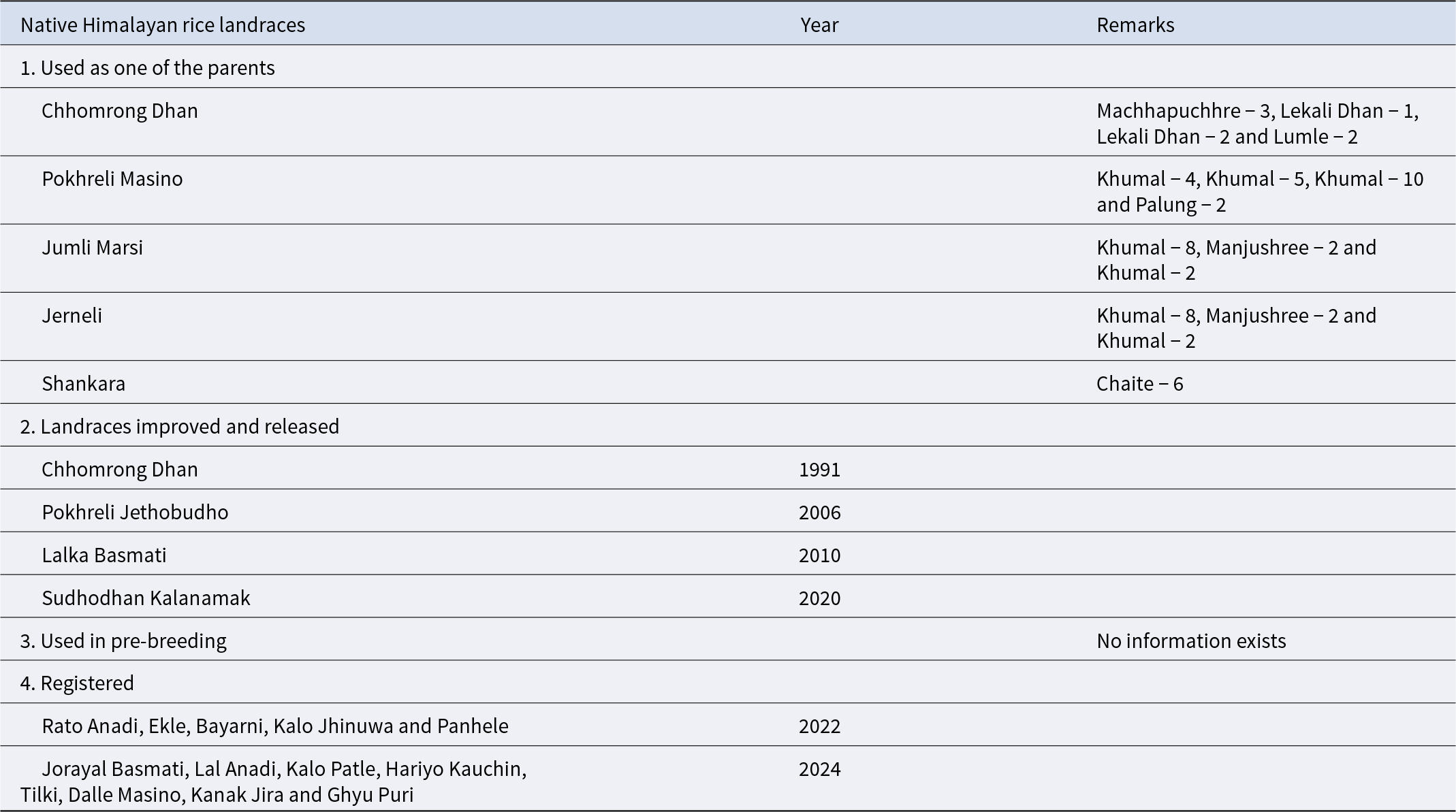
Table 2 Long description
The table groups native Himalayan rice landraces by how they were used in Nepal’s rice breeding and registration activities, with years listed where available. As breeding parents, Chhomrong Dhan contributed to Machhapuchhre 3, Lekali Dhan 1, Lekali Dhan 2, and Lumle 2, while Pokhreli Masino contributed to Khumal 4, Khumal 5, Khumal 10, and Palung 2. Jumli Marshi and Jerneli are each linked to Khumal 8, Manjushree 2, and Khumal 2, and Shankara is linked to Chaite 6. Landraces improved and released include Chhomrong Dhan in 1991, Pokhreli Jethobudho in 2006, Lalka Basmati in 2010, and Sudhodhan Kalanamak in 2020. The pre-breeding section notes that no information exists. Registration entries list five landraces registered in 2022 and eight landraces registered in 2024. Several parent-use rows have blank years, so the table emphasizes relationships and categories more than timelines for those entries.
Findings from the analysis of rice varietal mapping in 2015

Table 3 Long description
The table counts rice landraces by conservation status category and by rice type (specialty, medium, fine, aromatic, basmati, and coarse), with totals. Across all types, critically endangered landraces are the largest group at 155 out of 189, while endangered account for 21 and common but locally grown for 10. Common and widely grown landraces are rare, totaling 3. By rice type overall, coarse is most frequent at 64, followed by fine at 40 and medium at 38; aromatic is least frequent at 10. Within the critically endangered category, coarse is especially high at 60, and medium and fine are also substantial at 32 and 36. Endangered landraces are spread across types, led by specialty at 6 and aromatic at 4. These figures reflect the underlying varietal mapping dataset and should be interpreted as counts from that source rather than as population-wide prevalence.
Source: Our analysis based on data from CDD (2015).
IRRI has facilitated the sharing of Nepalese rice germplasm globally, supporting rice breeding efforts worldwide (Fig. 8). Nepalese rice germplasm is highly valued, contributing to breeding programmes in over 60 countries. For example, Jumli Marsi’s chilling tolerance played a crucial role in developing the upland rice variety FOFIFA-172 in Madagascar (Raboin et al. Reference Robion, Randriambololon, Ramanantsoanirina, Ahmadi and Dusserre2014), while Chhomrong Dhan is widely cultivated in Bhutan and Madagascar, covering a significant portion of upland rice acreage (Raboin et al. Reference Robion, Randriambololon, Ramanantsoanirina, Ahmadi and Dusserre2014; Ghimire et al. Reference Ghimire, Pandey and Velasco2013).
Global distribution and use of native Himalayan rice germplasm in plant breeding and genetic research.

Grain quality and nutritional profiling of NHR
The NHR landraces vary widely for grain pigmentation, textures and quality from coarse to fine, including Basmati and other fragrant types (Fig. 9). These landraces are integral to the food traditions of many ethnic groups and play a critical role in food security (Joshi et al. Reference Joshi, Sthapit, Subedi, Budhathoki and Gurung1996, Reference Joshi, Rana and Subedi2001a). These landraces exhibit substantial phenotypic diversity; however, their nutritional and health attributes remain poorly characterized, as earlier studies largely emphasized agronomic and easily measurable morphological traits.
Examples of diversity in grain size, shape and pigmentation of Nepalese rice germplasm. (A) Coarse grain (NGRCO 10093). (B) Variation in grain type and glume colour of aromatic rice (NGRCO 10248). (C) Long slender Basmati rice (NGRCO 10984). (D) Short round grain rice (NGRCO 10445). (E) Glutinous Anadi Dhan (NGRCO 3138). (F) Medium grain rice (NGRCO 10103).

Advances in analytical tools now allow rapid nutritional profiling of rice to evaluate both nutritional and agronomic value (Mbanjo et al. Reference Mbanjo, Kretzschmar, Jones, Ereful, Blanchard, Boyd and Sreenivasulu2020). A diversity in thousand-grain weight of NHR is reported, ranging from 15 to 35 g, with mountain varieties having heavier grains due to the extended grain-filling period in cooler temperatures (Sthapit et al. Reference Sthapit, Subedi, Sen, Gurung, Joshi, Dhital and Paudel1988, Joshi et al. Reference Joshi, Sthapit, Subedi, Budhathoki and Gurung1996; Joshi Reference Joshi1997a; Ghimire et al. Reference Ghimire, Lamsal and Sankuratri2026). Rai et al. (Reference Rai, Khadka and Pokhrel2023) reported substantial variation in NHR landraces, with grain lengths ranging from 4.2 to 8.6 mm, widths from 1.8 to 3.4 mm and shapes spanning from short-round to long-slender. They also documented considerable diversity in cooking qualities. Very little work is reported on grain pigmentation, for example, a study involving four landraces, e.g., Jumli Marsi, Borang Dhan, Hans Raj and Sali Dhan – revealed that Jumli Marsi had superior polyphenol (83 mg/100 g), flavonoid (205 mg/100 g) and antioxidant content (53 mg/100 g) compared with non-pigmented varieties (Joshi et al. Reference Joshi, Ojha, Gauchan, Ghimire, Bhandari, KC, Gauchan, Joshi, Bhandari, Manandhar and Jarvis2020). Its nutritional richness is further supported by the presence of tannins, alkaloids, terpenoids, proteins and glycosides (Gautam et al. Reference Gautam, Kandel, Chalaune and Koirala2022), consistent with findings by Pakuwal and Manandhar (Reference Pakuwal and Manandhar2021). There is limited nutritional and biochemical profiling of pigmented and red-pericarp (‘red’) varieties and SR landraces of Nepal. The effects of altitude, environment and traditional processing on their grain quality remain unclear, and comparisons with modern varieties remain scarce. As a result, these ‘red’ landraces are undervalued and weakly integrated into commercial value chains.
Research on glycaemic index of rice landraces in Nepal is limited. Rai et al. (Reference Rai, Khadka, Upadhyay and Rai2025) analyzed the glycaemic index of Nepalese rice landraces – Anadi white, Bhotange and Kalo Nuniya – and found that Bhotange had a glycaemic index <55, while none of the landraces fell into the high glycaemic index category (>70). In a separate study, Yadav et al. (Reference Yadav, Bhandari, Babu, Jha, Pandey, KC, Upadhaya, Panta and Joshi2025) reported that Jumli Marsi possesses antioxidant, antibacterial and anti-diabetic properties, indicating its suitability as an alternative to non-pigmented rice for individuals with diabetes. A nutritional study in Assam, India, reported low glycaemic index values of 44–55 among landraces selected for low glycaemic index (John et al. Reference John, Bollinedi, Jeyaseelan, Padhi, Sajwan, Nath, Singh, Ahlawat, Bhardwaj and Rana2023), highlighting the relevance of comparable profiling in Nepal.
Geographical indication
Nepalese rice landraces hold high genetic, cultural and economic value, making their protection through Geographical Indication (GI) rights increasingly important (Joshi et al. Reference Joshi, Ghimire, Bista, Yadwa, Shrestha, Kharel, Paneru, RB and Bhandari2021). Over 20 landraces in Nepal show strong potential for GI registration due to distinctive traits such as aroma, grain texture, colour, taste, cooking quality, nutritional properties and microclimatic adaptation (Joshi et al. Reference Joshi, Acharya, Gauchan, Singh, Ghimire and Sthapit2017). These NHR include Jetho Budo, Jumli Marsi, Kalanamak, Suga Pankhi, Khoile, Samundraphinj, Joryal Basmati, Ghiu puri, Thapachini, Sali Dhan, Masino basmati, Lal Anadi, Tilki, Kanak Jira, Kalo Jhinuwa, Ekle, Bayarni, Hariyo Kauchin, Manamuri, Hansaraj, Jhinuwa, Pokhreli Masino, Shyamjira and Suwa Dhan (also see Supplementary Table 4). The local origin of each landrace gives it a unique geographical and cultural identity, and communities are actively pursuing GI protection. Thirteen landraces have already been registered with the National Seed Board, reflecting growing local commitment. Jumli Marsi ranked second among 19 crop landraces for bioactive compounds (Joshi et al. Reference Joshi, Ojha, Gauchan, Ghimire, Bhandari, KC, Gauchan, Joshi, Bhandari, Manandhar and Jarvis2020), supporting its potential as a nutritious and health-promoting landrace. The crude protein content of Jumli Marsi (9.9%) and Chhomrong Dhan (8.4%) also surpassed that of nutrient-dense finger millet (Kumar et al. Reference Kumar, Metwal, Kaur, Gupta, Puranik, Singh, Singh, Gupta, Babu, Sood and Yadav2016; Gautam et al. Reference Gautam, Kandel, Chalaune and Koirala2022).
Discussion
The synthesis aims to support the sustainable commercialization of Himalayan SR by leveraging the unique traits of Nepal’s native landraces to develop premium, climate-resilient varieties. Molecular and phenotypic studies confirm that Nepalese rice landraces harbour rich genetic diversity shaped by altitude, climate, farmer-led selection and culinary traditions. However, this diversity faces accelerating erosion driven by replacement with high-yielding varieties, which is obvious from the lowest area coverage and varietal richness of NHR (37 landraces out of 189) in the Terai region, where the impact of modern plant breeding is greatest. Other drivers of genetic erosion are farmland abandonment, weak market infrastructure and limited consumer and farmer awareness of the nutritional and cultural value of NHR. Despite extensive documentation, critical gaps persist in translating these resources into practical utilization and higher market value to improve commercialization.
Passport data for rice germplasm conserved in the IRRI and other gene banks show inconsistencies across several variables. Many accessions may represent duplicate samples of the same landraces, while the names of several landraces are incomplete or incorrectly recorded. In addition, the information on the site of collection and the geographic coordinates of collection sites are often missing or inaccurate. These issues highlight the need for further research to critically review the passport data and determine a reliable estimate of the number of unique NHR conserved in the IRRI gene bank.
NHR landraces are valued for their genetic uniqueness, cultural significance and agroecological adaptation, yet their conservation status remains precarious. Landraces are poorly promoted in urban cuisine and underrecognized for their nutritional and health benefits (Joshi et al. Reference Joshi, Ojha, Gauchan, Ghimire, Bhandari, KC, Gauchan, Joshi, Bhandari, Manandhar and Jarvis2020; Pakuwal and Manandhar Reference Pakuwal and Manandhar2021), constraining consumer demand and on-farm retention incentives. The small number of officially released and registered landraces (SQCC 2024) reflects their underutilization in formal breeding programmes, while their minimal use in pre-breeding represents a missed opportunity for strengthening Nepal’s breeding pipeline. Targeted research, robust pre-breeding strategies and improved value-chain promotion are essential to arrest genetic erosion.
Most studies have focused narrowly on inventory and conservation, with classification relying on morphological descriptors such as grain size and shape that inadequately capture biochemical, nutritional and bioactive compound diversity – limiting competitiveness in health- and wellness-oriented markets.
IRRI research has demonstrated substantial nutrient variation across the global rice gene pool (Juliano and Villareal Reference Juliano and Villareal1993), and NHR, cultivated with minimal chemical inputs in relatively unpolluted environments, holds considerable premium market potential. Improved characterization of key attributes, including antioxidants, low GI and anti-cancer compounds, would strengthen market differentiation. Recognizing the value producers and consumers assign to specific rice traits could enable Nepal to build sustainable enterprises that conserve its agricultural heritage while improving local livelihoods. Market-based conservation and promotion of SR varieties can position the country as a leader in high-value, sustainable agricultural products, benefiting both farmers and consumers.
Stress-tolerance traits remain underutilized: drought research has largely quantified yield losses without integrating physiological and genetic analyses, and chilling-tolerant high-altitude landraces lack genomic mapping of useful genes for climate resilience and nutritional improvement. Contemporary genomic and high-throughput phenotyping approaches now offer opportunities to address these gaps. Ghaiya and other stress-adapted landraces exemplify underutilized resources despite their proven adaptation to rainfed, drought-prone and marginal environments. Disease resistance gaps are equally significant – resistance gene characterization is limited, climate change effects on disease dynamics are poorly understood, pathotype diversity is underexplored, and systematic surveillance across altitudinal gradients is lacking.
Nepal’s agricultural environment is evolving from a productivity-focused system towards one that recognizes indigenous biodiversity. For example, the review of national legislation highlights that policies are increasingly supporting conservation through use (Joshi Reference Joshi2017). The Seed Act (2022) and Seed Regulation (2024) are pivotal, as they finally grant legal recognition to local landraces, allowing for their formal commercialization and branding (Joshi et al. Reference Joshi, Thapa, Prasai and Bhandari2026). However, the absence of a dedicated Geographical Indication (GI) Act hinders international market exclusivity for high-value varieties like Jumli Marsi (Ministry of Industry, Commerce and Supplies (MoICS) 2017).
Global demand for aromatic, Basmati and health-promoting SR is accelerating. The United States exported USD 1.39 billion of glutinous rice in 2023 (Tridge 2023), and India is targeting a USD 120 billion nutraceutical rice market (Sreenivasulu, pers. com.). These trends create strong opportunities for Nepal to market its NHR landraces through enhanced profiling, value-addition, branding and targeted value-chain development, leveraging their agroecological adaptability, fragrance traits and premium grain quality. However, weak understanding of socioeconomic drivers of landrace abandonment, underdeveloped value chains and insufficient diversity-market linkages constrain Nepal’s competitiveness. NHR landraces currently lack the scientific validation, profiling and commercialization strategies required to secure Geographical Indication (GI) rights and fully realize their high-value market potential.
Supplementary material
The supplementary material for this article can be found at https://doi.org/10.1017/S1479262126100719.
Acknowledgements
The authors would like to thank Dr. Jongsoo Shin, IRRI Asia Director and Dr. Il Ryong Choi, IRRI Representative, South Korea, for their guidance and support while conducting this research. We are thankful to the Temperate Rice Research Consortium for its support in conducting the research. The authors acknowledge Dr. Sanjay Katiyar, Breeding Modernization Lead, International Rice Research Institute (IRRI) and Dr. Saurabh Badoni, Scientist, Grain Quality and Nutrition, IRRI South Asia Regional Office, for the internal review and feedback on the manuscript. We acknowledge the contribution of Dinesh Khadka, Scientist, NARC, for preparing a GIS map for this publication.
Author contributions
K.D.J. was responsible for data curation, methodology, formal analysis, investigation, resources, project administration, supervision, writing – original draft and writing – review and editing. N.K. contributed to data entry, data management, figure preparation, writing – review and formatting. B.K.J. contributed to investigation and writing – review and editing. R.B.K. contributed to investigation, writing – review and editing and figure preparation. A.J. contributed to data curation, cluster analysis and formal analysis. J.R.W. contributed to conceptualization, methodology, investigation, supervision, validation and writing – review and editing.
Data availability statement
The original contributions presented in the study are included in the article/Supplementary Material. Further inquiries can be directed to the corresponding author.
Competing interests
The authors confirm that this research was carried out without any commercial or financial relationships that could be interpreted as potential conflicts of interest.




 Open access

