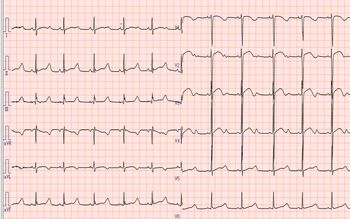
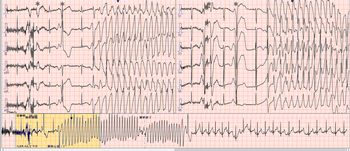
A 12-year-old boy was referred to our hospital after experiencing syncope at school. He collapsed while rushing to the teachers’ room to hand over a school item, but spontaneously recovered after a few minutes. He had no family history of sudden death. Upon admission, he was conscious with a heart rate of 55 beats per minute and blood pressure of 102/54 mmHg. Electrocardiography showed a corrected QT interval of 529 milliseconds (Bazett’s formula) (Fig 1). The treadmill exercise test showed that the corrected QT intervals at maximum heart rate of 178 beats per minute and at 4 minutes after the cessation of exercise were 491 milliseconds and 488 milliseconds, respectively. As per our institutional protocol, we performed a face immersion test to evaluate the risk for diving-induced arrhythmias. The procedure involved immersing the patient’s face into cold water (temperature of 10 cent degree) to stimulate the parasympathetic nervous system.Reference Kamimura, Yoshinaga and Kono1 The test showed prolonged QT intervals, with multiforme bigeminy, and premature ventricular contractions, as well as R on T phenomenon. These resulted in several seconds of torsades de pointes (Fig 2). T wave alternans were obscure. We witnessed another episode of faintness, from which he spontaneously regained consciousness. Genetic analysis revealed a mutation of c.322 T>C, p. Cys108Arg in KCNH2 that encoded for an alpha subunit of the rapid component delayed rectifier potassium channel. This finding supported the definitive diagnosis of type 2 long QT syndrome. Oral metoprolol was administered, and the patient has not experienced syncope thereafter.
A 12-lead electrocardiogram shows heart rate of 55 beats per minute with normal sinus rhythm and a corrected QT interval of 529 milliseconds according to Bazett’s formula. A recording speed was 25 mm per second.

A 12-lead electrocardiogram during a face immersion test into cold water shows prolonged QT intervals, with multiforme bigeminy, and premature ventricular contractions (asterisks), as well as R on T phenomenon, following several seconds of torsades de pointes. A recording speed was 25 mm per second.

Patients with long QT syndrome have gene-specific triggers that may cause life-threatening cardiac events or sudden death; exercise or swimming are triggers for type 1, auditory or emotional events for type 2, and sleep for type 3 long QT syndrome.Reference Schwartz, Priori and Spazzolini2,Reference Moss, Robinson and Gessman3 Choi et al. described that the gene mutations in patients with near-drowning or drowning histories were type 1 long QT syndrome in 85% and type 2 long QT syndrome in 6%.Reference Choi, Kopplin, Tester, Will, Haglund and Ackerman4 Usually, a treadmill exercise test evokes tachycardia, whereas a face immersion test evokes bradycardia. As torsades de pointes was induced in our patient by the face immersion test rather than the treadmill exercise, a trigger might more likely be involved. The slow delayed rectifier potassium current is suppressed during bradycardia because the current shows a use- and frequency-dependent property.Reference Chen, Sampson and Kass5 Therefore, cardiac repolarisation during bradycardia tends to depend upon the rapid delayed rectifier potassium current. A face immersion test is therefore feasible to predict cardiac events in adolescents with type 2 long QT syndrome.
Financial Support
This research received no specific grant from any funding agency, commercial or not-for-profit sectors.
Conflicts of Interest
None.