Antibiotics are frequently prescribed in nursing homes; however, a large proportion of these prescriptions are considered inappropriate. Reference Thompson, LaPlace and Epstein1–Reference Lim, Kong and Stuart3 Judicious use of antibiotics is critical because nursing home residents are at increased risk of harms from antibiotic use, including adverse drug events, drug interactions, Reference Gurwitz, Field and Avorn4 and colonization and infection with multidrug-resistant organisms and Clostridioides difficile. Reference Drinka, Crnich and Nace5–Reference Campbell, Giljahn and Machesky7 The Centers for Disease Control and Prevention (CDC) published the Core Elements of Antibiotic Stewardship for Nursing Homes in 2015 as a framework for the implementation of stewardship programs in nursing homes. 8 The 7 core elements include (1) leadership commitment to improve antibiotic use; (2) accountability for stewardship activities; (3) access to drug expertise; (4) actions through policy and practice change; (5) tracking prescribing, use and resistance; (6) reporting information to staff; and (7) education of clinicians, nursing staff, residents and families. 8 The CDC National Healthcare Safety Network (NHSN) Long-Term Care Facility (LTCF) Component is a surveillance reporting system to track infections and prevention process measures in nursing homes (https://www.cdc.gov/nhsn/ltc/index.html). Nursing homes enrolled in the NHSN LTCF Component have reported their antibiotic stewardship practices yearly since 2014. 9 In 2016, 42% of nursing homes reported implementing all 7 core elements. Reference Palms, Kabbani, Bell, Anttila, Hicks and Stone10 A higher number of staff hours dedicated to infection prevention and control (IPC) in the nursing home was associated with implementation of all 7 core elements. Reference Palms, Kabbani, Bell, Anttila, Hicks and Stone10 Since then, the Centers for Medicare & Medicaid Services (CMS) finalized a rule requiring nursing homes to implement an antibiotic stewardship program, with antibiotic use protocols and systems for monitoring antibiotic use, and to designate at least 1 infection preventionist as part of their IPC program. 11 The objective of this analysis was to assess the national uptake of the core elements in nursing homes since 2016 to identify opportunities to improve antibiotic stewardship implementation. In addition, we reassessed the effect of IPC hours on the implementation of stewardship activities.
Methods
We used the NHSN LTCF annual surveys from 2016 to 2018 to assess the implementation of the core elements of antibiotic stewardship in nursing homes. The NHSN LTCF annual survey collects data on facility-level characteristics as well as information regarding implementation of IPC practices. US nursing homes were eligible for inclusion if they reported to the NHSN LTCF Component in 2016, 2017, or 2018. Nursing homes with multiple survey submissions in the same year or missing occupancy data were excluded. Facility characteristics were described using frequency and percentage for categorical variables and median with interquartile range (IQR) for continuous variables. We compared nursing homes reporting to the NHSN to nursing homes nationwide using facility characteristics reported in the 2016 Kaiser Family Foundation nursing facility report 12 and the 2015 CMS Data Compendium. 13 Implementation of the core elements of antibiotic stewardship was defined as self-reported adherence to at least 1 corresponding stewardship activity, based on previously described methodology (Supplementary Table 1 online). Reference Palms, Kabbani, Bell, Anttila, Hicks and Stone10 We evaluated the implementation of each core element individually and identified the percentage of nursing homes that reported implementation of all 7 core elements from 2016 to 2018. Absolute differences in percent implementation were used to assess the change in the percentage of nursing homes implementing all 7 core elements by year. Nursing home characteristics associated with implementation of all 7 core elements were assessed using χ2 tests for categorical variables and Wilcoxon rank-sum tests for non-normally distributed continuous variables. We conducted multivariable analyses using log-binomial regression models to assess the effect of IPC hours on the implementation of all 7 core elements while controlling for confounding by facility characteristics.
Considering that the composition of nursing homes enrolled in the NHSN varies by year, we conducted a sensitivity analysis to assess potential nonresponse bias. We included consecutive reporters, defined as nursing homes that submitted an annual survey in all 3 years of the study period (2016–2018), and we compared results to the primary analytic cohort of nursing homes enrolled at any time in 2016–2018. Statistical analyses were conducted using SAS version 9.4 software (SAS Institute, Cary, North Carolina).
Results
Facility characteristics
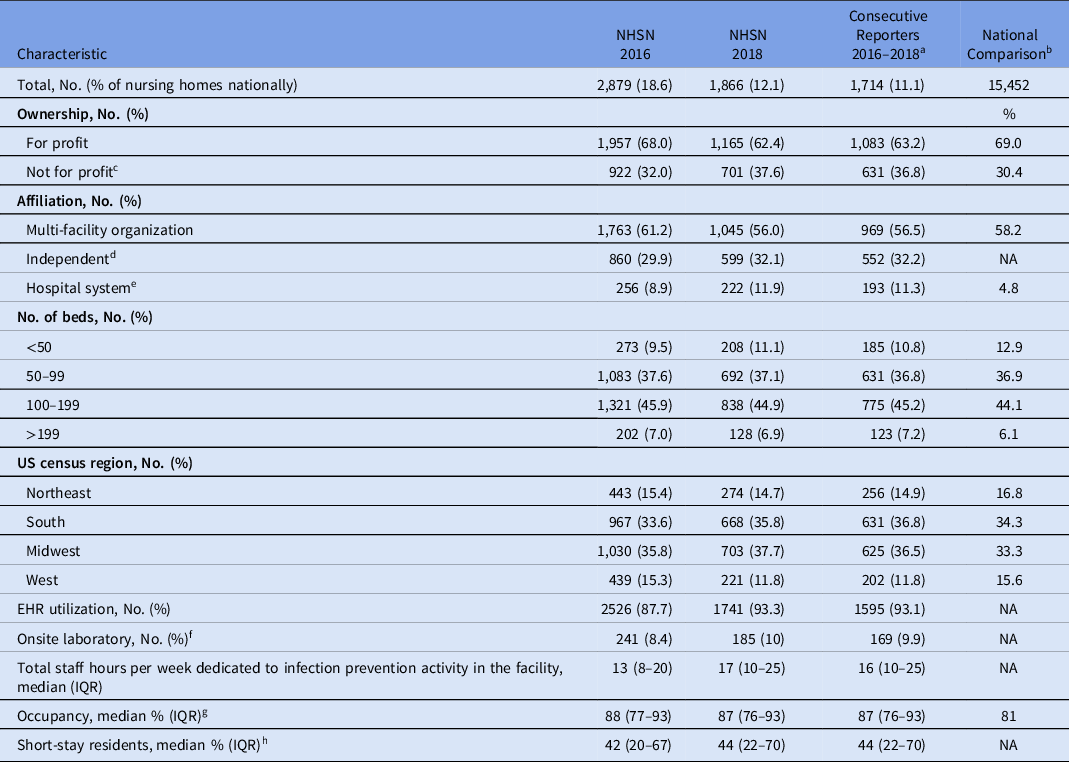
From 2016 to 2018, 7,833 annual surveys were submitted to the NHSN from nursing homes. We excluded 327 surveys due to duplication or missing occupancy data. There was a 35% decline in the number of nursing homes reporting to the NHSN from 2016 to 2018. In 2018, enrollment represented 12% of all US nursing homes, and most nursing homes were for-profit entities (62%) and were part of a multifacility organization (56%), with a median bed size of 100. The facility characteristics were similar across the study years 2016–2018 and were not meaningfully different from the national distribution among US nursing homes (Table 1).
Characteristics of Nursing Homes Reporting to the NHSN from 2016 to 2018 and Comparison to the National Distribution

Note. NHSN, National Healthcare Safety Network; IQR, interquartile range; NA, not available.
a 2018 characteristics reported.
b Based on 2016 data from the Kaiser Family Foundation report on nursing facilities and 2014 data from the Centers for Medicare & Medicaid Services Nursing Home Data Compendium.
c Not for profit ownership includes church, government, and Veterans’ Affairs facilities.
d Independent includes free-standing and continuing-care retirement community.
e Hospital system includes free-standing and attached hospital-affiliated nursing homes.
f 10 surveys were missing onsite laboratory information.
g Percent occupancy = (average daily census/no. of beds) ×100.
h Percent short-stay residents = (no. of unique short-stay residents in year/total unique residents in year) × 100.
Implementation of core elements of antibiotic stewardship
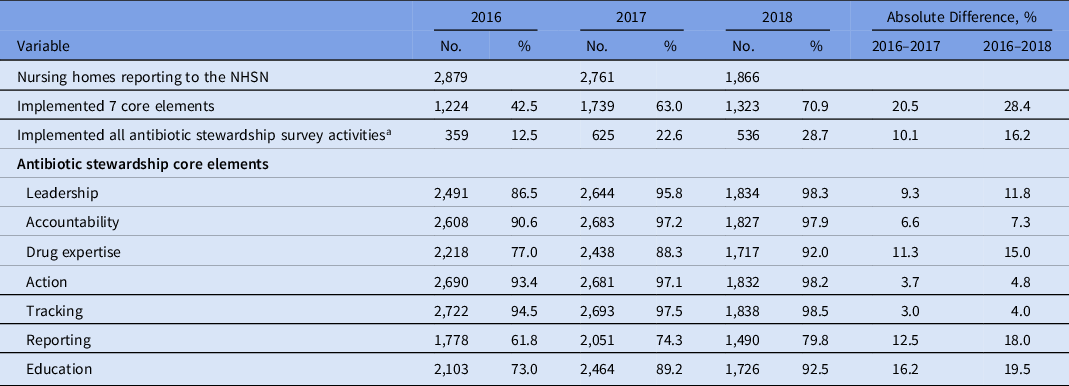
In 2018, 1,323 nursing homes (71%) reported implementing all 7 core elements of antibiotic stewardship, a 28% increase from 2016. Affirmative responses to all 13 stewardship activities included in the survey increased from 13% in 2016 to 29% in 2018 (Table 2). Bivariate analyses indicated that weekly IPC staff hours, for-profit facility ownership, multiorganization affiliation, US census region, and higher percentage of short-stay residents were statistically significantly associated with implementation of all 7 core elements (Supplementary Table 2 online). In the final multivariate analysis, nursing homes that reported at least 20 staff hours of IPC activity per week in 2018 were 14% more likely to implement all 7 core elements (95% confidence interval [CI], 7%–20%) when controlling for confounding by facility ownership and affiliation.
Nursing Home Implementation of the Core Elements of Antibiotic Stewardship, 2016–2018

Note: Data are reported using specified inclusion criteria; 2016 results may not match previously published results; NHSN, National Healthcare Safety Network.
a Responded affirmatively to all 13 antibiotic stewardship survey questions.
We detected increases in the implementation of all 7 core elements from 2016 to 2018, with the largest increases in education (19%), reporting (18%), and drug expertise (15%) (Table 2). In 2018, the reported implementation of each individual core element ranged from 80% to 99%. The leadership core element was implemented by 98% of nursing homes in 2018; leadership review of antibiotic use and resistance data increased from 83% in 2016 to 96% in 2018. However, 14% of nursing homes were missing a written statement of support from leadership. The accountability core element was implemented by 98% of nursing homes; the roles responsible for activities to improve antibiotic use were the director of nursing (83%), medical director (77%), and pharmacist (71%), a 27% increase in pharmacist involvement since 2016. In addition, 30% of nursing homes self-reported that an infection preventionist was responsible for stewardship activities. Access to drug expertise was reported by 92% of nursing homes. The action core element was implemented by 98% of nursing homes in 2018; the individual activities ranged from 62% having a procedure for follow-up assessments (a 20% increase since 2016) to 91% having a policy to document antibiotic indication. Tracking had the highest reported implementation (99%), with 86% of nursing homes monitoring policy adherence for antibiotic indication documentation and 81% receiving a monthly antibiotic use report from the pharmacy. Reporting had the lowest reported implementation (80%), with 77% of nursing homes giving prescribers feedback on therapy selection and/or duration or route and/or dosing. Finally, 93% of nursing homes implemented education (Supplementary Table 1 online).
Consecutive reporters
Overall, 1,714 nursing homes (92%) enrolled in the NHSN in 2018 reported consecutively from 2016 to 2018 and had similar characteristics to the full cohort (Table 1). In 2018, 1,209 consecutive reporters (71%) implemented all 7 core elements of antibiotic stewardship, a 30% increase from 2016 (N = 703) (Table 1). Nearly half (47%) of nursing homes improved in implementation of 1 or more core elements since 2016. The greatest improvements were seen in education (21%), reporting (19%), and drug expertise (16%), similar to the increases observed in the full cohort.
Discussion
Implementing antibiotic stewardship activities in nursing homes is critical to improving prescribing practices and resident safety. However, many nursing homes face barriers to implementing an effective antibiotic stewardship program, including limited resources and limited staff expertise. Therefore, we assessed progress in the implementation of the core elements from 2016–2018 using survey data reported to the NHSN to identify successes and challenges to inform improvement efforts. We found that nearly three-quarters of nursing homes enrolled in the NHSN in 2018 implemented all 7 core elements of antibiotic stewardship, and full implementation was more likely in facilities with at least 20 staff hours dedicated to IPC per week. Nursing homes made substantial increases in the implementation of drug expertise, reporting, and education, the core elements with the lowest reported implementation in 2016.
The 28% increase in reported implementation of the core elements from 2016 to 2018 was likely driven by CMS antibiotic stewardship requirements that went into effect in November 2017. 11 Likewise, hospitals experienced a similar increase in uptake after antibiotic stewardship program requirements from the Joint Commission went into effect in 2017, from 41% in 201414 to 85% in 2018, 15 highlighting the impact of regulatory changes on healthcare practices.
The study results indicate that hours dedicated to IPC may be associated with antibiotic stewardship implementation. Infection preventionist are critical in ensuring resident and staff health and safety in nursing homes; their expertise can inform strategies to improve antibiotic use and they are often accountable for stewardship activities, including tracking antibiotic use, infections, and resistance patterns. 8 Previous studies have shown that nursing homes with trained infection preventionist are more likely to have comprehensive antibiotic stewardship programs and policies. Reference Stone, Herzig, Agarwal, Pogorzelska-Maziarz and Dick16,Reference Fu, Mantell, Stone and Agarwal17 Although nursing homes are required to have a trained infection preventionist, there are no guidelines on the number of weekly hours that should be dedicated to IPC activities in nursing homes, 11 and the number of hours dedicated to IPC did not increase significantly from 2014 to 2018 with the expansion of CMS IPC program requirements. Reference Stone, Agarwal and Pogorzelska-Maziarz18 Although limited resources can lead to staffing and training restraints in nursing home settings, these findings suggest that staff hours dedicated to IPC activities are important for decreasing antibiotic resistance in nursing homes, not only by implementing practices to reduce pathogen transmission and healthcare-associated infection but also by improving antibiotic prescribing practices.
Uptake of all 7 core elements increased from 2016 to 2018, with substantial improvements in drug expertise, reporting, and education. Nursing homes may have improved the implementation of drug expertise through increased consultant pharmacist involvement in antibiotic stewardship programs. Overall, 71% of nursing homes reported that a pharmacist was responsible for the impact of activities to improve antibiotic use, coinciding with a Pennsylvania study showing that pharmacists were involved in 85% of stewardship programs in LTCFs. Reference M’Ikanatha, Boktor, Seid, Kunselman and Han19 The role of pharmacists in leading the implementation of antibiotic stewardship is emphasized in the updated Core Elements of Hospital Antibiotic Stewardship Programs, 20 which highlights their impact on antibiotic stewardship across the healthcare spectrum. Although onsite availability of pharmacists varies in the nursing home setting, consultant pharmacists can have a large impact on nursing home antibiotic stewardship by implementing facility policies and procedures, performing antibiotic reviews, and providing staff with education and feedback on stewardship activities. Reference Martin21
A large increase in core element implementation was observed for reporting; most nursing homes reported giving providers feedback on selection and duration or route and dosing of antibiotic therapy. Similar results were reported in a nationally representative survey of nearly 900 nursing homes in which 69% of nursing homes provided feedback on antibiotic use and prescribing to providers. Reference Fu, Mantell, Stone and Agarwal17 However, further evaluation is needed to assess the timeliness of feedback to prescribers and whether antibiotics were reassessed for appropriate drug and duration. The increase in education implementation may be attributed to increased availability of nursing home-specific resources, such as educational tool kits and workshops developed by state health departments, support from Quality Innovation Network-Quality Improvement Organizations (QIN-QIOs), Reference Quigley, Dick and Stone22 and training courses and online resources developed by the CDC. 23,24 Several studies have highlighted the importance of education as a first step in implementing stewardship programs. In a 2-year quality improvement trial, researchers found that training modules and free continuing education credit resulted in a 18% decrease in the rate of systemic antibiotic prescriptions at 12 months and 23% decrease at 24 months. Reference Sloane, Zimmerman and Ward25 Continued access to free training and education in nursing homes may help to standardize and improve infection control and antibiotic prescribing practices.
This study has several limitations. It represents a small percentage of all US nursing homes and was subject to selection bias of facilities that voluntarily reported to the NHSN. There was a large decrease in nursing homes reporting to the NHSN in 2018, which may correspond to the end of a CMS-funded initiative that supported nursing home enrollment and participation in the NHSN. Reference Dick, Bell, Stone, Chastain, Sorbero and Stone26 However, representativeness of facility characteristics did not change throughout the study period; therefore, the decline in nursing homes likely did not have a large impact on our ability to track improvements over time. The adherence to the core elements in the NHSN survey responses are self-reported without external validation, and social desirability bias may have led to affirmative responses. In addition, some core elements can be fulfilled with multiple stewardship activities on the survey, which may partially explain their higher implementation than core elements with fewer survey questions. Nevertheless, our results show an increase in awareness and implementation of stewardship practices and are comparable to other studies that have evaluated antibiotic stewardship implementation in hospitals 15 and nursing homes. Reference Fu, Mantell, Stone and Agarwal17 Different nursing homes submit the survey each year; therefore, year-to-year comparisons must be interpreted with caution. However, our sensitivity analysis of consecutive reporters revealed the same temporal increase in core element implementation as the primary analysis. Finally, this study did not measure the effectiveness of the core elements on improving antibiotic use or resident outcomes, as rates of antibiotic prescribing and clinical outcomes in these nursing homes were not reported.
Nursing homes reported substantial progress in antibiotic stewardship implementation under new regulatory requirements. Reporting to the NHSN enables monitoring of stewardship implementation and infection surveillance in the nursing home setting, which can be used to identify facility-level challenges and address barriers in implementation to stewardship activities and IPC practices. Nursing homes may benefit from increased staff hours dedicated to IPC activities to advance their antibiotic stewardship practices. Improvements in accessing drug expertise, reporting to prescribers, and antibiotic stewardship education may reflect increased stewardship awareness and availability of resources, including consultant pharmacy services and IPC training. Further research should evaluate the barriers facing nursing homes in implementing successful antibiotic stewardship policies and should identify the stewardship activities that are most feasible, sustainable, and effective in improving prescribing practices and resident outcomes in nursing home settings.
Acknowledgments
The findings and conclusions in this report are those of the authors and do not necessarily represent the official position of the Centers for Disease Control and Prevention.
Financial support
This study was supported by the US Centers for Disease Control and Prevention.
Conflicts of interest
K.A.G. is employed by Chenega Enterprise Systems and Solutions and is assigned to the US Centers for Disease Control and Prevention as part of a contract covering multiple tasks and positions. A.A. is employed by CACI (subcontractor to Leidos) and is assigned to the US Centers for Disease Control and Prevention as part of a contract covering multiple tasks and positions. J.M., E.M., and T.T.M. are employed by Leidos and are assigned to the US Centers for Disease Control and Prevention as part of a contract covering multiple tasks and positions. All other authors report no conflicts related to this article.
Supplementary material
To view supplementary material for this article, please visit https://doi.org/10.1017/ice.2021.209