Introduction
Sir Douglas Mawson is well known as a polar explorer and scientist rather than as an entrepreneur. But, he recognised opportunities for commerce in Antarctic and sub-Antarctic regions in the early days of his career, even before his appointment as Professor of Geology and Mineralogy at University of Adelaide in 1921. At the meeting of the Australasian Association for the Advancement of Science (AAAS) in January 1911, Mawson presented a lecture on the proposed Australasian Antarctic Expedition (AAE) 1911–14; in the abstract of his talk, he stated that ‘There is also considerable prospect of an economic return from whale and seal products and from guano and mineral wealth’ (Mawson, Reference Mawson1912, p. 399). He made similar statements in the prospectus used to lobby for financial support for the expedition (Mawson Archives, file 11AAE). In newspaper articles in June 1910, Mawson pointed out the potential economic value of the region from ‘gold and mineral wealth, whale oil, seal oil, or anything else it may contain - will of course be to the advantage of Australia’ (cited by Howitt, Reference Howitt2019, p. 254).
In 1915, Mawson made expansive comments about the possible economic value of Antarctic resources, including coal (Washington Post (Washington, DC), 31 January 1915, p. 12). In this context, it should be noted that Mawson’s first degree was in Engineering (Mining); examples of his interest in commercial mining possibilities are shown by his share in a prospect at Radium Hill and his work on a potential phosphate deposit at Elders Rock, both in north-eastern South Australia (Jago & Pharaoh, Reference Jago and Pharaoh2016), his work for Shackleton on the viability of a gold mine in Hungary and the lease he took out on alunite deposits in Western Australia (Ayres, Reference Ayres1999). Furthermore, in the gazetteer of the geographical narrative of the AAE, Mawson (Reference Mawson1942, p. 311) recorded ‘patches of penguin guano’ on the Mackellar Islets and estimated the amount at 500 tonnes; this suggests he might have thought of mining it.
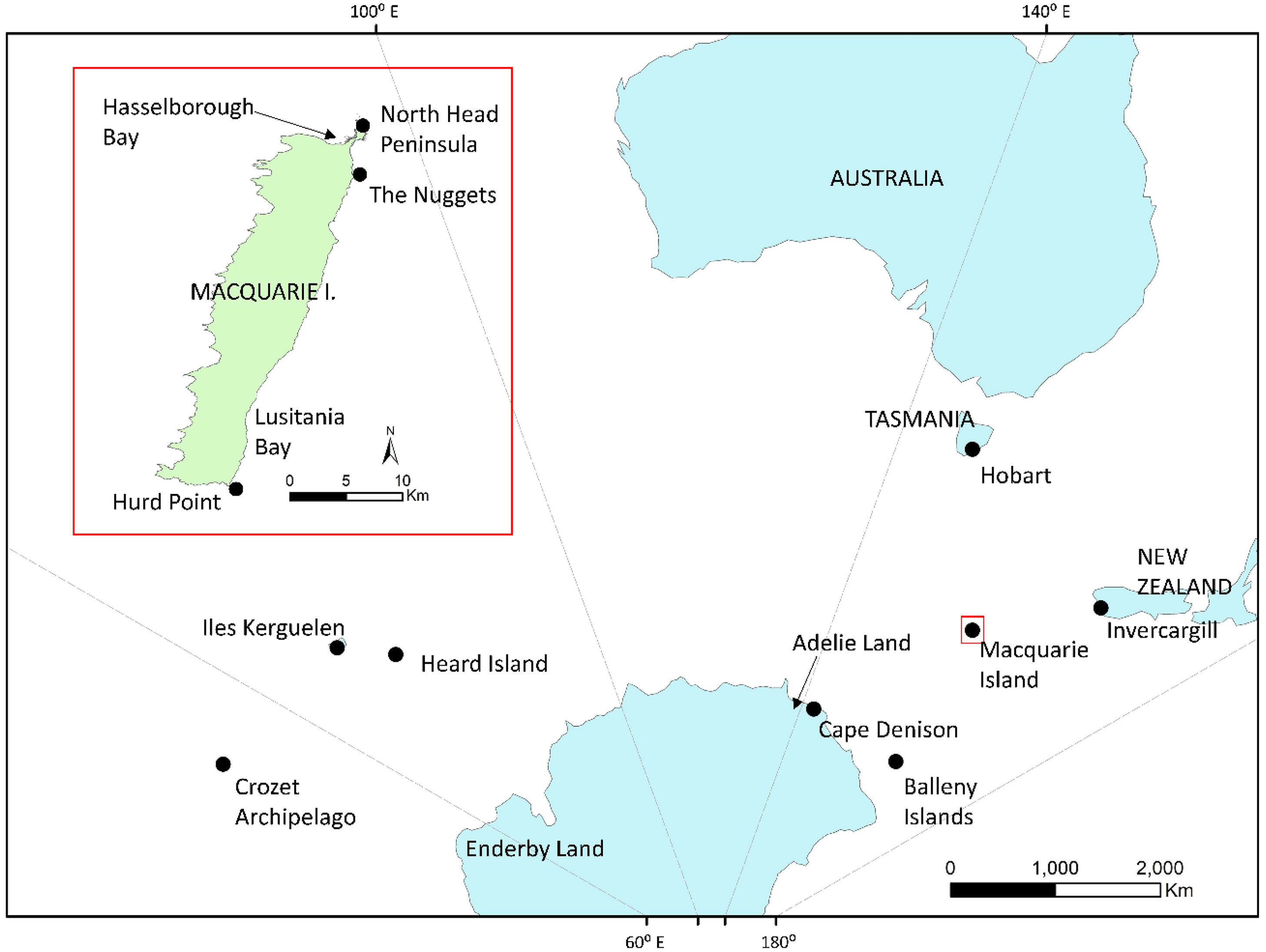
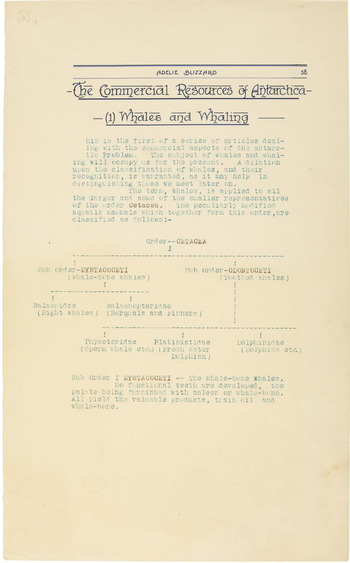
In 1913, Mawson was at Cape Denison, Commonwealth Bay, Antarctica (Figs. 1 and 2), on the AAE with six other expeditioners before returning to Australia on the expedition vessel Aurora in early 1914. During 1913, they produced the Adelie Blizzard, one of the first magazines written in Antarctica. Mawson contributed articles in four of its issues about Antarctic natural resources and their possible utilisation with the overall title ‘The commercial resources of Antarctica’ (Mawson, Reference Mawson and McLean1913; Fig. 3). Although articles in the Adelie Blizzard are anonymous, those on Antarctic resources have been attributed to Mawson by Leane and Pharaoh (Reference Leane, Pharaoh and McLean2010), which is supported by a letter from Mawson to Dr A. McLean (editor of the Adelie Blizzard; Mawson Archives, file 178AAE, dated 16 September 1916). Each of the five issues of the Adelie Blizzard is prefaced with ‘Volume 1’. Since there was no second volume, we have omitted ‘Volume 1’ when referring to the articles.
An Adelie penguin on the motor launch at Cape Denison, Commonwealth Bay, December 1913. Left to right: Gillies (behind), Hodgeman, Mawson. Note the cine-camera. (AAE photo: F. Hurley, H599).

Map of the Southern Ocean showing Cape Denison and Macquarie Island, sites occupied by the Australasian Antarctic Expedition 1911–1914, and other places referred to in the text.

The first page of Mawson’s contributions to the Adelie Blizzard about commercial resources.

Some of Mawson’s ideas expressed in the Adelie Blizzard articles and in diaries that he kept on his Antarctic expeditions (Jacka & Jacka, Reference Jacka and Jacka1988) are referred to below. After his return to Australia, some were developed further in articles and presentations to learned societies, and in the print media. Mawson was an enthusiastic conservationist, as demonstrated for instance by his push to have Macquarie Island declared a sanctuary. On the other hand, he promoted Australia’s interests in whaling in the 1920s and 1930s and endeavoured to develop business interests based on harvesting penguins and seals. In this article, we show that Mawson’s attitude to harvesting marine mammals appears to have been ambivalent and almost contradictory. We refer to and comment on ideas that Mawson presented in the Adelie Blizzard and in later articles on the use of natural resources in the Antarctic and sub-Antarctic. Some of these ideas have also been discussed by Ayers (Reference Ayres1999), Hains (Reference Hains2002), Hince (Reference Hince2005) and Swan (Reference Swan1961).
Whales and whaling
In number 2 of the Adelie Blizzard in an article entitled whales and whaling, Mawson (Reference Mawson and McLean1913) began with an overview of the classification of cetaceans and he noted species that occur in southern waters. He outlined the products that could be obtained from whales and thought that to develop a pelagic whaling industry would be difficult, despite its potential. His prediction that whaling would occur in the Ross Sea was soon correct.
In issue number 4 of the Adelie Blizzard, Mawson (Reference Mawson and McLean1913) described methods used to extract oil from blubber of penguins, whales and seals. He referred to trying out in large iron vessels (i.e., trypots) which, in his view, ‘tends to impair the value of the oil, and is much dirtier than’ the more modern method of using pressurised boilers that were steam-fired and hence produced a superior product (Mawson Reference Mawson and McLean1913, p. 158).
Mawson’s interest in the possibility of Australia becoming involved in pelagic whaling might have been enhanced during the first AAE voyage on Aurora in the 1911–12 summer when whales were seen along the Antarctic coast. One of the favoured species for whaling then was the southern right whale Eubalaena australis. Mawson claimed to have seen right whales close to Antarctica early in 1912, but biologist John Hunter disagreed on the identification (Hunter, Reference Hunter2011, diary entry for 30 September 1912). Mawson arranged for a whaling captain (James Davis) to accompany the relief voyage of Aurora in the 1912–13 summer to provide ‘more authoritative information concerning the whales of the Antarctic seas’ (Mawson, Reference Mawson1940, p. 153). James Davis saw whales on that voyage, but not right whales (James Davis, in Shaughnessy, Reference Shaughnessy2000).
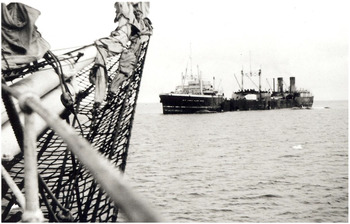
Mawson’s ideas on pelagic whaling were probably reinforced by his visits to Antarctic pelagic whaling factory ships during the voyages of the British, Australian and New Zealand Antarctic Research Expedition (BANZARE) in the summers of 1929–30 and 1930–31, when their ship (Discovery) took on coal from whale factory ships, including Sir James Clark Ross (Fig. 4) (Grenfell Price, Reference Grenfell Price1963; Jacka & Jacka, Reference Jacka and Jacka1988). Further reinforcement was likely aided by the sight of many whaling ships (chasers and factory ships) during the BANZARE voyages, particularly on 8 February 1931 off the coast of Princess Elizabeth Land (Ayres, Reference Ayres1999; Jacka & Jacka, Reference Jacka and Jacka1988). Mawson reported notable whaling grounds off Enderby Land and further west (Mawson, Reference Mawson1930). Later, in an address to a meeting of the AAAS in July 1935, he provided statistics from the 1929 whaling season, wrote about the recent development of floating factory ships with their stern ramp for hauling whales aboard for processing in a steam digester plant below decks, and their oil tanks for storage (Mawson, Reference Mawson1935). In addition, he was a consultant and adviser to the Australian Whaling Company in the 1930s (Brisbane Courier (Brisbane, Queensland), 13 December 1932, p. 10).
Discovery approaching the whale factory ship Sir James Clark Ross to take on coal during the second BANZARE voyage, December 1930. (BANZARE photo: T. Harvey Johnston, 660).

In 1949, Mawson was still enthusiastic about pelagic whaling when he was supporting the new director of the Australian Antarctic Division, Phillip Law in convincing the Australian government to establish Australia’s Antarctic programme (Ayres, Reference Ayres1999). In an obituary for Phillip Law, Quilty and Lugg (Reference Quilty and Lugg2013, p. 140) stated that Mawson ‘believed that the [Australian Antarctic] Division should become financially self-sustaining by cooperating with an industry such as whaling.’ Law managed to avoid that encumbrance. In fact, Mawson was keen that Australia’s Antarctic programme should be doing more to pay its own way (Ayers, Reference Ayres1999; Griffiths Reference Griffiths2007), as had his own expeditions. Although Mawson was enthusiastic about the possibilities of commercial whaling, he realised that whales should not be exterminated and that strict regulations would be required (Mawson Reference Mawson1935).
Seals and sealing
Seals at Macquarie Island
In the Adelie Blizzard number 3, Mawson (Reference Mawson and McLean1913) discussed seals and sealing. He summarised the classification of pinnipeds and discussed products that could be obtained from them: furs, skins, blubber for oil, seal meat and fertiliser. He also wrote about hunting methods, both at sea and on land, and controls on sealing in the northern hemisphere. These were contrasted with the limited regulations on sealing in the southern hemisphere, notably on the sealing operations of Joseph Hatch of Invercargill, New Zealand at Macquarie Island which were directed at southern elephant seals Mirounga leonina under permit granted by the Tasmanian government. Mawson had seen Hatch’s operations in December 1911 when establishing AAE’s Macquarie Island radio relay station.
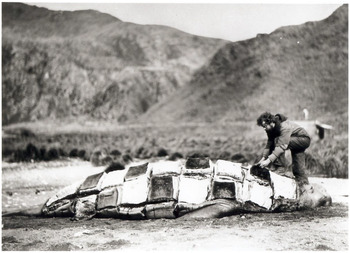
Mawson was opposed to Hatch’s elephant seal harvest, which was predominantly of adult males (Fig. 5). He believed the population at Macquarie Island was dwindling rapidly (Mawson, Reference Mawson and McLean1913). These sentiments were repeated in a lecture to the Royal Geographical Society of Australasia (South Australian Branch) when he stated (Mawson, Reference Mawson1919, p. 5) ‘that its extermination is now only a matter of a few years, unless adequate measures are adopted for its protection’ and again (Mawson, Reference Mawson1923, p. 42) that it ‘would be an easy matter, by … uncontrolled slaughter over a period of several years, to wipe out the Sea-elephant and penguin life of Macquarie Island’. In the most recent edition of the account of the AAE, Mawson repeated his belief that elephant seals at Macquarie Island had been hunted ‘even to the degree of extinction’ and that the island was ‘more favoured by [sealers] than probably any other known locality’ (Mawson, Reference Mawson1934, p. 20).
De-blubbering an adult male southern elephant seal at Macquarie Island. (AAE photo: H. Hamilton, H577).

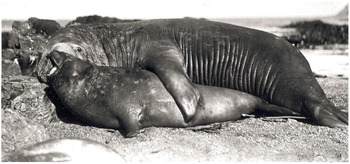
Nevertheless, Mawson realised that elephant seals were still prevalent on the stormy west coast of Macquarie Island where it was difficult for sealers to access animals (Mawson, Reference Mawson1923). Furthermore, he noted that their polygynous breeding habits contributed to their survival because adult males with their greater size than adult females were more attractive to the sealers (Fig. 6).
Southern elephant seals copulating at Macquarie Island, illustrating the size differences between the sexes. (AAE photo: H. Hamilton, H297).

The AAE party of five men stationed at Macquarie Island from December 1911 until December 1913 had no doubt that there were many elephant seals on the island. The leader, George Ainsworth stated that there ‘are thousands of them’ (Ainsworth Reference Ainsworth and Cumpston1914, p. 253). The AAE geologist Leslie Blake (in Cumpston, Reference Cumpston1968, p. 268) noted there were ‘very big rookeries of sea elephants’ on the west coast, and biologist Harold Hamilton was of the opinion that despite the sealing effort, ‘Macquarie Island will be the home of these seals for years to come’ (Hamilton, in Shaughnessy, Reference Shaughnessy2000, p. 8). In addition, Edgar Waite of Canterbury Museum, Christchurch, New Zealand, an AAE visitor to Macquarie Island in winter of 1912, indicated that elephant seals were abundant away from areas where Hatch’s men were operating (Waite, in Shaughnessy, Reference Shaughnessy2000). Similar sentiments on the status of elephant seals at Macquarie Island were expressed by J. K. Davis, master of the Aurora who stated that ‘the Sea-elephant is “not on the verge of extinction” ’ (Davis, Reference Davis1919, p. 67).
In summary, according to local commentators, Hatch’s operations were not leading to destruction of elephant seals, primarily because his sealers were limited by terrain and logistics, and because the harvest was directed at adult males. His oiling gangs were only able to work at colonies of seals (and penguins) that were accessible to beaches where landings could be made at the open roadsteads of Macquarie Island’s coastline. That limited his operations to The Nuggets and The Isthmus, both located on the east coast near the northern end of the island (Fig. 2). Hatch’s transport between Invercargill and Macquarie Island was by sailing ship and, according to accounts in Cumpston (Reference Cumpston1968), was unreliable.
The seal harvest ended in 1918 (see below), and the elephant seal population appeared to have recovered by December 1930 when Mawson’s BANZARE visited Macquarie Island. The Chief Scientist, T. Harvey Johnston noted that ‘sea elephants were very abundant’ and that there ‘was no evidence of there having been a slaughter for several years’ (Harvey Johnston in Shaughnessy, Reference Shaughnessy2000, p. 88).
The Macquarie Island operations of Joseph Hatch directed at elephant seals (and royal penguins) were severely limited by terrain and logistics. Because they were land-oriented operations, it would have been possible to limit their activities (e.g., by quotas, locations or seasons) and to inspect them for humaneness. At South Georgia, the last twelve years of elephant sealing (to 1964) were conducted successfully under such conditions after earlier uncontrolled harvesting caused a severe decrease in the seals’ population size (Bonner, Reference Bonner1982).
Pack ice seals
During the late 1920s, Mawson was lobbying for another Antarctic expedition, which became the BANZARE. That expedition, in the summers of 1929–30 and 1930–31, was ship-oriented, on Captain Scott’s former ship Discovery. In London, Mawson was in contact with R. G. Casey, who was then at the Australian High Commission. In association with senior officers of the Hudson’s Bay Company (HBC), Mawson developed ideas for exploiting seals in the Antarctic, south of Australia. This is apparent in correspondence from Casey to the Australian Prime Minister, S. M. Bruce (Casey, Reference Casey1980). Roles that Casey undertook for Mawson included lobbying the Australian government to fund the expedition and, by May 1929, arranging for the proposed expedition after Mawson’s departure from London (Casey, Reference Casey1980, letter 196).
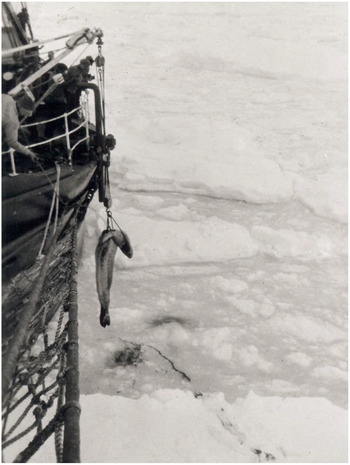
Regarding the possible harvest of Antarctic seals, Mawson noted that seals in the Antarctic were more abundant that those taken by the Canadians in the Arctic (mostly ringed seals Phoca hispida) and that the Antarctic seals were of greater size. Mawson (Reference Mawson1930, p. 554) commented that one of the Antarctic seals, the crabeater seal Lobodon carcinophaga was ‘everywhere distributed the pack ice’ (Fig. 7). Casey (Reference Casey1980, letter 186) noted that the HBC were developing a process to produce hair seal pelts with a value approaching those of the fur seal.
A dead crabeater seal being hauled aboard the Discovery from pack ice. (BANZARE photo: K. Oom, 1049).

Several things deserve comment here. First, sealers valued fur seals more highly than other seals (loosely referred to as hair seals) because the former has two layers of hair, an outer, coarse guard hair covering the fine, dense, soft layer which is usually referred to as fur. The fur layer was prized by furriers, but most fur seal species were commercially extinct by the 1920s. The seal species referred to above by Mawson are hair seals rather than fur seals. No evidence has been found to indicate that the HBC’s procedure for processing hair seal pelts eventuated. In Mawson’s letter to the HBC dated 19 October 1931, he concludes that their interest in ‘the matter has flagged’ because he had not heard from them since 29 August 1930 when the HBC governor noted that prices of all commodities had fallen (Mawson Archives, file 70BZE).
Second, the crabeater seals in the Antarctic to which Mawson was referring are one of the most abundant of all seal species. For example, over a longitudinal range of 86o in pack ice off east Antarctica, Southwell et al. (Reference Southwell, Bengtson, Bester, Blix, Bornemann, Boveng and Trathan2012) estimated their abundance at almost one million animals. Although the crabeater seal is so abundant, there are few records of large aggregations of them. For instance, on the BANZARE voyages, the largest group seen was estimated at 104 seals (Shaughnessy Reference Shaughnessy2000, Table 9). Similarly, Mawson (Reference Mawson1930, p. 554) noted that crabeater seals were ‘in no sort of concentration.’ Like the crabeater seal, ringed seal abundance is measured in millions (Lowry, Reference Lowry2016), but its body size is considerably smaller.
Finally, at least two twentieth century exploratory sealing expeditions have operated in the Antarctic pack ice. A Norwegian expedition near the South Orkney Islands during the spring of 1964 took 1,127 seals, most of which were crabeater seals (Øritsland, Reference Øritsland and Holdgate1970). During that expedition, counts of seals were made from helicopter surveys; the density reported was low, at 0.12 seals per square km (Øritsland, Reference Øritsland and Holdgate1970). A Russian sealing expedition that operated in the vicinity of the Ninnis and Mertz glaciers (near Cape Denison) and at the Balleny Islands in the 1986–87 summer took 4,802 seals, mostly crabeater seals (SCAR, 1989). Commercial sealing in the Antarctic did not follow from either venture.
On the first BANZARE voyage during November 1929 at Atlas Cove, Heard Island, Mawson recorded in his diary for the 29th that two small elephant seals were killed ‘for commercial skins’ and ‘a larger Leopard shot and commercial skin taken’ (Jacka & Jacka, Reference Jacka and Jacka1988, p. 266). In his account of the voyage, Fletcher (Reference Fletcher1984) also noted that two female southern elephant seals were shot at Heard Island in November 1929 and that they were skinned for the HBC to trial their process. More young elephant seals were killed at Lusitania Bay on Macquarie Island on 4 December 1930 during the second BANZARE voyage ‘for testing commercial value of skins’ (Jacka & Jacka, Reference Jacka and Jacka1988, p. 360). Because little commercial value had been found previously for elephant seal skins, Mawson must have had faith in the proposed process for hair seal pelts of the Hudson Bay Company.
Late on the first BANZARE voyage (on 18 January 1930) during a storm and after a discussion with Captain Davis about future movements of the ship, Mawson sent a note to Davis listing ‘the minimum programme yet to be undertaken’; item 5 stated ‘several seals required for … skins and oil for Hudson’s Bay Rept’ (Jacka & Jacka Reference Jacka and Jacka1988, pp. 320, 321). When they reached Iles Kerguelen in early February 1930 (to load coal), Mawson noted in his diary that ‘Blubber, collected in Antarctic, rendered down for Hudson’s Bay Co’ (Jacka & Jacka, Reference Jacka and Jacka1988, p. 330). It is not clear from Mawson’s diary of the first BANZARE voyage which species (of seal or penguin) this statement refers to.
Samples of oil were sent to the HBC in July 1930, along with jars containing liver and other internal organs preserved in ethanol for their potential value to be determined. Nothing appears to have come from this effort and, as noted above, Mawson concluded in a letter to HBC on 19 October 1931 that their interest in ‘the matter had flagged’ (Mawson Archives, file 70BZE). Mawson appears to have been let down by the HBC which had encouraged him to collect skins and oil but then lost interest in their commercial development.
Penguins
In the Adelie Blizzard number 4, Mawson (Reference Mawson and McLean1913) discussed birds and fish. He noted that oil from penguin blubber was a ‘well-known product on the market’. Penguins that congregate and breed in large numbers on sub-Antarctic islands had been the source of ‘profitable commercial operations … for quite a century past’. Properly regulated, he believed that such harvesting would have little impact on population size. Another product that he mentioned was penguin eggs for human consumption and he ensured that a large supply was gathered by expeditioners at Cape Denison by early 1913 for their use (Hunter, Reference Hunter2011). Further, Mawson noted the trade of penguin eggs from South Africa to Great Britain. The source of this statement has not been located: a thorough review of exploitation of eggs from wild birds, including penguins from South Africa, does not refer to such trade (Cott, Reference Cott1953).
Mawson (Reference Mawson1923) discussed harvesting of royal penguins Eudyptes schlegeli at Macquarie Island where 300,000 were killed annually and processed, while his AAE party were there in 1912 and 1913 (Fig. 8). His team was based at The Isthmus and had a lot of contact with Hatch’s oiling gang who were harvesting elephant seals at the northern end of the island and royal penguins from The Nuggets. Blubber from both species was converted to oil in steam-heated digesters, primarily on the beach at The Nuggets (Fig. 9). As noted above, Mawson predicted that it would be easy ‘to wipe out the … penguin life of Macquarie Island’ (Mawson, Reference Mawson1923, p. 42).
Royal penguins on the beach at The Nuggets, Macquarie Island, with the creek on the right that leads to large penguin rookeries, December 1930. The view overlooks the boiling-down works, possibly for Hurley to aim for an idyllic image. (AAE photo: F. Hurley, W181).

Remains of the boiling-down works at The Nuggets, Macquarie Island in December 1930, with a steam digester inside the building. (BANZARE photo: F. Hurley, WP226).

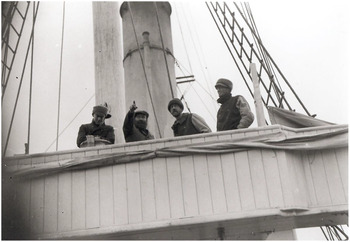
The AAE party based on The Isthmus referred to Hatch’s men as the ‘oilers’. The latter had experience working on Macquarie Island and provided considerable help to Mawson’s AAE party, right from the arrival of Aurora in December 1911 when the Headsman (Otto Bauer) guided Captain Davis into Hasselborough Bay (Fig. 10). Both Ainsworth (Reference Ainsworth and Cumpston1914) and Leslie Blake in his diaries (Dartnall, Reference Dartnall2014) described many examples of assistance provided by the oilers. A modern description of Joseph Hatch’s operations at Macquarie Island is provided by Chapple (Reference Chapple2005).
Otto Bauer (Joseph Hatch’s headsman at Macquarie Island) pointing out the best anchorage in Hasselborough Bay, Macquarie Island, to Captain J. K. Davis on the bridge of the Aurora in December 1911, with Mawson (on the right) looking on. (AAE photo: F. Hurley, H119).

In the Adelie Blizzard article, Mawson (Reference Mawson and McLean1913, p. 157) proposed that ‘the time to take [penguins] for oil is when they first come ashore to breed’. The downside of that timing would be that the breeding stock would be reduced immediately. According to Falla (Reference Falla1937), Hatch’s royal penguin harvesting season at Macquarie Island began in February and lasted for six weeks. The first part of the harvest consisted of ‘fats’ (the oilers’ term for one-year-old birds) when they were ashore to moult. It was followed by a harvest of adults when they also came ashore to moult; that followed breeding and then feeding at sea for several months and they were fat again. Timing of the penguin harvests was several months after the breeding season had finished in February. The harvest was confined to birds at The Nuggets ‘and thus affected less than half of the total breeding stock’ (Falla Reference Falla1937, p. 113).
In the view of Robert Falla, ornithologist on the BANZARE voyages who later was a noted New Zealand conservationist, Hatch’s penguin harvest at Macquarie Island was sustainable. He believed (Falla, Reference Falla1937, p. 111) that ‘Whether by accident or design there was thus evolved a system of killing [royal penguins] that inflicted minimum damage on the stock’. From the viewpoint of population dynamics, it is preferable to take young birds, thereby directing the harvest at the age-class with the highest natural mortality rate. One of the royal penguin age-classes harvested by Hatch on Macquarie Island (the ‘fats’) fitted that criterion, which minimized the impact on the species’ future population size.
During the AAE at Cape Denison, Mawson’s diary entry for 20 September 1912 recorded that he melted ‘blubber for samples of oil’ and calculated the value of ‘seal and penguin products’ that three men could produce in six weeks during summer and calculated its likely monetary value (Jacka & Jacka, Reference Jacka and Jacka1988, p. 113). In the following year at Cape Denison, his diary entries for 3 and 6 November 1913 recorded the weight of an Adelie penguin Pygoscelis adeliae at 16 pounds [7.3 kg] and determined the ‘total yield oil per penguin before egg laying taken as 1½ lb [0.68 kg] oil each’ (Jacka & Jacka, Reference Jacka and Jacka1988, p. 216). On 7 November 1913, he skinned ‘several penguins to see if [they are] of any commercial value’ (Jacka & Jacka, Reference Jacka and Jacka1988, p. 216). Samples of seal and penguin oil were sent to London to the Imperial Institute of the United Kingdom, the Colonies and India for analyses. Their detailed report was sent to Mawson dated 11 December 1917; it noted that ‘a market could be easily found for oils represented by these samples’ (Mawson Archives, file 168AAE). Another letter from the Imperial Institute (dated 12 January 1918) expressed pleasure with Mawson’s promise to include ‘the report in your Scientific Results.’ But, the data do not appear to have been included in any of the AAE scientific reports, and the topic is not mentioned in a discussion by Ayres (Reference Ayres1999) of Mawson’s problems with publication of reports. According to Cumpston (Reference Cumpston1968, p. 303), the Imperial Institute released a report on the quality and value of ‘the prepared oils from sea leopards, seals and penguins’. That did not impress The Illustrated London News of 23 February 1918, which highlighted the killing that would be involved to obtain the product.
Mawson’s suggestions in the Adelie Blizzard of harvesting penguins for oil, collecting skins and eggs for sale, as well as his interest in the potential of producing oil from Adelie penguins at Cape Denison are surprising considering his later enthusiasm and agitation for shutting down Hatch’s operations at Macquarie Island that involved harvesting royal penguins.
Other examples of Mawson aiming to use natural resources
Living resources
On the British Antarctic Expedition (BAE), Mawson and two companions relied on meat from Weddell seals when sledging along the coast of McMurdo Sound on the way to the South Magnetic Pole. He proposed that the several coastal sledging teams of the AAE would also rely on meat from Weddell seals, which was common practice among Antarctic expeditioners of that period.
Before the AAE, Mawson was liaising with Ernest Shackleton about their proposed joint Antarctic expedition that did not eventuate. In a letter to Shackleton (undated) about financing the proposed expedition, Mawson suggested collecting skins of seals with the aim of selling them to ‘museums to help defray expenses’. He predicted earning 2,000–3,000 pounds from this source (Mawson Archives, file 11AAE, on letterhead of the BAE 1907). In a sense, this happened after the BANZARE voyages when natural history specimens that had not already been distributed to museums went to the Australian Museum, Sydney in accord with an agreement with the government of New South Wales which funded publication of the expedition reports (Mawson Reference Mawson1937).
In January 1915, after his return to Australia from the AAE, Mawson corresponded with an animal skin and trophy dealer in London, Rowland Ward. Mawson sent him a list of seal and bird skins, and bird eggs that he could provide for sale. Rowland Ward expressed interest in skins and eggs of several bird species, with an agreed commission of 10% on sales (Mawson Archives, file 168AAE). Because there is no further correspondence on the file, it is likely that this potential business deal did not progress further. Nor was it revived for the BANZARE voyages when it could have been quite lucrative and helped to defray expedition expenses. In the context of Mawson’s attempts to arrange business deals based on the utilisation of Antarctic living resources, it is interesting to note that in 1911, Mawson stated that he ‘had to buy the Aurora without even having the money to purchase her’ (Jacka & Jacka Reference Jacka and Jacka1988, p. 56) and to recall the thoughts of Captain J. K. Davis soon after the AAE: ‘recent expeditions have had to beg for funds’ (Davis Reference Davis1919, p. 67). Mawson was paying off debts of his expeditions for many years.
Non-living resources
In Adelie Blizzard number 5, Mawson’s article on resource use entitled ‘General’ included some interesting proposals. The first one was directed at minerals, which he noted would have to be of valuable substances from rich deposits to be commercially viable. During Shackleton’s BAE, Mawson noted mineral outcrops on several occasions along the western coast of McMurdo Sound between Cape Bernacchi and Depot Island on the trek towards the South Magnetic Pole. Examples are on 18 and 21 December 1908, and the minerals included monazite, which contains rare earths and thorium, and the possibility of ‘greenish mineral like vanadium or uranium mineral’ (Jacka & Jacka, Reference Jacka and Jacka1988, p. 30). On the AAE, Mawson took an electroscope to locate electric charges (Jacka & Jacka, Reference Jacka and Jacka1988) and it is likely that it was also used to try to identify radioactive minerals.
The most abundant and purest mineral available was ice, which he suggested might become a saleable item for water in large cities (Mawson, Reference Mawson and McLean1913). He noted that winter ice from Scandinavian lakes had been shipped to the London market, and from North America to Calcutta (Mawson Reference Mawson1935). Ice was also shipped to Melbourne from lakes in North America in the late 19th century (Blainey, Reference Blainey1968). The idea of towing icebergs north for a fresh water supply was considered seriously later in the twentieth century (e.g., Schwerdtfeger, Reference Schwerdtfeger1997; Weeks & Campbell, Reference Weeks and Campbell1973) but did not eventuate. Nevertheless, Mawson was ahead of his time with that idea.
Another proposal was to use wind power at Antarctic stations (Mawson, Reference Mawson and McLean1913), which he repeated in his address to a meeting of the AAAS, with the additional idea of producing ‘atmospheric-nitrogen products’ (Mawson, Reference Mawson1935, p. 36). The Australian Antarctic Division began using wind power in the 2002–03 summer with a wind generator installed at Mawson station (Paterson, Reference Paterson2003). Wind also provides power on Ross Island for the New Zealand and US stations Scott Base and McMurdo (Anon., n. d.).
A far-sighted prediction in the Adelie Blizzard concerned sightseeing in the Antarctic, which Mawson repeated in his address to a meeting of the AAAS in 1935, although he realised then that shipping would need to be developed for it to become a reality (Mawson, Reference Mawson1935+). Mawson was prescient in this prediction, in that ship-borne tourism to Antarctica and the sub-Antarctic has become popular (Headland, Reference Headland1994; Stonehouse, Reference Stonehouse2000).
Less perspicacious was the suggestion to farm Arctic foxes Alopex lagopus on sub-Antarctic islands (Mawson, Reference Mawson and McLean1913), making use of the ready availability of seal and penguin meat. This idea was repeated (Mawson, 1919, p. 14; Reference Mawson1935, p. 36) with the caveat that at Macquarie Island, foxes be restricted to ‘the north-end headland’ with an effective barrier across The Isthmus, presumably to protect fauna on most of the island from any escapees. But, the idea was rescinded later (Mawson, Reference Mawson1943). The idea of farming foxes for their fur was short-sighted because, ultimately, some of them would have escaped; on Macquarie Island, fox escapees could have decimated populations of burrowing petrels, and surface nesting albatrosses, giant petrels and penguins. Mawson seemed oblivious to the havoc that terrestrial predators could cause.
At Macquarie Island on the second BANZARE voyage, Mawson collected soil samples at The Nuggets and at ‘north end spit’ (presumably The Isthmus) for examination at University of Adelaide. His diary entry for 2 December 1930 noted that there ‘May be useful amount of phosphate, nitrate in them for fertilizer’ (Jacka & Jacka, Reference Jacka and Jacka1988, p. 358).
Mawson expressed interesting ideas on the potential use of non-living resources from the Antarctic. Two of them have come to fruition, Antarctic tourism and wind power, and a third, towing icebergs to water-deprived cities, may yet prove viable.
Macquarie Island as a sanctuary
In 1915 while in London, Mawson was campaigning to have Macquarie Island declared a sanctuary and interested the Governor-General of Australia in the matter (Cumpston, Reference Cumpston1968). At the end of World War I while still in London, Mawson resumed lobbying for a sanctuary at Macquarie Island and produced a pertinent article in the Lady Galway Belgium Book (Mawson, Reference Mawson1916). He wrote to the Governor-General in December 1918 on the topic (Cumpston, Reference Cumpston1968) and was joined by the eminent biologist Baldwin Spencer of Melbourne as well as the Zoological Society of London. They urged the cessation of penguin killing at the island and its transfer to the Australian government (from the Tasmania government) in the belief that it would enhance protection for the island’s wildlife. The call was even taken up in England in 1919 by Arthur Mee’s weekly Children’s Newspaper (Hince Reference Hince2005).
In August 1919, Frank Hurley (cinema-photographer and photographer with the AAE) added his voice to the effort against Joseph Hatch’s penguin harvesting methods, stating in The Sydney Morning Herald that penguins were driven up to the top of the boiler, knocked on the head and kicked in (Cumpston, Reference Cumpston1968). No credence for that method of killing royal penguins was given in descriptions of the harvest by several AAE observers, including Edgar Waite (in Falla, Reference Falla1937) and Ainsworth (Reference Ainsworth and Cumpston1914). Nor did Hatch’s men believe that penguins were driven up a ramp to the boiler, according to statements made many years later by several of them, including one who simply stated that a penguin cannot be driven ‘as he will stand up and argue’ (Cumpston, Reference Cumpston1968, p. 301). The idea that penguins were driven up a ramp to the top of the digester possibly emanated from the description in the Adelie Blizzard (Mawson, Reference Mawson and McLean1913, p. 158) of the methods of killing penguins commercially ‘at Iles Kerguelen, amongst other places’ by driving live birds up an inclined plank to the top of the digester, where they were pushed in alive by the pressure of birds behind them. The source of Mawson’s description has not been located.
Hurley’s message in The Sydney Morning Herald was followed by a question in the Federal House of Representatives to the relevant Minister. This was forwarded to the Premier of Tasmania, who refuted the suggestion that such cruelties occurred at Macquarie Island (Cumpston, Reference Cumpston1968).
As noted above, Mawson was also opposed to Hatch’s sealing operations. In November 1929, Mawson and his party saw, photographed and filmed South African sealers operating at Possession Island, Crozet Archipelago during the first BANZARE voyage and they were appalled at the wanton slaughter (Grenfell Price, Reference Grenfell Price1963). A description of the ‘pile of rotting caracases’ on beaches of Macquarie Island at the end of a sealing season has been imagined by Hince (Reference Hince2005, p. 162), and McEwin (Reference McEwin2008, p. 49) noted that Mawson was ‘disgusted by the continuing destruction’ [of elephant seals] at Macquarie Island in December 1911.
Mawson continued lobbying for a sanctuary at Macquarie Island in a lecture to the Royal Geographical Society of Australasia (South Australian Branch) in September 1919 (Mawson Reference Mawson1919) which he repeated with some variations (Mawson, Reference Mawson1923; Mawson, Reference Mawson1943). His lobbying involved several lines of evidence, one of which attributed the reduction in numbers of king penguins Aptenodytes forsteri at Macquarie Island to Hatch’s men (Mawson, Reference Mawson1923). Hatch’s gangs harvested king penguins at Lusitania Bay for oil for several years from 1889 (Cumpston, Reference Cumpston1968). Later, their eggs were taken for food, which would have had a detrimental effect on the population, especially because of its reduced size after the harvest.
Mawson considered three possibilities for the future of Macquarie Island. These were stated several times, with minor variations (Mawson, Reference Mawson1916; Mawson, Reference Mawson1919; Mawson, Reference Mawson1923; Mawson, Reference Mawson1943): (i) an unrestricted lease for harvesting the island’s fauna; (ii) a limited lease with conditions to slaughter elephant seals and royal penguins, as well as raising domestic animals, such as cattle, sheep, reindeer and possibly fur-bearing mammals and (iii) the withdrawal of Hatch’s lease and proclamation of the island as a reserve. He preferred the last but realised that it would require supervision, particularly because Hatch’s boiling-down plants remained on the island after his permit was not renewed in 1919. Consequently, Mawson proposed that a small government party be based on the island, which could provide meteorological observations by radio to Australia and New Zealand. He further proposed that the activity could be self-supporting financially by limited harvesting of surplus bull elephant seals and royal penguins, and collecting penguin eggs for human consumption (Mawson Reference Mawson1943).
Lobbying by Mawson and Hurley contributed to the end of Hatch’s operations; a final lease was granted to him to harvest elephant seals and royal penguins at Macquarie Island from 1915 to 1918, and then an extension for one year to enable equipment to be removed from the island (Mawson, Reference Mawson1923, p. 48). Hatch’s last load of oil was shipped from Macquarie Island on 1 April 1919, and the Southern Isles Exploitation Company through which he was operating went into liquidation in May 1919 (Cumpston, Reference Cumpston1968). The boiling-down plants were left in place.
Thus, Mawson was successful in stopping Hatch’s harvesting operations, and Macquarie Island was later (May 1933) declared a sanctuary for wildlife (Ayres, Reference Ayres1999; Selkirk, Seppelt, & Selkirk, Reference Selkirk, Seppelt and Selkirk1990). An indication of Mawson’s contradictory attitude to conservation is apparent here: his lobbying for Macquarie Island to be set aside as a sanctuary involved placing a supervisory party there funded by limited harvesting of the local wildlife.
Conclusions
A recurring theme in this article is Mawson’s efforts to explore all possible commercial opportunities to raise funds for his expeditions or to pay off debts resulting from them because funds from governments and benefactors were insufficient. Examples are selling seal skins to help defray expenses (in a letter to Shackleton before the AAE) and production of oil samples from penguins for the Hudson Bay Company to investigate their commercial potential. A similar example is the proposal to market oil from blubber of bull elephant seals at Macquarie Island to pay for the running of a meteorological station there. In addition, Leane and Pharaoh (Reference Leane, Pharaoh and McLean2010, p. xviii) noted that Mawson and McLean signed an agreement about publication of the Adelie Blizzard which stipulated that ‘any monies raised by sales would go to pay the salaries of Mawson’s six companions in Reference Mawson and McLean1913’.
Clearly, Mawson’s attitude to conservation of populations of wild animals did not exclude harvesting them for the resources available, which was not unusual during his time. But, his enthusiasm for having Macquarie Island declared a sanctuary and closing down the oiling operations of Joseph Hatch seems contrary to that view. Perhaps, it was the image of clubbing masses of royal penguins and the sight of many elephant seal carcasses littering the beaches that caused Mawson distress and inspired him to act to have Macquarie Island declared a sanctuary.
Mawson’s views for conservation of Antarctic wildlife were contrasted with his schemes for the use of living resources by Hains (Reference Hains2002, p. 48), who argued that his conservation views were “characterised by a ‘wise use’ philosophy”. Further, she noted that Mawson ‘was disturbed by the wholesale slaughter of seals and penguins on Macquarie Island’ and that Mawson’s proposals for Antarctic enterprises would involve ‘efficient, scientifically planned exploitation [which] would replace the shortsighted ravaging of wildlife populations by ignorant contractors’ (Hains, Reference Hains2002, p. 49). If Mawson had been able to implement his schemes of utilising wildlife of Macquarie Island and the pack ice on a profitable basis, they also would have involved some slaughter. We also note that the harvesting of elephant seals and royal penguins on Macquarie Island by Joseph Hatch’s oiling gangs was sustainable in the long-term, although it was not scientifically planned.
Mawson’s attitude to harvesting marine mammals and penguins appears to have been ambivalent and almost contradictory. In an address to the Assembly of the Congregational Union of Australia and New Zealand, he stated that ‘it would be the height of folly for man to allow the whale to become exterminated’ and that young whales should be preserved (The Chronicle (Adelaide, South Australia), 29 May 1930, p. 58). Similarly, Mawson lobbied successfully for the cessation of killing elephant seals and royal penguins at Macquarie Island (Mawson, Reference Mawson1923).
On the other hand, Mawson’s attitude to utilisation of living natural resources in the Antarctic was summarised in an article in a South Australian newspaper in 1925 in the context of the claim by France of Terre Adelie: ‘As regards its economical future, it may be very great … there is a great wealth of life in the seas – whales, seals and penguins are found in great numbers’ (The Register (Adelaide, South Australia), 13 February 1925, p. 9). He advocated that Australia be involved in pelagic whaling, with strict regulations (Jacka & Jacka, Reference Jacka and Jacka1988; Mawson, Reference Mawson1935), and attempts were made to establish such an industry from early 1929 (Grenfell Price, Reference Grenfell Price1963). But, the history of pelagic whaling shows that it was subject to overexploitation and was difficult to control (e.g., Gambell, Reference Gambell, Twiss and Reeves1999; Yablokov, Reference Yablokov1994). Here, it is important to note, as McEwin (Reference McEwin2018) did in her review of Mawson’s life, that he and his contemporaries believed ‘that science underpinned successful natural resource exploitation’ and that this was ‘entirely consistent with the prevailing ethos in Australian science and more general trends in attitudes to natural resource management’ (McEwin Reference McEwin2018, pp. 139–140). Furthermore, Mawson’s attitudes should be placed in their historical context: in the early twentieth century, utilisation of living natural resources was viewed much more favourably than in modern times. A contemporary example is the interest in potential Australian economic products, such as from pine trees (Baker & Smith Reference Baker and Smith1910).
In view of Mawson’s enthusiasm for harvesting living natural resources as outlined above, one can only wonder what he would have thought about harvesting seals and penguin eggs at Macquarie Island if the industry had been more lucrative and if a harbour was available to make shipping safe.
In their preface to a reprint of ‘The Home of the Blizzard’, Anderson and Brown (Reference Anderson and Brown1996) consider that Mawson should be recognised as ‘an early proponent of conservation’. Support for that view comes from several of his activities: in 1919, he was a foundation member of the South Australian branch of the Australian Forest League, a community-based native tree preservation association (The Register (Adelaide, South Australia), 10 June 1920, p.6.); he was a member of the board of the Belair National Park in the Adelaide Hills, South Australia from 1924 (Cordes, Reference Cordes1983); and when involved in promoting the New Zealand Sounds hydroelectric scheme in 1928, he hoped the proposed development would not spoil the beauty of the natural environment (Ayers, Reference Ayres1999). Although we consider Mawson’s views on conservation of living natural resources to have been complicated and inconsistent in many ways, his efforts in successfully promoting Macquarie Island as a sanctuary should be recognised as among the most important of his many negotiations on utilisation of Antarctic and sub-Antarctic natural resources.
Acknowledgements
We thank Dr Jim Jago, University of South Australia, Dr Emma McEwin, University of Adelaide and two anonymous reviewers for their helpful comments on the manuscript.
Financial support
Research for this commentary received no specific grant from any funding agency, commercial or not-for-profit sectors.
Conflicts of interest
None.