Introduction
Contraceptive use and unmet need for contraception have bearings on unintended pregnancies, which are the leading cause of maternal death as they can result in complicated pregnancies or clandestine and unsafe abortions (Moronkola et al., Reference Moronkola, Ojediran and Amosu2006; Bankole et al., Reference Bankole, Keogh, Akinyemi, Dzekedzeke, Awolude and Adewole2014). Unintended pregnancies can also result in inadequate birth spacing, which increases the risk of pregnancy complications and maternal mortality (Adongo et al., Reference Adongo, Tabong, Azongo, Phillips, Sheff, Stone and Tapsoba2014). Maternal mortality is one of the greatest health disparities worldwide, as nearly 99% of maternal deaths occur in low- and middle-income countries (WHO, 2014). Despite global efforts to reduce maternal mortality, reductions in sub-Saharan Africa have been less prevalent. In sub-Saharan Africa, the lifetime risk of maternal death is 1 in 38, compared with a global average of 1 in 190 women. Furthermore, the Maternal Mortality Ratio (MMR) for the region is estimated to be 510 maternal deaths per 100,000 live births, which is more than twice the global average of 210 deaths per 100,000 live births (WHO, 2014). Due to the low prevalence of contraceptive use, rates of unintended pregnancies are high, and as many as 50% result in elective abortions (Abiodun & Balogun, Reference Abiodun and Balogun2008). Abortions in sub-Saharan African are often performed under unsafe and secretive conditions, with approximately 25% resulting in serious complications which account for 20–40% of maternal deaths (WHO, 2004; Bankole & Oye-Adeniran, Reference Bankole and Oye-Adeniran2006). Family planning methods, including contraceptives, can protect women from unintended pregnancies, thus reducing the number of unsafe pregnancies and abortions that may result. In fact, if high-risk pregnancies were eliminated from sub-Saharan Africa, maternal mortality rates could fall by 25% (Moronkola et al., Reference Moronkola, Ojediran and Amosu2006).
In Ghana, the risk of unintended pregnancy is still estimated to be quite high, at 0.7 per woman (Johnson & Madise, Reference Johnson and Madise2011; Omane-Adjepong et al., Reference Omane-Adjepong, Oduro and Annin2012). Furthermore, 35% of women report an unmet need for contraception (UNICEF, 2010). High rates of unintended pregnancy and unmet need for contraception are indicative of poor access to reproductive health care, inadequate reproductive health rights and low empowerment of women (Ghana Statistical Services [GSS], 2009; Johnson & Madise, Reference Johnson and Madise2011; Omane-Adjepong et al., Reference Omane-Adjepong, Oduro and Annin2012; Eliason et al., Reference Eliason, Baiden, Yankey and Awusabo-Asare2014).
Women’s health outcomes are often related to the infrastructures of communities and government, and initiatives to promote safe motherhood and reproductive justice for women (Fathalla, Reference Fathalla2006; Khan et al., Reference Khan, Wojdyla, Say, Gulmezoglu and Van Look2006). Moreover, women’s health and access to reproductive resources, such as contraception, are a reflection of women’s place in society and their ability to access social and health services, while also reflecting disparities in economic development (WHO, 2010; Eliason et al., Reference Eliason, Baiden, Yankey and Awusabo-Asare2014; Fawole & Adeoye, Reference Fawole and Adeoye2015). Women’s place in society is usually measured by indicators of status and empowerment (Kabeer, Reference Kabeer1999; Malhotra et al., Reference Malhotra, Shuler and Boender2002). Women’s status is typically defined as a woman’s position in society (Safilios-Rothschild, Reference Safilios-Rothschild1982), which includes their educational, cultural, economic, legal and political position (Thaddeus & Maine, Reference Thaddeus and Maine1994; Na et al., Reference Na, Jennings, Talegawkar and Ahmed2015). Women’s empowerment refers to the process by which women who have been denied agency in making strategic life choices acquire such ability (Kabeer et al., Reference Kabeer, McFadden, Arnfried, Dominguez and Saaadallah2001), and involves the ability to influence decision-making in many life aspects, including economic, socio-cultural, familial and interpersonal dimensions (Malhotra et al., Reference Malhotra, Shuler and Boender2002; Lee-Rife, Reference Lee-Rife2010). It is reflected by proxy measures such as: women’s participation in household decisions, control over household resources, perceptions of gender norms and perceived equality in relationships (Safilios-Rothschild, Reference Safilios-Rothschild1982; Malhotra et al., Reference Malhotra, Shuler and Boender2002; Upadhyay et al., Reference Upadhyay, Gipson, Withers, Lewis, Ciaraldi and Fraser2014).
Economically empowered women are more involved in income-generating activities and in control over finances, particularly related to health care (Kabeer, Reference Kabeer1999; Quisumbing & Maluccio, Reference Quisumbing and Maluccio2003). Socio-cultural and familial empowerment is characterized by women’s freedom of mobility and decision-making regarding interpersonal and/or family affairs. This increases women’s ability to acquire money, essential items (e.g. food, clothing), and support from family and friends (Na et al., Reference Na, Jennings, Talegawkar and Ahmed2015). Women with lower socio-familial empowerment are at higher risk of being unhealthy (Grown et al., Reference Grown, Gupta and Pande2005) as a result of limited access to reproductive health services (Bloom et al., Reference Bloom, Wypij and Gupta2001; Furuta & Salway, Reference Furuta and Salway2006 Ahmed et al., Reference Ahmed, Creange, Gillespie and Tsui2010). These, and other, indicators, such as childhood beating and early marriage, reflect broader gender norms regarding girls and women in society (Kishor & Subaiya, Reference Kishor and Subaiya2008; Hindin, Reference Hindin2012; Pandey et al., Reference Pandey, Lama and Lee2012).
In attempts to address the disparities in women’s health, most research has focused on clinical issues, while less has focused on social determinants of health, such as women’s empowerment and status in her home or society (Sorbye et al., Reference Sorbye, Vangen, Oneka, Sundby and Bergsjo2011; van de Akker et al., Reference van de Akker, van Rhenen, Mwagomba, Lommerse, Vinkhumbo and van Roosmalen2011; Okereke et al., Reference Okereke, Ahonsi, Tukur, Ishanku and Oginni2012). Studies that have investigated this have found that in sub-Saharan Africa, women’s education and income are associated with increased contraceptive use (Tekelab et al., Reference Tekelab, Melka and Wirtu2015), as well as discussions with health care providers regarding reproductive health services (Melka et al., Reference Melka, Tekelab and Wirtu2015). Another study in India found women’s autonomy, decision-making and literacy were positively associated with contraception use (León, Reference León2013). Furthermore, an analysis in Pakistan showed that older women with greater education, literacy, autonomy and decision-making abilities in relationships were more likely to report use of contraceptives within couples, particularly female-only methods (Hameed et al., Reference Hameed, Azmat, Ali, Sheikh, Abbas, Temmerman and Avan2014). However, few, if any, studies have utilized multi-dimensional indicators of women’s empowerment in Ghana. Although Crissman et al. (Reference Crissman, Adanu and Harlow2012) examined the association between sexual empowerment and contraceptive use in Ghana, they did not examine women’s empowerment in terms of household position and social status. Another cross-country study using data from the 2008 Demographic and Health Survey (DHS) found associations between women’s empowerment and contraceptive use in Ghana, Namibia, Uganda and Zambia, but this primarily examined economic empowerment and did not investigate other indicators of women’s status (Do & Kurimoto, Reference Do and Kurimoto2012). The most recent wave of the Ghana DHS provides a unique opportunity to do this, and gives a more recent picture of the relationship between women’s empowerment, household status and contraception use; thus the purpose of this study was to examine the influence of women’s empowerment and household status on current contraceptive use and unmet need for contraceptives.
Methods
Study design and sample
The study was a secondary analysis of 2014 Ghana Demographic and Health Survey (GDHS) data. The DHS programme employs a national cross-sectional survey design. The sampling frame used was updated from the 2010 Ghana Population and Housing Census provided by the Ghana Statistical Service, consisting of ten administrative regions. A two-stage sampling design was intended to allow estimates at the national level and for urban and rural regions for each of the administrative regions. The first stage consisted of sampling selected clusters. A total of 427 clusters were selected: 216 in urban areas and 211 in rural areas. The second stage consisted of systematically sampling households. Households were randomly selected from a household listing operation (GSS, 2009). Weighting factors were added for each region so that the results were proportionate at the national level. The study population consisted of 1828 women aged 15–49, who were either permanent residents of the selected households or visitors staying in the household the night before the survey.
Study variables
Respondents were asked whether they were currently using contraception, and if they had an unmet need for contraception. These were the primary outcomes variables. Women reported all methods of contraception that they were currently using. This was then dichotomized as either using contraception (yes=1) or not using contraception (no=0). Women reported their unmet need for contraception coded as yes=1 and no=0. Women who wanted to prevent a pregnancy but did not have access to contraception were said to have an unmet need.
Participation in decision-making
The survey asked women whether they were involved in decision-making in five different areas: on health care, major household purchases, daily household purchases, spending respondent’s earnings and visiting relatives (GSS 2009). Decisions on daily household purchases are indicative of women’s influence over routine household activities, while decisions on large household purchases are indicative of decision-making with a partner. Furthermore, visits to relatives suggest influence over women’s social life. Finally, women’s participation in health care decisions is the most likely indicator of women’s health care decision-making (Fawole & Adeoye, Reference Fawole and Adeoye2015). Women reported their involvement in each decision as ‘yes’ or ‘no,’ and a composite index was created with higher scores indicative of involvement in more decisions (GSS 2009). For this scale, the minimum score possible was ‘0’ and the maximum ‘5’.
Attitudes towards wife beating
The 2014 GDHS collected information on the degree of acceptance of wife beating by asking whether a husband is justified beating his wife in each of the following scenarios: if she burns food, if she withholds information from him, if she neglects the children, if she argues with him, and if he refuses to have sex with him. A higher score indicates acceptance of wife beating in more scenarios, and thus less empowerment. For this scale, the minimum score possible was ‘0’ and the maximum ‘5’.
Women’s household status
The following were used as indicators of women’s status: working in the past 12 months, land ownership, power over earnings and relationship to household head. These variables were chosen based on associations seen with other women’s health outcomes in other studies (Fawole & Adeoye, Reference Fawole and Adeoye2015; Shimamato & Gipson, Reference Shimamato and Gipson2015). Women indicated the sex of the household head and their relationship to him/her. This was coded as either ‘spouse’ or ‘other’. Women were asked whether they were currently working or had worked in the past 12 months; this was coded as yes=1 (worked in the last 12 months) or no=0 (has not worked in the last 12 months). Women reported who primarily made decisions regarding their earnings: either solely her partner, a joint decision between the respondent and partner, or solely the respondent. Finally, women indicated whether they owned land or not. This was coded as no=0, joint ownership with male partner=1, or respondent is the sole owner=2.
Sociodemographic characteristics
Social and demographic information included in the analysis were women’s age, place of residence (urban or rural) and highest year of education attained. Indicators of socioeconomic circumstances included a computed wealth and literacy index used by the GDHS, with higher scores indicating greater wealth and literacy, respectively (GSS 2009). In the regression analyses, highest years of education was run as a continuous variable. The wealth index was split into the following three categories: poor, middle class, rich/upper class. The literacy index was split into the following three categories: illiterate, can read parts of sentences, can read full sentences.
Statistical analysis
Two different regression models were computed, one with contraceptive use as the dependent variable, the other with unmet need as the response variable. Binary logistic regressions were employed to test associations between women’s empowerment, household status and sociodemographic variables with use of contraceptives and unmet need for contraception. Sample weights were computed to account for the complex sampling scheme of the GDHS.
Results
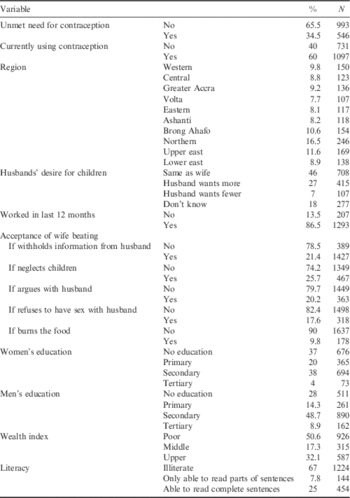
Table 1 presents the socio-demographic characteristics of the sample women from the 2014 GDHS. The mean age of the women was 33 years (SD=7.81). Thirty-seven per cent of the women had received no formal education. Many (86.5%) had reported working for pay in the past 12 months. The majority of the women (98.1%) lived in a household with a male head (97% reported their husband was the head of the household). Sixty per cent of women reported using contraceptive methods and 34.5% reported having an unmet need for contraception. Acceptance of wife beating if partner withholds information, neglects children, argues with husband, refuses to have sex with husband or burns the food were 21.4%, 25.7%, 20.2%, 17.6%, and 9.8%, respectively. On average, women participated in three of the five household decisions discussed.
Descriptive statistics of women aged 15–49, 2014 Ghana DHS, N=1828

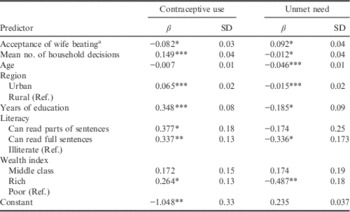
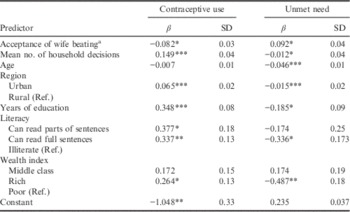
Table 2 shows the regression analysis of the association of women’s empowerment with contraceptive use and unmet need. Older women were less likely to report unmet need for contraception (β=−0.046; p<0.001). Education was negatively associated with an unmet need for contraception (β=−0.185; p<0.05). Accepting wife beating was associated with a greater unmet need for contraceptive (β=0.092; p<0.05). Number of household decisions made by women was negatively associated with the unmet need for contraception (β=−0.102; p<0.05). Women in urban regions were, surprisingly, more likely to report an unmet need for contraception (β=0.105; p<0.001). Education was positively associated with using contraception (β=0.348; p<0.001). Accepting a greater number of justifications for wife beating was associated with a decreased in use of contraception (β=−0.082; p<0.05). Women’s number of household decisions was positively associated with contraceptive use (β=0.149; p<0.001). Women in urban regions were more likely to report contraceptive use (β=0.065; p<0.001).
Regression analysis of women’s empowerment and contraceptive indicators
*p<0.05; **p<0.01; ***p<0.001.
a Number of scenarios where wife beating was deemed justified.
Ref.: reference category.
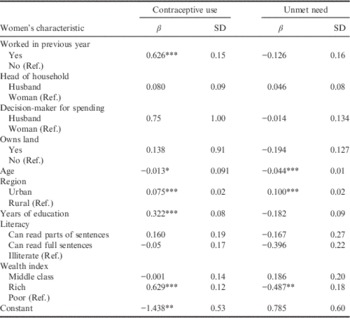
Table 3 shows the association between women’s status and contraception use and unmet need. Working in the past 12 months was positively associated with using contraception (β=0.626; p<0.001). Education was also positively associated with contraceptive use (β=0.322; p<0.001). Indicators of women’s household status were not significantly associated with previous unmet need for contraception.
Regression analysis of women’s household status and contraception use indicators

*p<0.05; **p<0.01; ***p<0.001.
Ref.: reference category.
Discussion
This study employed multidimensional operationalization of women’s empowerment and various indicators of women’s household status to examine the relationships of these with contraception use. Past studies and policies have operated under the assumption that women who were more involved in household decision-making, and thus were more empowered, would be more likely to use health services and therefore have better health outcomes (Furuta & Salway, Reference Furuta and Salway2006; Fawole & Adeoye, Reference Fawole and Adeoye2015). The results of this study, to some extent, confirm the assumption that women’s empowerment and position within the household are associated with contraceptive use and perceptions of unmet need.
Nonetheless, contraceptive use can be affected by elements outside of a woman’s societal position (Furuta & Salway, Reference Furuta and Salway2006; Fawole & Adeoye, Reference Fawole and Adeoye2015), such as government subsidies and policies (Oheneba-Sakyi, Reference Oheneba-Sakyi1992; Tawaih, Reference Tawaih1997; Bouyou-Akotet et al., Reference Bouyou-Akotet, Mawili-Mboumba and Kombila2013). However, the results of this study do indicate the importance of women’s empowerment and household status. Two multidimensional constructs measured women’s empowerment: attitudes towards intimate partner violence and household decision-making. Women who accepted more instances of physical violence as being justified were less likely to use contraception and were more likely to report an unmet need for contraception. This may indicate that women who do not accept intimate partner violence reject the beliefs that place them at a lower status relative to men (Fawole & Adeoye, Reference Fawole and Adeoye2015). Furthermore, it may mean that these women do not view violence as a means of solving conflict (UNFPA & UNIFEM, 2005). The belief that wife beating is acceptable is dangerous for women’s health for a variety of reasons. Upholding this notion perpetuates family and community violence, and furthermore, women who hold the belief that wife beating is acceptable are less likely to report if they are being abused and seek health care from trained health professionals following abuse (World Bank, 2007; Population Council, 2008). These women are also less likely to seek health services from trained health care providers (World Bank, 2007; Population Council, 2008; Fawole & Adeoye, Reference Fawole and Adeoye2015).
Women’s ability to make decisions was also positively associated with contraceptive use, and negatively associated with perceived unmet need. However, it is important to note that women’s involvement in decisions may not be as influential as the combined involvement of herself and her husband. In sub-Saharan Africa, many decisions on the management of sexual and reproductive health are scrutinized by husbands and older female relatives, who generally wield more influence on women’s use of health services (Furuta & Salway, Reference Furuta and Salway2006; Fawole & Adeoye, Reference Fawole and Adeoye2015). Women who have lower empowerment with regards health decisions are also more at risk of neglect from health care providers, either receiving poor-quality services, or discontinuing health services all together (Singh et al., Reference Singh, Bloom and Brodish2013). Thus, research should also focus attention on how partners and other family members influence women’s use of health services and their sexual and reproductive health decisions.
Indicators of household status such as education and employment were found to be associated with improved use of contraceptives. This is not surprising as women who are working and more educated are more likely to be exposed to health information in their places of work or education, which should lead to increased uptake of health services (Furuta & Salway, Reference Furuta and Salway2006; Fawole & Adeoye, Reference Fawole and Adeoye2015). The relationship between women’s education and contraceptive use is consistent with results of previous studies (Fayehun et al., Reference Fayehun, Omololu and Isiugo-Abanihe2011) and also highlights how systems beyond the household may affect women’s health. Studies have suggested several possible mechanisms to explain this effect. Fayehun and colleagues suggested that education may help in fostering attitudes that are more favourable towards modern health care, including use of modern contraceptive methods (Fayehun et al., Reference Fayehun, Omololu and Isiugo-Abanihe2011). Other studies have suggested that education may impart feelings of self-worth and self-confidence, which are necessary for changing health behaviour and seeking out health services for the first time (Singh et al., Reference Singh, Bloom and Brodish2013; Sado et al., Reference Sado, Spaho and Hotchkiss2014). Education may also increase a woman’s ability to act on the demand for health services by increasing discussion and decision-making between husbands and wives, and reducing the power differential between women and health care providers (Furuta & Salway, Reference Furuta and Salway2006; Fayehun et al., Reference Fayehun, Omololu and Isiugo-Abanihe2011; Singh et al., Reference Singh, Bloom and Brodish2013).
The primary limitation of this study is that it is cross-sectional, so trends over time and causality cannot be determined. Furthermore, because this was a secondary analysis, key variables were missing; there are many other indicators of women’s empowerment, in particular household status, that could provide useful information, but were not included in the original survey. Thus, the findings should be interpreted with caution. Finally, in the initial study, social desirability bias is always a risk, particularly for sensitive topics such as reproductive health and other aspects of women’s health. Despite these limitations, this study did show a relationship between women’s empowerment and, to some extent, household status and contraceptive use and unmet need for contraceptives.
In conclusion, the results of this study intimate that women’s empowerment does influence contraceptive use among women in Ghana. Socio-demographic factors such as region, wealth and literacy also emerged as influential factors. This suggests that in addition to current federal and international strategies being implemented to improve women’s health, promoting women’s status in the home and empowerment are important for improving women’s health (Upadhyay et al., Reference Upadhyay, Gipson, Withers, Lewis, Ciaraldi and Fraser2014; Fawole & Adeoye, Reference Fawole and Adeoye2015; Na et al., Reference Na, Jennings, Talegawkar and Ahmed2015). Thus interventions to reduce the acceptability of intimate partner violence and improve women’s decision-making in the household merit sustained attention.
Acknowledgments
The author thanks the Demographic and Health Survey in partnership with USAID and the Ghana Statistical Services for granting access to data.