





Introduction
Palmer amaranth is consistently ranked as one of the most common and troublesome weeds for farmers in the United States (Van Wychen Reference Van Wychen2025). The species is native to the southwestern United States (Sauer Reference Sauer1972) but has proliferated throughout many central and southeastern states (Ward et al. Reference Ward, Webster and Steckel2013; Webster and Grey Reference Webster and Grey2015). Palmer amaranth has been documented to produce more than 600,000 seeds per plant (Keeley et al. Reference Keeley, Carter and Thullen1987), and it germinates rapidly and grows quickly (Burke et al. Reference Burke, Schroeder, Thomas and Wilcut2007; Horak and Loughin Reference Horak and Loughin2000; Steckel et al. Reference Steckel, Sprague, Stoller and Wax2004). Palmer amaranth has been considered by far the most successful invader of disturbed habitats (Ward et al. Reference Ward, Webster and Steckel2013). Palmer amaranth can cause extensive yield losses in row crops such as soybean [Glycine max (L.) Merr.], corn (Zea mays L.), cotton (Gossypium hirsutum L.), sweetpotato (Ipomoea batata L.), and grain sorghum (Sorghum bicolor L.) due to competitive interference (Klingaman and Oliver Reference Klingaman and Oliver1994; Massinga et al. Reference Massinga, Currie, Horak and Boyer2001; Meyers et al. Reference Meyers, Jennings, Schultheis and Monks2010; Moore et al. Reference Moore, Murray and Westerman2004; Morgan et al. Reference Morgan, Baumann and Chandler2001).
Palmer amaranth, due to its high fecundity and being a dioecious species, has a high potential to rapidly develop herbicide resistance (Borgato et al. Reference Borgato, Ohadi, Brunharo, Patterson and Matzrafi2025; Roberts and Florentine Reference Roberts and Florentine2021). Herbicides are categorized into groups by the Weed Science Society of America (WSSA) according to their mode of action against weeds. Thus far, Palmer amaranth evolved resistance to herbicides in nine of those groups, including herbicides that inhibit acetolactate synthase (ALS; WSSA Group 2), microtubule assembly (WSSA Group 3), photosystem II (PSII; WSSA Group 5), 5-enolpyruvyl-shikimate-3-phosphate synthase (EPSPS; WSSA Group 9), glutamine synthetase (WSSA Group 10), protoporphyrinogen oxidase (PPO; Group 14), very-long-chain fatty acids (VLCFAs; WSSA Group 15), and 4-hydroxyphenylpyruvate dioxygenase (HPPD; WSSA Group 27) (Heap Reference Heap2025). Palmer amaranth has also exhibited resistance to synthetic auxins (Group 4). In addition, populations with resistance to multiple modes of action and/or cross-resistance to multiple herbicide families with the same mode of action are widespread in the United States (Heap Reference Heap2025).
Atrazine affects photosynthesis by preventing electron transfer at the reducing site of PSII in the chloroplasts and subsequently causes an overproduction of free radicals that disrupt cell membrane integrity (Cooper et al. Reference Cooper, Laws, Das, Narotsky, Goldman, Lee Tyrey and Stoker2007; Shimabukuro and Swanson Reference Shimabukuro and Swanson1969). Atrazine can be used for preemergence and postemergence weed control and is effective on many annual broadleaf and certain grass weed species (Knuesli Reference Knuesli1970; Solomon et al. Reference Solomon, Baker, Richards, Dixon, Klaine, La Point, Kendall, Weisskopf, Giddings, Giesy, Hall and Williams1996). It is primarily used to control weeds in sorghum (Sorghum bicolor (L.) Moench), sugarcane (Saccharum L.), and corn (Williams et al. Reference Williams, Boerboom and Rabaey2010). Atrazine is used extensively in U.S. corn production, with more than 63% of corn hectares treated annually (Armel et al. Reference Armel, Wilson, Richardson and Hines2003), where an average of 32 million kg of the herbicide is applied across 30 million ha (US EPA 2020). Before glyphosate-tolerant crops were introduced, triazine-based herbicides were the commonly used in corn production between 1990 and 2005, when they were applied to 62% to 89% of corn fields (Webster and Nichols Reference Webster and Nichols2012).
Through extensive usage, the first case of atrazine resistance in Palmer amaranth was reported in Texas and subsequently confirmed in Georgia, Kansas, Iowa, Nebraska, New York, and Wisconsin (Heap Reference Heap2025). Resistance to atrazine in Amaranthus species is commonly associated with a target-site mutation in the psbA gene that encodes the D1 protein of PSII, particularly a Ser-264-Gly substation that reduces atrazine binding at the QB-binding site (Devine and Preston Reference Devine, Preston, Cobb and Kirkwood2000; Hirschberg and McIntosh Reference Hirschberg and McIntosh1983). Despite reports of atrazine resistance in Palmer amaranth since 1993, it is likely that the reproductive fitness penalties associated with triazine (PSII inhibitors) target-site resistance have halted the occurrence and spread of this mutation in Amaranthus species (Kohrt et al. Reference Kohrt, Sprague, Swathi Nadakuduti and Douches2017; Sibony and Rubin Reference Sibony and Rubin2003; Soltani et al. Reference Soltani, Vyn, Swanton, Weaver and Sikkema2008). However, non–target site resistance mechanisms have also been reported, most commonly involving enhanced metabolic detoxification mediated by the increased glutathione S-transferase activity (Anderson and Gronwald Reference Anderson and Gronwald1991). Because non–target site resistance mechanisms do not appear to impose measurable fitness penalties in Amaranthus species (Gray et al. Reference Gray, Balke and Stoltenberg1995), they may persist and spread more readily among the species (Chahal et al. Reference Chahal, Jugulam and Jhala2019; Chaudhari et al. Reference Chaudhari, Varanasi, Nakka, Bhowmik, Thompson, Peterson, Currie and Jugulam2020; Nakka et al. Reference Nakka, Godar, Thompson, Peterson and Jugulam2017; Wu et al. Reference Wu, Davis and Tranel2018). Thus, non–target site resistance associated with enhanced metabolic activity may facilitate sustained persistence and dissemination of atrazine resistance in Amaranthus populations. Despite this potential, atrazine generally remains effective in North Carolina, because a survey of 120 Palmer amaranth accessions demonstrated that atrazine continued to control Palmer amaranth (Moore et al. Reference Moore, Jennings, Monks, Jordan, Boyette, Leon, Mahoney, Everman and Cahoon2021).
However, in 2016, a farmer in Washington County, North Carolina, reported a failure to control Palmer amaranth in a corn field that had been treated postemergence with atrazine. Plants from the Washington County Palmer amaranth population were collected for further analysis to determine whether atrazine resistance was present. Thus, the objectives of this research were to determine whether the Washington County Palmer amaranth population had developed resistance to atrazine and to determine which postemergence herbicides would effectively control this population.
Materials and Methods
Plant Material
Mature seedheads from the Washington County (WC) Palmer amaranth plants that survived applications of atrazine were collected in 2016 from the atrazine-treated field. The seeds were threshed, cleaned, and combined into a single sample and stored at 4 C. Two known atrazine-susceptible Palmer amaranth populations from North Carolina, collected from the Upper Coastal Plains Research Station (35.892556, −77.680500) located in Edgecombe County (EC) and the Central Crops Research Station (35.668156, −78.501842) located in Johnston County (JC) were selected for comparison. Mature seedheads from both susceptible populations were collected during fall 2020 and cleaned and stored as described above.
Postemergence Dose-Response Experiment
Seeds from the WC, EC, and JC populations were sown in March 2023 into separate 52- × 25- × 6-cm plastic trays containing a 4:1 mixture of potting media (Sunshine Mix #1; Sun Gro Horticulture, Agawam, MA) and sand. The trays received 5 g of Osmocote Flower Food (ICL Specialty Fertilizers, Dublin, OH, USA) granules (14-14-14) as fertilizer. Plants were watered as needed through overhead irrigation. Once germinated, two seedlings (1 to 3 cm tall) from each population were transplanted into 8- × 8-cm square plastic pots containing the growing medium described above. The greenhouse conditions were set for diurnal fluctuations of 30/20 C and 12:12 h day/night photoperiods, with supplemental light provided (600–1,000 µmol m−2s−1).
The experimental design consisted of a randomized complete block with four replications and two experimental runs replicated in space, using two adjacent greenhouses set for the same environmental conditions as described above. Atrazine (Aatrex 4L; Syngenta, Greensboro, NC) was applied postemergence to plants that were 7- to 9-cm tall (4- to 6-leaf stage) with a CO2-powered track-mounted sprayer equipped with an 8002EVS nozzle (TeeJet Technologies, Glendale Heights, IL) 46 cm above the target height at an output of 140 L ha−1. Atrazine doses consisted of 0, 56, 177, 560, 1,770, 5,600, and 17,700 g ai ha−1 along with a crop oil concentrate (Helena Chemical Co., Collierville, TN) at 10 mL L−1 as recommended by the product label for postemergence applications.
Plant survival was evaluated at 21 d after treatment (DAT) by visually assessing each plant as either alive (i.e., new, green vegetative tissue present) or dead (i.e., no green vegetative tissue present). Survival was recorded at the experimental unit level (two plants per pot), where the number of surviving plants per unit ranged from 0 to 2. Subsequently, for graphical representation purposes, percent survival for each population and herbicide rate was calculated as the mean number of surviving plants per experimental unit divided by the total number of treated plants (two) and expressed as a percentage. Following the survival assessment at 21 DAT, aboveground dry biomass was collected by clipping individual shoots at the soil surface, placing them into paper bags, drying 65 C for 72 h, and recording the dry weight. Relative dry biomass was calculated for each experimental unit as a percentage of the nontreated control within each population.
Effective Postemergence Herbicide Screen
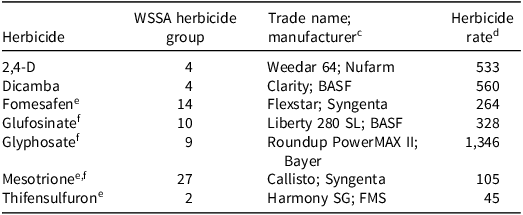
Simultaneous experiments were conducted in March 2023 to evaluate effective alternative postemergence herbicides for the WC population. Herbicides were selected based on their common use as postemergence herbicide options in North Carolina corn and soybean production systems (W.J. Everman, personal communication). Even though glyphosate and thifensulfuron resistance in Palmer amaranth is widespread in North Carolina (Mahoney et al. Reference Mahoney, Jordan, Roma-Burgos, Jennings, Leon, Vann, Everman and Cahoon2020), they were added to evaluate the susceptibility of the WC, EC, and JC populations. The remaining herbicides were selected due to their effectiveness for controlling glyphosate-resistant Palmer amaranth (Meyer et al. Reference Meyer, Norsworthy, Young, Steckel, Bradley, Johnson, Loux, Davis, Kruger, Bararpour and Ikley2015). Alternative PSII–inhibiting herbicides were not included because the objective of this experiment was to identify effective postemergence control options outside of the PSII mode of action. Seeds from the WC, EC, and JC populations were sown and maintained under greenhouse conditions as described above. Single seedlings (1 to 3 cm tall) were then individually transplanted into 4 × 20 cm cone-tainers (Greenhouse Megastore, Danville, IL) containing the soil medium described above. The experiment was designed as a randomized complete block with seven replications and two experimental runs replicated in space, using two adjacent greenhouses set up with the same environmental settings as described above. Seven herbicides with different modes of action were applied to plants 7- to 9-cm in height (4- to 6-leaf) using the CO2-powered track-mounted sprayer with the same settings used in the dose-response experiment. Herbicide doses were applied at 1× labeled field-use rates with adjuvants per product label recommendations (Table 1). A visual assessment of plant survival was performed 21 DAT as described in the dose-response section.
Postemergence herbicides evaluated to determine effective control of the Washington County Palmer amaranth population.a,b

Table 1. Long description
A table comparing various herbicides, their groups, trade names, manufacturers, and application rates. The table has six columns: Herbicide, WSSA herbicide group, Trade name, manufacturer, and Herbicide rate. It contains eight rows of data. Row 1: Herbicide, 2,4-D; WSSA herbicide group, 4; Trade name; manufacturer, Weedar 64; Nufarm; Herbicide rate, 533. Row 2: Herbicide, Dicamba; WSSA herbicide group, 4; Trade name; manufacturer, Clarity; BASF; Herbicide rate, 560. Row 3: Herbicide, Fomesafen; WSSA herbicide group, 14; Trade name; manufacturer, Flexstar; Syngenta; Herbicide rate, 264. Row 4: Herbicide, Glufosinate; WSSA herbicide group, 10; Trade name; manufacturer, Liberty 280 SL; BASF; Herbicide rate, 328. Row 5: Herbicide, Glyphosate; WSSA herbicide group, 9; Trade name; manufacturer, Roundup PowerMAX II; Bayer; Herbicide rate, 1,346. Row 6: Herbicide, Mesotrione; WSSA herbicide group, 27; Trade name; manufacturer, Callisto; Syngenta; Herbicide rate, 105. Row 7: Herbicide, Thifensulfuron; WSSA herbicide group, 2; Trade name; manufacturer, Harmony SG; FMS; Herbicide rate, 45.
a Abbreviations: WSSA, Weed Science Society of America.
b Herbicide application rates corresponded to a labeled field-use rate (1×). A nontreated control was included in the experiment.
c Herbicide manufacturer locations: BASF Corporation, Research Triangle Park, NC; Bayer CropScience, St. Louis, MO; FMC Corporation, Philadelphia, PA; Nufarm, Morrisville, NC; Syngenta Crop Protection, Greensboro, NC.
d Herbicide rates expressed as g ai or ae ha−1.
e Crop oil concentrate was added at 1 mL L−1.
f Ammonium sulfate was added at 1,680 g ha−1.
Statistical Analysis
Postemergence Dose-Response Experiment
Plant survival and biomass reduction data were analyzed using nonlinear regression to estimate population-level dose-response relationships. To model the binomial response of plant survival (where 0 = dead and 1 = alive), data were modeled using a two-parameter log-logistic function (Equation 1) with SAS software (v. 9.4; SAS Institute, Inc., Cary, NC) with a binomial distribution and logit link, with the upper asymptote fixed at “1” (100% survival):
 $Y = {1 \over {\left( {1 + \exp \left( {b{\rm{^*}}\left( {\log \left( x \right) - \log \left( e \right)} \right)} \right)} \right)}}$
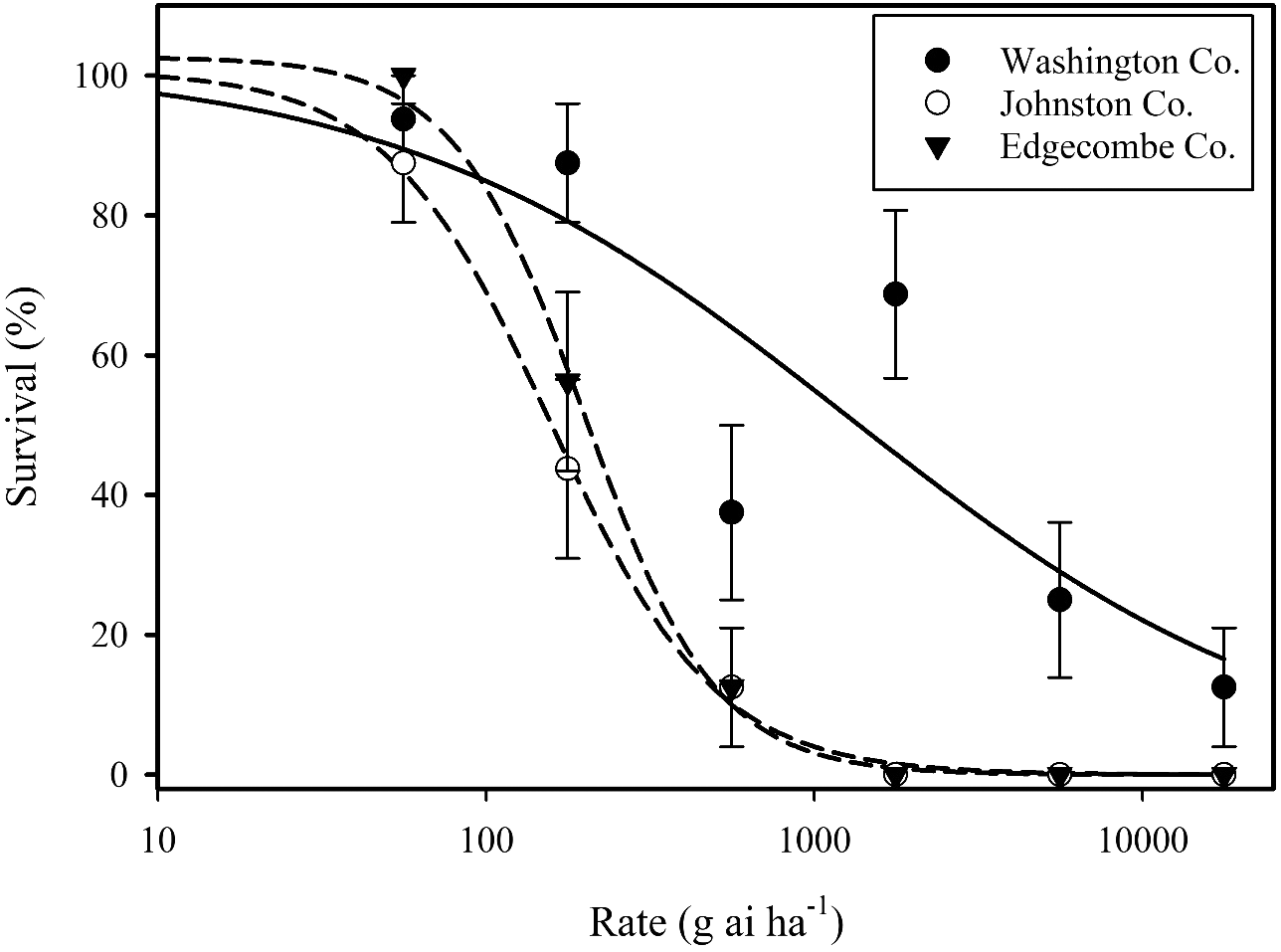
where Y is the probability of plant survival at herbicide dose x, e is the herbicide dose required to reduce survival by 50% (LD50), and b is the slope parameter describing the rate of change in survival at e. Population-specific LD50 and slope parameters were estimated within a single nonlinear model, with experimental run and replication treated as random effects. Percent survival for graphical representation was calculated as the mean survival per experimental unit divided by the total number of plants per unit (two plants) and expressed as a percentage. Dose-response curves for each population were plotted with Sigmaplot software (v. 14.0) for graphical representation of the observed survival data (Figure 1).
Dose-response curves describing survival of North Carolina Palmer amaranth populations 21 d after postemergence atrazine application. The analysis includes a putative atrazine-resistant population from Washington County and two susceptible populations from Edgecombe and Johnston counties. Vertical bars represent the standard error (±) of the mean.

Dry biomass data were analyzed using the GLIMMIX procedure in SAS software (v. 9.4) where population and rate were considered main effects while experimental run and replication were treated as random effects. Dry biomass data were modeled using a three-parameter log-logistic equation (Equation 2) in Sigmaplot 14.0 (Systat Software, Palo Alto, CA):
 $y\; = {a \over {[1 + \left( {x/x0} \right)b}}$
where a is the upper asymptote, x is the herbicide rate, x0 equals the BR50 (herbicide dose required to reduce dry biomass by 50%), and b is the slope at x0. In addition, BR50 estimates, BR80 values (the herbicide dose required to cause 80% mortality and/or dry biomass reduction) were calculated from the fitted models to allow further comparison among populations.
Resistance factors (RFs) were calculated to determine atrazine susceptibility shifts between the WC (putative resistant) and the EC and JC (known susceptible) populations, where the LD50/BR50 value of the WC population were divided by the LD50/BR50 values of the EC and JC populations. An RF value statistically greater than 2.0 suggests the population is herbicide-resistant (Burgos et al. Reference Burgos, Tranel, Streibig, Davis, Shaner, Norsworthy and Ritz2013).
Effective Postemergence Herbicide Screen
Plant survival and biomass reduction data were subjected to ANOVA using the GLIMMIX procedure in SAS (v. 9.4) (α = 0.05) where population and herbicide were considered main effects and experimental run and replication were considered random effects. The main effect of population was not significant (P = 0.36); however, the herbicide used had a significant main effect on plant survival (P < 0.001), and a significant population by herbicide interaction (P < 0.0001) revealed that herbicide response varied by population. Means for the effective herbicide screen were separated using a Fisher LSD test (P ≤ 0.05) and control data from nontreated plants and treatments that incurred complete control (e.g., 100% control) were excluded from statistical analysis to not violate the constant variance assumption of the ANOVA. Ninety-five percent confidence intervals were calculated to determine whether any treatment was like the treatments excluded from the analysis. Data from the effective herbicide screen were further evaluated using the mixed-model ANOVA framework previously described. Population, herbicide, and their interaction were examined to assess whether herbicide performance differed between the putative resistant and susceptible populations.
Results and Discussion
Postemergence Dose-Response Experiment
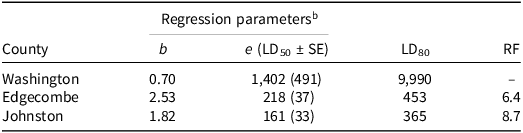
The WC population of Palmer amaranth exhibited the lowest susceptibility to atrazine as shown by plant mortality (Figure 1). The estimated LD50 for the WC population treated with atrazine was 1,402 g ai ha−1, in contrast to 218 and 161 g ai ha−1 for the EC and JC populations, respectively (Table 2). The RF values for the WC population were 6.4 and 8.7 compared with the EC and JC populations, respectively. Decreased susceptibility was further demonstrated by the WC population because the LD80 was 12,107 g ai ha−1, whereas the EC and JC populations exhibited LD80 values of 453 and 365 g ai ha−1, respectively (Figure 1; Table 2).
Regression parameters from the two-parameter logistic equation describing plant survival of the putative atrazine-resistant Palmer amaranth population from Washington County compared with the Edgecombe and Johnston County populations 21 d after postemergence atrazine treatment. a

Table 2. Long description
A table comparing regression parameters of Palmer amaranth populations from different counties after atrazine treatment. The table has four rows and five columns. The columns are labeled County, b, e (LD 50 ± SE), LD 80, and RF. The row labels are Washington, Edgecombe, and Johnston. Row 1: County, Washington; b, 0.70; e (LD 50 ± SE), 1,402 (491); LD 80, 9,990; RF, -. Row 2: County, Edgecombe; b, 2.53; e (LD 50 ± SE), 218 (37); LD 80, 453; RF, 6.4. Row 3: County, Johnston; b, 1.82; e (LD 50 ± SE), 161 (33); LD 80, 365; RF, 8.7.
a Abbreviations: LD50, the lethal dose (g ai ha−1) required to control 50% of the population; LD80, the lethal dose (g ai ha−1) required to control 80% of the population; RF, resistance factor as determined by dividing the LD50 for the Washington County population by the LD50 for the Edgecombe and Johnston County populations, SE, standard error.
b Two-parameter logistic equation: y = 1/(1 + exp{b * [log(x) − log(e)]), where x is the herbicide rate, e equals the LD50 (lethal dose to control 50% of the population [survival]) rate, and b is the slope at e.
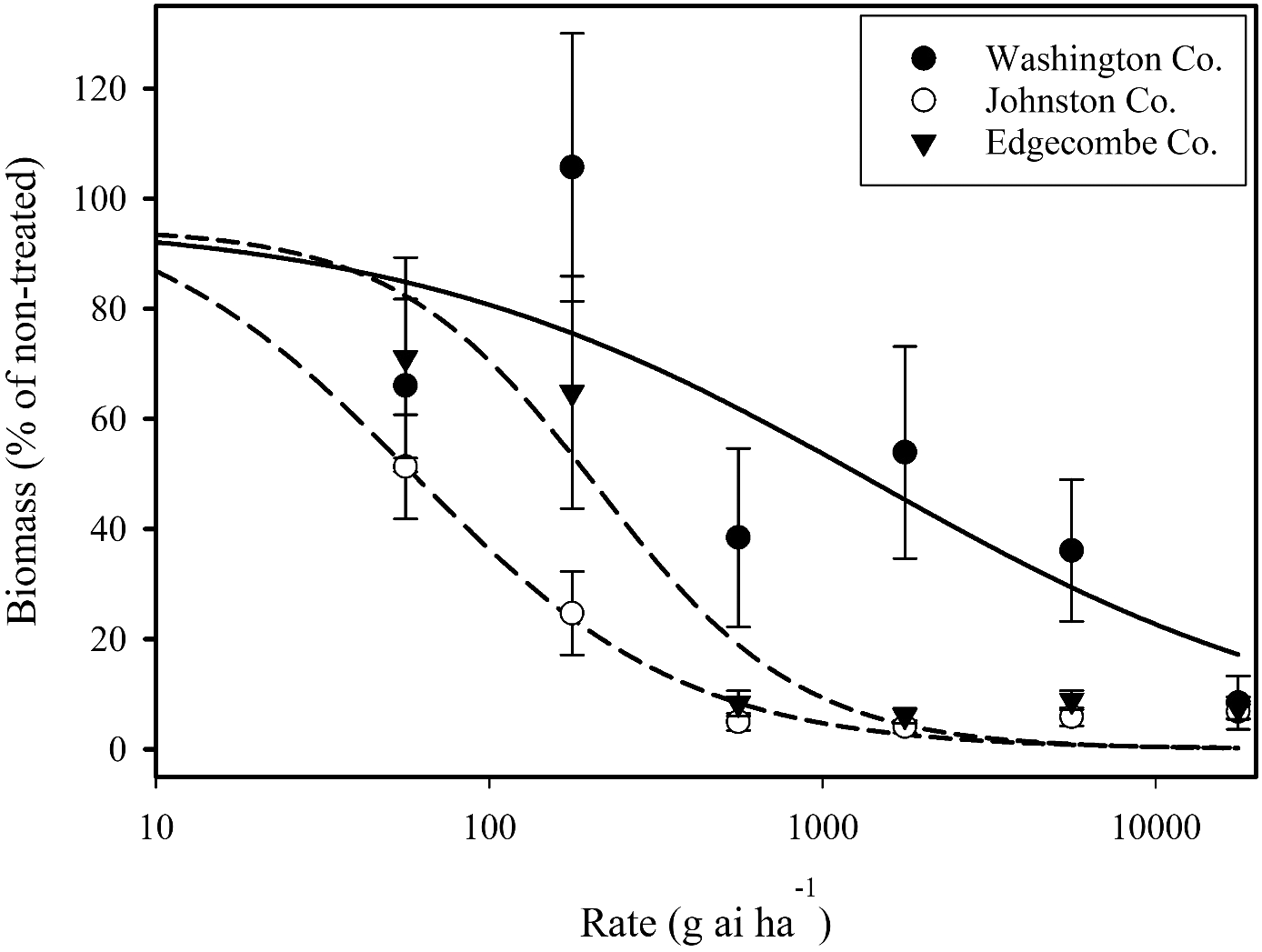
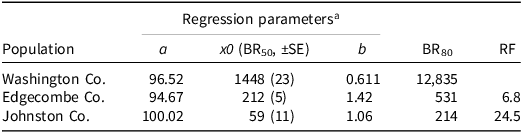
Dry biomass reduction data results followed a similar trend as plant mortality in that the WC population displayed the lowest biomass reduction following treatment with atrazine compared with the other two populations (Figure 2). The BR50 was 1,448 g ai ha−1 for the WC population, compared with 212 and 59 g ai ha−1 for the EC and JC populations, respectively (Figure 2; Table 3). Corresponding RF values for the WC population were 6.8 and 24.5 relative to the EC and JC populations, respectively (Table 3). Furthermore, the BR80 for the WC population was 12,835 g ai ha−1, whereas it was 531 and 214 g ai ha−1 for the EC and JC populations, respectively.
Dose-response curves describing dry biomass reduction of North Carolina Palmer amaranth populations 21 d after postemergence atrazine application. The analysis includes a putative atrazine-resistant population from Washington County and two susceptible populations from Edgecombe and Johnston counties. Vertical bars represent the standard error (±) of the mean.

Regression parameters from the three-parameter logistic equation describing plant biomass reduction of the putative atrazine-resistant Palmer amaranth population from Washington County compared with the Edgecombe and Johnston County populations 21 d after postemergence atrazine treatments.

Table 3. Long description
The table presents regression parameters for plant biomass reduction in three populations: Washington Co., Edgecombe Co., and Johnston Co. It has four rows and five columns. The columns are labeled as follows: Population, a, x0 (BR50 ± SE), b, BR80, and RF. The row labels are the names of the counties. The values in the table are as follows: Row 1: Washington Co., a, 96.52, x0 (BR50 ± SE), 1448 (23), b, 0.611, BR80, 12835, RF, 6.8. Row 2: Edgecombe Co., a, 94.67, x0 (BR50 ± SE), 212 (5), b, 1.42, BR80, 531, RF, 6.8. Row 3: Johnston Co., a, 100.02, x0 (BR50 ± SE), 59 (11), b, 1.06, BR80, 214, RF, 24.5.
a Abbreviations: BR50, dose (g ai ha−1) to reduce 50% of the dry biomass of the population; BR80, dose (g ai ha−1) to lethal dose to reduce 80% of the dry biomass of the population; RF, resistance factor as determined by dividing the BR50 for the Washington County population by the BR50 for the Edgecombe and Johnston County Populations, SE, standard error.
b Three-parameter logistic equation: y = a/(1 + [x/x0]b), where a is the upper asymptote, x is the herbicide rate, x0 equals the BR50 (the dose of herbicide required to reduce 50% of the dry biomass of the population) rate, and b is the slope at x0.
The WC population survived atrazine rates that were lethal to two known susceptible populations. The lethal rates of atrazine in this research were comparable to those confirmed in other research on atrazine resistance (Besançon et al. Reference Besançon, Brunharo, Polashock and Sosnoskie2026; Jhala et al. Reference Jhala, Sandell, Rana, Kruger and Knezevic2014; Kohrt et al. Reference Kohrt, Sprague, Swathi Nadakuduti and Douches2017; Nakka et al. Reference Nakka, Godar, Thompson, Peterson and Jugulam2017). Additionally, the WC population exhibited survival at atrazine rates exceeding the labeled maximum, as indicated by the LD80 value of 12,107 g ai ha−1. This rate is more than five times the maximum application rate of 2,240 g ai ha−1 as listed on the product label. These results suggest that the WC population is resistant to atrazine (Burgos Reference Burgos2015; Burgos et al. Reference Burgos, Tranel, Streibig, Davis, Shaner, Norsworthy and Ritz2013).
In Kansas, a population of Palmer amaranth with confirmed resistance to atrazine exhibited BR50 values of 11,386 g ai ha−1 (Nakka et al. Reference Nakka, Godar, Thompson, Peterson and Jugulam2017). In Michigan, Kohrt et al. (Reference Kohrt, Sprague, Swathi Nadakuduti and Douches2017) reported a BR50 of 1,200 g ai ha−1, while in Nebraska, a Palmer amaranth population that received the maximum tested rate of atrazine (13,450 g ai ha−1) was controlled by only 20% and biomass was reduced by 25% (Jhala et al. Reference Jhala, Sandell, Rana, Kruger and Knezevic2014). Most recently, Besançon et al. (Reference Besançon, Brunharo, Polashock and Sosnoskie2026) reported 50% survival of two Palmer amaranth populations in New York when approximately 21,355 g ai ha−1 of atrazine was applied and a 50% biomass reduction at 278 g ai ha−1.
While this study did not investigate the physiological or molecular basis of atrazine resistance in the WC population, previous research in Amaranthus species has shown that resistance to PSII–inhibiting herbicides can arise through both target-site and non–target site mechanisms. The most widely reported target-site mechanism involves the Ser-264-Gly substitution in the psbA gene, which reduces atrazine binding at the D1 protein and can confer cross-resistance to other triazine herbicides (Beckie and Tardiff 2012; Devine and Preston Reference Devine, Preston, Cobb and Kirkwood2000). Non–target site resistance mechanisms, including enhanced metabolic detoxification mediated by glutathione S-transferases, have also been documented and may contribute to more variable responses among PSII–inhibiting herbicides (Anderson and Gronwald Reference Anderson and Gronwald1991; Nakka et al. Reference Nakka, Godar, Thompson, Peterson and Jugulam2017). Although the specific mechanism of resistance in the WC population remains unknown, these previously reported resistance pathways help contextualize the observed reduction in atrazine sensitivity and suggest that additional studies are needed to clarify whether cross-resistance to other Group 5 herbicides may also be present.
Atrazine activity and observed injury responses may vary depending on application method and exposure pathway. Previous research has demonstrated that atrazine can be absorbed through both foliar and root tissues, and that a whole-plant response may reflect contributions from both pathways following postemergence application (Thompson and Slife Reference Thompson and Slife1969, Reference Thompson and Slife1970). Foliar uptake of atrazine is known to be variable and influenced by environmental and physiological conditions at the time of application, while root uptake following soil deposition can also contribute to overall efficacy (Dexter et al. Reference Dexter, Burnside and Lavy1966; Smith and Nalewaja Reference Smith and Nalewaja1972; Thompson and Slife Reference Thompson and Slife1970). Because this study evaluated only postemergence foliar applications, direct comparisons to soil-applied atrazine responses cannot be made, and interpretation is limited to foliar exposure conditions.
Effective Postemergence Herbicide Screen
Plant survival in the WC population varied widely depending on the herbicide applied, ranging from complete control to no effect (Table 4); therefore, results are presented separately by herbicide and ordered by ascending WSSA herbicide group number.
Plant survival of the Washington County Palmer amaranth population and two atrazine-susceptible populations (Edgecombe and Johnston Counties, NC) 21 d after treatments with postemergence herbicides applied at a labeled field-use rate.a–c

Table 4. Long description
The table presents plant survival percentages across three counties (Washington County, Edgecombe County, and Johnston County) after treatments with various herbicides. The table has 3 rows and 8 columns. The columns are labeled as Population, 2,4-D, Dicamba, Fomesafen, Glufosinate, Glyphosate, Mesotrione, and Thifensulfuron. The row labels are Washington County, Edgecombe County, and Johnston County. Each cell contains the survival percentage and standard error (SE) for each herbicide treatment. Notable trends include high survival rates in Washington County for 2,4-D and Thifensulfuron, and low survival rates for Glyphosate. Edgecombe County shows high survival rates for Dicamba and Thifensulfuron, while Johnston County has high survival rates for Glyphosate and Thifensulfuron.
a Abbreviation: SE, standard error.
b Means with different letters within the same column indicate statistical differences (P < 0.05) using a Fischer LSD test.
c Treatments that violated the constant variance assumption were not included in the analysis, but 95% confidence intervals were used to determine whether values were similar.
Thifensulfuron
Thifensulfuron was ineffective against the WC population, with 100% plant survival observed, consistent with the EC and JC populations, in which all plants also survived treatment (Table 4). This response aligns with previous reports demonstrating widespread ALS-inhibitor resistance among Palmer amaranth populations throughout North Carolina, where statewide screenings have shown minimal control with thifensulfuron (Alsdorf Reference Alsdorf2024; Moore et al. Reference Moore, Jennings, Monks, Jordan, Boyette, Leon, Mahoney, Everman and Cahoon2021; Poirier et al. Reference Poirier, York, Jordan, Chandi, Everman and Whitaker2014). Given the lack of response to thifensulfuron by the WC population and the well-documented statewide prevalence of ALS resistance, the WC population was concluded to be resistant to thifensulfuron.
Dicamba
When the WC and JC Palmer amaranth populations were treated with dicamba, plant survival dropped to 14%, whereas 64% of the EC population survived (Table 4). Further research is warranted to better characterize the EC population’s response to dicamba. Previous research in Nebraska reported 91% to 100% control of glyphosate-resistant Palmer amaranth with dicamba, accompanied by reductions in biomass and seed production (de Sanctis et al. Reference de Sanctis, Knezevic, Kumar and Jhala2021). Similarly, Moore et al. (Reference Moore, Jennings, Monks, Jordan, Boyette, Leon, Mahoney, Everman and Cahoon2021) observed consistent dicamba efficacy in North Carolina, although variability in control was also noted in herbicide resistance screening conducted by Alsdorf (Reference Alsdorf2024).
2,4-D
Treatment of the WC population of Palmer amaranth with 2,4-D resulted in 21% survival, compared with 64% survival of the EC population and 43% of the JC population after 2,4-D was applied (Table 4). Although some WC plants survived the 2,4-D treatment, the herbicide remains a useful tool in integrated management programs when using tank mixes and rotating herbicides with various modes of action is advised, particularly in cropping systems with 2-4,D resistant crop cultivars that allow postemergence over-the-top applications. The relatively high survival of the EC and JC populations suggests that further studies are warranted to evaluate their susceptibility to 2,4-D. The EC and JC populations were collected from fields with a history of repeated research with 2,4-D-resistant crops, and where repeated applications of 2,4-D may have contributed to reduced susceptibility. Resistance to 2,4-D by Palmer amaranth has been documented in North Carolina (Argueta Reference Argueta2025; Heap Reference Heap2025) and reported in Kansas (Heap Reference Heap2025; Kumar et al. Reference Kumar, Liu, Boyer and Stahlman2019). Regional studies previously indicated that 2,4-D remained effective in North Carolina; however, recent findings confirm the presence of 2,4-D–resistant populations of Palmer amaranth in the state, demonstrating that control can vary substantially among plant populations and environmental conditions (Alsdorf Reference Alsdorf2024; Argueta Reference Argueta2025; Moore et al. Reference Moore, Jennings, Monks, Jordan, Boyette, Leon, Mahoney, Everman and Cahoon2021).
Glufosinate
Glufosinate treatment resulted in no survival of plants from any of the WC, EC, and JC Palmer amaranth populations following treatment (Table 4). These results are consistent with screening of other Palmer amaranth populations in North Carolina in which 100% of tested populations were effectively controlled (Alsdorf Reference Alsdorf2024; Mahoney et al. Reference Mahoney, Jordan, Roma-Burgos, Jennings, Leon, Vann, Everman and Cahoon2020; Poirier et al. Reference Poirier, York, Jordan, Chandi, Everman and Whitaker2014). Despite this consistent efficacy, the recent confirmation of glufosinate-resistant Palmer amaranth in North Carolina (Jones et al. Reference Jones, Dunne, Cahoon, Jennings, Leon and Everman2024) underscores the urgency of diversifying herbicide programs to delay further resistance development.
Glyphosate
Glyphosate treatment was ineffective against the WC population, with 93% of plants surviving, compared with 29% and 71% survival of the EC and JC populations, respectively (Table 4). Similar to the results that occurred when thifensulfuron was applied, widespread glyphosate-resistant Palmer amaranth has been documented through statewide screenings in North Carolina (Alsdorf Reference Alsdorf2024; Mahoney et al. Reference Mahoney, Jordan, Roma-Burgos, Jennings, Leon, Vann, Everman and Cahoon2020; Poirier et al. Reference Poirier, York, Jordan, Chandi, Everman and Whitaker2014). Consistent with these patterns and the lack of control observed at rates listed on the product label, the WC population was concluded to be resistant to glyphosate. Although glyphosate remains valuable for controlling other weed species, it is not recommended for management of this population of Palmer amaranth.
Fomesafen
Only 14% of the WC population survived the fomesafen application, and no plants from the EC and JC populations survived (Table 4), suggesting that fomesafen may be an effective herbicide option for managing the WC population, particularly if a crop rotation includes soybean. Previous research has reported effective Palmer amaranth control with fomesafen in North Carolina (88% to 96%; Whitaker et al. Reference Whitaker, York, Jordan and Culpepper2010) and in other states (Bond et al. Reference Bond, Oliver and Stephenson2006). However, Alsdorf’s (Reference Alsdorf2024) statewide herbicide resistance screening of Palmer amaranth throughout North Carolina documented numerous control failures with fomesafen, and further dose-response experiments confirmed fomesafen resistance in the state (Heap Reference Heap2025). Additionally, postemergence resistance to fomesafen has been reported in North Carolina in related Amaranthus species such as waterhemp (A. tuberculatus) and redroot pigweed (A. retroflexus) (Jones et al. Reference Jones, Andres, Owen, Dunne, Contreras, Cahoon, Jennings, Leon and Everman2023a, Reference Jones, Andres, Dunne, Leon and Everman2023b).
Mesotrione
The WC population of Palmer amaranth was completely controlled with mesotrione, with no plants surviving (Table 4). It also effectively controlled the EC population, however, 29% of the JC population survived treatment. Although resistance to HPPD-inhibiting herbicides has emerged in other states and multiple-herbicide resistance has been documented, primarily based on atrazine resistance mechanisms (Jhala et al. Reference Jhala, Sandell, Rana, Kruger and Knezevic2014; Ma et al. Reference Ma, Kaundun, Tranel, Riggins, McGinness, Hager, Hawkes, McIndoe and Riechers2013), no such resistance was observed in the WC population. Nonetheless, the introduction of HPPD-resistant cotton and increasing HPPD-inhibitor herbicide use may raise concerns about future resistance selection pressure. Variable responses to mesotrione reported in the plant screening conducted by Alsdorf (Reference Alsdorf2024) along with the results observed by Mahoney et al. (Reference Mahoney, Jordan, Roma-Burgos, Jennings, Leon, Vann, Everman and Cahoon2020) reinforce the need for to avoid relying solely on HPPD-inhibiting herbicides and to incorporate multiple effective sites of action into herbicide programs.
A potential limitation of this study is the exclusion of other PSII–inhibiting herbicides from the effective postemergence herbicide screening process. Inclusion of additional Group 5 herbicides could have provided further insight into the extent of cross-resistance among PSII–inhibiting herbicides; however, this was not the primary objective of the present study. Instead, the focus was to identify effective postemergence control options following field-observed failure of postemergence applications of atrazine to Palmer amaranth. In addition, many alternative PSII–inhibiting herbicides are primarily used as soil-applied residual treatments or have limited utility as postemergence options in North Carolina row-crop systems. Therefore, the herbicide experiment was intentionally restricted to commonly used postemergence herbicides that have alternative modes of action. Future research evaluating additional PSII–inhibiting herbicides could further clarify cross-resistance patterns within Group 5 herbicides in this population.
The results of the current herbicide screening studies align with findings from previous statewide evaluations conducted in North Carolina (Alsdorf Reference Alsdorf2024; Mahoney et al. Reference Mahoney, Jordan, Roma-Burgos, Jennings, Leon, Vann, Everman and Cahoon2020; Moore et al. Reference Moore, Jennings, Monks, Jordan, Boyette, Leon, Mahoney, Everman and Cahoon2021; Poirier et al. Reference Poirier, York, Jordan, Chandi, Everman and Whitaker2014). Across all studies, variability in herbicide efficacy was observed among Palmer amaranth populations (Table 4). Furthermore, glyphosate and thifensulfuron failed to control the WC population, and thifensulfuron was similarly ineffective against the JC and EC populations. These findings are consistent with documented widespread resistance to both glyphosate and ALS-inhibiting herbicides in North Carolina Palmer amaranth populations (Alsdorf Reference Alsdorf2024; Mahoney et al. Reference Mahoney, Jordan, Roma-Burgos, Jennings, Leon, Vann, Everman and Cahoon2020; Poirier et al. Reference Poirier, York, Jordan, Chandi, Everman and Whitaker2014). Nevertheless, these herbicides remain a part of weed control programs due to their effectiveness in controlling other weed species. Multiple resistance to glyphosate, atrazine, and ALS inhibitors has been reported in Palmer amaranth populations in Georgia and Michigan (Heap Reference Heap2025; Kohrt et al. Reference Kohrt, Sprague, Swathi Nadakuduti and Douches2017).
These findings conclusively indicate that effective herbicides for controlling the WC Palmer amaranth population remain available. Although the results reflect conditions at the time this population was first reported in 2016, they still highlight which herbicides provided control of this atrazine-resistant population. Notably, the farmer in Washington County who in 2016 originally reported a failure to control Palmer amaranth in a corn field that had been treated postemergence with atrazine later reported having eliminated the WC population in the following years with the use of dicamba and glufosinate (W.J. Everman, personal communication) demonstrating the importance of using several herbicides with various modes of action. Widespread resistance to glyphosate and ALS-inhibiting herbicides, along with early signs of declining efficacy of fomesafen and mesotrione, and recent confirmation of resistance to glufosinate in North Carolina, emphasize the increasing limitations in postemergence control options. The WC population of Palmer amaranth represents the first case of atrazine resistance in North Carolina, along with, potentially, the second case of a resistance profile consisting of atrazine, glyphosate, and thifensulfuron in the southeastern United States (Heap Reference Heap2025). Although this weed population represents an isolated case of atrazine resistance in the state, preventive actions such as including integrated weed management strategies that delay the onset of atrazine resistance are crucially important in maintaining its effectiveness. Future research should characterize the susceptibility of the WC population to preemergence herbicides to further provide information on effective control options. Further research should also focus on investigating the mechanism of atrazine resistance of the WC population to better understand implications for long-term management, improve management recommendations to slow the spread and occurrence of resistance within the state, and assess the potential for cross-resistance to other PSII–inhibiting herbicides. Additionally, future herbicide screenings should include atrazine to inform North Carolina farmers where the herbicide remains effective.
Results of these studies indicate that although several postemergence herbicides remain effective for controlling the WC Palmer amaranth population, the overall herbicide toolbox is becoming increasingly constrained by widespread resistance to multiple modes of action. The continued reliance on a limited number of effective postemergence herbicides, particularly dicamba and glufosinate, raises concern regarding increased selection pressure and the potential for accelerated evolution of additional resistance traits. While no additional cases of atrazine resistance have been confirmed from this population since its initial detection, the presence of resistance to multiple herbicide sites of action highlights the vulnerability of current management systems when a diversity of control tactics is limited. Without sustained integration of multiple herbicide modes of action and complementary nonchemical strategies, the likelihood of further resistance stacking in Palmer amaranth populations in North Carolina remains high.
Practical Implications
The confirmation of atrazine resistance in the WC population represents the first documented case of atrazine and three-way resistance in North Carolina Palmer amaranth. Given the critical role of atrazine in corn production and its utility in both preemergence and postemergence programs, it remains a vital part of integrated weed management in the region. However, overreliance on atrazine, especially in the absence of other effective practices, increases selection pressure and risks accelerating the spread of resistance across the North Carolina.
Although several effective postemergence herbicides remain available for controlling Palmer amaranth, their long-term utility depends on applying a diversity of management strategies that reduce selection pressure on a limited number of effective chemistries. Effective management will increasingly rely on systems that integrate strong residual herbicide programs and complementary nonchemical tactics, rather than depending primarily on postemergence control. This includes practices that combine multiple herbicide modes of action, rotating herbicides according to seasons, and i incorporating both preemergence and postemergence residual herbicides to improve control duration and reduce repeated selection on the same sites of action.
Beyond herbicide use, cultural and mechanical tactics are essential components of sustainable Palmer amaranth management. Crop rotation with soybean expands herbicide options and enables more diverse control programs, while planting cover crops, practicing deep tillage where appropriate, and harvest weed seed control can collectively reduce weed emergence and seedbank replenishment. Without consistent integration of these practices, the likelihood of further resistance evolution and spread among Palmer amaranth populations will increase, threatening the long-term sustainability of chemical weed control in North Carolina cropping systems.
Funding
This research received no specific grant from any funding agency, commercial or not-for-profit sectors.
Competing Interests
The authors declare they have no competing interests.


 Open access

