





Introduction
Transgender, nonbinary, genderqueer, and agender (trans) people more commonly experience suicidal thoughts and behaviors compared with cisgender people. Of note, myriad terms have been used in the scientific and clinical literature to describe this community, and preferences of community members for specific terms vary widely (Zwickl et al., Reference Zwickl, Skewis, Ruggles, Murray, Cook and Cheung2026). In the present work, we follow the recommendations and practices of Tebbe & Budge (Reference Tebbe and Budge2016), using trans ‘to denote any identity an individual may hold whose assigned sex at birth does not align with the corresponding socially expected gender identity’ (p. 996). Trans adults are more than twice as likely as cisgender adults to report recent suicidal ideation (SI) in community health settings (Kirakosian et al., Reference Kirakosian, Stanton, McKetchnie, King, Dolotina, O’Cleirigh, Grasso, Potter, Mayer and Batchelder2023), controlling for covariates and demographic characteristics. Suicide attempts are more frequent in trans samples even compared with cisgender sexual minority individuals, who also experience poorer mental health than heterosexual cisgender people (Srivastava et al., Reference Srivastava, Rusow and Goldbach2021; Su et al., Reference Su, Irwin, Fisher, Ramos, Kelley, Mendoza and Coleman2016).
These suicide disparities may be driven by differential exposure to stressors that are less common for or not experienced by cisgender people (Anderson et al., Reference Anderson, Alston, Warren, Morgan, Bridge and Ford2023, Reference Anderson, Mallory, Alston, Warren, Morgan, Bridge and Ford2024). These include personal factors, such as childhood adversity (Biedermann et al., Reference Biedermann, Asmuth, Schröder, Briken, Auer and Fuss2021), as well as social factors, such as low social support (Trujillo et al., Reference Trujillo, Perrin, Sutter, Tabaac and Benotsch2017) and gender-related victimization or discrimination (Busby et al., Reference Busby, Horwitz, Zheng, Eisenberg, Harper, Albucher, Roberts, Coryell, Pistorello and King2020). These factors occur within socioecological contexts that further suicide-related health disparities, such as lack of access to gender-affirming care (Allen et al., Reference Allen, Watson, Egan and Moser2019).
First applied to sexual minorities (Brooks, Reference Brooks1981), minority stress (MS) theories have been extended to trans people (Testa et al., Reference Testa, Habarth, Peta, Balsam and Bockting2015, Reference Testa, Michaels, Bliss, Rogers, Balsam and Joiner2017) and to include minority resilience (Meyer, Reference Meyer2015). The gender MS and resilience model (Testa et al., Reference Testa, Habarth, Peta, Balsam and Bockting2015) posits that both interpersonal (e.g. discrimination and rejection) and intrapersonal (e.g. internalized transphobia and concealment) processes directly contribute to poor health outcomes for trans people. Furthermore, gender-related negative interpersonal experiences also indirectly influence these outcomes by exacerbating harmful intrapersonal processes, such as internalized transphobia. Resilience factors, such as community connectedness and identity pride, are hypothesized to buffer the association between these stressors and health outcomes.
A growing body of cross-sectional research demonstrates associations between interpersonal MS and suicidal thoughts and behaviors. This includes associations between suicidal thoughts or behaviors in trans people and gender-related discrimination (Busby et al., Reference Busby, Horwitz, Zheng, Eisenberg, Harper, Albucher, Roberts, Coryell, Pistorello and King2020), victimization (Barboza, Dominguez, & Chance, Reference Barboza, Dominguez and Chance2016; Busby et al., Reference Busby, Horwitz, Zheng, Eisenberg, Harper, Albucher, Roberts, Coryell, Pistorello and King2020), rejection (Klein & Golub, Reference Klein and Golub2016), and nonaffirmation or nonacceptance of gender identity (Price & Green, Reference Price and Green2023). There is a similar body of cross-sectional literature documenting the association between intrapersonal MS and suicide ideation and attempts (Pellicane & Ciesla, Reference Pellicane and Ciesla2022).
Although limited, some work examines the associations between MS and mental health using intensive longitudinal methods, such as daily or weekly diaries and ecological momentary assessment (EMA), allowing for stronger inferences regarding mechanisms underlying health disparities by capturing the temporal sequence of MS and health outcomes over hours, days, or weeks. Much of this work, however, has focused on outcomes other than suicide, such as negative affect, depression, anxiety, or self-esteem (Dyar, Herry, & Pirog, Reference Dyar, Herry and Pirog2024; Puckett et al., Reference Puckett, Dyar, Maroney, Mustanski and Newcomb2023), or has combined trans and cisgender sexual minority participants (e.g. Mereish et al., Reference Mereish, Peters, Brick, Killam and Yen2023), limiting clarity in the unique experiences of trans people.
To the best of our knowledge, only two peer-reviewed articles present intensive longitudinal data examining gender MS and resilience in relation to suicide outcomes. In a community sample of trans adults, gender-related discrimination and rejection predicted elevated capability for suicide (pain tolerance and low fear of death) on the same day, but not the following day; momentary gender dysphoria did not relate to suicide capability (Botelho et al., Reference Botelho, Mak, Clark, Brem and Wolford-Clevenger2023). In a small (N = 15) EMA study of suicidal trans adolescents, gender-related parental invalidation was concurrently associated with passive, but not active, SI (Esposito et al., Reference Esposito, Ellerkamp, Eisenberg, Handley and Glenn2024). No published EMA studies have examined the range of theoretically derived gender MS and resilience factors in relation to SI in trans adults.
Gender minority resilience includes connection to other trans people and pride in one’s gender identity (Testa et al., Reference Testa, Habarth, Peta, Balsam and Bockting2015), which typically demonstrate an inverse relationship to suicidal thoughts and behaviors. Evidence for the hypothesized moderation effect in relation to suicide, however, is quite mixed and includes only consideration of connectedness (not identity pride). Considering two cross-sectional studies of trans adults, one observed no moderation of the association between MS and a composite suicide risk indicator by community connectedness (Cogan, Scholl, Cole, & Davis, Reference Cogan, Scholl, Cole and Davis2020); the other study observed that, for trans U.S. military veterans, trans friend support moderated the association between discrimination and SI, such that discrimination predicted SI only for those with high or average trans friend support, evincing opposite directionality than what is predicted by theory (Carter et al., Reference Carter, Allred, Tucker, Simpson, Shipherd and Lehavot2019). In a longitudinal study of trans adults in Korea, however, vigilance to gender MS predicted SI only among those with low community connectedness, consistent with theory (Choo et al., Reference Choo, Kim, Lee, Eom, Yi, Kim, Williams and Kim2024). Results suggest that the moderating role of resilience must be further tested in diverse samples, including those with varied levels of recent SI, and that the relevance of these factors may differ across time scales.
To address gaps in the extant literature, we present results from a sample of trans adults recruited for recent suicidal thoughts or behaviors who completed a 3-week EMA protocol measuring gender MS, resilience, SI, and suicidal behavior. We predicted that higher momentary intrapersonal (Hypothesis 1) and interpersonal (Hypothesis 2) MS would predict subsequent increases in SI and that intrapersonal and interpersonal MS would interact such that a combination of both stressors would show the strongest association with SI (Hypothesis 3). Finally, we predicted that gender minority resilience would moderate the within-person association between MS and SI, such that greater resilience would weaken the association between gender MS and SI (Hypothesis 4).
Materials and methods
Study design and procedures
Suicidal trans adults Reference Costello and Horlacher2016were recruited from across the United States in the second half of 2021 for a fully virtual (remote) study. Advertisements used the terms ‘transgender and gender diverse adults’, without further definition, to describe the target sample, allowing individuals to self-identify as they preferred. Of note, one participant in the study reported their biological sex as intersex, which, for some people, may not overlap with trans identity (Costello, Reference Costello and Horlacher2016); however, given that this participant self-selected into a study recruiting on the basis of gender identity, we felt that it would be inappropriate to exclude the participant on the basis of biological sex. Eligible individuals were at least 18 years old, residing in the United States, identified as transgender or gender diverse, reported SI or suicidal behaviors in the month before enrollment, able to complete study measures in English, and owned a smartphone or other device to receive notifications for and access EMA surveys. Sample size was determined based on the availability of funding and feasibility; no a priori power analyses were conducted. However, simulation studies using our analytic approach with intensive longitudinal data suggest adequate power to examine our most complex model (testing cross-level moderation) for our sample size and total observations (4,207; Schultzberg & Muthén, Reference Schultzberg and Muthén2018). Recruitment occurred via social media (e.g. Facebook) and relevant internet forums (e.g. Reddit). Advertisements linked to a prescreening form describing study procedures, which interested individuals could use to provide contact information for the team to schedule the baseline session.
Participants met with a trained research assistant over a secure Zoom platform to provide informed consent, complete study measures, and review the EMA procedures (see the following text), including a training set of EMA items. Participants provided written and verbal informed consent, and all study procedures followed the ethical guidelines and approvals of the host university’s Institutional Review Board and relevant international standards. The baseline session took 2–3 h, and participants received a $50 Amazon gift card. Eligible participants were given the opportunity to complete the follow-up EMA portion of the study, for which they received a $50 Amazon gift card regardless of number of surveys completed, and an additional $25 Amazon gift card as a ‘bonus’ if at least 100 surveys were completed out of 126 possible. All participants received a list of national and at least two local mental health resources and had the opportunity to develop a safety plan with study team members if desired.
EMA surveys were scheduled based on participants’ self-reported wake and bedtimes; the scheduling system allowed for ‘blackout’ windows when participants were not available. Surveys were pseudorandomly scheduled during available windows such that each participant received six surveys per day over 21 days. Strategies to increase completion rates included weekly check-ins from research staff. Of the 126 possible surveys, participants completed a median of 102 (80.95% completion; M = 91.17, SD = 26.93, range = 14–123). EMA compliance rates were not associated with demographics, mean EMA-reported resilience, SI, or MS, with the exception of the item ‘treated as if others were afraid of you’, for which mean endorsement was negatively correlated with the number of surveys completed (r = −0.38, p = 0.008). Within initiated EMA surveys, item-level missing data were sparse, ranging from 66 (SI items, 1.54%) to 78 (MS items, 1.82%) and were accounted for by the analytic approach detailed in the following text.
During the baseline session, participants were informed that EMA surveys were not monitored in real time and should not be used for crisis support; this information was reiterated on the first page of each survey. Each page of the EMA survey reminded participants of this information and provided a link to the crisis resources list offered at the baseline session. Participants reporting distress during the baseline session completed a standardized risk assessment and management protocol used by the research team for multiple studies with high-risk participants, and a similar protocol was used during follow-ups after any reported suicidal behavior during EMA. If a participant responded ‘yes’ to a question keyed to suicidal behavior, a report was automatically generated and sent to the research team, prompting a follow-up within 24 h. If elevated risk was reported during follow-up, research staff offered additional check-ins, suicide prevention resources, and opportunities to develop or revise a safety plan. Check-ins were conducted by advanced doctoral students supervised by Sarah E. Victor, a licensed clinical psychologist with expertise in suicide and self-harm risk management, following a detailed protocol available on the project’s Open Science Framework (OSF) page (https://osf.io/bvz65/). No suicidal behavior flags during the study required medical or other emergency services upon follow-up.
Measures
The measures used in the study were chosen and developed in consultation with a Community Advisory Board (CAB) of trans community members (n = 8). The CAB reviewed questionnaire drafts to ensure that they were representative of trans experiences with MS, resilience, nonsuicidal self-injury, and suicidal thoughts and behaviors. This review shaped the study to be more accessible and inclusive for the trans community. CAB members participated on a volunteer basis (due to internal funding restrictions) and were not otherwise involved in the study (i.e. they were not study participants). CAB members varied with respect to gender identity, age, and geographic region; however, they were primarily non-Hispanic/Latinx White and most often affiliated with a university (student or staff), which likely yielded less representative feedback than what would have been obtained from a larger, more diverse CAB.
At baseline, participants completed an adapted version of the Columbia Suicide Severity Rating Scale (Posner et al., Reference Posner, Brown, Stanley, Brent, Yershova, Oquendo, Currier, Melvin, Greenhill, Shen and Mann2011) to assess SI and behaviors, as well as an adapted portion of the Self-Injurious Thoughts and Behaviors Interview (Nock, Holmberg, Photos, & Michel, Reference Nock, Holmberg, Photos and Michel2007) to assess nonsuicidal self-injury urges and behaviors. Participants also completed a lab-created measure of demographic characteristics, including age, biological sex, gender identity, racial identity, ethnicity, and sexual orientation (see Table 1).
Participant characteristics

Table 1. Long description
The table contains two columns: Characteristics and N (%).
Biological sex: Male 4 (8.51), Female 42 (89.36), Intersex 1 (2.13).
Gender identity (choose one): Transgender man, transmasculine, or female-to-male 18 (38.3), Transgender woman, transfeminine, or male-to-female 2 (4.26), Nonbinary/gender nonconforming/gender-fluid/genderqueer 26 (55.32), Other 1 (2.13).
Gender identity (check all that apply) top responses: Nonbinary 26 (55.32), Transmasculine 20 (42.55), Transgender man 16 (34.04), Genderqueer 15 (31.91), Androgynous 14 (29.79), female to male (F T M) 13 (27.66), Gender non-conforming 13 (27.66).
Sexual orientation: Asexual 3 (6.38), Bisexual 15 (31.91), Gay or lesbian 6 (12.77), Heterosexual or straight 3 (6.38), Pansexual 5 (10.64), Queer 12 (25.53), Questioning 1 (2.13), Other 2 (4.26).
Race/ethnicity: Non-Hispanic/Latinx White 32 (68.09), Hispanic/Latinx White 6 (12.77), Black/African-American 3 (6.38), Asian/Asian-American 1 (2.13), Biracial/multiracial/other 5 (10.64).
Educational attainment: Less than high school 1 (2.13), High school diploma or General Educational Development credential 2 (4.26), Some college 20 (42.55), Associate’s 5 (10.64), Bachelor’s 12 (25.53), Advanced degree 7 (14.89).
Working outside home: No 12 (25.53), Part-time 16 (34.04), Full-time 19 (40.43).
Government assistance: No 37 (78.72), Yes 9 (19.15), Not sure 1 (2.13).
Baseline self-injurious thoughts and behaviors characteristics: Lifetime suicide attempt 31 (65.96), Past-month attempt 1 (2.13), Lifetime nonsuicidal self-injury 45 (95.74), Past-month nonsuicidal self-injury 11 (23.4).
E M A self-injurious thoughts and behaviors characteristics: Reported suicide attempt (participants) 8 (17.02), Reported suicide attempt (E M A surveys) 10 (0.24), Reported nonzero suicidal ideation (participants) 45 (95.74), Reported nonzero suicidal ideation (E M A surveys) 2122 (50.30).
Note: All percentages reflect the number of participants out of 47, except for reported suicide attempts by EMA (ecological momentary assessment) survey (out of 4,207) and reported nonzero suicidal ideation by EMA survey (out of 4,219). The ‘check all that apply’ gender identity item included instructions noting, ‘We understand that these are not the only genders, and some of these terms may be offensive to you. Please mark whatever feels most applicable to your gender identity as you understand the term.’ This was added based on Advisory Board feedback regarding terms that some felt were offensive, and others preferred for themselves. The following identities were listed but not endorsed by any participant: cisgender woman, cisgender man, crossdresser, neutrois, pangender, transfeminine, transsexual woman, and transsexual person.
At each EMA survey, participants completed items assessing present experiences (‘at this moment…’) and experiences since the last completed survey (‘since the last survey you completed…’). Two items captured momentary SI on a scale from 1 (not at all) to 5 (very much): ‘I feel that life is not worth living’ and ‘I want to die’. Suicidal behavior since the prior survey was assessed with a binary item, ‘Did you do anything to try to kill yourself?’ This phrasing was intentionally broad to capture varied ways participants described suicidal behaviors in prior study interviews and based on Advisory Board feedback.
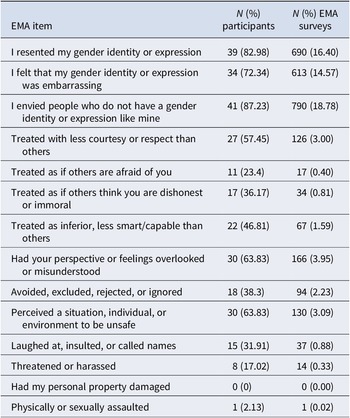
Intrapersonal MS since the last survey were captured using three adapted items from the Gender Minority Stress and Resilience Scale (GMSRS; Testa et al., Reference Testa, Habarth, Peta, Balsam and Bockting2015) internalized transphobia subscale. Interpersonal MS since the last survey were assessed using an adapted measure (Livingston et al., Reference Livingston, Flentje, Brennan, Mereish, Reed and Cochran2020), which itself was adapted from the Everyday Discrimination Scale (Williams, Yu, Jackson, & Anderson, Reference Williams, Yu, Jackson and Anderson1997) to capture daily interpersonal stressors ranging from minor to severe, and then further revised in consultation with our Advisory Board. Participants were shown 11 options and asked to mark which, if any, had occurred since the last survey. For each item marked as occurring, participants were asked, ‘Was this experience related to an aspect of your identity?’ and given the option to indicate ‘yes, related to my gender identity’, ‘yes, related to another aspect of my identity (race, sexual orientation, disability, age)’, or ‘no’. Participants could mark that an experience was related to both gender and another aspect of identity (Table 2).
Descriptive characteristics of EMA-reported minority stressors

Table 2. Long description
The table contains three columns: E M A item, N (percentage) participants, and N (percentage) E M A surveys.
* I resented my gender identity or expression: 39 (82.98 percent) participants; 690 (16.40 percent) surveys.
* I felt that my gender identity or expression was embarrassing: 34 (72.34 percent) participants; 613 (14.57 percent) surveys.
* I envied people who do not have a gender identity or expression like mine: 41 (87.23 percent) participants; 790 (18.78 percent) surveys.
* Treated with less courtesy or respect than others: 27 (57.45 percent) participants; 126 (3.00 percent) surveys.
* Treated as if others are afraid of you: 11 (23.4 percent) participants; 17 (0.40 percent) surveys.
* Treated as if others think you are dishonest or immoral: 17 (36.17 percent) participants; 34 (0.81 percent) surveys.
* Treated as inferior, less smart or capable than others: 22 (46.81 percent) participants; 67 (1.59 percent) surveys.
* Had your perspective or feelings overlooked or misunderstood: 30 (63.83 percent) participants; 166 (3.95 percent) surveys.
* Avoided, excluded, rejected, or ignored: 18 (38.3 percent) participants; 94 (2.23 percent) surveys.
* Perceived a situation, individual, or environment to be unsafe: 30 (63.83 percent) participants; 130 (3.09 percent) surveys.
* Laughed at, insulted, or called names: 15 (31.91 percent) participants; 37 (0.88 percent) surveys.
* Threatened or harassed: 8 (17.02 percent) participants; 14 (0.33 percent) surveys.
* Had my personal property damaged: 0 (0 percent) participants; 0 (0.00 percent) surveys.
* Physically or sexually assaulted: 1 (2.13 percent) participants; 1 (0.02 percent) surveys.
Note: All items above were asked with respect to the period of time ‘since the last beep’. Endorsement rates for interpersonal minority stressors reflect when these experiences were reported to have occurred, and the participant endorsed that they were at least in part due to their gender identity. Percentages reflect the proportion of participants endorsing this experience at least once (out of 47 total) and the proportion of ecological momentary assessment (EMA) surveys on which the experiences were endorsed (out of 4,207 total).
Gender resilience was assessed using three items from the GMSRS tapping gender identity pride and community connectedness, which were displayed at the first survey opened each morning and rated on a scale from 1 (not at all) to 5 (very much). These items were averaged to create a between-person resilience indicator.
Data preparation and analyses
Hypotheses and data analytic plans were preregistered on the OSF, where all data, code, and output from this article, along with the measures used in the larger study battery, are available (https://osf.io/bvz65/). Note that Hypothesis 4 in this article reflects the fifth hypothesis on the OSF, as Hypothesis 4 (examining direct, main effects of resilience on changes in SI) was previously published (Hoelscher, Victor, Trieu, & Edmiston, Reference Hoelscher, Victor, Trieu and Edmiston2023).
We preregistered our intention to use dynamic structural equation modeling (DSEM), a multilevel modeling approach useful for intensive longitudinal data and appropriate for skewed, zero-inflated, and categorical predictors and outcomes, as well as high rates of missingness (Hamaker et al., Reference Hamaker, Asparouhov, Brose, Schmiedek and Muthén2018; Schultzberg & Muthén, Reference Schultzberg and Muthén2018). Analyses were conducted in Mplus, Version 8.11 (Muthén & Muthén, Reference Muthén and Muthén1998). DSEM uses Bayesian estimation to compute point estimates and 95% credibility intervals (CIs), which can be used to determine statistical significance. Unlike traditional structural equation modeling, DSEM does not provide model fit indices, instead modeling convergence based on potential scale reduction (PSR) values that fall below a model-specific threshold. All models were estimated with a minimum of 5,000 iterations, after which the model was rerun with double the iterations required for convergence to ensure model stability.
Although preregistered hypotheses identified ‘suicide risk’ as the target outcome (both SI and suicidal behaviors), the base rate of suicidal behaviors was low (n = 10 events across eight participants); thus, SI served as our primary outcome. Attempts to model MS and SI as latent variables led to model convergence errors, as did random effects models in which MS was modeled as a count variable and SI was modeled as the mean of the two SI Likert-type items. This was likely due to zero inflation of both variables; across all completed surveys, 73.4% of responses indicated no intrapersonal minority stressors, 92.2% reported no interpersonal minority stressors, and 49.7% of responses indicated no SI (M = 1.86, SD = 1.16). Thus, we modeled SI and MS as binary (present vs. absent) for all models.
We then tested fixed-effects models with binary predictors and outcomes using two possible time lags – 60 and 120 min – to determine the most appropriate data fit. Models using a 120-min time interval were more robust, with better model convergence and lower PSR values, and are presented in the following text.
Results
Participant characteristics
A total of 58 trans adults were enrolled; of these, 47 were eligible and had usable EMA data. Participants were not excluded for any other reason. Participants were 19–56 years old (M = 28.32, SD = 7.54), primarily nonbinary, gender nonconforming, gender-fluid, or genderqueer (55.3%), bisexual (31.9%), and non-Hispanic/Latinx White (68.1%). All participants reported SI or suicidal behavior in the month before enrollment; most (66.0%) had at least one lifetime suicide attempt (Table 1).
MS and proximal SI
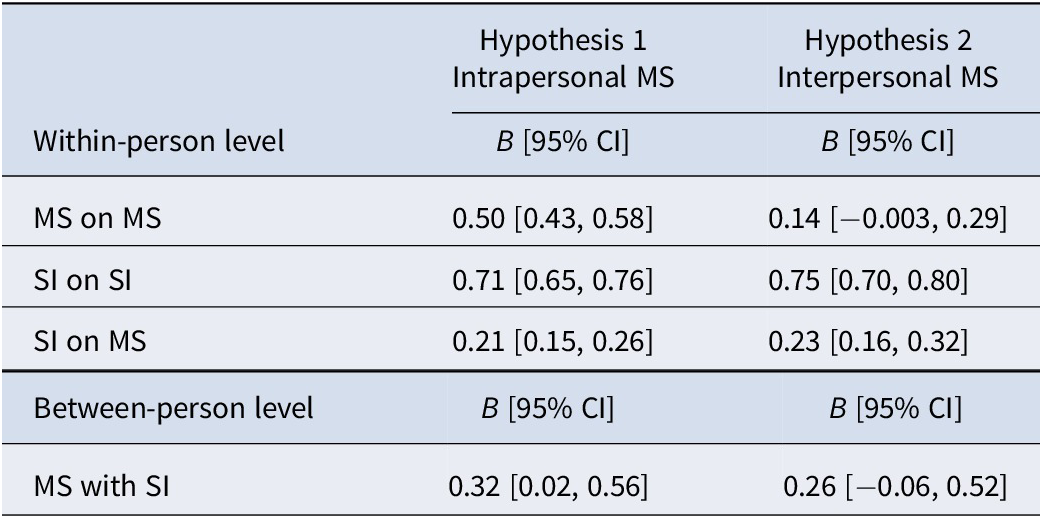
To test the influence on intrapersonal MS on SI (Hypothesis 1), we modeled the within-person covariance of ‘since last survey’ intrapersonal MS on ‘at this moment’ SI, accounting for autoregressive (inertia) effects of each construct over time. We observed a significant, positive relationship between intrapersonal MS and within-person change in SI (B = 0.21, 95% CI = [0.15, 0.26]). Thus, higher intrapersonal MS over the preceding few hours, relative to one’s own mean, predicted higher momentary SI, also relative to one’s own mean. We also observed this relationship at the between-person level (B = 0.32, 95% CI = [0.02, 0.56]), such that individuals with more frequent intrapersonal MS throughout EMA had higher EMA-reported SI.
We then examined an identical model for interpersonal MS. Consistent with Hypothesis 2, we observed a significant, positive relationship between interpersonal MS and SI (B = 0.23, 95% CI = [0.16, 0.32]) at the within-person level. There was, however, no significant between-person association between aggregated interpersonal MS and aggregated SI over EMA (B = 0.26, 95% CI = [−0.06, 0.52]). Full model results for Hypotheses 1 and 2 can be found in Table 3.
Model results for Hypotheses 1 and 2

Table 3. Long description
The table is organized into three columns: Variable, Hypothesis 1 Intrapersonal M S, and Hypothesis 2 Interpersonal M S. Data is presented as B [95% C I].
Within-person level results:
* M S on M S: Hypothesis 1 is 0.50 [0.43, 0.58]; Hypothesis 2 is 0.14 [-0.003, 0.29].
* S I on S I: Hypothesis 1 is 0.71 [0.65, 0.76]; Hypothesis 2 is 0.75 [0.70, 0.80].
* S I on M S: Hypothesis 1 is 0.21 [0.15, 0.26]; Hypothesis 2 is 0.23 [0.16, 0.32].
Between-person level results:
* M S with S I: Hypothesis 1 is 0.32 [0.02, 0.56]; Hypothesis 2 is 0.26 [-0.06, 0.52].
Note: B represents standardized beta; C I represents credible interval; M S represents minority stress; S I represents suicidal ideation.
Note: B, standardized beta; CI, credibility interval; MS, minority stress; SI, suicidal ideation.
Within-person interactions of MS
For Hypothesis 3, we predicted that the combination of high intrapersonal and interpersonal MS would be associated with greater SI than either MS type individually. In a model with a binary interaction term, intrapersonal MS, and interpersonal MS as predictors of SI, all autoregressive effects were significant, as was the direct effect of interpersonal (B = 1.65, 95% CI = [0.14, 2.44]) MS on SI. There was no significant effect of intrapersonal MS when controlling for concurrent interpersonal MS (B = 0.27, 95% CI = [−0.002, 0.52]), nor was there a significant interaction term (B = −1.65, 95% CI = [−2.54, 0.09]). These results may be due to the high overlap of these MS observed on a per-survey basis within the EMA data, as almost all surveys with interpersonal MS also included nonzero intrapersonal MS (253 out of 329, 76.90%). Full model results are presented in Table 4.
Model results for Hypothesis 3

Table 4. Long description
The table consists of two columns: Within-person level and B [95% C I].
Within-person level results:
* Intra M S on intra M S: 0.41 [0.32, 0.49]
* Inter M S on inter M S: minus 0.10 [minus 0.14, minus 0.05]
* S I on S I: 0.75 [0.69, 0.81]
* S I on intra M S: 0.27 [minus 0.002, 0.52]
* S I on inter M S: 1.65 [0.14, 2.44]
* S I on interaction: minus 1.55 [minus 2.54, 0.09]
* Intra M S with inter M S: 0.87 [0.70, 0.99]
* Intra M S with interaction: 0.91 [0.79, 0.99]
* Inter M S with interaction: 0.98 [0.95, 0.99]
Between-person level results:
* S I with intra M S: 0.33 [0.03, 0.57]
* S I with inter M S: 0.23 [minus 0.08, 0.50]
* S I with interaction: 0.27 [minus 0.05, 0.55]
* Intra M S with inter M S: 0.59 [0.32, 0.77]
* Intra M S with interaction: 0.73 [0.51, 0.86]
* Inter M S with interaction: 0.88 [0.78, 0.94]
Note: B refers to standardized beta; C I refers to credible interval; intra M S refers to intrapersonal minority stress; inter M S refers to interpersonal minority stress; interaction refers to the interaction term between intrapersonal and interpersonal minority stress; S I refers to suicidal ideation.
Note: B, standardized beta; CI, credibility interval; intra MS, intrapersonal minority stress; inter MS, interpersonal minority stress; interaction, interaction term between intrapersonal and interpersonal minority stress; SI, suicidal ideation.
Buffering role of resilience in the MS–SI relationship
We hypothesized that, at the between-person level, trans community connectedness and identity pride would moderate the within-person association between MS and SI, such that resilience would weaken the association between each MS type and SI. In two separate random-effects models, we estimated person-level slopes for the relationship between intrapersonal and interpersonal MS and SI, which were allowed to covary with aggregated resilience at the between-person level. Unfortunately, the model examining interpersonal MS was not calculable due to convergence errors, likely due to the low endorsement of these stressors (7.8% of surveys) in the context of a random-effects model. For intrapersonal MS, between-person resilience was negatively associated with aggregated SI (B = −0.36, 95% CI = [−0.59, −0.09]) and intrapersonal MS (B = −0.45, 95% CI = [−0.65, −0.19]). Resilience did not moderate the MS–SI relationship (B = −0.02, 95% CI = [−0.41, 0.35]); this was also observed when community connectedness and pride items were modeled individually (see Table 5). As with the aggregate resilience model, models testing community connectedness and pride items separately in relation to interpersonal MS did not converge.
Model results for Hypothesis 4 (intrapersonal MS)

Table 5. Long description
The table consists of five columns: an unlabeled first column for variables, followed by Resilience aggregate, Resilience Item 1, Resilience Item 2, and Resilience Item 3. Data is presented as B [95% C I].
Within-person section:
* M S on M S: 0.48 [0.40, 0.55] for aggregate; 0.49 [0.41, 0.55] for Items 1, 2, and 3.
* S I on S I: 0.70 [0.65, 0.75] for aggregate; 0.69 [0.64, 0.74] for Items 1, 2, and 3.
Between-person section:
* M S with S I: 0.38 [0.08, 0.63] for aggregate; 0.41 [0.11, 0.64] for Item 1; 0.39 [0.09, 0.63] for Items 2 and 3.
* M S with resilience: -0.45 [-0.65, -0.19] for aggregate; -0.39 [-0.61, -0.12] for Item 1; -0.40 [-0.62, -0.13] for Item 2; -0.40 [-0.61, -0.13] for Item 3.
* S I with resilience: -0.36 [-0.59, -0.09] for aggregate; -0.20 [-0.46, 0.09] for Item 1; -0.36 [-0.59, -0.09] for Item 2; -0.42 [-0.63, -0.13] for Item 3.
* M S minus S I slope with resilience: -0.02 [-0.41, 0.35] for aggregate; -0.05 [-0.41, 0.34] for Item 1; -0.05 [-0.46, 0.35] for Item 2; -0.02 [-0.42, 0.37] for Item 3.
* M S minus S I slope with S I: -0.28 [-0.68, 0.26] for aggregate; -0.21 [-0.65, 0.33] for Item 1; -0.20 [-0.64, 0.32] for Item 2; -0.21 [-0.64, 0.32] for Item 3.
* M S minus S I slope with M S: 0.002 [-0.45, 0.48] for aggregate; 0.01 [-0.45, 0.50] for Item 1; 0.05 [-0.44, 0.53] for Item 2; 0.04 [-0.43, 0.52] for Item 3.
Note: B, standardized beta; CI, credibility interval; MS, minority stress; SI, suicidal ideation. Resilience Item 1 = ‘My gender identity or expression makes me feel special and unique’ (identity pride); Resilience Item 2 = ‘I felt connected to other people who share my gender identity’ (community connectedness); Resilience Item 3 = ‘When interacting with members of the community that share my gender identity, I feel like I belong’ (community connectedness). Aggregate resilience reflects the average of all three resilience items across the entire EMA period.
Discussion
To the best of our knowledge, this is the first study to examine the full range of risk and protective factors described by gender MS and resilience theory (Testa et al., Reference Testa, Habarth, Peta, Balsam and Bockting2015) using an intensive longitudinal design. Consistent with hypotheses and previous literature, both intrapersonal and interpersonal MS were associated with within-person changes in SI over time. Of note, these models accounted for within-person stability of both SI and MS over time and reflect ‘since last survey’ MS’ impact on ‘at this moment’ SI, helping to establish temporal precedence. This work extends prior research showing within-person associations between intrapersonal (Botelho et al., Reference Botelho, Mak, Clark, Brem and Wolford-Clevenger2023) and interpersonal (Esposito et al., Reference Esposito, Ellerkamp, Eisenberg, Handley and Glenn2024; Rabasco & Andover, Reference Rabasco and Andover2021) MS and trans suicide outcomes, albeit over longer time intervals and with different sample characteristics. Interestingly, at the between-person level, only intrapersonal MS was associated with aggregated SI; this suggests that external, interpersonal events may be most relevant to SI insofar as they drive negative self-relevant appraisals, internalized transphobia, anticipation of rejection, or identity concealment.
Contrary to Hypothesis 3, the presence of both types of MS did not more strongly predict SI than either MS type on its own. It is possible that this is a statistical artifact, given the high overlap between MS types, or that the interactive effect of these stressors may be observed at other levels of analysis (e.g. cross-sectional and traditional longitudinal) but not apparent in the context of very short-term changes in risk.
In previously published work from this dataset (Hoelscher et al., Reference Hoelscher, Victor, Trieu and Edmiston2023), we observed a direct effect of gender resilience on SI at the daily level; here, we extend this work to test the buffering hypothesis that resilience would moderate MS–SI relationships across participants. Although aggregated identity pride and community connectedness was associated with reduced SI over the EMA period, resilience did not moderate the association between MS and SI, whether modeled in aggregate or at the item level, meaning the momentary impact of MS was similar regardless of resilience. This suggests that interventions promoting resilience among high-risk trans adults may reduce SI, but resilience alone is not enough to reduce or eliminate the negative effects of MS as a driver of SI. It is also possible that resilience serves a buffering role after, rather than before, MS contributes to SI, for example, if an individual’s resilience factors contribute to faster recovery from SI over time, or predicts lower severity of SI (rather than simply its presence vs. absence). Future research would benefit from more nuanced examination of community connectedness as a potential moderator of risk, given prior work suggesting that its impact on trans health outcomes varies by context and community (Lefevor et al., Reference Lefevor, Sorrell, Skidmore, Huynh, Golightly, Standifird, Searle and Call2024).
Study design strengths and limitations
As with all empirical research, results should be interpreted considering several strengths and weaknesses. By recruiting participants from across the United States, results may be more generalizable than those drawn from a single geographic region or from a convenience sample likely to reflect a restricted age range (e.g. college students). Yet only one third of the sample held a minoritized racial or ethnic identity, and only two participants were transgender women, limiting generalizability. This may be particularly relevant to interpersonal MS models, as racialized trans people and trans women experience disproportionate discrimination and victimization (Grant et al., Reference Grant, Mottet, Tanis, Harrison, Herman and Keisling2011). It is also plausible that binary and nonbinary trans people may have distinct experiences of MS and resilience that we were unable to examine in these data, given the small sample size and limited power to consider between-person covariates or moderators. The lack of a formal power analysis is also a limitation insofar as null effects may be attributable to low power to detect between-person effects in a (relatively) small sample, even with the large number of data points per participant. Participants were also recruited online and had to own a smartphone to participate; thus, we may have relatively fewer participants with low technological literacy or access than would be expected in a truly random sample of trans people. Finally, to ensure adequate endorsement of suicide-related outcomes over follow-up, all participants had past-month suicidal thoughts or behaviors at baseline; although this approach yields findings with clear clinical relevance to suicidal trans adults, results may not generalize to trans people who do not have a history of SI or suicidal behaviors, nor do they clarify what factors drive first onset of these experiences.
Methodologically, the use of multiple EMA items to capture MS and resilience improves measurement reliability, but skewness in endorsement rates required some of these measures to be collapsed into binary indicators, impacting statistical power. In relation to the outcome (SI), this means that the models captured the presence or absence of suicidal thinking but cannot speak to the level of severity, chronicity, or suicidal intent associated with reported SI. Furthermore, even though Advisory Board input was incorporated into measure selection and adaptation, it is likely that EMA items did not exhaustively capture all potential gender-relevant stressors and resilience factors experienced by participants; this is important when considering the concept of trans resilience, which has been appropriately challenged in prior work as reflecting an unreasonably intraindividual, rather than communal, focus (Matsuno & Israel, Reference Matsuno and Israel2018; Puckett, Domínguez, & Matsuno, Reference Puckett, Domínguez and Matsuno2024). Although the Advisory Board provided critically valuable feedback in study design and dissemination, its membership, of course, represents a self-selected subpopulation of trans people (e.g. those who were willing and able to volunteer their time) and thus does not represent the breadth of trans people’s experiences. Future work may benefit from a more formal, larger qualitative component to more robustly integrate varied experiences into later quantitative research.
With respect to interpersonal MS, participants self-reported whether an event was related to gender; these appraisals may differ by individual or contextual factors, an inherent limitation in self-report research (e.g. there is no ‘objective’ way to measure, across all individuals and contexts, whether mistreatment is driven by gender identity, another aspect of identity, or neither). Finally, the low endorsement of suicidal behavior in this sample precluded analysis of suicide attempts as an outcome; results must thus be characterized as informing our understanding of drivers for suicidal thinking, with additional work needed to understand unique and shared risk factors for the transition to suicidal behavior.
Taken together, our findings have clear implications for future research testing gender MS and resilience theory, public policy, and clinical practice with suicidal trans adults. First, additional EMA work should replicate and extend our findings to diverse groups of trans adults and youth, including through measures capturing gender MS and resilience in different ways. Future work might also test the theoretical mediational relationship between interpersonal MS and later changes in intrapersonal MS, which is beyond the scope of this article. Second, ongoing consultation with members of the trans community is needed to interpret results, disseminate them to the community and clinical providers serving them, and design research of importance to trans people. Third, public policy approaches to reducing trans discrimination, victimization, and rejection may have downstream effects on suicide prevention, such as through antidiscrimination laws’ effects on daily discrimination events (Truszczynski, Truszczynski, Estevez, & Elliott, Reference Truszczynski, Truszczynski, Estevez and Elliott2022) and on mental health outcomes for trans people (Blosnich et al., Reference Blosnich, Marsiglio, Gao, Gordon, Shipherd, Kauth, Brown and Fine2016). Finally, providers working with suicidal clients may benefit from gaining familiarity with interventions designed to address trans experiences in culturally humble and effective ways, such as those building from the transgender resilience intervention model (Matsuno & Israel, Reference Matsuno and Israel2018).
Acknowledgments
We are grateful to our Advisory Board members, who provided critical feedback and support in study design and recruitment, as well as to our participants, whose willingness to share their experiences with us is the foundation of this work. We further acknowledge the contributions of Dr. Adrienne Grzenda in study design and Dr. Micah Iserman in the development and validation of our EMA distribution system. Finally, we recognize the important contributions of the graduate and undergraduate students who contributed to this study during their time in the Tracking Risk over Time Lab.
Funding statement
This work was supported by institutional funding from Texas Tech University awarded to S.E.V. for professional development and research start-up funds. Texas Tech University had no role in the design, administration, analysis, or presentation of study findings or results.
Competing interests
E.K.E. has provided paid expert testimony for Lambda Legal. The remaining authors declare no competing interests.



 Open access

