‘Diligent and belligerent programs of ‘law and order’ entailing the enlargement and exaltation of the police, the courts, and the penitentiary have also spread across the First world because they enable political elites to reassert the authority of the state and shore up the deficit of legitimacy officials suffer when they abandon the mission of social and economic protection established during the Fordist-Keynesian era’ (Wacquant, Reference Wacquant2010: 198)
Introduction
Sociologists such as Garland (Reference Garland2001) or Wacquant (Reference Wacquant2010) have argued that globalization and neo-liberalism have caused a ‘punitive turn’ in industrialized Western countries. Although the causal mechanism linking globalization and neo-liberalism to ‘diligent and belligerent programs of “law and order”’ (Wacquant, Reference Wacquant2010: 198) differs depending on the author and the study (see below), the mainstream of the literature converges in terms of the overall story. The root cause for tougher law and order policies is said to be found in macro-trends, namely economic globalization: ‘If the watchwords of post-war social democracy had been economic control and social liberation, the new politics of the 1980s put in place a quite different framework of economic freedom and social control’ (Garland, Reference Garland2001: 100). The empirical evidence used to support this claim mostly comes from case studies, very often from the United States or the United Kingdom, or from quantitative analyses of imprisonment rates.
This article challenges the view of a deterministic path leading from increasing globalization and the advent of neo-liberal ideas to harsher law and order policies in all countries. Instead, I argue that national characteristics – and especially partisan politics – continue to play a crucial role as they moderate the impact of global trends on national policymaking. The main concern of this paper is therefore to clarify how existing differences in terms of law and order policies can be explained and what role the interactions between globalization trends and the characteristics of national political systems play in this process. In answering this research question, the present contribution adds to the existing literature in at least two ways as follows: first, it presents new empirical evidence on the cross-national differences in law and order policies and their development over time using different indicators than so far. Until recently, law and order policies have been largely neglected by scholars of comparative public policy [see, for instance, the review by Gottschalk (Reference Gottschalk2008); a couple of notable exemptions are Norris (Reference Norris2007, Reference Norris2009) and Tepe and Vanhuysse (Reference Tepe and Vanhuysse2013) or Wenzelburger (Reference Wenzelburger2014)]. This void has been filled by criminologists who have looked at the development of law and order policies in individual countries and, in recent years, also cross-nationally (Cavadino and Dignan, Reference Cavadino and Dignan2006; Tonry, Reference Tonry2007; Lacey, Reference Lacey2008, Reference Lacey2010a, Reference Lacey2012; Lappi-Seppälä, Reference Lappi-Seppälä2014). However, these analyses are still very much tied to the overarching [but ‘“thin” and under-theorized’ (Matthews, Reference Matthews2005: 178)] concept of punitiveness,Footnote 1 which quantitative studies mostly approximate by imprisonment rates (Sutton, Reference Sutton2004; Cavadino and Dignan, Reference Cavadino and Dignan2006; Downes and Hansen, Reference Downes and Hansen2006).Footnote 2 Hence, my approach of combining different indicators – namely the number of police officers, law and order spending, and imprisonment – contributes to a more nuanced understanding of law and order policies. Second, I use time-series cross-sectional (TSCS) regressions to investigate how the effect of globalization on law and order policies differs depending on the characteristics of national political systems. The results indicate that the impact of globalization is conditioned by the ideological stance of governments as well as by the national party system. These results challenge the idea of a deterministic path leading from globalization to harsher law and order policies and point to the continuing relevance of national policy-making systems in general and partisan ideology in particular.
The remainder of this paper is structured as follows. The next section develops a theoretical framework from theories of comparative public policy, relates it to criminological explanations of law and order policies, and develops testable hypotheses. The third section presents data, variables, and methods. The empirical analysis is presented in penultimate section, before a final section draws conclusions and indicates avenues for further research.
Theory and state of the art
Theoretical accounts of law and order policies as well as the empirical state of the art in the literature are rather fragmented. Owing to the gradual evolution of the field, many explanations have been put forward without integrating them in an overall framework or clarifying their value.Footnote 3 Furthermore, the explanations vary in terms of their causal distance to the dependent variable, the type of variance they look at (temporal or cross-sectional), and the nature of the assumed relationship (structural-functionalist, institutional, international, actor centered, etc.). In this section, I structure existing accounts by relating them to a general framework of public policymaking, develop an explanatory model, and deduct three testable hypotheses.
Given the fragmented theoretical state of the art, it is helpful to start with a general framework of public policy-making in order to organize the different approaches. In his conceptualization of the policy-making process, Hofferbert (Reference Hofferbert1974: 225–226) distinguishes context-related and actor-related factors and organizes them in a causal order: socio-economic developments are treated as demand factors feeding into the policy-making system (and are thus causally far away from the output), whereas political decisionmakers are most proximate to the policy output because they take the final decisions. Although the approach can be criticized from different perspectives (e.g. Blomquist, Reference Blomquist1999: 208–219), Sabatier concludes that it ‘constitutes a parsimonious view of the policy process with clear (of perhaps not always valid) driving forces. It is a useful starting point for cross-sectional comparisons […]’ (Reference Sabatier1991: 150–151). Following this ‘parsimonious view’, one can re-organize the existing explanations for law and order policies and distinguish three kinds of theoretical accounts as follows (for an overview, see Table 1 in the online appendix): (1) ‘big trends’ that create demands on the policy-making system, such as globalization or de-industrialization; (2) features of the policy-making system itself, which are mainly institutional and represent the proximate context in which political actors decide; and (3) preferences of the policymakers themselves, and especially their ideological stance toward a certain policy.
Big trends
Explanations of law and order policies referring to big trends come in three flavors as follows: structural-functionalist theories argue that diverse economic and societal conditions lead to a particular development of punishment. Economic downturns, rising unemployment and inequality (Rusche and Kirchheimer, Reference Rusche and Kirchheimer1968; Chiricos and Delone, Reference Chiricos and Delone1992), higher crime rates (Gottfredson and Hindelang, Reference Gottfredson and Hindelang1979; Bottoms, Reference Bottoms1995), or, more specifically, the perception of a higher crime rate by the middle class (Garland, Reference Garland2001) have been found to cause harsher law and order policies. Although different mechanisms are put forward (for an overview, see Chiricos and Delone, Reference Chiricos and Delone1992), the gist of the argument is that these socio-economic variables will force political actors to implement harsher policies – for instance, because higher crime rates create a strong demand for more and tougher punishment. A second strand focuses on societal change and general concepts such as the risk society or postmodernism, to name just two buzzwords (Beck, Reference Beck1986, Reference Beck2011; Giddens, Reference Giddens1990; Beck et al., Reference Beck, Giddens and Lash1994; Bauman, Reference Bauman1999). These broad concepts, which argue that structural developments within societies, as well as a profound value change, have set in motion a substantial transformation of Western societies, are used by criminologists to make sense of harsher policies (Singelnstein and Stolle, Reference Singelnstein and Stolle2012). Again, governments are said to respond to these external forces by implementing tougher law and order policies to increase the citizens’ (feelings of) security.
The third theoretical argument links globalization and the spread of neo-liberal capitalism to law and order policies. However, compared with the two above-mentioned approaches, the globalization hypothesis stands out because globalization is considered to be at the origin of both structural socio-economic change such as rising inequality or higher crime rates, and societal change toward a risk society. Hence, economic globalization can be considered as some kind of root cause leading to a number of other developments, which, in turn, generate harsher policies (Garland, Reference Garland2001; Downes, Reference Downes2011; Muncie, Reference Muncie2011). What are the causal mechanisms discussed in this context? Four mechanisms can be distilled from the literature as follows: first, some scholars argue that globalization has created new forms of crime to which governments respond with harsher policies (Zedner, Reference Zedner2009: 125; Aas, Reference Aas2013: 104–147). Second, globalization is held responsible for increasing income inequality and poverty (Wacquant, Reference Wacquant2001), which in turn creates – in accordance with the classic structural-functionalist theories – tougher law and order policies (Western, Reference Western2006; Western and Pettit, Reference Western and Pettit2010). Third, globalization has also been identified as generating higher (perceived) insecurity in labor markets and as creating general feelings of insecurity (Pratt, Reference Pratt2007: 37). According to the theory, these feelings of insecurity, which are an important element of the concept of the risk society (Beck, Reference Beck1986), lead to a societal demand for tougher sanctions by the government (see above). Finally, a fourth mechanism linking globalization to harsher law and order policies puts the political actor center stage. It posits that politicians have a stronger incentive to present themselves as capable of acting in the field of law and order because the room for maneuver in the area of economic and social policymaking decreases owing to austerity pressures caused by globalization and international competition (Simon, Reference Simon2007; Wacquant, Reference Wacquant2010: 198).
In sum, although the explanations presented above put forward different causal mechanisms, they are similar in their functional logic as they posit that national policies are determined, to a large extent, by general trends. If one adheres to the view that globalization lies at the origin of many of these trends, this explanation stands out as the most important driving force of harsher policies: rising fear of crime and an increasing quest for security (Hope and Sparks, Reference Hope and Sparks2000; Zedner, Reference Zedner2003), higher crime rates (Garland, Reference Garland2000: 354–364), the retrenchment of the welfare state and escalating inequality (Wacquant, Reference Wacquant2009: 6), and the development of a risk society (Beck, Reference Beck2011) – all these developments have been said to be a result of globalization and at the same time an explanation for law and order policies. Consequently, increasing globalization should therefore be considered a major variable shaping the development of law and order policies.Footnote 4
The proximate context
In the literature on law and order policies, several explanations argue that the proximate context matters. Micro-sociological approaches try to show that there is a direct link between the attitudes of the citizens and penal policy responses [‘democracy at work’ thesis (Beckett, Reference Beckett1997a: 15; Roberts et al., Reference Roberts, Stalans, Indermaur and Hough2003)].Footnote 5 Path dependency is acknowledged by studies emphasizing the specific cultural and historical tradition of a country (Savelsberg, Reference Savelsberg2011). Very much linked to such approaches are regime-specific explanations according to which the specific organization of a capitalist system (Lacey, Reference Lacey2008) or the structure of the welfare state (Cavadino and Dignan, Reference Cavadino and Dignan2006) influence a country’s law and order policy and keep it on a certain policy path. Besides, the proximate context is also made up of interest groups such as victim organizations, which have been held responsible for harsher policies in the United States (Miller, Reference Miller2008) and New Zealand (Bartlett, Reference Bartlett2009: 40–62), as well as of a certain budgetary context, limiting law and order spending (Tepe and Vanhuysse, Reference Tepe and Vanhuysse2013; Wenzelburger, Reference Wenzelburger2014).
Finally, the most important aspect characterizing the proximate context is the institutional setup of a political system – and the configuration of the party system in particular. Influential explanations argue that the electoral systems (Lacey, Reference Lacey2010b, Reference Lacey2011) and the resulting party systems and partisan competition (Jacobs and Helms, Reference Jacobs and Helms2001; Newburn, Reference Newburn2007) shape a country’s law and order policy as follows: first-past-the-post electoral systems, which foster fierce partisan competition of two parties have been found to create a dynamic where the two (non-liberal) parties (e.g. the Tories and Labor in the United Kingdom) compete on law and order issues and move their ideology and their policies gradually in a more repressive direction – a spiral Lacey has termed ‘prisoner’s dilemma’ (Lacey, Reference Lacey2008). Hence, party system characteristics are of prime importance. Besides this major institutional impact, several other institutional characteristics have been discussed in the literature: liberal media systems with strong tabloid newspapers (Green, Reference Green2007) as well as the popular election of actors in the justice system (Levitt, Reference Levitt2002; Huber and Gordon, Reference Huber and Gordon2004) have been found to lead to harsher law and order policies too.
These theoretical accounts resonate well with the public policy literature, in which political institutions play a prominent role (Immergut, Reference Immergut1990; Tsebelis Reference Tsebelis1995; Schmidt, Reference Schmidt1996; Jahn, Reference Jahn2010). Although these concepts differ in several important respects, they share the idea that political institutions provide a proximate context for the policymakers’ impact on the policy-making process. In terms of law and order policies, it seems that the configuration of the party system is the most important characteristic, which will therefore be taken into account more prominently in the empirical analysis (see below).
The political actors
The variables most closely connected to the policies deal with the political decisionmaker, because ‘human beings have to act for there to be a policy’ (Hofferbert, Reference Hofferbert1974: 226). As proponents of the theory on partisan politics (Castles, Reference Castles1982; Schmidt, Reference Schmidt1996) have argued forcefully, the ideology of political parties in government is crucial in this respect. Concerning law and order policies, the common denominator of the existing approaches is that the ideological position of a government will affect its policies.Footnote 6
For law and order policies, several case studies on the United States and the United Kingdom have revealed that partisan positions of major parties are converging and moving to the more repressive pole (Medina-Ariza, Reference Medina-Ariza2006; Morgan, Reference Morgan2006: 468; Newburn, Reference Newburn2006: 183, Reference Newburn2007; Downes and Morgan, Reference Downes and Morgan2007; Farrall and Jennings, Reference Farrall and Jennings2012). The reason for this development is summarized by Roberts et al. as follows: ‘It is the fear of being seen as “soft on crime” – or at least as being softer than one’s political opponents – rather than a commitment to “out-tough” them that tends to drive politicians to the extremes of penal excess’ (Reference Roberts, Stalans, Indermaur and Hough2003: 161). In terms of partisan effects, this dynamic has two consequences as follows: first, it should not necessarily matter for policies what party family is in power because a left party in one country could well hold a tougher stance toward law and order than a Christian democratic party in another country. However, second, if partisan positions on law and order are measured, one would expect partisan effects. Clearly, a government holding a more repressive stance at a certain point in time (in a certain country) should implement harsher policies than a government with a more liberal position at another point in time (in another country). Hence, if one aims at explaining the influence of partisan ideology, using ideological positions of government parties is advisable.
This relates directly to the question how these ideological positions can be measured. Häusermann et al. (Reference Häusermann, Picot and Geering2013) argue that when analyzing partisan effects, one should definitely use the axis of partisan competition, which is relevant for the policy under investigation. For law and order policies, using the standard left–right measure is therefore not appropriate because parties compete on a liberal vs. repressive dimension, which does not coincide with left–right measures [see, for instance, many European liberal parties that are liberal in terms of law and order but conservative in terms of economic policies (Laver and Hunt, Reference Laver and Hunt1992; Pappi and Shikano, Reference Pappi and Shikano2004)].
Building an explanatory model of law and order policies
The discussion above has identified several possible explanations for law and order policies and has shown that it makes sense to order these explanations according to their distance to the dependent variable, namely law and order policies. This subsection binds together the different approaches discussed above and builds a theoretical model, which is put to a test in the empirical analysis. Two aspects are most relevant to this model-building exercise: first, all the variables that should, on theoretical grounds, affect law and order policies must be included in the model. Second, the variables should be organized in a reasonable way reflecting the differences between general trends, proximate context, and actor-related variables in terms of causal order.
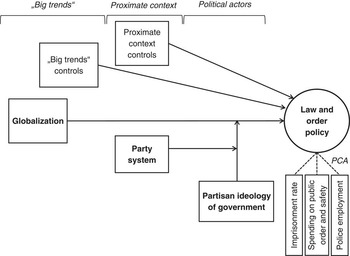
Figure 1 gives a stylized overview of the explanatory model. Discussing the causally most distant explanation to the policy output first, globalization plays an important role in this model. However, as discussed in the section above, I consider globalization to be a general trend, an overall tone. Depending on the specific context of the analyzed political systems, globalization may or may not lead to a harshening of law and order policies, because it ‘does not force politicians to do anything nor does it prohibit certain policies. Globalization only changes the cost/benefit relations for certain policies’ (Zohlnhöfer, Reference Zohlnhöfer2009: 106).
A stylized explanatory model of law and order policies. PCA=principal component analysis.

What are the conditions that decide whether the overall tone set by globalization exerts the effect on policies that the literature expects? From Hofferbert’s model and many other studies on public policies, one can deduct that the government is the most important agenda setter in the public policy-making process and that its ideology has therefore to be accounted for. To give an example, if a government with a very liberal ideology is in office, it could well decide not to implement harsher law and order policies even though (1) globalization has given rise to new forms of international crime and even though (2) the room to present itself as capable leader in the field of social and economic policies is limited owing to the era of permanent austerity caused by economic globalization. In sum, the effect of globalization can be expected to be conditioned by the ideological stance of the governing party or coalition.
Besides, the impact of the proximate context has to be accounted for too. Within this category, the characteristics of partisan competition are of prime importance. In a two-party system with fierce partisan competition, the two parties competing for office and votes may try to out-tough each other in terms of law and order policies. Hence, one would expect the harshest policies when a government with a repressive ideological stance acts in a context of a two-party system. On the contrary, the same government might not have the same incentives to implement harsh policies in a context of a multi-party system where the dynamic is more consensus oriented.
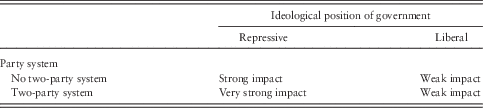
In sum, treating globalization as a ‘big trend’ variable that affects a government’s policies depending on (1) its ideological position and (2) the configuration of the party system in which it is embedded, one would therefore expect an interaction effect, which can be summarized as follows (see Table 1): if the government is ideologically strongly in favor of harsher policies (repressive, second column in Table 1) and if it operates in the context of fierce partisan competition with one main competitor, the impact of globalization will translate directly into harsher law and order policies. However, if the context of the party system is more consensus oriented in a multi-party context, this should dampen this effect to a certain extent. In contrast, if a liberal government is in office (last column in Table 1), it will oppose the pressure of globalization leading to a smaller effect. In this case it is unclear if the party system matters. On the one hand, one could argue that, in a two-party context, even liberal parties might push for harsher policies; on the other, it is questionable if liberal parties would really opt for a tougher stance, given the preferences of their electorate. Given that the case-study literature identifies the ‘out-toughing’ dynamics only in cases when the major competitors are non-liberal (United States and United Kingdom), I, therefore, do not expect the party system to matter if liberal parties are in office (last column in Table 1).
The impact of globalization on law and order policies conditioned by the party system

From this discussion, I deduct three hypotheses, which deal with the interactions of globalization, partisan ideology, and party system characteristics and their impact on law and order policies: The first hypothesis posits that the effect of partisan ideology on law and order policies is conditioned by the type of the party system, the second hypothesis spells out the ways in which globalization may affect policy outputs in the context of different governmental ideologies, and the third hypothesis finally combines all three variables and shows how the impact of globalization varies depending on the ideology of the government and the party system characteristics in which it operates (see Table 1). Besides, given the central role of governments and their ideology in the policy process, Hypothesis 1 also suggests a direct effect of government ideology and the harshness of law and order policies:
Hypothesis 1 The more repressive the ideological stance of a government, the harsher the law and order policies it implements. This effect of repressive partisan ideology is stronger if the government acts in a two-party context.
Hypothesis 2 Globalization leads to substantially harsher law and order policies if governments with a repressive stance are in power. Governments formed of a party (of a coalition) with a liberal ideology counteract this pressure leading to a much weaker globalization effect.
Hypothesis 3 The repressive dynamic resulting from strong globalization and a repressive governmental ideology is reinforced if the government acts in a two-party system.
Two additional remarks are in order. The first remark concerns control variables. To empirically assess the relationships put forward in the hypotheses, the regression models include a number of controls. These variables represent several other explanations for law and order policies as discussed above (for an overview, see Table 1 in the online appendix) and are situated at the level of ‘big trends’ (e.g. income inequality) as well as at the level of the proximate context (e.g. micro-sociological explanations, see Figure 1). The second remark is related to the question, if variables exert their effect immediately or with a certain time lag. Getting the lag structure right is a demanding exercise when modeling the regression equations – but the best starting point is always theoretical (Plümper et al., Reference Plümper, Troeger and Manow2005). The model in Figure 1 gives at least some hints because it shows that some variables are causally more proximate to the policy output than others. In the major part of the cases, this causal distance has also a temporal dimension, which can be captured by appropriate time lags. The partisan ideology of a government, for instance, should affect the policy output without much time lag, whereas an increase in the fear of crime (proximate context variable) has first to be perceived as a problem by political actors before they react with a legislative proposal. In this case, one would expect a certain, but not very big, time lag. In contrast, the effect of globalization works with an even larger temporal distance. According to one of the theoretical arguments, globalization leads to economic insecurity (especially on the labor market), which causes general feelings of insecurity that, in turn, trigger a reaction by the government to introduce harsher law and order policies. Here, I would clearly expect a longer time lag before a change in the independent variable (in this case globalization) affects the dependent variable.
Data, variables, and methods
Data and variables
A quantitative analysis of law and order policies necessitates the measurement of the core concepts. Concerning the dependent variable, most of the comparative criminological studies use imprisonment data, which is readily available for a longer time period and several industrialized countries.Footnote 7 However, law and order policies represent several dimensions (Matthews, Reference Matthews2005; Kury and Ferdinand, Reference Kury and Ferdinand2011), out of which two – the political and the judicial dimension – are most relevant for our purposes. Taking into account this multi-dimensionality, I combine three variables as follows: I use imprisonment rates as they reflect legislative choices as well as the harshness of judicial decisions and thus tap into both the political and (maybe somewhat more) the judicial dimension. Besides, I include the number of police officers per inhabitant and public spending on law and order as they account for political decisions not reflected by imprisonment rates (e.g. a governmental decision to hire more police officers or to expand the supervision of telephone calls). Although the number of police officers is a good complement to imprisonment rates because the visibility of police on the streets is a politically important symbol (Tepe and Vanhuysse, Reference Tepe and Vanhuysse2013), public spending on public order and safety (following the international COFOG classification) is used because it refers to aspects of policy that are neither covered by imprisonment nor by police personnel (such as a decision to spend more on new surveillance techniques).Footnote 8 These three indicators are combined via a factor analysis (principal component analysis, results see online appendix). The analysis yields a one-factor result and all three variables load highly on the factor (spending: 0.74; police employment: 0.71; imprisonment: 0.73). Cronbach’s α is 0.56 which is satisfying given that three variables are compared.
As the focus of my analysis is mainly on the cross-national differences in the development of law and order policies over time, I have de-meaned the raw data of the three indicators. For each country-year observation, I have subtracted the country-specific mean from the raw data of the three variables. As a consequence, much cross-country variation in levels has been eliminated, whereas cross-country variance in the changes over time (more precisely, the differences from the country mean) remains (see Figure 1 in the online appendix).
In the regression models different independent variables are combined. Aside from the variables of main theoretical interest – namely measures of globalization, government ideology, and institutional constraints – the models include a substantial number of covariates (such as homicide, fear of crime, or unemployment).Footnote 9 As the controls are measured according to the existing criminological and political–economic standard in the literature (see online appendix, Table 2), I only elaborate on the measurement of the main variables of theoretical interest: globalization, government ideology, and the party system. Globalization is measured by three different indicators – namely the KOF index of economic globalization, the KOF index of social globalization (Dreher, Reference Dreher2006), and the index of the openness of the economy (sum of import and export as a percentage of GDP). The choice of these indicators reflects the theoretical relationships that are expected to be at work. Two of these relationships assume economic globalization to be the root cause for the tendency toward harsher law and order policies. The argument on the insecurity of labor markets and income inequality can be related to the competition of companies in international markets (indicator: openness of the economy), and the argument on political actors using law and order policies to claim credit in times of austerity to general economic globalization (KOF index on economic globalization including data on capital restrictions and taxes). Finally, the indicator on social globalization is used to approximate the argument that harsher law and order policies are a reaction to the globalization of crime.
Government ideology, the second independent variable of theoretical interest, is coded using the partisan position of the governing parties on a law and order scale according to the Party Manifesto Dataset (Klingemann et al., Reference Klingemann, Volkens, Bara, Budge and McDonald2006) weighted by their share of cabinet seats. I have calculated the governments’ positions using the manifesto measure of law and order issues, namely the share of positive quasi-sentences on law and order issues in relation to all quasi-sentences in a party manifesto. Hence, the indicator is a measure for the relative (positive) importance of law and order within the manifesto of a party. Weighting the position using the cabinet shares is a way to take into account the relative strength of parties in a coalition government (ideological center of gravity). As a result, I get a time-varying governmental ideological position toward law and order.
Finally, the characteristics of a party system are measured by two dummy variables based on the classification by Golosov (Reference Golosov2011: 553). The first dummy variable takes the value of 1 for two-party systems according to Golosov; the second dummy variable treats ‘bivalent multi-party systems’ like two-party systems in order to capture multi-party systems with dynamics that resemble two-party systems.Footnote 10 Both variables are used interchangeably in the regression analysis.
Method
As the data is pooled across time and space [280 country-year observations from 14 years (1995–2008) and 20 countriesFootnote 11 ], I run TSCS regressions. Estimating regressions for pooled data creates some trouble – especially unit heterogeneity, temporal dependence, and heteroscedasticity. I test for these problems and use econometric solutions, which I will briefly discuss in the following section.
Unit heterogeneity of the dependent variable has been greatly reduced owing to the de-meaning of the raw indicators, which are combined in the factor. Moreover, running a full fixed-effect (FE) model (which is equivalent to de-meaning the independent variables too) is theoretically not very sensible as almost all relationships in the theoretical model expect an impact of levels of independent variables [e.g. the ideological position of the government as such and not its change should influence the development of law and order policies (for a similar argument, see Plümper et al., Reference Plümper, Troeger and Manow2005: 333)]. Finally, running a Hausman test between an FE model and a full model (excluding time-invariant variables) does not point to the necessity of including FE.Footnote 12 Temporal dependence is an issue in the regression equations as the data are serially highly correlated. To account for the temporal dependence, I model a lag structure according to the theoretical assumptions discussed above. I first start with a full autoregressive distributed lag (ADL) model, suppress non-significant lags of independent variables subsequently (De Boef and Keele, Reference De Boef and Keele2008), and check if there is remaining serial correlation in the error terms. The results are reported in the regression tables. Non-stationarity is not an issue for the dependent variable, which is serially correlated but not non-stationary (Dickey–Fuller tests reject non-stationarity). Moreover – and more importantly – the issue of non-stationarity is rather ambiguous in the context of standard political economy data sets (as the present) and has recently been discussed very critically (Beck and Katz, Reference Beck and Katz2011: 342–344). This is why I follow the advice of Beck and Katz (Reference Beck and Katz2011) – start with an ADL model including theoretically sensible lags and test whether they are necessary. Finally, as panel-heteroscedasticity is present in all estimations, I estimate panel-corrected standard errors (Beck and Katz, Reference Beck and Katz1995). All regressions have been checked in terms of robustness by excluding one country at a time and estimating the regressions without this country. If results are not robust, this will be reported in a footnote.
Empirical analysis
The theoretical section has argued that national law and order policies may well be affected by macro-trends such as globalization, but that this impact is mediated by the ideological preferences of the government and the characteristics of the party system. The following regression analysis investigates if the expectations can be corroborated empirically.
Direct effects
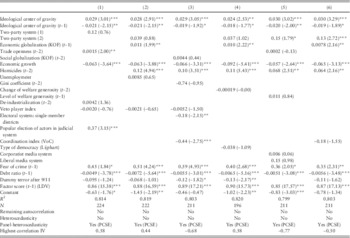
I will present regression models without interactions first, to inspect the direct relationships before turning to the conditional effects, which are illustrated graphically. All models include a number of control variables as discussed above. The first block of coefficients presented in the regression table concerns the main variables of interest – namely the indicator representing the ideological position of the government, two different operationalizations of the party system, as well as three different indicators of globalization. The next block includes the variables from the ‘big trends’ explanations, followed by the explanatory variables representing the proximate context. Some variables are not tested at the same time owing to multicollinearity or because they represent slightly different measures of one and the same concept (such as the two indicators for the party system). The lag structure reflects, on the one hand, the theoretical expectations, and on the other, the omission of non-significant lags, which had been included in the initial full ADL model (not presented here).Footnote 13 Test statistics for all models are included at the end of each model. Model 6 represents a more parsimonious model where variables, that have proven to be non-significant in models 1–5, have been omitted.
What is clearly discernible from Table 2 is the statistically significant and very robust effect of the ideological center of gravity on the law and order policies. The effect is positive in the short term (non-lagged values) indicating that a more repressive ideological stance of the government leads to more repressive law and order policies. In the long run, however, this effect is somewhat reduced as the lagged variable comes with a negative coefficient. Hence, the long-run multiplier based on model 6 amounts to
 ${{0.03{\minus}0.019} \over {1{\minus}0.87}}=0.085$
, which is positive, corroborating the expectations. Turning to the impact of the party system, the positive coefficient for both measures indicates that a two-party system indeed seems to be related to harsher law and order policies. However, this effect is only significant in some specifications and for the second operationalization (where bivalent multi-party systems are coded together with two-party systems). Finally, the coefficients for all indicators representing globalization are positive as expected, but the KOF index on economic globalization performs best.Footnote
14
Hence, it seems indeed that the broader operationalization of economic globalization including the capital market openness is more relevant, especially compared with social globalization.
Regression analysis, direct effects

t statistics in parentheses. Test statistics (all tests at a 95% significance level): remaining autocorrelation residuals have been determined from the coefficient of the lagged residual in a regression of the lagged residuals and all independent variables on residuals (Beck, Reference Beck2001: 279); heteroscedasticity: Breusch–Pagan/Cook–Weisberg test; panel-heteroscedasticity: Greene test; highest correlation IV: highest Pearson correlation between independent variables (excluding correlations between variables and their lags).
VoC=variety of capitalism, LDV=lagged-dependent variable, PCSE=panel-corrected standard errors.
*p<0.1, **p<0.05, ***p<0.01.
Concerning the control variables, most significant relationships are in line with the theoretical expectations. Turning to the ‘big trend’ controls first, sluggish economic growth and a high level of homicide leads to higher scores of the law and order factor. Interestingly, no significant relationship with the level and change of welfare state generosity, unemployment, inequality, or de-industrialization show up. From the variables representing explanations linked to the proximate context of the decisionmakers, the popular election of judges, a low coordination of the capitalism (liberal market economy type), high fear of crime in the population, and a low debt ratio are significantly linked to harsher law and order policies and confirm the results of the existing qualitative literature. In contrast, the negative coefficient for the dummy, which takes the value of 1 after the incidents of 9/11 is unexpected but also not entirely robust in its significance. The same applies for the variable representing the electoral system, which takes the value of 2 in first-past-the-post systems. This result, paired with the significant relationship of the party system indicator, points to the necessity to look more closely at the party system and the partisan competition and not just at the electoral system, which is one but not the only factor influencing party system characteristics.
In sum, the results of the regression models that include only direct effects and the most important control variables, clearly underscore the importance of the ideological position of the government and, to a smaller extent, of the party system variable. At the same time, rising globalization as a general trend is linked to harsher law and order policies – although the significance of the relationship is not entirely robust. What is not discernible from this model, however, is the interaction between globalization, the ideology of the government, and the party system characteristics. This very question is dealt with in the following section.
Conditional relationships
In the theoretical section, I have argued that although globalization as a big trend may well set the overall tone in law and order policymaking, it is the national political system and the ideology of the governments that condition this impact. This idea of a conditional relationship can be tested via interactions in regression models. As the interaction coefficients from regression tables cannot be easily interpreted as marginal effects (Brambor et al., Reference Brambor, Clark and Golder2006; Kam and Franzese, Reference Kam and Franzese2007), I will present graphical illustrations. The regression models including the interaction effects can be found in the online appendix.
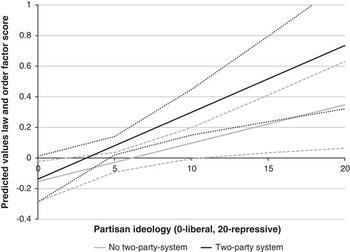
The first hypothesis expects that the effect of the partisan ideology of the government on law and order policies is stronger in a two-party context. The rationale behind this idea is that repressive governments are pushed to implement even harsher policies in such an environment. The result of such an interaction is represented by the two lines in Figure 2, which show the relationship between the ideological position of the government (x-axis) and the predicted law and order factor score (y-axis) in the case of a two-party system (black line) and in the case of the absence of a two-party system (gray line). The finding is crystal clear: whereas liberal governments do not implement harsher policies (no significant effect), policies get much tougher when the partisan ideology moves to the more repressive pole. However, as expected, this development is much more pronounced in two-party systems. This finding therefore corroborates the first hypothesis: two-party systems indeed seem to catalyze the impact of a move of the ideology to the more repressive pole.
Interaction effect – partisan ideology conditioned by party system. 95% confidence intervals (dotted/dashed lines).

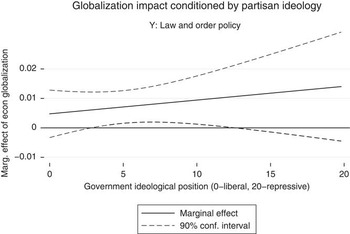
The second hypothesis argues that the impact of globalization on law and order policies will only materialize if the national governments are ideologically willing to adopt tougher law and order policies. One would therefore expect a stronger effect of globalization on law and order policies if repressive governments are in power and a weaker effect for liberal governments. Figure 3 is a graphical representation of this relationship based on the data. It depicts the marginal effect of globalization on the law and order factor score over the entire range of the ideological positions of governments. The positive slope of the line indicates that globalization indeed exerts a stronger effect if governments hold a more repressive ideological stance. The significance of the relationship is not overwhelming but, still, the interaction effect is clearly visible.
Interaction effect – globalization conditioned by partisan ideology.

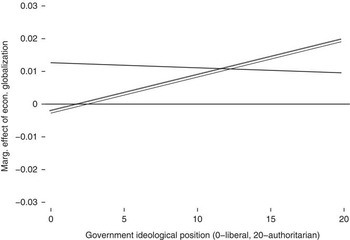
How do ideological preferences of the government, the party system, and globalization interact? The third hypothesis touches upon this question and argues that the repressive dynamic resulting from strong globalization and a repressive governmental ideology is reinforced if the government acts in a two-party system. Figure 4 plots this three-way interaction using a marginal effects plot similar to the one depicted in Figure 3 but distinguishes between party systems. What is obvious from this graph is that the effect from a marginal increase in globalization is very strong if a government with a repressive ideological stance rules in a two-party system. In sharp contrast, there is no significant effect in non-two-party systems. This finding is in line with the third hypothesis.
Three-way interaction. Stars indicate a significant effect (95% confidence interval).

In sum, the empirical investigation of the relationships that affect law and order policies, therefore, points to the fact that the ideological position of the government indeed is a major explanation of law and order policies in Western industrialized countries. Not only does the partisan ideology influence law and order policies directly, but it also conditions the effect of globalization. What is more, the party system characteristics seem to act as a catalyzer for partisan effects: governments with a repressive ideological stance influence law and order policies more strongly in a two-party context, and the conditional impact of parties on globalization is stronger, as well, when there are only two major parties in a system. These results mesh well with the qualitative literature on law and order policies in individual states and especially in the United Kingdom, which illustrates how two ideologically repressive parties compete in a two-party context leading to harsher law and order policies (Morgan, Reference Morgan2006; Newburn, Reference Newburn2007; Lacey, Reference Lacey2008). Hence, although the process of causation seems to be very complex, the results underscore the importance of partisan ideology as an explanation of law and order policies.
Summary and discussion
This contribution started from the popular claim put forward by leading criminologists that globalization will lead to more punitive, that is tougher, law and order policies in Western industrialized countries. This paper challenges this hypothesis both theoretically and empirically. Theoretically, I have argued that although globalization and its consequences may set the overall tone, there are good reasons to believe that national political and institutional settings continue to matter. National policies are still decided by national governments acting in a specific institutional and political environment, which affects national policies not only directly but also indirectly. The national arrangements filter the impact of more general forces, such as globalization, and therefore condition these relationships. Under certain circumstances, we can expect these big trends to matter, but specific national characteristics can also prevent these general forces from affecting national policies. In brief, the process of causation seems to be much more complex than existing theories on the politics of law and order and crime posit.
Empirically, this contribution has shed some light on the relationships that are at work between globalization, the partisan ideology of a government, and party system characteristics on the one hand and law and order policies on the other. The analysis shows that although globalization generally leads to harsher law and order policies, there is no uniform reaction to globalization in all countries. In other words, globalization does indeed set the overall tone (direct effect), but the strength of the effect depends on the specific setting of a country. The results of the regression analyses indicate that variables such as governmental ideology (liberal vs. repressive stance), or the party system, condition the impact of globalization on law and order policies. The globalization effect is visible indeed if governments with a more repressive stance act in a two-party context; however, it is much less pronounced if liberal parties are in office and in the context of a two-party system. These results contribute to the existing, mainly qualitative literature, at least in two ways. First, the results show that although some major trends may well set the overall tone in terms of law and order policies, there is still a rather substantial scope of action for national governments. This result is at odds with studies that postulate overall general trends in all industrialized societies leading to a punishment society irrespective of a country’s idiosyncrasies. Instead, it emphasizes the necessity to look at the characteristics of individual political systems as conditioning variables when the substantial variance in law and order policies that exists between Western industrialized countries is to be explained. These findings, therefore, can be seen as a starting point for more genuinely (small-N) comparative analyses of law and order policies, which take the institutional and political setup seriously and inspect the complex process of causation in more detail. Second, and more generally, this study contributes to the literature by showing that it is worth thinking more deeply about the complex relationships between variables and to model them accordingly in a quantitative analysis. Interactions between general trends, proximate context, and the political actors will most probably be not only relevant in the case of law and order policies but also in other policy areas. In this connection, getting the causal distance and the relationships of variables right is a major point, which future studies should take into account – and the distinction along the proximity of explanatory variables to the outcome, as proposed by this study, seems to be helpful.
The findings of this study point to several important avenues for future research. First of all, building on the findings of this quantitative analysis, comparative case studies or analyses using configurational methods could be valuable steps forward to look more closely into interaction effects between the theoretically most relevant explanatory variables. In fact, just as interaction effects in a regression equation that estimate the conditional impact of a certain variable dependent on another variable, configurational methods such as qualitative comparative analysis (QCA) (Ragin, Reference Ragin2008; Schneider and Wagemann, Reference Schneider and Wagemann2012) take into account the possibility that some effects only come about if certain conditions are present. Hence, using a mid-size sample of countries or a sample of major reforms, QCA-based studies could be used to corroborate the findings of this article. Moreover, QCA may also help us to dig deeper into issues of equifinality – something which could not be done here owing to the functional logic of regression analysis. Second, it is obvious that further studies on law and order policies from a comparative public policy perspective are badly needed. In this paper, I focused on three specific variables and their interactions. However, many other variables that have proven to be influential in the regressions presented above (and treated, sadly enough, as covariates) could be inspected in much more detail. Third, data is also an issue of concern. As comparable data on legislative decisions on law and order is missing, research over and again uses indicators such as imprisonment rates. Adding alternative indicators such as spending or the number of police personnel is one possible remedy, but not the best solution. Most welcome would be a larger effort of data collection on legislative changes – something that has been done for other policies such as terrorism (Epifanio, Reference Epifanio2011) or moral policies (Heichel et al., Reference Heichel, Knill and Schmitt2013). More data does not necessarily lead to an overall understanding of what is going on out there. However, it helps to gain an insight into some important relationships and serves as an additional piece of information when assembling the overall puzzle.
Acknowledgments
The author wants to thank the members of the empirical research colloquium at the Department of Social Sciences, University of Frankfurt, and especially Markus B. Siewert and Claudius Wagemann for their helpful comments. An early draft of this paper was also presented at the ‘Dreiländertagung’ of the German, Swiss, and Austrian Political Science Associations in Innsbruck in fall 2013 where Oliver Treib made some very good suggestions, which improved the paper significantly. Finally, I want to thank the three reviewers of this journal as well as the editors for their helpful comments. For all the remaining errors and weaknesses the usual disclaimer applies. The research presented in the article has benefited from a grant of the German Research Foundation DFG (Project-ID: We 4775/2-1).
Supplementary Material
To view supplementary material for this article, please visit http://dx.doi.org/10.1017/S1755773915000247