Introduction
Tetraspanins are a superfamily of transmembrane proteins characterized by having four transmembrane domains that form a small and a large extracellular loop (Maecker et al., Reference Maecker, Todd and Levy1997). Metazoan members of this superfamily are classified into four major monophyletic families, named CD, CD63, uroplakin and RDS (Garcia-España et al., Reference Garcia-España, Chung, Sarkar, Stiner, Sun and DeSalle2008). Tetraspanins participate in several aspects of the regulation of cellular development, proliferation, activation and motility. These roles are thought to be associated with the capacity of tetraspanins to interact with other proteins such as adhesion molecules, receptor and co-receptor molecules, major histocompatibility complex antigens, cytoplasmic kinases and also other tetraspanins (Hemler, Reference Hemler2003; Seigneuret et al., Reference Seigneuret, Conjeaud, Zhang and Kong2013).
In parasitic platyhelminths, particularly of the classes Cestoda and Trematoda, tetraspanins have structural roles in the development, maturation and stability of the tegument (Tran et al., Reference Tran, Freitas and Cooper2010; Mousavi et al., Reference Mousavi, Afgar, Mohammadi, Mortezaei, Faridi, Sadeghi and Fasihi Harandi2020), and possibly in modulating the host immune system (Dang et al., Reference Dang, Yagi and Oku2012). Platyhelminths have tetraspanins that are abundantly expressed in the tegument, where they are exposed to the host's immune system (Dang et al., Reference Dang, Yagi and Oku2012; Piratae et al., Reference Piratae, Tesana and Jones2012). Some of these tetraspanins have been proposed as potential vaccine and/or drug target candidates against platyhelminth infections (Dang et al., Reference Dang, Yagi and Oku2009; Piratae et al., Reference Piratae, Tesana and Jones2012). To date, the tetraspanins have not been studied in platyhelminths of the class Monogenea.
Monogeneans are mainly fish ectoparasites, classified into two subclasses: Monopisthocotylea and Polyopisthocotylea. Infection with these parasites can cause haemorrhaging, inflammation, epithelial hyperplasia and fused lamellae (Andree et al., Reference Andree, Roque, Duncan, Gisbert, Estevez, Tsertou and Katharios2015), and leads to mortality, reduced growth and stress in cultured fish (Ogawa, Reference Ogawa2015), with economic loss as a consequence (Shinn et al., Reference Shinn, Pratoomyot, Bron, Paladini, Brooker and Brooker2015). In silico analysis of tetraspanin sequences in monogeneans can be used to predict their roles and to find candidates for vaccine development and as drug targets.
Here, we identify and classify for the first time the tetraspanin proteins in the genome, transcriptome or expressed sequence tags (ESTs) of the monopisthocotylean monogeneans Rhabdosynochus viridisi, Scutogyrus longicornis, Gyrodactylus salaris and Neobenedenia melleni. This allowed us to assign orthologs of tetraspanins both inside and outside monogenean lineage. Among these proteins was a potential drug/vaccine target for the control of monogenean parasitic infections.
Materials and methods
Tetraspanin identification
Predicted tetraspanins were identified from the de novo transcriptome assemblies of the monopisthocotylean monogeneans R. viridisi and S. longicornis (Mendeley Data repository doi: 10.17632/2wvnwn4d7p.1), the genome of G. salaris (Hahn et al., Reference Hahn, Fromm and Bachmann2014; Howe et al., Reference Howe, Bolt, Shafie, Kersey and Berriman2017) and EST sequences of N. melleni that are available in the National Center for Biotechnology Information (NCBI) database (accession numbers GW917985.1–GW924710.1). Predicted proteins were aligned against the Pfam protein domain database version 34 (Finn et al., Reference Finn, Coggill, Eberhardt, Eddy, Mistry and Mitchell2016) using HMMSCAN 3.1.b2 (Potter et al., Reference Potter, Luciani, Eddy, Park, Lopez and Finn2018) with default parameters. Only the sequences with the tetraspanin domain (PF00335) were retained as the best hits. The transmembrane domain was identified using the Phobius web server (Käll et al., Reference Käll, Krogh and Sonnhammer2007). To detect potential contaminant and non-tetraspanin sequences, the proteins were aligned against the NCBI non-redundant protein database using NCBI BLASTp with default parameters (e-values <0.05). To avoid overrepresentation of genes, the longest isoform for each gene was extracted using the Trinity helper script ‘get_longest_isoform_seq_per_trinity_gene.pl’ and CD-HIT 4.8.1 (Li & Godzik, Reference Li and Godzik2006) with 100% identity.
In addition, for comparative purposes, tetraspanin proteins were identified in the polyopisthocotyleans Protopolystoma xenopodis and Eudiplozoon nipponicum; in the cestodes Echinococcus multilocularis, Hymenolepis microstoma and Taenia asiatica; in the trematodes Fasciola hepatica and Schistosoma mansoni; and in the free-living platyhelminths Bothrioplana semperi and Schmidtea mediterranea (Laumer et al., Reference Laumer, Hejnol and Giribet2015; Howe et al., Reference Howe, Bolt, Shafie, Kersey and Berriman2017; Vorel et al., Reference Vorel, Cwiklinski and Roudnický2021).
Phylogenetic analysis
The tetraspanin superfamily in metazoans was first classified using the reviewed UniProt proteins database. To this end, a phylogenetic analysis was performed using the protein domains of Homo sapiens and Mus musculus (supplementary fig. S1). A second phylogenetic analysis was performed using the domains of 159 tetraspanin proteins belonging to 24 metazoan species (supplementary fig. S2). To retrieve the region of the tetraspanin Pfam domain, the sequence was searched in MOTIF (https://www.genome.jp/tools/motif/MOTIF.html).
The sequences were aligned using MAFFT 7.31 (Katoh & Standley, Reference Katoh and Standley2013) using default parameters for phylogenetic analysis, and the gaps were removed with Trimal (Capella-Gutiérrez et al., Reference Capella-Gutiérrez, Silla-Martínez and Gabaldón2009) using the automated mode (-gappyout). The best evolutionary models were obtained with the ModelFinder program (Kalyaanamoorthy et al., Reference Kalyaanamoorthy, Minh, Wong, Von Haeseler and Jermiin2017), and the tree was constructed in IQ-TREE 1.6.12 (Nguyen et al., Reference Nguyen, Schmidt, Von Haeseler and Minh2015) using the approximate likelihood ratio test, which is similar to the Shimodaira–Hasegawa test (1000 replicates). The tree was visualized and annotated with FigTree 1.4.2 (http://tree.bio.ed.ac.uk/software/figtree/) and the ITOL web server (Letunic & Bork, Reference Letunic and Bork2021). To support functional prediction, we considered only the nodes with bootstrap values greater than or equal to 80%.
To verify the consistency of the classification, a third phylogenetic analysis was performed with the sequences previously used and additional tetraspanin domains from the plant Arabidopsis thaliana and the amoeba Dictyostelium discoideum (supplementary fig. S3); a fourth used the complete sequence of the 159 metazoan proteins already analysed (supplementary fig. S4). According to our analysis, the metazoan tetraspanins can be divided into 17 groups (supplementary table S1 and supplementary figs S1–S4), which were used to classify the monogenean proteins. It was not possible to cluster metazoan proteins into more specific groups.
Three phylogenetic analyses were performed for the monopisthocotylean tetraspanins using the methodology described above. The first of these analyses was performed to predict proteins orthologous to metazoan tetraspanins using monopisthocotylean protein domains, with reference to Homo sapiens and Mus musculus. The second phylogenetic analysis was performed using protein domains from monopisthocotyleans and S. mansoni, to determine orthologous and paralogous groups between monogenean species and to identify proteins orthologous to Sm-TSP-1, Sm-TSP-2 and Sm23 (GenBank accession numbers AAN17278.2, AAN17276.1 and P19331.1, respectively), which are potential vaccine candidates from S. mansoni (Loukas et al., Reference Loukas, Tran and Pearson2007). We considered orthologous groups with similar topology in the phylogenetic analysis.
The proteins were aligned to the following NCBI non-redundant protein databases to identify lineage-specificity of the monogenean tetraspanins and their similarity with other taxa: Cestoda (taxid: 6199), Trematoda (taxid: 6178), Rhabditophora (taxid: 147100), Lophotrochozoa (taxid: 1206795; exclude: Platyhelminthes), Spiralia (taxid: 2697495; exclude: Lophotrochozoa), Protostomia (taxid: 33317; exclude: Spiralia) and Bilateria (taxid: 33213; exclude: Protostomia). The e-values were visualized in a heatmap using the ITOL web server.
Results
Tetraspanin superfamily in monogeneans
We identified 473 putative tetraspanins in 13 species of Platyhelminthes (fig. 1 and supplementary table S2). The sequences in fasta format are available in supplementary file S1. The most abundant tetraspanins were those with four domains (supplementary fig. S5). Monopisthocotylean monogeneans contributed 114 putative tetraspanins (40 in R. viridisi, 39 in S. longicornis, 22 in G. salaris and 13 in N. melleni), containing mainly either three or four domains (supplementary table S2).
The numbers of tetraspanin proteins identified in various platyhelminths.

Phylogenetic analysis
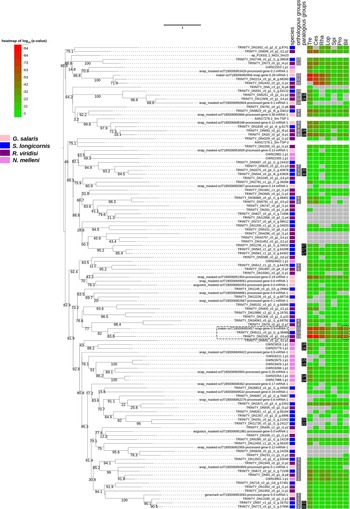
The phylogenetic analysis yielded 13 orthologous groups and nine paralogous groups of monopisthocotylean tetraspanins (fig. 2 and supplementary table S3). We identified putative monopisthocotylean tetraspanins closely related to Sm-TSP-1 (‘ortholog group 8’: snap_masked-scf7180006948348-processed-gene-0.12-mRNA-1 of G. salaris, TRINITY_DN20_c0_g2_i4.p1 and TRINITY_DN693_c0_g1_i9.p1 of R. viridisi, and TRINITY_DN1839_c0_g1_i4__g.6175 of S. longicornis), a tetraspanin from the trematode S. mansoni considered to be a potential candidate for use in a vaccine (fig. 3). Orthologous relationships between monogenean proteins and Sm-TSP-2 and Sm23 were not detected.
Phylogenetic analysis performed using the protein domains of 114 tetraspanins belonging to monopisthocotyleans and three from S. mansoni. The midpoint-rooted phylogenetic tree was constructed using 1000 replicates of the approximate likelihood ratio test (similar to the Shimodaira–Hasegawa test). The WAG + F+R5 model was implemented. The coloured boxes indicate the log10-transformed e-values obtained from the alignment of the monogenean sequences against sequences from different taxa using the NCBI database. Abbreviations: Tre, Trematoda; Ces, Cestoda; Rha, Rhabditophora; Lop, Lophotrochozoa; Spi, Spiralia; Pro, Protostomia; Bil, Bilateria. The proteins Sm23, Sm-TSP-1 and Sm-TSP-1 of S. mansoni were used as reference sequences. Dashed lines show ortholog group 8 and information of the similarity with bilaterian tetraspanins. Colors in the species column represent: purple, R. viridisi; blue, S. longicornis; skin, G. salaris; pink, N. melleni.

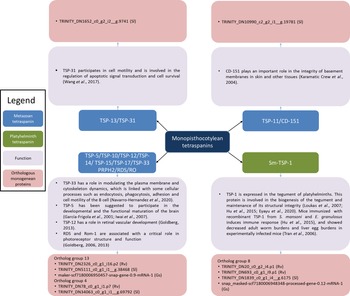
Monopisthocotylean tetraspanins that are phylogenetically closer to other metazoan tetraspanins. Information on the functions of the reference proteins and the identifiers of the monopisthocotylean tetraspanin are shown. Abbreviations: Rv, R. viridisi; Sl, S. longicornis; Gs, G. salaris.

Seven of the 114 monopisthocotylean tetraspanins had phylogenetic closeness to four monophyletic groups of metazoan tetraspanins (fig. 3, supplementary fig. S6 and supplementary table S3). Five proteins from R. viridisi, S. longicornis and G. salaris (‘ortholog group 4’ and ‘ortholog group 13’) were close to the proteins TSP-5, TSP-10, TSP-12, TSP-14, TSP-15, TSP-17, TSP-33, PRPH2, RDS and ROM from other metazoans. A protein from S. longicornis (TRINITY_DN10990_c2_g2_i1__g.19781) was phylogenetically close to TSP-11 and CD-151, whereas another (TRINITY_DN1652_c0_g2_i2__g.9741) was close to TSP-13 and TSP-31.
Twenty-seven monopisthocotylean-specific and 34 flatworm-specific tetraspanins were identified (e-value >1e−5) (supplementary table S4). The similarity of the monopisthocotylean tetraspanins was highest with trematodes, followed by cestodes and then free-living platyhelminths. The ortholog group 13 proteins of monopisthocotyleans were the most conserved tetraspanins, having phylogenetic closeness to proteins of trematodes, cestodes, free-living platyhelminths and distant taxa (fig. 2). Orthologous proteins of this group were identified in platyhelminths through phylogenetic analysis (supplementary fig. S7). With the exception of ortholog group 13, monogenean tetraspanins showed little similarity to bilaterian proteins (see heatmap in fig. 2).
Discussion
In the present study, the identification and classification of the tetraspanin superfamily in monopisthocotylean monogeneans was performed through a bioinformatic pipeline. The number of tetraspanins found in monopisthocotyleans was similar to those found in other parasitic flatworms. Orthologous relationships between monopisthocotylean tetraspanins were scarce. The monopisthocotylean tetraspanins present large sequence divergence, as observed in other metazoans (Garcia-España et al., Reference Garcia-España, Chung, Sarkar, Stiner, Sun and DeSalle2008). This could be related to the ability of tetraspanins to undergo functional adaptation, because they serve important, overlapping and non-essential functions (Huang et al., Reference Huang, Tian, Chen, Yu and Xu2010). For example, tetraspanins are involved in diverse biological processes such as motility, cell adhesion, signalling, protein trafficking and cell–cell interaction (Levy & Shoham, Reference Levy and Shoham2005; Andreu & Yáñez-Mó, Reference Andreu and Yáñez-Mó2014). This suggests that in some taxa, including monogeneans, tetraspanins are the result of rapid sequence divergence.
The 17 monophyletic groups of metazoan tetraspanins identified herein contrast with the classification proposed by Garcia-España et al. (Reference Garcia-España, Chung, Sarkar, Stiner, Sun and DeSalle2008), who suggested four major monophyletic subfamilies. This difference is probably due to the classification methods used. We used the approximate likelihood ratio test, similar to the Shimodaira–Hasegawa test, for the phylogenetic analysis, whereas Garcia-España et al. (Reference Garcia-España, Chung, Sarkar, Stiner, Sun and DeSalle2008) used the maximum parsimony approach, in which the amino acid characters are weighted according to the genetic analysis used.
It was difficult to predict functionality in the monopisthocotylean tetraspanins because they were clustered with multiple reference tetraspanins having different functions. For highly divergent protein groups, their orthologous relationships with proteins from related species can infer and support the prediction of functionality. However, in helminth parasites, the functions of only a few tetraspanins are known (Mousavi et al., Reference Mousavi, Afgar, Mohammadi, Mortezaei, Faridi, Sadeghi and Fasihi Harandi2020). The high divergence of monopisthocotylean tetraspanins is similar to that observed in other worms (Huang et al., Reference Huang, Yuan and Dong2005). Nonetheless, our results suggest that monopisthocotylean tetraspanins of ortholog group 13 are conserved. It is possible that the current repertoire of monopisthocotylean tetraspanins diverged from ortholog group 13 through duplication events and rapid divergence, as suggested for other taxa (Huang et al., Reference Huang, Tian, Chen, Yu and Xu2010). This group includes essential proteins that in vertebrates participate in the regulation of photoreceptor architecture and maturation of tissues (fig. 3). The parasitic platyhelminths also have photoreceptors, which participate in directional responses to light and in the process of locating the larva to a host (Pike & Wink, Reference Pike and Wink1986). Given the essential functions of this protein group in diverse taxa, these tetraspanins might have a similar role in monogeneans.
Special attention was given to proteins with potential for improving strategies to control parasites. Thus, the orthologous relationship between some monopisthocotylean tetraspanins (ortholog group 8) and Sm-TSP-1 represents an interesting finding. Sm-TSP-1 and Sm-TSP-2 are proteins expressed in the tegument of S. mansoni, and represent potential vaccine candidates (Loukas et al., Reference Loukas, Tran and Pearson2007). For example, mice inoculated with recombinant Sm-TSP-1 and Sm-TSP-2 from S. mansoni showed decreased adult worm burdens and liver egg burdens after being infected (Tran et al., Reference Tran, Pearson and Bethony2006). Similarly, mice immunized with recombinant TSP1 from Echinococcus granulosus showed induction of IgG1 and IgG2a antibodies, IFN-γ and IL-12 (Hu et al., Reference Hu, Song and Xie2015). Therefore, TSP-1 in monogeneans might be a potential vaccine candidate for controlling these parasites in fish.
According to the present study, TSP-1 is absent in non-platyhelminth metazoans. In E. granulosus, Eg-TSP-1 is expressed in the tegument and is involved in its biogenesis and maintenance of its structural integrity (Hu et al., Reference Hu, Song and Xie2015; Eyayu et al., Reference Eyayu, Zeleke and Worku2020). The important function of this protein and its possible absence in hosts suggest that TSP-1 might be a potential drug target for controlling platyhelminth infections.
One of the main shortcomings of this study was in the assignment of putative functionality because few monogenean tetraspanins showed orthology to functionally characterized proteins. The limited amount of genomic information available in monopisthocotyleans might have prevented a larger number of orthologous and paralogous groups being found in the phylogenetic analysis. This is important considering that proteins conserved in different species can represent pharmacological targets for an antiparasitic drug. In this study, given the type of data acquired, some tetraspanins were not identified, perhaps because the arrangement of introns and exons was not analysed, which might be important for the detection of these proteins (Huang et al., Reference Huang, Yuan and Dong2005).
Because the transcriptome information was developed from adult monopisthocotylean organisms, it was not possible to detect proteins at specific stages of growth, which might be useful for understanding how tetraspanins participate in the development of monogeneans. It is important to validate the in silico-predicted tetraspanins using other omic technologies and experimental approaches. For example, for G. salaris, transcriptomic information could validate that the tetraspanins predicted from the genome are expressed. Similarly, proteomic information would help validate tetraspanins predicted from the R. viridisi and S. longicornis transcriptome and N. melleni ESTs. Experimental approaches such as RNA interference (RNAi), transgenesis, CRISPR–Cas9 gene editing and immunofluorescence assays could help determine the function and localization of tetraspanins from monogeneans. In non-model organisms in which genetic manipulations are difficult, RNAi is an important tool for determining phenotypes (McVeigh et al., Reference McVeigh, McCusker and Robb2018). Immunofluorescence assays have been used with other platyhelminths to determine the localization of tetraspanins, which is important for identifying the proteins of the tegument that can represent potential target vaccines, as was done for Sm-TSP-1 (Loukas et al., Reference Loukas, Tran and Pearson2007). CRISPR–Cas9 has shown potential for experimental silencing or enhancement of transcription for inferring function in genes of interest in helminths (Lok et al., Reference Lok, Shao, Massey and Li2017).
In summary, the phylogeny of monogenean tetraspanins was reconstructed and a possible evolutionary scenario proposed. One can speculate that the proteins in ortholog group 13, which are phylogenetically close to TSP-5, TSP-10, TSP-12, TSP-14, TSP-15, TSP-17, TSP-33, PRPH2, RDS and ROM, represent an ancestral state of monopisthocotylean tetraspanins. The present study identified vaccine candidates and other potential drug-target proteins in monogeneans. The tetraspanin superfamily represents an important group of proteins to which more attention should be given as potential targets in the development of new control methods against monogenean parasites.
Supplementary material
To view supplementary material for this article, please visit https://doi.org/10.1017/S0022149X22000098.
Financial support
This research was funded by the National Council of Science and Technology of Mexico (CONACyT) through the grant FORDECYT-PRONACES CF/1715616. V.C.-B. thanks CONACyT for his graduate student scholarship.
Conflicts of interest
None.
Ethical standards
The research did not involve human and/or animal experimentation.