The prevalence of mental disorders is not evenly distributed across the population (WHO, 2003). At an individual level, women have a higher prevalence of mental disorders than men, especially those most prevalent mental disorders such as depression and anxiety (Alonso & Lepine, Reference Alonso and Lepine2007; Artazcoz, Borrell, & Benach, Reference Artazcoz, Borrell and Benach2001; Gispert et al., Reference Gispert, Puig, Palomera, Autonell, Gine and Ribas2006; Rocha, Pérez, Rodríguez-Sanz, Borrell, & Obiols, Reference Salvador-Carulla, Costa-Font, Cabases, McDaid and Alonso2010). In addition, unemployed and inactive people (Alonso & Lepine, Reference Alonso and Lepine2007; Artazcoz, Benach, Borrell, & Cortès, Reference Artazcoz, Benach, Borrell and Cortes2004; Fryers, Melzer, & Jenkins, Reference Fryers, Melzer and Jenkins2003; Haro et al., Reference Haro, Palacin, Vilagut, Martínez, Bernal, Luque and Alonso2006; Weich et al., Reference Wilkinson and Pickett2002), people with a lower socioeconomic status and those with poorer physical health (Barbaglia et al., Reference Barbaglia, Duran, Vilagut, Forero, Haro and Alonso2013; Fryers et al., Reference Fryers, Melzer and Jenkins2003; Gispert et al., Reference Gispert, Puig, Palomera, Autonell, Gine and Ribas2006; Rocha et al., Reference Salvador-Carulla, Costa-Font, Cabases, McDaid and Alonso2010) are more likely to develop mental disorders. Post-traumatic stress and other stressful life events (including childhood adversities such as abuse, abandonment and neglect) are also associated with a higher prevalence of mental disorders (Hatch & Dohrenwend, Reference Hatch and Dohrenwend2007). Depression is up to twice as common among those with low-income levels (WHO, 2003).
Living in a neighborhood with a low socioeconomic status is associated with a higher incidence of depression, regardless of individual socioeconomic variables and other covariables (Muntaner et al., 2006; Rocha, Rodríguez-Sanz, Pérez, Obiols, & Borrell, Reference Rocha, Rodríguez-Sanz, Pérez, Obiols and Borrell2013; Weich et al., Reference Wilkinson and Pickett2002). Therefore, there is a higher prevalence of mental disorders in poorer areas (Fone, Dunstan, Williams, Lloyd, & Palmer, Reference Fone, Dunstan, Williams, Lloyd and Palmer2007; Rocha, Rodríguez-Sanz et al., Reference Rocha, Rodríguez-Sanz, Pérez, Obiols and Borrell2013), with the highest unemployment rates (Gispert et al., Reference Gispert, Puig, Palomera, Autonell, Gine and Ribas2006; Harrison, Barrow, & Creed, Reference Harrison, Barrow and Creed1998), the highest proportion of economically inactive individuals (Fone et al., Reference Fone, Dunstan, Williams, Lloyd and Palmer2007; Weich et al., Reference Wilkinson and Pickett2002), higher immigration and/or ethnic minority rates (Gispert et al., Reference Gispert, Puig, Palomera, Autonell, Gine and Ribas2006; Harrison et al., Reference Harrison, Barrow and Creed1998) and higher mortality rate before the age of 65 (Harrison et al., Reference Harrison, Barrow and Creed1998).
A previous study conducted in Catalonia concluded that, in addition to individual variables (age, employment status and chronic diseases), contextual variables, such as higher unemployment and immigration rates in the area, were associated with a higher prevalence of mental disorders or current psychological stress, measured through the General Health Questionnaire (GHQ-12) screening instrument. Furthermore, another study showed that there are differences in the distribution of psychological morbidity in the different Autonomous Communities (ACs) in Spain, also using the GHQ-12 (Ricci-Cabello, Ruiz-Perez, Plazaola-Castano, & Montero-Pinar, Reference Rocha, Pérez, Rodríguez-Sanz, Borrell and Obiols2010). However, the study does not explore which contextual variables of the ACs could explain these differences.
In Spain, there are significant socioeconomic inequalities in the 17 ACs. Another important aspect to highlight is that the Spanish health system is regional and decentralized in the 17 ACs (Reverte-Cejudo & Sánchez Bayle, Reference Ricci-Cabello, Ruiz-Perez, Plazaola-Castano and Montero-Pinar1999). Each AC has its own mental health plan. The diversity in the organization of mental health throughout the ACs can be positive, but can also generate inequalities (WHO, 2005).
Although the health care system is only one of the determinants of the health of a population, there is evidence that health systems with public financing achieve better levels of equity (Hsiau & Liu, Reference Hsiao, Liu, Evans, Whitehead, Diderichsen, Bhuiya and Wirth2001). Studies conducted in Spain have described inequities in the distribution of mental health resources among the ACs (Medel & Sarria, Reference Medel and Sarria2009). Thus, differences in relation to the budget allocated to mental health, the number of mental health professionals per capita (Medel & Sarria, Reference Medel and Sarria2009; Salvador-Carulla, Costa-Font, Cabases, McDaid, & Alonso, Reference Salvador-Carulla, Garrido, McDaid and Haro2010; Salvador-Carulla, Garrido, McDaid, & Haro, Reference Salvador-Carulla, Saldivia, Martinez-Leal, Benjamin, Garcia-Alonso, Grandon and Haro2006) and also in the access to mental health services (Montilla, Gonzáles, Retolaza, Duenas, & Alameda, Reference Muntaner, Li, Xue, Thompson, O'Campo, Chung and Eaton2002; Rocha, Pérez et al., Reference Rocha, Rodríguez-Sanz, Pérez, Obiols and Borrell2013; Salvador-Carulla et al., Reference Weich, Blanchard, Prince, Burton, Erens and Sproston2008) are observed.
In this context, the objective of the present study was to analyze inequalities in poor mental health prevalence and its association with socioeconomic variables and with the mental health care network of the Autonomous Communities (ACs) in Spain in 2006.
Method
In this study, a multilevel cross-sectional study design was performed, using the individual data collected in the National Health Survey of Spain (ENS-2006) and contextual data of the 17 Autonomous Communities (ACs).
Study population, sample and procedures
The study population was non-institutionalized individuals. The ENS-2006 population was selected using stratified multistage sampling. The first stage units were census tracts and second stage units were households. Within each household, one adult (over 16 years of age) was randomly selected to complete the questionnaire. The sample included approximately 31,300 households spread over 2,236 census tracts. Ninety-six percent of the theoretical sample was interviewed. The total number of respondents over 16 years of age was 29.478. Data were collected between June 2006 and June 2007. The interviews were conducted in the interviewee’s home by trained interviewers (MNHS, 2006).
Dependent variable
Mental health: It was evaluated using the screening instrument for mental health problems General Health Questionnaire (GHQ-12). The GHQ-12 identifies possible cases of mental disorder in the population and consists of 12 items that are answered using a 4-point Likert-type scale. The GHQ-12 assesses the subjective mental health state of individuals and identifies their current psychological stress (psychological distress) and is more sensitive to depression and anxiety disorders. The dependent variable in this study are those individuals that scored 3 or more points on the GHQ-12 score, a value that has been proposed as a cut-off point for screening depressive and anxiety disorders (Goldberg et al., Reference Goldberg, Gater, Sartorius, Ustun, Piccinelli, Gureje and Rutter1997; Rocha, Pérez, Rodríguez-Sanz, Borrell, & Obiols, Reference Rocha, Pérez, Rodríguez-Sanz, Alonso, Muntaner and Borrell2011).
Independent or explanatory variables
The individual variables included were age, occupational social class, health coverage, country of origin and employment status. Age was divided into 3 groups: 16–44; 45–64; 65 or more. The social class variable was obtained comparing the social class of the individual who works or had worked and that of the main breadwinner and choosing the most privileged of the two, grouped into either manual and non-manual classes, according to the Spanish adaptation of the British Registrar General classification (Domingo-Salvany, Regidor, Alonso, & Alvarez-Dardet, Reference Domingo-Salvany, Regidor, Alonso and Alvarez-Dardet2000). The health coverage was classified as either public coverage only or dual coverage (public and private). The country of birth was grouped into: 1) Europe and other developed countries, and 2) countries considered as low income (countries with a Human Development Index less than 0.9 according to the United Nations Development Program). The employment status was grouped into student or employee; unemployed or on sick leave; retirees or pensioners and homemakers.
Autonomous Community Contextual variables
Socioeconomic
Gini index (Cowell & Kuga, Reference Cowell and Kuga1981): This is a measure of income equality. Zero corresponds to perfect equality and 100 corresponds to the greatest income inequality. Data for the year 2006. Information source: Observatorio Social de España. Wage Structure Survey, Reference Reverte-Cejudo and Sanchez-Bayle2006.
Unemployment rate: Percentage of unemployed individuals who are their household reference in each AC. Data from 2001. Observatorio Social de España, Reference Reverte-Cejudo and Sanchez-Bayle2006.
Percentage of immigrants: Percentage of immigrant population in each AC. Data from 2006. SI: Data from the Active Population Survey, 2006.
Mental Health Network
Human Resources: Number of psychiatrists, psychologists and nurses working in mental health per 100000 population per AC. Data from 2007. Observatorio de Salud Mental de la Asociación Española de Neuropsiquiatría (2009).
Number of mental health centers per 100000 populations. Data from 2007. Observatorio de Salud Mental de la Asociación Española de Neuropsiquiatría (2009).
Number of mental health care beds per 100000 populations. Data from 2007. Observatorio de Salud Mental de la Asociación Española de Neuropsiquiatría (2009).
Data Analyses
Individual Analyses
The first step was to analyze the prevalence of the current psychological distress in the population, according to variables such as age, social class, health coverage, country of origin and employment status.
Multilevel analyses
Multilevel logistic regression models were fitted to obtain odds ratios (OR) and confidence intervals (95% CI), which allowed for the simultaneous examination of the effects at the AC level and variables at an individual level. These models were fitted using the Hierarchical Linear and Nonlinear Modeling (HLM) statistical software. The models were divided into two levels, the individual variables (age, social class, health coverage, country of origin and employment status) and area-level variables (socioeconomic and mental health care network variables). The steps in the construction of the models were: 1) Model 1: included all individual variables; 2) Model 2: 5 models, each of which included the individual variables and one of the contextual variables, and 3) Model 3: included the individual and contextual variables that were significant in the previous models. The last step was to study the explained variability in the different models. All analyzes took into account the weights derived from the sample design.
Results
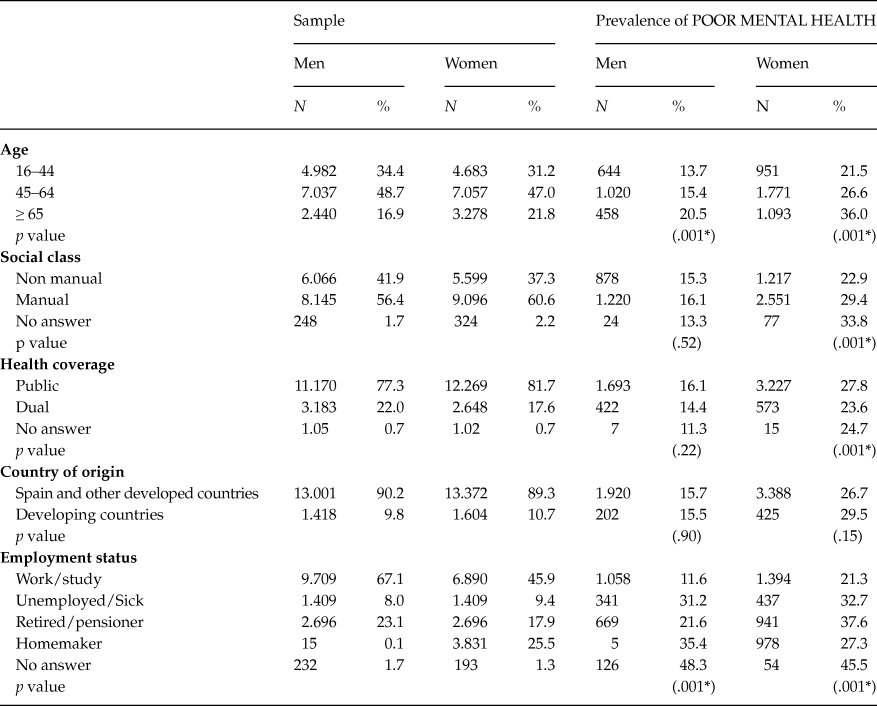
The results in Table 1 show that the prevalence of poor mental health increased significantly with age, for both men and women. Women from the manual social class that only had public health coverage had a significantly higher prevalence of poor mental health. Men and women who were unemployed (or on sick leave), or retired (or pensioners) had a higher prevalence of poor mental health.
Sample description and prevalence of poor mental health according to socioeconomic variables (n = 29.478)

Note: *p value < .001.
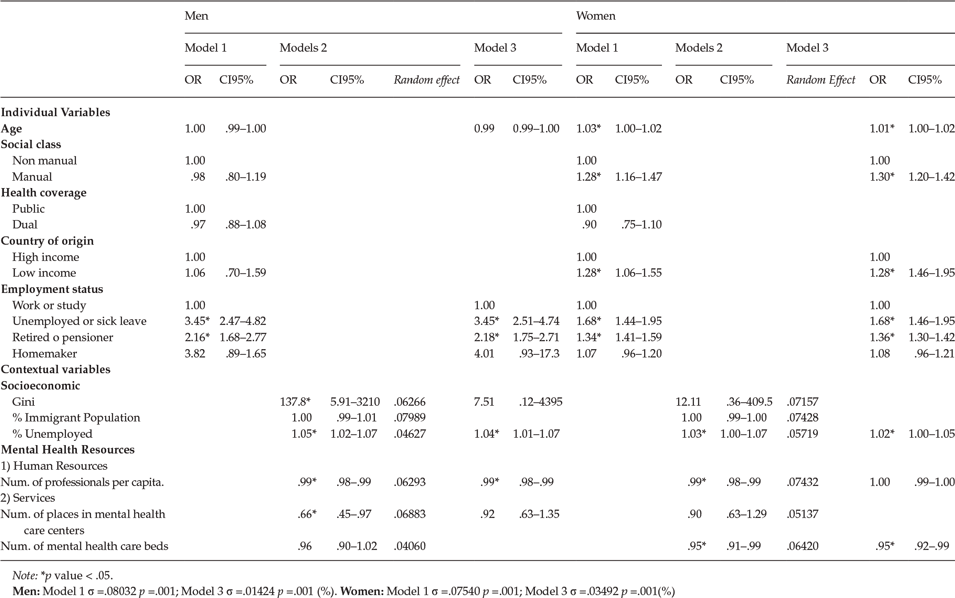
The results in table 2 shows the model 1, which jointly analyzed all individual variables, results show that men who were unemployed or on sick leave, retired or on a pension had poorer mental health. The results for model 2, which included all individual variables and each of the contextual variables separately, show that the ACs with greater income inequality in their population (Gini index OR 137.8 CI 5.91–3210) and a higher percentage of unemployment (OR 1.05 CI 1.02–1.07) had higher prevalence of poor mental health. Among the variables of the mental health care network, results show that in those communities that had a lower rate of mental health professionals and fewer mental health care beds per habitant, a greater prevalence of poor mental health existed. Model 3, which included individual and contextual variables that were significant in models 1 and 2, shows that at an individual level, prevalence of poor mental health remained significantly higher among the unemployed or on sick leave (OR 3.45 CI 2.51–4.74) and among retirees or pensioners (OR 2.18 CI 1.75–2.71). Among the contextual variables, a higher rate of unemployment in the AC (OR 1.04 CI 1.01–1.07) and a lower rate of mental health professionals per capita in the AC (OR .99 CI .98–.99) were associated with a higher prevalence of poor mental health.
Association between the prevalence of common mental disorder (poor mental health) and individual and contextual variables. Multilevel analysis

Note: *p value < .05.
Men: Model 1 σ =.08032 p =.001; Model 3 σ =.01424 p =.001 (%). Women: Model 1 σ =.07540 p =.001; Model 3 σ =.03492 p =.001(%)
In model 1, results for women show that the increase in age, belonging to manual social class, being an immigrant from a low-income country and being unemployed/on sick leave or retired/pensioner were associated with a higher prevalence of poor mental health. The results for model 2, which analyzed all individual variables together with each of the contextual variables separately, show that in ACs with higher unemployment rates a higher prevalence of poor mental health existed (OR 1.03 CI 1.02–1.07). Among the variables of the mental health care network, it is observed that in communities with lower rates of mental health care professionals per capita and fewer mental health care beds there was a greater prevalence of poor mental health. In model 3, which included the individual and contextual variables that were significant in models 1 and 2, results show that with increasing age, the prevalence of poor mental health (OR 1.01 CI 1.01–1.02) increased. This is also the case for women from manual social classes (OR 1.30 CI 1.20–1.42), immigrants from low-income countries (OR 1.28 CI 1.46–1.95) and among those unemployed or on sick leave (OR 1.68 CI 1.46–1.95) and retired or receiving a pension (OR 1.36 CI 1.30–1.42). Among the contextual variables, a higher rate of unemployment in the ACs (OR 1.02 CI 1.00–1.05) and a lower rate of mental health care beds per capita in the ACs (OR .95 CI .92–.99) are associated with a higher prevalence of poor mental health.
Discussion
This study shows that there are inequalities in the prevalence of poor mental health in Spain associated with both individual and contextual factors of the Autonomous Communities. Previous studies have revealed that the prevalence of poor mental health varies in accordance with individual socioeconomic variables both at a national (Artazcoz et al., Reference Artazcoz, Benach, Borrell and Cortes2004; Gispert et al., Reference Gispert, Puig, Palomera, Autonell, Gine and Ribas2006; Rocha et al., Reference Salvador-Carulla, Costa-Font, Cabases, McDaid and Alonso2010) and at an international (Alonso & Lepine, Reference Alonso and Lepine2007; Fryers et al., Reference Fryers, Melzer and Jenkins2003; Haro et al., Reference Haro, Palacin, Vilagut, Martínez, Bernal, Luque and Alonso2006; Weich et al., Reference Wilkinson and Pickett2002) level. However, this present study shows that, in addition to these individual inequalities, differences in the prevalence of poor mental health are associated with socioeconomic variables of the AC, such as the unemployment rate in the AC and the level of income inequality (Gini). Results of previous studies show that there are inequalities in the distribution of mental health resources in Spain by AC (Medel & Sarria, Reference Medel and Sarria2009; Salvador-Carulla et al., Reference Salvador-Carulla, Saldivia, Martinez-Leal, Benjamin, Garcia-Alonso, Grandon and Haro2006; Reference Salvador-Carulla, Garrido, McDaid and Haro2010), which generate not only inequalities in the access to mental health services (Montilla et al., Reference Muntaner, Li, Xue, Thompson, O'Campo, Chung and Eaton2002; Rocha, Pérez et al., Reference Rocha, Rodríguez-Sanz, Pérez, Obiols and Borrell2013; Salvador-Carulla et al., Reference Weich, Blanchard, Prince, Burton, Erens and Sproston2008), but also inequalities in the prevalence of poor mental health, as shown by the results of the present study.
Previous research showed that, at an ecological level, there were significant differences in the distribution of poor mental health in the different Autonomous Communities in Spain (Ricci-Cabello et al., Reference Rocha, Pérez, Rodríguez-Sanz, Borrell and Obiols2010). However, these studies did not explore which individual and contextual variables might explain these differences. Thus, after controlling for individual variables, it can be observed that the higher prevalence of poor mental health is associated with a higher rate of unemployment in the AC, for both men and women. These results corroborate the results found in Gispert et al. (Reference Gispert, Puig, Palomera, Autonell, Gine and Ribas2006) study with data from the Catalonia Health Survey. There are many studies showing the association between unemployment and mental health problems at the individual level (Alonso & Lépine, Reference Alonso and Lepine2007; Artazcoz et al., Reference Artazcoz, Benach, Borrell and Cortes2004; Fryers et al., Reference Fryers, Melzer and Jenkins2003; Haro et al., Reference Haro, Palacin, Vilagut, Martínez, Bernal, Luque and Alonso2006), however, there is scarce literature that explores this impact at a contextual level. These results are particularly important considering the context of Spain, which historically presents high rates of unemployment (Legido-Quigley et al., Reference Legido-Quigley, Otero-Garcia, la Parra, Alvarez-Dardet, Martin-Moreno and McKee2013).
The ACs with the highest level of income inequality have a higher prevalence of poor mental health, which reinforces the negative impact of income inequality on mental health. Studies comparing countries show that countries with higher levels of equality exhibit better indicators of population health (Buss & Pelligrini, Reference Buss and Pellegrini2007; Kawachi & Kennedy Reference Kawachi and Kennedy1997; Wilkinson & Pickett, 2009). This result substantiates the importance of studying the social inequalities within a country, which may be considered unfair and unjust.
In addition to the contextual socioeconomic variables, mental health care network variables are also associated with the prevalence of poor mental health. Among men, a lower rate of mental health professionals per population (psychiatrists, psychologists and nursing staff trained to work in mental health), and a lower rate of mental health care are associated with higher prevalence of poor mental health. In women, the lower rate of hospital beds for mental health care is associated with a higher prevalence of poor mental health. These findings reinforce the importance of studying the impact of the availability of mental health resources in the mental health of the population. According to the Mental Health Atlas of the World Health Organization (WHO, 2011) the costs of mental health in Spain on behalf of the Health Department is 5% of the total health budget. On the other hand, it is estimated that, in Spain, neuropsychiatric disorders contribute 27.4% of the global burden of illnesses (WHO, 2008). In this regard, it is noted that there is a substantial difference between the burden caused by mental disorders and the resources available for prevention and treatment (WHO, 2011).
Since 1986, Spain has a National Health System (NHS), which is publicly funded mainly through general taxation, and provides universal service coverage. It is noteworthy that, after the cutbacks performed in the health sector in 2012, the universality of the system can be questioned (Legido-Quigley et al., Reference Legido-Quigley, Otero-Garcia, la Parra, Alvarez-Dardet, Martin-Moreno and McKee2013). The Spanish health system is regional and decentralized into17 ACs (Reverte-Cejudo & Sánchez Bayle, Reference Ricci-Cabello, Ruiz-Perez, Plazaola-Castano and Montero-Pinar1999).
In Spain, each AC has its own mental health care plan and there is a national mental health strategy (MNHS, 2006). The plans are very similar in their theoretical formulation, but differ in their practical application, showing significant disparities in the organization of the mental health network and in the finance resources allocated to mental health care in the AC. The diversity in the organization of the mental health care of the ACs can be positive, but can also generate inequalities (WHO, 2005), which is confirmed by the results of this study.
The results of this study reinforce that access to mental health services has a protective nature for mental health problems. In times of financial crisis, such as the present where austerity plans include a major cutback in Healthcare costs (Legido-Quigley et al., Reference Legido-Quigley, Otero-Garcia, la Parra, Alvarez-Dardet, Martin-Moreno and McKee2013), these results have an increased relevance, as they highlight the fact that cutbacks can have very negative effects on the health of the population. Future studies should investigate the effect of the crisis and cutbacks in health care, and mainly on the mental health of the Spanish population.
The study has some limitations, one of which is in relation to the instrument used, which is a screening tool and not diagnostic tool. It is more sensitive than specific, which may lead to an overestimation of the existing mental health problems. Another aspect to consider is that this is a cross-sectional study, which hinders the possibility of establishing causal relationships between the study variables. On the other hand, one of the strengths of this study is the sample size, with more than 29,000 participants and their representation of the Spanish population and the fact that it was regionalized into ACs, which enabled a multilevel analysis. This underlines the methodological sophistication, and identifies inequalities that can serve as tools to establish mental health policies that serve the mental health of the entire Spanish population equally.
Not only the access to health services is important, but also income and unemployment inequality, which are the biggest problems of the country, considering that the survey was conducted in 2006, before the recession and the subsequent rise in unemployment to 30% and 55% for the active and the young population respectively (INE, 2013). The risk of psychiatric disorders such as depression becomes even more pressing in terms of social policies (job creation) and services.
This project was funded partly by the National Plan for Scientific Research, Development and Technological Innovation (Plan Nacional de I + D + i 2008–2011), by the Departamento General de Investigación, Evaluación y Promoción del Instituto de Salud Carlos III (PI09/90676) and by the Sociedad Epidemiológica Enrique Nájera award.