INTRODUCTION
It has been suggested that differences in the upper visual field (UVF) and bottom visual field (BVF) might relate to extrapersonal and peripersonal space differences, respectively (Previc, Reference Previc1990). Previc suggests that stimuli that are located in the lower visual field are more likely to be found in peripersonal space, whereas those located in the upper visual field are more likely to be located at a distance, in extrapersonal space. Furthermore, it is suggested that when an object is brought into peripersonal space, it will likely also be brought into the lower visual field (Previc). These differences are additionally thought to be associated with dorsal and ventral visual stream processing differences.
Weiss et al. (Reference Weiss, Marshall, Wunderlich, Tellmann, Halligan and Freund2000) demonstrated that when acting in peripersonal space there is greater neural activity in the dorsal stream; however ventral stream activity is greater during extrapersonal space processing. A space-based dissociation has also been shown in clinical hemispatial neglect, as it can occur solely in peripersonal space (Halligan & Marshall, Reference Halligan and Marshall1991), or alternatively, can be stronger in extrapersonal space (i.e., Keller, Schindler, Kerkhoff, von Rosen, & Golz, Reference Keller, Schindler, Kerkhoff, von Rosen and Golz2005), suggesting that distance-related differences might occur in pseudoneglect (Bowers & Heilman, Reference Bowers and Heilman1980), as well.
Various tasks have been used to examine pseudoneglect, such as line bisection and landmark tasks (i.e., Luh, Reference Luh1995; McCourt & Jewell, Reference McCourt and Jewell1999). On these tasks, typically individuals exhibit a lateral bias, whereby they are more likely to bisect lines to the left of center or to indicate that a transection mark is located to the left of center (landmark task). It has been suggested that this reliably observed phenomenon is similar to clinical hemispatial neglect and therefore has been referred to as pseudoneglect (Bowers & Heilman, Reference Bowers and Heilman1980). Examinations of pseudoneglect in peripersonal and extrapersonal space using line bisection and landmark tasks have typically found that the leftward bias is stronger in peripersonal space than extrapersonal space (Bjoertomt, Cowey, & Walsh, Reference Bjoertomt, Cowey and Walsh2002; Garza, Eslinger, & Barrett, Reference Garza, Eslinger and Barrett2008), with one study identifying a progressive bias that became rightward in extrapersonal space (Varnava, McCarthy, & Beaumont, Reference Varnava, McCarthy and Beaumont2002).
Line bisection tasks are typically performed in extrapersonal space through the use of a laser pointer. Interestingly, Longo and Lourenco (Reference Longo and Lourenco2006) found that although the leftward bias shifted rightward when a laser pointer was used during bisection, the use of a stick led to a consistent leftward bias, regardless of distance. They concluded that the use of a stick allows extrapersonal space to be remapped as peripersonal space, allowing the leftward bias to persist. When using a laser pointer this remapping does not occur and areas typically activated by peripersonal space (i.e., intraparietal sulcus in the right hemisphere; Bjoertomt et al., Reference Bjoertomt, Cowey and Walsh2002) are no longer activated, leading to a rightward shift in bias (Longo & Lourenco).
Alternatively, Varnava et al. (Reference Varnava, McCarthy and Beaumont2002) suggested that each cerebral hemisphere has a unique spatial coordinate system, and that as one system is used more or less prominently, there is a gradual shift in coordinate system, leading to opposing biases in peripersonal and extrapersonal space. They proposed that the progressive nature in which the bias becomes rightward points to a gradual shift, as opposed to an abrupt switch from left to right. This suggestion is consistent with the findings of Longo and Lourenco (Reference Longo and Lourenco2006). However, Wilkinson and Halligan (Reference Wilkinson and Halligan2003) did not find distance-based differences when stimulus size was held constant, highlighting the importance of controlling this factor.
Initial research examining UVF and BVF differences on line bisection and landmark tasks has been conducted; however results of these studies have been inconsistent. McCourt and Jewell (Reference McCourt and Jewell1999) and McCourt and Garlinghouse (Reference McCourt and Garlinghouse2000) compared performance on a landmark-type task in the UVF and BVF using tachistoscopic presentation (150 ms). Lines were presented at 3.6° and 5.8° visual angle, respectively. Participants were asked whether a transector was located to the left or right of center. In both instances, a stronger leftward bias was identified in the UVF compared with the BVF.
A third investigation by Barrett, Crosson, Crucian, & Heilman, (Reference Barrett, Crosson, Crucian and Heilman2000) used a manual line bisection task (unlimited completion time) presented at 40.5 cm either above or below the midsagittal plane. Barrett and colleagues identified a stronger leftward bias in lower body space as opposed to upper body space. It is difficult to draw any strong conclusions relating to these findings, as all three studies were methodologically different. It is clear that the results of these studies are not consistent with one another.
To better understand how perceptual asymmetries are affected by viewing distance, the gray-scales task was presented in both peripersonal and extrapersonal space. Furthermore, to increase understanding of how visual field differences and space-based differences relate, this task was presented to both the UVF and the BVF. Previous findings have been contradictory, suggesting that both space-based and visual field differences should be examined in one manipulation to better understand their relationship, as well as how each individually influences perceptual asymmetries.
The gray-scales task has been used to examine perceptual asymmetries (Nicholls, Bradshaw, & Mattingley, Reference Nicholls, Bradshaw and Mattingley1999). This task involves making a judgment between two equiluminant mirror-reversed rectangles going from black on one side to white on the other, one rectangle being dark on the left and the other dark on the right. When asked to select which image appears to be darker (or brighter) overall, most often individuals will choose the rectangle with the salient feature on the left side, despite the images being equiluminant (Nicholls et al., Reference Nicholls, Bradshaw and Mattingley1999). Kinsbourne (Reference Kinsbourne1970) hypothesized that as a result of right hemisphere involvement in attention, attentional vectors are preferentially directed to the left side of space. Therefore, the leftward bias observed on this task is thought to reflect increased attention being directed to the left, and leading to a left-side spatial bias. Similar tasks have been used to examine judgments of size, numerosity (Nicholls et al., Reference Nicholls, Bradshaw and Mattingley1999), and distance (Krupp, Robinson, & Elias, in press), all of which also demonstrate leftward biases.
There have been a number of suggested explanations, including scanning and reading habits (Chokron, Bartolomeo, Perenin, Helft, & Imbert, Reference Chokron, Bartolomeo, Perenin, Helft and Imbert1998; Manning, Halligan, & Marshall, Reference Manning, Halligan and Marshall1990), motor biases (i.e., Nicholls & Roberts, Reference Nicholls and Roberts2002), and intentional or pre-motor biases (Brodie & Pettigrew, Reference Brodie and Pettigrew1996; Heilman & Valenstein, Reference Heilman and Valenstein1979). Nicholls and Roberts (Reference Nicholls and Roberts2002) carried out a series of experiments demonstrating that these explanations do not fully account for observed leftward biases. Individuals with opposite reading patterns also demonstrated leftward biases, and bimanual responding led to leftward biases, as well, illustrating that these explanations are incomplete.
Attentional or perceptual biases currently appear to be the most plausible explanation for perceptual asymmetries. The leftward bias also occurs during tachistoscopic presentation (McCourt & Jewell, Reference McCourt and Jewell1999), supporting the idea that left biases are attentional in nature. A final explanation, although preliminary, also appears promising. It has been shown that birds demonstrate a leftward bias on perceptual asymmetries tasks, which suggests the possibility of an evolutionary basis for the leftward bias (Diekamp, Regolin, Güntürkün, & Vallortigara, Reference Diekamp, Regolin, Güntürkün and Vallortigara2005; Regolin, Reference Regolin2006). However, this explanation is quite preliminary and admittedly difficult to examine in a human population.
Prior research indicates a need to evaluate space-based differences in perceptual asymmetries by using a paradigm that is easily performed in both peripersonal and extrapersonal space. The current study examined both peripersonal and extrapersonal space differences and visual field differences using the gray-scales task. Although a stronger leftward bias has been previously observed in extrapersonal space, it was hypothesized that when the visual angle of the stimuli was kept constant, (i.e., Dellatolas, Vanluchene, & Coutin, Reference Dellatolas, Vanluchene and Coutin1996; Wilkinson & Halligan, Reference Wilkinson and Halligan2003), there would not be any distance-based differences in perceptual asymmetries. Controlling the visual angle of the stimulus would ensure that the relative size of the stimulus remained constant and did not create a confound. We also investigated UVF and BVF differences by presenting gray-scale pairs to either the UVF or the BVF. As McCourt and colleagues (Reference McCourt and Jewell1999; Reference McCourt and Garlinghouse2000) found a stronger leftward bias in the UVF using an attention-based landmark task, it was expected that the leftward bias would be stronger in the UVF compared with the BVF. It has been suggested that UVF and BVF differences may correspond with extrapersonal and peripersonal space; however, as distance-based differences were not expected, this interaction was not expected to be observed.
METHODS
Participants
Thirty-nine right-handed undergraduate Psychology students (10 males; mean age = 19.72, SD = 3.74) at the University of Saskatchewan participated in the current study. Students received course credit in exchange for participation. Based on self-report, all participants had normal or corrected-to-normal vision. This study was conducted with the ethical approval of the Behavioral Research Ethics Board at the University of Saskatchewan.
Materials
Gray-scales task
E-prime (Psychology Software Tools, Inc., Pittsburgh, PA; www.pstnet.com/eprime) was used to administer a series of 320 gray-scales, of five different lengths: 400, 480, 560, 640, and 720 pixels. Eighty of the gray-scales were two mirror-reversed images where one appeared directly above the other, with one of the images being dark on the left side, whereas the other was dark on the right side. The remaining 240 gray-scales were not mirror-reversed, in that one gray-scale was 250, 500, or 1000 pixels darker than the other one. Gray-scales were at 9.2° visual angle, either above or below the center of the screen, with 160 trials in each visual field condition (UVF, BVF). As it is important to control visual angle when looking at distance-based differences (i.e., Dellatolas et al., Reference Dellatolas, Vanluchene and Coutin1996), visual angle was maintained across conditions. This task can be easily performed in extrapersonal space through the use of a data projector.
There were two viewing distances: peripersonal space and extrapersonal space, each with 160 trials. Stimuli in the peripersonal space condition were administered on an IBM clone computer (PIV 2.6 GHz) interfaced with a 19” LCD monitor running at 1024 × 768 resolution. Participants used a chin rest in this condition to minimize head movement, and distance to the screen was 71.1 cm. In the extrapersonal space condition, an IBM laptop computer interfaced with a Sony VPL-ES3 3 LCD projector was used to project stimuli onto a screen at a distance of 289.6 cm from the participant. As it was not possible to use a chin rest in the extrapersonal space condition, participants were asked to remain as still as possible for the duration of the task.
Participants were asked to select whether the image on the top or the bottom of the pair appeared darker. A central fixation was presented prior to each trial and participants were free to scan the images prior to responding. The gray-scales task does not require significant motor involvement for responses, which were made with the right hand using the “t” and “b” keys, where “t” represents the top image is chosen, and “b” represents the bottom image is chosen. Responses, as well as response time, were recorded. Participants were given a maximum of five seconds to respond and no one exceeded this maximum. A response bias score was calculated by subtracting the number of leftward responses from the number of rightward responses, with a negative score indicating a leftward bias (Nicholls et al., Reference Nicholls, Bradshaw and Mattingley1999).
Procedure
Following informed consent, participants completed a demographic questionnaire addressing items such as sex, age, visual or hearing impairments, and handedness and footedness (Elias, Bryden, & Bulman-Fleming, Reference Elias, Bryden and Bulman-Fleming1998). Following completion of the questionnaire, participants completed the gray-scales task twice, once in peripersonal space and once in extrapersonal space, with presentation order being counterbalanced.
RESULTS
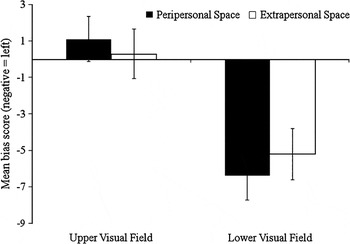
A 2 × 2 × 5 repeated-measures analysis of variance (ANOVA) was computed with within-subjects independent variables being visual field (UVF, BVF), viewing distance (peripersonal, extrapersonal), and length of the gray-scale (400, 480, 560, 640, 720 pixels), and the dependent variable being the bias score on the gray-scales task. There was no main effect of viewing distance, F(1, 38) = .023, p = .879, demonstrating that performance did not differ between peripersonal and extrapersonal space. Nor was there a main effect of length of the gray-scale, F(4, 152) = 1.758, p = .140. The interaction of viewing distance and visual field also failed to reach significance, F(1, 38) = .878, p = .355. There was an overall main effect of visual field, F(1, 38) = 28.288, p < .001, indicating a stronger leftward bias in the BVF than the UVF (p < .001; see Figure 1).
Interaction of visual field and viewing distance. Error bars represent standard errors of the mean.

Significant interactions between length of the gray-scale and visual field (F(4, 152) = 9.929, p < .001) and between length of the gray-scale and viewing distance were also observed (F(4, 152) = 2.689, p = .033). For the length of the gray-scale by visual field interaction, post hoc paired-samples t-tests showed that a stronger left bias occurred in the BVF for the 720-pixel length than for the 400 (p = .015) and 640 (p = .008) pixel lengths. In the UVF, post hoc paired-samples t-tests showed that a stronger left bias occurred for the 400 (p < .001), 480 (p < .001), and 640 (p < .001) pixel lengths when compared with the 720-pixel length. There was also a stronger left bias for the 480 (p = .004) and 640 (p < .001) pixel lengths compared with the 560-pixel length. The 640-pixel length also had a stronger left bias than the 400-pixel length (p = .034).
For the length by viewing distance interaction, post hoc paired-samples t-tests indicated that in extrapersonal space, the gray-scale that was 640 pixels in length had a significantly stronger leftward bias than all other lengths (all p’s < .014). No other significant differences were seen for the length by viewing distance interaction.
Overall, for gray-scale pairs that were equiluminant, participants chose the gray-scale that was darker on the left side 62.5% of the time. Accuracy scores were also calculated to examine how accuracy was influenced by luminance difference. When there was a 250-pixel difference between the gray-scales, participants were accurate in choosing the gray-scale that was actually darker 63% of the time. When there was a 500 or 1000 pixel difference between the gray-scales, participants were accurate in choosing the gray-scale that was actually darker 72.5% and 79.5% of the time, respectively. As visual field differences were observed, accuracy scores were also compared across the upper and bottom visual fields for each luminance difference. There was no significant difference in accuracy scores for 250 pixel differences, t(38) = 1.69, p = .08; however a difference was seen in both the 500 pixel, t(38) = −1.83, p = .04, and the 1000 pixel luminance differences, t(38) = −2.02, p = .03) Participants were more accurate in the UVF in both instances (500 pixels: UVF = 75%, BVF = 71%; 1000 pixels: UVF = 83%, BVF = 79%); however, this difference only occurred in extrapersonal space, as there were no accuracy differences in peripersonal space (all p’s > .15).
DISCUSSION
A significant leftward bias was observed, with participants exhibiting a stronger leftward bias in the BVF than the UVF. Interestingly, a significant interaction was observed with length and both viewing distance and visual field; however, no consistent pattern of findings emerged. There were no space-based differences when comparing performance in peripersonal and extrapersonal space. This is consistent with prior suggestions that when the visual angle of stimuli is held constant, space-based differences will not occur (i.e., Dellatolas et al., Reference Dellatolas, Vanluchene and Coutin1996). Although prior investigations of perceptual asymmetries have identified the possibility of space-based differences, the current findings did not demonstrate any such difference. Although variations in the type of task might also contribute to the lack of a significant difference, the current result supports the suggestion that when visual angle is maintained, space-based differences will not occur.
As a variety of previous studies have identified distance-based differences using line bisection tasks, it is possible that line bisection and the gray-scales task are not measuring the same phenomenon. In the past, researchers (i.e., Nicholls et al., Reference Nicholls, Bradshaw and Mattingley1999) have failed to observe a correlation between the two tasks, which might show that performance on one task is not closely related to performance on the other. Although it remains unclear as to why the two phenomena do not correlate, motor involvement in manual line bisection may contribute to differential findings. The underlying neural mechanisms are thought to be similar for both tasks, as both are proposed to measure spatial biases; however, pseudoneglect previously observed on line bisection tasks might not be the same as the perceptual asymmetries measured by the gray-scales task.
There was a significant difference observed between the visual field conditions, with a stronger leftward bias being observed in the BVF than in the UVF. This was not consistent with the findings of McCourt and Jewell (Reference McCourt and Jewell1999) or McCourt and Garlinghouse (Reference McCourt and Garlinghouse2000), who found a stronger leftward bias in the UVF on a landmark task. This result, however, is consistent with that of Barrett et al. (Reference Barrett, Crosson, Crucian and Heilman2000), who also observed a stronger left bias in the BVF. It is of interest to note that McCourt and colleagues used tachistoscopic presentation (150 ms) in both studies, and the method employed by Barrett et al. and in the current study was a free-viewing presentation. Methodological differences in task and presentation time appear to be the most likely explanation for these mixed results; however, the method employed by Barrett et al. bears no similarities to the current method, further complicating the interpretation of these findings.
Examination of the accuracy scores by visual field showed that participants were more accurate in the UVF in extrapersonal space as the luminance difference increased. This suggests an UVF accuracy advantage is occurring in extrapersonal space, which would be consistent with a stronger leftward bias in the BVF (performance is not as accurate). As perceptual biases exhibited visual field differences in the absence of distance-based differences, it does not appear to be the case that the distance-based and visual field differences correspond with one another in perceptual asymmetries. Based on the current results, it would appear that this explanation is not plausible in explaining visual field differences. As there is some evidence to indicate that dorsal and ventral visual stream differences might relate to visual field processing, it would be of interest to compare perceptual asymmetries performance using tasks that specifically target either the dorsal or the ventral visual stream. This would assist in determining whether visual stream processing differences relate to the visual field differences that have been observed in perceptual asymmetries.
An additional possibility relates to the more recent evolutionary explanations that have emerged from the examination of perceptual asymmetries in birds. Further research in this area might also contribute to the understanding of visual field differences that have been observed among human participants. As research in this area has been preliminary thus far, it is difficult to suggest possible mechanisms that might underlie the leftward bias. It has been suggested that processing differences in the UVF and BVF might correspond with situations in which an individual would have been more likely to engage with a particular stimuli in a specific visual field. Future research in this area should aim to clarify this through the identification of stimuli-specific processing differences in the UVF and BVF.
ACKNOWLEDGMENTS
This research was supported by a fellowship to N.A.T. and a grant to L.J.E. from the Natural Sciences and Engineering Research Council. There are no financial or other relationships that could be interpreted as a conflict of interest affecting this manuscript.