




No CrossRef data available.
The Free Silver Movement in America: A Reinterpretation
Published online by Cambridge University Press: 31 January 2005
Abstract
Monetary historians have contended that Free Silver advocates were inflationists seeking debt reduction. We offer an alternative interpretation using a theory of money demand with differential returns on nominal units and a nonoptimum nominal money stock. Our explanation is more logically appealing and more consistent with contemporary evidence. The restrictive coinage laws of the period produced chronic shortages, and our empirical analysis provides clear evidence of these shortages. A shortage of coins valued at a half-day's wage and less, raised transactions costs, produced hardship and spawned protest.
Information
- Type
- ARTICLES
- Information
- Copyright
- © 2004 The Economic History Association
Most investigators who have explored problems of monetary theory and history have concentrated on total money held and neglected the denominational distribution of money balances. As a result, occurrences such as currency reform, the existence of differential demands for nominal denominations of money, and shortages of nominal money have been studied only in terms of ad hoc theories.1
An important exception is the work of Sargent and Velde, Big Problem, on shortages of “small change in Medieval and Renaissance Europe.”
The supporters of “cheap money,” who formed the Free Silver movement, have historically been held to be inflationists who sought, within the logic of the quantity theory of money, to lower the real value of their debt burden by increasing the nominal money stock and thereby driving up prices.2
See Redish, Bimetallism, p. 209; Friedman and Schwartz, Monetary History, p. 115; and Laughlin, History, p. xi. By the same logic, it could be argued that creditors promoted a policy of deflation to reap its distributional effects. Before the middle of 1864, creditors lost due to unanticipated price changes and after the middle of 1864, they gained. See Mitchell, History, p. 364. Friedman, “Bimetallism,” p. 85, presents the most positive modern assessment of bimetallism as a potential policy of monetary stability.
This article analyzes the Free Silver period of American history under circumstances where there are differential returns on nominal units of money in reducing the cost of exchange. The result is an optimum denominational structure of the money stock. We then apply the theory to data from the period and show that during the Free Silver period the country suffered from an acute shortage of small denominations of hand-to-hand money, which raised the costs of exchange and produced hardship, especially in the South and the West. Within the context of an optimally denominated money stock, the Free Silver movement is seen as an effort to eliminate a shortage of subsidiary coins rather than to increase the aggregate money supply. Because this shortage affected debtors and creditors alike, it is not surprising that cheap money policies in the areas of money shortage obtained widespread popular support. Not only do the existing data suggest such an explanation, but the proponents of cheap money stated it continuously, and the legal structure of coinage laws of the 1880s and 1890s could hardly have produced any other result. Our work suggests a new and more logically appealing explanation of the Cheap Money movement in America.
Our analysis is related to, but distinct from, the recent work by T. J. Sargent and F. R. Velde where shortages of small change in Medieval and Renaissance Europe resulted from the “debasement” of fractional currency.3
See Sargent and Velde, Big Problem.
NOMINAL MONEY AND THE FREE SILVER ERA
All estimates of the circulation of coins and coin substitutes in the United States prior to the mid-1870s are notoriously unreliable. As late as 1852, foreign coins circulated freely even in American cities. With a substantial increase in the minting of subsidiary coins (coins with denominated values of less than a dollar) in 1853, foreign coinage began to disappear from circulation.4
See House Executive Document 42, 34th Congress, 3rd Session.
See Department of the Treasury and Bureau of the Mint, Domestic and Foreign Coins, pp. 25–27.
In his 1862 report, Mint Director Pollock gave the most widely accepted estimate of the value of subsidiary silver coin in the country before the war as $45 million.6
See Carothers, Fractional Money, pp. 151–52.
Ibid., p. 157.
After suffering a heavy decline in the volume of retail trade induced by the coin shortage, private firms, cities, and even some states began to issue coin substitutes. The federal government was unable to enforce its statutes prohibiting the private issuance of money, and the market system responded to the presence of the growing premium on coins through just such issues. States, banks, and business firms sold fractional currency “shinplasters” (privately issued notes); foreign coins, principally Old Spanish quarter dollars, came back into circulation; and greenbacks were cut into parts and circulated in measured portions.8
See Mitchell, History pp. 159–160.
See Carothers, Fractional Money, pp. 168–69.
See Mitchell, History, p. 163.
Silver, brought to the mints to be coined during the Civil War, never entered circulation and was either hoarded or exported. According to Carothers, “after the greenbacks fell to a discount in 1862, the profit on export [of coins] to Canada became large, and in a short while, Canada was overrun with United States silver.” Even larger amounts of American subsidiary coinage flowed into Latin America where “their half-peso and two-real pieces were almost identical to our half dollars and quarters in weight and gold values.”11
See Carothers, Fractional Money, pp. 218–19.
While data on the total circulation of fractional notes is unreliable, it seems clear that the total circulation of fractional currency never approached the value of subsidiary coin that had been in circulation prior to the Civil War.12
Ibid, pp. 151–256.
Since the demise of the Second Bank of the United States (70 percent of whose notes circulated in the South and West in 1832), the West and South had depended largely on state bank notes for the consummation of exchange.13
See Muhleman, Monetary and Banking Systems, p. 57.
Ibid.
The National Banking Act of 1866 had an extremely harmful effect on the West and South. After 1 July 1866 the 10-percent tax on state bank notes eliminated non-national bank note issue, most of which was in small denominations.15
See Dewey, State Banking, p. 64.
See Anderson, “National Banking.”
There is record of state bank notes as small as six cents (Muhleman, Monetary and Banking Systems, p. 54). See Dewey, State Banking, p. 65; and Hepburn, History, pp. 84, 90, 94, 163, 181, and 308.
Throughout the period there was extraordinary antipathy toward subsidiary coins, fractional notes, and small denominations of currency. The reason for the antipathy toward the issue of small notes by state banks, national banks, and the federal government is an interesting study of popular misunderstanding. Under conditions of stable prices in the presence of a gold or bimetallic standard, metallic coin was supposed to furnish the requirements of hand-to-hand money for small transactions. During an inflation of paper currency, metallic coins disappeared and small denomination notes (usually state bank notes) came into general use.
To many observers, the coincidence of small note issue and inflation implied that it was the small notes that drove specie out of circulation and caused the suspension of specie payment.18
See Mints, History, p. 148.
Not only the federal government but states as well sought to restrict small note issue. See Hepburn, History, pp. 161–64.
It seems to have been generally recognized that banks preferred to issue small denomination notes in order to retard the “reflux of their circulation.”20
Dewey, State Banking, p. 64.
After the demise of state bank notes, the legal money system could not respond to the excess demand for small denominations of notes, and premiums on coins produced little or no supply reaction. After the 10- percent tax on state bank notes eliminated non-National bank note issue:
There were always a few unclaimed notes, the result of bank failures or voluntary surrenders, and a ready market existed for this circulation. But buying [state] bank notes at a premium was indeed paying “blood money” as one Kansas banker described it, and western bankers agitated for Congressional action to end the note famine.21
See Unger, Greenback Era, p. 63.
In his 1872 and 1873 Annual Reports on “shinplasters,” or privately issued money, Comptroller of the Currency John Jay Knox marveled at the circulation of notes issued by savings-banks, railroads, municipal and state corporations, and numerous private companies, none of which were legal tender.22
U.S. Congress, Annual Report of the Comptroller of the Currency, 1872, pp. 96–97; and Report of the Comptroller, 1873, p. 109.
House of Representatives, Miscellaneous Document 48, p. 2. For an excellent discussion of these types of nineteenth century problems see Timberlake, “Denominational Factors.”
Even after the issue of one and two dollar silver certificates was initiated, so short was the stock of small denominations that they sold at a 2- percent premium even in New York.24
See Bryan, Speeches, p. 127.
See Carothers, Fractional Money, p. 250.
How can we pay our debts without selling something and how can we sell anything unless there is money in circulation to buy with.26
See Bryan, Speeches, p. 128.
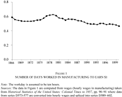
To put the monetary problems of the Free Silver period in perspective, it is instructive to construct the purchasing power of a $1 bill in that period as measured by year 2000 equivalent values. Figure 1 shows the value of a $1 bill in the years 1869–1900 as measured by the number of days worked in manufacturing to earn $1.

NUMBER OF DAYS WORKED IN MANUFACTURING TO EARN $1
The fact that a dollar represented more value than a half-day's labor in the highest wage sector of the economy throughout most of the Free Silver period gives vivid meaning to Senator Morgan's contention that, “a twenty-dollar gold piece is the nucleus of a fortune.”27
See Lauglin, History, p. 229.
Calculated using the nominal hourly wages in manufacturing for the year 2000 taken from the U.S. Census Bureau, Statistical Abstract of United States: 2001, p. 391. The average hourly wage of $14.38 is converted into a daily wage equivalent by multiplying by ten, the average number of hours in a work day during the 1880s and 1890s.
Given the value of a $1 bill during the Free Silver period, it appears likely that much of the notorious debt of rural Americans, especially those living in the South and West, must have been debt on accounts with merchants who used the running up of debt as a way to convert everyday transactions into values that could be settled with the available monies of the time. This running up of debt at the company store or general store must have contributed to the conception of cheap money advocates as debtors who hoped to benefit from rising prices through the debasement of the currency and a lowering of the real value of their debts. It seems likely, however, that the running up of debt on account was the product of a currency system with a significant shortage of coins valued at over half a day's wage and less.
The timing of the growth of support for the Greenback movement is important. Not until the panic of 1873 did substantial numbers of farmers support cheap money.29
See Unger, Greenback Era, p. 195.
See Garber, “Nominal Contracts,” p. 1013.
See Selgin, “Suppression,” p. 611.
Although the famous Coinage Act of 1873 demonetized silver and ended the coinage of silver dollars, it did promote the coinage of subsidiary silver coins in two ways. First, subsidiary silver coins—halfs, quarters, and dimes—were to be paid out in exchange for gold coins at par. Secondly, almost as an afterthought, a “provided” clause added that for two years subsidiary silver coins would be exchanged for silver bullion.32
See Sanger, Statues, pp. 428–29.
See Carothers, Fractional Money, p. 250.
The relief was short lived. By 1875 the special provision allowing for the sale of subsidiary silver coins for silver bullion had expired and the gold bullion purchase provision was superceded by the 14 January 1875 act “Providing for Redemption of Fractional Notes with Silver Coin.” The 1875 act tied the issue of subsidiary silver coins to the redemption of fractional currency and “required [the Treasury] to redeem an equal amount of such fractional currency” as subsidiary silver coins were issued.34
Ibid., p. 351.
Ibid., p. 353.
Given that the prewar circulation of subsidiary silver coins was estimated to be $43 million and that there was a significant stock of coin denominated state bank notes that circulated widely in the west and south, it is almost certainly true that the 1876 Coinage Act capped the total circulation of subsidiary coin and coin substitutes at a lower level than existed before the Civil War. This is extraordinary, especially when taking into account the growth in the economy that had occurred over the ensuing quarter of a century. From 1859 to 1874 value added in agriculture in the United States grew by 66 percent. Value added in manufacturing and mining grew by 252 percent and 500 percent respectively.36
See U.S. Census Bureau, Historical Statistics of the United States: Colonial Times to 1970, p. 239.
On population, see U.S. Census Bureau, Historical Statistics of the United States: Colonial Times to 1970, p. 14. On real income, see Friedman and Schwartz, Monetary History.
The desperate desire to enlarge the circulation of coin, especially in the small denominations a silver-based money would produce, is evident in the speeches in Congress of the supporters of free silver. Free silver advocates focused on the transactions return on subsidiary silver coins. The eloquent statement of Senator Morgan from Alabama is typical:
A twenty-dollar-gold piece is the nucleus of a fortune, to remain hid until some freak of fortune shall add other prisoners to its cell. But twenty dollars in silver dimes is the joy of the household, the substance of things hoped for, the evidence of things not seen. Silver is to the great arteries of commerce what the mountain-springs are to the rivers. It is the stimulant of industry and production in thousands of little fields of enterprise which in the aggregate make up the wealth of the nation.38
See Laughlin, History, p. 229.
We do not have to rely on what supporters claimed was the force behind free silver, however, because the market records shortages by the existence of premiums and the growth of substitutes. Not only did subsidiary coin and small notes command a premium during the Free Silver era, but also private currency substitutes circulated widely.39
See Timberlake, “Significance” and “Private Production.”
See Timberlake, “Denominational Factors,” pp. 844–50.
In his study of the period, Taylor noted:
From the South and West, there comes constant complaint of inadequate currency facilities. According to common accounts, this lack of money not infrequently is so extreme as to make necessary the resort to barter or the substitution for money of store orders or some similar device.41
See Taylor, “Objects,” p. 312.
“By the end of 1876 more than $15 million in fractional notes had been redeemed, and in October 1877 the total reached $23 million.”42
See Carothers, Fractional Money, p. 258.
Ibid., p. 260. Although Carothers' description of the denuding of America of coin with the onset of the Civil War and the sudden reappearance of those same coins with the onset of specie resumption seems difficult to believe, a cursory review of the current value of American coins relative to the quantity minted suggests that Carothers was indeed correct. If coins minted before and during the Civil War had been melted down or otherwise lost, one would expect the value of American coins issued prior to and during the Civil War to be substantially higher for a given level of mintage than coins issued in the 1870s, but remarkably that is not the case. According to the November 2001 edition of Coin Prices, in 1855, 760,000 silver half dollars were minted and one of those half dollars today is valued by collectors at $60. In 1870, 635,000 silver half dollars were minted and one of those half dollars today is valued at $65. The sole exception we have found to this general pattern is coins minted in 1861. It could be that those coins were in fact melted down, but it is equally probable that the current value reflects collector interest in the first silver coins struck during the Civil War.
See Department of the Treasury and Bureau of the Mint, Domestic and Foreign Coins, p. 22.
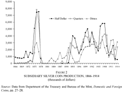
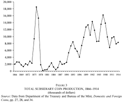
In Figure 2 we show the production of subsidiary silver coinage from 1866–1914. As is apparent from the Figure, after a surge in production to replace the fractional currency issued during the Civil War, subsidiary silver coinage virtually stopped for more than a decade. This pause in coinage is also apparent in Figure 3 which shows the total value of subsidiary coinage, including nickels and pennies. The virtual disappearance of new coinage coincided with the decade in American history that saw the rise of the Free Silver movement.

SUBSIDIARY SILVER COIN PRODUCTION, 1866–1914 (thousands of dollars)

TOTAL SUBSIDIARY COIN PRODUCTION, 1866–1914 (thousands of dollars)
Circulation of subsidiary silver coins in the late 1870s and throughout the 1880s and 1890s was dominated by the return of old coins from abroad and by legal constraints on the aggregate circulation. The 1873 law placed no limits on the coinage and issuance of subsidiary silver, but “the law of 1876 which restored silver coinage limited to $50 million the combined total of [fractional] notes officially outstanding and new coins issued ….”45
See Carothers, Fractional Money, p. 270.
Ibid.
By 1878 the $50 million limit was binding and “he [Treasury Secretary John Sherman] was obliged to stop coinage.”47
Ibid.
See U.S. Congress, Annual Report of the Secretary of the Treasury, 1906 and Annual Report of the Directory of the Mint, 1906.
See Carothers, Fractional Money, p. 271.
Temporary relief from the initial impact of the $50 million limit on the circulation of subsidiary silver coin was provided by the reimportation of old coins and by Secretary Sherman's “dubious interpretation which permitted an additional coinage of $8 million” by deeming such coinage replacement for lost fractional currency.50
Ibid., p. 270.
Ibid., p. 269.
Ibid., p. 268.
Ibid., p. 271.
WHEN NOMINAL MONEY MATTERS
Contemporary monetary theory treats the cost incurred in trading, transactions costs, as a function of the buying and selling done and real money balances held.54
See Saving, “Transactions Costs”; and Dutton and Gramm, “Transactions Costs.”
See Saving, “Transactions Costs”; and Dutton and Gramm, “Transactions Costs.”
Clearly carried to the extreme, the assumption that demanders of money are indifferent about the nominal stock of money they hold is invalid, and the assumptions of the standard model are intended to apply only when the various denominations of money can be freely exchanged at par. In the analysis of any period of monetary upheaval, where there are artificial restrictions on the supply of specific denominations or types of money, we are required to recognize public differentiation among nominal units and types of money.
If various denominations and types of money are not freely exchanged at par, then the conventional model must be adapted to recognize that in such periods of disequilibrium, nominal money matters. The holdings of various denominations of money in such periods can and generally will deviate from those which would be chosen if convertibility at par were preserved.
If convertibility at par is not maintained and the monetary authority follows some rule other than reflux minimization in issuing the various denominations of money, society can possess a nonoptimal mix of money and rising transactions costs will lower welfare. Supply and demand for the denominations in excess demand can be equated only by some implicit or explicit premium. Such a premium may be in the form of extra transactions time entailed in acquiring the denomination which is in excess demand or the actual paying of a premium to acquire and hold denominations in relative short supply.
It is clear from the conventional transactions-cost model of the demand for money that a premium on a given denomination of money will reduce the demand for that denomination. The premium will drive up the cost of using the denomination of money on which the premium occurs and reduce wealth. The decline in wealth will lower demand for the denomination if it is a normal good. In most circumstances, however, we would be assured that in any case the substitution effect dominates the small wealth effect that would be generated by a premium on a given denomination of money.56
See Dutton and Gramm, “Transactions Costs,” p. 658.
Therefore, if acute shortages of subsidiary coins existed during the Free Silver period and premiums existed on subsidiary coins during that period, we would expect to find that the ratio of subsidiary coins relative to the holding of all hand-to-hand money, subsidiary coins, ones, twos, fives, tens and twenties, would have been lower during the Free Silver period than in periods where greater convertibility existed. Further, because dollar coins and dollar bills would have been the closest available legal substitutes for subsidiary coins, we would also expect to find that the ratio of ones to the total level of hand-to-hand money was higher during the Free Silver period than in periods when greater convertibility existed.
AN EMPIRICAL ANALYSIS OF THE DEMAND FOR SUBSIDIARY COINS IN THE UNITED STATES 1866–1914
Contemporary evidence of a shortage of subsidiary coins abounds during the last 30 years of the nineteenth century. Not only did subsidiary silver coins command a premium and trade at near par with gold before specie resumption, but one and two dollar notes, the best available, legal substitutes for subsidiary coins, often traded at a premium as well.57
See Carothers, Fractional Money, p. 250; and Bryan, Speeches, p. 127. Also see Timberlake, “Significance” and “Private Production.”
See Unger, Greenback Era, p. 63.
See U.S. Congress, Annual Report of the Comptroller of the Currency, 1872, pp. 96–97, and Report of the Comptroller, 1873, p. 109; and House of Representatives, Miscellaneous Document 48, p. 2. Also see Timberlake, “Denominational Factors.”
Despite the explosion of the economy during the Civil War and in the 25 years afterward, federal statute capped the circulation of subsidiary coin at a level below the effective circulation which had existed before the war started.60
See Friedman and Schwartz, Monetary History, p. 30. Also see U.S. Census Bureau, Historical Statistics of the United States: Colonial Times to 1970, pp. 239 and 14. See Carothers, Fractional Money, p. 270.
See Carothers, Fractional Money, p. 271.
See Timberlake, “Denominational Factors,” p. 258.
See Carothers, Fractional Money, p. 271.
Using the available data on the circulation of subsidiary coins and the circulation of other denominations of coin and currency used in hand-to-hand exchange (i.e., twenty dollars and smaller), we looked at the composition of the demand for money for the period 1866–1914, with special attention to the Free Silver period (1880–1896). If subsidiary coins were in very short supply and exchanging at a premium during the Free Silver period, we would expect that during that period the stock of subsidiary coins in circulation, relative to all hand-to-hand money, would have been lower than during periods where convertibility at or near par existed. From the theory presented, we would also expect that the ratio of one dollar bills and coins to other coin and currency used in hand-to-hand exchange would have been higher during the period when subsidiary coins were in short supply, as they were the closest available legal substitutes for subsidiary coin.
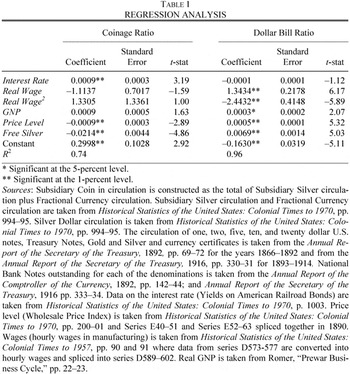
Because of the substitution between subsidiary coins and dollars we test these hypotheses by simultaneously estimating the following two equations using Zellner's seemingly unrelated regression (SUR) version of generalized least squares


where γ and o, are respectively the ratio of subsidiary coins and one-dollar bills and dollar coins to all hand-to-hand money. Subsidiary coins consist of the circulation of all silver coins less than a dollar in denominated value plus the circulation of fractional notes, which functioned as subsidiary coin substitutes prior to specie resumption. All hand-to-hand money consists of all subsidiary coins plus all dollar bills and dollar coins, two dollar bills, and five, ten, and twenty dollar bills and coins in circulation. The remaining variables are as follows: r is the real interest rate, w is real hourly wages, P is the price level, GNP is real gross national product, and FS is a dummy variable that takes the value of unity during the Free Silver period (1880–1896) and zero elsewhere. The time period covered in the regression is from 1869 to 1914.
A priori, one would expect that if convertibility is maintained, the real interest rate, the cost of holding money balances, would not affect the desired composition of money demand. However, during a period where a shortage of subsidiary coin existed and premiums existed, increases in real interest rates should increase the relative demand for subsidiary coin and decrease the relative demand for ones, the closest substitute. The effect of real wages has two offseting components. First, as real wages increase, individuals engage in larger transactions, increasing the demand for larger denominations and decreasing the ratio of subsidiary coins to all money. Second, as real wages increase, more transactions are conducted with money, and initially such transactions are conducted with subsidiary coin, increasing the ratio of subsidiary coin to all money. Decreases in the price level increase the real value of all denominations of money, allowing the same transactions to be conducted more efficiently with ever smaller denominations of money. As a result, a decrease in the price level, which occurred throughout the Free Silver period, should be expected to increase the ratio of subsidiary coins to all money.
Gross national product is a proxy for the total level of transactions activity. Finally, if there was a significant shortage of subsidiary coin during the Free Silver period, as is suggested by all of the anecdotal evidence, then the coefficient of the Free Silver dummy variable should be negative and significant in the subsidiary coins ratio equation and positive and significant in the one dollar ratio equation.
In Table 1 we show the results of the SUR estimation of equations 1 and 2. For the subsidiary coin ratio equation 1, the statistically significant coefficients are the interest rate, the price level, and the Free Silver dummy variable. Most importantly for our hypothesis that the Free Silver movement was about a shortage of subsidiary coins is the sign and significance of the Free Silver dummy variable—negative and significant. Thus, during the Free Silver Period, it does, in fact, appear that there was a quantifiable shortage of silver subsidiary coins. As compared to the whole 1866–1914 period, the data suggest that during the Free Silver period the public held fewer subsidiary coins than they would have held if there had been free convertibility at par. Such a shortage would have resulted in a premium on subsidiary coins, higher transaction costs, and lower welfare.

Most of the other coefficient values are consistent with what was anticipated. The real interest rate coefficient is positive and statistically significant. The price level coefficient is negative and significant, while the per capita GNP coefficient is positive but insignificant. Wages are insignificant, perhaps indicating that the effect of increased market transactions and the size of transactions effect offset one another.
In the one dollar ratio equation 2, the statistically significant coefficients are real wages, the square of the real wage, real GNP, the price level, and the Free Silver dummy variable. The coefficient of the Free Silver period dummy variable is positive and highly significant. Thus, during the Free Silver period, it appears that the demand for ones relative to all hand-to-hand money increased significantly as compared to the period as a whole. A shortage of subsidiary coins would have been expected to cause the public to hold more of the closest available substitute. This finding seems to confirm F. W. Taussig's observation that “when it appeared that new notes of small denominations were no longer to be supplied, the old ones were kept in use long after they had become unfit for circulation,”64
See Taussig, Silver Situation, p. 579.
Ibid., pp. 41–42.
As expected, the coefficients on the other explanatory variables are the opposite in sign to those in the subsidiary coin regression. There existed a quadratic relation between real wages and the one dollar ratio, where higher wages increased the predicted ratio with a diminishing impact as wages increased. The turning point of the concave function, where increased wages would begin to decrease the predicted dollar bill ratio, was at 27.5 cents (wages were lower than this until 1912). Both the price level and real GNP are positive and significant.
The results presented in Table 1 strongly support the anecdotal evidence that the Free Silver movement was at least in part the result of a shortage of subsidiary coins and not just the lobbying of silver producers and debtors.
SUMMARY AND CONCLUSIONS
Monetary historians have long contended that Free Silver advocates were simply inflationists who sought a redistribution of wealth by lowering the real burden of their debts through inflation. Friedman and Schwartz followed the same argument as Laughlin, Hepburn, and numerous others when they concluded66
See Laughlin, History, p. 217. The domain of the dispute according to Laughlin was: “Money has three-chief functions to perform; as a medium of exchange (to transfer value), as a common denominator of value (to compare value) and as a standard of deferred payments. Now, bimetallism is concerned mainly with the last function” (p. xi). See Hepburn, History.
Debtor farmers in the Middle West and South, who had no interest in a higher price for silver, joined the silver producers, in the belief that “free coinage” or “free silver,” as they termed it, would increase the money supply and thereby lower the real burden of their debt.67
See Friedman and Schwartz, Monetary History, p. 115.
In the context of traditional monetary theory, where the cost of exchange depended only on real money balances, no other explanation offered itself for the Free Silver movement. The fact that evidence of nominal money shortages abounded did not change the fact that such evidence made no sense without some theory that nominal money mattered. When we take into account the differential returns on nominal units of money when convertibility at par does not occur, an alternative (or at least complementary) explanation of the moving force behind the Free Silver movement is manifested. Not only does the theory suggest the possibility of the existence of a nonoptimum nominal money stock during the Free Silver period, but evidence of shortages of small denominations of money abound; the stated goals of the Free Silver groups reflect these shortages; the coinage laws of the 1870s de-linked coinage from any measure of the economic requirements for subsidiary coinage and virtually guaranteed that the actual circulation would not meet the needs of trade; and empirical analysis using existing data confirms that shortages did in fact exist.
It was this shortage of circulating subsidiary coin and the cost it imposed that was the real impetus of the Free Silver movement. By impeding trade and lowering welfare, the shortage of small units of hand-to-hand money induced general support for coinage in the areas of monetary deprivation. This support was from debtors and creditors alike. Had free coinage of silver existed, the increase in the value of coins relative to bills that occurred during the 1880s and 1890s would have brought silver to the mint and coinage would have risen until convertibility was restored. This would have allowed demanders to once again determine the denominational structure of the money supply. Under the restrictions imposed by law from 1876 to 1900 this could not happen.
Although a western farmer was not likely to recognize a relation between government monetary policy and the real value of his debts, it took no economic sophistication to recognize that the denominations of money normally used to consummate sales and purchases circulated at a premium. The resort to tokens or barter added to exchange costs, impeded trade, and produced hardships. In those areas of the country where the shortages were greatest there was a public outcry. By ascribing this outcry only to debtors seeking relief, for a hundred years historians and economists have largely been forced to accept an explanation of the Free Silver periods that assumes that ordinary people in the nineteenth century understood the Equation of Exchange. From the analysis presented, it appears likely that at least a part of the debt burden of farmers in the South and West was debt on account accumulated because of a shortage of denominations of money valued at a half a day's wages and less. This shortage forced them to use credit to build up the volume of transactions to a level that could be consummated with a dollar that had a value of over $80 in today's wages. Paradoxically, farmers in the South and West were then, to some degree, debtors because of the dearth of silver coins and not advocates of silver coinage because they were debtors.
This article has benefited from the input of two anonymous referees of this Journal and from major assistance provided by Thomas R. Saving. We would also like to thank George Selgin and Richard Timberlake, Jr. for their help.
References
Anderson G. L.
1933.
“The National Banking System: A Sectional Institution.“
Ph.D. Diss., University of Illinois,Google Scholar
Balke N. S., and R. J. Gordon.
1989
“The Estimation of Prewar Gross National Product: Methodology and New Evidence.”
Journal of Political Economy
97, no. 1
38–92Google Scholar
Bryan W. J.
1909.
Speeches of William Jennings Bryan.
New York:
Funk and Wagnalls Company,
Carothers N.
1967.
Fractional Money, Reprint of Economic Classics.
New York:
August M. Kelly,
2001.
Coin Prices, Iola:
Krause Publications,
November
Dewey D. R.
1910.
State Banking Before the Civil War.
National Monetary Commission, Sen. Doc. no. 581, 61st Congress, 2nd Sec,
Washington, DC:
GPO,
Dutton D. S., and W. P. Gramm.
1973
“Transactions Costs, the Wage Rate and the Demand for Money.”
American Economic Review
63, no. 4
652–65Google Scholar
Friedman M., and A. J. Schwartz.
1963.
A Monetary History of the United States 1867–1960.
Princeton, NJ:
Princeton University Press,
Friedman M.
1990
“Bimetallism Revisited.”
Journal of Economic Perspectives
4, no. 4
85–104Google Scholar
Garber P. M.
1986
“Nominal Contracts in a Bimetallic Standard.”
American Economic Review
76, no. 5
1012–30Google Scholar
Hepburn A. B.
1967.
A History of Currency in the United States.
New York:
Macmillan,
[1924]
Laughlin J. L.
1968.
The History of Bimetallism in the United States.
New York:
Greenwood Press,
[1904]
Mints L. W.
1945.
History of Banking Theory in Great Britain and the United States.
Chicago:
University of Chicago Press,
Mitchell W. C.
1960.
A History of the Greenbacks: With Special Reference to Their Issue, 1862–1865.
Chicago:
University of Chicago Press,
[1903]
Muhleman M. L.
1908.
Monetary and Banking Systems.
New York:
Monetary Publishing Company,
Redish A.
2000.
Bimetallism: An Economic and Historical Analysis.
Cambridge:
Cambridge University Press,
Romer C. D.
1989
“The Prewar Business Cycle Reconsidered: New Estimates of Gross National Product, 1869–1908.”
Journal of Political Economy
97, no. 1
1–37Google Scholar
Sargent T. J., and F. R. Velde.
2002.
The Big Problem of Small Change.
Princeton, NJ:
Princeton University Press,
Saving T. R.
1971
“Transactions Costs and the Demand for Money.”
American Economic Review
61, no. 3
407–20Google Scholar
Sanger G. P.
1873.
Statues at Large and Proclamations of the United States of America, from March 1871 to March 1873.
Boston:
Little, Brown, and Company,
Selgin G.
2000
“The Suppression of State Bank Notes: A Reconsideration.”
Economic Inquiry
38, no. 4
600–15Google Scholar
Shaw W. A.
1967.
The History of Currency, 1252–1896.
New York:
G. P. Putnam's Sons,
[1896]
Timberlake R. H.
1974:
“Denominational Factors in Nineteenth-Century Currency Experience.”
This Journal
34, no. 4
835–50.Google Scholar
Timberlake R. H.
1981:
“The Significance of Unaccounted Currencies.”
This Journal
41, no. 4
853–66.Google Scholar
Timberlake R. H.
1987
“Private Production of Scrip-Money in the Isolated Community.”
Journal of Money, Credit, and Banking
19, no. 4
437–47Google Scholar
Taussig F. W.
1893.
The Silver Situation in the United States.
New York:
G. P. Putnam's Sons,
Taylor F. M.
1920:
“The Objects and Methods of Currency Reform in the United States.”
Quarterly Journal of Economics
12, no. 3
307–42.Google Scholar
Unger I.
1964.
The Greenback Era: A Social and Political History of American Finance 1865–1879.
Princeton, NJ:
Princeton University Press,
U.S. Bureau of the Mint.
1906.
Annual Report of the Director of the Mint.
Washington, DC:
GPO,
U.S. Census Bureau.
2001
Statistical Abstract of the U.S. 2000: The National Data Book.
Washington, DC:
GPO:
U.S. Census Bureau.
1960.
Historical Statistics of the United States: Colonial Times to 1957.
Washington, DC:
GPO,
U.S. Census Bureau.
1975.
Historical Statistics of the United States: Colonial Times to 1970.
Washington, DC:
GPO,
U.S. Congress.
1873.
Report of the Comptroller,
House Executive Doc. 1603,
Washington, DC:
GPO,
U.S. Department of the Treasury.
1892.
Annual Report of the Secretary of the Treasury.
Washington, DC:
GPO,
U.S. Department of the Treasury.
1906.
Annual Report of the Secretary of the Treasury.
Washington, DC:
GPO,
U.S. Department of the Treasury.
1916.
Annual Report of the Secretary of the Treasury.
Washington, DC:
GPO,
U.S. Department of the Treasury and Bureau of the Mint.
1981.
Domestic and Foreign Coins Manufactured by Mints of the U. S., 1793–1980.
Washington, DC:
GPO,
U.S. House of Representatives.
1873.
Miscellaneous Document 48,
43rd Congress, 1st Session, 19 December
U.S. Office of the Comptroller of the Currency.
1872.
Annual Report of the Comptroller of the Currency.
Washington, DC:
GPO,
U.S. Office of the Comptroller of the Currency.
1892.
Annual Report of the Comptroller of the Currency.
Washington, DC:
GPO,
Walker F. A.
1887.
Political Economy.
New York:
H. Holt and Company,
White H.
1935.
Money and Banking.
Boston:
Ginn and Company,
NUMBER OF DAYS WORKED IN MANUFACTURING TO EARN $1
SUBSIDIARY SILVER COIN PRODUCTION, 1866–1914 (thousands of dollars)
TOTAL SUBSIDIARY COIN PRODUCTION, 1866–1914 (thousands of dollars)
REGRESSION ANALYSIS
 You have
Access
- 6
- Cited by