Mr. Dawson's “Negro Folk Symphony” took the house by storm. The custom of no applause during a symphony gave way after the second movement to a spontaneous outburst that brought the orchestra to its feet, and at the end the enthusiasm was so great that Mr. Dawson was called to the stage repeatedly to bow his acknowledgements.
It is easy enough to account for this commotion. The Negro themes chosen by the composer are striking in themselves and are employed with skill; the music is vivid with imagination, warmth, drama; and then there is the sumptuous orchestral dress.
Nor does the immediate success of the symphony give rise to doubts as to its enduring qualities. One is eager to hear it again and yet again.Footnote 1
—Pitts Sanborn, The New York World-Tribune, 21 November 1934
The whole production impresses me as the most distinctive and promising American symphonic proclamation which has so far been achieved. Whether or not Dawson could duplicate or improve upon his feat should he leave the strict domain of the Negro spiritual is another question, and one which everyone would like to see him answer soon and successfully.Footnote 2
—Leonard Liebling, New York American, 25 November 1934
Despite the lavish praise his symphony received upon its premiere in 1934, William Levi Dawson (1899–1990) is remembered today largely for his contributions to American choral music. His arrangements of spirituals are canonic works for high school and college choirs; he brought the Tuskegee Institute Choir to international fame as its director from 1931 until 1955; and he made appearances around the United States and beyond as a guest conductor and choral clinician well into his 80s. Yet, despite his formidable achievements in that field, Dawson sometimes felt constrained and frustrated by the limits of choral music, and yearned for a career as an orchestral composer and conductor. For a brief period he seemed so close to realizing his goal of lasting national prominence as a symphonist that in retrospect, it is almost more surprising that he did not ultimately succeed than that he nearly did.
Dawson's Negro Folk Symphony was one of three symphonies by African American composers to be given premieres by major orchestras within a period of just over three years during the Harlem Renaissance, together with William Grant Still's Afro-American Symphony (performed in October 1931 by the Rochester Philharmonic under Howard Hanson) and Florence B. Price's Symphony in E Minor (premiered in June 1933 by Frederick Stock and the Chicago Symphony Orchestra).Footnote 3 The Negro Folk Symphony was performed four times in November 1934 by the Philadelphia Orchestra under Leopold Stokowski, and one of these concerts was broadcast nationwide on the radio. Although the symphonies by Still and Price were also well received at their premieres, Dawson's orchestral debut was the most prominent and prestigious in terms of conductor, orchestra, venue, and size of audience; moreover, the tumultuous approbation the Negro Folk Symphony received from critics and audiences alike set it apart—not only from contemporaneous works by African Americans, but also from most new classical music of the period. The following pages trace the early triumph and swift descent into obscurity of Dawson's great instrumental masterpiece, his first and only symphony.
Like African American choral titans Nathaniel Dett and Hall Johnson before him, Dawson began his formal musical training not as a singer, but as an instrumentalist—in his case, a trombone and euphonium player.Footnote 4 The oldest of seven children born in Anniston, Alabama to George and Eliza Dawson, he ran away from home at age thirteen to enroll at the Tuskegee Institute, where he learned to play several instruments, sang in the choir, and copyrighted his first composition—a song titled “Forever Thine”—in 1920. After receiving his diploma from Tuskegee in 1921, he completed the Bachelor of Music degree from the Horner Institute of Fine Arts in Kansas City, Missouri. It was at his 1925 commencement from Horner that he experienced his first public triumph as a composer, ironically coupled with an insult he was never to forget. His friend, the journalist Roy Wilkins, later told the story in his column for the Kansas City Call, a black weekly newspaper:
Nine years ago I was sitting in a little cramped balcony there exclusively “for Mr. Dawson's colored friends.” Bill was being graduated from Horner Institute, but he was right there among us in the tiny balcony, not up on the stage with the white graduates. The little orchestra there was playing Bill's melody, a composition judged to be good enough to have a star place on the graduation program. It was a sweet thing, wispy, haunting music for violin, cello and piano. It brought applause and many in that audience, even though they were from Kansas City, looked around for William L. Dawson, not thinking, for the moment, that his brown face had sent him into the background where he could not even acknowledge the applause his brain-child called forth. He could not even march up from where he was and get his diploma. It was “thought best” to deliver it to him the next day in the office. Might start a riot or something to pass it to him along with white graduates.Footnote 5
Undaunted, Dawson went on in 1927 to receive the Master of Music in composition from the American Conservatory of Music in Chicago. In the same year he began work on what he optimistically titled his “Symphony No. 1,” which took him approximately four years to complete. During his time in Chicago he played first trombone in the Chicago Civic Orchestra, becoming that organization's only African American member, and served as choir director for at least one church.Footnote 6 He also played jazz trombone, recording four tracks in 1927 with Charlie “Doc” Cook's Doctors of Syncopation and Jimmy Noone's Apex Club Orchestra.Footnote 7 In 1929, he assembled and conducted the only African American band and chorus to enter a competition held by the Chicago Daily News; their victory led to his being appointed bandmaster for the Chicago World's Fair's African American division in 1933.Footnote 8 Three of his compositions won first prizes in Rodman Wanamaker Competitions in 1931 and 1932: a Scherzo for orchestra, and two songs, “Lovers Plighted” and “Jump Back, Honey, Jump Back.”Footnote 9 Unsolicited job offers poured in from black colleges around the South, including Florida Agricultural & Mechanical College for Negroes (Tallahassee), Lincoln University (Jefferson City, Missouri), Prairie View State Normal and Industrial College (Prairie View, Texas), and Calhoun Colored School (Calhoun, Alabama). Dawson was clearly one of the most promising young black musicians and musical leaders of his generation.
When the invitation came in 1930 to join the faculty of the Tuskegee Institute in order to establish and lead a full-fledged school of music there, Dawson readily returned to Alabama. As an alumnus, he would have been aware of the challenges he faced in creating a degree-granting music program at an institution founded by Booker T. Washington during Reconstruction for the normal and industrial education of African Americans. Washington was a controversial figure, criticized by W.E.B. Du Bois and others who called for racial uplift via the education and achievements of an exceptional “Talented Tenth” of African Americans, and who disparaged Washington's willingness to strike political compromises with Southern whites in exchange for economic opportunity and physical safety. Dawson, however, remained loyal to Washington throughout his life: “If ever there were a man who was misunderstood by the ‘Talented Tenth,’ he was,” Dawson said in a 1979 interview. “He was after the ninety percent of us.”Footnote 10
Having received an intellectually stimulating education himself as a student at Tuskegee, Dawson strongly believed that a rigorous music program could indeed flourish at the school, and he approached his task with fervor. He brought in faculty that included the noted concert pianist Hazel Harrison and soprano Abbie Mitchell, creator of the role of Clara in the first production of Porgy and Bess. Despite Dawson's efforts, the School of Music lasted only a few years, with one student receiving the Bachelor of Arts in Music in 1935, and five in 1936. In 1937 the board of trustees voted to dissolve the School, citing budgetary concerns. They reduced it to a service department, and Dawson supervised no further music majors in his remaining eighteen years at Tuskegee.
School of Music or no, Dawson shaped the Tuskegee Institute Choir into an ensemble nationally famous for its beautiful sound and precise execution, particularly of Dawson's arrangements of Negro spirituals. Among the choir's most prestigious appearances were those at the opening festivities for New York's Radio City Music Hall in late 1932 and early 1933 at the invitation of impresario Samuel “Roxy” Rothafel. Also involved in the opening events was Leopold Stokowski, famed conductor of the Philadelphia Orchestra and champion of contemporary music. Rothafel told Stokowski that Dawson had composed a symphony, and although the conductor's interest was immediate, it was nearly two years before the piece had its premiere. Dawson's correspondence suggests that he did not know precisely when his work would be programmed until roughly two weeks before the first concert. On 7 and 8 November 1934 he sent dozens of letters to inform friends and acquaintances that his symphony was to be performed on 14, 16, 17, and 20 November. On 10 November 1934 he wrote to Stokowski, “I have been recovering from the surprise and confusion that have followed the receipt of your telegram and letter, advising me of your acceptance [of] the Negro Folk Symphony and your plans to give it a public performance.”Footnote 11 Given that Dawson knew the Philadelphia Orchestra had read the piece at the beginning of the month, his statement suggests that Stokowski's decision to program the work was made and acted upon with incredible speed.Footnote 12
A pair of telegrams between Dawson and Stokowski in early November 1934 reveals a fascinating moment in the piece's history. On 2 November 1934, Stokowski sent the following message:
HAVE JUST CONDUCTED NEW VERSION YOUR SYMPHONY IN REHEARSAL AM VERY ENTHUSIASTIC ABOUT IT PLEASE WIRE ME TITLE OF SYMPHONY ALSO TITLES OF EACH OF THREE MOVEMENTS WHAT WOULD YOU THINK OF TITLE FOR SYMPHONY AFRICAN AMERICAN SYMPHONY OR NEGRO SYMPHONY WISH TO GIVE IT TITLE THAT WILL EXPLAIN ITSELF TO LISTENER SAME WITH TITLES OF INDIVIDUAL MOVEMENTS FEEL THAT INDIVIDUAL TITLE SUCH AS ALLEGRO ADAGIO MEANINGLESS CONGRATULATIONS ON WONDERFUL SYMPHONY YOUR FRIEND
Leopold StokowskiFootnote 13
Dawson replied from Tuskegee two days later:
Letter follows with spelling and punctuation.Footnote 14
Had Stokowski not made this inquiry, would the composer have left his work titled simply Symphony No. 1, and the movements with their “meaningless” tempo markings? Much later, in a 1982 interview on National Public Radio, Dawson stated that the programmatic title had already been part of his plan:
The Detroit Symphony came to Chicago during the World's Fair in '33. . . . And they played the “New World” Symphony of Dvořák and I was there. And this is what the commentator said: “This symphony is based on Indian themes.” And I cried and I got up and walked out. That hurt me. ‘Course I knew, I know what's in the symphony. And America doesn't know these folk songs. And I said to myself, I said if I'm successful to complete a symphony based on the music of the Negro I'm going to title it Negro Folk Symphony. Can't remove that title.Footnote 15
Nevertheless, the fact that Stokowski requested titles less than two weeks before the work's premiere on 14 November suggests that Dawson had not originally planned to inscribe race publicly on his symphony in this way. Two years later, Florence Price faced a similar conundrum with her Symphony in E Minor: as musicologist Rae Linda Brown has noted, the composer chose to excise her original subtitle of “Negro Symphony” from that score, “possibly because it might have suggested a programmatic work and limited the perception of the symphony's scope.”Footnote 16 Dawson may have shared this concern. However, Stokowski's request for descriptive titles reflected the fact that the work's “racial” qualities, and Dawson's own identity as an African American composer, were guaranteed to be in the forefront of listeners’ minds, rendering “Allegro” not so much meaningless as coy.
Having been urged to come up with titles that would imply a program, Dawson went considerably further, providing a programmatic description to be distributed at the first performances (see Appendix). In it, he explained that the symphony's recurrent opening theme was “symbolic of the link uniting Africa and her rich heritage with her descendants in America.” He specifically identified the spirituals he had used in the first and third movements; the second movement, he revealed, was a detailed depiction of the monotony of lives spent in slavery, leavened briefly by the playfulness of “children, unmindful of the heavy cadences of despair.” Although the study score published in 1963 does not include a program, slight variations on this first version have been distributed at most performances of the work, and the 1963 recording's liner notes by George Jellinek also summarize the program.Footnote 17
Stokowski's telegram evidently inspired Dawson to reveal the symphony's program, but the composer rejected his specific suggestions for titles. Whereas “Negro Symphony” would have drawn a straight line from race to genre, encouraging listeners to understand the work as being fundamentally shaped by its creator's race and the heritage upon which he drew, Dawson chose to interpolate “Folk,” thus not only highlighting his use of African American folk songs, but also calling attention to the fact that an individual composer had made an idiosyncratic attempt to integrate cotton field and concert hall.Footnote 18 Stokowski's second suggestion, “African American Symphony,” corresponded well with Dawson's program, but risked confusion with William Grant Still's Afro-American Symphony, which had been premiered by Howard Hanson and the Rochester Philharmonic in 1931.
Dawson's choice of Negro Folk Symphony also resonates with his lifelong preference for the term “Negro folk song” over “spiritual.” In the aforementioned 1979 interview he explained:
I don't call them spirituals. . . . Many years ago I decided that I wanted to know, what do they mean by “spiritual”? And I got an unabridged dictionary and looked it up. There were ten or fifteen definitions of the word “spiritual.” For an example, in Paris, France, they had concerts on Sunday; they called them spirituals. But these are folk songs and we have got to know and treat them as folk songs because they contain the best that's in us. And anywhere in the civilized world, when you say, “This is a folk song,” all the nations prize their folk songs. All the great composers utilize their folk songs, their source of material for development.Footnote 19
Thus, for Dawson the adaptation of three African American folk songs for use in his symphony—“Oh, My Little Soul Gwine Shine Like a Star” in the first movement, “O Lemme Shine” and “Hallelujah, Lord, I Been Down into the Sea” in the third—was not solely a matter of reflecting his own cultural heritage, but also followed the example of “great composers” such as Brahms and Dvořák. This was the pantheon of composers among whom he sought to position himself.
The Philadelphia Orchestra gave three performances of the Negro Folk Symphony at the Academy of Music in November 1934, followed by a fourth at Carnegie Hall. The other works on the program suggested a theme, which a New York Times headline of 21 November characterized as a “concert of novelties”: U.S. composer Harl McDonald's first symphony, The Santa Fe Trail; Chapultepec, by Mexican conductor and composer Manuel M. Ponce; and Maurice Ravel's Rapsodie espagnole.Footnote 20 Dawson's piece was last on the program, and New York Times music critic Olin Downes's description of the audience's reaction suggests the wisdom of this ordering: “The end of the concert saw a majority of them remaining to applaud long and lustily, and to call Mr. Dawson several times back to the stage.”Footnote 21
Roy Wilkins provides a vivid account of the audience's tumultuous response at Carnegie Hall. After telling the story of Dawson's 1925 humiliation in Kansas City quoted earlier in this essay, he describes the very different events of 20 November 1934:
An audience of nearly 3,000 persons, hundreds of them in high silk hats, tail coats, trailing evening dresses and ermine capes, sat enraptured by Dawson's “Negro Folk Symphony” as the one and only Leopold Stokowski conducted the great Philadelphia Orchestra in a masterly rendition of it. The second movement so gripped the audience that once it was over they broke the iron-clad rule against applause before the end of a number and applauded in unrestrained fashion.
When the third and final movement was played, the storm broke. The audience called Mr. Stokowski back once and then he brought out Bill. This time the composer did not have to sit in a balcony because he was black. He bowed across the footlights and then to the orchestra which had played his work so magnificently. The members of the orchestra clapped again and again for the young composer. He bowed and shook hands with Mr. Stokowski. . . . He shook hands with the first violinist.
But the audience was not through. He was called back two more times.Footnote 22
Few concert venues in the United States can compete with the prestige or symbolic value of Carnegie Hall. Wilkins was well aware of the significance of an African American composer's riotous reception in such a hall, and his account suggests that he relished it—and the victory it represented over those who had exiled the Horner Institute's star pupil to a Kansas City balcony—in a way that the self-contained Dawson never allowed himself to do publicly.Footnote 23
For many African Americans, even more affecting than the fact of a Carnegie Hall concert was the experience of hearing the 16 November 1934 performance broadcast over the Columbia Broadcasting System. Letters and telegrams poured in to Dawson from around the country in the wake of the broadcast, with friends and strangers alike describing the joy they took in listening to the Negro Folk Symphony. George Lake Imes, Secretary of the Tuskegee Institute, sent a telegram saying that although the radio reception had been poor in Logan Hall (“SELDOM HEARD STRINGS”), a large gathering of students had devoured the broadcast and applauded effusively along with the audience in the hall.Footnote 24 Floyd C. Covington, Executive Secretary of the Los Angeles Urban League, congratulated Dawson for “hav[ing] done the Negro Race of America one of the finest services by so ably dignifying it in music,” and said that he and his staff had listened to the broadcast together.Footnote 25 An old friend from Kansas City wrote, “House parties turned into listening groups at the hour of broadcasting. Lincoln High School held general assembly. In fact the whole town was William L. Dawson minded.”Footnote 26
Particularly noteworthy is the description given in a letter by Shirley Graham (later Du Bois), whose 1935 master's thesis from Oberlin Conservatory, “The Survivals of Africanism in Modern Music,” deals at length with the Negro Folk Symphony. Five days after the radio broadcast she wrote to Dawson:
I tried to express some of the joy and pride which I felt in your achievement by the telegram which I sent you in Philadelphia last Friday. The telegram was wholly inadequate, however. I sent it on my way home from the professor's house where a room full of us had gathered to listen to your Symphony. Mrs. Jaszi, our hostess, a brilliant Viennese was almost as excited as I as the hour drew near. She had invited in a group of people many who had attended premieres in London, and Paris and Vienna. They were my friends and therefore willing to accept my assurance that they were in for a treat, but I could feel the mental reservations with which they waited.
And then your music came flooding into the room. Teacups were set down, startled eyes were raised. They were people who knew. I saw the quick adjustment necessary for this revelation. And then I forgot them. [. . .] As the music rolled on gathering color, intensity and volum[e], I saw all of us who toil and hope and wait behind the veil. Your music lost its purely racial individuality and became a great universal cry which tore the veil asunder and as the horns pealed forth “Oh! lemme Shine!”, I saw the light come pouring out. Oh! It was glorious. “That is the work of a Master,” they said, reverently.Footnote 27
Graham's reference to the veil, a concept first named and illuminated with regard to the African American experience by W.E.B. Du Bois (her future husband), is especially telling. By using this term, Graham draws the connection between Dawson's achievement and the aspirations of others in the African American community, particularly but not exclusively those active in creative pursuits dominated by whites.Footnote 28 Although the symphony's performance and its broadcast had great personal significance for Graham, partly because she knew how much it meant to Dawson, a large part of the emphasis in her account is upon her fellow listeners—“people who knew”—and Dawson's victory over their reservations. Like Wilkins, Graham saw Dawson's achievement as going beyond the composition of an effective symphony and its successful performance by a major orchestra under the baton of a famous conductor. The most viscerally powerful moment of victory came when knowledgeable white listeners were moved to uproarious applause. Being able to hear their ovation was, for thousands of African Americans leaning into their radios, glorious indeed.
The critics, who were also generally appreciative of the Negro Folk Symphony at its premiere, took note of the audience's reaction. Wrote Olin Downes in the New York Times, “Some will attribute this acclaim to the audience's impulse to honor a gifted artist of the Negro race for a signal achievement. In this they would be partly right, but if they estimated the symphony by any such measurement they would be signally wrong.” He went on to offer both praise (“a sweep and intensity that are not to be forgotten”) and criticism (“development is often halting, inexpert, non-consecutive”) before concluding, “One of these days Mr. Dawson may bob up with a magnificent score. For his music has life-blood, humor, feeling, force.”Footnote 29
Like Downes, the noted African American cultural critic Alain Locke was equivocal about the work, but saw it as a harbinger of still greater works yet to come from Dawson. More important, it modeled an answer to the call to African American composers that Locke was in the process of issuing in a two-part essay for Opportunity titled “Toward a Critique of Negro Music.”Footnote 30 Along with a congratulatory letter, in December 1934 Locke sent Dawson a draft of a postscript to the essay's second part, dealing specifically with the Negro Folk Symphony. Footnote 31 As published the postscript reads, in part:
[The second movement's] greatest grandiloquence is movingly successful, where a duel of pagan melody and rhythm toss wave-high against a Christian spiritual like the meeting of the Gulf Stream and the North Atlantic. It is moments like this that I had in mind in writing that the truly Negro music must reflect the folk spiritual and eventually epitomize the race experience. To have done this without too much programistic literalness is an achievement and points as significant a path to the Negro musician as was pointed by Dvorak years ago. In fact it is the same path, only much further down the road to native and indigenous musical expression.Footnote 32
In the essay, written before the premiere of the Negro Folk Symphony, Locke had written that Dvořák's “New World Symphony stands there a largely unheeded musical sign-post pointing the correct way to Parnassus.”Footnote 33 In this light, his declaration that Dawson's work was its equal as a “sign-post” for other African American composers to follow was high praise indeed. The Negro Folk Symphony seems to have been the first orchestral piece that satisfied Locke's vision for truly great African American music:
It is classic in form but Negro in substance, it shows mastery or near-mastery of the terrific resources of the modern orchestra, it builds on to the classic tradition with enough ‘modernism’ to save it from being purely academic, and with enough originality to save it from the blight of imitation, and more than all else it is unimpeachably Negro.Footnote 34
By offering a persuasive musical bridge between the “Negro Folk” and the “Symphony,” the Negro Folk Symphony contained within itself the very triumph over boundaries that African American listeners experienced when they heard the cheers for Dawson emanating from their radios.
The composer himself seems to have been somewhat overwhelmed by the publicity and acclaim that followed the Philadelphia Orchestra performances. In response to the scores of congratulatory letters that poured in, he created a form letter in which he urged the recipient “to accept this formal note in appreciation of the thoughtful kindness of your encouraging words, which mean more to me than I can express here.” Perhaps betraying his level of stress, Dawson sent this boilerplate letter not only to strangers and remote acquaintances, but also to family members, close friends, colleagues, and even to his own Tuskegee Institute Choir, whose members had sent their director a warm letter. He also sent it to several of the musical luminaries who contacted him, including Caterina Jarboro, Nathaniel Dett, Hall Johnson, and William Grant Still.Footnote 35
Dawson found himself at a professional crossroads. At thirty-five years of age, he had made his debut as a symphonic composer on the national stage, and now the musical horizon visible from the Tuskegee Institute seemed rather bleak. He revealed his dissatisfaction with choral music and working with amateur musicians in a November 1935 letter to his friend William Van Den Burg, who had just been appointed assistant conductor of the San Francisco Symphony:
I certainly envy you in your great opportunity to render a bigger service in the world of music. I do hope that I may one day have the opportunity to conduct a Symphonic Organization also. I enjoy choral conducting but the possibilities for realizing various effects that I feel and hear are very limited and with the amateur organizations by force of which I must confine my efforts in conducting, makes the matter less enjoyable.Footnote 36
His dissatisfaction with Tuskegee was not limited to his creative work, however. Although he was in a position of some authority at the Institute, he found himself frustrated by the limitations of that school's finances and infrastructure, and by the limits placed on his own power as director of the School of Music. An unsent letter of resignation addressed to the President of the Tuskegee Institute, written three months after the momentous Philadelphia concerts, reveals the extent of his dissatisfaction.
My dear Mr. Moton:
I came to Tuskegee in 1931 thoroughly imbued with the intention and determination of building here, for our people, one of the best schools of music in the country. I planned carefully with the utmost confidence in the possibility of accomplishing my program as I planned it. I have spared nothing in my effort to secure results equal to the standard I set for the school of music. You may, therefore, realize my disappointment and regret in having to admit that I have not been able to accomplish any of the things I planned. . . . My work, due to certain conditions with which I am faced, has ceased to be a pleasure. To continue under such circumstances is unfair to the students, to the institute as an employer, and to my own personal satisfaction.Footnote 37
Despite his grievances, Dawson ultimately remained on the Tuskegee faculty until 1955. This letter was to be the first of several near-resignations over the coming decades.
There was surely never a more promising moment for a bold career change than in early 1935, when the applause was still ringing in Dawson's ears and conductors from around the country were expressing their interest in programming the Negro Folk Symphony. William Van Den Burg led the Philadelphia Orchestra in another performance of the work on 31 July 1935 during the summer concert series in Robin Hood Dell. Although the performance was plagued by problems with weather and acoustics, Dawson's symphony was favorably if not effusively received by critics.Footnote 38 The Birmingham Civic Symphony, conducted by Dorsey Whittington, played the piece twice, in April and May 1935; the second movement was clearly the standout, and the ensemble performed it separately four additional times, in April 1935 and 1936.Footnote 39
And then the Negro Folk Symphony fell silent. Despite its excellence, its brilliant premiere, and its composer's ambition to continue his orchestral career, apparently no additional performances occurred until Stokowski and his American Symphony Orchestra made the first recording of the work in 1963.Footnote 40 The crucial factor leading to this loss of momentum—from which the work has yet to recover—was that there were simply not enough copies of the score and parts to meet the demand early on, and before long conductors turned their attention elsewhere. At the end of January 1935, Dawson submitted one of his two copies of the conductor's score to the Juilliard School's Annual Competition for the Publication of Orchestral Compositions, having been urged to do so by the Chairman of the Tuskegee Institute Board of Trustees, who had earlier been contacted by a representative of the Juilliard Foundation.Footnote 41 This personal (albeit indirect) invitation to enter the competition, coupled with the work's auspicious premiere, made the Negro Folk Symphony seem a likely winner, which would mean its publication at the Juilliard Foundation's expense. Stokowski invited Dawson to Philadelphia to go over the score so that the conductor might, in Dawson's words, “give his personal criticisms and suggestions, before it is printed.”Footnote 42 Dawson wrote his unsent letter resigning from Tuskegee within two weeks of his entry into the competition, when his expectation of a future as a successful orchestral composer was doubtless at its height.
The Juilliard Competition panelists held onto the score for nine months. In the meantime, Dawson's other copy of the score passed slowly from conductor to conductor, with the composer writing frantic letters at every turn, trying to ensure that it reached the right hands in time. William Van Den Burg, perhaps the Negro Folk Symphony's most important champion after Stokowski, received the score and instrumental parts (of which there was only one set) in June 1935, and conducted the symphony in July. After relocating to California for an assistant conductor position with Pierre Monteux's San Francisco Symphony, Van Den Burg showed the score to Monteux and also to Otto Klemperer, then conductor of the Los Angeles Philharmonic Orchestra. Both considered programming it. In September 1935, Dawson received a request for the score from the assistant of Artur Rodzinski, conductor of the Cleveland Orchestra. Dawson wrote both to Juilliard and to Van Den Burg, and received the score and parts back from the latter in November 1935. He passed them along to Rodzinski, who returned them four months later without having performed the work, despite repeated expressions of interest in doing so. In the meantime, an opportunity for a performance by the San Francisco Symphony under either Van Den Burg or Monteux had come and gone, because it had been unclear whether the score and parts would be available in time for a February 1936 concert. Juilliard finally returned its copy of the score to Dawson in November 1935, with an apology from Assistant Dean Oscar Wagner for the delay, which he attributed to the illness of one member of the judging panel. Although it was among the four finalists, the Negro Folk Symphony was passed over for the prize and publication in favor of Reflections from a Greek Tragedy by Albert Elkus—a work that was subsequently to surpass Dawson's symphony in obscurity.Footnote 43
Aware that demand was exceeding supply and that publication was not imminent, in early December 1935 Dawson purchased enough transparent manuscript paper to create a new copy of the symphony score, which would enable additional copies to be made by means of a chemical reproduction process.Footnote 44 Several of Dawson's letters from December 1935 and January 1936 refer to the time and expense associated with this undertaking, but it is unclear when, or whether, it was ever completed. Certainly there remained only one set of parts, leading to a tense exchange between Dawson and the Birmingham Civic Symphony Orchestra's manager and president in March. Dawson explained that the score and parts were in the possession “of one of the Eastern Conductors and I do not expect them back until the latter part of March.”Footnote 45 Given that the Birmingham CSO was planning to perform the piece at the end of March, they were understandably impatient. Manager Emma McCarthy wrote to Dawson in mid-March:
We find that we have the photostatic copy of your Symphony which the Birmingham Civic Symphony Orchestra had made [in 1935]. We have copyists copying the second movement which is the part we wish to use in our March 31st concert in Birmingham and the Montgomery concert on April 15th and we hope this arrangement is agreeable to you. That would save getting the copies from Cleveland.Footnote 46
McCarthy's casual tone reveals that she had no idea what sort of person she was dealing with. In the decades to come, Dawson would distinguish himself as a fierce protector and tenacious controller of his creative property, filing numerous lawsuits against those he felt (often correctly) had plagiarized or stolen his arrangements of spirituals.Footnote 47 In this case, he wrote directly to the president of the Birmingham CSO, calling the unauthorized copying of his score “unethical” and encouraging the organization to “respect the right of public performance which is reserved.”Footnote 48
President Charles F. Zukoski responded swiftly, establishing his dominance with scrupulously polite efficiency. He provided an explanation (but no apology) for the copying, writing, “Miss McCarthy and others of the orchestra have proceeded as they have upon the assumption that it would meet with your approval.” He proposed to have the copies sent to Dawson or destroyed, after the concerts.Footnote 49 Nine days later, Zukoski offered Dawson half of his requested performance fee ($20 instead of $40) for the 15 April concert in Montgomery, coolly noting that he would remove the piece from the program if the composer did not agree.Footnote 50 Dawson wished neither to sever ties with Zukoski nor to forego the performance. The next day he wrote to accept the terms for what was to prove the symphony's last airing for many years.
In early June 1936, Dawson sent the score to the British Broadcasting Corporation at the urging of Felix Greene, a BBC broadcaster to whom Dawson had been introduced by James Weldon Johnson.Footnote 51 Greene indicated that the BBC was interested in having the Negro Folk Symphony performed by the BBC Orchestra on the radio, and had even mentioned the possibility of having the composer come to London conduct the work, to which Dawson replied that he could “get away at any date” for the opportunity.Footnote 52 More than five months after he sent the score, in mid-November 1936, Greene wrote a regretful letter to Dawson explaining that although there was great enthusiasm for the piece among the Director of Music and Program Advisory Panel, they had decided after much deliberation that the symphony would require too much rehearsal time. The score was returned.
By the end of 1936, conductors’ interest in the Negro Folk Symphony had tapered off. A representative of the Free Library of Philadelphia contacted Dawson in May 1935 about obtaining the score for the Edwin A. Fleisher Collection of Orchestral Music, and in late 1939 a copy of the score and performance parts became part of that collection. Library records show that these have never been checked out for performance.Footnote 53
Thor Johnson, conductor of the Cincinnati Symphony, contacted Dawson in 1948 to ask about his short orchestral piece, A Negro Work Song, a 1940 commission from CBS Radio. Footnote 54 In his response, Dawson was dismissive of that work, but encouraged Johnson to consider the Negro Folk Symphony instead. He also admitted, “Because of the nature of my work, for the past several years, I have done very little writing for the orchestra; however, I hope that in the future I shall have more time to write for the orchestra instead of the chorus.”Footnote 55 Although the balance of Dawson's long and active career was to remain focused on choral music (A Negro Work Song proved to be his last instrumental work), the Negro Folk Symphony stayed on his mind. He revised it following a 1952–53 research trip to six West African countries, particularly by giving a more prominent role to a slightly enlarged percussion section. It was this revised score that was finally published by Shawnee Press in 1963, and recorded by the American Symphony Orchestra under Leopold Stokowski that same year.Footnote 56
In the wake of the high-profile recording, Dawson went to some lengths to promote the revised symphony, sending copies of the freshly printed miniature study score to the managers of several orchestras nationwide along with a personal letter calling their attention to the new Stokowski LP. His efforts produced modest results; information in the Dawson Collection suggests that the symphony (or one movement from it) was programmed approximately two dozen times between 1963 and the composer's death in 1990, by orchestras ranging from professional symphonies in Atlanta and Houston to youth and college orchestras in Washington, DC, Sacramento, and Detroit. Dawson himself conducted a few of the performances, including those by the Kansas City Philharmonic in January 1966 and the Baltimore Symphony Orchestra in May 1975. The composer took fastidious care of the still-limited number of conductor's scores and sets of orchestral parts that Shawnee Press rented out, paying to have them shipped to Alabama after nearly every performance so that he could make certain that they had not been altered or marked in pen.
He also continued marking minor revisions on the rental scores at least into the 1970s, leading one exasperated conductor (who initially believed that the music had been defaced by previous renters) to cancel a planned performance and complain to Shawnee Press that they should reprint the score, noting that its current dilapidated state would lead conductors to “continue to buy clean, new parts and scores to Beethoven, Brahms, et al., because it is easier. Works like the one in question will continue to have one more strike against receiving extensive hearings.”Footnote 57 It was an astute point: as in the 1930s, logistical problems with physical scores were hindering the symphony's chances to enter the canon of American concert music. The small amounts of money that sales and rentals of the Negro Folk Symphony brought in to Shawnee explain why they did not reprint it, and for all his pride in his magnum opus, Dawson was not prepared to take this labor and expenditure upon himself.
The Negro Folk Symphony remains under the radar today. It is certainly overshadowed by William Grant Still's Afro-American Symphony, which is performed relatively often and has had a movement included in every edition of the Norton Anthology of Western Music since 2001.Footnote 58 In classroom discussions of black composers of classical music it is Still and his Afro-American Symphony that are most likely to be featured. The possible reasons for this are numerous, among them that Still's first symphony was published much earlier (in 1935, by J. Fischer), and that he continued as an active and well-connected composer in New York and Los Angeles, whereas Dawson remained rooted at Tuskegee, making his illustrious contribution to the less prestigious field of choral music.Footnote 59 Still's Afro-American Symphony, it may also be acknowledged, contains instantly memorable themes and readily graspable forms (including the ingenious incorporation of a twelve-bar blues as a primary theme in the first movement's modified sonata form), making it, as its inclusion in the Norton anthology attests, pedagogically useful, rhetorically striking, and immediately appealing.
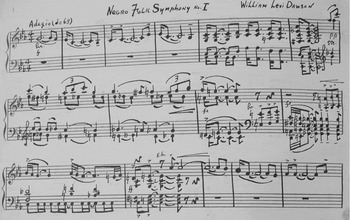
Dawson's Negro Folk Symphony, on the other hand, can be dauntingly dense upon first listen. As John Andrew Johnson writes in his 1999 article on the work, “Dawson tends toward manipulation and variation of his themes—a rhetorical presentation of his ideas rather than merely musical architecture.”Footnote 60 Indeed, one of the most noteworthy features of Dawson's symphony is that although its three movements adhere to the traditional forms one expects from a neo-Romantic symphony, the themes are handled with such virtuosic flexibility of rhythm and timbre that each movement seems to evolve organically, never simply following a preordained structure. The themes themselves, most of which are either adaptations or imitative of Negro spirituals, are ripe for development, which each receives almost instantly. The opening measures of the symphony, for example, introduce in C minor the pentatonic theme that reappears in each of the three movements. (Refer to Figure 1, which reproduces Dawson's piano reduction of the symphony's first fifteen measures.Footnote 61) This solo call from the horn elicits a homorhythmic response from wind and brass instruments, insistently repeating the “Scotch snap” rhythm of the theme and building swiftly to a somber, quasi-plagal cadence in C minor (m. 6). A less imaginative composer might have moved immediately to a restatement of the opening theme in a different key. Dawson, however, interpolates six measures that introduce the tone color of the strings, offer further development of the Scotch snap, complicate the opening theme's pentatonic vocabulary with considerable chromaticism, and reinterpret the earlier cadence in the parallel key of C major, which in turn sets up the expected return of the opening theme, now in F minor (and promptly followed by further development).
William Levi Dawson, Negro Folk Symphony (piano reduction of 1934 version), movement 1, mm. 1–15. Manuscript, Archives, and Rare Book Library, Emory University. Reproduced by permission of Milton Randolph, Jr.

Even these first measures reveal this to be a work at least as concerned with rhythm and tone color as with pitch-related processes. An analysis that focuses primarily on the thematic and harmonic components of the Negro Folk Symphony will overlook the work's most revolutionary aspect: instead of demonstrating (as does Still's Afro-American Symphony) that melodies and structures derived from African American vernacular idioms can be effective in the context of a symphony, it confronts the symphonic genre head on, demonstrating not only what Houston A. Baker, Jr. calls “mastery of form” but also “deformation of mastery.”Footnote 62 Despite being more than capable of constructing a symphony to the most exacting European-American formal standards, Dawson imbues his magnum opus with a distinctively African American aesthetic that privileges the rhetorical power of rhythm and timbre over the narrative current of harmony.
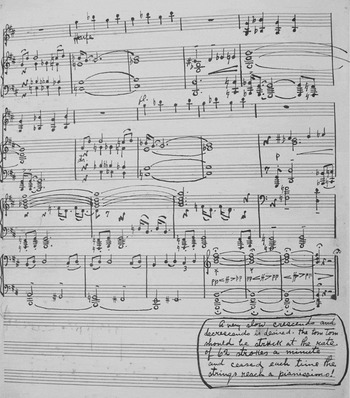
Nowhere is this more apparent than at the conclusion of the second movement. Although the movement begins and ends in B minor, mm. 219–34 of the revised symphony are in G minor, largely pentatonic and harmonically almost static, presenting reminiscences of both the movement's main theme (at mm. 221–22 and mm. 227–28) and the opening theme of the symphony (for example, at mm. 218–20 and 224–27). Measures 231–34 repeatedly affirm G as tonic with a unison F-to-G cadential figure in the low strings. In m. 235, however, Dawson unapologetically shifts to the “correct” key of B minor—a shift of a major third that, because of the stripped-down texture, surprisingly does not offend the ear—and sustains this chord for the remaining twenty-six slow measures of the movement. The conclusion consists of a series of swelling and subsiding tonic triads in the strings, low woodwinds, and flutes, accompanied by the triangle and rolling timpani, with somber punctuation from the chimes.
This passage, in which harmony becomes almost irrelevant and melody gives way to dynamic and timbral gesture, moved every audience in November 1934 to applaud at the conclusion of the movement, in spite of convention. And it struck radio listeners at home as well, for reasons that one of Dawson's acquaintances described provocatively in a letter:
I enjoyed every minute of the performance, but for me, when the church bells began to ring—well I had to sit down, to keep from falling. We do not hear them in K. C. [Kansas City] but in small towns it was not Sunday until the church bells rang: and to me nothing could so nearly complete and individualize a Negro Symphony as a piece of Negro Art as the sound of the bells.Footnote 63
The emotional reaction that the second movement's conclusion elicited in 1934 is all the more striking because this passage was considerably more succinct before Dawson revised the symphony in the 1950s: what unfolds over forty-two measures (sixteen in G minor and twenty-six in B minor) in the score published in 1963, the earlier version accomplishes in only nineteen (twelve measures of G minor, seven of B minor), as can be seen in Figure 2, taken from the 1930s-era piano reduction.Footnote 64 Not only is the later version twenty-three measures longer, but it reverses the proportion of time spent in the two keys, stretching out the passage in the tonic key and considerably intensifying the impact of the closing gestures. A comparison of the two versions of the symphony makes clear that Dawson's commitment to the subversive prioritization of rhythm and timbre in his magnum opus had only intensified between its initial composition and its revision beginning in the early 1950s.
William Levi Dawson, Negro Folk Symphony (piano reduction of 1934 version), movement 2, mm. 219–39. Manuscript, Archives, and Rare Book Library, Emory University. Reproduced by permission of Milton Randolph, Jr.

The Negro Folk Symphony deserves to be far better known than it is today. As a matter of historical interest, the symphony's lauded 1934 performances and radio broadcast were events of towering significance for thousands of African Americans across the United States, a symbolic triumph worthy of commemoration alongside contralto Marian Anderson's performance on the steps of the Lincoln Monument five years later. Had its debut been less noteworthy, the Negro Folk Symphony would still be a masterpiece of American symphonic literature, deserving of widespread performance and renown. Given that its present obscurity is due to the score's limited accessibility and not to any defect in the piece itself, there is no good reason for its continuing neglect.
One is tempted to entertain thoughts of what might have been, not only for the work and its composer but also for the development of American classical music in the twentieth century. Had things gone differently on any number of levels, might Dawson have fulfilled the prophesies of Antonin Dvořák and Alain Locke, leading and inspiring a robust cohort of American contemporaries who would use African American folk music as the basis for “a great and noble school of music”?Footnote 65 Few composers of Dawson's generation or those to follow could master—or cared to master—the symphony in all its Romantic splendor. His commitment to this most illustrious of European genres was coupled with an even greater fervor for the folk music of his ancestors, leading to the aesthetic choices that make the Negro Folk Symphony extraordinary. Placing African American folk and European classical music on an equal footing, and moving in both spheres with rare virtuosity, Dawson created a symphony whose impact should have resonated over the decades to come, both musically and politically. As he said in an interview two years before the first performance of his symphony, “I've not tried to imitate Beethoven or Brahms, Franck or Ravel—but to be just myself, a Negro. To me, the finest compliment that could be paid my symphony when it has its premiere is that it unmistakably is not the work of a white man. I want the audience to say: ‘Only a Negro could have written that.’”Footnote 66
Appendix: Program Notes on Negro Folk Symphony From Philadelphia Orchestra Concert at Carnegie Hall, 20 November 1934
The composer of this work has kindly supplied the annotator [Lawrence Gilman] with the following information concerning himself and his Symphony:. . . .
“This Symphony is based entirely upon Negro folk-music. The themes are taken from what are popularly known as Negro spirituals, and the practiced ear will recognize the recurrence of characteristic themes throughout the composition.
“This folk-music springs spontaneously from the life of the Negro people as freely today as at any time in the past, though the modes and forms of the present day are sometimes vastly different from the older creations.
“In this composition the composer has employed three themes taken from typical melodies over which he has brooded since childhood, having learned them at his mother's knee.
FIRST MOVEMENT—“THE BOND OF AFRICA”
“The introduction (Adagio, E-flat major, 4–4 time) opens with a ‘Leading Motive’ played by the first horn, which is symbolic of the link uniting Africa and her rich heritage with her descendants in America. It is pentatonic, and shows itself in numerous guises, forms, and circumstances throughout the entire composition.
“The chief theme of the main movement (Allegro con brio, E-flat major, 2–2 time) is given to the first horn, first B-flat clarinet, and E-flat clarinet, with a tremolo on the higher strings. After a few measures of contrasting material, this theme is sung by the full orchestra. A transitional passage based on the ‘Leading Motive’ leads to the second theme, presented by the first oboe, and based on the Negro melody:
After the woodwinds have sung this theme, a new idea appears in the strings. It suggests the rhythmical clapping of the hands and patting of the feet, and is immediately taken up by the full orchestra.
“The development begins (Adagio, 4–4 time) with the ‘Leading Motive’ in the trombones (in A-flat minor), and a working-out of the principal theme. This is followed by further elaboration of the principal theme. A section is now devoted to a working-out of the second theme, after which another section is devoted to the principal theme. Finally, the full orchestra gives out a new version of the ‘Leading Motive,’ and gradually leads into the Recapitulation. Except for changes in the instrumentation, and a few abbreviations, this division is the same as before. A short coda brings the movement to a close.
SECOND MOVEMENT—“HOPE IN THE NIGHT”
“This movement opens (Andante, 4–4) with three strokes from the gong, intended to suggest the Trinity, who guides forever the destiny of man. The strings, playing pizzicato, provide a monotonous background, creating the atmosphere of the humdrum life of a people whose bodies were baked by the sun and lashed with the whip for two hundred and fifty years; whose lives were proscribed before they were born. The English horn sings a melody that describes the characteristics, hopes, and longings of a Folk held in darkness. After a climax, this division is followed by one conceived in a happier mood. The children, unmindful of the heavy cadences of despair, sing and play; but even in their world of innocence, there is a little wail, a brief note of sorrow. After much development of the theme of the children, and a cry from the strings, muted brasses, and trilling woodwinds, there is a return of the previous material. This in turn is succeeded by another outburst, in which the ‘Leading Motive’ is given out by the full orchestra. The movement closes with slow crescendoes and decrescendoes after each of three mysterious sounds from the gong and other percussion instruments.
THIRD MOVEMENT—“O LEM-ME SHINE”
“The third movement begins (Allegro con brio, E-flat major, 2–2) with four introductory measures in the strings, which precede the entrance of the principal theme. This movement is based on two Negro melodies. For the first time the composer has used the melody:
This theme, after being given out by the woodwinds, is followed by related material, which in turn is succeeded by a return of the principal theme. A short episode leads to the second theme in G major, which is stated by the first oboe, and immediately taken up by the full orchestra. This is the second of the two Negro melodies used in this movement—‘Hallelujah, Lord, I been down into the sea.’ The development begins with the principal theme of the movement in the first clarinet, above a tremolo on the lower strings, and is taken up respectively by the first oboe, first flute, and first horn. A new picture of the second theme, combined with the principal theme of the first movement, is now presented, and fragments of ideas from the codetta of the third movement are made use of. The principal theme is now given out by the brasses and woodwinds in augmentation. This section, after rising to a great climax, descends slowly to the Recapitulation. A coda is built on the two themes of the movement, and is brought to a close as the brasses exhibit in bold relief the principal theme, ‘O lem-me shine lik’ a mornin’ star.’”