


Introduction
In many low-income countries, governments fail to provide basic services such as education, roads, and drinking water to a large share of their citizens, in part due to misuse of funds. One prominent explanation is that voters have limited information available to select good politicians and to hold them accountable (Fearon Reference Fearon, Przeworski, Stokes and Manin1999; Pande Reference Pande2011). However, the selection of politicians whose preferences are aligned with those of their voters is not sufficient: ultimately, elected politicians rely on bureaucrats to administer funds and provide services. Political oversight—the ability of politicians to hold bureaucrats responsible for their actions—is therefore a critical link in the accountability relationship between voters and their government. Although this link has been extensively studied in the context of developed democracies (Banks and Weingast Reference Banks and Weingast1992; McCubbins and Schwartz Reference McCubbins and Schwartz1984), it has received only scant scholarly attention in the context of low-income countries.
In practice, the link between local elected representatives and bureaucrats is complex and often tenuous. Monitoring bureaucrats, who typically possess more expertise than politicians, can be difficult. As Max Weber noted, “the ‘political master’ finds himself in the position of the ‘dilettante’ who stands opposite the ‘expert,’ facing the trained official who stands within the management of administration” (Weber Reference Weber1970, 232). The struggle to control the bureaucracy is a common theme in descriptions of Western bureaucracies (Epstein and O’Halloran Reference Epstein and O’Halloran1994). This asymmetry can be even starker in low-income countries, due to greater differences in education, tenure, and access to information and resources between bureaucrats and politicians, particularly in local governments, which provide a large share of services.
This article investigates accountability relationships within local governments, both theoretically and empirically, through a combination of qualitative data and, to my knowledge, the first field experiment on political oversight. I focus on the setting of a dominant party regime—where multiple parties are allowed to compete in elections, without resulting in an alternation of power—the most prevalent form of nondemocratic regimes since the end of the Cold War (Magaloni and Kricheli Reference Magaloni and Kricheli2010). Local politicians may use opportunities to engage in oversight to seek to improve services or to extract more personal rents, thus ultimately undermining government performance further. This is reflected in a tension in the literature. On the one hand, a central premise of the decentralization literature is that political decentralization—by enabling locally elected politicians to exert greater oversight over government performance—improves the accountability of governments to their citizens (Bardhan and Mookherjee Reference Bardhan and Mookherjee2006). On the other, a large literature is concerned with too little insulation of the bureaucracy from politicians (Brierley Reference Brierley2020; Peters and Pierre Reference Peters and Pierre2004; Weber Reference Weber1922; Wilson Reference Wilson1887). In particular in settings with high levels of clientelism, bureaucratic insulation is seen as a measure to reduce political meddling and rent extraction (Pereira Reference Pereira2001).
For politicians to engage in oversight, they must have both the incentives and the capacity to hold the bureaucracy accountable. Engaging in political oversight over bureaucrats is hard—politicians must not only change their own behavior but also seek to change the behavior of others in government, who may be at a structural advantage. I investigate the conditions under which politicians have incentives to exert this effort. I argue that in contexts where the national ruling party controls the state apparatus, local political leaders from opposing parties have greater incentives to engage in and support political oversight over the local bureaucracy. When their capacity constraint is relaxed, local politicians in governments that are not entirely under the control of the national ruling party are therefore more likely to provide oversight, with positive downstream effects on service delivery.
To test this argument, I conduct a field experiment on the effect of increased opportunities for political oversight on elite behavior and service delivery. In collaboration with the Ugandan Ministry of Finance, I implemented the experiment in 260 subcounty governments, each serving about 4,600 people, in all regions of the country. Local politicians in Uganda have limited capacity to monitor bureaucrats due to a sparse understanding of their rights as elected representatives and lack of reliable information about local governments’ revenues. The intervention sought to increase this capacity through two components: first, a training about the mandate and rights of local politicians and, second, the quarterly dissemination of newly available subcounty-specific financial information.
To measure politicians’ behavior and local government performance, I conducted a panel survey with more than 2,800 elected and appointed local government officials, as well as a physical audit survey of 657 local government projects, and collected behavioral, institutional, and qualitative measures. To test the conditioning effect of the political environment on politicians’ incentives to engage in oversight, I take advantage of Uganda’s substantial subnational variation in hegemonic party control. Although large parts of the country are strongholds of the ruling party, some areas have a history of support for opposition parties and still have representatives of opposition parties or independents in local political leadership positions today.
My main finding is that local politicians responded to the intervention by increasing their monitoring effort and attempts to improve service delivery. Knowledge levels of local government finances and procedures increased among politicians as a result of the intervention, as did political oversight, especially relating to demanding and accessing locally available financial documents. The treatment effects on political oversight are conditioned by structural differences in the political environment: effects on politician behavior are driven by nonaligned local governments where the elected chairperson is from an opposition party or an independent. Here, politicians significantly increased the number of actions taken to improve substandard service delivery—for example, insisting that poor work be redone, placing formal complaints, or seeking to withhold payment of contractors for poor performance. The increased oversight effort in nonaligned areas translated into measurable improvements in user satisfaction—including senior health and education workers and elected village leaders—with the quality of services and improvements in observed service delivery. In contrast, in ruling-party strongholds, the intervention had little effect on local politicians’ behavior and no effect on user satisfaction with services.Footnote 1 I do not find any evidence that the intervention resulted in increased rent-seeking by politicians in either aligned or nonaligned areas.
Qualitative data and a survey experiment provide evidence on the underlying mechanisms. Low-level politicians in party strongholds feared material and reputational repercussions from higher-ups in their party for speaking out about misallocations of funds and thus being perceived as “troublemakers” threatening the status quo. At the same time, low-level politicians in nonaligned areas had little to lose from speaking out, especially if they belonged to the opposition, and could call on political leaders who shared their incentives. In summary, the findings suggest that oversight opportunities can lead to increased oversight efforts among local politicians—even in weakly institutionalized settings—provided the national ruling party does not entirely control local governments.
The article contributes to the literatures on the bureaucracy, dominant party regimes, and accountability. The main contribution is the demonstration of the importance of an understudied accountability mechanism—political oversight—for local government performance, even in the hard case of a bureaucracy captured by the ruling party. This follows a long tradition of political scientists studying the relationship between elected politicians and the bureaucracy (McCubbins and Schwartz Reference McCubbins and Schwartz1984; Niskanen Reference Niskanen1975). While previous work on the topic has primarily focused on advanced democracies and relied on observational methods, this article presents the first experimental evidence on the effects of an exogenous shift in political oversight capacity, thereby allowing me to demonstrate its causal effect. In so doing, this article also contributes to the study of accountability in low-income countries, in particular to our understanding of the role of accountability relationships within governments, a critical precondition for electoral accountability to translate into improved service delivery. In contrast to studies examining the accountability relationship between voters and politicians (Dunning et al. Reference Dunning, Grossman, Humphreys, Hyde, McIntosh and Nellis2019; Pande Reference Pande2011), this article instead examines the next step in the nested principal-agent problem: the conditions under which elected politicians exert oversight over the bureaucracy. As shown in Martin and Raffler (Reference Martin and Raffler2021), increased political oversight may in turn have important downstream effects on electoral accountability.
Second, taking advantage of local-level variation in party dominance, the article analyzes how variation in local political context shapes the incentives of politicians to engage in oversight of the bureaucracy. By focusing on subnational rather than national governments, which are typically the focus of studies of political oversight in both advanced democracies (Epstein and O’Halloran Reference Epstein and O’Halloran1994) and authoritarian regimes (Williamson and Magaloni Reference Williamson and Magaloni2020), the article demonstrates that political alignment between local and national governments conditions local politicians’ incentives to engage in political oversight in dominant party regimes.
Finally, this article adds to a small but growing literature on the management of bureaucracies in low-income countries. Work focusing on local politicians’ oversight over bureaucrats in this context demonstrates the importance of electoral incentives (Gulzar and Pasquale Reference Gulzar and Pasquale2017; Pierskalla and Sacks Reference Pierskalla and Sacks2020), perceived ability to shape bureaucrats’ careers (Brierley Reference Brierley2020), and collective action failures among local politicians (Williams Reference Williams2017). Related work highlights the difficulties national incumbents face in monitoring the behavior of decentralized bureaucrats (Berliner Reference Berliner2017; Hassan Reference Hassan2020; Hassan and O’Mealia Reference Hassan and O’Mealia2018). This article contributes to this literature by examining the role local politicians play in the accountability relationship between national incumbents and local bureaucrats and how it is meditated by their party affiliation.
The findings have implications for policy makers. Accountability relationships within local governments are critical for political decentralization to be effective. A sole focus on strengthening the accountability relationship between voters and politicians is unlikely to have a tangible effect unless politicians have the capacity to ensure their preferred policies’ implementation. In considering whether to invest in programs that facilitate political oversight, policy makers should consider the political environment shaping local politicians’ incentives to improve service delivery. Even in settings with weak accountability relationships, political outsiders with an incentive to promote better services may provide a linchpin for increased accountability. Furthermore, the findings suggest an alternative approach to community monitoring interventions, which, despite becoming increasingly popular in the past decade, have yielded mixed results (Olken Reference Olken2007; Raffler, Posner, and Parkerson Reference Raffler, Posner and Parkerson2020). Rather than circumventing local government institutions, policy makers should consider strengthening their internal accountability mechanisms.
Political Oversight and Government Performance
When does greater political oversight capacity over the bureaucracy result in improved services? Information asymmetries between politicians and bureaucrats are well established (Epstein and O’Halloran Reference Epstein and O’Halloran1994; Huber and Shipan Reference Huber and Shipan2002). In light of them, scholars have long realized the tension between bureaucratic autonomy and democratic responsiveness (Aberbach, Putnam, and Rockman Reference Aberbach, Putnam and Rockman1981; Evans Reference Evans1995). Although insulation may shield bureaucracies from patronage politics, this argument is fundamentally at odds with a central premise of the decentralization literature: that political decentralization—by enabling locally elected politicians to exert greater oversight over government performance, thus effectively reducing bureaucratic insulation—improves accountability of service delivery (Bardhan and Mookherjee Reference Bardhan and Mookherjee2006; Seabright Reference Seabright1996). In this view, the higher the cost of auditing or monitoring bureaucrats’ behavior for politicians, the greater the surplus the bureaucracy can extract (Banks Reference Banks1989). This article addresses this tension by studying the conditions under which greater political oversight capacity by local politicians is likely to improve service delivery. I define political oversight as effort exerted by politicians to monitor bureaucrats’ implementation of their decisions and to hold them accountable in case of deviations.
Governments broadly consist of politicians, who devise policy, and bureaucrats, who implement it on politicians’ behalf. In many local governments in weakly institutionalized settings, local politicians’ foremost policy decisions are, first, determining which share of the resources available to their government to allocate toward service delivery versus personal or party rents and, second, allocating these resources across different projects and localities.Footnote 2 Bureaucrats are then typically tasked with the administration of funds, the drawing up of technical plans, and procurement. Bureaucrats thus act as the agents of politicians. In hierarchical bureaucracies, local bureaucrats also report to higher-level bureaucrats. Citizens, in turn, observe government performance and on this basis decide whether or not to reelect the incumbent (Fearon Reference Fearon, Przeworski, Stokes and Manin1999; Ferejohn Reference Ferejohn1986). I assume that voters value service delivery (Conroy-Krutz Reference Conroy-Krutz2013; Harding Reference Harding2015).
In order to engage in political oversight of the bureaucracy, politicians need to have both the capacity and the incentives to do so. Bureaucrats can use their position as experts and the resulting information asymmetries to deviate from the policy decisions made by their political principals (Dragu and Polborn Reference Dragu and Polborn2013; Weber Reference Weber1922), for example to enrich themselves (Mbaku Reference Mbaku1994), to promote the agenda of a party they are beholden to, or, in the case of mission-driven or career-oriented bureaucrats, to prevent rent-seeking and political subversion of government programs by politicians (Honig Reference Honig2020).
Capacity to Engage in Political Oversight
Drawing on principal-agent theory, I distinguish between the capacity to monitor—to observe bureaucrats’ actions—and the capacity to sanction—to introduce consequences for their behavior (Ferejohn Reference Ferejohn1986). Observing the actions of bureaucrats is a nontrivial task in the best of circumstances. It is even more challenging in settings where oversight institutions are weak and access to reliable information scarce (Banks Reference Banks1989), thus increasing the transaction costs of monitoring (Huber and Shipan Reference Huber and Shipan2002). Examples of critical information in the context of a local government include data on fiscal transfers and local revenue in order to assess the budget envelope, detailed expenditure information to understand how funds were spent, and technical documents with planned project inputs to understand how they should have been spent. Similarly, procedural knowledge can be critical, including about which information exists, where to request it, and who has a right to access it. Accessing such information can be challenging for local politicians (Igbokwe-Ibeto Reference Igbokwe-Ibeto2012).
Beyond the ability to monitor, politicians also need to have the ability to reward or punish bureaucrats in order to engage in effective oversight. The extent to which they are able to do so depends not only on the sanctioning mechanisms directly available to politicians but also their ability to call in reinforcement, such as through investigations through the police, auditors, and political or bureaucratic higher-ups who can exert pressure in case of malfeasance (O’Donnell Reference O’Donnell1998). Access to the media may generate public pressure by exposing wrongdoing (Ferraz and Finan Reference Ferraz and Finan2008). Informal institutional arrangements may facilitate social sanctions and thus promote accountability even in authoritarian contexts (Tsai Reference Tsai2007).
Institutions shaping oversight capacity are typically determined at the national level. Thus, local politicians may find their oversight capacity to be exogeneously constrained. For example, their mandate to influence the careers of bureaucrats, access to government information, training of incoming politicians, the existence of independent national oversight bodies, and the independence of the media all shape politicians’ ability to engage in oversight and are beyond the control of local politicians. This article studies the effect of relaxing the constraint in oversight capacity.
Incentives to Engage in Political Oversight
What shapes the incentives of local politicians to engage in oversight of the bureaucracy directed at improving service delivery in a weakly institutionalized context? On the one hand, politicians incur costs when engaging in political oversight (Gulzar and Pasquale Reference Gulzar and Pasquale2017). In addition to the effort and time required, uncovering and sanctioning behavior by bureaucrats may be politically costly if the bureaucrats’ behavior is approved of by higher-ups in the politician’s party. Furthermore, bureaucrats may wield influence about the allocation of personal rents and political favors—for example, by collaborating on rent extraction, informing favored politicians about new government programs first so that they can inform their political supporters, etc. Thus, falling out of favor with a local bureaucrat may also result in a direct loss of personal and political benefits. On the other hand, politicians may expect benefits from engaging in political oversight. Voters may reward both the action in itself and positive downstream effects on the quality of service delivery at the ballot box. Politicians’ standing in their party may also increase as a result of uncovering bureaucratic malfeasance, depending on their party’s stance on the issue.Footnote 3
In dominant party regimes, local politicians representing the ruling party stand more to lose from disrupting the status quo by engaging in political oversight—both in terms of immediate benefits the bureaucrat may withhold and in terms of potential loss of future access if the party views their oversight efforts negatively. In these regimes, the line between the state and the party in power is blurred (Magaloni Reference Magaloni2006). As a result, ruling-party representatives at all levels are more likely to be able to use the state apparatus to their benefit, such as extracting rents and winning elections (Levitsky and Way 2010; Tripp Reference Tripp2010). At the same time, the party can wield greater future access to these resources in the form of access-to-power positions as a powerful incentive for loyal supporters (Gandhi Reference Gandhi2008; Magaloni and Kricheli Reference Magaloni and Kricheli2010). In addition, in contexts where voters perceive the bureaucracy as being captured by a hegemonic party (Mwenda and Tangri Reference Mwenda and Tangri2005), uncovered malfeasance by bureaucrats may be tarnishing the reputation of the party, thus providing further disincentives to politicians representing it.
I argue that in the context I study, the salient difference shaping politicians’ incentives is between local governments where the entire political leadership is representing the dominant ruling party (aligned) and those where at least someone in a political leadership position is opposing the party (nonaligned). Local governments typically consist of multiple, hierarchically structured political positions (UCLG 2008). When the (local) political leadership has agenda-setting power, thus acting as veto player, and lower-level politicians need the backing of the body in order to effect change, their hands are tied (Baron and Ferejohn Reference Baron and Ferejohn1987). In contexts where lower-level local politicians can directly initiate action by regional or national oversight institutions, the salient variation in incentives is likely to be at the level of the individual politician.
This article studies the effect of alleviating the capacity constraint by providing local politicians with information and skills to oversee bureaucrats on politician behavior and service delivery outcomes and observes how differences in alignment status shape politicians’ incentives to respond to such increased capacity. In line with the framework presented above, I argue that local politicians in nonaligned areas have a greater incentive to respond to improved capacity by engaging in increased oversight, which may ultimately result in improved service delivery outcomes.
Local Governance in Uganda
Uganda is ruled by a hegemonic party—one political party remaining continuously in power while holding regular multiparty elections—and is a semiauthoritarian regime, featuring both democratic and authoritarian elements (Kagoro Reference Kagoro2016; Platas and Raffler Reference Platas and Raffler2021; Tripp Reference Tripp2010). The ruling party, the National Resistance Movement (NRM), holds 68% of Parliamentary seats.Footnote 4 President Museveni has held office since 1986. The lines between party and government are blurred and people widely perceive the bureaucracy as being controlled by the ruling party (Mwenda and Tangri Reference Mwenda and Tangri2005).
Levels of service delivery in Uganda are low (UBoS 2015). Although in part due to lack of resources, the available means are also often not effectively used (Grossman and Michelitch Reference Grossman and Michelitch2018; OAG 2015). Uganda is ranked 139 out of 168 countries on Transparency International’s corruption perception index (Transparency International 2015). Especially at the local level, ethnic divisions are not a primary factor shaping Ugandan politics (Martin and Raffler Reference Martin and Raffler2021). In the subcounties studied, an average of 89% of sampled council members belong to the same ethnic group.
Three factors make Uganda a good test case for my argument. First, local governments consist of clearly delineated bureaucratic and political teams that are jointly responsible for providing a large share of the nation’s services, and the bureaucracy is hierarchically structured. Second, a gap exists between the law’s mandate for political oversight and reality, opening the door for a government intervention. Third, Uganda exhibits substantial subnational variation in the intervening variable, dominance of the ruling party. However, the control exerted by a hegemonic party and the implications for political accountability may also make Uganda a hard case for a finding that political oversight strengthens service delivery.
Coproduction of Local Services
Uganda is heavily decentralized. The bulk of services are delivered by the 112 districts and more than 1,400 subcounties. Subcounties—the unit of analysis here—are the lowest level of government with its own budget; they are responsible for implementing smaller development projects, such as boreholes and maintaining feeder roads. A subcounty serves a median population of 20,000; an average of 12 subcounties comprise a district.
Local governments consist of a political and a bureaucratic wing. The subcounty’ political wing is the council, consisting of the LC3 chairperson; one elected councilor per parish; and councilors representing women, youth, and people with disabilities.Footnote 5 All council members are directly elected in partisan first-past-the-post elections and hold five-year terms. There are no term limits. The chairperson presides over the council and controls the agenda. In contrast to the chairperson, regular councilors do not receive a salary, but small allowances for council meetings. The bureaucratic wing consists of career civil servants tasked with implementing the decisions by the council. It is led by the subcounty chief, who oversees two to four technical officers. Subcounty chiefs are employed by the district bureaucracy; their direct supervisor is the Chief Accounting Officer (CAO)—the chief bureaucrat at the district, who, in turn, is employed by the central bureaucracy. Local bureaucrats thus effectively have two principals, the council and the CAO.
Local governments primarily depend on ear-marked transfers from the central government. One of councilors’ core responsibilities is to decide funding allocations within narrowly defined guidelines. They have little influence over allocations to sectors.
Limited Political Oversight
On paper, the relationship between the bureaucratic and political arms of Ugandan local governments is one of mutual checks and balances. According to the 1997 Local Government Act, councilors serve as policy makers while bureaucrats serve as implementers of council decisions. Councilors primarily determine the allocation of subcounty funds and monitor the bureaucrats’ project implementation, on their constituents’ behalf. Bureaucrats, on the other hand, administer the budget and advise councilors on government rules. The slogan “Eyes on, hands off” captures this division of labor by implying that although councilors are supposed to watch the use of government resources, they are not supposed to “touch” the money.
In reality, however, local councils have little control over the bureaucracy, resulting in frequent complaints from politicians about lack of financial transparency, suspected misuse of funds, low quality of service implementation, and absenteeism (Supplemental Information [SI] Table C1). Several factors contribute to their limited oversight. First, bureaucrats act as gatekeepers of information between the central government and councilors. Directives and information about transfers from line ministries reach local councils through the bureaucracy. Stark educational asymmetries aggravate this relationship: although all subcounty bureaucrats must hold university degrees, the median councilor has not completed secondary school (SI Table C2). In addition, bureaucrats, usually career civil servants, spend their professional lives in government building knowledge and professional networks, whereas councilors receive only a short introductory training. As a result, many counselors, confused about their rights and responsibilities, rely on bureaucrats for clarification. Bureaucrats can use these asymmetries to claim that technical documents are intended for their exclusive use. During the baseline survey for this study, 22% of subcounty bureaucrats reported that a law prevented councilors from accessing certain information about subcounty finances. No such law exists. To the contrary, councilors have the legal authority to oversee their government’s finances. Yet, as one councilor described, “It’s hard to get documents from the [subcounty] technical personnel. They keep telling us it’s above us and that we should do things as per our level.”Footnote 6
Second, subcounty bureaucrats are the sole signatories for the subcounty accounts and, therefore, the only ones with access to bank statements. These statements serve as subcounties’ only reliable financial information. Central government funds are hard to predict, they typically arrive late and in lesser amounts than in the budget, with no public announcements. Subcounty councilors rely on the bureaucrats to discover how much money the central government sent and when; at a later stage bureaucrats disclose how the money was reportedly spent. During the baseline, 72% of councilors reported that it would be “very” or “somewhat hard” to gain access to bank statements of the subcounty if they had a question. One councilor explained, “It’s not easy [to get financial information from the subcounty bureaucrats]. They dodge, dodge you. You only get it if you persist. But you may get it when it is useless—they delay until the information is old. It is intentional.”Footnote 7
Last, bureaucrats are responsible for paying councilors all government allowances, including monitoring facilitation. Because bureaucrats manage subcounty funds, it is extremely difficult for politicians to steal or divert money without colluding with bureaucrats.
The result is a large discrepancy between councilors’ legal mandate to monitor the delivery of services and the reality. As one former district chairperson described, “The very person you are going to monitor controls your pocket. There is no monitoring.” Ruling-party councilors face additional disincentives for engaging in political oversight. Those who voice complaints about financial mismanagement may be castigated as “troublemakers.” The ruling party has several strategies for punishing its members including not informing politicians when government welfare programs arrive, tarnishing their reputations, and withholding support during reelection campaigns. Especially in strongholds, politicians’ political survival is primarily a function of their standing in the party. Contrary to members of the opposition, ruling-party councilors have a hard time running on a platform against bureaucratic corruption, as voters perceive the bureaucracy and the ruling party as intertwined.
Nonetheless, councilors possess some options for initiating repercussions against the bureaucracy. Although local politicians cannot fire bureaucrats, they can initiate a transfer by presenting a formal request to the CAO. In about 50% of cases,Footnote 8 CAOs grant these requests, transferring the bureaucrat to another subcounty within the same district. Such transfers are unpopular among subcounty bureaucrats because they negatively affect their reputation and chances of promotion. In some instances, the transfers disrupt clientelistic networks. In extreme cases of substantiated malfeasance, councils may refer the case to the police or national anticorruption agency for formal investigations; these may result in loss of employment and legal consequences.
Subnational Variation in Party Control
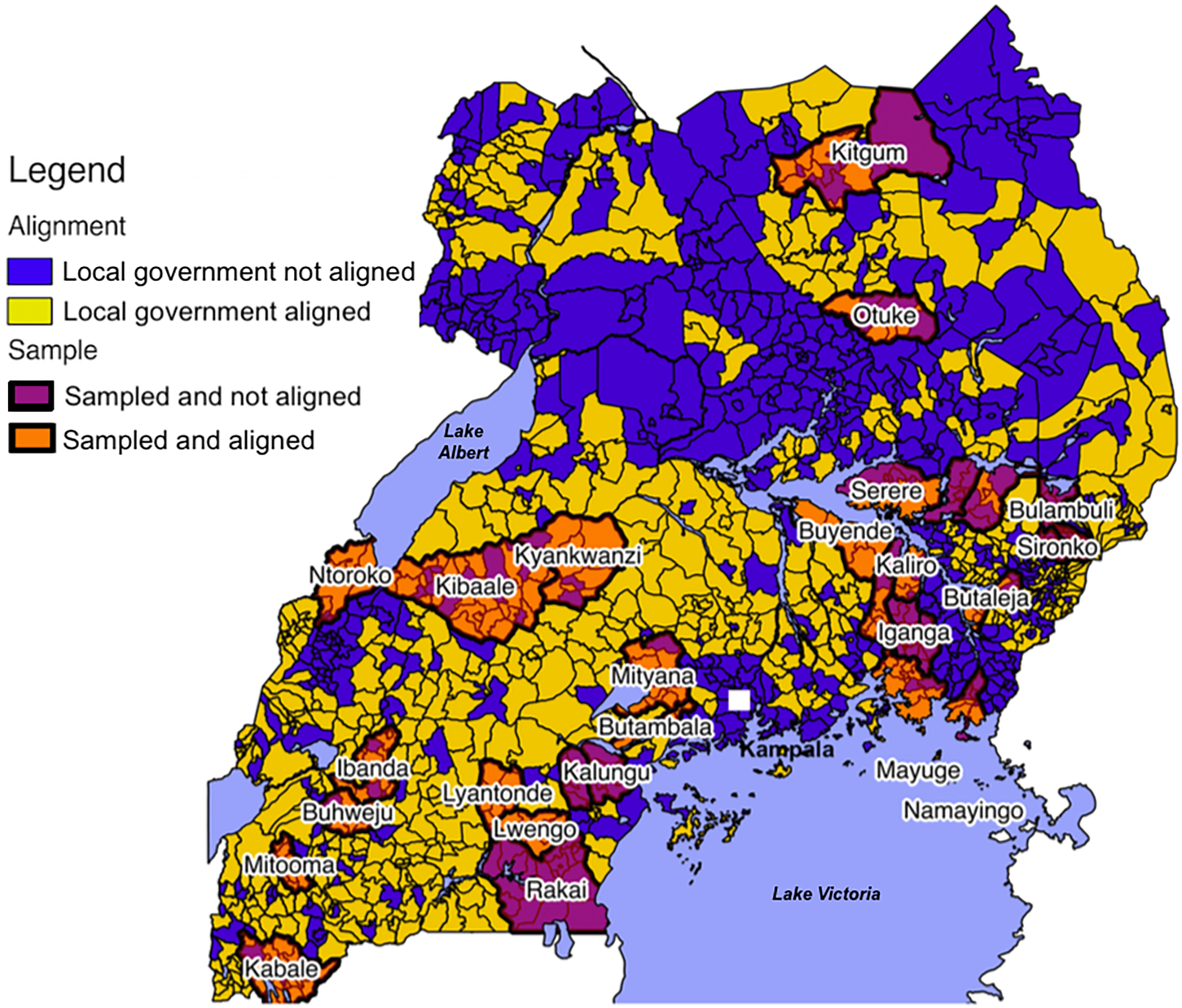
Finally, Uganda exhibits substantial levels of subnational variation in party control. Fifty-eight percent of subcounties are led by a chairperson representing the ruling party and belong to a district led by a chairperson representing the ruling party. In other words, in nearly 60% of the country, members of the ruling party hold political leadership positions at all levels of government—subcounty, district, and the presidency (see SI Table C3). I refer to these areas as aligned with the ruling party. However, in parts of Uganda opposition parties traditionally have a stronger standing. Figure 1 shows the regional distribution of aligned subcounties.
Map of Uganda by Alignment

Aligned and nonaligned subcounties differ along different measures of political competition. Aligned subcounties have significantly higher vote margins (42% vs. 21% for LC3 chairpersons), more candidates running unopposed (18% vs. 4% for LC3 chairpersons), and fewer candidates running for either office (see SI Table C6). Furthermore, aligned subcounties more heavily favor the NRM in national elections (Museveni received a vote share of 75%, compared with 65% in nonaligned subcounties). One may thus characterize them as ruling-party strongholds. I leverage this subnational variation to study how different political environments shape councilors’ incentives to engage in political oversight when exogeneously lowering the cost of doing so.
Intervention
This study was implemented in collaboration with the Ugandan Ministry of Finance, Planning, and Economic Development (MoFPED), the Overseas Development Institute (ODI), and Innovations for Poverty Action (IPA) in 260 subcounty governments across 28 districts in Uganda. Treatment assignment was randomized at the subcounty level.
The intervention sought to enable local politicians to monitor the performance of their bureaucratic counterparts. It consisted of two components: (i) a one-off training workshop and (ii) the quarterly dissemination of information on budget allocations, fiscal transfers to, and reported expenditures in the respective constituencies. Both components are discussed below. They were designed on the basis of dozens of exploratory interviews with local and national government officials and civil society leaders.
Councilor Training
Councilors and bureaucrats in treatment subcounties were invited to a day-long training workshop conducted by the research team on behalf of the Ministry of Finance. The training’s objectives were twofold. First, it sought to clarify the division of labor between bureaucrats and politicians while reinforcing politicians’ mandate to monitor and access information. One goal was to debunk common misinformation such that a law exists according to which elected representatives are not allowed to access financial information.
Second, the participatory curriculum was designed to build monitoring capacity. Components included the reporting process for budget data, interpreting financial information, accessing additional documents only available at the local level, using budget data to monitor projects, and actions they can take if the realities on the ground and the data do not match. We developed the curriculum with the support of two local firms specializing in training local governments. It was extensively piloted and reviewed by the Ministry of Finance. Each participant received a handbook summarizing the training’s content, their subcounty’s financial information, and a certificate.
The two local consultancy firms and IPA conducted the training, holding workshops in the five local languages spoken in sample districts and following detailed scripts to ensure consistency across regions. Seven three-member teams completed four days of train-the-trainer workshops before dispatching to the field. Four members of the research team consistently monitored them to ensure compliance with the script. Up to three subcounties were combined per training workshop. Subcounty bureaucrats were invited to make the increased oversight capacity of councilors salient to them.
Budget Information
Due to a budget reporting reform in 2010, each quarter subcounty and district bureaucrats must submit highly disaggregated, digital information on local government expenditures to the Ministry of Finance. Following the training, the research team delivered prints of subcounty financial reports to the respective councilors in treatment subcounties quarterly to overcome one frequently cited challenge in fulfilling their mandate: lack of information on planned and reported government projects and expenditures. Indeed, not all bureaucrats favored this information becoming public. During piloting, one bureaucrat offered a research assistant a substantial bribe for not sharing the budget data with councilors because, as he put it, “otherwise they will be on our neck.”
The reports presented financial information in nontechnical terms, for instance: “Shs 12.2 million were allocated to drill a borehole in Bbira trading center, Bbira parish, Makokoto subcounty, Mbale district between June 2012 and July 2013. As of July 2013, Shs 12.9 million have been transferred. The project has been reported as completed by the District.”Footnote 9
Implementation of the Intervention
The intervention was introduced and perceived as a program by the Ministry of Finance.Footnote 10 One important incentive for the Ministry to collaborate on this project was the attribution of responsibility between different levels of government: when planned projects are left un- or partially implemented, local governments have incentives to claim that the allocated funds never arrived. By providing detailed public records of transfers from the central to local governments, the Ministry was able to push back against this narrative.Footnote 11 Delegations from the Ministry traveled to all study districts introducing the project to district officials, who then introduced the intervention to subcounty officials. The research team recruited and trained intervention teams, who traveled with introduction letters from the Permanent Secretary and district officials. The Ministry approved all distributed material, which followed official government templates and used the Ministry’s branding.Footnote 12 The Ministry considered the study period a pilot phase. Upon completion, implementation responsibility and material were transferred to the Ministry of Finance.
The intervention was very popular among local politicians. It was still salient in councilors’ minds 20 months after the launch. Asked how they learned about subcounty finances in qualitative interviews in eight treatment subcounties, 79% of council members mentioned the program unprompted (see SI A.2). The qualitative work was not associated with the Ministry or the intervention.
Of those who received printed materials and budget information, 90% of respondents reported having used them (75% for monitoring, 13% for demanding accountability from bureaucrats (see SI A.2).
Research Design
The sample consists of 2,365 elected politicians and 461 bureaucrats in 260 subcounties in 28 districts.Footnote 13 I randomly assigned subcounties to either treatment (J = 150) or control group (J = 110). Randomization was blocked on district and a behavioral measure of the relative type of politicians and bureaucrats in a given subcounty.Footnote 14 Further details are included in the SI at the Amercian Political Science Review Dataverse. All councilors and bureaucrats in treatment subcounties were invited to participate in the intervention. A preanalysis plan for this study was filed on the AEA registry (AEARCTR-0000402) prior to having access to outcome data. Deviations from the preanalysis plan are discussed in SI A.3 and ethical considerations in SI A.4.
The study was conducted in 28 of 112 districts across all four regions of Uganda. SI A.1 includes a map of study districts. Criteria for selection into the sample were budget reporting performanceFootnote 15 (because one cannot assess the effect of disseminating budget data in districts where little or no such data exists), regional spread, and the absence of other accountability interventions. Budget reporting performance is largely a function of the capacity of the District Planner and not correlated with overall local government performance.
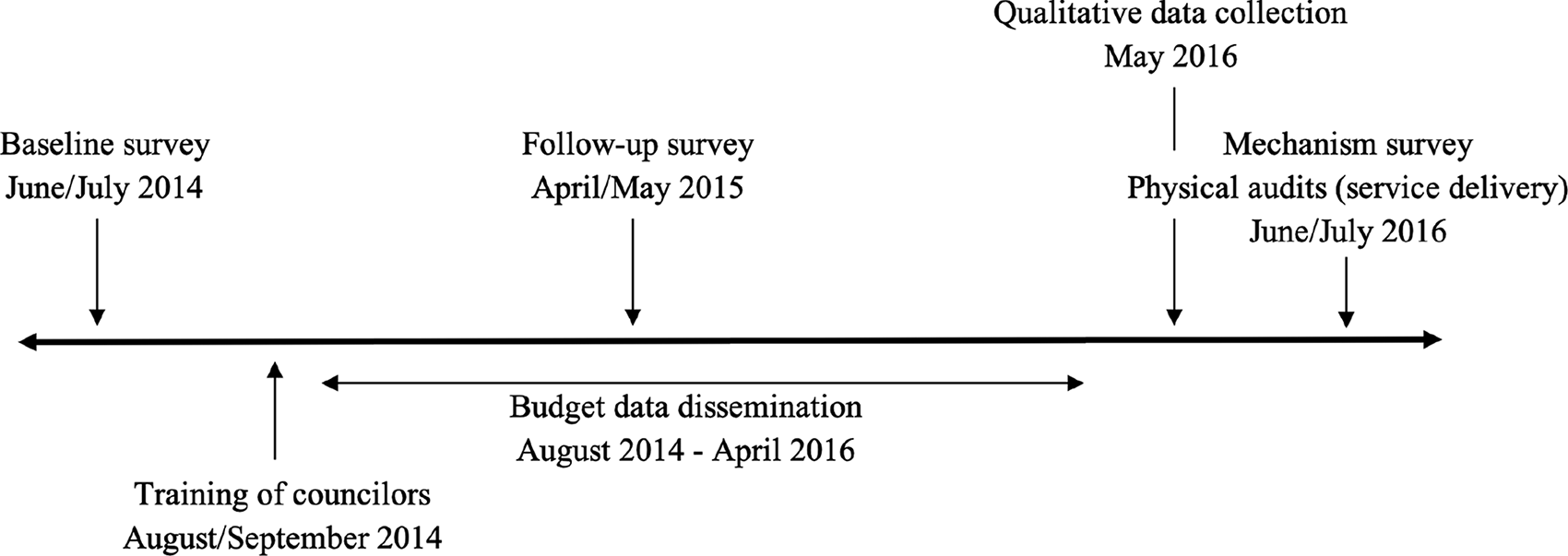
A total of 260 rural subcounties—lower level local governments—were included in the study, constituting nearly all rural subcounties in the study districts.Footnote 16 The sample consists of a panel of 2,826 subcounty officials, including subcounty bureaucrats, councilors, and the subcounty chairperson.Footnote 17 The baseline survey was conducted in June/July of 2014. The training of councilors and first budget data dissemination took place in August/September of 2014, followed by quarterly budget dissemination until April 2016. The follow-up survey to assess effects on councilors’ knowledge and oversight behavior took place in April/May of 2015, eight months after the onset of the intervention. This was followed by qualitative data collection with 48 councilors across four districts in May 2016 and a survey to get at the underlying mechanisms and physical audits of local government projects to assess effects on service delivery in June/July 2016, 22 months after the onset of the intervention.Footnote 18 The timeline of the study is displayed in Figure 2.Footnote 19 Great care was taken to ensure that intervention and enumeration teams were not associated with each other (see SI in the APSR Dataverse). The attrition rate between baseline and follow-up surveys was 4.4% (4.1% among politicians, 6.3% among bureaucrats). Attrition is balanced across treatment and control groups.
Study Timeline

Balance Treatment is mostly balanced when regressing the treatment dummy on all baseline covariates, baseline values of dependent variables, and stratification variables. The p value for the joint hypothesis test is 0.786 with district fixed effects and 0.498 without (see SI in the APSR Dataverse). Some variables do not pass a univariate two-sided t test (see SI C.2). All variables with p < 0.10 on the two-sided t test are included in the vector of controls. All main results are robust to the exclusion of covariates.
Compliance Treatment compliance was high. Ninety-three percent of respondents in subcounties assigned to treatment reported attending the workshop and 95% reported receiving hard-copy budget reports. Individually invited, workshop participants introduced themselves in front of their colleagues. Therefore, it is highly unlikely that officials from control subcounties participated in the workshops.
Results
This section summarizes the empirical results. I first show pooled results on the first-stage outcome, councilor knowledge of local government rules and procedures, before discussing the main outcome, political oversight. I then discuss effects on the main outcome by the subgroups identified in the theory section.
The main specification to estimate the effect of the pooled treatment is:
 $$ {Y}_i={\displaystyle \begin{array}{l}{\beta}_0+{\beta}_1{Treat}_{ij}+{\beta}_2{Y}_i^0+\sum \limits_{j=1}^{J-1}{\gamma}_j{X}_{ij}^0\\ {}+\hskip2px \sum \limits_{j=1}^{J-1}{\delta}_j{Treat}_{ij}\ast {X}_{ij}^0+\sum \limits_{j=1}^{J-1}{\unicode{x03B5}}_j{S}_{ij}^0+\sum \limits_{j=1}^{J-1}{\zeta}_j{D}_{ij}^0+{u}_i,\end{array}} $$
where Yi is the outcome measure for respondent i,
 $ {Treat}_{ij} $
is the treatment indicator in subcounty j,
 $ {Y}_i^0 $
is the outcome measure for respondent i measured at baseline (where available),
 $ {X}_{ij}^0 $
is a vector of standardized covariates,
 $ {Treat}_{ij}\ast {X}_{ij}^0 $
is the treatment indicator interacted with the vector of standardized controls (see Lin Reference Lin, Green and Coppock2013), and
 $ {S}_{ij}^0 $
are stratification blocks;
 $ {D}_{ij}^0 $
are district indicators, and ui are robust standard errors clustered at the subcounty level, the unit of randomization. The vector of covariates includes respondent’s years of education, number recall, wealth index, gender, and the share of subcounty council members from the opposition. Covariates are measured at baseline and were prespecified.Footnote 20 In addition, I include all covariates with p < 0.10 or less in the two-sided univariate balance test, shown in SI C.2. I run all analyses with and without district fixed effects, with and without control variables, and with dependent and independent variables aggregated at the subcounty level. Results for robustness tests are reported in SI E.
To reduce the number of comparisons, all dependent variables are z-score indices consisting of the components listed in SI Table B1, standardized to have mean 0 and a standard deviation of one, as prespecified.Footnote 21 Signs of individual z scores are oriented such that a higher value implies a more beneficial outcome. The treatment effect on the averaged z-score index can then be interpreted as the average treatment effect on index components in terms of standard deviations. I apply Benjamini–Hochberg corrections to account for multiple comparisons. As reported in SI Table E4, all significant results pass the Benjamini–Hochberg procedure at, at most,
 $ \alpha =0.1 $
. Treatment effects on individual components of indices are reported in SI D.
Councilor Knowledge of Local Government Rules and Procedures
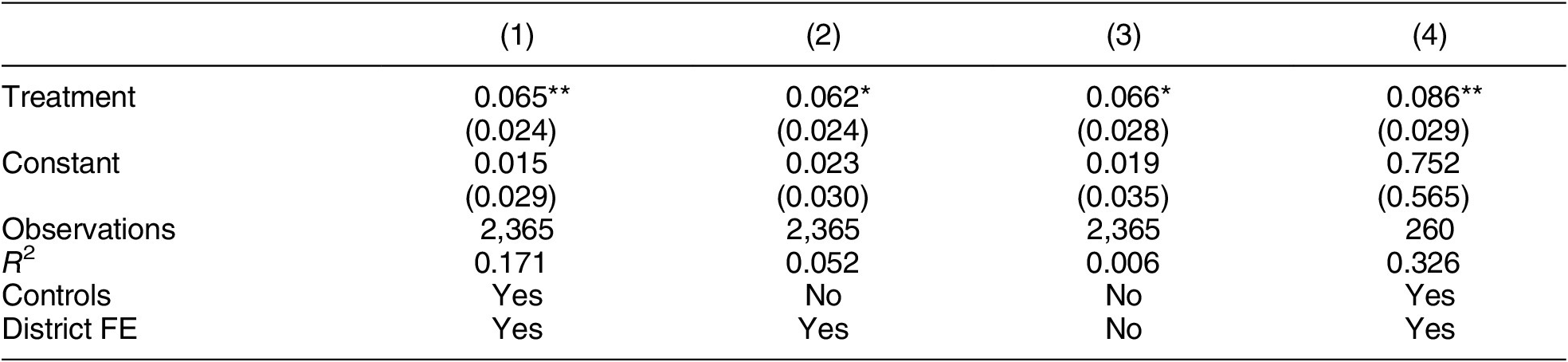
As a first-stage outcome, or manipulation check, I assess the effect of the intervention on councilors’ knowledge of local government rules and procedures. The dependent variable is an averaged z-score index consisting of eight factual knowledge questions collected eight months after the intervention. They relate to procedures for budget formulation, actions subcounty bureaucrats can take to rectify substandard service delivery, technical monitoring skills, subcounty finances, and councilors’ rights to access financial information of the subcounty. The intervention had a small, positive and significant effect on councilors’ knowledge of local government rules and procedures of 0.06 to 0.09 standard deviations. Table 1 summarizes the results. Column 1 shows the main specification with the full vector of controls and district fixed effects. Columns 2 and 3 show results without control variables, except for stratification variables and without district fixed effects, respectively. Column 4 shows results for the main specification aggregated at the subcounty level. Results are robust across the four specifications. Treatment effects on index components are reported in SI Table D2. Councilor knowledge increased in both aligned and nonaligned areas (see SI Table D4).
Treatment Effects on Knowledge

Note: The DV is the index of councilors’ knowledge on local government rules (average z-score index). In columns 1–3, the unit of analysis is the individual councilor, in column 4 the subcounty average. Robust standard errors are shown in parentheses (clustered at the subcounty level in columns 1–3). Specifications include controls and district fixed effects as indicated. ***p < 0.001, **p < 0.01, *p < 0.05, +p < 0.10.
Political Oversight
Next, I assess whether the increase in knowledge translated into increased oversight effort, defined as actions councilors take to seek greater transparency and to correct existing problems. The measure of political oversight is divided into three subindices. The first, monitoring effort, combines measures of councilors’ demands for additional financial documents, as well as their monitoring visits as observed by third parties. One problem councilors commonly identify is that their colleagues are either too disempowered and/or too disinterested to ask the subcounty bureaucrats for such financial and technical documents as bank statements, bills of quantities outlining the technical specifications for development projects, or detailed quarterly financial reports. For example, at baseline, 59% of councilors said that subcounty bank statements were very difficult to obtain. Yet, these more detailed documents are essential for monitoring and supplement the information provided by the Ministry of Finance. The index includes measures of self-reported demand for different financial documents, which I cross-validate with information provided by local bureaucrats.
Second, I measure councilors’ efforts to physically monitor local government service providers—for example, schools and health centers—by conducting a survey with headmasters and health workers to assess how often councilors made monitoring visits in the past 12 months. The second subindex combines self-reported measures on the frequency with which councilors have been granted access to different types of financial and technical documents by the subcounty bureaucrats. Last, I construct a subindex on repercussions initiated by councilors to improve substandard service delivery. The index consists of the following components: the number of times councilors demanded a redo of substandard work, the withholding of payment or replacement of a contractor, the initiation of an investigation, and attempts to transfer bureaucrats. Outcomes were collected eight months after intervention launch.
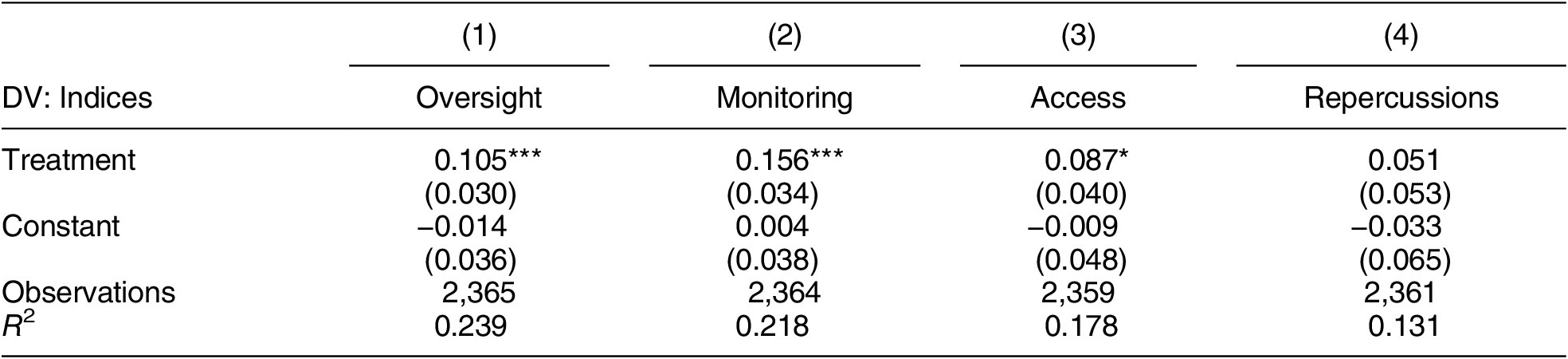
Table 2 summarizes treatment effects on the oversight index and its subindices. The treatment had a positive, significant effect on the oversight index of 0.11 standard deviations and positive, significant effects on monitoring effort and access to financial information. For example, the program increased the number of bureaucrat-held financial documents requested by councilors by 27% and the number accessed by 15% (see SI Table D6). The effect on initiated repercussions is not significant in the pooled analysis.
Treatment Effects on Political Oversight

Note: The aggregate index of political oversight (oversight index) (1) and its subindices, (2) monitoring effort, (3) access to financial documents, and (4) initiated repercussions, are averaged z-score indices. All models include controls and district fixed effects. Robust standard errors clustered at the subcounty level are shown in parentheses. ***p < 0.001, **p < 0.01, *p < 0.05, +p < 0.10.
By Party Dominance
Next, I examine how treatment effects vary by the extent of dominance of the ruling party. As argued above, local politicians should have stronger incentives to engage in political oversight in areas where politicians not belonging to the ruling party hold leadership positions. Such political outsiders are less likely to benefit from preferential treatment by bureaucrats, less likely to suffer repercussions by higher-ups in their party for speaking up, and more likely to perceive the uncovering of corrupt behavior by a bureaucracy controlled by the ruling party as a viable campaign strategy. Thus, they should be more inclined to support efforts by lower-level politicians to engage in political oversight. In turn, lower-level politicians have a greater incentive to invest in costly oversight of the bureaucracy when such outsiders hold local leadership positions because their efforts are more likely to be successful.
Data from qualitative interviewsFootnote 22 suggest that the partisan dynamics in strongholds of the ruling party play a critical role in preventing councilors from holding local bureaucrats accountable. Fear of repercussions by the party and being branded a troublemaker for speaking out were themes frequently mentioned by councilors in these subcounties. As one former NRM member in a stronghold noted,
The one who is following things properly, the [party] don’t want them. They call them rebel—are they rebel?! … The problem is we have few people who have the country at their heart. We wanted to use the budget information, but we failed.Footnote 23
The quote indicates councilors intended to use the tools to increase oversight of the bureaucracy, but stopped for fear of being branded a “rebel” who disturbs the status quo, thus potentially violating the interests of more powerful people in the party and drawing attention to mismanagement of funds. Had they cared more about their constituency and “the country,” instead of their own reputation, so the insinuation, they would have proceeded regardless.
One explanation for the resistance by the party is that higher-level politicians and bureaucrats are benefiting from the status quo. Asked whether councilors had used the financial information, the same person explained,
They are fearing their bosses. Let me give you an example. We were buying coffee seedlings for the subcounty. They bought some at a very high price but it was dry, so no one wanted it. We asked the chief [bureaucrat] to withhold payment. I wrote a letter complaining to the CAO [district bureaucrat]. The CAO came in and said [the supplier] is our colleague, so pay him. So the councilors backed down and paid him. The person supplying the coffee was the [party] district chairperson. They gave all councilors 20,000 shillings (about USD 6) to agree.
Opposition councilors in a district led by an opposition chairperson suggested that sometimes councilors ask colleagues across the aisle to speak out on their behalf. Referring to colleagues from the ruling party who wanted to act against bureaucratic corruption, they explained,
Yet they cannot speak out because of the party. So instead they came to us, the opposition councilors, and asked us to speak on their behalf. … If they were to speak directly, it would violate the trust their fellow party members have in them and it may lead to a lot of fights. Most of them are scared of being disciplined by the party.Footnote 24
Quantitative Evidence
To test the hypothesis that party dominance conditions councilors’ incentives to engage in political oversight more systematically, I test for heterogeneous treatment effects by alignment. A subcounty is considered as aligned with the hegemonic national ruling party when both the directly elected subcounty chairperson and the directly elected district chairperson are ruling-party members, and not aligned otherwise. Thus, in a nonaligned subcounty at least one local political leader—at the subcounty or the district level—is an opposition-party member or an independent.Footnote 25 SI Table C3 presents the distribution of parties represented by the political head at the subcounty (LC3 chairperson) and the political head at the district (LC5 Chairperson), respectively, in the study sample. Different specifications code subcounties as nonaligned only when either the political chairperson of the subcounty or that of the district is not representing the ruling party. Results are robust across the three specifications (see SI Table E3). As alignment is not randomly assigned, this specification includes standardized controls for subcounty characteristics, drawn from the census and measures of political competition,Footnote 26 as well as their interaction with the treatment dummy.Footnote 27
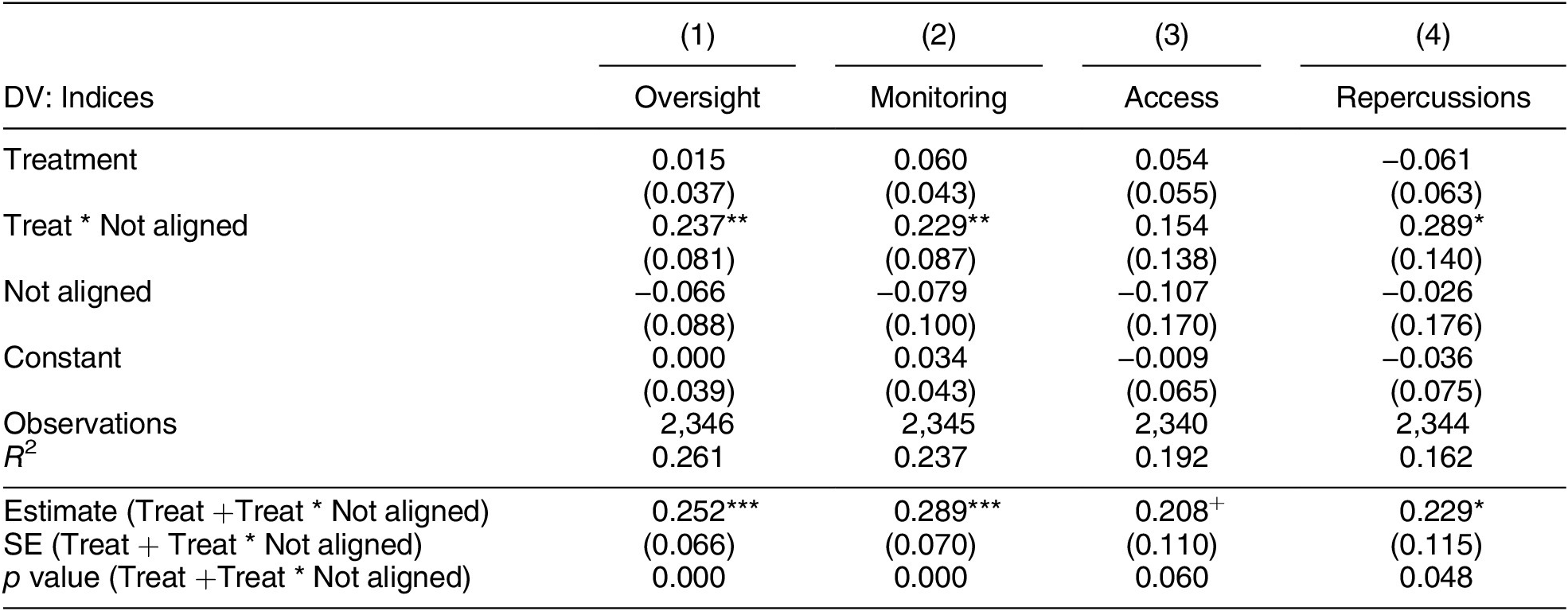
Table 3 reports treatment effects on the aggregate oversight index and its subindices by alignment. Treatment effects vary substantially by alignment. In aligned subcounties, the treatment had no measurable effect on the aggregate oversight index (column 1) and only small effects on two of its components: monitoring effort and access to additional financial documents. In nonaligned subcounties, on the other hand, the treatment led to significant increases in the aggregate oversight index and each of its subindices, including the introduction of repercussions for substandard service delivery (see bottom panel). In substantive terms, in nonaligned subcounties the number of documents requested increased by 65%, whereas the number accessed increased by 51%. The number of projects with tensions increased by 52%, whereas those where repercussions were introduced against contractors increased by 38% (see SI Table D7).Footnote 28
Treatment Effects on Political Oversight and Subindices by Alignment

Note: The aggregate index of political oversight (oversight index) and its subindices, monitoring, access to financial documents, and initiated repercussions, are averaged z-score indices. Robust standard errors clustered at the subcounty level are shown in parentheses. All models include controls and district fixed effects. Not aligned is a binary indicator for the political leadership not entirely belonging to the national ruling party. Predicted treatment effects and p values for councilors in nonaligned subcounties are included in the bottom panel. ***p < 0.001, **p < 0.01, *p < 0.05, +p < 0.10.
The differences in effects between aligned and nonaligned subcounties are statistically significant for the aggregate index and all of the subindices except access to additional financial documents. The results are robust to using different definitions of alignment (SI Table E3) and to excluding covariates and district fixed effects (SI Table E2). Two caveats are in order. First, one may be concerned about other systematic differences between aligned and nonaligned areas driving the difference in treatment effects. Steps taken to alleviate concerns over omitted variable bias and councilor selection are described in the Discussion. Second, because alignment is endogenous, the difference in treatment effects should not be interpreted as causal but rather as evidence of how the different incentives created by alignment status condition the treatment effect of increased oversight capacity.
To further dicern how treatment effects vary by partisanship, I run a triple interaction between being a member of the ruling party and alignment. Results are presented in SI D.1. The effect on the oversight index is insignificant for both opposition and ruling-party councilors in aligned subcounties. However, the results differ markedly in nonaligned subcounties. Here, councilors from all parties demand more documents, gain greater access (not significant for councilors from the ruling party), and are more likely to take measures to improve service delivery. Treatment effects are strongest among independent and opposition councilors in nonaligned subcounties. In particular, monitoring effort increased by 0.35 standard deviations, access to financial documents by 0.39 standard deviations, and repercussions by 0.31 standard deviations, resulting in an increase of 0.34 standard deviations in the aggregate oversight index. The treatment also had a positive effect on political oversight for ruling-party councilors in nonaligned subcounties. I attribute this to two factors. First, ruling-party councilors in nonaligned subcounties may anticipate that the political leadership may be responsive to their efforts, thus affecting their cost–benefit calculation regarding whether to engage in oversight. Second, because subcounty councils need to work as a group to take formal steps such as sanctioning bureaucrats or contractors, several of the variables entering the oversight index refer to the actions taken by the entire council rather than actions taken by individuals. As the last quote in the introduction to this section indicates, councilors collaborate across the aisle to hold bureaucrats accountable.
Discussion
This section discusses the robustness of the heterogeneous treatment effects on political oversight, investigates the underlying mechanisms, and examines whether the intervention resulted in increased rent-seeking by politicians and in improved service delivery.
Whether a local government is aligned with the national ruling party is endogenous. Therefore, one concern is that aligned local governments may differ along other dimensions, which, in turn, may affect councilor response. One such potential confounder is candidate quality. Because nonaligned subcounties are more competitive, voters may select higher-quality politicians—those who care more about service delivery and are therefore more responsive to the intervention. To test for this possibility, I ran behavioral games at baseline designed to measure councilors’ honesty, public-mindedness, and cognitive abilities. As shown in SI Table C7, I do not find significant differences between stronghold and nonstronghold subcounties on any of these measures. Councilors in stronghold subcounties are marginally more educated (by 0.18 years). The vector of controls for all specifications assessing differences by alignment include all imbalanced covariates (p ≤ 0.2) as well as their interaction with the treatment indicator, suggesting that candidate selection is not driving the difference in results between aligned and nonaligned areas.
Second, nonaligned areas may differ along other sociodemographic characteristics that may be correlated with councilors’ incentives. Using data from the last available census, I test for differences between the two types of subcounties in education levels, income, and ethnic fractionalization. The results are presented in SI Table C5. As before, all imbalanced covariates (p ≤ 0.2) as well as their interaction with the treatment indicator are included in the vector of controls.
Finally, a stronger treatment effect in nonaligned areas could be due to a “catch-up” effect. If, in the absence of the treatment, levels of outcome variables are substantially lower in nonaligned areas than in strongholds, the intervention may have a stronger effect due to convergence to the mean. I do not find any evidence for such a pattern in the data. As SI Table C8 shows, outcomes in the control group are not significantly different in aligned and nonaligned areas, suggesting that ceiling effects are not driving results.
Mechanisms
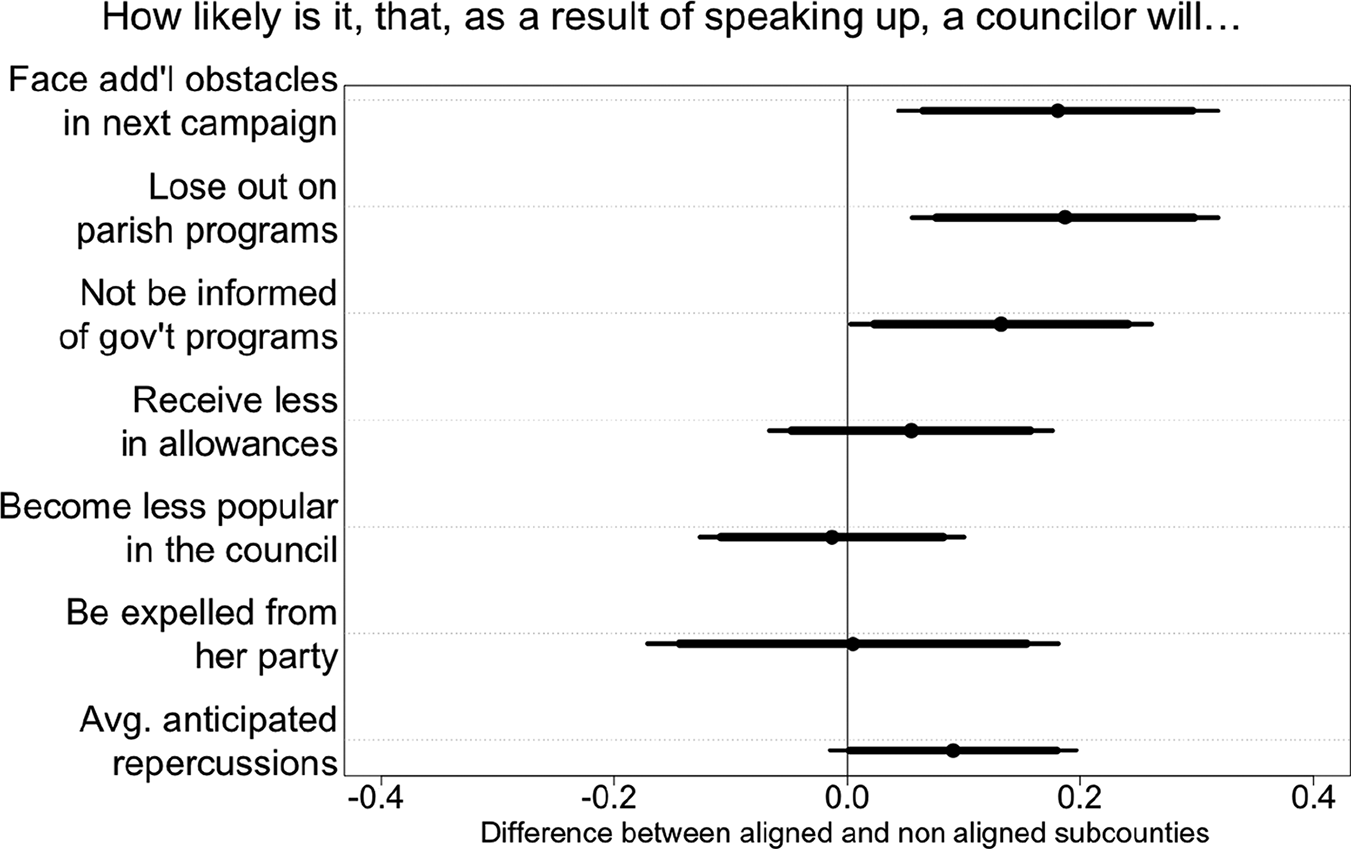
To further probe the mechanisms underlying the heterogeneous treatment effects by alignment identified in the qualitative interviews—namely, that lower-level local politicians in aligned areas fear speaking up about any discovered malfeasance, as their reputation and political future ultimately depend on their standing with influential members of the ruling party—I ran another survey 22 months after the intervention with the same sample of local politicians (n = 2,394). Respondents were read a vignette about a hypothetical councilor in a subcounty similar to theirs, who uncovered substandard service delivery and started to make “a lot of noise” about it. Respondents were then asked how likely, on a Likert-type scale ranging 1–4, they believed this councilor would suffer certain consequences for speaking out. Figure 3 shows the difference in responses between aligned and nonaligned subcounties. Each coefficient is derived from a separate regression of the perceived probability of a consequence occurring on an indicator variable that takes value 1 if a subcounty is aligned and 0 otherwise. The specification includes the standard set of covariates. Robust standard errors are clustered at the level of the subcounty.
Differences in Anticipated Consequences by Alignment
Note: Difference in anticipated consequences for speaking out about substandard service delivery between aligned and nonaligned subcounties. Each coefficient is derived from a separate regression of the perceived probability of a consequence occurring on an indicator variable that takes value 1 if a subcounty is aligned and 0 otherwise.

Politicians in aligned subcounties are more likely to anticipate some repercussions for speaking out about poor service delivery. In particular, they anticipate an outspoken politician will face obstacles in the next campaign (p = 0.010), lose out on parish programs (p = 0.005), and not be informed of upcoming government programs (p = 0.048). There are no significant differences in politicians’ beliefs about the probability of receiving fewer allowances, being expelled from one’s party, or becoming less popular in the council. The difference in the aggregate index is statistically significant at the 90% level (p = 0.092). Results are also reported in SI Table D2.
Treatment Effects on Personal Rents
One argument in favor of bureaucratic insulation is that, in particular in weakly institutionalized settings, politicians may use any leverage—especially in the form of information about financial transfers to their governments—to seek personal rents. To test this alternative expectation to my theory, I collected data on legal payments to and consumption patterns of councilors 8 and 22 months after the intervention. Legal payments consist of sitting fees and monitoring allowances, which are paid by the subcounty chief. The exact amounts are discretionary. If councilors know how much money their subcounty received, they may be better able to negotiate for payments. At the same time, some councilors voiced concerns that bureaucrats may retaliate against increased oversight by reducing allowances. I do not find a significant net effect on allowances paid to councilors after either 22 or 8 months (columns 1 and 5; SI Tables D10 and D11).
Since illicit activities—in this case collusion in corruption—are difficult to measure, I instead collect fine-grained information on expenditures, which are likely to be affected by changes in income from corruption. These include measures of household consumption, support for relatives, and assets. I do not find treatment effects on any of these measures (columns 2–4 and 6–8; SI Tables D10 and D11). In summary, I do not find any evidence that councilors used the improved monitoring tools to extract more personal rents.
Treatment Effects on Service Delivery
Finally, I test whether councilors’ increased oversight effort by councilors in nonaligned areas had any effects on stakeholders’ satisfaction and quality of local service delivery. To do so, I collected both survey and observational data from 657 local government projects—for example, boreholes, latrine construction and maintenance, and equipment for schools—22 months after the intervention. The majority of projects (65%) was located in schools or health centers. Projects were sampled from a list of all subcounty projects implemented in the past year. Enumerators visited projects unannounced and conducted interviews with the elected village chairperson and, if located at a school or health center, the most senior available facility staff to assess their level of satisfaction with the quality of service delivery. Respondents were asked about their overall satisfaction with the project, the information they received about it, processes of project implementation, the extent to which the project type met users’ needs, and staff and end user satisfaction. These five indicators enter the satisfaction index, treatment effects on components are reported in SI D.3. Enumerators also inspected the projects physically and, on the basis of their own observation and their conversations with local stakeholders, rated the quality of implementation. Enumerators were blind to treatment status.
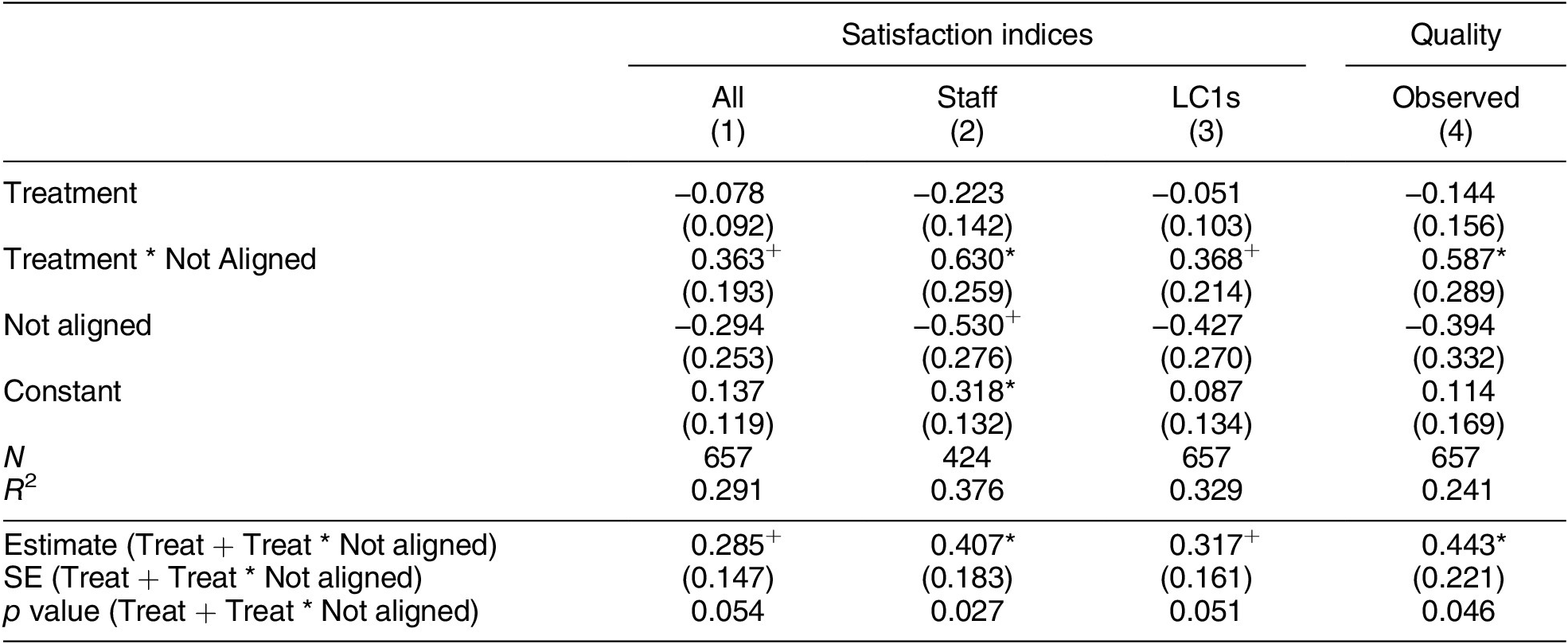
Table 4 shows the treatment effects on user satisfaction and project quality by alignment. In line with the theoretical predictions, satisfaction with the quality of project implementation significantly improved in nonaligned subcounties but not in aligned ones. The treatment effect on the z-scored satisfaction index is 0.29 to 0.41 standard deviations. The treatment also had a significant positive effect on observed project quality of 0.44 standard deviations in nonaligned subcounties. However, this last result is less robust and should be viewed as suggestive. The treatment did not have a net effect on service delivery in the pooled analysis. Further results and robustness checks are included in SI D.3.
Treatment Effects on Service Delivery

Note: DVs are z-score indices measuring the satisfaction of (1) facility staff and elected village leaders, (2) facility staff only, or (3) village leaders only. The DV in (4) is project quality as observed by an enumerator (standardized). Robust standard errors clustered at the subcounty level are shown in parentheses. All models include controls and district fixed effects. Not aligned is a binary indicator for the political leadership not fully representing the national ruling party. Predicted treatment effects for councilors in nonaligned subcounties are included in the bottom panel. ***p < 0.001, **p < 0.01, *p < 0.05, +p < 0.10.
Conclusion
This study examines accountability dynamics within local governments in Uganda. Politicians’ ability to monitor bureaucrats is critical to ensure accountable service delivery. In the empirical literature, this ability tends to be taken for granted. In reality, the link between local elected representatives and bureaucrats is complex and often tenuous. In local governments in low-income countries, bureaucrats’ and politicians’ differences in education, tenure, and access to information and resources often make this asymmetry particularly stark. Engaging in political oversight over the bureaucracy in order to promote better services is costly: local politicians must not only change their own behavior by engaging in increased monitoring but also seek to change the behavior of bureaucrats and their allies, risking potential repercussions.
Thus, the question arises, under what conditions do local politicians have an incentive to engage in such political oversight? This article has considered this question both theoretically and empirically. I argue that the extent to which local politicians have an incentive to engage in political oversight is constrained by the extent to which the national ruling party controls the local government—in particular, whether its political leadership is aligned with the ruling party or not.
To test this argument, I conducted a field experiment on the effect of political oversight on government performance in 260 local governments in Uganda, implemented in collaboration with the Ministry of Finance. Councilors in treatment subcounties received newly available, highly disaggregated, subcounty-specific financial information as well as a day-long training workshop, designed to increase their capacity to engage in political oversight. To test the effect of the intervention on local government performance, I conducted a panel survey with more than 2,800 elected and appointed local government officials and a physical audit survey of nearly 700 local government projects and collected behavioral, institutional, and qualitative measures. I find that the intervention had significant, positive effects on councilors’ knowledge of not only local government rules and procedures but also monitoring best practices. It also resulted in a significant increase in political oversight, measured through an index including requests for additional financial documents held at the subcounty and the steps taken to improve projects perceived to have been poorly implemented.
These treatment effects are conditioned by a structural factor, party control. Uganda exhibits significant subnational variation in political environments. About two-thirds of the country are effectively ruled by a one-party system in which the ruling party controls all levels of government and controls the bureaucracy, or what I term aligned. In the remainder of the country, opposition parties and independent candidates compete with the ruling party. To assess how the political environment conditions councilors’ incentives to engage in political oversight, I test for heterogeneous treatment effects by alignment. These subgroup analyses demonstrate that the effects on politician behavior were driven by subcounties with political leadership consisting of members of the opposition or independents. The oversight efforts by councilors in nonaligned areas translated into increased user satisfaction with local government projects. In contrast, in subcounties where the political leadership is aligned with the national ruling party, the intervention had no effect on local politicians’ accountability-seeking behavior.
In summary, the findings suggest that increased opportunity for political oversight can lead to improved service delivery in settings that are not effectively under one-party control. Further theoretical development and empirical tests of the relationships between politicians and bureaucrats will improve our understanding of the impediments to government accountability in dominant party regimes.
Supplementary Materials
To view supplementary material for this article, please visit http://doi.org/10.1017/S0003055422000181.
DATA AVAILABILITY STATEMENT
Data that support the findings of this study are openly available at the American Political Science Review Dataverse: https://doi.org/10.7910/DVN/SI0NQF.
ACKNOWLEDGMENTS
The preanalysis plan for this study was filed on the AEA registry (AEARCTR-0000402). I thank Peter Aronow, Kate Baldwin, Robert Bates, Chris Blattman, Daniel Carpenter, Ana De La O, Tiberiu Dragu, Thad Dunning, Ryan Enos, German Feierherd, Jeffry Frieden, Daniel Gingerich, Don Green, Guy Grossman, Peter Hall, Michael Hiscox, Macartan Humphreys, Torben Iversen, Horacio Larreguy, Malte Lierl, Justin Loiseau, Lucy Martin, Gareth Nellis, Samuel Olweny, Melina Platas, Daniel Smith, Dustin Tingley, Steven Wilkinson, and participants of CAPERS, NEWEPS, and WGAPE and seminars at Columbia University, UC Berkeley, Stanford, and Yale University for helpful comments. I am grateful to Samuel Olweny, Frederic Cochinard, Antoine Dewatripont, Greg Dobbels, Yuen Ho, Mathew Kato, Christian Keller, Steven Kizza, Justin Loiseau, Ridwan Syed Muntasir, Harrison Diamond Pollock, and Chloe Rosset for invaluable research assistance.
FUNDING STATEMENT
This research was funded by the International Growth Centre (grant #1-VRG-VUGA-VXXXX-89103), the Yale Georg W. Leitner Program in Political Economy, the Fidelity Charitable Gift Fund (grant #4865), and the Hewlett Foundation (grants #2014-1088 and #2015-3257).
CONFLICT OF INTEREST
The author declares no ethical issues or conflicts of interest in this research.
ETHICAL STANDARDS
The author declares the human subjects research in this article was reviewed and approved by the Yale Human Subjects Committee (#1404013737), the Institutional Review Board of Innovations for Poverty Action (#1063), and the Uganda National Council for Science and Technology (#SS3489). The author affirms that this article adheres to the APSA’s Principles and Guidance on Human Subject Research.




Comments
No Comments have been published for this article.