Introduction
An association between schizophrenia and other psychotic disorders and an elevated risk of antisocial behaviour has been well established (Fazel et al. Reference Fazel, Gulati, Linsell, Geddes and Grann2009a ), although the extent to which such risk extends to non-violent offending is less clear (Tiihonen et al. Reference Tiihonen, Isohanni, Räsänen, Koiranen, Moring and Rasanen1997). Furthermore, many studies have failed to consider the temporal nature of the relationship between the two factors – either because information was gathered cross-sectionally or because lifetime records of both psychosis and criminality were examined for association. There is, however, an emerging literature to support the importance of different underlying mechanisms and likely outcomes for different mentally disordered offender typologies defined by whether or not criminality precedes or follows onset of severe mental illness (Wallace et al. Reference Wallace, Mullen and Burgess2004; Kooyman et al. Reference Kooyman, Walsh, Stevens, Burns, Tyrer, Tattan and Dean2012). The vast majority of studies of offending risk have also focused on severe mental disorders such as schizophrenia while less is known about other disorders. The danger of focusing on one disorder or group of disorders is that unfounded assumptions can emerge about the diagnostic specificity of relationships and this in turn can have undue influence on the range of underlying mechanisms investigated. Recently, a number of studies have emerged focusing on disorders other than schizophrenia, including bipolar disorder (Fazel et al. Reference Fazel, Lichtenstein, Grann, Goodwin and Langstrom2010) and substance use disorders (Grann & Fazel, Reference Fazel and Grann2004). The small number of population-based studies and some studies of specific offences such as homicide which have considered a range of mental disorders (Swanson et al. Reference Swanson, Holzer, Ganju and Jono1990; Hodgins et al. Reference Hodgins, Mednick, Brennan, Schulsinger and Engberg1996; Arseneault et al. Reference Arseneault, Moffitt, Caspi, Taylor and Silva2000; Fazel & Grann, Reference Fazel and Grann2004) indicate that the association between mental disorder and offending risk may not be confined to those with psychotic disorders. However, these studies remain limited by ignoring whether criminality was present before or after onset of illness. Our previous work examining pre-illness-onset offending (Stevens et al. Reference Stevens, Agerbo, Dean, Nordentoft, Nielsen and Mortensen2012) also supports the notion that the association extends across the spectrum of psychiatric disorders. The importance of examining the role of co-morbidity, particularly with substance use and personality disorders, is often raised but not routinely considered in population studies of the association between individual mental disorders and offending or violence. Finally, a number of previous studies have not included women, not considered them separately from men or been limited by having insufficient numbers of women to obtain precise estimates of association.
The aim of this study was to estimate the incidence rate ratio (IRR) of any offending and violent offending after the first psychiatric contact across the entire spectrum of psychiatric diagnoses compared with the general population. Results were calculated separately for men and women, and co-morbidity with substance use and personality disorders was taken into account.
Method
Study population
Our study population consisted of exactly 25% of the Danish population randomly selected from the Danish Civil Registration System (CRS). The sample was then restricted to those born in 1965 or later, who were alive and residing in Denmark on the day they turned 15 years, the age of criminal responsibility in Denmark. The CRS contains information on gender, date and place of birth, continuously updated information on vital status and the CRS numbers of parents, along with many other variables. Each person is assigned a unique personal identification number at birth or at point of first immigration to Denmark, through which it is possible to link information between registers (Pedersen et al. Reference Pedersen, Gotzsche, Moller and Mortensen2006).
Assessment of offence
All members of the cohort were followed from their 15th birthday until their first criminal conviction, death, emigration or the end of follow-up in 2010, whichever came first. From the Danish National Crime Register, which is virtually 100% complete, we extracted information on transgressions against the penal code (Jensen et al. Reference Jensen, Greve, Høyer and Spencer2006) and conducted separate analyses for first offending (any) and first violent offending (including assault, aggravated assault/grievous bodily harm, homicide and attempted homicide, threats including to life, bomb threats and threats made in public, illegal restraint/deprivation of liberty and illegal force/coercion, and robbery). Only guilty verdicts resulting in custodial sentences, suspended sentences, conditional withdrawal of charges, fines, and sentences to psychiatric treatment were included.
Assessment of mental disorder
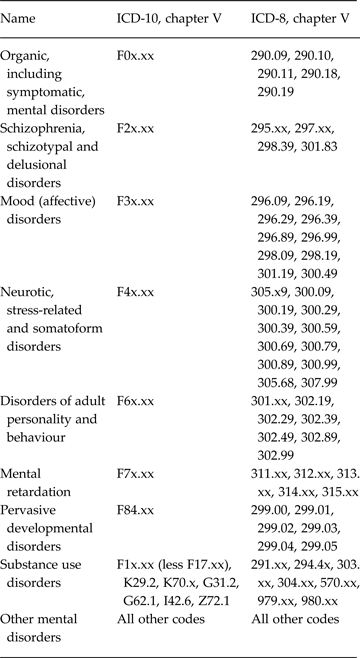
Information on mental disorders was obtained from the Danish Psychiatric Central Research Register (PCRR), which contains data relating to all admissions to psychiatric hospitals since 1969 and all out-patient contacts and emergency room visits since 1995 (Mors et al. Reference Mors, Perto and Mortensen2011). Primary diagnoses were given according to the International Classification of Diseases (ICD)-8 (World Health Organization, 1982) until 1993 and according to ICD-10 (World Health Organization, 1992) from 1994 onward. We grouped discharge primary diagnoses into eight distinct groups (Table 1) and retained information on an individual's first diagnosis within each group. Relying on the hierarchical logic in the ICD-10, individuals with more than one psychiatric contact and who belonged to more than one diagnostic category were allowed to move up in the hierarchy, but not down. An ‘other’ category was created to include codes that could not be translated between ICD-8 and -10 (among these approximately 40% were in the F9 category). The ‘other’ group also included those with mental health contacts for observation/medical advice but without diagnoses made (DZ codes) and those with unspecified mental disorders (F99) (10% of the group). Co-morbid substance misuse was assessed separately using information from main and secondary diagnoses in both the PCRR and the Danish National Hospital Register; the latter covers all hospital admissions since 1977 and all out-patient contacts and emergency room visits since 1995 (Andersen et al. Reference Andersen, Madsen, Jørgensen, Mellemkjær and Olsen1999). All diagnoses were coded as time-varying. The impact of multiple psychiatric contacts on rates of offending was also examined.
Diagnostic categories

ICD, International Classification of Diseases.
Assessment of parental mental disorder and educational status
We have previously found that the presence of mental disorders in parents is associated with increased risk of both criminality (Dean et al. Reference Dean, Mortensen, Stevens, Murray, Walsh and Agerbo2012) and mental disorder (Dean et al. Reference Dean, Stevens, Mortensen, Murray, Walsh and Pedersen2010) in offspring, and thus we considered this a potential confounder of any association found between mental disorders and offending. Using data from the PCRR we recorded the presence of severe (F2 and F3 with ICD-8 equivalents) or other (all other) mental disorders in the mother or the father in a time-varying fashion. Correspondingly, we considered the potential confounding effect of parental socio-economic status. Here we used information on maternal and paternal level of education in the year when the proband turned 15 years. The highest obtained level of education for each parent was coded as: basic education, vocational training, higher education, educational status unknown, and parent unknown. This information was obtained from the Integrated Database for Labour Market Research, which contains information from the 1970 population and housing census along with annually updated information from 1980 onwards (Statistics Denmark, 2007).
Statistical analysis
Data were analysed as a cohort study (Clayton & Hills, Reference Clayton and Hills1993) using Poisson regression with the GENMOD procedure in SAS version 9.1.3 (USA). Poisson regression was used in a particular way in the analysis to achieve a survival analysis – the number of person-years at risk was used as an offset variable in order to obtain IRRs (Clayton & Hills, Reference Clayton and Hills1993; Andersen & Keiding, Reference Andersen and Keiding2002). We calculated the incidence rate of offending as the number of first convictions per 1000 person-years at risk. The main outcome measures were IRRs, where each psychiatric exposure group was compared with the reference category of no psychiatric contacts. IRRs were calculated by log-likelihood estimation, and Wald's 95% confidence intervals (CIs) were used. Basic models with adjustment for calendar period and age were fitted for each gender for both outcomes (any and violent offending), and adjusted models were fitted for all analyses controlling for co-morbid substance misuse, maternal and paternal mental disorder and educational level, and non-Danish place of birth.
We performed additional analyses where bipolar disorders (F30 and F31 with ICD-8 equivalents) were omitted from the affective disorder category and where the impact of co-morbid personality disorders (F6 and ICD-8 equivalents) on other mental disorders was assessed separately. Measures of population attributable risk fractions were calculated by measuring the percentage of first offences (or first violent offences) that would not have occurred if the risk of offending had been the same in exposed and non-exposed groups (Greenland, Reference Greenland, Rothman, Greenland and Lash2008).
Results
Descriptive results
The cohort included 521 340 persons who were born between 1 January 1965 and 31 December 1995, and who were alive and residing in Denmark on their 15th birthday. In total they contributed 7 455 866 person-years of risk time in the analyses of any offending and 8 019 097 person-years in the analyses of violent offending. During the follow-up from 1980 to 2010, 57 390 persons (44 802 men and 12 588 women) were convicted of at least one offence, and in 17 423 cases (15 684 men and 1739 women) at least one was of a violent nature.
Mental disorders and any offending
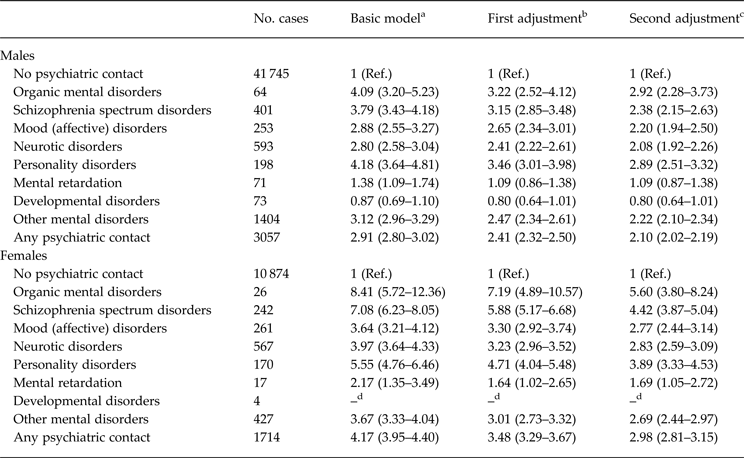
Males who had ever had a psychiatric contact had an IRR of 2.91 (95% CI 2.80–3.02) for any offending, and although effect sizes varied somewhat between the diagnostic groups (Table 2), all categories other than developmental disorders were significantly elevated compared with those persons without any mental disorder. While offending rates were much higher in men, the relative impact of mental disorders on risk of offending was stronger in women, for whom any psychiatric contact yielded an IRR of 4.17 (95% CI 3.95–4.40). Additionally, we found a dose–response relationship between multiple mental health contacts and risk of offending. Those who had a single psychiatric contact were 2.79 (95% CI 2.66–2.91) more likely to offend than those with no contacts, two or three contacts carried a risk of 3.13 (95% CI 2.97–3.30) while four or more contacts had an IRR of 4.99 (95% CI 4.71–5.28).
Risk of any offending in men and women

Data are given as incidence rate ratio (95% confidence interval).
Ref., Reference.
a Adjusted for age and calendar period.
b Adjusted for age, calendar period, parental mental disorder, parental level of education and non-Danish place of birth.
c Adjusted for age, calendar period, parental mental disorder, parental level of education, non-Danish place of birth, and substance misuse.
d Insufficient number of exposed cases.
Mental disorders and violent offending
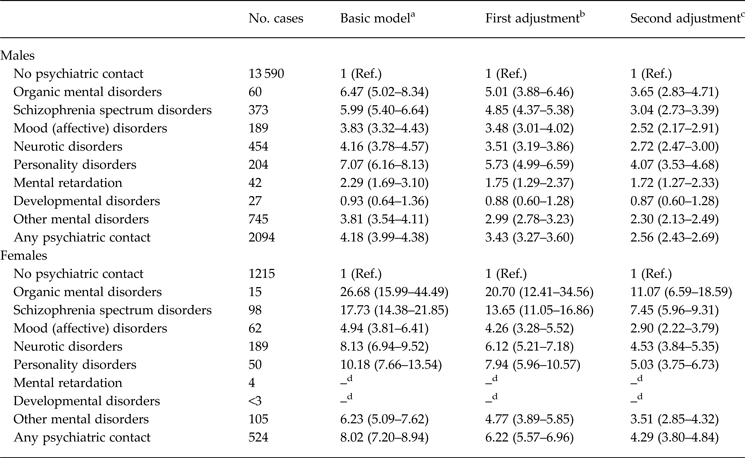
In both genders the association between mental disorders and violent offending was greater than that between mental disorders and any offending (Table 3). Men with any psychiatric contact had an IRR of 4.18 (95% CI 3.99–4.38), while the corresponding estimate for women was 8.02 (95% CI 7.20–8.94). Relative risks were consistently greater for women than men and, for many disorders, much greater.
Risk of violent offending in men and women

Data are given as incidence rate ratio (95% confidence interval).
Ref., Reference.
a Adjusted for age and calendar period.
b Adjusted for age, calendar period, parental mental disorder, parental level of education and non-Danish place of birth.
c Adjusted for age, calendar period, parental mental disorder, parental level of education, non-Danish place of birth, and substance misuse.
d Insufficient number of exposed cases.
Adjusted models
The third columns in Tables 2 and 3 (first adjustment) show the effect of adjusting the IRRs for parental mental disorders, parental socio-economic status and non-Danish place of birth. For all disorder categories this adjustment resulted in attenuation of IRRs, but only to the point of no association for any offending among males with mental retardation. The attenuation was stronger for violent than for any offending for both genders; however, the association between mental disorders and violent offending remained stronger than for any offending across the board.
As substance misuse may be regarded as either a confounder or a mediating factor (or both) we chose to present separate estimates for this adjustment, as shown in the final columns of Tables 2 and 3 (second adjustment). The effect was that of further attenuation of the results; however, all IRRs that were significant in the first adjustment remained so after the inclusion of substance misuse. The impact on results was greater for violent than for any offending and especially pronounced among women. It is of note that in the fully adjusted model for males with any offending, IRRs were similar in magnitude across diagnostic categories.
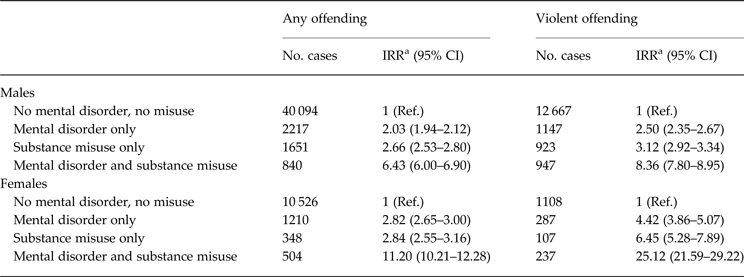
We also examined the relationship between substance misuse without any diagnosed psychiatric co-morbidity and after adjustment for familial risk factors. We found a significantly higher risk for violent offending in both genders and any offending in males compared with those with any psychiatric disorder without co-morbid substance misuse. Those with co-morbid mental illness and substance misuse were found to be at particularly high risk, especially with regard to risk of violent offending among women (Table 4).
Combined effects of mental disorders and substance misuse

IRR, Incidence rate ratio; CI, confidence interval; Ref., reference.
a Adjusted for age, calendar period, parental mental disorder, parental level of education and non-Danish place of birth.
In order to examine the notion that the effects found were caused by the presence of co-morbid personality disorders, we conducted sensitivity analyses in which persons with this diagnosis were excluded. As expected, this resulted in further attenuation of the estimates; however, for most diagnostic categories adjusted results were well within the confidence bands found in the main analyses. The exception was any offending in women with schizophrenia spectrum disorders [reduction from 4.42 (95% CI 3.87–5.04) to 2.85 (95% CI 2.29–3.56)].
Additionally, we tested whether the associations in the affective disorders category were driven solely by persons with bipolar disorder. Here we found that although the risk of offending among those with bipolar disorder [IRR 2.47 (95% CI 1.69–3.60) for males and 3.08 (95% CI 1.91–4.97) for females, fully adjusted model, any offending] more closely resembled the risk among those with schizophrenia spectrum disorders than other affective disorders, they were in fact not significantly different. We also found that the corresponding drop in risk in the remaining group of affective disorders [from IRR 2.20 (95% CI 1.94–2.50) to IRR 2.18 (95% CI 1.91–2.48) for males and from 2.77 (95% CI 2.44–3.14) to 2.75 (95% CI 2.41–3.13) for females, fully adjusted model, any offending] was modest to negligible. Similar results were seen for the analyses focused on violent offending [IRR for bipolar disorder was 3.38 (95% CI 2.22–5.14) for males and 5.49 (95% CI 2.60–11.61) for females, fully adjusted model].
Population impact
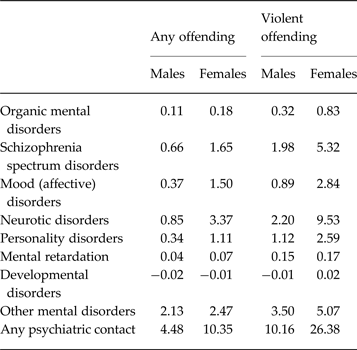
Calculating population attributable risk fractions we found that 4.5% of male and 10.4% of female offending was attributable to mental disorders. The impact on violent offending was greater since it accounted for 10.2% of male and 26.4% of female violent offending. The largest contribution came from other mental disorders in males (2.1% for any offending, 3.5% for violent offending) and neurotic disorders in females (3.4% for any offending and 9.5% for violent offending) (Table 5).
Population attributable risk fractions (%) a

a Male fractions of male offending and female fractions of female offending. Models are adjusted for age and calendar period.
Discussion
Main findings
To our knowledge, this is the first study to systematically compare the association between violent and non-violent offending and the full spectrum of psychiatric diagnoses, with regard to offending which specifically follows onset of disorder. Studying 521 340 Danish inhabitants we found almost all types of mental disorders to be associated with an increased risk of offending (with a stronger association found for violent offending), a dose–response relationship between the number of psychiatric contacts and risk of offending, and a strong combined effect on risk of offending, especially among women, of being diagnosed with both mental disorder and substance misuse.
The risk elevation found for both any and violent offending was apparent across a range of psychiatric diagnoses and was not confined to major mental disorders such as schizophrenia, even after adjustment. In fact, for men, the strength of association, after full adjustment, for any offending was significant across all but two diagnostic groups and effect sizes were similar across disorders (range 2.08–2.92). For violent offending and offending among women, however, the strength of association varied to a greater extent between disorders. The fact that risk of offending appears to extend across the full spectrum of mental disorders, particularly in the case of males and any offending where even the magnitude of association differed little, may imply a role for common rather than disorder-specific underlying mechanisms. Shared pathways to offending may involve aspects of social disadvantage, either as a mediating factor or as a common cause of mental disorder and offending. Shared pathways mediating the association between disorders of various types and offending may also involve common affective and behavioural responses to disorder [e.g. anger in response to psychotic symptoms has been identified as an important mediator for violence (Coid et al. Reference Coid, Ullrich, Kallis, Keers, Barker, Cowden and Stamps2013) but may also be relevant for a range of non-psychotic disorders]. A shared inability to avoid detection following perpetration of offending behaviour may well be another explanation. Disorder-specific factors may play a greater role in explaining risk of offending for women and for violent offending for both men and women, and are likely to include the impact of specific symptoms in addition to other direct effects of disorder. It should be noted, however, that the associations of varying magnitude were based on smaller-sized groups and thus the precision of estimated effect sizes is likely to be limited for these groups.
Comparisons with other studies
Although the magnitude of the associations differ, our results replicate those of a previous Danish population-based study (Hodgins et al. Reference Hodgins, Mednick, Brennan, Schulsinger and Engberg1996) which found elevated offending risks in a range of disorders. However, that study importantly was not restricted to first-time offending after the onset of mental disorder. Compared with this previous study, we were also able to include a broader range of disorders, largely because we utilized data from out-patient as well as in-patient sources. Our findings do contrast, however, to some extent with a number of smaller non-Scandinavian studies. In the Dunedin study (n = 1037), an increased risk (unadjusted) of court convictions for violence was found in mania, schizophrenia spectrum disorders, and alcohol and marijuana dependence, but not in depression, anxiety or eating disorders (Arseneault et al. Reference Arseneault, Moffitt, Caspi, Taylor and Silva2000). However, the number of study subjects in each diagnostic category was modest, and hence the statistical power was limited. A study based in Camberwell, London (n = 1076) found that criminality in women with schizophrenia was three times higher than those with other mental disorders, and for men an elevation in risk was found for violent offending (twice that of other mental disorders) (Wessely et al. Reference Wessely, Castle, Douglas and Taylor1994). In addition to studies of offending risk, other measures of antisocial behaviour such as self-reported violence have also been found to be associated with diagnoses beyond psychosis (Swanson et al. Reference Swanson, Holzer, Ganju and Jono1990).
In a field dominated by studies of schizophrenia and offending, our findings contribute to the limited but accumulating evidence (Látalová, Reference Látalová2009; Fazel et al. Reference Fazel, Lichtenstein, Grann, Goodwin and Langstrom2010) that a diagnosis of bipolar disorder is also associated with an increase in risk. Within the affective disorders category we looked specifically at bipolar disorder and found that the magnitude of risk was comparable with that of schizophrenia and appeared greater than that of the other affective disorders (although the latter comparison was not statistically significant).
In our study, mental retardation was not found to increase the risk of any offending in males, in contrast to the findings of the Stockholm Metropolitan study (Hodgins & Janson, Reference Hodgins and Janson2002), where offending in mental retardation was found to be around the same magnitude as major mental disorders (schizophrenia, bipolar disorder and major depression). There has been some debate about whether those with intellectual disability are over-represented among offenders and the debate has highlighted a number of key issues of methodology which are likely to give rise to differences in findings on this question – relating first to the impact of severity of intellectual disability and second to the nature of the sample. In our study those classified with intellectual disability were likely to have significant disability (intelligence quotient significantly less than 70) since their primary diagnosis and reason for contact with services was classified as intellectual disability. Any challenging behaviour even if it qualified as offending is perhaps less likely to have been reported or to have led to conviction and for those with particularly severe disorder, capacity to commit offending behaviour may have been limited. In many other studies addressing the question, individuals with borderline and mild intellectual disability have predominated and, in some cases, the source of the sample has meant that the presence of conduct or other problems in addition to intellectual disability has been common (Lindsay & Dernevik, Reference Lindsay and Dernevik2013).
Gender differences
Finding a higher relative risk of offending among women with mental disorder compared with men replicates previous studies of schizophrenia (Fazel et al. Reference Fazel, Gulati, Linsell, Geddes and Grann2009a ), major mental disorders (Brennan et al. Reference Brennan, Mednick and Hodgins2000) and recently discharged psychiatric patients (Robbins et al. Reference Robbins, Monahan and Silver2003). Comparing pre- and post-morbid criminality in psychosis, Kooyman et al. (Reference Kooyman, Walsh, Stevens, Burns, Tyrer, Tattan and Dean2012) found evidence to support the notion that female offending is related more to illness factors, whereas pre-morbid factors are more predictive of male offending. In a study of offending prior to first psychiatric contact, we have previously reported a risk elevation across most disorders, with a similar strength of association for both genders (Stevens et al. Reference Stevens, Agerbo, Dean, Nordentoft, Nielsen and Mortensen2012). Given this finding in contrast to those of the current study, we would argue that there is now strengthening evidence to indicate: (1) that the nature of the relationship between mental disorder and offending risk differs by gender; and (2) that in women it is more likely to be explained by the direct impact of disorder rather than as a result of common causes or vulnerabilities. Risk assessment approaches and preventative strategies, the vast majority of which are gender blind, may need to take such potential gender differences into account.
The role of substance misuse
That the misuse of substances is highly correlated with offending in general (Grann & Fazel, Reference Fazel and Grann2004) and when co-morbid with other mental disorders (Fazel et al. Reference Fazel, Långström, Hjern, Grann, Lichtenstein and Langstrom2009b ) can hardly be contested. However, whether mental illness poses an increased risk of offending over and above the presence of co-morbid misuse has been debated (Elbogen & Johnson, Reference Elbogen and Johnson2009; Van Dorn et al. Reference Van Dorn, Volavka and Johnson2012). It is arguably likely that the additional presence of substance misuse both confounds and mediates any association between mental disorder and offending and on this basis we considered its adjustment separately. We found that primary associations between mental disorders and offending persisted after this adjustment, although we acknowledge that relying on secondary care diagnosis of substance misuse co-morbidity is likely to have resulted in residual confounding (Hansen et al. Reference Hansen, Munk-Jørgensen, Guldbaek, Solgård, Lauszus, Albrechtsen, Borg, Egander, Faurholdt, Gilberg, Gosden, Lorenzen, Richelsen, Weischer and Bertelsen2000). We also found that, apart from any offending in women, risks of offending were significantly elevated for those with substance misuse alone compared with another mental disorder diagnosis alone.
Population impact
In addition to presenting the relationship between mental disorder and offending in the form of relative risks, indicating the strength of associations, we examined the population impact of disorders on first offending, taking both the association strength and prevalence of the exposure into account. Assuming causality, the proportion by which the number of offenders would be reduced if no psychiatric contact had occurred in the population was found to be less than 5% for any offending by men, approximately 10% for violent offending by men and any offending by women, and over 25% for violent offending by women. The notion that the importance of particular mental disorders in relation to risk of offending extends beyond psychotic and other major mental disorder diagnoses is also supported by these findings. It should be noted that the documented association does not confirm causality and these findings must be interpreted with caution. Also, only first offences are included and potential differences in recidivism rates would affect the proportion of the total volume of offending associated with mental illness. It is, however, important to highlight the absolute as well as relative risk findings, particularly given the tendency of those in the media and, to some extent as a consequence, the public to regard individuals with mental illness as presenting a greater risk of harm to others than is supported by the evidence. In addition, evidence is emerging to indicate that risk of victimization is greater than perpetration for those with mental disorder (Choe et al. Reference Choe, Teplin and Abram2008).
Strengths and limitations
The current study benefits from a large sample size, minimal selection, attrition and information biases, and includes consideration of the full spectrum of psychiatric diagnoses with clarity about the post-illness-onset nature of offending identified. However, it does suffer from a number of potential limitations.
Diagnostic issues–misclassification, validity/reliability, co-morbidity
Data were obtained during both the ICD-8 and ICD-10 eras and thus required a translation between systems. This may have led to a degree of diagnostic misclassification, although the broad categories of diagnosis employed here did not change significantly. However, we were unable to assess possible associations between offending and childhood behavioural disorders (such as conduct disorder and attention-deficit/hyperactivity disorder) since these were less accurately classified prior to ICD-10. It is not unlikely that part of the effect found in the ‘other’ category is due to these disorders, and further investigations are merited given the evidence of the importance of these diagnostic groups (Fergusson et al. Reference Fergusson, Horwood and Ridder2005; Dalsgaard et al. Reference Dalsgaard, Mortensen, Frydenberg and Thomsen2013). Recent research on pathways to violence and offending for those with psychotic disorders also highlights the importance of distinguishing those with a prior history of conduct problems (Hodgins et al. Reference Hodgins, Tiihonen and Ross2005; Winsper et al. Reference Winsper, Singh, Marwaha, Amos, Lester, Everard, Jones, Fowler, Marshall, Lewis, Sharma, Freemantle and Birchwood2013).
One of the key strengths of the study was the ability to include diagnostic information from out-patient as well as in-patient mental health service contact; most previous register-based population studies have had a limited ability to examine the full range of psychiatric diagnoses since many disorders are characterized by limited contact with in-patient services (e.g. anxiety disorders). We were, however, only able to include out-patient contacts after 1995 (i.e. from age 30 years for the oldest members of the cohort) and thus our findings for such disorders are likely to be conservative given that those with prior contacts would be misclassified. However, this is only the case for those individuals with out-patient contact only before 1995 and no contact at all (out-patient or in-patient) after 1995. We were also unable to include those with mental disorder in the population either not receiving any treatment or receiving treatment only in primary care. This misclassification problem is likely to have had a greater impact on particular diagnostic groups (e.g. personality disorders and anxiety disorders), with estimates of the association with offending for these groups potentially overestimated since those receiving secondary care input are likely to have more severe disorder and such severity of disorder may be associated with increased risk of conviction.
Diagnostic validity and reliability are often called into question when routinely collected clinical data are relied upon. Validation studies have been undertaken for a number of diagnoses (e.g. schizophrenia, dementia and affective disorders) but validation has not been established for all diagnoses considered in the current study (Kessing, Reference Kessing1998; Jakobsen et al. Reference Jakobsen, Frederiksen, Hansen, Jansson, Parnas and Werge2005; Phung et al. Reference Phung, Andersen, Høgh, Kessing, Mortensen and Waldemar2007). Issues relating to diagnostic validity and reliability are likely, in the context of clinically informed administrative data, to be greater for some diagnoses than others (e.g. substance use disorder and personality disorders may be particularly prone to diagnostic misclassification error). It should be noted that all diagnoses were ascribed by a treating psychiatrist and often based on a period of observation rather than a single clinical or research interview. Reliance on clinically determined diagnoses also enables results to be more readily generalized to clinical settings where structured diagnostic interviews are utilized infrequently.
Examining the associations between individual mental disorder categories and risk of offending in a mutually exclusive manner has particular implications for individuals who have repeated mental health contact over time and whose primary diagnosis changes. We utilized the hierarchy inherent in the ICD whereby our results are at risk of being underestimated for those with diagnoses at the bottom of the hierarchy. We were able, however, to examine the impact of co-morbidity between mental disorders and both substance misuse and personality disorders, an aspect of diagnostic complexity which has rarely been examined in detail.
Although our study covered a long period and included individuals aged up to 45 years, we could not cover the entire period of risk for onset of mental disorder, particularly for disorders with later onset such as those in the organic disorders category.
Causality
While we are able to establish the patterns of post-onset associations between mental disorder and offending, we are not able to draw any conclusions about the causal nature of such associations or, if assumed to represent causality to some degree, we are unable to determine what particular causal factors are important. For example, although we have importantly established the temporal ordering of exposure and outcome, temporal proximity of likely causal factors such as the presence of active symptoms of illness and an occurrence of offending cannot be established. Another potential explanatory factor about which we do not have information is in relation to treatment received and treatment response for those with mental disorder. Associations are based simply on the presence of a diagnosis and thus the potential impact of treatments for particular disorders (e.g. antipsychotic medication) on risk of offending cannot be examined.
Measurement of offending
Relying on official criminal records of conviction for data on offending behaviour obviously ignores behaviour that does not result in criminal conviction, either because it is of a lesser severity or is not detected/reported/pursued. In addition, using the date of conviction implies a risk of including as pre-offence some cases of mental health contact that actually occurred subsequent to the offence but prior to conviction. Such instances are not likely to be many. For analyses of first violent conviction, time at risk for offending may have been limited by a previous incarceration for non-violent offending but given the approach to sentencing for such offences in Denmark it is unlikely this will have had a significant impact on findings.
Conclusions
In a large population-based study we found an increased risk of post-illness-onset offending across a range of mental disorders. For any offending among males the magnitude of risk was strikingly similar across diagnostic groups. For violent offending and any offending among females, differences between groups were larger, indicating that specific illness-related factors could be involved. A particularly high risk was found among those suffering from dual diagnoses, highlighting the clinical importance of addressing problems of substance misuse and indicating the need to further elucidate the complex mechanisms involved.
Acknowledgements
H.S. was funded by The Danish Council for Independent Research Medical Sciences (grant 271-08-0489) and Danish Regions (grant 08/2741). T.M.L., P.B.M. and E.A. are supported financially by the Stanley Medical Research Institute and The Lundbeck Foundation. K.D. is funded by the Justice Health & Forensic Mental Health Network, NSW, Australia. The funders had no involvement in any aspect of this study.
Declaration of Interest
None.