Introduction
Eucalyptus (Myrtaceae) was introduced into Sri Lanka as a plantation crop in the latter part of the eighteenth century by planters who had links with Australia. About 10 species of Eucalyptus are found in three agroclimatic regions – dry, intermediate and the upcountry wet zone – in an area of about 29,619 ha in Sri Lanka. The most widespread variety in the country is Eucalyptus camaldulensis (Bandaratillake, Reference Bandaratillake1993).
Among the large number of pests attacking Eucalyptus, gall-forming insects cause the most damage. Although there are diverse groups of gall-inducing insects infesting Eucalyptus in Australia (La Salle, Reference La Salle, Raman, Schaefer and Withers2005), since 1990 several species of gall-inducing wasps have attacked Eucalyptus outside Australia. In 2000, a new pest of Eucalyptus was originally detected in the Mediterranean Basin and named Leptocybe invasa Fisher & La Salle (Hymenoptera: Eulophidae) (Mendel et al., Reference Mendel, Protasov, Fisher and La Salle2004). It has now spread into many tropical and subtropical regions around the world (Mendel et al., Reference Mendel, Protasov, Fisher and La Salle2004; FAO, 2007). Leptocybe invasa, commonly known as the blue gum chalcid, attacks many Eucalyptus species, such as Eucalyptus botryoides, Eucalyptus bridgesiana, E. camaldulensis, Eucalyptus globulus, Eucalyptus gunnii, Eucalyptus grandis, Eucalyptus saligna, Eucalyptus maidenii, Eucalyptus robusta, Eucalyptus tereticornis and Eucalyptus viminalis. This wasp mostly attacks seedlings, coppiced shoots and trees less than 3 years of age. The affected seedlings show stunted growth and become unsuitable for planting (Mendel et al., Reference Mendel, Protasov, Fisher and La Salle2004).
The biology of L. invasa was studied in detail in Israel between 2001 and 2003 in the Volcani Center at Beit Dagan (Mendel et al., Reference Mendel, Protasov, Fisher and La Salle2004). Galls induced by L. invasa on E. camaldulensis trees develop mainly in five stages. Stage 1 begins 1–2 weeks after oviposition, with the cork tissue symptoms appearing at the egg insertion spot. The colour of the section that carries the eggs often changes from green to pink. At the end of stage 1, round glossy green galls develop, and each can easily be identified separately. In stage 2, the typical bump shape develops and galls reach their maximum size. In stage 3, the green colour of the gall surface fades and tends to change to pink while retaining its typical gloss. In stage 4, the glossiness of the gall surface is lost and, depending on whether the galls are formed on the leaves or stems, the colour changes to light or dark red. In stage 5, galls can be recognized by the appearance of emergence holes and their change in colour to light brown on leaves and red-brown on stems (Mendel et al., Reference Mendel, Protasov, Fisher and La Salle2004).
Biological control is an effective way to counter invasive pests in large areas and in nurseries (Kim et al., Reference Kim, Mendel, Protasov, Blumberg and La Salle2008). Different types of parasitoids of L. invasa, such as Quadrastichus mendeli Kim & La Salle and Selitrichodes kryceri Kim & La Salle (Kim et al., Reference Kim, Mendel, Protasov, Blumberg and La Salle2008; Doganlar and Hassan, Reference Doganlar and Hassan2010), have been identified from Australia. In Italy, Turkey and Israel, two native Megastigmus sp. have been found to be parasitoids of L. invasa. Gupta and Poorani (Reference Gupta and Poorani2009) reported another four parasitoid species from India: Aprostocetus gala, Megastigmus sp., Parallelaptera sp. and Telenomus sp.
In Sri Lanka, damage caused by gall formation has been observed in Eucalyptus plantations for more than 7 years, and five species of Eucalyptus have been identified as being susceptible to gall damage. In 2010 (Karunaratne et al., Reference Karunaratne, Edirisinghe and Ranawana2010), gall-forming wasps were reared from galls on highly infested coppices in Maragamuwa plantation in Naula, Matale District, and identified as L. invasa, but no natural enemies were found. A recent visit to the same plantation revealed a considerable decrease in gall infestation compared with that in 2010. This observation resulted in the present study aimed at investigating the biology of L. invasa, damage caused by it and the presence of any natural enemies.
Materials and methods
Study site
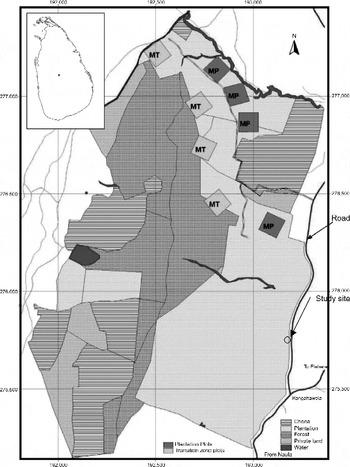
The study was conducted from June 2011 to June 2012 in a Eucalyptus plantation established in the late 1970 s in Maragamuwa in the Naula area of Matale district (Fig. 1 and Plate 1). The plantation is about 60 ha in area and is planted with 500 trees/ha that have been coppiced to allow natural forest recovery. Within the study site, two plots each containing 25 coppices were demarcated for the study.
Map of Maragamuwa Eucalyptus plantation showing the study site adjacent to the road indicated by the black line (Source: Reed et al., Reference Reed, Ranawana and Nanayakkara2009). Location of the study site is indicated with a circle in the map of Sri Lanka in the top left corner.

Maragamuwa plantation of Eucalyptus camaldulensis.

Biology of Leptocybe invasa
The life cycle of the Eucalyptus gall wasp was studied by observing the insects from the time of oviposition to the emergence of adults on live coppices. The appearance and development of galls were monitored until the emergence of wasps by recording the changes in colour, shape and size of each stage. The branches with galls were brought to the Entomology Laboratory in the Faculty of Science, University of Peradeniya, and dissected to observe and record the different stages of wasps that were developing within the galls.
Five coppices were selected in a single plot to record the activity patterns of L. invasa during the daytime. A sticky trap, using a laminated yellow A4 sheet treated with the adhesive Tanglefoot (Contech, USA), was hung (Plate 2) at each coppice to monitor activity patterns during the daytime. The sticky traps were hung from 08.00 to 15.00 h. At hourly intervals, insects glued to the traps were removed without causing damage with the help of a hand lens and stored in 70% alcohol. The traps were installed in 2011 for 5 days during the dry season from August to September and for 5 days during the wet season from October to December. Insects were brought to the laboratory, identified to generic/species level with the help of descriptions and photographs given in Mendel et al. (Reference Mendel, Protasov, Fisher and La Salle2004) and Kavitha Kumari (Reference Kavitha Kumari2009), and counted.
Sticky traps hung on Eucalyptus coppices in the Eucalyptus camaldulensis plantation in Maragamuwa.
Assessment of the severity of damage in relation to coppice development
Damage caused by L. invasa at different stages of coppice development was assessed monthly for a period of 5 months in 20 Eucalyptus coppices. The selected coppices were cut to allow new development. All the cut coppices sprouted, and assessment of the severity of damage was started early as new growth appeared. At the same time, colour changes were also recorded until the coppices reached maturity. The severity of damage was assessed according to the criteria and formula given by Thu et al. (Reference Thu, Dell and Burgess2009) and scored from 0–4 (damage index), based on the percentage of leaves affected, as follows: 0, healthy tree, no damage; 1, < 25% leaves and twigs of crown infected; 2, 25–50% leaves and twigs of crown infected; 3, 51–75% leaves and twigs of crown infected; and 4, >75% leaves and twigs of crown infected.
Based on the level of severity in all the selected coppices, the damage incidence (percentage of trees affected) and the average damage index were calculated according to the following formula:
 $$\begin{eqnarray} \end{eqnarray}$$
where R is the average damage index, n i the number of trees infected at damage index i, v i the damage index at level i, N the number of trees assessed and V the highest level of damage (4). Based on the average damage index, the level of damage severity was identified as follows: nil, average damage index = 0.0; low, average damage index < 1.0; medium, average damage index 1.1–2.0; severe, average damage index 2.1–3.0; and very severe, average damage index 3.1–4.0.
Assessment of the effect of climatic factors on the severity of damage
The effect of rainfall and temperature on the severity of damage caused by L. invasa in developing coppices was investigated once every month for 1 year from June 2011 to May 2012 in 10 selected coppices. Severity was assessed according to the criteria and formula given by Thu et al. (Reference Thu, Dell and Burgess2009). Two-sample t test was carried out to determine the average damage index in dry and wet periods. Rainfall and temperature data for the study period were obtained from the Sri Lanka Mahaweli Authority, Naula.
Investigation for the presence of parasitoids
Six small branches of E. camaldulensis with mature galls were collected and brought to the Entomology Laboratory in the Faculty of Science, University of Peradeniya. In the laboratory, the galled plant samples were covered with ventilated polythene bags and wasps emerging from them were collected daily into 70% alcohol. Specimens were identified with the help of descriptions and photographs given by Kavitha Kumari (Reference Kavitha Kumari2009). The numbers of individuals of each species, both gall wasps and their parasitoids, were recorded. When parasitoids were reared from the samples, the percentage of parasitization was calculated using the following formula (Kim et al., Reference Kim, Mendel, Protasov, Blumberg and La Salle2008):
 $$\begin{eqnarray} \end{eqnarray}$$
Data analysis
Damage intensity, gall wasp abundance and parasitization percentage were calculated using the given formulae, Minitab 16 (Minitab Inc., State College, Pennsylvania) and Microsoft Excel.
Results
Biology of Leptocybe invasa
Leptocybe invasa infested the coppices of E. camaldulensis within 5–6 weeks of bud breakout. Wasps inserted their eggs in a line on the underside of the midrib of young leaves and in the petioles of newly developed leaves about 3 cm in length. After about 7 days of oviposition, the openings of the injury were blocked by a secretion from the wound (Plate 3).
Underside of a Eucalyptus camaldulensis leaf showing oviposition sites along the midrib blocked by secretions.
Larvae, pupae and adults of the gall-forming wasp were identified in dissected galls belonging to different stages (Plate 4). Small larvae were found in galls of stage 2. Mature larvae were found in galls of stage 3. Pupae were found in galls of stage 4. Adults emerged from galls of stage 5 (Plates 5 and 6). A single male wasp (Plate 6) was found among the adults that emerged. Adult emergence was observed throughout the year. Most of the dissected galls contained several chambers each containing developing wasps. In Maragamuwa, the development of wasps from the egg to the adult emergence stage occurred in 129 days.
Developmental stages of galls infested with Leptocybe invasa on the midrib of newly developed Eucalyptus camaldulensis leaves.
Developmental stages of Leptocybe invasa inside galls on the leaves of Eucalyptus camaldulensis.
Adult male and female Leptocybe invasa wasps collected from sticky traps hung on Eucalyptus camaldulensis coppices in Maragamuwa plantation.
Activity patterns of Leptocybe invasa during the daytime
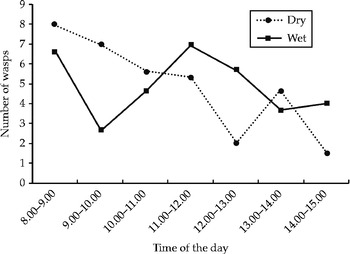
Investigations on the activity patterns of L. invasa using sticky traps revealed that although the insects were active throughout the study period from 08.00 to 15.00 h, they were more active only in the morning (Fig. 2). The highest number of individuals was recorded from 08.00 to 9.00 h during the dry season. Highest activity was observed from 11.00 to 12.00 h during the wet season. The activity was higher in the dry season than in the wet season. However, there was no significant difference in the abundance of L. invasa (P>0.05; P= 0.69) between the dry and wet seasons during the study period.
Number of Leptocybe invasa wasps collected from sticky traps hung on five coppices of Eucalyptus camaldulensis in Maragamuwa plantation for 5 days during the dry season and 5 days during the wet season.

Severity of damage in relation to coppice development
The growth of coppices was monitored to assess the severity of damage caused by L. invasa. A clear pattern in colour change was observed in growing coppices that were red from the initial stage to about 2–3 weeks; there was a reduction in the red colour with leaf maturity. The leaves turned green in colour after 5–6 weeks (Plate 7).
Newly growing coppices of Eucalyptus camaldulensis showing a change in colour from red to green.
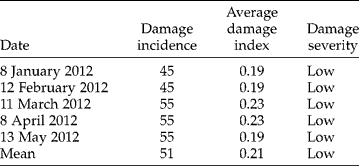
Damage to the coppices from gall formation occurred within 5–6 weeks of bud breakout. The damage was ‘low’ with an average damage index of 0.21 ± 0.02 (standard deviation) throughout the study period (Table 1).
Impact of Leptocybe invasa on the growing coppices of Eucalyptus camaldulensis in the field on 5 days from January to May 2012, as determined by the damage incidence, damage index and damage severity

Effect of climatic factors on the severity of damage
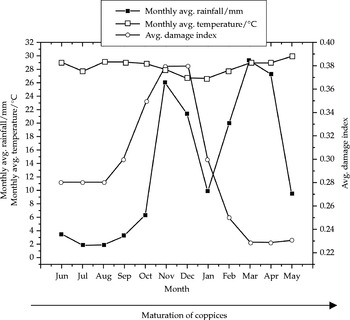
The severity of damage caused to the coppices was investigated during the study period in relation to the temperature and rainfall patterns in the study site (Fig. 3). The rainy period ranged from November to April (monthly average rainfall was 9.95–29.55 mm) and the monthly average temperature was low (26–27 oC) during the rainy period. The damage increased with increasing rainfall and decreasing temperature, but there was no further increase in damage at coppice maturity. There was no significant difference in average damage index between the high rainfall period (9.40–29.55 mm) with a comparatively low temperature (26–27 oC) and the low rainfall period (1.95–6.30 mm) with a comparatively high temperature (28–30 oC) (two-sample t test; P= 0.81). The damage was ‘low’ throughout the study period.
Monthly average rainfall and monthly average temperature at Maragamuwa Eucalyptus plantation and changes in the average damage index (20 coppices) from June 2011 to May 2012.

Presence of parasitoids of the Eucalyptus gall wasp
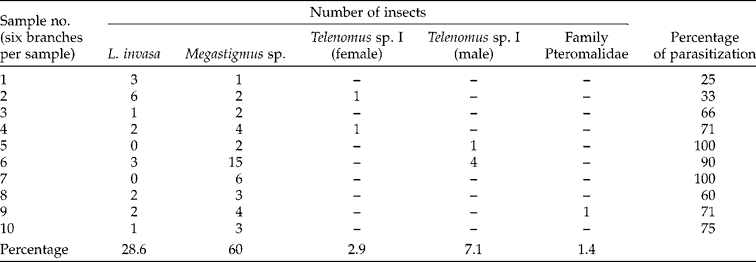
A total of six species of parasitoid wasps were reared from 60 E. camaldulensis branches: Megastigmus sp. (Torymidae) (Plate 8), Telenomus sp. I, Telenomus sp. II, a member of the Pteromalidae family, species of Cynipidae and species of Platygastridae (Plate 9). The most abundant wasp was Megastigmus sp. The percentage of parasitization on different samples ranged from 25 to 100 with a mean of 69.10 ± 8.00% (Table 2).
Female and male Megastigmus sp. collected from sticky traps hung on Eucalyptus camaldulensis coppices.
Other hymenopterans collected from Eucalyptus camaldulensis coppices in Maragamuwa plantation: (A) Telenomus sp. I (female); (B) Telenomus sp. I (male); (C) species of Pteromalidae family from gall-infested branches kept covered with ventilated polythene bags; (D) Telenomus sp. II; (E) species of Cynipidae and (F) species of Platygastridae collected from sticky traps hung on coppices.
Numbers of wasps (Leptocybe invasa and four genera of parasitoids) collected from 60 gall-infested Eucalyptus camaldulensis branches during the study period

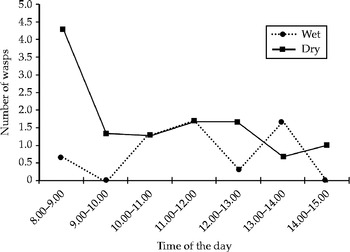
Both sexes of the parasitic wasp Megastigmus sp. (Plate 8) were observed. Investigations on the activity patterns of Megastigmus sp. revealed that they were more active in the morning, although adults were active throughout the study period from 08.00 to 15.00 h. The highest number of Megastigmus sp. was recorded from 08.00 to 9.00 h during the dry season and from 13.00 to 14.00 h during the wet season. The activity was higher during the dry season than during the wet season (Fig. 4). However, there was no significant difference in the abundance of Megastigmus sp. (P= 0.15) between the two seasons.
Average number of Megastigmus sp. collected from sticky traps hung on five coppices of Eucalyptus camaldulensis in Maragamuwa plantation from 08.00 to 15.00 h for 5 days during both the dry and wet seasons.

In addition to L. invasa, both sexes of Megastigmus sp., Telenomus sp. I, Telenomus sp. II and the pteromalid sp. emerged from galled plant materials; members of families Cynipidae and Platygastridae were collected from sticky traps (Plate 2).
Discussion
The coppices of E. camaldulensis in the study site were infested only with L. invasa during the study period. A single male wasp was found, indicating thelytokous reproduction (Mendel et al., Reference Mendel, Protasov, Fisher and La Salle2004). In India, Protasov et al. (Reference Protasov, Doganlar, La Salle and Mendel2008) and Kavitha Kumari et al. (Reference Kavitha Kumari, Kulkarni, Vastrad and Goud2010) had found only a few males of L. invasa infesting E. camaldulensis, Eucalyptus urophylla and E. tereticornis. Development took 129 days in Maragamuwa; in Israel, it was 136 days at room temperature (Mendel et al., Reference Mendel, Protasov, Fisher and La Salle2004). In India, Kavitha Kumari (Reference Kavitha Kumari2009) reported a development period of 54–65 days; Kulkarni (Reference Kulkarni2010) reported 123 days, indicating a relationship with the prevailing environmental conditions of the area.
Leptocybe invasa adults were active throughout the day, but exhibited highest activity only in the morning. Highest activity was observed early in the morning during the dry season and late in the morning during the wet season. In Israel, Mendel et al. (Reference Mendel, Protasov, Fisher and La Salle2004) have observed adults on young leaves in the morning and late afternoon. Kavitha Kumari et al. (Reference Kavitha Kumari, Kulkarni, Vastrad and Goud2010) reported that L. invasa is more active during sunny hours in India. Although L. invasa adults were very active during the dry season, the activity was not significantly different between the dry and wet seasons in the study site. However, according to Mendel et al. (Reference Mendel, Protasov, Fisher and La Salle2004) in Israel, gall wasps prefer warmer climates; their development is slow and suppressed during the winter and wasps resume their activity only in April.
Typical signs of oviposition by L. invasa were observed throughout the year during the present study. As wasps were more active during the dry season, they damaged most plants at that time and therefore signs of damage were more visible in the wet season. The average damage index increased with increasing rainfall and decreasing temperature, but there was no further increase in damage due to coppice maturity. The damage index decreased again with coppice maturity as the percentage of damaged leaves decreased. From the results, it was found that there was no significant difference in damage caused to the plantation between the dry and wet seasons.
Leptocybe invasa attacked the shoots of E. camaldulensis after they turned green in colour. Many tropical plant species are lush with red-, white- or light-green-coloured leaves (Coley and Barone, Reference Coley and Barone1996). In these species, there is a delay in the normal greening process. The photosynthetic capacity of leaves with delayed greening is lower than that of leaves with normal greening; therefore, they have lower available resources and are less damaged by herbivores (Thomas and Coley, Reference Thomas and Coley1992). In addition, the leaves are red in colour due to the presence of anthocyanins, which protect them from harmful radiation. Accordingly, E. camaldulensis trees may protect their young leaves from gall wasps through delayed greening.
The present study highlights the existence of natural enemies of L. invasa for the first time in Sri Lanka. According to Professor Zvi Mendel (personal communication), certain species may be native hymenopterans of the country that have become parasitoids of the introduced L. invasa. Native Megastigmus sp. are known to parasitize L. invasa in Italy, Turkey and Israel (Viggiani et al., Reference Viggiani, Loudannia and Bernardo2000; Protasov et al., Reference Protasov, Doganlar, La Salle and Mendel2008). In India, most of the parasitoids of L. invasa are native hymenopterans that have adapted to parasitize an invasive pest (Kavitha Kumari, Reference Kavitha Kumari2009). The prevailing warmer climate may have facilitated the activity of Megastigmus sp., as they were observed throughout the year in the study site, and similarly the percentage of parasitization on different samples was comparatively higher ranging from 25 to 100 during the study period. Kulkarni et al. (Reference Kulkarni, Kumari, Vastrad and Basavangoud2010) reported that the percentage of parasitization in India was 28.33 and gradually increased with time. The high percentage of galls of L. invasa that were parasitized might have contributed to the ‘low’ damage intensity in the coppices of E. camaldulensis in Maragamuwa plantation during the present study.
Acknowledgements
The authors are grateful to the former Head of the Department of Zoology, Professor K.B. Ranawana, for providing facilities to work in the Maragamuwa Biodiversity Conservation Site. They also thank the two reviewers for their constructive comments and specifically for helping to identify the parasitoids of the gall wasp.