Introduction
In contemporary transnational knowledge intensive (TKI) firms – such as engineering consortia, global law firms and software development companies – services are sold, customized and delivered both locally and internationally (Faulconbridge, 2007, Reference Faulconbridge2008; von Nordenflycht, Reference von Nordenflycht2010). The TKI firm relies on a resource base consisting mainly of professionalized and other expert workers, and their collective ability to present solutions to customers’ problems (von Nordenflycht, Reference von Nordenflycht2010; Whittle, Mueller, & Carter, Reference Whittle, Mueller and Carter2016). These experts contribute their skills, expertise, experience, relationships, reputation and professional networks to the firm (Løwendahl, Reference Løwendahl2005). The centrality of intellectual and symbolic skills in the work of the experts is important, and is referred to as ‘knowledge work’ by Alvesson (Reference Alvesson2004). Depending on the particular combination of expertise involved, consistent services can be delivered and distributed from multiple locations that are structured in several ways (Segal-Horn & Dean, Reference Segal-Horn and Dean2009). The use of information and communications technology (ICT) and various computers, manuals, tools and software templates form an integral part of the work. However, the manifold locations, functions, customer demands and regulatory issues interacting in these high-pressure contexts reflect organizational complexities scarcely imagined by management and organizational theorists a generation ago (Adams, Reference Adams2017). Thus, little is known about how these firms actually manage the complexity of diverse locations, functional specialties and customer needs (Klimkeit & Reihlen, Reference Klimkeit and Reihlen2016).
In this paper, we address the ways that knowledge intensive services are provided from different locations using globally distributed experts and ask: How do distributed experts provide services from different locations? And, what are the necessary integrative and responsive settings for achieving co-ordination in transnationals? We use practice theory to identify how experts collaborate, focusing on organized activities that form a practice. A practice is composed of activities that in turn are composed of what people do and say (Schatzki, 2010, Reference Schatzki2012). Different practices may form organized configurations of activities across time and space which we will consider in relation to transnational collaboration for service provision. Several authors and studies use Schatzki’s practice theory to highlight cross-border activities (e.g., Smets, Morris, & Greenwood, Reference Smets, Morris and Greenwood2012; Hydle, Reference Hydle2015; Smets, Jarzabkowski, Burke, & Spee, Reference Smets, Jarzabkowski, Burke and Spee2015). However, none of these have looked into the activity configurations and the shapes in transnational service provision. Using practice theory, we analyse the necessary integrative and responsive mechanisms for achieving joint service provision.
In the following section, we survey literature and theories relevant to organizational issues in contemporary TKI firms. From this, we describe aspects of practice theory in relation to activity configurations (Schatzki, 2010, Reference Schatzki2012). We then proceed to the empirical part of the paper, describing case selection, data collection and analysis – we follow the internal practices of Verco (a pseudonym), an engineering TKI firm. Our analysis identifies six different transnational activity configurations; each configuration with different options for organizing and coordinating expert work in these complex settings. The paper concludes with a discussion of these findings in the context of these medium-large knowledge intensive organizations that cross-national borders, so that we can address the ubiquitous added complexity presented by the global context.
Organizing in Complex Knowledge Intensive Settings
Extant literature identifies organizational structures and features of TKIs such as location structures (Løwendahl, Reference Løwendahl2000), the multiplex organization (Greenwood, Morris, Fairclough, & Boussebaa, Reference Greenwood, Morris, Fairclough and Boussebaa2010) and global service teams (Boussebaa, Morgan, & Sturdy, Reference Boussebaa, Morgan and Sturdy2012).
Location structures have a focus on global customers and the need for consistent services at multiple sites (Løwendahl, Reference Løwendahl2000). The three different structures identified by Løwendahl (Reference Løwendahl2000) consist of a central pool of professional resources, a single hub and network of delivering units, or a global network of multiple hubs. Although the firms are global, the co-ordination between locations are characterized more by one-way delivery with control than by mutual exchange. However, these three different types of location structures do not specify the different collaboration needs between the experts involved, the practices used for co-operating, nor how projects may involve different people at different locations.
In the multiplex organizational form, Greenwood et al. (Reference Greenwood, Morris, Fairclough and Boussebaa2010) identify features of TKI firms. The characteristics of the multiplex form are the balance between axes of specialization (professional, customer and jurisdictional expertise), norms of reciprocity and a customer management system. The latter system consists of two parts: sorting customers according to their importance and various teams of professionals – core and temporary – who serve the customers. However, it is not clear how these teams collaborate to serve the customers, nor how complex (e.g., transnational) projects are structured.
Global service teams are described by Boussebaa, Morgan, and Sturdy (Reference Boussebaa, Morgan and Sturdy2012), demonstrating how TKI firms use global resourcing systems and service teams to expedite cross-border cooperation. These global service teams function by moving consultants on loan to internal offices for project staffing. They found that firms’ national profit centres and incentive systems locally limit the global service teams. These findings are highly relevant for firms with national profit centres and with business models based on travelling people and not on travelling services. As we will discuss later, the case is different when people are mainly stationary at different locations, but the services move among them in global organization processes.
Several studies relate how joint training and committees, common technology platforms, common systems practices for optimizing knowledge management and common human resources management practices (Maister, Reference Maister1993; Grosse, Reference Grosse2000; Boussebaa, Reference Boussebaa2009; Segal-Horn & Dean, Reference Segal-Horn and Dean2009) are important for TKI firms to respond to global customers in multilocal markets. Segal-Horn and Dean (Reference Segal-Horn and Dean2009) conclude that standardized protocols, ICT and direct personal relations based on trust contribute to seamless cross-border integration in global law firms. However, none of these studies show how the expert workers actually collaborate cross-borders, and through which means, which we address.
Activity Configurations
To grasp how experts collaborate transnationally and through which means, we draw on practice theory (Schatzki, Knorr Cetina, & von Savigny, Reference Schatzki, Knorr Cetina and von Savigny2001; Schatzki, 2005, 2006, 2010, Reference Schatzki2012). Schatzki, Knorr Cetina, and von Savigny explain that ‘practice theorists conceived of practices as embodied, materially mediated arrays of human activity centrally organized around shared practical understanding’ (Reference Schatzki, Knorr Cetina and von Savigny2001: 2). A practice is understood as ‘an organized constellation of different people’s activities’ (Schatzki, Reference Schatzki2012: 13). Practices consist of activities; and in this study, we focus on the different configurations of activities. Practices form organized configurations of activities. In Schatzki’s words ‘… because practices are composed of doings and sayings, they are organized configurations of temporal-spatial activity events’ and thus the ‘bundling of practices in a social phenomenon is an elaborate configuration of interwoven timespaces’ (2010: 78). We thus look at the different dispersed activities that experts undertake when providing services at different locations, and the related configurations.
A practice comprises multiple people and is a social phenomenon. Human life is understood as rooted in practices, being organized activities of multiple people. This entails that the ‘social’ is not the activity of individuals, nor is structure given ontological primacy. Rather, there is a social ontology (Schatzki, Reference Schatzki2012: 14) giving ontological primacy to practices. Practice ontologies are flat since practices are laid out on one level (Schatzki, Reference Schatzki2016b). That practices are laid out on one level entails that there are no levels such as micro–macro; rather social phenomena are slices and aspects of linked practices and arrangements. Instead of levels, there are different features of social phenomena, such as density, size, duration, shape and qualitative complexity. Density refers to the number of activities, relations and practices, whereas size relates to small–large spectrum. However, duration, shape and qualitative complexity is not explained nor examined (Schatzki, Reference Schatzki2016a), which we do in this paper.
To understand and uncover practices, we tend to think flatly instead of in layers, and we thus need different concepts than micro and macro with which to work. According to Schatzki (Reference Schatzki2016a), identifying different shapes could provide an overview of things; we will focus on the shapes and the qualitative complexities of the social phenomena of service practices. To understand this in a TKI firm context, focus is on the activities that are interrelated or interwoven, for instance focusing on all activities that are part of providing engineering services to customers.
We identify a series of activity configurations in TKI firms, and show how they represent accommodations created through practices used to meet customer needs. TKI firms may divide work assignments between or among internal experts that are located in different entities and localities. For example, a consulting project for a large industrial firm may be primarily provided by the TKI office located near the headquarters of the industrial firm; but although part of the work is performed in India, the customer being the industrial firm, receives (and perceives) the project as one entity. Thus, the practices of an activity configuration are the ways that various distributed knowledge workers engage in joint work, and how such collaboration occurs within TKI firms. In the following section, we present the methodology and research methods used before discussing the findings.
Research Design
The paper is aimed at understanding transnational collaboration between experts for service provision and TKI work. The study can be seen as an extension of social constructivism (Berger & Luckmann, Reference Berger and Luckmann1966; Rasche & Chia, Reference Rasche and Chia2009) as a practice-based study. A practice-based study was important for determining practices and activities that were quite stable over time. The everyday activities serve as the object of analysis whilst being teleological for achieving the service work and forming activity configurations (Schatzki, 2010, Reference Schatzki2012). The constructivists’ insistence on the complex, dynamic and context-based nature of knowledge is hence highly relevant (Charreire Petit & Huault, Reference Charreire Petit and Huault2008), whilst favouring closeness, complexity and locality for the researchers (Thorpe, Reference Thorpe2008; Rasche & Chia, Reference Rasche and Chia2009).
Case selection
The empirical case materials derived from observing the services provided by Verco, a global provider of third-party services for managing risk through the provision of professional services worldwide. The firm comprised 300 offices in 100 countries, with about 9,000 employees representing 86 nationalities, and organized into four business areas. The third-party services that Verco provided include offshore classifications and onshore engineering services in the oil and gas industries worldwide. Verco performed ship and offshore classifications among other services. Classification is a comprehensive verification service with requirements laid down in rules and standards. These rules and standards are to be met during design and construction, and maintained during operation. In general, the process of classification involves setting standards, verifying compliance with standards and documenting compliance with standards. It is important that the classification service is standardized since the inspection of ships and offshore installations takes place over time and can be conducted by many different engineers located in different ports. Services are delivered at a wide variety of locations – from the customers’ premises, ports, third-party locations and various combinations of these.
Other services were, for instance, the risk-based verification being conducted on field developments, pipelines, risers, subsea facilities and process systems. The service consisted of a risk and cost/benefit analysis between technical and operational issues and between safety and costs. The customers ranged from large industrial manufacturers, automotive companies, shipping companies to offshore oil platforms.
Data collection
Verco was studied by the first author over 5 years, while the empirical material for this paper stems from 2007 to 2009, and were collected in five different localities on three continents. We conducted individual, semi-structured interviews and group interviews as well as doing participant observation at internal meetings in one of the business areas. We specifically asked Verco for permission to conduct interviews at different localities and continents so to view how the experts collaborated and how services were provided locally and across borders. We discovered that, whether the customer was situated locally or on the other side of the globe, the work processes remained consistent – knowledge workers at particular sites generally did not move to other sites as groups; rather, they were involved in the daily, online provision of services from their base workplaces. The transnational collaboration in focus transpired in at least two different countries and locations, involving several professionals with different functions and expertise. We gathered data in multiple locations, not only for comparison, but also to identify the units being linked to each other in a more or less coherent structure. We assured that different ethical requirements were met through reflexivity (Alvesson & Sköldberg, Reference Alvesson and Sköldberg2000; Alvesson, Reference Alvesson2003), confidentiality for the firm and the professionals and the credibility of the researchers.
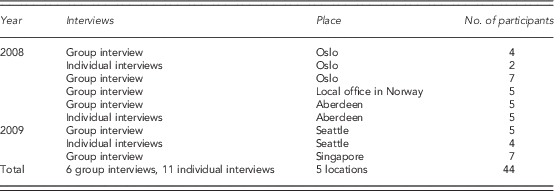
The data collection was based on group interviews, individual interviews, observations, documents, as well as intranet and other internal electronic sources. We used the documents, intranet and electronic internal sources as background material on the different projects undertaken, services rendered and ICT systems; and in order to better facilitate discussion with the Verco employees. The data presented in this paper stem from six group interviews and 11 individual semi-structured interviews conducted in 2008 and 2009, with a total of 44 informants – see Table 1 for details. Our Verco contact person liaised with different local managers and coordinators at the different localities that we wanted to visit, to invite people to the group and individual interviews following our requests for breadth in seniority and expertise. The interviews performed in Norway were conducted in Norwegian, while the remaining interviews were in English.
Details of interviews conducted in this study

Different methods were used for gathering data to ensure breadth and flexibility (Balogun, Huff, & Johnson, Reference Balogun, Huff and Johnson2003) in a research context that was transnational. The group interviews were structured and controlled discussions intended to elicit the participants’ differences of opinion on a limited topic (Krueger & Casey, Reference Kvålshaugen, Hydle and Brehmer2000). The participants of the group interviews were different project managers ranging from senior to junior level. Project managers were provided with advance notice to select one of their projects to present in the group. Each group interview lasted 4 h, including lunch. The lunch break seemed to serve as an important informal arena. Questions and discussions aimed to examine particular practices and what ‘really’ went on.
As a supplement to the group interviews, we also interviewed project members individually following a semi-structured interview style where the facilitation of good conversation was the norm. Individual interviews were for more in-depth data on issues of collaboration and project interaction, division of labour and professional competence in projects. These individual interviews began with asking the engineer how a normal day evolved; then we delved deeper into the different services in which they took part, all the different activities they performed in different projects, various services and for different customers, the customer interaction (such as customer visits, phone calls), the tools they used and who they collaborated with and where. In addition, the data included the observation of a 2-day internal seminar involving 40 people from over 30 locations.
Data analysis and coding
The data analysis proceeded in five stages. First, we made field notes and transcripts (word-processed and hand-written) from each of the group interviews. The information was condensed into case-stories using a Microsoft PowerPoint presentation to present Verco easily and effectively. The aim was to employ the thick description mode of analysis (Geertz, Reference Geertz1973). We presented a case story from each location and one covering all the locations to the top management and different project managers in Verco in addition to making them available to the participants in the group interviews. This was in order to validate the data’s veracity and enhance the trustworthiness of the analysis (Lincoln & Guba, Reference Lincoln and Guba1985) as well as providing possibilities for feedback. Our data included the practices used for collaborating, the activities of project work, use of tools, the role of the project manager, knowledge and experience needed, and networking within and across projects were important themes. These issues were often referred to by actors when they discussed work, how they worked, when they collaborated with colleagues locally, or with other offices globally.
Second, the different PowerPoint presentations were examined along with the transcribed notes from the group and individual interviews, and the notes from observations, specifically looking at collaborating practices. Transcriptions and research notes from interviews and observations were imported into NVivo – a software package to aid qualitative data analysis.
Third, we coded the collected material. Observations, group interviews and individual interviews were analyzed using NVivo 9. Responses and observations were categorized according to whether the activities for service provision were only performed locally at one site or whether the activities involved transnational collaboration.
Fourth, focusing on the transnational collaboration, the codes evolved over time due to iteration between data and interpretation (Alvesson & Sköldberg, Reference Alvesson and Sköldberg2000). Initially, the data were coded according to whether the collaboration in transnational service performance involved difficulties or ease, and what were the constraints or enablers for collaboration. Transnational collaboration was for instance explained through sharing projects for the same customer across locations and expertise. The enablers where how the work was divided according to expertise and function.
Finally, it became clear that there were so many nuances that needed to be further understood; so we went back to practice theory and focussed on how the activities were organized. By comparing and contrasting various aspects of the activities involved in the practices, different patterns of collaboration were found. These patterns were found based on practice theory’s focus on uncovering practices from those activities that hang together in relation to intentional actions of doings and sayings, with an aim to perform something for an end result (Schatzki, 2010, Reference Schatzki2012). These activities involved: (i) the practical understanding from the experts of the activities performed, (ii) their general understanding of what type of work they did, (iii) how they followed rules, instructions and directions, (iv) different teleo-affective structures that were at play for rendering and providing the services and (v) the different material arrangements and infrastructure that they used – such as ICT systems.
Thus, the empirical patterns we found of organized configurations of temporal-spatial activity events based on practice theory varied in relation to:
1. The number of knowledge workers involved in a project (a proxy for project complexity): the projects involved two to over 40 people. Simple projects involved fewer professionals than the complex;
2. The reasons the professionals were involved: the data revealed that particular professionals were involved for a variety of reasons, such as proximity to customers, predefined organizational specifications for the division of labour, uniqueness of expertise and spatial proximity to each other for the purpose of brainstorming;
3. The tools that were used: there were differences regarding the use of off-the-shelf and custom-made technology, based on the specific task at hand. Standard and off-the-shelf ICT tools in use were mail and instant messaging. Two custom-made ICT systems were particularly in use: The Vercolus, which is a workflow tool to test, verify and classify vessels; and the Project Portal, a tool made for project work for large complex projects with many tasks.
4. The need for physical proximity: there were differences in the need to be in the same space for brainstorming or physical teamwork, such as on-site workshops or participation with a number of experts. This observation contributed to the understanding of space with respect to configuration patterns. One specific pattern was observed whereby several professionals from different locations travelled to meet at a customer’s site.
The coding in relation to these four different data interpretation steps resulted in the identification of six different types of activity configurations with unique characteristics. The six configurations, their characteristics, and the various practices related to different configurations will be discussed in the following section.
Findings
We begin with the first of several illustrative examples. Stephen, a senior ship architect engineer in Verco Aberdeen, who was responsible for a ‘new build’ process of a vessel:
‘We did the UK verification side. … There is the legal requirement for the schemes … all the safety is approved, which needs to be designed to class. The class aspect was dealt with in Rotterdam. I went there. … An experienced customer would have made sure that they comply with standards; but this customer does not …, which is much more challenging and labour intensive.’
The machines for the new build came from Bergen, and had been approved there. The customer – being new for Verco – was situated in London; and the machinery and related machinery approval process from Bergen. UK legislation compliance and verification processes were headed by Stephen in Aberdeen, and the final approval process performed by professionals at the headquarters in Oslo. The different teams in Bergen, Oslo, Aberdeen and Rotterdam never met in one place: Stephen went several times to Rotterdam to team up with the new build engineers there. He had a lot of communication with the customer in London over the phone and mail; and some contact with the approval professionals in Oslo through mail, phone, and through the custom-made systems for Verco classification. ‘The units here are not standard; learning how to do these things… a new process, new types of assets…interpreting the rules while going, and a new customer!’
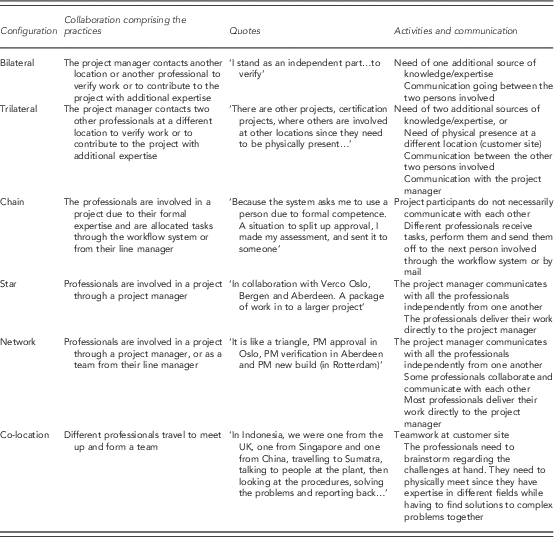
This example of transnational collaboration illustrates one of many types. Our findings include configurations of transnational collaboration that are not only consistent within a given organization, but also across locations, and frequently across temporal, spatial, national, linguistic and cultural borders. The activity configurations represent the division of labour and the methods of collaborating between and/or among different experts and professions, yet are also utilized in the process of completing projects and delivering services. The analyses pointed towards six different types of activity configurations (see Table 2).
Six types of activity configurations used for collaborative project work

Six configuration activities
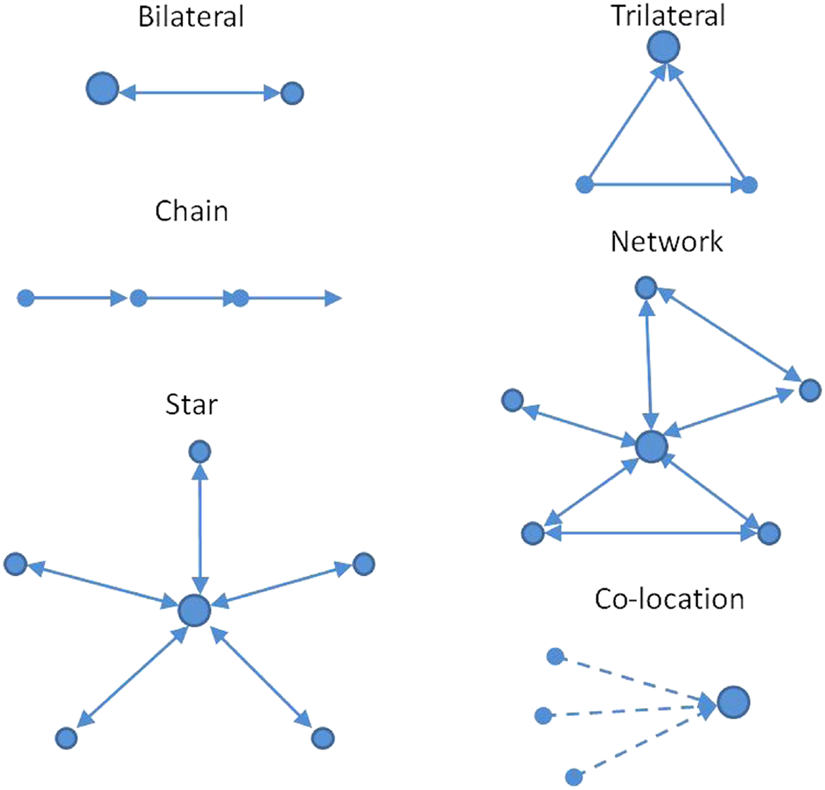
The first and second configurations were basic bilateral and trilateral collaborations, which entailed dividing work among multiple sites, either from one site to another, or from a single professional to a team, respectively. The third configuration, a chain of services, represented a division of tasks dependent on knowledge, functions, capacity and control. The links in the chain represent the functional division of labour between different actors and/or locations. Fourth, the star configuration was defined as a configuration where a central project manager coordinates all collaboration and other activities performed by experts at multiple sites. The fifth configuration found was that of a network, being a combination of the chain and star. Within this configuration, there was a central coordinator managing both the functional division of labour and various team activities. Finally, the co-location configuration consisted of the activities of professionals who travelled to team up and collaborate at the customer’s premises. These collaborative activity configurations reflected different patterns of interaction found in projects providing a service to the customers. The different types of the activity configurations are illustrated in Figure 1.
Nature of collaboration and six configurations

First, bilateral collaboration entails dividing work between two professionals located in different places and the work is provided separate in time and place. The contact and collaboration is one-to-one, and involves professionals having either different types of expertise, or the need for the same expertise in a different region due to customer presence, as in the following examples: ‘I (being in Oslo) was contacted by colleagues in China for a project, so I wrote an offer. After half a year, we got the project (together)…’ and ‘They (Aberdeen, Rio and Singapore) contact us if they need something. Often we write offers based on the resources we have’.
The second configuration, trilateral collaboration, involves three parties working in contact and collaborating with each other, but not as a standard team or at the same time. A typical case would involve a project manager working with two other people on a project who are collaborating with each other. Another example consists of Verco providing service to a customer in Korea, who in turn is providing services to a large customer in Houston. In this example, Verco provided services to both customers, while the work collaboration between the customers happened without the intervention of Verco.
The third configuration, the chain of services, represents a division of labour, or tasks, depending on the experts’ knowledge, functions and capacity. The division of labour follows a step-wise chain where each step involves different tasks and expertise. Professionals provide work according to their function and they complete different functions in the provision and delivery of service. An exemplary quote would be: ‘I made my assessment and sent it to a verifier’. Evaluation and verification of each-others’ work is part of the value-chain. For example, a professional might hand off work to the next professional: ‘Because the system asks me to use a person due to formal competence’.
The star is the fourth configuration, where there is one project manager collaborating with each of many professionals and coordinating all of the activities performed by professionals at multiple places both simultaneously and separate in different places. The different pieces of independent work are assembled by the central project manager. Professionals provide their part of the work to the project manager, without collaborating or being in contact with each other. Professionals’ descriptions included: ‘We provide the report for our part of the project scope, but we never hear from those who put it all together’, and ‘We do things in parallel and then the work is assembled in the East’.
Fifth, the network configuration is a combination of the chain and star configurations. In this configuration, there is a central coordinator managing both functional divisions of labour and different team activities. This configuration would be used with larger projects involving from four to 40 people. There is one central project manager; however, part of the work may be coordinated by others, or there may be workshops among some of the participants in order to better coordinate work and solve challenges. Work is performed both simultaneously and separate in different places. Professionals described the work as follows: ‘Some projects are managed from here, and the network goes from here. Other projects are managed elsewhere where we are part of the network’,
‘The project manager thought that we needed to involve him and another one. After another meeting, we involved even more people since we needed that. If we all met physically? No, all were never assembled at once. The project manager collected the threads and we contributed with different parts.’
Finally, co-location collaboration occurs when professionals are required to travel and team up at the customer’s premises and perform the job as one integral team, thus collaborating on site. In such a case, a specially challenging project requires a visit that brings together all of the necessary Verco professionals from different locations and different sections. For example, a team of three typically travels from three different locations, such as Aberdeen, Shanghai and Oslo, to meet up in Indonesia. Part of the work was performed beforehand and separate in time while the remaining work was provided there and then at the customer site. Participants described the collaboration: ‘It was no egos; it was the team!’ The work consists of serious engineering complications necessitating collaboration across the professional disciplines; ‘Very few companies could put together that kind of expertise’. The professionals have not necessarily worked together previously, but they know of each other through the internal informal company network. Some examples of quotes were: ‘I need to make 3 to 4 phone calls’, ‘I know who to call and where’ and ‘Knowing the internal network is essential’. People developed their own networks over time, or used other people’s networks in order to get in touch with different professionals, as demonstrated by the quote, ‘Bob worked in the Far East, and I get to use his network’.
Coordinated actions, interaction modes and spatial dimensions
These six activity configurations were analyzed with a view to understanding the roles of coordinated actions, interaction modes and spatial dimensions. Analysis of the six activity configurations revealed some consistent similarities as well as unique distinctions among them. We found that there were differences in all three areas – and we delve into each of these three axes separately in the following paragraphs.
The main difference among the six configurations is based on the various types of coordinated action (Schatzki, Reference Schatzki2010: 69). Coordinated action, or how the experts coordinated their activities, is understood as ‘actions that combine to achieve a result that someone intends be achieved, though the people performing the coordinated actions need not have agreed on the intended result or even be conscious that their actions are coordinated’ (Schatzki, Reference Schatzki2010: 69). Intent is thus a key factor in this coordinated action. Our findings explicate the different types of co-ordination in relation to each configuration.
For bilateral and trilateral collaboration, the actions and activities performed by one is complementary with that of the other. ‘It will be different people involved in different phase with the client’. For the chain configuration, the activities follow different functions and predefined tasks. ‘The work share is structured by Verco processes’. The star configuration is like bilateral collaboration in that the activities are complementary and performed independently, but in this case, all collaborate with one coordinating person. ‘I am the project manager, and then there is one other surveyor, he goes when I can’t do it, and then there is one electrical surveyor’. The network configuration is similar to the star, but with physical interaction and co-ordination between certain professionals in order to solve challenges together. ‘The project manager does the design reviews, and get help from experts that are more experienced’. Finally, the co-location configuration primarily concerns the need for physical proximity in order to be able to perform the activities collaboratively and where it is needed.
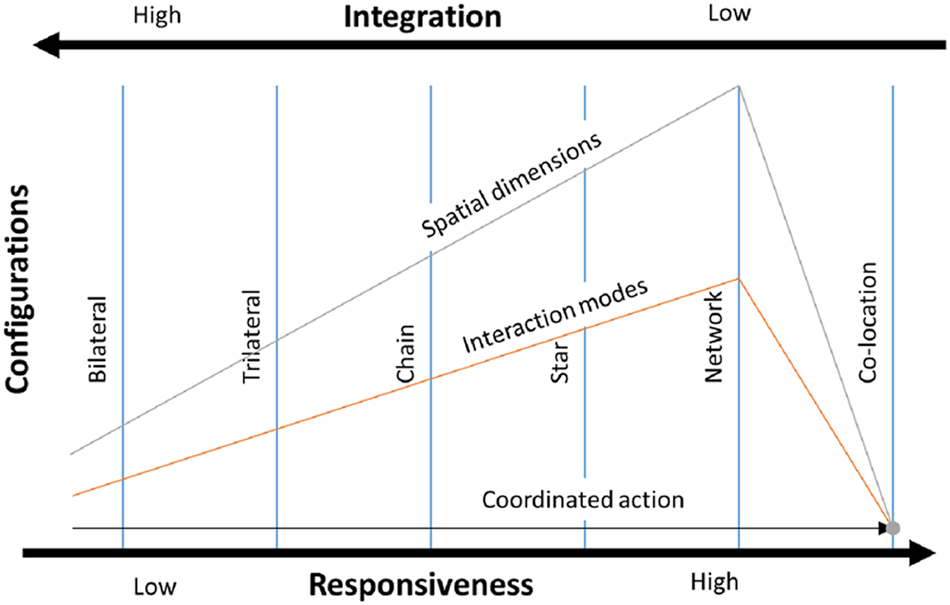
By analyzing the findings through coordinated actions, we find the logical sequence of the different configurations (Figure 2). Starting from low co-ordination, we find the bilateral and trilateral collaboration, where high co-ordination involves a project manager for coordinating the activities as in star and network configuration. Finally, the solution for highly complex work, where the actions need to be coordinated all the time, is by teaming up and working together in co-location.
The configurations in relation to integration and responsiveness

The coordinated actions are closely linked to the interaction mode used, or how they interacted, which is the second axis in our transnational solution. Following practice theory, ‘Interaction, in short, is an order sui generis. Nothing that preexists it – neither social nor cultural orders nor cognitive elements such as rules qua internalized instructions – can predetermine its forms or results. Social orders do not determine human interactions; rather, interactions determine social orders’ (Schatzki, Reference Schatzki2010: 185). This entails that the way the participants interact, one-to-one, one-to-several, several-to-several, face-to-screen and face-to-face determine the order, that is, the type of configurations.
Because the bilateral configuration is relatively straightforward (involving only two knowledge workers), there is little need for training beforehand apart from their professional expertise. Any conceptual tools such as written information needed for exchanging work activities can be transacted through the mail; interaction mode is face-to-screen and one-to-one interaction. ‘The telephone is the biggest tool I got. Follow up by mail sometimes. Most of the discussions…the technical is by email, then the discussion over the phone will follow’.
For trilateral collaboration, there is greater need for project information and oversight for all participating employees (because three individuals are involved) with one-to-several interaction. The chain configuration requires that oversight of activities be transferred down the chain, while still maintaining a customer focus; here the ICT used for transnational service delivery is custom-made for the tasks at hand, involving face-to-screen interaction with tailor-made tools. ‘Our projects are dealt with through the workflow tool, Vercolus. Vercolus we use for all the technical documents and correspondence’.
The star collaboration configuration reveals more interaction modes than does the chain configuration, related to project management, project oversight and follow up. In order for the company to maintain focus on processes and on the customer during transnational service delivery processes, some kind of supervision or management is necessary to assure that the customer requirements and time constraints are maintained throughout the service provision. As the star involves many employees located in different separate locations, the project manager needs to be trained in project management to effectively facilitate the division and management of labour, involving one-to-several interaction. ‘I know who to call and where. If I can, I take with me juniors.’ Involving junior colleagues so that they can learn from more senior people, maintaining customer contact during the service provision, and building relations are part of such project management.
The network collaboration is similar to the star, but requires physical interaction between some participants due to the need to brainstorm, with face-to-screen, face-to-face, one-to-one and one-to-several interactions.
‘We have a lot of technical meetings. We involve the main customer, 3–4 other suppliers and the professionals internally. The main customer can take part in meetings with sub suppliers or not. Today we will have meetings without the main customer, only regarding the technical, but we inform the main customer and they have the possibility to be present.’
If the necessary participants are not at the same location, they have to move to the same space through travel, or, if possible, interact virtually through the use of social media such as an internal company wiki, microblogging and collaboration software.
The co-location configuration is a mixture of the bilateral and network configurations; either the involved employees use simple tools for communicating – such as email prior to teaming up at a common place – or they use social media to brainstorm before travelling. This virtual social networking prior to teaming up physically was essential for team members to learn who-knows-what, and thus to verify that the correct professionals are being included. This is a several-to-several interaction mode. ‘The project manager was from Verco Taiwan, then an expert from Oslo, and then someone from Aberdeen. They met physically, onsite’.
The more complex the work, the more the need for coordinated action, more tools, interaction modes and processes are needed for interaction. At the highest levels of complexity, thus, the greater the benefits are to team up physically/spatially as in co-location. The bilateral and trilateral configurations require few tools or training. Chain and star configurations both require existing tools for process or project oversight, and supervision or project management facilitation to ensure the quality of service provision and delivery. The network and co-location configurations require physical networking in the same place during the service provision.
Coordinated actions and interaction modes are closely related to the transnational’s spatial dimensions. ‘Spatiality embraces arrays of places and paths anchored in entities, where a place is a place to perform some action and a path is a way among places’ (Schatzki, Reference Schatzki2012: 19). Spatial dimensions represent the way that these collaboration practices enable and assemble different activities spatially, or how the different activities assembled across space.
Both bilateral and trilateral collaboration have independent activities in separate places that become assembled when the service delivery is to be handed over to the customer, through a path using ICT. The chain configuration is similar, with multiple but interdependent activities in separate places that become assembled in the end. For both the star and network configurations, the project manager begins with a project that is then split up into different independent activities in various locations, before the activities are assembled again by the same project manager. The co-location configuration is characterized by different professionals teaming up in the same place, and is afterwards dissolved once the task is completed.
Although we look at the spatial dimensions of activities and not explicitly the temporal, the activities are inherently temporal-spatial: ‘time and space are inherently related constitutive dimensions of action and that the happening of action is the opening – or coming to be – of these dimensions: the opening of time-space. Activity is a temporal-spatial event in the sense that is in the occurrence of activity that time-space comes to be’ (Schatzki, Reference Schatzki2010: xi). Our findings reveal how the spatial dimensions vary in relation to the configurations, and how different places and paths, such as travels and ICT, are used in different ways among the various locations.
Observing these three axes (coordinated actions, interaction modes and spatial dimensions) across the first five of our six activity configurations, generally start from low – with the bilateral configuration – gradually increasing through the network configurations. There are more actions coordinated, use of different interaction modes, and more places and paths involved. However, in co-location configuration – when the coordinated actions become most complex – the other axes conflate as interaction needs to become face-to-face and several-to-several, and the participants need to be in the same place to get their work done. These patterns are illustrated in Figure 2.
Differentiated integration–responsiveness
The six collaborative activity configurations provide a set of organizational options for practicing a ‘transnational solution’ in different settings. At first sight, the configurations fit nicely with the integration–responsive framework, each allowing different aspects of globality/integration and locality/responsiveness required for the transnational (Harzing, Reference Harzing2000). For example, the bilateral, trilateral and chain configuration are mainly integrative: the firm can lay the ground for integration by using common processes and procedures, and introducing tailor-made ICT systems for co-ordination of activities. Some representative quotes are: ‘The Verco systematic side being the basic such as the AQSC system, the reporting systems, the tailor-made systems and the general understanding of how Verco operates…it is the Verco way of doing.’; ‘When we work with the same clients, we need to do things the same way’; ‘It is the Verco competence, which is about a style of management. Understanding of the rules and the type of thing we need to get approval for, where to get the approvals, where we can go and not’.
On the other hand, the star, network and co-location configurations are mainly responsive as they leave room for more autonomy to deal with challenging customer/context/project realities: ‘I learn every day. A new client is a new relationship. I am an adventurer. I like the challenge. That is why I like a challenge’; ‘In December, I spend in Indonesia, in November, in Bergen. Before that, Taiwan, then Singapore…somewhere else. Two jobs are completely different’.
However, more in-depth analyses reveal differentiated integration and responsiveness throughout all the configurations. At one end of the spectrum is the bilateral, with high degree of integration and low degree of responsiveness, while at the other end is co-location, low on integration and high on responsiveness (as illustrated in Figure 2). However we recall that the classic transnational is defined as being high on both integration and responsiveness, with ‘differentiated contributions by national units to integrate worldwide operations’ (Bartlett & Ghoshal, Reference Bartlett and Ghoshal1989: 65). Our findings are clearly consistent with this ideal, with even the bilateral’s low responsiveness and the co-location’s low integration representing relatively sophisticated (i.e., high) structural capabilities (Kvålshaugen, Hydle, & Brehmer, Reference Krueger and Casey2015). We continue developing this theme in the following section.
Discussion
The article has addressed two research questions: How do distributed experts provide services from different locations? And, what are the necessary integrative and responsive settings for achieving co-ordination in transnationals? By looking at how they actually work together transnationally, we found six different activity configurations and three corresponding axes namely coordinated actions, interaction modes and spatial dimensions. These findings illustrate the assertion by Bartlett and Ghoshal (Reference Bartlett and Ghoshal1989: 60) that ‘instead of centralizing or decentralizing…the transnational makes selective decisions’ concerning organization of work activities in these complex environments. The overall context is clearly highly complex – in terms of both integration and responsiveness – yet the TKI firm organizes along the lines of one of these configurations based on the stringencies of the task and customer requirements.
Using practice theory to view the activity configurations proved to be a powerful tool to grasp the different activities performed in different temporal and spatial dimensions. These six different activity configurations and three corresponding axes have not hitherto been uncovered; and they represent contributions to both the international/transnational organization literature as well as to practice theory.
The contributions to practice theory are, first, the different shapes that activity configurations can take; and second, how the axes of coordinated action, interaction modes and spatial dimensions are used differently. The shapes exposed different geometrical concepts (bilateral, trilateral, chain, star, network and co-location) that provide an overview, without going into the typical layered dichotomies of micro–macro. Uncovering the different geometrical shapes answer the call to reveal shapes of social phenomena where the site of the social is ontologically a flat plenum of practices (Schatzki, Reference Schatzki2016a) and we thus extend practice theory.
Further, we found that the configurations differently used the axes of coordinated action, interaction modes and spatial dimensions, which exposed the qualitative complexity. These axes have not hitherto been used together or identified as analytical constructs (Schatzki, Reference Schatzki2010), but emerged through the analysis of the differences between the activity configurations. Thus, the axes of coordinated action, interaction modes and spatial dimensions represent conceptual tools for analyzing collaboration, division of work and activities across time and space, elaborating practice theory. By exposing shapes and qualitative complexity of social phenomena, such as transnational collaboration and service provision, we contribute to practice theory.
Using activity configurations in a TKI context has interesting implications. First, the division of labour between or among globally dispersed knowledge workers, such as when a service is divided into activities across space, illustrates how activity configurations are enacted to meet customer needs. These findings complement the Segal-Horn and Dean (Reference Segal-Horn and Dean2009) ‘effortless experience’ model and add specificity to the ‘multiplex’ form suggested by Greenwood et al. (Reference Greenwood, Morris, Fairclough and Boussebaa2010). Second, transnational service work exists and functions due to the practices in use, the structured nature of organizational processes and tools such as ICT. These bind the necessary component activities together that is the basis of providing a service. In following the transnational practices, the results are linking professionals together, depending on the work to provide. Third, the different activity configurations clearly show how the structures and organizing design are in use, in a TKI firm. The six configurations and the three interdependent axes expand the current TKI firm literature regarding features and organizing design (Greenwood et al., Reference Greenwood, Morris, Fairclough and Boussebaa2010). As Greenwood et al. (Reference Greenwood, Morris, Fairclough and Boussebaa2010) establish the four elements reinforcing a culture of reciprocity in transnational organizing; this paper establishes how collaboration occurs across projects and the necessary tools in use.
Further, the findings show that it is a reality to transcend national borders with mobile services, contradicting the findings of Boussebaa, Morgan, and Sturdy (Reference Boussebaa, Morgan and Sturdy2012). Existing research focussing on local incentive systems fail to view how firms with global key performance measures and process organization operates. From a focus on travelling consultants (Boussebaa, Morgan, & Sturdy, Reference Boussebaa, Morgan and Sturdy2012), this paper focussed on travelling services where the findings demonstrate that five out of six configurations were about travelling services, and only one of travelling consultants.
The activity configurations also provide new insights to the existing theoretical understanding of location structures (Løwendahl, Reference Løwendahl2000). Following the findings of the different activity configurations, we elaborate and extend exiting theorizing. Extant research identified location structures to provide consistent services to customers, which consisted of a central pool of resources, a single hub and network of delivering units or even a global network of multiple hubs (Løwendahl, Reference Løwendahl2000). The central pool entailed delivering services from a single knowledge centre, without needing to worry about localization, configurations or co-ordination between locations (Reference Løwendahl2000: 154).
As we specifically explored transnational projects involving experts from multiple locations, we have not gone into details of how professionals deliver services when they are provided from one single place. Further, the single hub with a network of delivering units implied that the professionals are closer to the customer sites. The central hub develops knowledge and standards to use, while the delivering units are close to customer needs and local markets (Løwendahl, Reference Løwendahl2000). This is in line with bilateral, trilateral and chain configurations, where the work, the processes and tools to follow are predefined. However, our findings show that the use of different professionals were not only due to closeness to customers, but also to accessing expertise.
Finally, the global network of multiple hubs implies that each hub has responsibility for knowledge development for a specific area of expertise and the distribution through the entire network. Although such firms are global, the co-ordination between locations was more characterized by one-way delivery with control than by mutual exchange (Løwendahl, Reference Løwendahl2000). The findings of this paper show that there is a global network of multiple hubs, within the star, network and co-location configurations, however, these multiple hubs or professionals do have mutual exchange. In contrast to existing literature, the findings show that there is mutual exchange between experts within the network and co-location configuration – in these contexts, the need to brainstorm and teamwork in the same space is a necessity for successful service provision. Although the star and network configuration show one-way delivery with control through the role of the project manager, the network and co-location configurations show mutual exchange. The findings therefore elaborate and extend current professional service firm theorizing relating to the globalizing professional firm (Lander, Heugens, & van Oosterhout, Reference Lander, Heugens and van Oosterhout2017).
We elaborate the understanding of location structures with a fine grained and nuanced understanding of the practices used for collaboration and the configurations at play. We also further theorizing in TKI contexts by proving mutual exchange and collaboration across space to provide services to customers. Extant literature has identified that the transnational structures of these firms (Boussebaa, Reference Boussebaa2009; Segal-Horn & Dean, 2007, Reference Segal-Horn and Dean2009). The findings of this paper not only demonstrate that there actually is transnational collaboration in TKIs to deliver services, but also demonstrates how such collaboration is undertaken.
Conclusion
The six activity configurations, bilateral, trilateral, chain, star, network and co-location, reflect the different patterns of intraorganizational service work in transnational organizations (Klimkeit & Reihlen, Reference Klimkeit and Reihlen2016). The analysis of the division of work and activities among dispersed expert workers has documented how the activity configurations function to achieve transnational collaboration. The activity configurations address both performance and customer needs.
One of the goals of this paper was to encourage the development of a greater focus on transnational collaborative service work and the ways that knowledge intensive services are provided and delivered across borders to fulfil customer needs. The analysis demonstrated that the nature of the work to be performed determines the number of professionals, the use of adequate organizational structures, and the type of collaboration involved to perform the work. When looking at the activity configurations, six different collaboration patterns were found. These activity configurations form part of the organization’s assets because they enable the organization to use resources and structures transnationally in relation to demands from and needs of different customers. The identification of the six activity configurations is the contribution of this research to the TKI theorizing. The paper clarifies the specific ways in which challenges in distributed professional service work can be overcome.
This study also provides a rare insight into the ‘transnational solution’ framework suggested by Bartlett and Ghoshal (1988, Reference Bartlett and Ghoshal1989) in a contemporary context. Whereas the ideal of simultaneous integration and responsiveness was quite rare a quarter century ago when this compelling work was originally published, today’s technological and organizational capabilities allow a wider range of organizational accommodations into the frame. At the same time, developed economies have become even more knowledge intensive and global; thus, our contribution of locating this study in a contemporary TKI organization to extending the range of the transnational construct. The limitations of these findings are associated with examining one single TKI firm and not being able to trace and follow the activity configurations when these are undertaken at multiple sites, but rather uncover these in retrospect as we did. We trust that other scholars will follow up with research that further extends and illustrates these organizational issues across national and occupational boundaries.
From a practitioner perspective, these activity configurations should provide managers in TKI contexts with quite intuitive models for understanding, facilitating and encouraging practices that will enable coordinated work across various locations. Whenever complex and demanding services are required, the appropriate activity configuration for intrafirm collaboration can be used. Furthermore, providing the project managers with tools and procedures to differentiate between the configurations could facilitate both co-ordination and collaboration across locations. The outcome for the customer would be most effective and efficient service delivery performed by the most competent team the organization could offer.