Introduction
Alcohol misuse amongst young people in developed countries is common and is associated with considerable burden of disease and social costs (Hibell et al. Reference Hibell, Guttormsson, Ahlström, Balakireva, Bjarnason, Kokkevi and Kraus2007; Gore et al. Reference Gore, Bloem, Patton, Ferguson, Joseph, Coffey, Sawyer and Mathers2011; Whiteford et al. Reference Whiteford, Degenhardt, Rehm, Baxter, Ferrari, Erskine, Charlson, Norman, Flaxman, Johns, Burstein, Murray and Vos2013; Gowing et al. Reference Gowing, Ali, Allsop, Marsden, Turf, West and Witton2015). The peak of disability occurs at 15–24 years of age, corresponding with the typical age of initiation to alcohol use (Andrews et al. Reference Andrews, Henderson and Hall2001; Teesson et al. Reference Teesson, Hall, Slade, Mills, Grove, Mewton, Baillie and Haber2010). Early prevention, prior to harmful patterns of alcohol use being established, is essential to reduce the development of alcohol use and co-morbid mental health disorders (Lai et al. Reference Lai, Cleary, Sitharthan and Hunt2015) and to alleviate the associated disability and harm (Sartor et al. Reference Sartor, Lynskey, Heath, Jacob and True2007). Although an array of school-based prevention programmes exists, the majority show minimal effects in reducing alcohol use and related harms (Foxcroft & Tsertsvadze, Reference Foxcroft and Tsertsvadze2011, Reference Foxcroft and Tsertsvadze2012; Strøm et al. Reference Strøm, Adolfsen, Fossum, Kaiser and Martinussen2014). The most common factor which undermines effectiveness is implementation failure (Botvin, Reference Botvin2004). Given that school-based prevention is the primary means by which alcohol education is delivered, it is essential to focus on increasing programme efficacy.
The two most common approaches to alcohol prevention are ‘universal’, delivered to all students regardless of level of risk, and ‘selective’, delivered to specific populations at greatest risk of developing problems (Foxcroft, Reference Foxcroft2014). Selective prevention involves targeting programmes to specific populations, such as individuals at greatest risk for developing problems with alcohol. Universal prevention aims to deliver interventions to all students regardless of their level of risk, predominately focusing on teaching normative education and drug resistance skills. Ultimately, preventive interventions should aim to delay onset of alcohol use in adolescents with low-risk profiles, who may be influenced to take up alcohol due to peer influence and social conformity, and in adolescents with high-risk profiles whose underlying vulnerability to psychopathology can lead to early and problematic alcohol misuse relative to low-risk youth (Castellanos-Ryan et al. Reference Castellanos-Ryan, O'Leary-Barrett, Sully and Conrod2013). However, there are currently no models of well-implemented programmes that concurrently adopt a universal and selective approach to target both social conformity and psychopathologically vulnerable (high-risk) groups concurrently (Foxcroft & Tsertsvadze, Reference Foxcroft and Tsertsvadze2011, Reference Foxcroft and Tsertsvadze2012; Strøm et al. Reference Strøm, Adolfsen, Fossum, Kaiser and Martinussen2014). The current study addresses this gap by evaluating the first integrated approach to preventing alcohol misuse and related harms in adolescents which combines the efficacious ‘universal’ Climate Schools and ‘selective’ Preventure programmes (Brown et al. Reference Brown, Catalano, Fleming, Haggerty and Abbott2005; Conrod et al. Reference Conrod, Castellanos and Mackie2008, Reference Conrod, O'Leary-Barrett, Newton, Topper, Castellanos-Ryan, Mackie and Girard2013; Ichiyama et al. Reference Ichiyama, Fairlie, Wood, Turrisi, Francis, Ray and Stanger2009; Newton et al. Reference Newton, Vogl, Teesson and Andrews2009, Reference Newton, Teesson, Vogl and Andrews2010). This model, known as the CAP (Climate and Preventure) intervention, is a comprehensive approach offering prevention of alcohol misuse at a whole-population level and has the potential to maximize outcomes for both high- and low-risk youth. In this article, we report 24-month primary alcohol outcomes from a cluster randomized controlled trial (RCT). As a primary objective, we investigate the efficacy of universal (Climate Schools), personality-targeted selective (Preventure) and combined (CAP) prevention programmes on the uptake of alcohol, harmful use of alcohol and alcohol-related harms relative to controls (health education as usual). Second, we evaluate the relative efficacy of universal v. combined prevention on these alcohol outcomes.
Our hypotheses were that universal, selective and the combined CAP intervention will be more effective than education as usual in reducing the uptake and harmful use of alcohol, and reducing alcohol-related harms. In addition, we hypothesize that the combined CAP intervention will be more effective than universal prevention alone in reducing the uptake and harmful use of alcohol, and alcohol-related harms.
Method
Design and randomization
A cluster RCT was implemented. A total of 190 schools were selected randomly from a list of all schools in New South Wales and Victoria, Australia, to participate in this research in September 2011. In total, 26 schools (17 private, nine public) participated in this studyFootnote 1 Footnote † . Blocked randomization was conducted by an external researcher using the online program Research Randomiser (www.randomiser.org). Participating schools were randomly assigned to one of four study conditions: (1) ‘control’; (2) ‘Climate’; (3) ‘Preventure’; or (4) ‘Climate and Preventure’ (CAP). The Consolidated Standards of Reporting Trials (CONSORT) diagram (see online Supplementary Fig. S1) summarizes participant flow and retention rates through the study for each condition. The research protocol (Newton et al. Reference Newton, Teesson, Barrett, Slade and Conrod2012), including informed consent procedures and sample size calculations, was approved by the University of New South Wales Human Research Ethics Committee, the Sydney Catholic Education Office, and the New South Wales Department of Education and Training. The current paper provides the first report on the universal effects within the total sample. The findings for high-risk students in two arms of the trial (the Preventure and control groups) investigating the efficacy of a personality-targeted intervention programme, relative to education as usual is reported elsewhere (Newton et al. Reference Newton, Conrod, Slade, Carragher, Champion, Barrett, Kelly, Nair, Stapinski and Teesson2016b ).
Trial registration
The trial is registered with the Australian New Zealand Clinical Trials Registry (ACTRN12612000026820).
Participants
Participants were year 8 students attending school in February 2012. Only those consenting students who also received parental consent were eligible to participate (2190 students). Some schools (n = 17) required passive parental consent, while students at other schools (n = 9) needed active consent due to ethical requirements. At baseline, all students completed the Substance Use Risk Profile Scale (SURPS), a 23-item questionnaire that assesses personality along four dimensions: sensation seeking (SS); impulsivity (IMP); anxiety sensitivity (AS); and negative thinking (NT) (Woicik et al. Reference Woicik, Stewart, Pihl and Conrod2009; Newton et al. Reference Newton, Barrett, Castellanos-Ryan, Kelly, Champion, Stapinski, Conrod, Slade, Nair and Teesson2016a ). Students scoring 1 s.d. above the school mean on any of the four personality risk subscales were categorized as high risk. Students with elevated scores on more than one subscale were allocated to the personality group where they deviated most from the mean, according to Z scores. Low-risk students were those who did not meet personality risk criteria (i.e. 56.8% of the year 9 population). All students were invited to participate in self-report follow-up assessments immediately post-intervention (approximately 6 to 9 months post-baseline) and 12 and 24 after baseline. Study retention was high: 76% (n = 1669) completed the post-intervention assessment, 83% (n = 1818) completed the 12-month assessment and 79% (n = 1794) completed the 24-month assessment.
Interventions
Universal intervention (Climate)
Schools randomized to the Climate condition administered the universal Climate Schools: Alcohol and Cannabis course to all year 8 students during health education classes. The course comprises 12 lessons of 40 min duration aimed at reducing alcohol and cannabis use and related harms. The first six lessons focus on alcohol and were delivered in term 1; the remaining six lessons focus on alcohol and cannabis and were delivered 6 months later. Each lesson comprised a 20-min online cartoon component completed individually by students, followed by a 20-min group or class activity delivered by the teacher, which reinforces the information in the cartoons and allows interactive communication between students. Teachers were provided with a hard-copy manual containing the activities, online access to implementation guidelines, links to the education syllabus, and teacher and student summaries for each lesson. Teachers and students were provided with confidential login details to access the study website (www.capstudy.org.au). Further details on the content of each lesson are described elsewhere (Newton et al. Reference Newton, Teesson, Barrett, Slade and Conrod2012).
Personality-targeted selective intervention (Preventure)
Preventure is a personality-targeted selective programme and only those students who were identified as ‘high risk’ on one of the four SURPS personality subscales were invited to participate. The Preventure programme comprised two 90-min group sessions, delivered 1 week apart by a trained facilitator (registered clinical psychologists) and co-facilitator (minimum training: Bachelor of Psychology Honours degree). In the first session, psycho-educational strategies were used to educate students about the target personality variable (NT, AS, IMP or SS) and the associated problematic coping behaviours. Students were encouraged to explore ways of coping with their personality through a goal-setting exercise. Subsequently, they were introduced to the cognitive–behavioural model by analysing a personal experience according to the physical, cognitive and behavioural responses. In the second session, participants were encouraged to identify and challenge personality-specific cognitive thoughts that lead to problematic behaviours. Further details on the Preventure programme have been described elsewhere (Conrod et al. Reference Conrod, Castellanos and Mackie2008; Newton et al. Reference Newton, Teesson, Barrett, Slade and Conrod2012). In addition, all students in the Preventure group (both low and high risk) received health education as usual.
Combined intervention (CAP)
Schools randomized to the CAP condition implemented the universal Climate programme to the entire year group. In addition, high-risk students received the personality-targeted Preventure programme.
Health education as usual condition (control)
Schools randomized to the active control condition received their usual health education classes over the year including lessons on drugs and alcohol. In Australia, drug and alcohol education is a mandatory part of the year 8 health curriculum and all control schools reported delivering drug and alcohol education lessons during this trial. Teachers were asked to provide details about the number and format of these lessons. Details on implementation fidelity of the intervention and control groups are provided in online Supplementary Table S1.
Measures
A self-report questionnaire was administered to all students assessing the primary outcomes (described below) and secondary outcomes (e.g. illicit drug use) that are not the interest of the current paper (Newton et al. Reference Newton, Teesson, Barrett, Slade and Conrod2012). Demographic data were obtained (e.g. sex, age and country of birth). Student responses were linked over time using a unique identification code to ensure confidentiality.
Primary outcome measures
Drinking was assessed by asking students to indicate how often they had consumed a standard drink of any kind in the past 6 months on a six-point scale (‘never’ to ‘daily or almost daily’). Binge drinking was assessed by asking students to indicate how often they consumed five or more standard alcoholic drinks on one occasion in the past 6 months on a six-point scale (‘never’ to ‘daily or almost daily’). Alcohol-related harms, experienced in the past 6 months, were assessed using an abridged version of the Rutgers Alcohol Problem Index (White & Labouvie, Reference White and Labouvie1989) and employed in previous studies of this kind (Conrod et al. Reference Conrod, Castellanos and Mackie2008). The nine items in this abridged scale were summed to create a composite score of alcohol harms, with higher scores reflecting more harms experienced.
Statistical analysis
As a preliminary analytic step, to determine whether significant differences existed between the conditions, baseline characteristics were analysed using χ2 tests for categorical data and analysis of variance for continuous data. All outcomes were then analysed using two-part latent growth models (LGMs; also called latent growth curve modelling and two-part semi-continuous latent growth modelling) and in accordance with the intention-to-treat (ITT) principle which includes all participants in the sample. As specified in the trial protocol (Newton et al. Reference Newton, Teesson, Barrett, Slade and Conrod2012), analyses were initially run with control as the reference group to examine the efficacy of universal (Climate), personality-targeted selective (Preventure) and combined (CAP) prevention programmes relative to education as usual (control). Models were then estimated with Climate as the reference group to examine the additive benefits of the combined (CAP) approach compared with universal prevention only.
Two-part LGMs
LGM is a flexible analytic approach that is well-suited for modelling change over time. Models were estimated using Mplus version 7.3. Using the LGM approach, baseline measurements serve as the reference point and latent intercept and slope factors are estimated to represent participant-specific starting points and change (growth) over time. Thus, the effect of intervention group on the intercept factor captures baseline differences between groups, and the slope factor captures the intervention effect (Gratz et al. Reference Gratz, Tull and Levy2014). Given the preponderance of zero responses in outcome data, two-part models were estimated to allow for examination of intervention effects on both the likelihood of alcohol use/harms and the frequency of that behaviour when present.
Two-part LGM involves decomposing the original distribution of the alcohol use outcomes into two distinct but related variables (see online Supplementary Fig. S2). To address the efficacy of the interventions in delaying the onset of alcohol use or harms, part 1 of the growth model (also called u, binary, or the dichotomous part) involved creating a binary variable indicating use v. non-use. These binary variables were analysed as a random-effects LGM with the log odds of use regressed on the growth factors. To examine intervention effects on growth of alcohol use or problems, part 2 of the growth model (also called y or the continuous part) involved creating continuous variables representing the frequency of non-zero responses. These continuous variables were analysed using traditional latent growth curve modelling and a log transformation to reduce skew and improve scaling for the Mplus estimation procedure. Full-information maximum likelihood (FIML) estimation was used to treat missing data in accordance with the ITT principle which includes all randomized participants. FIML uses all available information to estimate parameters rather than deleting cases with missing data. It is superior to traditional methods (listwise/pairwise deletion) (Schafer & Graham, Reference Schafer and Graham2002) and has been employed in numerous studies applying two-part LGM to alcohol use outcomes (Brown et al. Reference Brown, Catalano, Fleming, Haggerty and Abbott2005; Ichiyama et al. Reference Ichiyama, Fairlie, Wood, Turrisi, Francis, Ray and Stanger2009; Henry et al. Reference Henry, McDonald, Oetting, Walker, Walker and Beauvais2011).
We utilized a stepwise analytic approach to estimate the two-part LGMs (Brown et al. Reference Brown, Catalano, Fleming, Haggerty and Abbott2005; Ichiyama et al. Reference Ichiyama, Fairlie, Wood, Turrisi, Francis, Ray and Stanger2009). First, the two parts of the model were fit separately as unconditional models to identify the growth functions (i.e. intercept only, linear or quadratic). These different growth functions model the starting point of alcohol use or problems (i.e. the intercept) and change in alcohol use as a constant process (i.e. linear growth) or gradual acceleration or deceleration in use (quadratic growth). Part 1 was evaluated using a χ2 difference test of the log likelihood values. Part 2 was evaluated using the Akaike information criterion (AIC), Bayesian information criterion (BIC), sample size-adjusted BIC and root mean square error of approximation (RMSEA). Lower AIC and BIC values indicate better model fit and RMSEA values less than 0.08 indicate good model fit (Browne & Cudeck, Reference Browne and Cudeck1993). Second, intervention status was included in the conditional two-part LGMs. Correlations between all growth factors were permitted to account for association between initial level and change during follow-up (Brown et al. Reference Brown, Catalano, Fleming, Haggerty and Abbott2005; Worley et al. Reference Worley, Trim, Roesch, Mrnak-Meyer, Tate and Brown2012).
Clustering
Given the clustered nature of the data (i.e. students clustered within schools), outcomes of individuals within a given cluster are likely to be correlated. Failure to account for within-cluster dependencies can result in artificial minimization of s.e., misleadingly narrow confidence intervals, low p values, spuriously elevated type I errors and an underpowered study (Preisser et al. Reference Preisser, Reboussin, Song and Wolfson2007; Fleming et al. Reference Fleming, Koletsi, Polychronopoulou, Eliades and Pandis2013; Cameron & Miller, Reference Cameron and Miller2015).The intracluster (or intraclass) correlation coefficient (ICC) provides a useful indication of the degree of similarity within schools (Botvin et al. Reference Botvin, Griffin, Diaz, Scheier, Williams and Epstein2000). All ICCs were <0.10 – frequency of drinking, ICC = 0.01; binge drinking, ICC = 0.01; alcohol-related harms, ICC = 0.07 – meaning that there was little variance at the school level across time. As a conservative step, clustering was taken into account using the Mplus ‘Complex’ and ‘Cluster’ terms.
Ethical standards
All procedures contributing to this work comply with the ethical standards of the relevant national and institutional committees on human experimentation and with the Helsinki Declaration of 1975, as revised in 2008.
Results
Baseline characteristics, equivalence, attrition and differential attrition
At baseline, the mean age of the sample was 13.3 years. In total, 86% of participants were born in Australia, 7.7% were born in another English-speaking country and 6.3% were born in a non-English-speaking country. There were some differences at baseline between students at the intervention and control schools. More males participated in the Preventure (82%) and CAP (79.3%) schools compared with the Climate (35.9%) and control (33.1%) schools (χ2 3 = 472.793, p < 0.01). The LGM analyses assessed the impact of the intervention on rate of change or growth over time from these baseline levels.
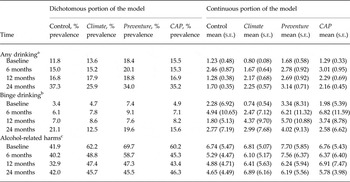
Attrition analyses were conducted to assess comparability of students who were present only at baseline v. students who completed a follow-up assessment. Attrition resulted from students being absent on the day of the survey, failing to use their unique identifying code or answering fewer than 80% of the items on any scale. Only a small number of students (n = 114, 5.2%) were present at baseline only. Compared with students who were present at baseline and any follow-up occasion, students present only at baseline consumed alcohol more frequently (F 1,2180 = 11.04, p < 0.01), and in greater quantities (F 1,2180 = 20.45, p < 0.01), had significantly higher binge drinking (F 1,2187 = 11.12, p < 0.01) and more alcohol-related harms (F 1,2187 = 20.53, p < 0.01). Evidence of differential attrition between the control and intervention conditions on the outcome measures over a 2-year follow-up assessment was observed. Specifically, attrition was more likely to occur in the Preventure group compared with the other groups. As mentioned earlier, FIML uses all available information to estimate parameters and handle missing data. FIML estimates are computed by maximizing the likelihood of a missing value based on observed values in the data. Table 1 provides the mean scores for the four groups for all outcome measures of interest by time and intervention status.
Summary of alcohol outcomes by time and intervention status

Climate, Universal prevention programme; Preventure, targeted prevention programme; CAP, combined prevention programme (Climate Schools and Preventure); s.e., standard error.
a Among those who reported use in the past 6 months, the dependent variable in the continuous portion of the model was coded as the average number of drinks per month: ‘less than monthly’ = 0.5 drinks per month, ‘once per month’ = one drink per month, ‘two to three times per month’ = 2.5 drinks per month, ‘weekly’ = four drinks per month and ‘daily or almost daily’ = 30 drinks per month.
b Among those who reported binge drinking in the past 6 months, the dependent variable in the continuous portion of the model was coded as the average number of binge drinking episodes per month: ‘less than monthly’ = 0.5 episodes per month, ’once per month’ = one episode per month, ‘two to three times per months’ = 2.5 episodes per month, ‘weekly’ = four episodes per month and ‘daily or almost daily’ = 30 episodes per month.
c Among those who reported harms in the past 6 months, continuous scale ranging from 0 to 32.
Two-part LGM
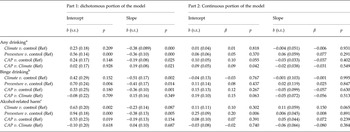
As the first step in modelling alcohol use (i.e. unconditional model), we estimated the growth function of each part of the two-part LGM model separately. Linear functions representing change in drinking variables generally provided the best fit to the data (see fit statistics presented in online Supplementary Table S2). Non-linear (e.g. quadratic) functions did not improve on model fit. Accordingly, change was modelled as linear growth in the conditional LGM model and intervention status was added to both parts of the model. Parameter coefficients and standard errors for the conditional LGMs are displayed in Table 2.
Two-part latent growth model parameters and s.e. examining the effects of universal, selective and combined intervention programmes on the likelihood and frequency of any drinking, the likelihood and frequency of binge drinking, and likelihood and extent of alcohol-related harm

s.e., Standard error; Ref, reference; Climate, universal prevention programme; Preventure, targeted prevention programme; CAP, combined prevention programme (Climate Schools and Preventure).
For ease of interpretation, standardized estimates (β) are reported for the continuous portion of the model (see Ichiyama et al. Reference Ichiyama, Fairlie, Wood, Turrisi, Francis, Ray and Stanger2009; Wood et al. Reference Wood, Fairlie, Fernandez, Borsari, Capone, Laforge and Carmona-Barro2010).
a Among those who reported use in the past 6 months, the dependent variable in the continuous portion of the model was coded as the average number of drinks per month: ‘less than monthly’ = 0.5 drinks per month, ‘once per month’ = one drink per month, ‘two to three times per month’ = 2.5 drinks per month, ‘weekly’ = four drinks per month and ‘daily or almost daily’ = 30 drinks per month.
b Among those who reported binge drinking in the past 6 months, the dependent variable in the continuous portion of the model was coded as the average number of binge drinking episodes per month: ‘less than monthly’ = 0.5 episodes per month, ‘once per month’ = one episode per month, ‘two to three times per month’ = 2.5 episodes per month, ‘weekly’ = four episodes per month and ‘daily or almost daily’ = 30 episodes per month.
c Among those who reported harms in the past 6 months, continuous scale ranging from 0 to 32.
Any drinking
The dichotomous portion of the model indicated that, relative to control students, Climate (b = −0.38, s.e. = 0.09, p < 0.001), Preventure (b = −0.36, s.e. = 0.10, p < 0.001) and CAP students (b = −0.19, s.e. = 0.08, p = 0.025) demonstrated significantly lower growth in their likelihood to drink alcohol over time. Relative to Climate students, CAP students demonstrated significantly faster growth in drinking over time. No significant findings were observed for the continuous part of the model. There were no significant correlations between the intercept and slope factors for both the dichotomous and continuous parts of the model.
Binge drinking
For binge drinking, long-term intervention effects were observed, with Climate (b = −0.51, s.e. = 0.17, p = 0.002), Preventure (b = −0.41, s.e. = 0.17, p = 0.014) and CAP students (b = −0.36, s.e. = 0.11, p = 0.001) demonstrating significantly lower growth in their likelihood to binge drink over time, relative to control students. No significant findings were observed for the continuous part of this model. No significant differences were observed for growth in binge drinking between CAP and Climate students in the dichotomous or continuous part of this model. As with the any drinking outcome, there were no significant differences between the intercept and slope factors.
Alcohol-related harms
In the context of long-term harmful alcohol outcomes, a significant intervention effect was observed only for the personality-targeted selective intervention programme, with Preventure students (b = −0.38, s.e. = 0.13, p = 0.005) demonstrating significantly lower growth in their likelihood to experience alcohol-related harms over time, relative to control students. No significant differences were observed in growth of alcohol-related harms between CAP and Climate students. There was a significant, but small negative, correlation between the intercept and slope for the dichotomous part of the model (r = −0.06, p < 0.001), suggesting that a higher propensity to experience any alcohol-related harms at baseline was associated with a lower growth in likelihood to experience alcohol-related harm over time.
In light of the baseline sex differences, the analyses for the main outcome variables were repeated controlling for sex. Results from analyses adjusting for the effects of sex revealed the same pattern of results, although with some attenuation of the intervention effects (see online Supplementary Table S3).
Discussion
Intervention effects of universal and selective interventions
Results of the primary outcomes of this cluster RCT indicate long-term benefits of universal, personality-targeted selective, and combined interventions on delaying drinking uptake and harmful drinking patterns among adolescents. Analyses showed reduced binge drinking in schools where Climate, Preventure or the combined CAP intervention were delivered, compared with control schools. To place this result into context, while 21% of control students were binge drinking at the 24-month follow-up, delivery of Climate, Preventure or the combined CAP intervention significantly reduced the proportion of students putting themselves at risk through binge drinking (12.5, 19.6 and 15.6%, respectively). There was also a slower growth in alcohol consumption in schools where Climate, Preventure or CAP was delivered, relative to control schools. Furthermore, delivery of Preventure reduced alcohol-related harms compared with control schools. The current findings not only provide replication of the efficacy of Climate Schools, they provide the first long-term follow-up and the first evidence for the effectiveness of Preventure outside Europe and Canada, with results indicating that intervention effects were sustained, with delayed growth in alcohol use and binge drinking still evident at the 24-month follow-up.
Combined intervention effects
The findings of this trial in relation to the combined universal and selective interventions are the most novel. Analyses showed reduced binge drinking in schools who received the combined CAP intervention, compared with control schools. In addition, compared with control schools, there was also a slower growth in alcohol consumption in schools who received CAP. Interestingly, while adolescents in both the CAP and Climate groups demonstrated slower growth in drinking compared with adolescents in the control group over time, CAP adolescents demonstrated faster growth in drinking compared with Climate adolescents.
The two interventions, Climate Schools and Preventure, were individually successful at reducing uptake, binge drinking and harms associated with alcohol use (Preventure) but when combined, and in contrast to the hypotheses, they were not more successful than the universal Climate Schools intervention. The mechanisms to explain this lack of effect are not clear. The two interventions are designed to influence different underlying mechanisms of change. The selective personality-targeted intervention focuses on high-risk youth and has its influence through increasing adolescents’ coping skills in personality-specific ways. The universal intervention takes a social influence approach, challenging norms in all youth. While distinct, these mechanisms are clearly inter-related. Despite the subgroup focus of the selective programme, this approach has already demonstrated universal effects at the population level (Conrod et al. Reference Conrod, O'Leary-Barrett, Newton, Topper, Castellanos-Ryan, Mackie and Girard2013), which might help explain no beneficial effect of adding a universal programme to a selective programme. By contrast, the lack of differences between CAP and Climate also suggest that universal interventions might neutralize risk in high-risk students through social normative influences. Studies utilizing social network analysis may provide important insights into peer-to-peer influence in the school setting and identify potential mechanisms of change within high- and low-risk groups.
Nevertheless, the selective personality-targeted intervention demonstrated superior effects in reducing alcohol-related harms compared with the control schools. Harms are more likely to be experienced by high-risk students who are the focus of the selective intervention (Castellanos-Ryan et al. Reference Castellanos-Ryan, O'Leary-Barrett, Sully and Conrod2013). When choosing a programme for implementation it may be that schools with greater risk profiles (e.g. heavy drinking cultures, other sociodemographic risk factors for heavy and problematic drinking) may benefit from implementing a selective approach.
Strengths and limitations
Strengths of this study include a large sample with high retention, ITT analysis, and the use of developmentally sensitive statistical analyses which capture individual differences in trajectories of outcomes and the complex structure of drinking data. The cluster RCT design and analysis also allow for control of contamination effects and adjustment for clustering of data at the school level. Potential limitations of this study are the lack of corroborating information to support self-reported drinking outcomes. The self-report data were collected using structured and validated instruments, with clear guidance including Australian alcohol drinking charts. And while our assessment protocol employed all the components to maximize reliable self-report by young people, it is also worth mentioning that self-report methods have been shown to be a reliable and valid approach to measuring alcohol consumption (Del Boca & Darkes, Reference Del Boca and Darkes2003) and are well accepted in substance use prevention. Second, there was an imbalance in the sex split across the groups; however, sensitivity analyses adjusting for sex indicated that this did not make an impact on the pattern of results or study conclusions, although findings were attenuated. Finally, despite the use of comprehensive methods (including emails, telephone calls, text messages and letters) to attempt to minimize attrition, greater attrition occurred in the Preventure group compared with the other groups. However, FIML estimation was used in our analyses, ensuring that all available information was used to estimate parameters and handle missing data.
Conclusion
This study demonstrated that intervention effects were observed across universal, selective and combined interventions. The combined universal and selective intervention, while effective, did not confer any incremental advantage over the universal intervention. It may be that some school characteristics may align with one intervention over another, for example, when it is not possible to restructure the school curriculum to implement a 12-session intervention. Alternatively, it may be that an emphasis on social normative influences may be effective for both high- and low-risk groups at an early age. Thus, staging the interventions with the universal first, then the selective intervention (for high risk) in later years may demonstrate superior effects. This would need to be the focus of future research and a more person-focused prevention strategy. Personalizing prevention to individuals and school needs is only recommended when effective alternatives are available, e.g. personality-targeted prevention. Considering the significant costs of youth alcohol misuse and harms to individuals and society, the effectiveness of these brief and highly implementable interventions is of considerable public health importance.
Supplementary material
The supplementary material for this article can be found at https://doi.org/10.1017/S0033291717000198
Acknowledgements
The authors would like to thank Tiberiu Mahu for statistical advice and consultation, and Julia Rosenfeld and Lucie Swaffield for research assistance. The authors would like to acknowledge the schools, students, teachers and health professionals who participated in this research. The research team also acknowledges the assistance of the NSW Department of Education and Communities for access to its schools (SERAP 2011201). This research was funded by the National Health and Medical Research Council (project grant: APP1004744; centre grant: APP1041129; M.T., research fellowship APP1870487; K.E.C., scholarship APP1056432). N.C.N and L.A.S are supported by a fellowship from the Australian Society for Mental Health Research.
M.T., N.C.N., P.J.C. and T.S. led the conception and design of the study; N.C. and T.S. led the analyses and interpretation of data with assistance from L.A.S.; E.L.B., K.E.C., N.C.N. and E.V.K. coordinated the implementation of the interventions and trial within schools; N.K.N. coordinated the final follow-up surveys within schools; M.T. and N.C.N. initially drafted the article and all authors approved the final version to be published.
Declaration of Interest
M.T. and N.C.N. are two of the developers of the Climate Schools programmes and P.J.C. is the developer of the Preventure programme. M.T. and N.C.N. are Directors of Climate Schools Pty Ltd.