1. Introduction
Different theories have been developed to explain judicial behaviour, first, in the US Supreme Court, and later, more generally, in federal and state courts.Footnote 1 More recently, European courts have been studied.Footnote 2 Formalists take the view that judges simply interpret and apply the law taking a conformist view of precedents. There is no role for judicial attributes. From a completely different perspective, the endorsers of the attitudinal model suggest that judicial preferences, with special emphasis on ideology, are the main explanatory variable. Finally, agency theorists recognize the importance of judicial preferences but argue that political and varying institutional realities are taken into account when they are implemented. In particular, judges adjudicate cases according to their attributes and expected consequences (for example, how other branches of government will react).Footnote 3
Realistically, judicial decision making reflects a complex set of different determinants, including personal attributes, attitudes (policy or ideological preferences being relevant), peer pressure and intra-court interaction (a natural pressure for consensus and court reputation, and a common objective to protect the judicial branch from unwanted interventions), and party politics (possible loyalty to the appointer) within a given legal and doctrinal environment.Footnote 4
Unsurprisingly, ideology has been the major determinant of judicial preferences considered by the literature. Around the world, constitutional judges are appointed by heavily politicized bodies. Inevitably they could be influenced by political parties when these actors play an active role in the selection and appointment process. The extent to which constitutional judges respond to party interests is a matter for empirical work.Footnote 5 The mere occasional alignment of judicial and parliamentary votes, for example, does not convey strong evidence against a potential lack of independence by constitutional judges. Similarly, observing votes in favour or against the constitutionality of legislation does not provide any clear inference about judicial intentions.
While the vast bulk of the empirical literature on courts is about ideology, several other possible determinants for judicial preferences have been suggested. For example, age has been debated. Older judges could be more independent since possible expected losses are relatively minor at a later stage in life. At the same time, direct gains from political alignment are more significant and easier to recoup when judges are appointed at a younger age.Footnote 6 The impact of age is expected to vary according to the length of appointment (lifetime appointment versus limited terms) and the possibility of renewal.
Gender has attracted attention, mainly in American studies.Footnote 7 The general idea is that female judges have a particular sensibility to certain areas of the law or particular litigants. Faced with cases involving such issues or individuals, the expectation is that male and female judges might differ in their behaviour. Empirical evidence seems to support these propositions to some extent.Footnote 8
Religion, race and judicial background have also been considered in the American literature to understand judicial preferences at federal and state levels.Footnote 9 Professional background (for example, career judiciary versus law professors) and language (consider the case of Belgium with French and Flemish languages being used in court) are also potential determinants investigated by the European literature.Footnote 10
Different nationalities are a more difficult explanatory variable to consider and study. International and European courts have a pluralism of judges from different countries.Footnote 11 However, because of the nature of supranational constitutional law, the explanation for varying judicial preferences has to lie in their cultural and legal backgrounds rather than in varying proximity to local issues or interests.
The British Judicial Committee of the Privy Council is an example of a court where cases are heard by local and foreign judges, particularly when entertaining appeals concerning Commonwealth law. Empirical analysis seems to support such a variance of nationalities playing a role. Although there is a standard background (all are common law judges), the reputation for independence and quality of the court seems enhanced by the mixing of judges, where the degree of detachment from local interest in the litigation process varies.Footnote 12
Unfortunately there are not many courts around the world with panels including foreign-appointed judges. Owing to obvious notions of state sovereignty, the importance of the judicial branch and the role of constitutional review, nations are not particularly motivated by the idea of accepting judges indicated or selected by foreign political entities. Such experiences can only be found in smaller states such as Andorra.Footnote 13
In this article, we explore empirically the possibility that foreign-appointed judges behave in ways that are different from nationally or locally appointed judges. A possible way to understand our empirical study of foreign-appointed judges is to use them as a ‘control group’, in the sense that they might be considered as particularly disinterested, unbiased and even-handed as they have no local stakes, while measuring the local judges against this ‘baseline’.
We use the cases adjudicated by the Constitutional Court of Andorra in the period 1993–2016 to assess the impact of foreign-appointed judges in relation to local institutional petitioners. The dataset consists of the entire population of abstract review cases (where the petitioner is always a local political institution). As in many civil law jurisdictions, unlike American judicial review, only abstract review tends to involve direct confrontation of an obviously political nature. Concrete review concerns petitions by private parties seeking enforcement of their constitutional rights with no direct or obvious political confrontation. It can be observed that government agencies are typical defendants in such cases. However, their role tends to be more technical and less political in nature (such as criminal prosecution, sentencing proportionality, procedural rights, and regulatory intervention). Therefore, because of the nature of concrete review, the proposition of measuring party alignment makes less sense for several reasons. First, in concrete review, the immediate political interests are frequently unclear and require a highly subjective assessment of local institutional or political alignments. Second, if a particular matter is of immediate political concern, we would expect the appropriate body to require abstract review. Relying on concrete review is very unlikely (although not impossible). Third, one would not expect a court to consider public policy considerations and political consequences rather than strong legal arguments when addressing concrete review (in fact, strictly speaking, in the civil law tradition, public policy considerations and political consequences should never be taken into account in judicial decisions).Footnote 14 These reasons justify our decision to focus on abstract review rather than expanding the dataset with a sample of concrete review cases. Concrete review (individual disputes) makes for 590 cases in the period 1993–2016 (Recursos d'empara) while abstract review (disputes involving local institutions in a more direct and partisan way) accounts for only 43 cases in the same period. The cost of the decision in favour of better data accuracy is a smaller dataset that begs for a more careful empirical analysis. In this respect, we follow the standard approach of previous studies about civil law jurisdictions such as those in Spain, Portugal, Belgium or Italy.Footnote 15
The paper goes as follows. Section 2 summarizes briefly the institutional arrangements of the Constitutional Court of Andorra. Section 3 suggests a theory of judicial behaviour when appointments involve foreign actors. The empirical evidence is introduced and discussed in Section 4. Section 5 concludes the paper.
2. The Constitutional Court of Andorra
Andorra is a small country in Europe landlocked between France and Spain. It is a co-principality with two formal heads of state (the co-princes), the President of France and the Bishop of Urgell (an old town in Spain), who do not reside in the country. The arrangement goes back to 1278, but has only recently evolved into a representative parliamentary democracy.
The Constitution of Andorra was adopted in 1993 after some pressure from the European Union. It introduces rights and freedoms and defines the government of the territory, including the executive branch (the Executive Council with eight members, including the prime minister), the legislative branch (the General Council, with 28 seats usually divided between two major coalitions, one more centre-right, the other more progressive), the municipalities of Andorra (there are seven parishes, including the capital Andorra la Vella), the court system (judges serve six-year renewable terms and there is a Judicial Council to guarantee independence) and the Constitutional Court of Andorra.
The Tribunal Constitucional de Andorra is the supreme interpreter of constitutional law and its decisions are binding on public authorities and private individuals. It has four members, one appointed by each co-prince and two selected by the General Council. They may not hold office for more than eight consecutive years. The renewal of the Court is partial. Every two years one constitutional judge is replaced. The new constitutional judge is selected by the same appointer. The leadership of the Court rotates every two years, thus each judge presides at some point during the eight-year term.
The Court endorses a consensual approach to adjudication. Nevertheless, it takes its decisions by majority (the president has the power to decide in case of a deadlock). However, votes and debates are secret. As in the French and Italian traditions, dissenting opinions are not published in the Constitutional Court of Andorra. For each decision, information concerning the composition of the deciding panel (court en banc) is made public.Footnote 16
The formal rules, the consensual approach and the power to resolve possible deadlocks highlight the fundamental role of the president. His/her views are likely to influence the decisions in ways that are not comparable to other judges. Because the presidency of the Court rotates every two years, each judge has a fair probability of playing that influential role. Empirically, it introduces variation on the exogenous characteristics of the president of the Court. These variations can be considered in order to assess the extent to which they determine outcomes. Particularly, in this context, we investigate whether or not a foreign (non-Andorran) president seems to be statistically different from a national (Andorran) president when it comes to being deferential to the political branches of government.
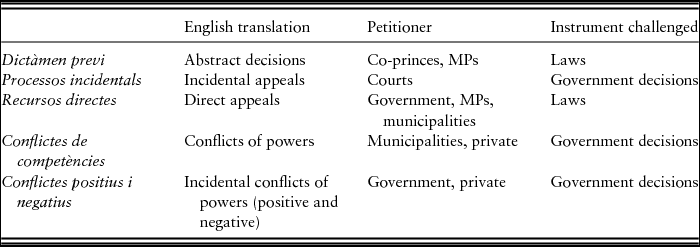
Table 1 summarizes the type of abstract review, the petitioners allowed to file such cases, and the legal instruments that are challenged by each type of case.

Concerning abstract review, the Court has limited control over its docket. Petitions filed by local institutions have to comply with the rules of procedure of the Court but, as in most civil law jurisdictions, tend to be formalistic rather than substantive. There is no mechanism comparable to a writ of certiorari.
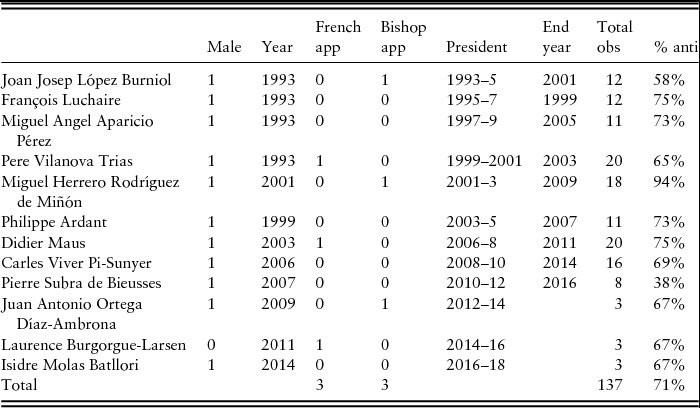
Since 1993, there have been 12 constitutional judges in Andorra. All except one have been males. Three judges have been appointed by the President of France, three judges have been indicated by the Bishop of Urgell, and six judges have been selected by the General Council. Several judges are not originally Andorran. All 12 judges have served as presidents of the Court at some point. Table 2 introduces the general description of the members of the Court for the period 1993–2016.
Members of the Constitutional Court of Andorra, 1993–2016

3. Judicial behaviour with foreign appointees: motivation
The appointment of foreign constitutional judges can be explained by three goals. First, the small size of local elites, the need to reinforce credibility and a reputation for independence, mainly in areas of the law relevant to business purposes, could justify an option to include foreign judges.Footnote 17 Second, foreign-appointed judges could be expected to be deferential to local petitioners in variable degrees and therefore play a positive role in promoting constitutional stability within a small country. Third, the development of an important area such as constitutional law could benefit from the knowledge and insights of foreign constitutional experts.
Once a constitutional court employs locals and foreigners, the question is the extent to which they behave in different ways. More specifically, if local appointees are selected by local political actors and if foreign appointees are chosen by foreign political actors, should we observe distinct behavioural patterns?
The first possibility is that foreigners are less likely to be captured by local political interests. They are not directly involved in local politics, they do not have commitment to local ideological agendas and they do not expect future appointments within the country. Since they keep strong ties with their native country, they have limited connection, personal or professional, with the country where they serve as constitutional judges. It is important to clarify that, in the specific case we study, the foreign-appointed judges live outside Andorra and have no previous political or other ties, except for the appointment by one of the co-princes. Consequently, they have no attachment to any particular municipality, Member of Parliament or local court. Because they are largely outsiders to the partisan divisions in the country, we hypothesize that foreign-appointed judges are more deferential to the presumption of constitutionality. Therefore, we expect them to adjudicate against local petitioners more often.
The second possibility is that foreigners are more loyal to the appointer because they do not need to worry about displeasing local political actors. In that context, we expect foreign-appointed judges to side more often than local judges with the petitioners when they are the co-princes.
For example, a few laws have been challenged by the co-princes: the Law of Nationality in 1993 and 1995 (not necessarily both at the same time), consumption taxes in 1999, the Law of Immigration in 2000, reform of justice in 2014. These occasions present a certain degree of confrontation between the co-princes and local party interests represented in the General Council and in Executive Council. Our hypothesis predicts that the judges appointed by the co-princes would be more inclined to side with their appointer than the other judges. We observe that the Court defers to the petitioners when the president is a foreign-appointed judge, while the ruling goes against the petitioners when the president is a local appointee.
Notice that the two possibilities are not mutually exclusive. They show that foreign judges are more likely to favour petitioners when they are the co-princes or the executive branch (because of deference). At the same time, they are less likely to favour petitioners when they are particular Members of Parliament, local courts or municipalities (because of detachment from local political interests).
4. Empirical results
The dataset includes all abstract review cases for the period 1993–2016. It has been compiled by the author from the information available on the website of the Constitutional Court of Andorra.Footnote 18 Each case carries an executive summary and the full decision of the Court, including the composition of the judicial panel.
There are 43 cases and 137 individual observations (an average of 11 votes per judge).Footnote 19 A few cases relate to the same legal matter and, consequently, this effect will be taken into account for the purposes of clustering. There are 34 independent clusters: that is, the population of abstract review cases includes 34 independent judicial rulings.
Table 2 presents the number of individual observations and the percentage of votes against the petitioner per judge. The more recent judges are less represented in the population of cases. Out of 137 individual votes, 71% go against the petitioner while 29% are favourable to the petitioner.Footnote 20 These proportions vary according to judges (notice, however, that there are no dissents since they are not allowed).
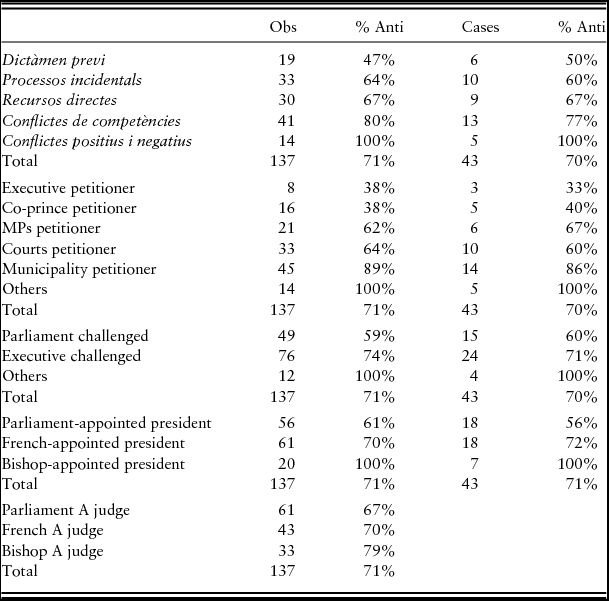
Table 3 presents the main descriptive statistics per individual observation and per case. We focus on individual observations since the results are consistent for both levels of analysis because of the lack of dissenting opinions. Let us start with the type of case. We can observe that while conflicts of competence tend to produce outcomes unfavourable to the petitioner (80% against the petitioner), abstract decisions go in the opposite direction (only 47% against petitioner). As to the type of petitioner, it varies from municipality petitioners (89% against the petitioner) down to executive branch and co-heads of state (38% against the petitioner). Finally, challenges to the General Council (i.e. the parliament) seem more likely to succeed than those to the Executive Council (59% and 74% against the petitioner respectively).
Descriptive statistics

We can also check in Table 3 how the proportion of individual votes against petitioner varies with the presiding judge. It goes from 61% (president appointed by the Parliament) to 70% (president appointed by the French President) and maximizes at 100% (president appointed by the Bishop of Urgell). From the descriptive statistics, we can observe that individual votes cast in cases presided by judges appointed by foreign political actors seem more prone to go against local institutional petitioners.
When it comes to classifying judges (as members of the panel rather than as president of the Court) by the appointer, we do not observe any significant variation in voting against petitioners. Such lack of variance is unsurprising given that dissents are not registered.
Summing up Table 3, the preliminary analysis points to some difference between conflicts of competence and abstract decisions, between municipality versus executive branch and co-heads of state petitions, and between foreign and local judges presiding over the case.
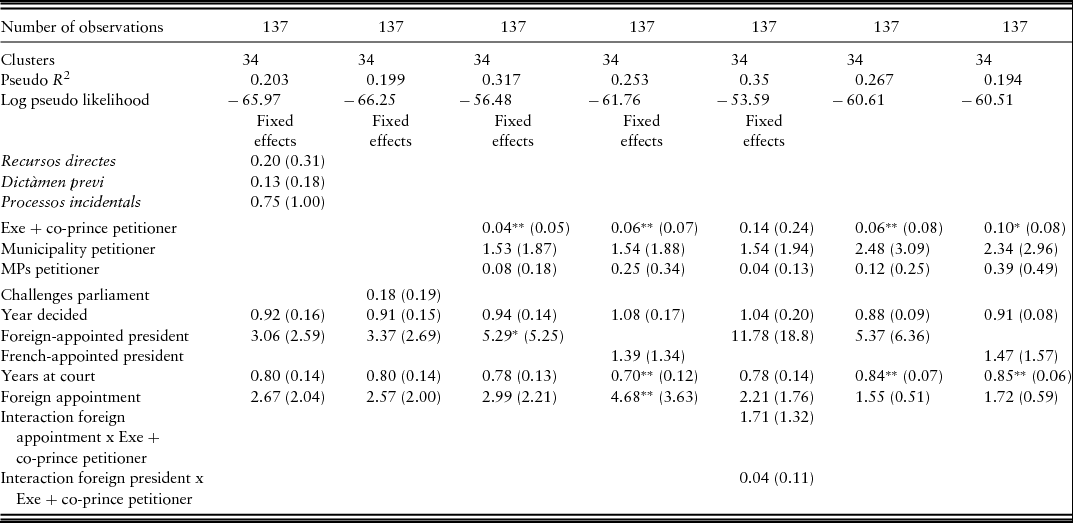
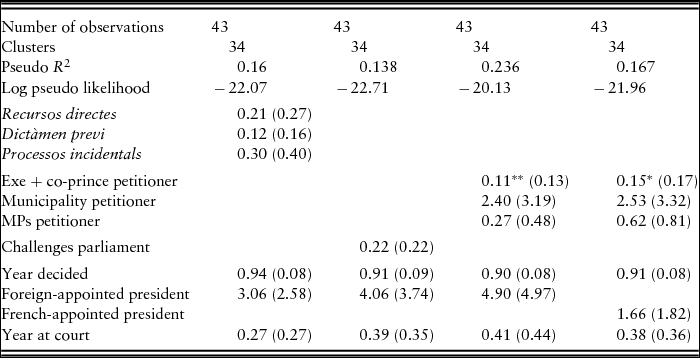
These insights are tested in Table 4 by means of regression analysis. As with a standard logistic regression, a baseline has been defined. For the first column, the baseline is conflicts of competence (against which the other three alternatives are measured) and local appointee both as president and as judge (against which foreign appointees are assessed). For the second column, the baseline is executive challenges (against which we measure challenges to parliament) and local appointee both as president and as judge. For the remaining columns, the baseline is where petitioners are the courts (against which alternative petitioners are assessed) and again local appointee both as president and as judge. A few interaction terms (between foreign-appointed judges and executive plus co-prince petitioners) have been used for robustness (fifth column).
Logist regressions (reporting odds ratios), clustered by cases

Standard deviations in parentheses. *** 1% significance, **5% significance,*10% significance
We report odds ratios for logistic regressions (coefficient above one attests a positive impact; coefficient below one illustrates a negative impact). Due to the lack of independence of individual observations and the small size of the population, we have clustered by cases. Consequently, statistical significance is more demanding than otherwise.Footnote 21 We also include fixed effects per judge in several specifications (except for those with too few observations in the population).Footnote 22
The results are reported in Table 4. They are not statistically impressive. Executive and co-prince petitioners seem to reduce the likelihood of the petitioner losing by a margin of 94% to 96% (against the baseline, where petitioners are the courts) and the result is generally statistically significant at 5%. The judicial attribute of being appointed by one of the co-princes seems to matter only when a judge presides over the panel; the magnitude of the effect is important (it multiplies by five the likelihood of the case being decided against local petitioner) but the effect is only significant at 10% in one specification (without fixed effects, the statistical significance is close but not below 10%). Years at court (individual appointments) seem to increase the odds of deciding a case for the petitioner by 16% to 30%; however the result is not always statistically significant (more specifically, the result is statistically significant for those specifications without fixed effects).
In Table 5 we present the results when the data is organized by case rather than by individual votes. The results are largely aligned with the statistics presented in Table 4. Executive and co-prince petitioners seem to reduce the likelihood of the petitioner losing by a margin of 85% to 89% (against the baseline, where petitioners are the courts) and the result is generally statistically significant at 5% or 10%, depending on the specification. No other determinant is statistically significant.
Logist regressions (reporting odds ratios), clustered by cases

Standard deviations in parentheses. *** 1% significance, **5% significance,*10% significance
Overall, the regressions reported in Tables 4 and 5 are in line with the main insights from Table 3. The stronger result seems to be that the Constitutional Court of Andorra is more deferential to petitions filed by the Executive Council and the co-princes and less deferential to petitions filed by other political actors. There is a very weak statistical indication that judicial panels presided over by a foreign-appointed judge are more likely to go against local petitioners (mostly driven by those three judges appointed by the Bishop of Urgell).
5. Conclusion
Judicial behaviour is determined by personal characteristics. An extensive literature has studied ideology and other political variables, in reference to both US federal and state courts and foreign constitutional courts. Gender, age, race, religion, language and professional background have been considered in some few studies. Nationality and appointment by foreign entities have not been analysed since there are few courts that mix local and foreign judges. Apart from international and European courts (where no judge is a local appointee), the British Judicial Committee of the Privy Council is the one that comes to mind. In this article, we used the Constitutional Court of Andorra as an example to consider since two out of four judges are appointed by foreign co-heads of state.
The conventional wisdom is that foreign-appointed judges are less attached to local petitioners. We analysed the population of abstract review cases in the period 1993–2016 to test for this proposition. We found that, although the Court seems statistically more deferential to petitions filed by the executive branch, there is only very weak evidence that foreign-appointed judges preside over cases that are more likely to be unfavourable to the petitioner.
Although recognizing the limitations imposed by the size of the population of cases (43 cases, 34 clusters and 137 individual observations without separate opinion) and the intrinsic procedural rigidity (no public dissenting votes are allowed), our empirical results are promising. It is known that the role of the presiding judge is crucial in small panels. A statistical inclination for cases under foreign-appointed presidents to be decided less favourably for local petitioners is consistent with the idea that a certain detachment from local petitioners and attachment to the appointers occurs.
The use of foreign-appointed judges introduces the possibility that constitutional adjudication is influenced or contaminated by foreign law, namely French or Spanish constitutional law. A statistical study of this effect requires a previous qualitative investigation of Andorran law which, unfortunately, has not been done. However, if such a study yielded findings in line with our empirical results, we should not anticipate a major effect.
The effectiveness of constitutional courts in small political entities is probably reinforced by mixing local and foreign-appointed judges. Unfortunately, there are not many courts around the world that actually use such mixing. Empirical testing is therefore necessarily limited. Still, the experience of the Constitutional Court of Andorra is definitely suggestive.
Acknowledgements
The article has benefited from comments by two anonymous referees and the editor in chief. The usual disclaimers apply.
APPENDIX
List of cross variations concerning petitioners and institutions being challenged, by individual observations


List of cross variations concerning petitioners and institutions being challenged, by case