INTRODUCTION
Non-native species represent a leading threat to native biodiversity globally (Clavero & García-Berthou Reference CLAVERO and GARCÍA-BERTHOU2005, Denslow Reference DENSLOW2003), and at a local level can permanently alter habitat structure, introduce new diseases, change species composition and alter ecosystem processes (Brown & Gurevitch Reference BROWN and GUREVITCH2004, Morris Reference MORRIS2010, Theoharides & Dukes Reference THEOHARIDES and DUKES2007, Walsh et al. Reference WALSH, VENTER, WATSON, FULLER, BLACKBURN and POSSINGHAM2012). Many successful non-natives are disturbance-adapted species (Brown & Gurevitch Reference BROWN and GUREVITCH2004, Fine Reference FINE2002, Hansen & Clevenger Reference HANSEN and CLEVENGER2005, Thuiller et al. Reference THUILLER, RICHARDSON, ROUGET, PROCHES and WILSON2006) for which anthropogenic disturbance could provide a competitive advantage during their introduction, establishment, growth and dispersal in new areas (Alston & Richardson Reference ALSTON and RICHARDSON2006, Ervin et al. Reference ERVIN, SMOTHERS, HOLLY, ANDERSON and LINVILLE2006).
Despite extensive study of non-native species globally (Gurevitch et al. Reference GUREVITCH, FOX, WARDLE, INDERJIT and TAUB2011), many questions remain about precisely how disturbance affects non-natives. This is in part because it is not easy to isolate the effect of one type of disturbance; degraded habitats represent the cumulative effect of numerous and varied suites of individual disturbances over time (Pollnac et al. Reference POLLNAC, SEIPEL, REPATH and REW2012, Seipel et al. Reference SEIPEL, KUEFER, REW, DAEHLER, PAUCHARD, NAYLOR, ALEXANDER, EDWARDS, PARKS, AREVALO, CAVIERES, DIETZ, JAKOBS, MCDOUGALL, OTTO and WALSH2012). Precise understanding of the effect of disturbance on non-natives has also remained elusive because disturbance is such a broad ecological concept: it encompasses a wide range of distinct anthropogenic and natural processes (e.g. selective logging, road construction) with varied ecological consequences (e.g. changed species composition, increased opportunities for dispersal) that can combine with species-specific traits and environmental conditions to favour or hinder the local or regional success of non-native species (Gurevitch et al. Reference GUREVITCH, FOX, WARDLE, INDERJIT and TAUB2011, Moles et al. Reference MOLES, GRUBER and BONSER2008). To advance mechanistic understanding, therefore, detailed analyses are needed that explicitly evaluate the relative effects of specific types, intensities and spatial scales of disturbance on the success of diverse types of non-native species (Gurevitch et al. Reference GUREVITCH, FOX, WARDLE, INDERJIT and TAUB2011, Pauchard & Shea Reference PAUCHARD and SHEA2006, Spellerberg Reference SPELLERBERG1998).
Studies of the influence of disturbance on non-native species are rare in tropical forests (Fine Reference FINE2002, Kull et al. Reference KULL, TASSIN and CARRIERE2014), yet tropical forests are facing increasing habitat disturbance (Gibson et al. Reference GIBSON, LEE, KOH, BROOK, GARDNER, BARLOW, PERES, BRADSHAW, LAURANCE, LOVEJOY and NAVJOT2011) and are vulnerable to invasion (Fine Reference FINE2002). Furthermore, such studies are needed on tropical forests on islands, which often harbour exceptional numbers of endemic species (Myers et al. Reference MYERS, MITTERMEIER, MITTERMEIER, DA FONSECA and KENT2000) but may be vulnerable to invasion (Denslow Reference DENSLOW2003). Native biodiversity on Madagascar, an island that is home to 3.2% of the world's plant species (Myers et al. Reference MYERS, MITTERMEIER, MITTERMEIER, DA FONSECA and KENT2000), is susceptible to species introductions because its taxa evolved in relative isolation prior to the arrival of humans 2300 y ago (Kull et al. Reference KULL, TASSIN, MOREAU, RAKOTO, BLANC-PAMARD and CARRIÈRE2012) and because more than 1200 non-native plant species have been intentionally or unintentionally introduced to the island since then (Beaujard Reference BEAUJARD2011, Kull et al. Reference KULL, TASSIN, MOREAU, RAKOTO, BLANC-PAMARD and CARRIÈRE2012). However, non-native species have not been the focus of extensive research or conservation attention in Madagascar and the effect of disturbance on non-native species on the island remains poorly understood (Binggeli Reference BINGGELI, Goodman and Benstead2003, Kull et al. Reference KULL, TASSIN and CARRIERE2014).
In this study, we aimed to understand the influence of degradation and the relative effects of different types of disturbances on a suite of non-native plant species in a tropical forest in Madagascar. We tested two hypotheses. First, because habitat degradation may open niches and provide a competitive advantage to species capable of rapidly exploiting changed biotic and abiotic conditions (Brown & Gurevitch Reference BROWN and GUREVITCH2004, Fine Reference FINE2002, Hansen & Clevenger Reference HANSEN and CLEVENGER2005, Thuiller et al. Reference THUILLER, RICHARDSON, ROUGET, PROCHES and WILSON2006), we hypothesized that the extent of degradation would positively correlate with densities of non-native plants at a whole-habitat scale. Second, because the success of non-native species often depends on the interaction between species traits and environmental conditions (Moles et al. Reference MOLES, GRUBER and BONSER2008), we hypothesized that the local-scale success of non-native plants would vary by disturbance type, but not consistently across all taxa.
METHODS
Study system
Data were collected in May and June 2012 in and around the Ankarana National Park (12°57′S, 49°8′E), a protected area established in northern Madagascar in 1956 and known for its high levels of biodiversity (Cardiff & Befourouack Reference CARDIFF, BEFOUROUACK, Goodman and Benstead2003). Research was conducted in semi-evergreen forest along the eastern periphery of the park, near the village of Mahamasina, an area exhibiting a gradient of human disturbance.
We studied five of the most common non-native plants in the Ankarana area: Lantana camara L. (Verbenaceae), Mucuna pruriens (L.) DC. (Fabaceae), Albizia lebbeck (L.) Benth. (Fabaceae), Mangifera indica L. (Anacardiaceae) and Tamarindus indica L. (Fabaceae). Lantana camara is a highly invasive perennial woody shrub that represents a complex of hybrids primarily originating in the American tropics (Vardien et al. Reference VARDIEN, RICHARDSON, FOXCROFT, THOMPSON, WILSON and LE ROUX2012), first reported in Madagascar in 1898 (Vardien et al. Reference VARDIEN, RICHARDSON, FOXCROFT, THOMPSON, WILSON and LE ROUX2012) and in the Ankarana area in the 1950s. Mucuna pruriens is an annual climbing shrub that may have originated in southern Asia (Lim Reference LIM and Lim2012); its status as a non-native in Madagascar is disputed (Kull et al. Reference KULL, TASSIN, MOREAU, RAKOTO, BLANC-PAMARD and CARRIÈRE2012), but is a recent arrival in the forested landscape of Ankarana (Madagascar National Parks pers. comm.). Although Lantana camara is generally introduced to new areas as an ornamental species, neither species was cultivated or intentionally dispersed by people in Madagascar (Kull et al. Reference KULL, TASSIN, MOREAU, RAKOTO, BLANC-PAMARD and CARRIÈRE2012). The other three species studied are trees. Albizia lebbeck originated in Asia and was brought to the island in 1814 and is now invasive (Binggeli Reference BINGGELI, Goodman and Benstead2003, Kull et al. Reference KULL, TASSIN, MOREAU, RAKOTO, BLANC-PAMARD and CARRIÈRE2012). Both Mangifera indica (native to India) and Tamarindus indica (tropical Africa and Asia) have been present in Madagascar for centuries (Kull et al. Reference KULL, TASSIN, MOREAU, RAKOTO, BLANC-PAMARD and CARRIÈRE2012), though the non-native status of Tamarindus indica in Madagascar is disputed (Binggeli Reference BINGGELI, Goodman and Benstead2003). These three tree species have been cultivated and intentionally dispersed by people for wood, fruit, shade or religious purposes (Binggeli Reference BINGGELI, Goodman and Benstead2003, Kull et al. Reference KULL, TASSIN, MOREAU, RAKOTO, BLANC-PAMARD and CARRIÈRE2012).
Data collection
To test the two hypotheses, data were collected on the relationship between anthropogenic disturbance and non-native species densities. For the first hypothesis, anthropogenic disturbance was determined categorically on the basis of the known disturbance history for three different forest types. Specifically, forest types were categorized as: (1) primary forest (little evidence of recent or historical anthropogenic disturbance; mean canopy height of fruiting trees is 22.9±1.38 m); (2) secondary forest (forest regenerating over an extended period of time after considerable historic deforestation which occurred > 60 y ago; mean canopy height of fruiting trees is 13.0±1.91 m); (3) degraded forest (secondary forest extensively altered by recent and historic anthropogenic disturbances; mean canopy height of fruiting trees is 8.51±0.54 m; Reuter Reference REUTER2015; Sewall & Andriamanarina unpubl. data).
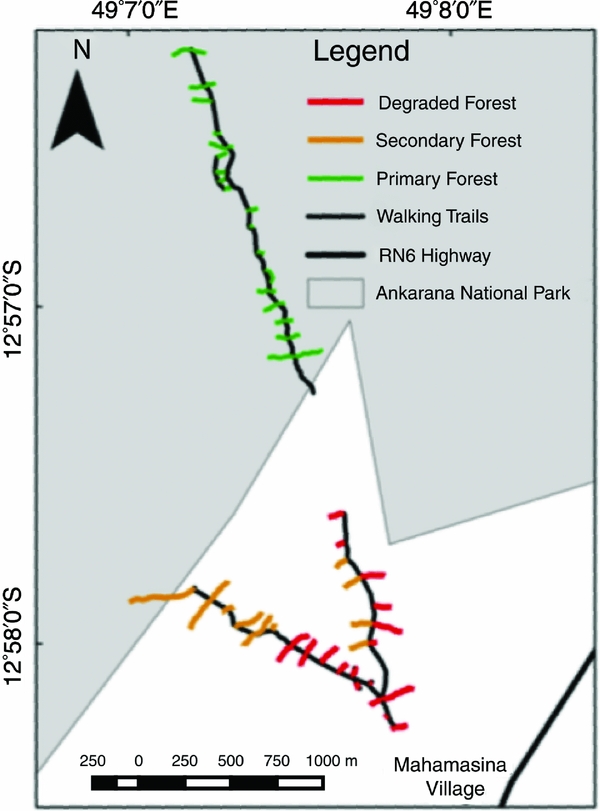
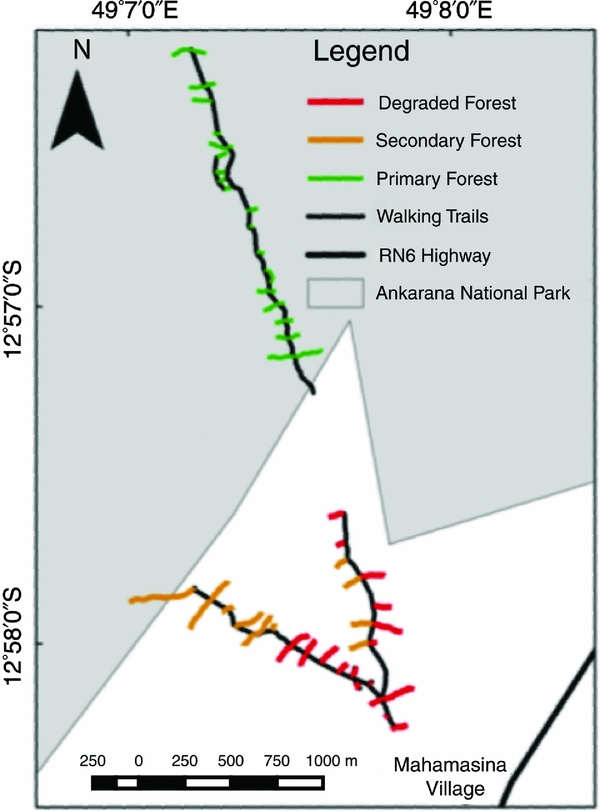
Densities of non-native plant species were determined along transects using a stratified random sampling design. Transects began at random points ≥ 100 m apart along pre-existing park roads and trails and extended perpendicularly in primary (n = 32 transects, 71±42 m, mean±SD), secondary (n = 12 transects, 125±111 m) and degraded (n = 26 transects, 87±53 m) forest (Figure 1). Mean transects lengths did not differ by forest type (Kruskal–Wallis rank sums test, χ2 = 3.12, df = 2, P = 0.21). We recorded all individuals of the shrub and climber species, and all individuals of the three non-native tree species over 1 m in height that occurred within 5 m of each transect line. For the three tree species, the diameter at breast height (dbh) was also recorded. We examined 60400 m2 of forest: 22700 m2 of primary forest, 15000 m2 of secondary forest and 22700 m2 of degraded forest. The secondary forest was the least common forest type.
Map of the study site, including locations of transects in the degraded (red), secondary (yellow) and primary forests (green) relative to the location of Mahamasina (lower right-hand corner), one of the three villages with a designated park entrance. The primary forest was contained completely inside the national park. The secondary forest was found both inside and outside the national park. The degraded forest was found outside the park and closest to the village.
For the second objective, both anthropogenic disturbance and non-native plant density were categorized at the local scale, in 10-m2 plots (n = 252), along the same straight-line transects. Within each plot, all non-native species were recorded as described above. In addition, all instances of visible anthropogenic disturbance to woody vegetation were recorded (n = 482; Appendix 1) and categorized as one of two variables related to changes to the physical structure of habitat (‘tree damage’ or ‘tree removal’) and one variable related to disturbance corridors (‘proximity to nearest road or trail’). ‘Tree damage’ included anthropogenic injury to living trees, as evidenced by the presence of machete marks on standing stems or the presence of cut branches. ‘Tree removal’ represented the felling of a tree, as evidenced by the presence of stumps or abandoned logs. ‘Proximity to nearest road or trail’ was measured as the shortest straight-line distance from the centre of the plot to the nearest point on the road (dirt one-lane road accessing the park) or trail (hiking trails constructed legitimately for park access or illegally for logging or other purposes). Other categories of anthropogenic disturbance – man-made fires, sacred/religious areas and garbage disposal – were also present but were only observed once each and for simplicity were not considered further. All field sampling was done by AAG and SCN to minimize potential inter-observer bias.
Statistical analyses
For the first objective, analyses examined changes in non-native plant density by forest type. These analyses used transects as replicates and were calculated using non-parametric Kruskal–Wallis rank sums tests due to unequal variances and lack of normality within the dataset. Post hoc Steel–Dwass tests were used for multiple controlled comparisons of the influence of forest type on non-native plant densities. Due to uneven sampling by forest type, densities of disturbance types and densities of non-native plants were used in analyses as opposed to raw frequencies.
For the local-scale analyses in the second objective, we focused solely on differences within the degraded forest, since few disturbances were recorded in the two other forest types. These analyses used plots as replicates to determine the relative importance of different types of disturbance on non-native plant densities. Because the best model was not known a priori, we first engaged in a model selection procedure, comparing the fit of a set of candidate models. Response variables in the candidate models were: the densities of each non-native plant species, total densities of shrub and climber plants, or the total densities of trees. Candidate models included combinations of the following predictor variables: ‘tree damage’ within the plot, number of ‘removed trees’ within the plot, ‘proximity to nearest road or trail’, and their pairwise interactions. Predictor variables were natural-log transformed. A random effect (Fisher Reference FISHER1925) for transect was included in each model to account for the non-independence of plots within transects. The sets of candidate models were evaluated separately for each response variable.
Because plots in this local-scale analysis were small, non-native plant species were missing from a number of plots, leading to zero-inflation of the dataset. For this reason, and because response variables represented count data with evidence of over-dispersion, a zero-inflated version of the negative binomial distribution was used for models of determinants of non-native plant abundance (following Zuur et al. Reference ZUUR, IENO, WALKER, SAVELIEV and SMITH2009). Negative binomial models used the standard parameterization of the error term. This rendered a set of zero-inflated, generalized linear mixed candidate models for each response variable (Appendix 2). We then compared the fit of each model given the data with an information theoretic approach (Burnham & Anderson Reference BURNHAM and ANDERSON2002) using Akaike's Information Criterion (Akaike Reference AKAIKE, Petrov and Csaki1973, Burnham & Anderson Reference BURNHAM and ANDERSON2002) to identify the best model. The best model was then evaluated. All analyses were completed in R statistical software version 3.1.3 (R Foundation for Statistical Computing, Vienna, Austria) with the glmmADMB version 0.8.3.2 package (Fournier et al. Reference FOURNIER, SKAUG, ANCHETA, IANELLI, MAGNUSSON, MAUNDER, NIELSEN and SIBERT2012).
RESULTS
Parameters of the dataset
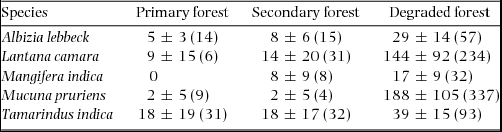
We surveyed 70 transects across three forest types covering 60400 m2, recording 482 instances of disturbance (Appendix 1) and 903 non-native plants in and around the Ankarana National Park (Appendix 2), including 86 individuals of Albizia lebbeck, 271 Lantana camara, 40 Mangifera indica, 350 Mucuna pruriens and 156 Tamarindus indica.
Effects of disturbance on non-native species (comparing among forests)
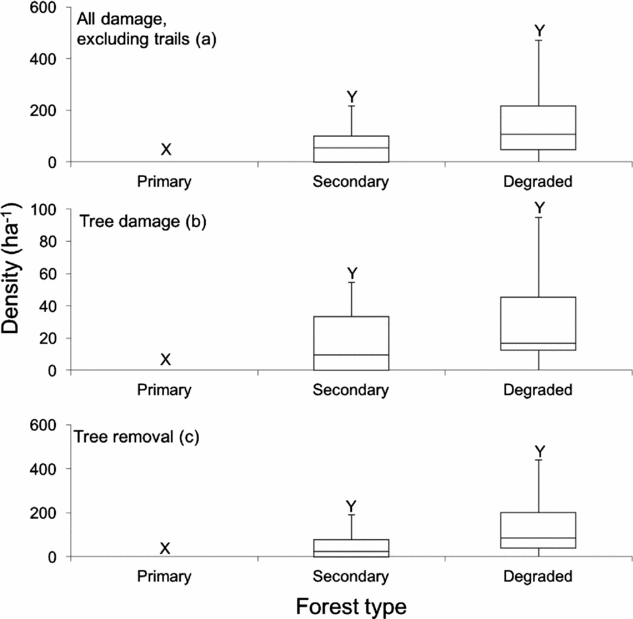
The three forest types differed in the level of habitat disturbance (Kruskal–Wallis rank sums test, χ2 = 34.1, df = 2, P < 0.0001), with the average density of tree damage and tree removal incidents increasing from in the primary, secondary and degraded forests, respectively (Figure 2). Average densities of forest disturbance increased between 53–192% from the primary forest to the degraded forest depending on the type of disturbance (Appendix 1).
Densities of anthropogenic disturbance per hectare recorded across the three forest types (Ankarana National Park, Madagascar), including for: all damage (excluding trails and roads) (a); damage to living trees (b); and tree removal (c). Boxes represent 25–75 percentiles, lines within boxes represent the median, and bars indicate the 90th and 10th percentiles. Letters indicate statistically significant differences (Steel–Dwass post hoc tests). Transects are replicates within each forest type.

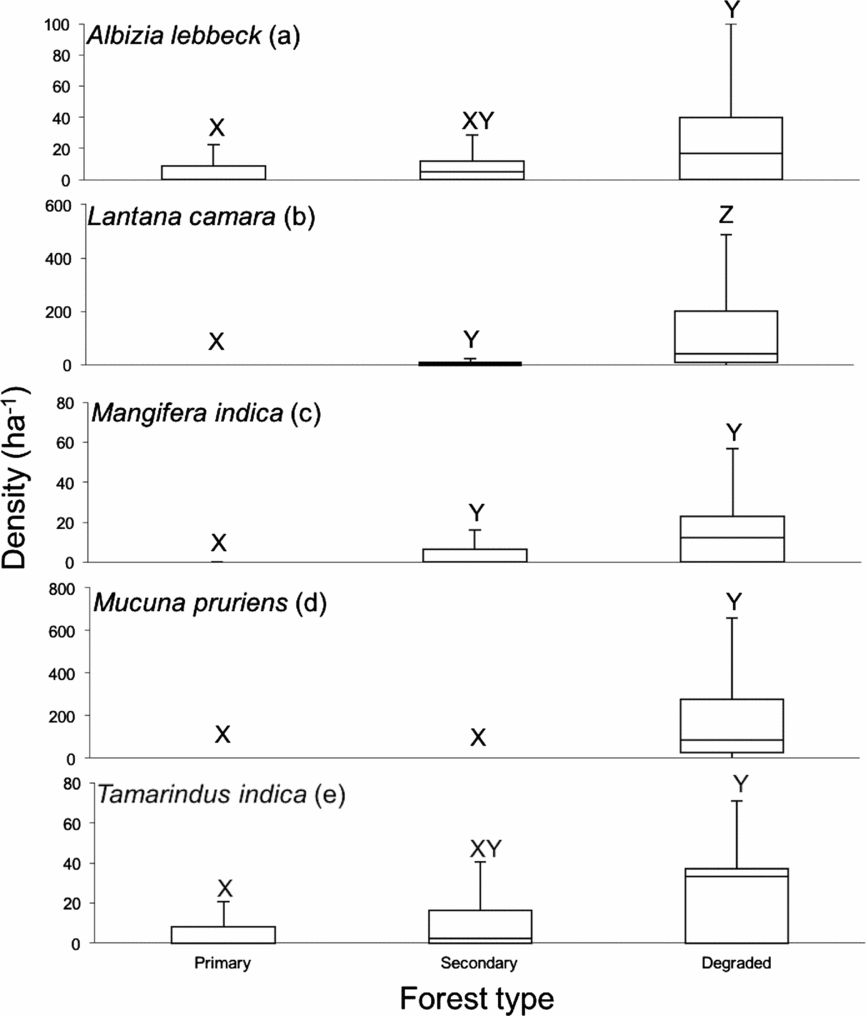
In accordance with the first hypothesis, densities of all five non-native plant species differed by forest type (Kruskal–Wallis rank sums test, all P < 0.005). Densities of each species differed between primary and degraded forest (Steel–Dwass, all P < 0.01, Figure 3), with a per cent difference in the densities of non-native plants of 72–200% between the average primary forest densities and degraded forest densities (Appendix 2). Densities in secondary forest were always intermediate between primary and degraded forest (Figure 3), though differences were only significant with primary forest in Mangifera indica and Lantana camara (Figure 3b, d, Appendix 3) and with degraded forest in Lantana camara and Mucuna pruriens (Figure 3d, e, Appendix 3).
Densities of non-native plant species (individuals ha−1) across the three forest types (Ankarana National Park, Madagascar), with transects as replicates, including: Albizia lebbeck (a); Lantana camara (b); Mangifera indica (c); Mucuna pruriens (d); and Tamarindus indica (e). Boxes represent 25–75th percentiles, lines within boxes represent the median, and bars indicate the 90th and 10th percentiles. Letters indicate statistically significant differences (Steel–Dwass post hoc tests).

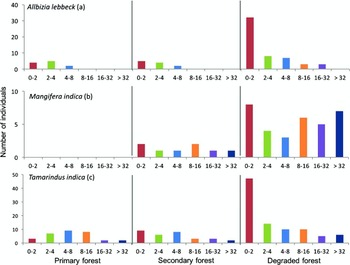
Among the three tree species, large-size-class (presumably older) individuals were absent in Albizia lebbeck in both primary and secondary forests and rare in Tamarindus indica (Figure 4). The smallest size class (saplings) was over-represented in both Albizia lebbeck and Tamarindus indica in the degraded forest (Figure 4). Mangifera indica was absent along transects in primary forest, but present in all size classes in secondary and degraded forests (Figure 4).
The distribution of non-native individuals of Albizia lebbeck (a), Mangifera indica (b), and Tamarindus indica (c), by the size class as observed along transects in the three forest types in and around the Ankarana National Park, Madagascar (x-axis: size by dbh in cm organized in six size classes; y-axis: number of individuals belonging to a size class). Note the log2 scale of the x-axis.

Effects of disturbance on non-native species (within a forest type)
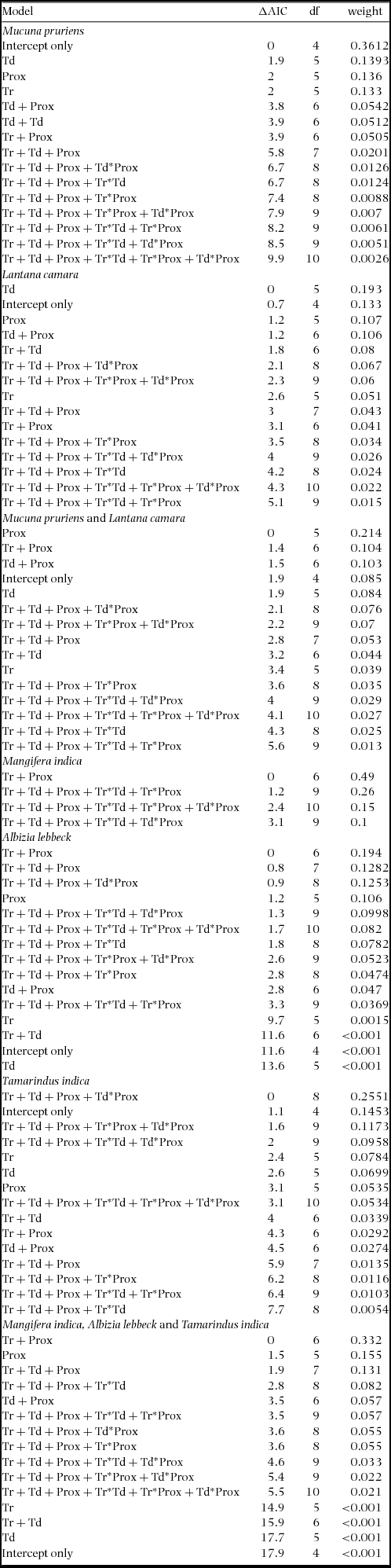
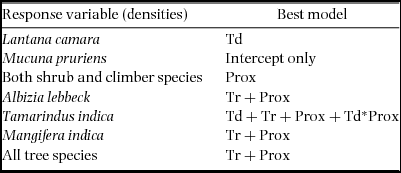
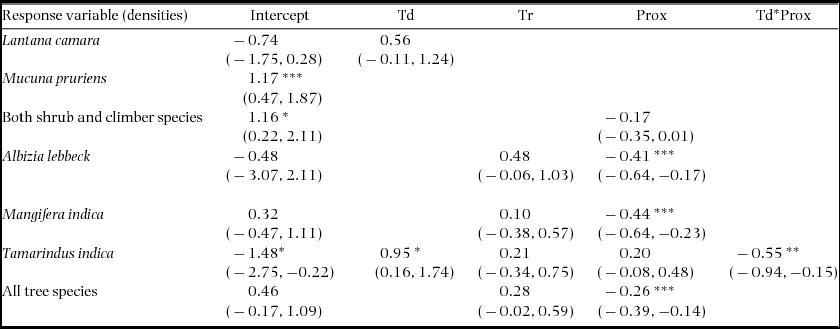
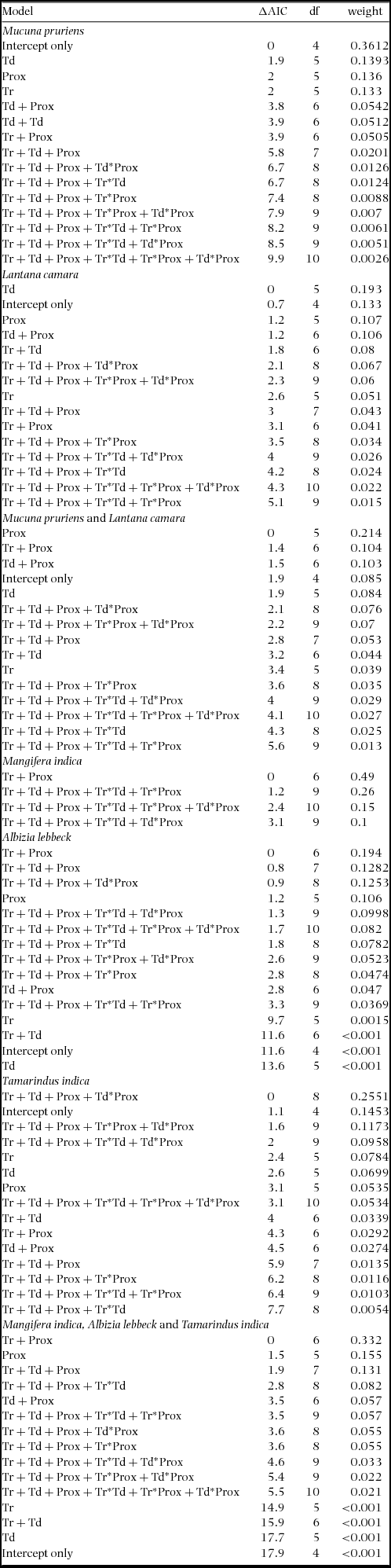
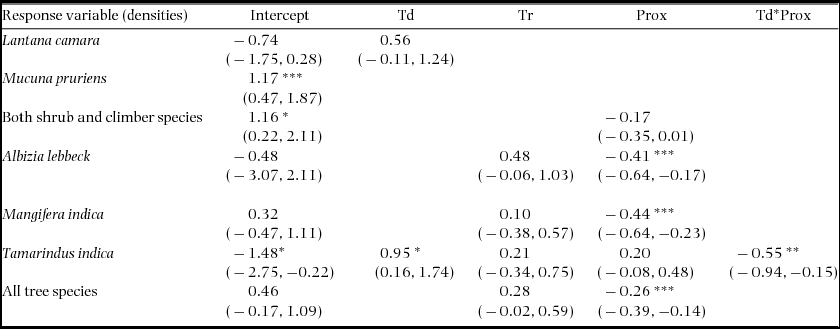
For the second objective, we completed the model selection process (Appendix 4), and identified (Table 1) and evaluated the best models (Table 2). These results provided support for the second hypothesis in non-native trees but not in non-native shrub and climber plants. Specifically, densities of these plants were not significantly related to anthropogenic disturbance at the plot scale (Table 2). In contrast, densities of non-native trees were related to anthropogenic disturbance, and in particular ‘proximity to nearest road or trail’ or an interaction including this variable was always strongly associated with non-native tree densities (Table 2). Non-native tree densities always decreased with distance from a road or trail (Table 2). For Mangifera indica and Albizia lebbeck, densities were only associated with ‘proximity to nearest road or trail’. For Tamarindus indica, densities were associated with ‘tree damage’ and with the interaction between ‘tree damage’ and ‘proximity to nearest road or trail’ (Table 2). ‘Tree removal’ was never related to the densities of non-native plants (Table 2).
The selected best models for each response variable, from analyses to determine the relative importance of different types of disturbance on non-native plant densities in the Ankarana National Park, Madagascar. Full model selection results are provided in Appendix 4 and the evaluation of these best models is presented in Table 2. Each model includes a random effect of transect to account for spatial non-independence. Td = ln(tree damage), Tr = ln(tree removal), Prox = ln(Proximity to nearest road or trail).

Variables and coefficients for the selected best models for each response variable, from analyses to determine the relative importance of different types of disturbance on non-native plant densities in the Ankarana National Park, Madagascar. 95% confidence intervals (± 2SE) shown in parentheses for each variable. Each model includes a random effect of transect to account for spatial non-independence. Predictor variables with coefficients listed were included in the best model for that response variable. Symbols represent significance level: *** indicates P <0.001, ** indicates P < 0.01, * indicates P < 0.05. Td = ln(tree damage), Tr = ln(tree removal), Prox = ln(Proximity to nearest road or trail). Positive values for Td and Tr (indicating increased non-native plant densities where tree damage and removal is greater) and negative values for Prox (indicating decreased non-native plant densities at further distances from roads or trails) indicate a positive association between disturbance and non-natives. Full model selection results are provided in Appendix 4.
DISCUSSION
The idea that disturbance facilitates non-natives is widely believed, but little studied in tropical forests, especially on islands (Denslow Reference DENSLOW2003, Fine Reference FINE2002). Here, our hypotheses linking higher densities of non-native plants to greater degradation and disturbance were largely supported at the whole-habitat scale and for trees at the plot scale. Further, in more degraded areas, non-native trees of small size classes were more highly represented, especially in Albizia lebbeck and Tamarindus indica, which may suggest an ongoing local population expansion, one of the defining characteristics of invasion (Gurevitch et al. Reference GUREVITCH, FOX, WARDLE, INDERJIT and TAUB2011). The same positive relationship with disturbance at the plot scale was not observed, however, for the woody shrub Lantana camara and climber Mucuna pruriens.
Our findings add to accumulating evidence that non-native plant species have higher densities along disturbance corridors such as those created by trails and roads (Arévalo et al. Reference ARÉVALO, OTTO, ESCUDERO, FERNÁNDEZ-LUGO, ARTEAGO, DELGADO and FERNÁNDEZ-PALACIOS2010, Flory & Clay Reference FLORY and CLAY2009, Pollnac et al. Reference POLLNAC, SEIPEL, REPATH and REW2012, Spellerberg Reference SPELLERBERG1998). Our study goes beyond previous studies, however, by indicating that the influence of roads and trails on non-natives is relatively greater than that of structural disturbances such as tree damage and removal. Roads and trails may benefit non-native trees by opening adjacent niches and providing access to interior habitats via intentional or unintentional human-mediated movement of propagules.
The relationship between non-native tree densities and disturbance from roads and trails may be complicated by human behaviour. For example, roads and trails also facilitate access to local residents for wood collection and timber extraction. Removal of trees via logging would be more likely in species where the wood is used locally for construction (such as Albizia lebbeck) than in species used for food, shade and medicine (such as Mangifera indica and Tamarindus indica) (Madagascar National Parks, pers. comm., BJS, AAG, pers. obs.). Indeed, the large-size class individuals (>32 cm dbh) that would provide the most profitable return on logging effort were common in degraded forest in Mangifera indica and Tamarindus indica (> 5 large individuals ha−1 in both species) but completely absent from study plots in Albizia lebbeck, despite the greater overall densities of Albizia lebbeck stems in proximity to roads and trails. Thus, in Mangifera indica or Tamarindus indica, individuals may be radiating from areas of early introduction near roads or trails. In Albizia lebbeck, however, roads and trails may be associated with opposing processes that initially facilitate tree establishment and reproduction via disturbance while later leading to the removal of large individuals via logging. An alternative possibility is that Albizia lebbeck has simply not been present locally long enough for any individuals to reach large size classes, but this seems unlikely given its prodigious growth rate (can reach maturity within 10 mo, Parrotta Reference PARROTTA1988), and its presence for more than two centuries on the island of Madagascar (Binggeli Reference BINGGELI, Goodman and Benstead2003).
We did not uncover a strong association between disturbance and densities of Mucuna pruriens and Lantana camara at the plot scale in degraded forests. There are several possible reasons for this result. First, it may be that spread by both species into the degraded forest is already at an advanced stage. Under this idea, both species may have already spread so completely and integrated so fully into the degraded forest that the disturbance processes that initially facilitated introduction and establishment can no longer be identified today via correlation with human disturbance measures. The high densities of these plants in degraded forests we observed provide some support for this idea. Trees, in contrast, may still be at an earlier stage of spread, perhaps in part due to their longer generation times – e.g. minimum of 5 y to first fruiting for wild Mangifera indica (Harper & White Reference HARPER and WHITE1974) and 10 y in wild Tamarindus indica (El-Siddig et al. Reference EL-SIDDIG, GUNASENA, PRASAD, PUSHPAKUMARA, RAMANA, VIJAYANAND and WILLIAMS2006) compared with 160 d from seedling to pod in Mucuna pruriens Klassen et al. Reference KLASSEN, CODALLO, ZASADA and ABUL-BAKI2006) – and therefore might still be found in degraded forest nearer to where they were first introduced.
It is also possible that the densities of Lantana camara and Mucuna pruriens are more strongly associated with variables that we did not measure. For example, in southern India, the distribution of the invasive Lantana camara was explained by a combination of microclimate and disturbance variables (Ramaswami & Sukumar Reference RAMASWAMI and SUKUMAR2014). Alternatively, shade tolerance, which is hypothesized to be an important trait limiting the spread of non-natives into interior habitats of primary tropical forests (Fine Reference FINE2002), could explain why the two species were common in degraded forests at Ankarana but nearly absent from the primary or secondary forests where canopies were more consistently closed. Forest fires may also facilitate Mucuna pruriens establishment in some way; this species was first noted by Ankarana park agents subsequent to a series of large fires in the area (Madagascar National Parks pers. comm.).
Animal-mediated processes of dispersal may also play a role; non-native species are often able to integrate themselves into existing mutualistic networks (Kaiser-Bunbury et al. Reference KAISER‐BUNBURY, VALENTIN, MOUGAL, MATATIKEN and GHAZOUL2011). At our site, we often observed the Madagascar bulbul Hypsipetes madagascariensis Statius Müller 1776, a common bird, consuming Lantana camara fruits. Such consumption of Lantana camara by frugivores has resulted in effective seed dispersal elsewhere, aided by the plant's year-round prolific production of fleshy fruit (Vardien et al. Reference VARDIEN, RICHARDSON, FOXCROFT, THOMPSON, WILSON and LE ROUX2012). In contrast, no local forest vertebrates are known to disperse the seeds of Mucuna pruriens (AAG, BJS, pers. obs.; through it is consumed by a lemur, Eulemur mongoz, elsewhere in Madagascar, Gérard et al. Reference GÉRARD, GANZHORN, KULL and CARRIÈRE2015). In fact, the stinging hairs on the pods of Mucuna pruriens are likely to discourage contact and primary dispersal by vertebrates. Further, unless cooked or soaked extensively in water, its seeds can be toxic to non-ruminant animals (Lampariello et al. Reference LAMPARIELLO, CORTELAZZO, GUERRANTI, STICOZZI and VALACCHI2012), likely restricting secondary dispersal. Follow-up studies are needed on both species to determine whether and how their introduction and spread may be linked to microhabitat, types of disturbance not measured in this study or dispersal processes.
Conservation and future research
Our results have several important implications for conservation and management. First, our results highlight the importance of avoiding the creation of new roads and trails in primary and secondary forest, given that roads and trails are so strongly associated with non-native spread. Second, for the same reason, management might prioritize areas along existing roads and trails in primary and secondary forest for proactive surveys to efficiently detect new colonization events and for targeting removals of non-native individuals that are detected, ideally before they reach the reproductive stage. Third, in degraded forests where Lantana camara has established, an integrated management approach involving mechanical removal followed immediately by chemical control may be most effective at preventing the establishment of the dense thickets (Duke Reference DUKE2012, Vardien et al. Reference VARDIEN, RICHARDSON, FOXCROFT, THOMPSON, WILSON and LE ROUX2012) that are associated with decreases in native herbaceous plant species (Wilson et al. Reference WILSON, DESAI, SIM, GRUBER and LESTER2014) and long-term changes in community composition and structure (Prasad Reference PRASAD2012).
Finally, management of non-native trees in degraded forests may also be attempted, though this will be more complex. Further spread of non-natives could be slowed by culling the relatively few large adult trees present, since these large trees are likely to contribute disproportionately to reproduction. Such a programme might even be organized to provide a short-term benefit to local communities, whose needs for firewood and construction wood are high (Reuter & Sewall unpubl. data). Such a culling programme should be carefully implemented, however, to avoid raising unsustainable expectations among local communities of continued wood provision by park management, and to avoid indirectly exacerbating the ongoing problem of illegal logging of native trees. Removal of non-native trees also risks some unintended consequences. As has been observed in a nearby protected area (Freed Reference FREED2012), we observed consumption of Mangifera indica and Tamarindua indica by the Endangered (IUCN Red List of Threatened Species Version 2016-1, www.iucnredlist.org.) lemurs Eulemur coronatus Gray 1842 and E. sanfordi Archbold 1932. Thus, removing reproductive individuals of these non-native trees could eliminate a food resource for animals of conservation importance (Gérard et al. Reference GÉRARD, GANZHORN, KULL and CARRIÈRE2015) in degraded areas where native fruit-bearing trees have already been severely reduced.
Additional research would be beneficial to further clarify the role of disturbance on non-native species in tropical forests and their implications for management. First, our research highlights the need for additional studies on whether and to what extent other specific types of disturbance may correlate with non-native densities, especially in plants like Lantana camara and Albizia lebbeck that are invasive in Madagascar (Binggeli Reference BINGGELI, Goodman and Benstead2003). Second, where possible, investigation into the effect of historical factors (e.g. date of introduction, early effort to cultivate or intentionally disperse the species, past densities and distribution) on current-day distribution and densities of non-natives could increase understanding of processes underlying the spread of non-native species over time.
ACKNOWLEDGEMENTS
Thanks to an anonymous reviewer for feedback which substantially improved the quality of the manuscript. Thanks to the Madagascar Institute for the Conservation of Tropical Environments for assistance with procuring research permits, to Community Centred Conservation Madagascar for providing free accommodation to researchers, and to Madagascar National Parks, the village of Mahamasina, the Ankarana staff and guides, and the University of Antsiranana for their hospitality. Funding was provided by: Philadelphia Louis Stokes Alliance for Minority Participation to AAG; Temple University College of Science and Technology to AAG, the American Society of Primatologists and a National Science Foundation Graduate Research Fellowship (DGE-1144462) to KER; Explorers Club Grant to SCN, and a National Science Foundation grant (DEB-1257916) to BJS. Any opinion, findings, and conclusions or recommendations expressed in this material are those of the authors and do not necessarily reflect the views of the sponsors.
APPENDICES
Densities of different types of human disturbance by forest type (ha−1,±95% CI using transects as replicates, n = number of instances of disturbance seen) inside and along the perimeter of the Ankarana National Park (Madagascar), as observed along all transects in the primary, secondary and degraded forests. Sample sizes are provided in parentheses.

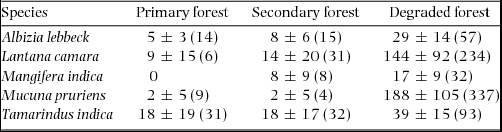
Densities of non-native plant species by forest type (ha−1,±95% CI using transects as replicates, n = number of individual plants seen) inside and along the perimeter of the Ankarana National Park (Madagascar), as observed along all transects in the primary, secondary and degraded forests. These are raw data (not densities) of the total number of individuals in 22700 m2 of primary forest, 15000 m2 of secondary forest and 22700 m2 of degraded forest. Sample sizes are provided in parentheses.
Differences in the densities of five non-native species in three different forest types inside and along the perimeter of the Ankarana National Park (Madagascar), as observed along all transects in the primary, secondary and degraded forests. The table shows P-values of Steel–Dwass post hoc tests, examining differences in densities of each species between Primary, Secondary and Degraded forest types.

Model selection results from analyses to determine the relative importance of different types of disturbance on non-native plant densities in the Ankarana National Park, Madagascar. Other candidate models did not converge and were excluded from the table. Each model includes a random effect of transect to account for spatial non-independence. Td = ln(tree damage), Tr = ln(tree removal), Prox = ln(Proximity to nearest road or trail).