Resilience is a dynamic process that encompasses the attainment of positive adaptation within the context of exposure to significant adversity that typically exerts major assaults on biological and psychological development (Cicchetti, Reference Cicchetti2010; Egeland, Carlson, & Sroufe, Reference Egeland, Carlson and Sroufe1993; Luthar, Cicchetti, & Becker, Reference Luthar, Cicchetti and Becker2000; Masten, Reference Masten2001; Rutter, Reference Rutter1987, Reference Rutter2012). Resilient functioning is among the most intriguing and adaptive phenomena of human development. Prior to the advent of theorizing and research on adaptive functioning in the face of significant adversity, investigations of risk and psychopathology generally portrayed the developmental process as somewhat deterministic, eventuating in adverse and maladaptive outcomes. Investigations ranging from genetic and biological predispositions to psychopathology, to assaults on development associated with inadequate caregiving, conveyed the multiplicity of risks that eventuate in pathology (Cicchetti & Garmezy, Reference Cicchetti and Garmezy1993).
Beginning in the 1970s, the publication of the early writings on resilience by major systematizers in the field contributed to a burgeoning of research on the determinants of resilient functioning (Garmezy, Masten, & Tellegen, Reference Garmezy, Masten and Tellegen1984; Luthar et al., Reference Luthar, Cicchetti and Becker2000; Masten, Best, & Garmezy, Reference Masten, Best and Garmezy1990; Rutter, Reference Rutter1987; Werner & Smith, Reference Werner and Smith1982). The major progenitor of this movement was Norm Garmezy, whose early writings on the topic were among the first exemplars of efforts to stress the importance of investigating protective factors in “at-risk” populations.
In discussing the merits of undertaking prospective longitudinal research with the offspring of schizophrenic parents, Garmezy asserted that these risk studies had the potential to “provide a developmental psychopathology that can produce a conceptual advance over a too dormant child psychiatry” (Reference Garmezy1974b, p. 116). Garmezy believed that such investigations could portray a compensating picture of a healthy normality in the midst of adversity and disadvantage, rather than the then prevalent notion of omnipresent disorder in such “at-risk” individuals (Garmezy, Reference Garmezy1974b). Garmezy (Reference Garmezy1971) also noted that by examining the processes that help to impel such disadvantaged individuals to function adaptively, it would be possible to construct models of primary prevention that could promote adaptation and decrease maladaptation in vulnerable individuals.
Garmezy's publications (Reference Garmezy1971, Reference Garmezy1974a, Reference Garmezy1974b, Reference Garmezy, Anthony and Koupernik1974c; Garmezy & Rutter, Reference Garmezy and Rutter1983) laid the groundwork for the conduct of future theoretical and empirical work on resilience. Efforts to comprehend the processes and mechanisms contributing to resilient functioning were spearheaded by Michael Rutter (Reference Rutter1987) and by other investigators conducting research from a developmental psychopathology perspective (Luthar, Reference Luthar, Cicchetti and Cohen2006; Luthar et al., Reference Luthar, Cicchetti and Becker2000; Masten, Reference Masten2011, in press; Masten et al., Reference Masten, Best and Garmezy1990). Through discovering the mechanisms and processes that eventuate in resilient functioning despite the presence of adversity, both normal development and psychopathology could become better understood (Cicchetti, Reference Cicchetti1984, Reference Cicchetti, Cicchetti and Walker2003; Masten et al., Reference Masten, Best and Garmezy1990; Rutter, Reference Rutter1986; Rutter & Garmezy, Reference Rutter, Garmezy and Hetherington1983).
Although Garmezy (Reference Garmezy1970, Reference Garmezy1974a, Reference Garmezy1974b) certainly recognized that genetic liability contributed to the development of maladaptation and serious psychopathology, his work on the factors that contributed to resilience was psychosocial in nature. Specifically, Garmezy delineated three sets of factors that were implicated in the development of resilience: (a) attributes of the individual children, (b) aspects of their families, and (c) characteristics of their broader environments (Masten & Garmezy, Reference Masten, Garmezy, Lahey and Kazdin1985; see also Werner & Smith, Reference Werner and Smith1982, Reference Werner and Smith1992). Until recently, the vast majority of research on the development of resilient functioning in humans eschewed the study of genetic and biological contributors. Because self-righting, one of the basic mechanisms contributing to the development of resilient adaptation, has historical roots that are embedded in the fields of genetics and embryology (Sameroff, Reference Sameroff and Mussen1983; Waddington, Reference Waddington1957), the paucity of biological measures in research on resilience has been an unfortunate circumstance.
The artificial distinction among genetics, neurobiology, and behavior in research on the determinants of resilience contradicts years of developmental research demonstrating coactions among all levels of analysis, from the molecular to the environment broadly construed (Gottlieb, Reference Gottlieb1992; Gottlieb & Halpern, Reference Gottlieb and Halpern2002). For the past decade, there have been calls for incorporating genetic and biological assessments into the research armamentaria of researchers investigating resilience (see, e.g., Charney, Reference Charney2004; Cicchetti, Reference Cicchetti, Cicchetti and Walker2003; Cicchetti & Curtis, Reference Cicchetti, Curtis, Cicchetti and Cohen2006; Curtis & Cicchetti, Reference Curtis and Cicchetti2003; Feder, Nestler, & Charney, Reference Feder, Nestler and Charney2009; Masten, Reference Masten2007). The scientific and technological advances that have taken place in recent years have begun to provide researchers with the means for investigating the biological processes that underlie the development of resilient functioning (see, e.g., Curtis & Cicchetti, Reference Curtis and Cicchetti2003; Feder et al., Reference Feder, Nestler and Charney2009).
Research on Resilience in Maltreated Individuals
Child maltreatment represents one of the most deleterious and stressful challenges that confront children (Cicchetti & Lynch, Reference Cicchetti, Lynch, Cicchetti and Cohen1995). The vast majority of abused and neglected children are adversely affected by their maltreatment experiences. Thus, child abuse and neglect may represent the greatest failure of the caregiving environment to provide opportunities for normal development (Cicchetti & Lynch, Reference Cicchetti, Lynch, Cicchetti and Cohen1995; Cicchetti & Valentino, Reference Cicchetti, Valentino, Cicchetti and Cohen2006). However, not all children who have been maltreated manifest maladaptive development and/or psychopathology (Cicchetti, Reference Cicchetti2010; Cicchetti & Lynch, Reference Cicchetti, Lynch, Cicchetti and Cohen1995; Cicchetti & Toth, Reference Cicchetti and Toth1995). Accordingly, investigating the pathways to resilient functioning among children who have experienced maltreatment has the potential to uncover the multilevel dynamic processes that eventuate in a multiplicity of child developmental outcomes in abused and neglected children, as well as in nonmaltreated children.
As is true for the field of resilience research more broadly, investigations of the factors and processes contributing to adaptive functioning within the face of adversity in abused and neglected individuals have focused predominantly on psychosocial variables (Collishaw et al., Reference Collishaw, Pickles, Messer, Rutter, Shearer and Maughan2007; Dumont, Widom, & Czaja, Reference DuMont, Widom and Czaja2007; Herrenkohl, Herrenkohl, & Egolf, Reference Herrenkohl, Herrenkohl and Egolf1994; Jaffee & Gallop, Reference Jaffee and Gallop2007; McGloin & Widom, Reference McGloin and Widom2001; Moran & Eckenrode, Reference Moran and Eckenrode1992; Wingo, Fani, Bradley, & Ressler, Reference Wingo, Fani, Bradley and Ressler2010). The psychosocial factors implicated in the development of resilience in maltreated children and adults include neighborhood characteristics, personality variables, secure attachment relationships, self-regulatory processes, close friendships and adolescent peer relationships, supportive parenting, high-quality, and adult love relationships, among others (Beeghly & Cicchetti, Reference Beeghly and Cicchetti1994; Haskett, Nears, Ward, & McPherson, Reference Haskett, Nears, Ward and McPherson2006).
In a longitudinal study on processes leading to resilience conducted in our laboratory, we, too, examined psychosocial determinants (Cicchetti & Rogosch, Reference Cicchetti and Rogosch1997). For the maltreated children, the major predictors of resilient functioning were the personality characteristics of ego overcontrol (i.e., the ability to monitor and control impulses and regulate affect) and ego resiliency (i.e., the degree of relative flexibility in regulating affect and behavior to meet situational demands; Block & Block, Reference Block, Block and Collins1980), and positive self-esteem. Promotion of resilience among nonmaltreated resilient children, in contrast, was more strongly related to positive relationships with adults and high levels of ego resiliency, irrespective of nonmaltreated children's level of ego control.
Thus, personality characteristics and self-system processes were more important in achieving resilient adaptation in maltreated children. Through the personality process of resilient overcontrol, maltreated children who function in a resilient fashion may be more attuned to what is necessary for successful adaptation in their adverse home environments. In contrast, the more affectively expressive style of resilient undercontrollers may not be well suited for successful adaptation in maltreating environments, because such personality styles may provoke attention and reaction from others that could result in greater risk for maltreatment (Cicchetti & Rogosch, Reference Cicchetti and Rogosch1997; Cicchetti, Rogosch, Lynch, & Holt, Reference Cicchetti, Rogosch, Lynch and Holt1993).
Additional cross-sectional research on the psychosocial determinants of resilience in maltreated and nonmaltreated children conducted in our laboratory has revealed that personality and self-processes play prominent roles in the development of adaptive functioning in maltreated children (Cicchetti et al., Reference Cicchetti, Rogosch, Lynch and Holt1993; Flores, Cicchetti, & Rogosch, Reference Flores, Cicchetti and Rogosch2005; Kim & Cicchetti, Reference Kim and Cicchetti2004).
In keeping with calls for a multiple levels of analysis perspective in the investigation of the development of psychopathology and resilience (Cicchetti & Curtis, Reference Cicchetti and Curtis2007; Cicchetti & Dawson, Reference Cicchetti and Dawson2002; Curtis & Cicchetti, Reference Curtis and Cicchetti2003; Masten, Reference Masten2007), we conducted two multilevel investigations that moved our work beyond a single level focus on psychosocial predictors of resilient adaptation. In the first study, emotion regulation and hemispheric EEG asymmetry were investigated as joint contributors to resilient functioning in maltreated and nonmaltreated children. EEG activity indexes a neural system that has emotion-specific influences whereby the two hemispheres of the cerebral cortex have been found to be differentially involved in emotion (Davidson, Reference Davidson2000). The left hemisphere is associated with positive emotions/approach behavior and the right hemisphere is linked with negative emotions/withdrawal behavior. Positive emotion and good emotion regulatory abilities have been associated with resilient adaptation (Davidson, Reference Davidson2000; Masten, Reference Masten1986). We found that a neural-level phenomenon, hemispheric EEG asymmetry, was an independent contributor to resilient functioning in maltreated children (Curtis & Cicchetti, Reference Curtis and Cicchetti2007). Specifically, maltreated children who were functioning in a resilient fashion exhibited left hemispheric activation asymmetry. Moreover, an adult behavioral rating of emotional regulation, based on 35 hours of child observation, also significantly predicted resilient adaptation in both maltreated and nonmaltreated children.
In a second multilevel investigation we found that ego resiliency and ego overcontrol and the adrenal steroid hormones associated with stress (i.e., cortisol and dehydroepiandrosterone [DHEA]) made independent and noninteractive contributions to resilience, even though they were operating at different levels of analysis (Cicchetti & Rogosch, Reference Cicchetti and Rogosch2007). We discovered that higher morning levels of cortisol were related to lower levels of resilient strivings for the nonmaltreated children. Physically abused children with high morning cortisol had higher resilient functioning than physically abused children with lower levels of morning cortisol.
In contrast, we found that higher morning levels of cortisol were related to lower levels of resilient strivings for the nonmaltreated children. Within the group of maltreated children, differences in cortisol regulation were found as a function of the subtype(s) of maltreatment experienced. Physically abused children with high morning cortisol had higher resilient functioning than physically abused children with lower levels of morning cortisol.
Prior research on neuroendocrine regulation has indicated that physically abused children generally exhibit lower levels of morning cortisol secretion (Cicchetti & Rogosch, Reference Cicchetti and Rogosch2001). It may be that the subgroup of physical abused children who were able to elevate cortisol to cope with the life stressors were demonstrating a greater striving for resilient adaptation. In contrast, the larger subgroup of physically abused children with lower levels of morning cortisol may have developed hypocortisolism over time in response to chronic stress exposure (i.e., allostatic load; Cicchetti, Rogosch, & Oshri, Reference Cicchetti, Rogosch and Oshri2011). As a result, for these children there may be a diminished capacity to mobilize the hypothalamic–pituitary–adrenal (HPA) axis to promote positive adaptation under conditions of ongoing stress. In addition, we found that the very low level of resilience among sexually abused children with high basal cortisol may be a product of their different traumatic experiences and consequences of chronic excessive vigilance and preoccupation, with commensurate HPA axis hyperarousal.
Finally, we also discovered that maltreated children with high resilient functioning exhibited a unique atypical pattern of a relative DHEA diurnal increase. Maltreated children who have the capacity to elevate DHEA over the course of the day may be better equipped to cope with the demands of high chronic exposure to stress and to adapt competently. In contrast, the nonmaltreated children who functioned resiliently did not exhibit the pattern of diurnal DHEA increase; instead, they displayed the lowest levels of DHEA across the day.
Gene–Environment (G × E) interactions: Implications for Resilience
Research on G × E interactions has demonstrated that child maltreatment is a strong candidate environmental pathogen (Caspi, Hariri, Holmes, Uher, & Moffitt, Reference Caspi, Hariri, Holmes, Uher and Moffitt2010; Karg, Burmeister, Shedden, & Sen, Reference Karg, Burmeister, Shedden and Sen2011). Maltreatment is an objectively measured, well-defined stressor, and meta-analyses have shown that robust findings in G × E investigations are more likely to occur when a specific stressor is identified (cf. Karg et al., Reference Karg, Burmeister, Shedden and Sen2011). Most G × E research that is relevant to resilience has focused on how genes also may serve as protective factors against developing psychopathology in individuals who have experienced maltreatment (e.g., Bradley et al., Reference Bradley, Binder, Epstein, Tang, Nair and Liu2008, Reference Bradley, Defife, Guarnaccia, Phifer, Fani and Ressler2011; Caspi et al., Reference Caspi, McClay, Moffitt, Mill, Martin and Craig2002, Reference Caspi, Sugden, Moffitt, Taylor, Craig and Harrington2003; Cicchetti, Rogosch, et al., 2011; Polanczyk et al., Reference Polanczyk, Avshalom, Williams, Price, Danese and Sugden2009).
Now that G × E studies of psychopathology have been accorded great attention in the literature (Caspi et al., Reference Caspi, Hariri, Holmes, Uher and Moffitt2010; Duncan & Keller, Reference Duncan and Keller2011; Karg et al., Reference Karg, Burmeister, Shedden and Sen2011; Risch et al., Reference Risch, Herrell, Lehner, Liang, Eaves and Hoh2009), several investigators have asserted that empirical studies of genetic contributors to resilience be undertaken (Cicchetti & Blender, Reference Cicchetti and Blender2006; Curtis & Cicchetti, Reference Curtis and Cicchetti2003; Feder et al., Reference Feder, Nestler and Charney2009; Kim-Cohen & Gold, Reference Kim-Cohen and Gold2009). To date, to the best of our knowledge, there have been no empirical studies that have investigated whether there are particular gene variants that may be related to the development of resilience in individuals who have experienced significant adversity such as child maltreatment (Kim-Cohen & Gold, Reference Kim-Cohen and Gold2009). It is unlikely that genes act in isolation in explaining such a complex, multiply influenced developmental process as resilience.
According to the differential susceptibility to environmental influence hypothesis proffered by Belsky and Pluess (Reference Belsky and Pluess2009; Belsky et al., Reference Belsky, Jonassaint, Pluess, Stanton, Brummett and Williams2009), genes that confer risk in harsh environments may confer benefits in normal or nurturing environments. In other words, the characteristics of individuals (including their genotypes) that render them disproportionately more vulnerable to experiencing adversity may also make them disproportionately more likely to benefit from supportive contexts (Belsky, Bakermans-Kranenburg, & van IJzendoorn, Reference Belsky, Bakermans-Kranenburg and Van IJzendoorn2007; Boyce & Ellis, Reference Boyce and Ellis2005; Ellis, Boyce, Belsky, Bakermans-Kranenburg, & van IJzendoorn, Reference Ellis, Boyce, Belsky, Bakermans-Kranenburg and van IJzendoorn2011).
In this, the first investigation of the contributions that molecular gene variants may make to the development of resilience in maltreated and nonmaltreated children from low-socioeconomic status (SES) backgrounds, we chose to investigate the separate and cumulative contributions of four candidate genes: the serotonin transporter gene (5-HTT), the oxytocin receptor gene (OXTR), the dopamine receptor D4 (DRD4–521C/T single nucleotide polymorphism [SNP]) gene, and the corticotropin releasing hormone receptor 1 (CRHR1) gene. Each of these genes was chosen because of their associations with aspects of behavior found to be predictive of resilience in single level psychosocial studies.
5-HTT has been shown to be involved in brain development and in individual differences in mood and emotion regulation (Caspi et al., Reference Caspi, Hariri, Holmes, Uher and Moffitt2010), which have been demonstrated to be related to resilience in behavioral and biological research (Curtis & Cicchetti, Reference Curtis and Cicchetti2007; Davidson, Reference Davidson2000). CRHR1 is the key activator of the HPA axis, binding to receptors that initiate the stress response and culminating with release of cortisol from the adrenal cortex. The ability to regulate stress has long been associated with resilient functioning (Masten & Garmezy, Reference Masten, Garmezy, Lahey and Kazdin1985; Rutter, Reference Rutter2012). DRD4, in combination with the -521C/T SNP, has been shown to be related to quality of attachment organization in some, but not all, studies (see Cicchetti, Rogosch, & Toth, Reference Cicchetti, Rogosch and Toth2011). Secure attachment with an adult figure has been shown to be related to resilience (Beeghly & Cicchetti, Reference Beeghly and Cicchetti1994). OXTR has been linked to individual differences in psychological resources that are predictive of physical and psychological health (Saphire-Bernstein, Way, Kim, Sherman, & Taylor, Reference Saphire-Bernstein, Way, Kim, Sherman and Taylor2011). Psychological resources such as self-esteem, optimism, and mastery have been found to be protective factors in the development of resilient functioning (Cicchetti & Rogosch, Reference Cicchetti and Rogosch1997; Masten, in press; Seligman & Csikszentmihalyi, Reference Seligman and Csikszentmihalyi2000). OXTR also has been shown to be related to attachment and relationship quality, which are valuable resources for resilient functioning (Bakermans-Kranenburg & van IJzendoorn, Reference Bakermans-Kranenburg and van IJzendoorn2008) as well as social behavior (Inoue et al., Reference Inoue, Kimura, Azuma, Inazawa, Takemura and Kikuchi1994). In this first investigation of genetic influences on resilience in maltreated children, we have selected these candidate genes because of their potential to influence processes known to be associated with resilience. However, it is clear that a diversity of other candidate genes also could be considered, and our selection is by no means exhaustive.
Hypotheses
This investigation was guided by the following hypotheses and research questions.
1. Nonmaltreated children will have higher mean levels of resilient functioning than maltreated children and a higher percentage of children in the high resilience group. Nonetheless, high resilient maltreated children will exist.
2. We will examine whether genetic variation in four candidate genes, 5-HTTLPR, CRHR1, DRD4–521C/T, and OXTR, contributes to variation in resilient functioning in low-income children. Based on prior evidence in the literature, we do not expect the independent main effect of each gene to be strong.
3. We will investigate the potential for G × E interactions among each of the four candidate genes and child maltreatment experience, in order to determine potential genetic moderation of the impact of maltreatment on resilient strivings in low-income children. Different genes may be related to resilient strivings based on maltreatment experiences. Based on the paucity of research on the role of G × E interactions in resilience, we did not posit a priori expectations about specific genotypes that could show differential effects for maltreated and nonmaltreated children.
4. We expect that the collective influence of variants from multiple genes, in interaction with child maltreatment experience, will increase prediction of variation in resilient functioning among maltreated and nonmaltreated children.
5. Among the group of children who have high levels of resilient functioning, maltreated and nonmaltreated children will differ in their genetic presentation.
Method
Participants
The participants in this investigation included 595 children aged 6 to 12 (M age = 9.81, SD = 2.06) who attended a summer camp research program designed for school-aged low-income children. Some children attended the camp for multiple years, and the data from their first year of attendance were used in the current study. The sample included both maltreated children (n = 313) and nonmaltreated children (n = 282). Among the participants, 53.4% were boys. The maltreated and nonmaltreated children were comparable in terms of racial/ethnic diversity and family demographic characteristics. The Add Health system for coding race and ethnicity (The National Longitudinal Study of Adolescent Health, n.d.) was used (http://www.cpc.unc.edu/projects/addhealth/data/code/race; DeYoung et al., Reference DeYoung, Cicchetti, Rogosch, Gray, Eastman and Grigorenko2011). A total of 62.0% of the sample was African American, 19.0% was White, 17.0% was Hispanic, and 2.0% was from other racial/ethnic groups. The families of the children were low income, with 95.1% of the families having a history of receiving welfare benefits. Single mothers headed 62.9% of the families.
Recruitment and classification procedures
Parents of all maltreated and nonmaltreated children provided informed consent for their child's participation, as well as consent for examination of any Department of Human Services (DHS) records pertaining to the family. Children in the maltreated group had been identified by the county DHS as having experienced child abuse and/or neglect, and the sample was representative of the children in families receiving services from the DHS. A recruitment liaison from DHS contacted eligible maltreating families, explained the study, and if parents were interested, then their names were released to the project team for recruitment. Families were free to choose whether or not to participate. Comprehensive searches of DHS records were completed, and maltreatment information was coded utilizing operational criteria from maltreatment nosology specified in the Maltreatment Classification System (MCS; Barnett, Manly, & Cicchetti, Reference Barnett, Manly, Cicchetti, Cicchetti and Toth1993), as discussed below.
Consistent with national demographic characteristics of maltreating families (National Incidence Study; Sedlak et al., Reference Sedlak, Mettenburg, Basena, Petta, McPherson and Greene2010), the maltreated children were predominantly from low-SES families. Consequently, demographically comparable nonmaltreated children were recruited from families receiving Temporary Assistance for Needy Families. A DHS recruitment liaison contacted eligible nonmaltreating families, described the project, and if interested, parents signed a release for their names to be given to the project for recruitment. DHS record searches were completed for these families to verify the absence of any record of child maltreatment. Trained research assistants also interviewed mothers of children recruited for the nonmaltreatment group to confirm a lack of DHS involvement and prior maltreatment experiences utilizing the Maternal Maltreatment Classification Interview (Cicchetti, Toth, & Manly, Reference Cicchetti, Toth and Manly2003). Subsequently, record searches were conducted in the year following camp attendance to verify that all available information had been accessed. Only children from families without any history of documented abuse or neglect were retained in the nonmaltreatment group. In addition, families who had received preventive services through DHS due to concerns over risk for maltreatment were excluded from the sample to reduce the potential for unidentified maltreatment existing within this group.
The MCS is a reliable and valid method for classifying maltreatment (Bolger, Patterson, & Kupersmidt, Reference Bolger, Patterson and Kupersmidt1998; English et al., Reference English, Upadhyaya, Litrownik, Marshall, Runyan and Graham2005; Manly, Reference Manly2005) that utilizes DHS records detailing investigations and findings involving maltreatment in identified families over time. Rather than relying on official designations and case dispositions, the MCS codes all available information from DHS records, making independent determinations of maltreatment experiences. Based on operational criteria, the MCS designates all of the subtypes of maltreatment children have experienced (i.e., neglect, emotional maltreatment, physical abuse, sexual abuse). Coding of the DHS records was conducted by trained research assistants, doctoral students, and clinical psychologists. Coders were required to meet acceptable reliability with criterion standards before coding actual records for the study. Coders demonstrated acceptable reliability with the criterion (weighted κs with the criterion ranging from 0.86 to 0.98. Reliabilities (κs) for the presence versus absence of maltreatment subtypes ranged from 0.90 to 1.00.
In terms of the subtypes of maltreatment, neglect involves failure to provide for the child's basic physical needs for adequate food, clothing, shelter, and medical treatment. In addition to inadequate attention to physical needs, forms of this subtype include lack of supervision, moral–legal neglect, and education neglect. Emotional maltreatment involves extreme thwarting of children's basic emotional needs for psychological safety and security, acceptance and self-esteem, and age-appropriate autonomy. Examples of emotional maltreatment of increasing severity include belittling and ridiculing the child, extreme negativity and hostility, exposure to severe marital violence, abandoning the child, and suicidal or homicidal threats. Physical abuse involves the nonaccidental infliction of physical injury on the child (e.g., bruises, welts, burns, choking, broken bones). Injuries range from minor and temporary to permanently disfiguring. Finally, sexual abuse involves attempted or actual sexual contact between the child and caregiver for purposes of the caregiver's sexual satisfaction or financial benefit. Events range from exposure to pornography or adult sexual activity, to sexual touching and fondling, to forced intercourse with the child.
Children in the maltreatment group all had documented histories of abuse and/or neglect occurring in their families according to DHS records. However, DHS record information was not complete enough to code maltreatment subtype information for 42 (13.4%) of the maltreated children. Among the remaining maltreated children, 77.1% had experienced neglect, 67.2% had experienced emotional maltreatment, 31.0% had experienced physical abuse, and 8.9.1% had experienced sexual abuse. As is typical in maltreated populations (Bolger et al., Reference Bolger, Patterson and Kupersmidt1998; Manly, Cicchetti, & Barnett, Reference Manly, Cicchetti and Barnett1994; Manly, Kim, Rogosch, & Cicchetti, Reference Manly, Kim, Rogosch and Cicchetti2001), the majority of children had experienced multiple subtypes of maltreatment. Specifically, 63.3% of the maltreated children had experienced two or more maltreatment subtypes. Among maltreated children, we derived two indices to characterize maltreatment subtype experiences. First, based on the number of subtypes of maltreatment children had experienced, we grouped children who had experienced one or two subtypes (80.7%) versus those who had experienced three or four subtypes (19.3%). Second, given the overlap among subtypes and the relatively lower rates of physical and sexual abuse compared to neglect and emotional maltreatment, we identified children who had experienced neglect and/or emotional maltreatment (63.1%) without physical or sexual abuse versus children who had experienced physical and/or sexual abuse (36.9%). The latter group also may have experienced neglect or emotional maltreatment.
Procedure
Children attended a week-long day camp program and participated in research assessments. At the camp, children were assigned to groups of eight same-age and same-sex peers; half of the children assigned to each group were maltreated. Each group was conducted by three trained camp counselors, who were unaware of the maltreatment status of children and the hypotheses of the study. Camp lasted 7 hr/day for 5 days, providing 35 hr of interaction between children and counselors. In addition to the recreational activities, after providing assent, children participated in various research assessments (see Cicchetti & Manly, Reference Cicchetti, Manly, Brody and Sigel1990, for detailed descriptions of camp procedures) and provided DNA samples. Trained research assistants, who also were unaware of research hypotheses and maltreatment status, conducted individual research sessions with children, in which questionnaires and other research measures were administered. Clinical consultation and intervention occurred if any concerns over danger to self or others emerged during research sessions. At the end of the week, children in each group completed sociometric ratings of their peers. The counselors, who had been trained extensively for 2 weeks prior to the camp, also completed assessment measures on individual children, based on their observations and interactions with children in their respective groups.
Measures
The measures described below constitute a subset of assessments conducted during the research camp. The camp context and associated measurement battery provide a multiple-informant, multiple-perspective view of child adaptive functioning. Measures include child self-report, peer evaluations, counselor observations, and counselor-report assessments of individual children, as well as school record data obtained from children's school districts.
DNA collection, extraction, and genotyping
Using an established protocol, trained research assistants obtained DNA samples from participants by collecting buccal cells with the Epicentre Catch-All Collection Swabs. Subsequently, using the conventional method, DNA was extracted with the Epicentre BuccalAmp DNA Extraction Kit, in order to prepare DNA for PCR amplification. Genotyping was conducted following previously published protocols.
DNA was whole-genome amplified using the Repli-g kit (Qiagen, Catalog No. 150043) per the kit instructions to ensure the availability of data over the long term for this valuable sample. Amplified samples were then diluted to a working concentration.
The 5-HTT gene has a polymorphism in the linked polymorphic region (5-HTTLPR) in the 5′ regulatory region due to a 44-base pair deletion that eventuates in either the short (s) or long (l) allele (Lesch et al., Reference Lesch, Bengel, Heils, Sabol, Greenberg and Petri1996). 5-HTTLPR samples were genotyped for fragment length polymorphisms of 5-HTTLPR with Hot Star Taq PCR Mix (Qiagen, Catalog No. 203205) and previously described primers (Gelernter, Kranzler, & Cubells, Reference Gelernter, Kranzler and Cubells1997), followed by fragment analysis using a CEQ 8000 (Beckman-Coulter, Inc., Fullerton, CA). The call rate for 5-HTTLPR was 99.7%.
CRHR1 was genotyped using assays for SNPs rs110402, rs242924, and rs7209436 purchased from Applied Biosystems, Inc. (ABI, Bedford, MA) as C2544843 10, C2257689 10, and C1570087 10, respectively. Individual allele discriminations were made using Taq Man Genotyping Master Mix (Applied Biosystems, Catalog No. 4371357) with amplification in an ABI 9700 thermal cycler and analyzing the endpoint fluorescence using a Tecan M200.
The call rates for the three SNPs for CRHR1 were as follows: rs7209436 = 99.7%, rs1104202 = 99.8%, and rs242924 = 99.8%. For four individuals, we could not confidently determine the genotype of one SNP of CRHR1. For two individuals, rs7209436 was indeterminate, whereas one individual was indeterminate for rs1104202 and one for rs242924. Because the remaining two CRHR1 SNPs for these four individuals were able to be genotyped, all participants in this study had a haplotype for each of the three CRHR1 SNPs.
Haplotypes for the three CRHR1 SNPs were determined using GeneticsBase (Warnes, Reference Warnes2003). Because the three SNPs were very strongly related (all r > .92), GeneticsBase was able to estimate haplotypes for every participant with a posterior probability higher than .98, which allowed us to assign a score of 0, 1, or 2 copies of the TAT haplotype to participants with a high degree of certainty. The TAT haplotype accounted for 32.1% of all haplotypes in the sample, with its complement, CGG, accounting for 60.1%.
The rs1800955 polymorphism is located 521 bp upstream from the first codon in the DRD4 gene. This SNP consists of either a C or a T and because of its location in the promoter region may affect transcription of the gene. The DRD4–521 C/T polymorphism was genotyped using a Taq Man SNP assay from Applied Biosystems, Inc. Individual allele determinations were made using Taq Man Genotyping Master Mix (Applied Biosystems, Catalog No. 4371357) with amplification on an ABI 9700 thermal cycler and analyzing the endpoint fluorescence using a Tecan M200 with JMP 8.0 (SAS, Inc., Cary, NC). The call rate for DRD4–521C/T was 99.5%.
The OXTR rs53576 SNP was genotyped using a TaqMan SNP assay from Applied Biosystems, Inc. Individual allele determinations were made using Taq Man Genotyping Master Mix (Applied Biosystems, Catalog No. 4371357) with amplification on an ABI 9700 thermal cycler and analyzing the endpoint fluorescence using a Tecan M200 with JMP 8.0 (SAS, Inc.).
If a genotype for any gene or SNP could not be determined after the first run, then it was repeated up to four times. If the null result persisted, then a genotype was not assigned to that individual.
All DNA samples were genotyped in duplicate for quality control. In addition, human DNA from cell lines was purchased from Coriell Cell Repositories for all representative genotypes in duplicate and genotypes confirmed by sequencing using DTC& chemistry on an ABI 3130x1. These and a no template control were run alongside study samples representing 9% of the total data output. Any samples that were not able to be genotyped to a 95% or greater confidence level were repeated under the same conditions.
Child self-report measures
Children's Depression Inventory (CDI)
The CDI (Kovacs, Reference Kovacs1982, 1992) is a widely used self-report questionnaire to assess depressive symptomatology in school-age children. For each item, children chose from among three option statements, depicting increasing levels of depressive symptoms, in order characterize their experiences in the past 2 weeks. Internal consistency for the total scale has ranged from 0.71 to 0.89, and validity has been well established (Kovacs, Reference Kovacs1982, 1992). In the present sample, CDI scores ranged from 0 to 42 (M = 8.93, SD = 7.51).
Peer measures
Peer nominations
After children had interacted with each other during the week of summer camp, children evaluated the characteristics of their peers in their respective camp groups using a peer nomination method on the last day of camp (cf., Coie & Dodge, Reference Coie and Dodge1983). Counselors conducted the sociometric assessment with individual children. For each peer in the camp group, children were given five brief behavioral descriptors characterizing different types of social behavior and asked to select one peer from the group who best file the behavioral description, as well as select the one child who he/she liked most and liked least. The behavioral descriptors included a child who was: cooperative, a leader, shy, disruptive, and a fighter. The total number of nominations that each individual child received from peers in each category was determined, and these totals were converted to proportions of the possible nominations in each category, and these scores in each category were standardized within each year of camp.
Counselor measures
Behavior ratings
Observations of children's social behavior were made based on the methodology of Wright (Reference Wright1983). Camp counselors rated the behavior of individual children on nine items tapping three aspects of interpersonal functioning, including prosocial behavior, aggressiveness, and social withdrawal. Seven-point ratings were completed each day based on 45-min observations of children in structured and unstructured camp settings (e.g., sports, lunch, art, free play, awards). Interrater reliabilities based on average intraclass correlations among pairs of raters across the years of assessment ranged from 0.68 to 0.80 (M = 0.76) for prosocial, 0.70 to 0.84 (M = 0.77) for aggression, and 0.61 to 0.77 (M = 0.71) for withdrawal. Individual counselor assessments for each of the three scales across measurement occasions were averaged to generate individual child scores.
Pupil Evaluation Inventory (PEI)
The PEI (Pekarik, Prinz, Liebert, Weintraub, & Neale, Reference Pekarik, Prinz, Liebert, Weintraub and Neale1976) was completed by camp counselors for children in their respective groups at the end of each camp week. The PEI consists of 35 items assessing social behavior, yielding three homogeneous and stable factors, including likeability, aggression, and withdrawal. Similar to peer nomination procedures, counselors were asked to select no more than two children who were best characterized by each individual item. Interrater reliabilities based intraclass correlations across the years of camp ranged from 0.72 to 0.85 (M = 0.78) for likeability, 0.85 to 0.90 (M = 0.88) for aggression, and 0.72 to 0.84 (M = 0.78) for withdrawal.
Teacher Report Form (TRF)
Behavioral symptomatology was evaluated at the end of each week by counselors' completion of the TRF (Achenbach, 1991). The TRF is a widely used and validated instrument to assess behavioral disturbance from the perspective of teachers, and the measure was used in the present study, because camp counselors are able to observe similar behaviors to that of teachers. The TRF, containing 118 items rated for frequency, assesses two broadband dimensions of child symptomatology, externalizing and internalizing, as well as total behavior problems. In the present study, interrater reliability for the internalizing and externalizing scales based on average intraclass correlations among pairs of raters ranged from 0.56 to 0.84 (M = 0.68) for internalizing, and from 0.78 to 0.88 (M = 0.83) for externalizing. The counselors' scores for each child were averaged to obtain individual child scores for the broadband dimensions. In the current sample, T scores ranged from 36 to 72 (M = 48.90, SD = 7.88) for internalizing and 39 to 80 (M = 52.46, SD = 8.79) for externalizing.
School record data
School risk index
Each year, information from school districts on children's adaptation to school was obtained for the academic year prior to camp. Annual evaluations of each child were used by the school districts to determine broad indicators of deficient school functioning. The school risk index is a total of five possible risk indicators, including (a) attendance problems in the form of excessive absences or tardiness, (b) poor performance on standardized achievement tests, (c) suspension from school, (d) failing school grades, and (e) being 2 or more years below age level for grade placement. Meeting criteria for any of these five indicators was considered substantial risk in adapting successfully to school.
Composite of resilient functioning
Consistent with prior work examining resilience in maltreated and nonmaltreated children (Cicchetti & Rogosch, Reference Cicchetti and Rogosch1997, Reference Cicchetti and Rogosch2007; Cicchetti, Rogosch, Gunnar, & Toth, 1993), a composite of resilient functioning was derived from indicators of children functioning well in domains of particular developmental importance for school-aged children. Initially, three composite indicators of social competence, combining the perspectives of peers and adults, were generated. First, a prosocial composite combined peer nomination scores for leader and cooperative with counselor behavior rating scores for prosocial behavior and counselor PEI scores for likeability. This composite was internally consistent with α values ranging from 0.66 to 0.75 (M = 0.70). Second, a disruptive–aggressive composite was comprised of peer nominations of disruptive and fights, and counselor behavior ratings of aggressive and counselor PEI scores for aggressiveness. The internal consistencies for this composite across the years ranged from 0.80 to 0.87 (M = 0.85). Third, a withdrawn composite included peer nomination scores for shy, counselor behavior ratings for withdrawn, and counselor PEI scores for the withdrawn subscale. Alphas ranged from 0.68 to 0.78 (M = 0.69). For each of these internally consistent composites, component variables were standardized within each camp year, and the standardized variables were averaged to generate the composite scores for each child.
In addition to these three indicators of social competence, the child's self-report of depressive symptoms on the CDI, counselor assessment of internalizing and externalizing behavior problems from the TRF, and the school risk index were other components of the resilience composite. For each of the seven indicators, criteria for the most competent functioning were established. More specifically, children were considered demonstrating competent functioning if they had scores in the top third of the distribution for the prosocial composite, scored in the lowest one-third of the distribution for the aggressive composite, the withdrawn composite, the CDI score, and TRF internalizing and externalizing scores, and had no school risk indicator. Children meeting the criterion on a given dimension were given a score of 1; all other children were given a score of 0 for that dimension. Summing across the seven indicators produced a composite index of resilient functioning with a possible range of scores ranging from 0 to 7 (M = 2.07, SD = 1.59). We also established criteria for levels of resilient functioning, with scores of 0–1 classified as low resilient function, 2–4 as medium, and 5 or more as high.
Results
We first evaluated whether there was evidence for an association between maltreatment status and genetic variation in each of the candidate genes under consideration, gene–environment correlation. Chi-square tests were conducted for maltreatment status and the genotype distributions of each of the genes. All chi-square tests were nonsignificant, χ2 (2, N = 595) = 1.36, p = .51 (5-HTTLPR); 0.89, p = .64 (CRHR1 TAT haplotype); 1.09, p = .58 (DRD4–521C/T); and 1.50, p = .47 (OXTR). Thus, genetic variation in each of the genes was unrelated to maltreatment status and children with different genotypes were not differentially more likely to experience maltreatment. We found no evidence for an evocative gene–environment correlation.
Resilient functioning and candidate genes: Evidence for G × E effects
In the next series of analyses, we used analyses of covariance (ANCOVAs) to examine the influence of maltreatment status and genetic variation on each of the candidate genes, and their interaction (G × E) in order to predict individual differences in resilient functioning scores. In each ANCOVA model, gender and age were included as covariates. In addition, a categorical race/ethnicity (Black, White, Hispanic, other) was included as a main effect in each of the models in order to address potential population stratification, and control for race and ethnicity effects.
5-HTTLPR
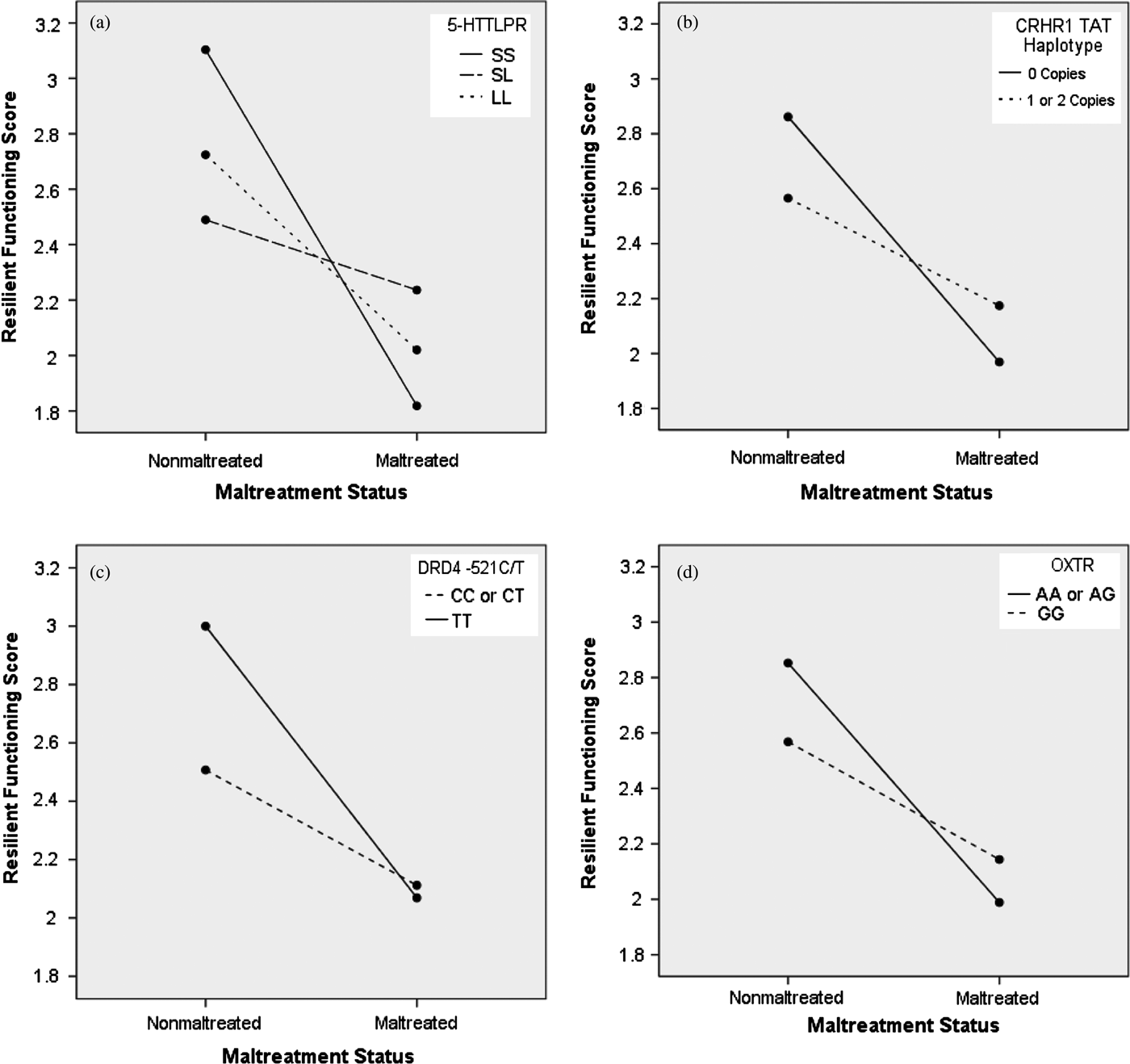
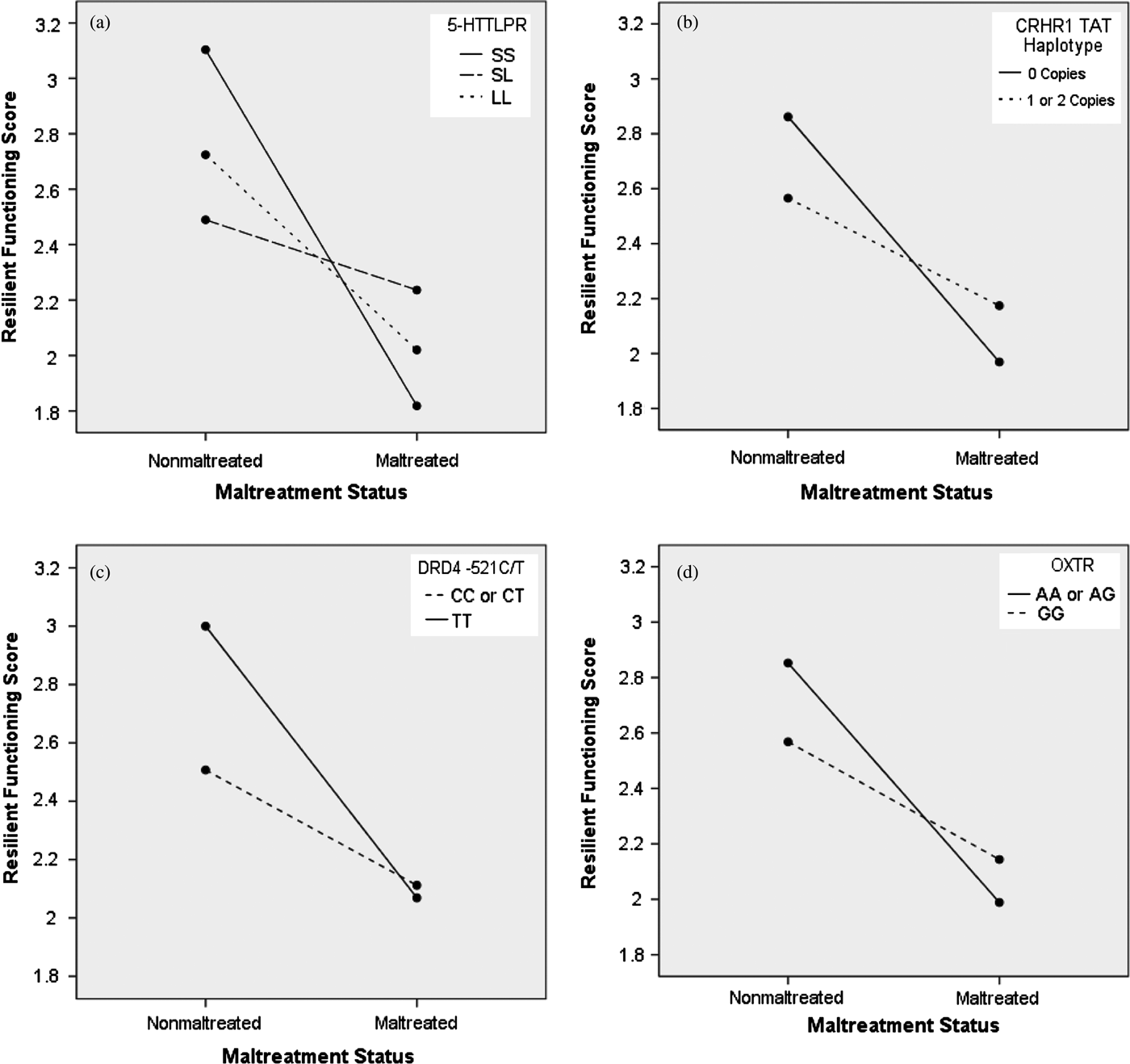
In the ANCOVA utilizing the 5-HTTLPR genotypes, the main effect for maltreatment status was significant, F (1, 593) = 21.57, p < .001, partial η2 = 0.036. Specifically, maltreated children had significantly lower resilient functioning scores than nonmaltreated children. In contrast, the main effect for 5-HTTLPR genotypes was nonsignificant, F (2, 593) = 0.097, p =.91, partial η2 = 0.00. However, a significant maltreatment status by 5-HTTLPR interaction was observed, F (2, 593) = 3.13, p = .945, partial η2 = 0.011. This interaction effect is depicted in Figure 1a. Follow-up ANCOVAs were used to probe the interaction effect within genotype groups. As shown in Figure 1a, the largest difference between maltreated and nonmaltreated children on resilient functioning was observed among children in the SS genotype group, F (1, 60) = 10.78, p = .002, partial η2 = 0.166; the maltreatment status difference also was significant in the LL genotype, F (1, 300) = 1571, p = .001, partial η2 = 0.051, but not in the SL genotype group, F (1, 233) = 2.56, p = .11, partial η2 = 0.011. Thus, while maltreated children generally have lower resilient functioning scores than nonmaltreated children, the difference between maltreated and nonmaltreated children is larger among children with the SS genotype.
(a) The interaction of the serotonin transporter linked polymorphic region gene (5-HTTLPR) and maltreatment status in predicting resilient functioning scores. (b) The interaction of the corticotropin releasing hormone receptor gene (CRHR1) TAT haplotype and maltreatment status in predicting resilient functioning scores. (c) The interaction of the dopamine receptor D4 521C/T gene (DRD4–521C/T) and maltreatment status in predicting resilient functioning scores. (d) The interaction of the oxytocin receptor gene (OXTR) and maltreatment status in predicting resilient functioning scores.
CRHR1 TAT haplotype
We next considered the effects of the CRHR1 TAT haplotype in the ANCOVA model, and its interaction with maltreatment status. The effect of maltreatment status was significant, F (1, 595) = 10.37, p = .001, partial η2 = 0.017, whereas the effect of the CRHR1 TAT haplotype was not, F (2, 595) = 1.67, p = .19, partial η2 = 0.006. The interaction effect also did not attain significance, F (2, 595) = 2.07, p = .13, partial η2 = 0.007. However, when we inspected the interaction effect, the figure indicated a larger difference between maltreated and nonmaltreated children's resilient functioning scores for the group with 0 TAT copies, relative to those children with one or two copies.
Accordingly, we reran the ANCOVA, grouping children with one or two copies together, and contrasting them with children with 0 copies. In this analysis, maltreatment status retained a significant effect, F (1, 595) = 24.89, p < .001, partial η2 = 0.041, the effect of the CRHR1 grouped variable was not significant, F (1, 595) = 0.13, p = .72, partial η2 = 0.00, and a significant G × E interaction was observed, F (2, 595) = 3.90, p = .049, partial η2 = 0.007. The interaction is depicted in Figure 1b. We probed the interaction effect with separate ANCOVAs within the CRHR1 TAT haplotype groups. Whereas maltreated children in both CRHR1 groups had lower resilient functioning scores than nonmaltreated children, the difference between maltreatment status groups was larger among children with 0 copies of the TAT haplotype, F (1, 252) = 21.49, p < .001, partial η2 = 0.079, than among children with one or two copies, F (1, 343) = 4.67, p = .03, partial η2 = 0.014.
DRD4–521C/T
A similar pattern of findings was observed when genotypes of the DRD4–521C/T were considered. The main effect for maltreatment status was significant, F (1, 575) = 16.86, p < .001, partial η2 = 0.028, whereas the main effect for DRD4–521C/T genotypes was not significant, F (2, 575) = 1.39, p = .25, partial η2 = 0.005. The G × E interaction also did not attain significance, F (2, 575) = 2.10, p = .12, partial η2 = 0.007. However, inspection of the figure of this interaction suggested larger differences between maltreated and nonmaltreated children for those with TT genotypes, compared to those children with CC or CT genotypes.
We examined this relation further by combining the children with a C allele (CC or CT) compared to children with a TT genotype. In this ANCOVA, the effect of maltreatment status was significant, F (1, 575) = 24.31, p < .001, partial η2 = 0.041, whereas the main effect of the DRD4 genotype group was not, F (1, 575) = 2.78, p = .10, partial η2 = 0.005. However, the interaction effect was found to be significant, F (1, 575) = 4.02, p = .045, partial η2 = 0.007.
As shown in Figure 1c, maltreated children irrespective of genotype group had lower resilient functioning scores than nonmaltreated children; however, the strength of these maltreatment group differences was stronger for children who had the TT genotype, F (1, 204) = 16.49, p < .001, partial η2 = 0.079, compared to children who had CC or CT genotypes, F (1, 371) = 6.75, p = .01, partial η2 = 0.018.
OXTR
The fourth candidate gene considered was OXTR, and results similar to the other genes emerged. Maltreatment status had a significant main effect, F (1, 594) = 16.42, p < .001, partial η2 = 0.027, but neither the OXTR main effect, F (2, 594) = 0.73, p = .48, partial η2 = 0.003, nor the G × E interaction, F (2, 594) = 1.77, p = .17, partial η2 = 0.006, was significant. As previously, however, inspection of the interaction effect suggested that there were larger differences in resilience functioning scores for maltreated and nonmaltreated children with AA or AG genotypes, compared to children with the GG genotype.
We reconducted the ANCOVA with a dichotomized OXTR variable (AA or AG vs. GG). In this analysis, the maltreatment status main effect was significant, F (1, 594) = 25.31, p < .001, partial η2 = 0.041, but the dichotomized OXTR effect was not, F (1, 594) = 0.25, p = .62, partial η2 = 0.000. A marginally significant interaction effect was obtained, F (1, 594) = 3.03 p = .08, partial η2 = 0.005. This interaction effect is depicted in Figure 1d. For children with AA or AG genotypes, the magnitude of the difference between maltreated and nonmaltreated children was larger, F (1, 262) = 23.00, p < .001, partial η2 = 0.083, than it was for children with a GG genotype, F (1, 332) = 5.16, p = .024, partial η2 = 0.016.
Resilient functioning and genetic moderation effects of multiple genes
Across the four candidate genes under consideration, a similar pattern of genetic and G × E effects has been found. Whereas maltreatment status as an environmental pathogen consistently negatively influences children's resilient functioning, none of the main effects for the genes were significantly related to resilience. However, for each of the genes, we observed G × E effects in which maltreated and nonmaltreated children evinced larger differences in resilient functioning for one genotype group versus others. We sought to determine the collective effects these genes have on resilient functioning. Accordingly, we focused on the genotype group for each gene where there was a larger effect size in differentiating maltreated and nonmaltreated children. We determined how many of these differentiating genotypes each child had. In particular, the SS genotype for 5-HTTLPLR, 0 copies of the CRHR1 TAT haplotype, the TT genotype of DRD4–521C/T, and the AA or AG genotypes of OXTR were examined. We counted how many of these differentiating genotypes each child had, with totals ranging from 0 to 4. Only five children had all four of the differentiating genotypes; thus, we combined children with three or four into one group.
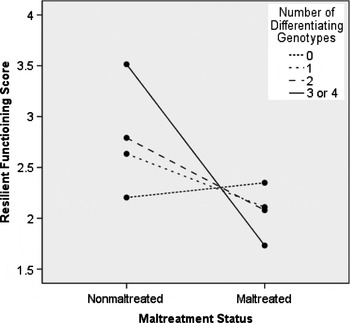
We used this genotype sum variable in our ANCOVA model to predict resilient functioning scores. As in our prior analyses, the main effect of maltreatment status was significant, F (1, 573) = 24.15 p < .001, partial η2 = 0.041, whereas the main effect for the multiple genotypes was not, F (3, 573) = 0.70, p = .55, partial η2 = 0.004. Furthermore, the G × E interaction was significant, F (3, 573) = 5.19, p = .002, partial η2 = 0.027.
The G × E interaction effect is shown in Figure 2. We probed this interaction by conducting ANCOVAs within the genotype sum groups. The significance of the difference between maltreated and nonmaltreated children and the partial eta-squareds for the respective groups are a follows: zero differentiating genotypes: p = .46, η2 = 0.006; one differentiating genotype: p = .006, η2 = 0.032; two differentiating genotypes: p = .006, η2 = 0.044; and three or four differentiating genotypes: p < .001, η2 = 0.299. The interaction pattern indicates an increasing larger effect size difference between maltreated and nonmaltreated children in resilience functioning scores as the number of differentiating genotypes increases, ranging from no difference for children with 0 of the differentiating genotypes to large differences for children with three or four of the differentiating genotypes.
Interaction of the number of differentiating genotypes and maltreatment status in predicting resilient functioning scores.

Effects of maltreatment subtype experiences
We also considered whether the effects of variation in maltreatment experiences among maltreated children contributed to further understanding of the G × E effects, beyond maltreatment status. Specifically, we examined the number of subtypes of maltreatment the maltreated children experienced, grouping children who had experienced one or two subtypes of maltreated versus those who had experienced three or four, and included nonmaltreated children in subsequent analyses. In addition, we also examined variation in the subtypes of maltreatment that maltreated children had experienced; maltreated children were dichotomized into two groups depending on whether they had experienced emotional maltreatment and/or neglect without abuse versus those who had experienced physical and/or sexual abuse (without restrictions on the experience of additional emotional maltreatment or neglect); nonmaltreated children were included as a third group. We used these subtype variables in a series of ANCOVAs in place of maltreatment status. Significant G × E effects were not found using the number of subtypes and subtype group variables for 5-HTTLPR, CRHR1, or OXTR. However, we did obtain significant G × E effects when examining DRD4–521C/T and the total number of differentiating genotypes.
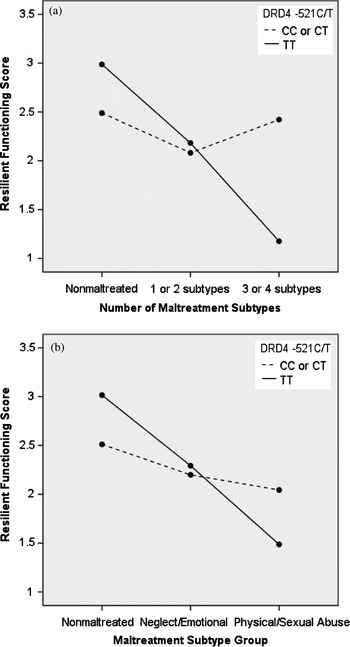
In the ANCOVA using number of subtypes of maltreatment to predict resilient functioning, the number of subtypes was found to have a significant main effect, F (2, 532) = 12.47, p < .001, partial η2 = 0.046, whereas the DRD4 genotype group effect was not significant, F (1, 532) = 1.46, p = .23, partial η2 = 0.003. It is important that the G × E interaction attained significance, F (2, 532) = 6.55, p = .002, partial η2 = 0.025 (see Figure 3a). We conducted follow-up tests of the interaction effect within genotype groups. Although the effect of the number of subtypes of maltreatment was significant for children with CC or CT genotypes, F (2, 348) = 2.96, p = .05, partial η2 = 0.017, number of subtypes had a stronger effect size among children with the TT genotype, F (2, 184) = 13.04 p < .001, partial η2 = 0.129. It is of interest to note how children with three to four subtypes of maltreatment were indistinguishable from nonmaltreated children in resilient functioning scores when then had the CC or CT genotype, whereas these two groups were substantially differentiated in resilient functioning scores among children who had the TT genotype.
(a) The interaction of the dopamine receptor D4 521C/T gene (DRD4–521C/T) and number of maltreatment subtypes in predicting resilient functioning scores. (b) The interaction of DRD4–521C/T and maltreatment subtype groups in predicting resilient functioning scores.

When maltreatment subtype group was used in the ANCOVA model, the main effect for subtype was significant, F (2, 534) = 15.17, p < .001, partial η2 = 0.055, whereas the genotype group effect was not significant, F (2, 534) = 0.01, p = .93, partial η2 = 0.000. A significant G × E interaction effect also was obtained, F (2, 534) = 4.07, p = .018, partial η2 = 0.015 (see Figure 3b). Follow-up ANCOVAs to explore the effects within genotype group suggested that the effects of the number of subtypes experienced was marginally significant for children who had the CC or CT genotype, F (2, 349) = 2.90 p = .056, partial η2 = 0.017, whereas the differences in resilient functioning were substantially stronger among children who had the TT genotype, F (2, 185) = 12.23, p < .001, partial η2 = 0.121. The children who had experienced physical or sexual abuse were not substantially different from other maltreated children or nonmaltreated children if they had a CC or CT genotype, whereas the variation in resilient functioning was large for these subtype groups when children had the TT genotype.
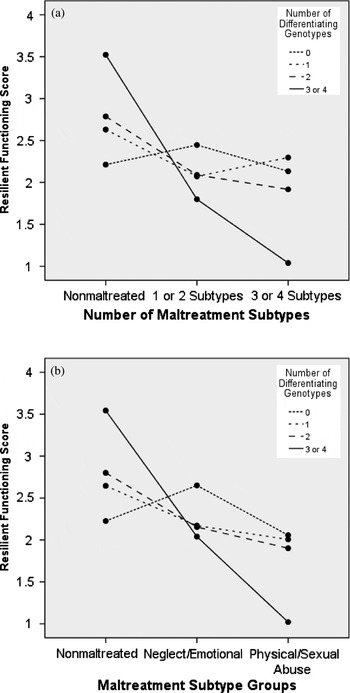
G × E effects involving the subtype variables also were obtained when we examined the sum of genotypes that differentiated resilient functioning among maltreated and nonmaltreated children. For the number of maltreatment subtypes, a significant main effect was obtained, F (2, 530) = 12.34, p < .001, partial η2 = 0.046, whereas the main effect for number of differentiating genotypes was not significant, F (2, 530) = 0.20, p = .90, partial η2 = 0.001. Moreover, the G × E interaction was found to be significant, F (6, 530) = 3.28, p < .004, partial η2 = 0.037. This interaction is depicted in Figure 4a. For children with 0 differentiating genes, the ANCOVA within this group of children revealed a nonsignificant main effect for number of subtypes, F (2, 102) = 0.60, p = .55, partial η2 = 0.013. In contrast, the size of the difference in resilient functioning increased as the number of differentiating genes increased. For children with one and two differentiating genotypes, significant differences between groups emerged, F (2, 219) = 3.76, p = .025, partial η2 = 0.034 and F (2, 156) = 3.64, p = .03, partial η2 = 0.047. For children with three to four differentiating genotypes, the effect of the number of subtypes was sizable, F (2, 53) = 14.61, p < .001, partial η2 = 0.394. Thus, with no differentiating genotypes, maltreated children and nonmaltreated children showed no differences in resilient functioning scores, whereas with increasing numbers of differentiating genotypes, the differences progressively increased. Among children with three to four differentiating genotypes, the nonmaltreated children and children with three to four subtypes had widely diverging levels of resilient functioning, with nonmaltreated children evincing the highest scores and those children with three to four subtypes the lowest.
(a) The interaction of the number of differentiating genotypes and number of maltreatment subtypes in predicting resilient functioning scores. (b) The interaction of the number of differentiating genotypes and maltreatment subtype groups in predicting resilient functioning scores.

We also investigated whether the specific subtypes of maltreatment children had experienced influenced the G × E effects, utilizing the subtype group variable in the ANCOVA model. The results revealed a significant main effect for subtype group, F (2, 532) = 15.37, p < .001, partial η2 = 0.056, a nonsignificant number of genotypes effect, F (2, 530) = 0.054, p = .98, partial η2 = 0.000, as well as a significant G × E interaction, F (6, 532) = 3.35, p = .003, partial η2 = 0.038 (see Figure 4b). The same fanning out interaction pattern is revealed in the figure. For children with 0 differentiating genes, no differences in resilient functioning were observed among the subtype groups, F (2, 102) = 129 p = .28, partial η2 = 0.027. In contrast, the size of the difference in resilient functioning increased as the number of differentiating genes increased. For children with one and two differentiating genotypes, significant differences between groups emerged between subtype groups, F (2, 219) = 3.52, p = .03, partial η2 = 0.032, and F (2, 158) = 3.98, p = .02, partial η2 = 0.050. However, among children with three to four differentiating genes, group differences were large, F (2, 53) = 16.87, p < .001, partial η2 = 0.428. The children with abuse experiences had the lowest level of resilient functioning, whereas the nonmaltreated children evinced the highest resilient functioning.
Genetic variation in resilient functioning groups
Consistent with prior research, our findings have shown that maltreated children on average have lower resilient functioning scores than nonmaltreated children. We also examined the number of maltreated children and nonmaltreated children in each of the resilient functioning groups: low (zero or one indicator of resilient functioning); medium (two to four indicators); and high (five or more indicators). A chi-square analysis indicated a significant difference in the distribution of maltreated versus nonmaltreated in each of the groups, for maltreated and nonmaltreated children, respectively: low (49.2% vs. 31.6%); medium (44.7% vs. 57.1%); and high (6.1% vs. 11.3%), χ2 (2, N = 595) = 20.61, p < .001. Thus, whereas nearly half of the maltreated children had low levels of resilient strivings, a small percentage of maltreated children with high levels of resilient functioning were identified.
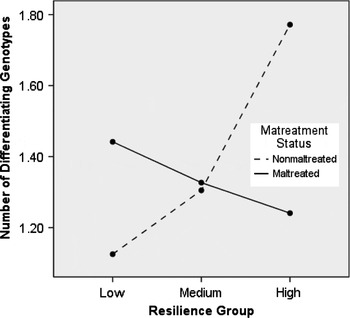
We next sought to determine if maltreated and nonmaltreated children with the same level of resilient functioning differed in the number of differentiating genotypes they had. Accordingly, we conducted an ANCOVA with maltreatment status and resilient group as main effects. Gender, age, and race and ethnicity were controlled as in previous analyses. The dependent variable was the number of differentiating genotypes a child had. Neither maltreatment status, F (1, 573) = .54, p = .49, nor resilience group, F (2, 573) = 1.25 p = .29, had a main effect on the number of differentiating genotypes. However, a significant interaction effect was observed, F (1, 573) = 4.56, p = .01 (see Figure 5). Follow-up ANCOVAs within resilience groups were conducted in order to probe the interaction. Among children with high resilient functioning, nonmaltreated children had significantly higher numbers of differentiating genotypes than maltreated children, F (1, 49) = 4.62, p = .04, partial η2 = 0.099; among medium-level resilient functioning, no differences were found between maltreated and nonmaltreated children, F (1, 290) = 0.002, p = .96, partial η2 = 0.000, and among children in the low group of resilience, maltreated children were found to have significantly higher mean number of differentiating genotypes than nonmaltreated children, F (1, 234) = 8.03, p = .005, partial η2 = 0.034. Thus, maltreated and nonmaltreated children had the opposite pattern of numbers of differentiating genotypes depending on whether they were in the high or low resilience groups. Follow-up analyses within the maltreated and the nonmaltreated group indicated that the effect of resilience group on number of differentiating genotypes was significant within the nonmaltreated group, F (2, 269) = 6.37, p = .005, partial η2 = 0.047, but not in the maltreated group, F (2, 304) = 1.17, p = .31, partial η2 = 0.008, indicating the more prominent role of gene variation on resilient functioning among the nonmaltreated children.
The number of differentiating genotypes for maltreated and nonmaltreated children at different levels of resilient functioning.

Discussion
This study was the first empirical investigation of the interaction of molecular genetic variants and child maltreatment on the development of resilient functioning. Despite the number of risks they encounter both within and outside the family context (Cicchetti & Valentino, Reference Cicchetti, Valentino, Cicchetti and Cohen2006), maltreated children nonetheless strive to be resilient. We found that maltreated children evinced lower resilient functioning than nonmaltreated children. Moreover, fewer maltreated children were in the high resilient group, whereas more maltreated children were in the low resilient group. These results are consistent with findings from extant studies on the neurobiological, hormonal, and psychosocial determinants of resilient functioning conducted in our laboratory (Cicchetti, Reference Cicchetti2010).
In our research, we have strived to ascertain the processes that impel some maltreated children to function resiliently despite the experience of significant adversity in their lives. Psychosocial processes were the first focus of our work. We discovered that individual personality characteristics, in particular, ego resiliency and moderate ego overcontrol, self-system processes, and relationship factors, were differentially predictive of resilient functioning in maltreated children and nonmaltreated children (cf. Cicchetti & Rogosch, Reference Cicchetti and Rogosch1997). Multilevel predictors, including research on hemispheric EEG activation asymmetry, emotion regulation, stress hormones, and personality characteristics have been investigated subsequently and have been demonstrated to be related to resilient functioning (Cicchetti & Rogosch, Reference Cicchetti and Rogosch2007; Curtis & Cicchetti, Reference Curtis and Cicchetti2007). In order to examine the processes underlying the development of resilience at additional levels of analysis, we embarked on research aimed at discovering whether there were gene variants of specified genes, in interaction with the experience of child maltreatment, that were associated with higher levels of resilient functioning in maltreated and nonmaltreated children. We chose four genes that have been found to be related to behaviors associated with resilient functioning.
Maltreatment consistently exerted a strong, adverse main effect on resilient functioning; however, none of the gene variants of respective genes were shown to have a main effect on resilience. In contrast, G × E interaction effects were obtained and a similar pattern emerged for all four genes: a particular genotype variant was found to differentiate between the level of resilient functioning of maltreated and nonmaltreated children more strongly.
Opposite of the typical G × E studies on psychopathology, our results generally revealed that genetic variation has a negligible effect for the maltreated group in predicting resilient functioning. In contrast, genotype was shown to contribute to higher resilient functioning in nonmaltreated children when they possess a particular genotype, at least relative to the maltreated children with the same genotype.
In the case of 5-HTTLPR, nonmaltreated children with the SS genotypic variant were significantly more likely to have higher resilient functioning, whereas maltreated children who possessed the same genetic variant had lower resilient functioning. These findings are consistent with a differential susceptibility to environmental influences interpretation (Belsky & Pluess, Reference Belsky and Pluess2009; Belsky, Schlomer, & Ellis, Reference Belsky, Schlomer and Ellis2011; Ellis et al., Reference Ellis, Boyce, Belsky, Bakermans-Kranenburg and van IJzendoorn2011). For children who possess the same SS genotypic variant of 5-HTTLPR, in the context of a more normal childrearing environment, nonmaltreated children achieve higher resilient functioning, whereas maltreated children, in the context of an adverse childrearing environment, show lower resilient functioning.
For CRHR1, nonmaltreated children, especially those with zero copies of the TAT haplotype, had higher levels of resilient functioning relative to maltreated children with the same number of copies of the TAT haplotype. Once again, these findings are in keeping with a differential susceptibility to the environment perspective (Belsky & Pluess, Reference Belsky and Pluess2009; Ellis et al., Reference Ellis, Boyce, Belsky, Bakermans-Kranenburg and van IJzendoorn2011); maltreated and nonmaltreated children have the same genetic variant (i.e., zero copies of the TAT haplotype), yet the nonmaltreated children show higher levels of resilient functioning, whereas the maltreated children (living in a more stressful context) evince lower levels of resilient functioning.
Analyses of the DRD4–521C/T SNP, revealed that nonmaltreated children and, in particular, those with the TT genotype, were more likely to exhibit higher resilient functioning scores than were maltreated children with this same genotype. The maltreated children manifested lower levels of resilient functioning. As with our previous analyses, the findings with DRD4–521C/T provide support for the differential susceptibility to environmental influences perspective (Belsky & Pluess, Reference Belsky and Pluess2009; Ellis et al., Reference Ellis, Boyce, Belsky, Bakermans-Kranenburg and van IJzendoorn2011).
In further analyses we examined the relation between number of maltreatment subtypes and DRD4–521C/T genotype to resilient strivings. Maltreated children who had experienced three or four subtypes fared dramatically worse with the TT genotype, whereas nonmaltreated children with this genotype fared the best. Maltreated children with three to four subtypes with the CC or CT genotypes were indistinguishable in level of resilient functioning from nonmaltreated children with these genotypes. Despite the very large detrimental effect that extensive maltreatment exerts on resilient functioning independent of genotype, these results provide an example of where the three to four maltreatment subtype group exhibits the same level of resilient functioning as do nonmaltreated comparisons with the same CC or CT genotypes.
Finally, with OXTR, not being maltreated was related to higher resilient functioning scores; in contrast, maltreatment was strongly related to lower levels of resilient functioning. In particular, nonmaltreated children who had either the AA or AG genotypes of OXTR displayed greater levels of resilient functioning than maltreated children with these same genotypes. Consistent with the findings obtained with the three previous candidate genes, the results provide strong support for the differential susceptibility to environmental influences framework (Belsky & Pluess, Reference Belsky and Pluess2009; Ellis et al., Reference Ellis, Boyce, Belsky, Bakermans-Kranenburg and van IJzendoorn2011).
The analysis aggregating the number of genotypes that most strongly differentiated the maltreated and nonmaltreated children revealed that the nonmaltreated comparison children evinced much higher levels of resilient functioning than the maltreated children among the group of children who had three or four of the differentiating genotypes. In contrast, among the group of children who did not have any of the differentiating genotypes, maltreated and nonmaltreated children were not different in their resilient functioning scores. By examining the collective influence of the gene variants, a more robust picture of potential differences in how the four candidate genes relate to resilient functioning differentially for maltreated and nonmaltreated children was attained (see Belsky and Beaver, Reference Belsky and Beaver2011; Sonuga-Barke et al., Reference Sonuga-Barke, Oades, Psychogiou, Chen, Franke and Buitelaar2009).
We obtained the same pattern of results when we examined the relation of the number of maltreatment subtypes and specific maltreatment subtype groups. For children with three to four differentiating genotypes, nonmaltreated children exhibited much higher resilient functioning scores than children with three to four maltreatment subtypes. For children with zero differentiating genotypes, nonmaltreated children and children with three to four maltreatment subtypes did not differ in their levels of resilient functioning.
In addition, for children with three to four differentiating genotypes, nonmaltreated children evinced much higher resilient functioning scores than children with PA and/or SA. In contrast, for children with zero differentiating genotypes, there were no differences in the resilient functioning scores of nonmaltreated children and children with PA and/or SA. Thus, children who have experienced many forms of maltreatment and those who have been abused are comparable to nonmaltreated children in resilient functioning when the children share one pattern of genotypic variation, whereas maltreated and nonmaltreated children vary widely in resilient functioning when they share a different pattern of genotypic variation.
Utilizing a more person-oriented analysis, we were able to obtain a clearer picture of the differences between nonmaltreated and maltreated children. We considered not mean levels of the resilient functioning scores, but instead focused on groups of children who demonstrated low, medium, and high levels of resilience. This person-oriented approach allowed us to examine genetic differences between maltreated and nonmaltreated children who showed the same levels of resilient strivings. In this analysis, we examined the number of differentiating genotypes on average that were observed in maltreated and nonmaltreated children in each resilience group. Maltreated children with high resilience had a significantly lower number of these differentiating gene variants compared to nonmaltreated children with high resilience. Whereas there were no differences between maltreated and nonmaltreated children with medium levels of resilience in the number of differentiating gene variants, when children with low levels of resilient strivings were examined, the maltreated children with low resilience had a higher number of the differentiating genes than the nonmaltreated children with low resilience.
Thus, the genetic variant profiles of maltreated and nonmaltreated children with high resilience are different; the genetic profile of resilient adaptation differs for maltreated and nonmaltreated children. Conversely, among children with very low resilience, the genetic profile of maltreated and nonmaltreated children also differs, but in the opposite direction.
It is noteworthy that we identified different gene variants as differentially important through contrasting maltreated and nonmaltreated children and their strivings for resilience. The variation among the genotypes and their relation to functioning differences would not be apparent without the consideration of experience. The genes did not have a singular role, outside of experiential context. The contrast between groups of maltreated and nonmaltreated children was important for understanding development in normal and atypical rearing environments.
Our findings suggest that the genes included in this investigation appear to be minimally related to resilient functioning in maltreated children. Maltreatment consistently had a statistically significant main effect on resilient functioning with each of the genes examined. Accordingly, it appears that the powerful maltreatment main effects may have overpowered any potential contribution of genetics to resilient functioning. Genetic variation had more of an impact on resilient functioning among the nonmaltreated children.
We must acknowledge that other biological systems are negatively impacted by abuse and neglect (Cicchetti & Toth, 2005; Cicchetti & Valentino, Reference Cicchetti, Valentino, Cicchetti and Cohen2006). Differences in brain structure and function (DeBellis, Reference DeBellis2001, Reference DeBellis2005), stress neurobiology (Cicchetti, Rogosch, Gunnar, & Toth, Reference Cicchetti, Rogosch, Gunnar and Toth2010), and inflammatory processes (Miller, Chen, & Parker, Reference Miller, Chen and Parker2011), among other biological systems, are not innate features of children, but rather are consequences of maltreatment. Maltreatment experiences also may influence genetic processes, including epigenetic processes involving the extent to which DNA methylation has occurred and the degree to which genes are expressed; however, these effects are not examined when focusing exclusively on G × E interaction. Moreover, genotypic variation for genes other than those utilized in this investigation may be related to higher resilient functioning in maltreated children. Thus, broader approaches to genetic influences associated with resilience in maltreated children must occur. Ongoing research in our laboratory is focusing on these critical genetic processes in studies of maltreated and nonmaltreated children.
Finally, psychosocial predictors also should be included in future multilevel longitudinal investigations of genetic influences on resilient functioning in maltreated and nonmaltreated children. For example, prior research has revealed that the personality characteristic moderate ego overcontrol was a strong predictor of resilient functioning in maltreated but not in nonmaltreated children (Cicchetti & Rogosch, Reference Cicchetti and Rogosch1997). These results show an interesting parallel to genetic findings reported herein. Specifically, some genetic variants were related to resilient functioning in nonmaltreated but not in maltreated children, and thus the same genetic influences may not operate in the same manner for children who have had different experiences.
Given the consistent detrimental impact of maltreatment on resilient functioning and the larger number of maltreated children who exhibit low levels of resilience, the importance of prevention and intervention to ameliorate the effects of maltreatment must be underscored. The results do not suggest that there are some maltreated children who are unaffected by maltreatment based on their genetic heritage, and thus gene variation is unlikely to be useful to identify maltreated children who may be more in need of intervention. At this time, a focus on promoting adaptive psychological processes, such as ego resiliency and moderate ego overcontrol, may advance resilient strivings in maltreated children.