Introduction
Schizophrenia (SCZ) and alcohol dependence or abuse (hereafter referred to as alcohol use disorder, AUD) are serious psychiatric disorders (Whiteford et al., Reference Whiteford, Degenhardt, Rehm, Baxter, Ferrari, Erskine and Vos2013). AUD is more common in individuals with SCZ [prevalence of 20–30% (Castillo-Carniglia, Keyes, Hasin, & Cerdá, Reference Castillo-Carniglia, Keyes, Hasin and Cerdá2019; Hunt, Large, Cleary, Lai, & Saunders, Reference Hunt, Large, Cleary, Lai and Saunders2018), compared to ~6% in the general population (SAMHSA, 2019)] and a diagnosis of both is associated with greater psychiatric comorbidity (Brady, Killeen, & Jarrell, Reference Brady, Killeen and Jarrell1993), more clinical complications (Duke, Pantelis, & Barnes, Reference Duke, Pantelis and Barnes1994), and a lower likelihood of sustained medication adherence (Drake & Wallach, Reference Drake and Wallach1989) than either disorder alone. Both SCZ and AUD are moderately to highly heritable [twin-h 2 for SCZ = 81% (Sullivan, Kendler, & Neale, Reference Sullivan, Kendler and Neale2003), AUD = 49% (Verhulst, Neale, & Kendler, Reference Verhulst, Neale and Kendler2015)], and genome-wide association studies (GWAS) have consistently found positive genetic correlations of AUD with SCZ (e.g. rg = 0.34, p = 3.7e-21) (Kranzler et al., Reference Kranzler, Zhou, Kember, Vickers Smith, Justice, Damrauer and Gelernter2019), suggesting that common genetic influences may potentially contribute to their co-occurrence (although environmental factors undoubtedly play a large role). Further, polygenic risk scores (PRS) for AUD are significantly associated with SCZ risk (Kranzler et al., Reference Kranzler, Zhou, Kember, Vickers Smith, Justice, Damrauer and Gelernter2019) and vice versa (Reginsson et al., Reference Reginsson, Ingason, Euesden, Bjornsdottir, Olafsson, Sigurdsson and Stefansson2018). In contrast, the genetic correlation between SCZ and measures of typical alcohol consumption is weak (e.g. drinks/week: rg = 0.01, p = 0.67) (Liu et al., Reference Liu, Jiang, Wedow, Li, Brazel, Chen and Psychiatry2019), suggesting that SCZ might share substantial genetic liability only with the psychopathological aspects of disordered drinking (Sanchez-Roige, Palmer, Fontanillas, Elson, & Clarke, Reference Sanchez-Roige, Palmer, Fontanillas, Elson and Clarke2019) and not alcohol consumption per se.
Despite the substantial genetic correlation between AUD and SCZ, there is little known regarding the underlying pleiotropic mechanisms in terms of the specific risk alleles, genes, and molecular pathways involved. Although recent studies have begun to elucidate the contributions of pleiotropic loci to shared genetic variance amongst disorders and complex traits (Lam et al., Reference Lam, Hill, Trampush, Yu, Knowles, Davies and Lencz2019; Lee et al., Reference Lee, Anttila, Won, Feng, Rosenthal, Zhu and Smoller2019), these efforts have not included AUD, one of the most common psychiatric disorders; until recently, GWAS of AUD were not well-powered. In addition to loci with a similar direction of effect on both disorders, modern cross-disorder GWAS methods can also identify divergent variants, i.e. those that are pleiotropic for two disorders but whose effect alleles operate in opposite directions, conferring risk for one disorder and protective effects for the other [e.g. potassium ion response genes that distinguish SCZ from bipolar disorder (Ruderfer et al., Reference Ruderfer, Ripke, McQuillin, Boocock, Stahl, Pavlides and Kendler2018)]. The identification of such variants is fundamental to identifying the pathways that contribute to diagnostic boundaries.
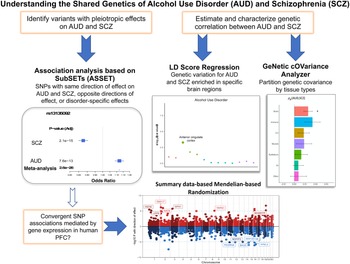
The current study outlines the nature of the shared genetic underpinnings of AUD and SCZ by conducting cross-disorder analyses of large genome-wide datasets of both European- and African-ancestry individuals (see Fig. 1 for overview). We conducted ancestry-specific cross-disorder meta-analyses to systematically identify pleiotropic loci with significant convergent and divergent effects on both SCZ and AUD, and loci specific to each disorder. We also linked pleiotropic variants to gene expression data from the frontal cortex in an effort to prioritize the genes that are more likely to be causal. Because the extent to which the correlation between AUD and SCZ is attributable to salient functional categories remains unknown, we partitioned the genetic covariance between AUD and SCZ into relevant annotations.
Conceptual overview of cross-disorder analysis of AUD and SCZ.

Materials and Methods
Samples
Alcohol use disorder
For the European-ancestry subset, we meta-analyzed a subset of the GWAS data from the largest available AUD meta-analysis (Zhou et al., Reference Zhou, Sealock, Sanchez-Roige, Clarke, Levey, Cheng and Gelernter2020b) (N = 313 959; N cases = 57 564): we meta-analyzed two GWAS of alcohol dependence and abuse (MVP + PGC), and did not include the GWAS of the problem sub-scale of the AUDs Identification Test in the UK Biobank. In the Million Veteran Program (MVP), case status was derived from International Classification of Diseases codes of alcohol dependence and abuse in electronic health records. In the Psychiatric Genomics Consortium (PGC) alcohol dependence GWAS (Walters et al., Reference Walters, Polimanti, Johnson, McClintick, Adams and Adkins2018), cases were defined by DSM-IV diagnoses.
We also meta-analyzed two published GWAS to create the African-ancestry subset: the MVP Phase 1 GWAS of AUD (Kranzler et al., Reference Kranzler, Zhou, Kember, Vickers Smith, Justice, Damrauer and Gelernter2019) (N = 56 648; N cases = 17 267), and the PGC GWAS of alcohol dependence (Walters et al., Reference Walters, Polimanti, Johnson, McClintick, Adams and Adkins2018) (N = 5799; N cases = 2991). We used METAL (Willer, Li, & Abecasis, Reference Willer, Li and Abecasis2010) (which combines genome-wide summary statistics across multiple samples) to generate the African-ancestry summary statistics by meta-analyzing the GWAS data from the MVP Phase 1 AUD and PGC alcohol dependence GWAS using an inverse variance-weighted fixed-effects model, excluding single nucleotide polymorphisms (SNPs) with INFO score <0.8 and/or minor allele frequency <0.01 within each sample.
Schizophrenia
For the European-ancestry sample, we used the PGC Phase 2 + CLOZUK (a sample of individuals with SCZ who were treated with clozapine) SCZ GWAS meta-analysis (Pardiñas et al., Reference Pardiñas, Holmans, Pocklington, Escott-Price, Ripke, Carrera and Hamshere2018) (total N = 105 318; N cases = 40 675). We used the summary statistics from the Genomic Psychiatry Cohort (GPC) SCZ GWAS (Bigdeli et al., Reference Bigdeli, Genovese, Georgakopoulos, Meyers, Peterson, Iyegbe and Kotov2020) (N = 10 070; N cases = 6152) for the African-ancestry cross-disorder analysis.
Analysis
Cross-disorder association analysis
We used ‘Association analysis based on SubSETs’ (ASSET) (Bhattacharjee et al., Reference Bhattacharjee, Rajaraman, Jacobs, Wheeler, Melin, Hartge and Chatterjee2012) to combine the genome-wide association data for AUD and SCZ (separately by ancestry), using the two-tailed meta-analysis approach to obtain a single cross-disorder association statistic, correcting for sample overlap. Unlike traditional meta-analysis approaches, ASSET takes into account SNPs with significant effects on multiple disorders even if the effects on the traits are in opposite directions. Default parameters were applied using the ‘h.traits’ function, and we used LD Score Regression (Bulik-Sullivan et al., Reference Bulik-Sullivan, Finucane, Anttila, Gusev, Day, Loh and Neale2015a, Reference Bulik-Sullivan, Loh, Finucane, Ripke, Yang and Pattersonb) (LDSC) to obtain a rough estimate of sample overlap, which we accounted for in the additional covariance term. We then separated the ASSET results into four subsets: a ‘convergent’ subset (effect allele with the same direction of effect for both disorders), a ‘divergent’ subset (effect allele with opposite directions of effect on the disorders), a subset of SNPs with AUD-specific effects, and a subset of SNPs with effects only on SCZ (online Supplementary Fig. S1).
In the European-ancestry sample, we then uploaded the subset results (i.e. convergent, divergent, AUD-only, and SCZ-only SNPs from ASSET output) to FUMA v1.3.6a (Watanabe, Taskesen, van Bochoven, & Posthuma, Reference Watanabe, Taskesen, van Bochoven and Posthuma2017) for annotation and identification of genome-wide significant risk loci and independent lead SNPs. We further subset these convergent and divergent loci to exclude top lead SNPs with p > 0.05 in either individual disorder GWAS, to create a more conservative set of cross-disorder variants with at least nominal significance in both disorders (although the full subsets were used for gene-set and pathway analyses).
In the African-ancestry samples, which were smaller and accordingly lacked power for more extensive analyses, we focused on the overall set of pleiotropic cross-disorder variants, rather than parsing the pleiotropic variants into subsets with convergent and divergent effects.
To examine specificity of genetic overlap, we also examined the effect sizes and p values of the top pleiotropic loci identified for AUD and SCZ in GWAS of attention deficit hyperactivity disorder (ADHD) (Demontis et al., Reference Demontis, Walters, Martin, Mattheisen, Als, Agerbo and Bækvad-Hansen2019), bipolar disorder (Stahl et al., Reference Stahl, Breen, Forstner, McQuillin, Ripke and Trubetskoy2019), depression (Howard et al., Reference Howard, Adams, Clarke, Hafferty, Gibson, Shirali and Wigmore2019), cigarettes per day (Liu et al., Reference Liu, Jiang, Wedow, Li, Brazel, Chen and Psychiatry2019), cannabis use disorder (Johnson et al., Reference Johnson, Demontis, Thorgeirsson, Walters, Polimanti, Hatoum and Agrawal2020), and opioid use disorder (Zhou et al., Reference Zhou, Rentsch, Cheng, Kember, Nunez, Sherva and Program2020a).
Gene, gene-set, and pathway analyses
In both the European-ancestry and African-ancestry samples, gene-based analyses in MAGMA (v1.08) (de Leeuw, Mooij, Heskes, & Posthuma, Reference de Leeuw, Mooij, Heskes and Posthuma2015) were conducted on the subset results (i.e. convergent and divergent SNPs from ASSET output) via the FUMA (Watanabe et al., Reference Watanabe, Taskesen, van Bochoven and Posthuma2017) platform. These analyses included gene-set analyses using curated gene-sets and GO terms from MsigDB (Liberzon et al., Reference Liberzon, Subramanian, Pinchback, Thorvaldsdóttir, Tamayo and Mesirov2011) (an online collection of annotated gene-sets) and gene-property analyses based on tissue expression data from GTEx (Aguet et al., Reference Aguet, Brown, Castel, Davis, He and Jo2017) v8 (a repository of expression data by brain region from autopsies of 960 donors) and brain samples at different developmental stages and specific ages from BrainSpan (Miller et al., Reference Miller, Ding, Sunkin, Smith, Ng, Szafer and Lein2014) (more details in Supplementary Materials).
Summary data-based eQTL analyses
To examine whether the effects of pleiotropic variants with convergent effects on AUD and SCZ may be mediated by gene expression patterns, we conducted a summary data-based Mendelian randomization (Zhu et al., Reference Zhu, Zhang, Hu, Bakshi, Robinson, Powell and Yang2016) (SMR) analysis on a set of expression quantitative trait loci (eQTL) data in the prefrontal cortex (meta-analyzed to combine data from ROSMAP (De Jager et al., Reference De Jager, Ma, McCabe, Xu, Vardarajan, Felsky and Bennett2018), PsychENCODE (Akbarian et al., Reference Akbarian, Liu, Knowles, Vaccarino, Farnham, Crawford and Geschwind2015), and COGA-INIA datasets (Kapoor et al., Reference Kapoor, Wang, Farris, Liu, McClintick, Gupta and Goate2019); total N = 1986). SMR is a Mendelian randomization-based analysis that integrates GWAS summary statistics with eQTL data to test whether the effect size of a SNP on the phenotype of interest is mediated by gene expression. SMR does not require raw eQTL data to build the weights. We excluded variants with pleiotropic effects significantly different from what would be expected under a causal model using the HEIDI-outlier method (Zhu et al., Reference Zhu, Zheng, Zhang, Wu, Trzaskowski, Maier and Wray2018) (excluding SNPs with HEIDI-outlier p < 0.05).
Differential gene expression analyses using AUD and SCZ post-mortem samples
We also examined whether genes mapped to pleiotropic loci by MAGMA (with p < 0.05) were significantly enriched for genes showing differential expression (p < 0.05) in the prefrontal cortex using two comparisons in independent samples: we compared gene expression in 65 individuals with alcohol dependence and 73 healthy controls (Kapoor et al., Reference Kapoor, Wang, Farris, Liu, McClintick, Gupta and Goate2019), and 258 individuals with SCZ and 279 controls (Fromer et al., Reference Fromer, Roussos, Sieberts, Johnson, Kavanagh, Perumal and Sklar2016) (details in Supplementary Note) using Fisher's exact test (Fisher, Reference Fisher1934).
Genetic correlations and partitioned covariance
We used LDSC (Bulik-Sullivan et al., Reference Bulik-Sullivan, Finucane, Anttila, Gusev, Day, Loh and Neale2015a, Reference Bulik-Sullivan, Loh, Finucane, Ripke, Yang and Pattersonb) to estimate the genetic correlations (r g) between AUD, SCZ, and two negative control traits (height and chronic ischemic heart disease).
We also used LDSC applied to Specifically Expressed Genes (LDSC-SEG (Finucane et al., Reference Finucane, Reshef, Anttila, Slowikowski, Gusev, Byrnes and Consortium2018)) to estimate the enrichment of AUD and SCZ across 13 specific brain regions (annotations defined using GTEx (Lonsdale et al., Reference Lonsdale, Thomas, Salvatore, Phillips, Lo, Shad and Moore2013) gene expression data).
We used GeNetic cOVariance Analyzer (GNOVA) (Lu et al., Reference Lu, Li, Ou, Erlendsdottir, Powles, Jiang and Zhao2017a) to partition the genetic covariance (ρ g) between AUD and SCZ into salient annotation categories. These included (1) functional v. non-functional areas of the genome (GenoCanyon (Lu et al., Reference Lu, Hu, Sun, Cheng, Cheung and Zhao2015) annotations, defined by integrating genomic conservation measures and biochemical annotation data to generate a functional potential score for each genetic variant), (2) tissue- and regional-specific functionality (GenoSkyline (Lu et al., Reference Lu, Powles, Abdallah, Ou, Wang, Hu and Mukherjee2017b; Lu, Powles, Wang, He, & Zhao, Reference Lu, Powles, Wang, He and Zhao2016) annotations, which are tissue-specific functional regions defined by integrating high-throughput epigenetic annotations, (3) GTEx v6 (Lonsdale et al., Reference Lonsdale, Thomas, Salvatore, Phillips, Lo, Shad and Moore2013) brain region annotations (adapted from LDSC cell-type specific analyses), and (4) minor allele frequency quartiles. We excluded the MHC region (chr6:26000885 - chr6:33999991) from both the LDSC-SEG and GNOVA analyses due to the long-range and complex LD in this region.
In sensitivity analyses conducted on individuals of European ancestry in the UK Biobank (from the Neale lab GWAS: https://www.nealelab.is/uk-biobank), we calculated the genetic correlation and partitioned genetic covariance between AUD, SCZ, and two negative control traits: height (N = 360 388) and chronic ischemic heart disease (CHD; N = 361 194; N cases = 12 769).
Results
Identifying pleiotropic variants, genes, and pathways in individuals of European ancestry
The cross-disorder analysis of AUD and SCZ in European-ancestry individuals identified numerous pleiotropic loci: after genome-wide clumping via FUMA (Watanabe et al., Reference Watanabe, Taskesen, van Bochoven and Posthuma2017), there were 55 independent risk loci (with 60 lead SNPs) with convergent effects and 44 risk loci (56 lead SNPs) with divergent effects (i.e. effect allele with opposite effects on AUD and SCZ; online Supplementary Fig. S1, Tables S1–S3). We also identified disorder-specific loci through ASSET: 90 with SCZ-only effects, and 8 with AUD-only effects (online Supplementary Tables S4 and S5). MAGMA gene-based analyses identified 119 significant genes from the convergent subset and 105 genes from the divergent subset (online Supplementary Fig. S2, Tables S6 and S7).
As ASSET (Bhattacharjee et al., Reference Bhattacharjee, Rajaraman, Jacobs, Wheeler, Melin, Hartge and Chatterjee2012) searches for and determines the most likely subset for each SNP (i.e. classifying SNPs as having an effect only on AUD, only on SCZ, or on both disorders), some of the pleiotropic SNPs identified by ASSET were only significant in one of the single-disorder GWAS. For a more conservative description of pleiotropic loci of divergent effect, we further considered only the eight loci where the top lead SNPs had opposite effects but p < 0.05 for both AUD and SCZ (online Supplementary Table S3; the convergent lead SNPs already had p < 0.05 for both disorders). In the convergent subset, the strongest association was on chromosome 11 (lead SNP rs6589386, cross-disorder p = 5.7 × 10⁻¹⁸; AUD p = 7.1 × 10⁻¹², SCZ p = 1.6 × 10⁻⁸). The strongest divergent signal was on chromosome 4 (lead SNP rs13135092, cross-disorder p = 2.9 × 10⁻³¹; AUD p = 4.9 × 10⁻¹⁸, SCZ p = 7.9 × 10⁻¹⁶), located in an intron of SLC39A8; the effect allele (A) increases risk for AUD and decreases risk (i.e. is protective) for SCZ.
MAGMA competitive gene-set analyses identified two significant GO terms in the convergent subset of variants, one related to DNA binding (GO: 0043565, p = 1.3 × 10⁻⁶) and one related to neuronal differentiation (GO: 0045664, p = 1.9 × 10⁻⁶; online Supplementary Table S8). There were no significant gene-sets identified for the divergent subset (online Supplementary Table S9).
Both the convergent and divergent subsets of variants showed enrichment in all 13 brain tissues in MAGMA gene-property analyses, and the divergent subset also showed enrichment in pituitary tissues (online Supplementary Fig. S3). The convergent subset of variants showed enrichment for the early-mid prenatal general developmental stage in the BrainSpan data, but did not show any significant enrichments in the 29 more specific age samples (online Supplementary Fig. S3). The divergent subset did not show enrichment in any of the specific ages or developmental stages.
Cross-disorder variants, genes, and pathways in African-ancestry individuals
In the African-ancestry cross-disorder analysis, there was limited power to identify pleiotropic loci, with results appearing to be primarily driven by the larger AUD GWAS (e.g. the one genome-wide significant SNP (rs150627184) that ASSET identified as being pleiotropic had p > 0.05 for SCZ; online Supplementary Table S10). There were three significant genes (ADH4, ADH1B, and EIF4E) identified in the MAGMA gene-based analysis (online Supplementary Fig. S4 and Table S11). No gene-sets passed Bonferroni correction in the competitive gene-set analysis (online Supplementary Table S12), and gene-property analyses did not reveal significant enrichment for any tissues or developmental stages (online Supplementary Fig. S5). While neither of the two-specific gene-sets identified in the European-ancestry cross-disorder analysis (related to DNA binding and neuron differentiation) were significant in the African-ancestry analysis after multiple testing corrections, a gene-set related to the regulation of dopaminergic neuron differentiation had p = 0.003.
Overlap of top loci with other psychiatric and substance use GWAS
To assess the specificity of the identified divergent and convergent loci, we examined the effect sizes of these loci in several European-ancestry psychiatric and substance use GWAS (online Supplementary Tables S13 and S14): ADHD, bipolar disorder, depression, cigarettes per day, cannabis use disorder, and opioid use disorder. Of the top lead SNPs at the 55 convergent loci, 22 showed statistically significant effects (Bonferroni corrected for the 55 SNPs tested: α = 0.0009) across one or more of the six phenotypes tested. Depression shared the most convergent SNPs with AUD and SCZ, with 10 of the 55 lead SNPs having p < 0.0009 in the depression GWAS. In the subset of 8 divergent SNPs with p < 0.05 in both AUD and SCZ, 3 were significantly associated (α = 0.00625) in one or more of the other GWAS. In particular, cigarettes per day showed a strong association (p = 1.2 × 10−123) with rs8042374, an intronic variant in the CHRNA3 gene which exerts an effect in the same direction for both the AUD and cigarettes per day GWAS and in the opposite direction of effect for the SCZ GWAS.
Genetically regulated gene expression analyses
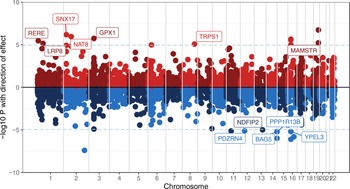
Of the 22 genes that survived Bonferroni correction (for the number of genes tested; pSMR <1.16 × 10⁻⁵), SMR analyses in the European-ancestry sample identified 12 convergent genes whose cross-disorder associations with AUD and SCZ were consistent with mediation via gene expression in the prefrontal cortex (PFC; the remaining 10 genes with pSMR <1.16 × 10⁻⁵ had pHEIDI <0.05, indicating pleiotropy outlier status; Figure 2; significant results in online Supplementary Table S15; full results in online Supplementary Table S16).
Genes in the convergent subset whose association with AUD and SCZ may be mediated by gene expression in the prefrontal cortex, analyzed using SMR. Genes in red show up-regulated gene expression, and genes in blue show down-regulated gene expression. The 12 labeled genes are significant after Bonferroni corrections and were not excluded as pleiotropic outliers (HEIDI-outlier method p > 0.05).

Differential gene expression enrichment analyses
Neither the convergent nor divergent genes identified in the European-ancestry sample were enriched in differential gene expression analyses of postmortem PFC tissue of individuals with SCZ (N cases = 258) v. controls or of AUD (N cases = 65) v. controls.
Genetic covariance and correlation
There was a significant positive genetic correlation (r g) between AUD and SCZ (rg = 0.392, p = 1.2 × 10−42). In sensitivity tests, the negative control measure of chronic ischemic heart disease was not significantly correlated with AUD but height showed a small negative correlation (rg = −0.093, s.e. = 0.021, p = 7.54 × 10⁻⁶). SCZ showed a nominal genetic correlation with heart disease (rg = −0.063, s.e. = 0.029, p = 0.032), but none with height.
LDSC-SEG (Finucane et al., Reference Finucane, Reshef, Anttila, Slowikowski, Gusev, Byrnes and Consortium2018) analyses that partitioned heritability enrichment by tissue-specific gene expression revealed significant enrichment for SCZ in three of 13 brain regions: the cortex, frontal cortex, and anterior cingulate cortex (FDR q-values <2 × 10⁻⁵), and for AUD in the anterior cingulate cortex (FDR q-value = 0.007; online Supplementary Fig. S6).
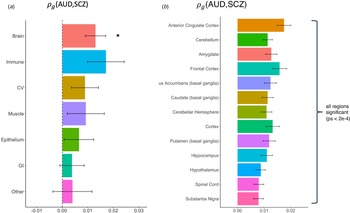
The genetic covariance (ρ g) of AUD and SCZ was significantly attributable both to functional regions of the genome (p = 1.0 × 10⁻⁸), including those specifically functional in brain tissues (p = 0.001; see Fig. 3a, online Supplementary Table S17) and non-functional regions (p = 1.5 × 10⁻¹⁹; online Supplementary Table S18), as well as all minor allele frequency quartiles except the lowest frequency quartile (p = 2.9 × 10⁻⁵–3.9 × 10⁻⁹; online Supplementary Table S19). While the point estimate of genetic covariance was highest in genes functional in immune tissues (ρ g = 0.017), this estimate had a relatively large standard error (0.007) and did not reach significance after multiple testing corrections. There were no significant findings when partitioning the genetic covariance between AUD and height or SCZ and heart disease into tissue-specific categories with GNOVA.
Stratified genetic covariance between AUD and SCZ. a: stratified by broad tissue type. Tissue annotations were defined using the GenoSkyline-Plus annotations. Significant tissues are starred. CV = cardiovascular; GI = gastrointestinal. b: stratified by 13 brain regions, defined using GTEx v6 gene expression data.

Because the genetic covariance of AUD and SCZ was significantly concentrated in brain tissues, we partitioned it further into 13 specific brain regions. We found significant concentrations of genetic covariance in all 13 brain regions tested, with the greatest concentrations in the anterior cingulate cortex (p = 7.6 × 10⁻¹²), frontal cortex (p = 3.3 × 10⁻⁹), cortex (p = 1.2 × 10⁻⁷), and amygdala (p = 3.1 × 10⁻⁹; online Supplementary Table S20, Fig. S3b).
Discussion
The prevalence of AUD is elevated in those with SCZ, relative to the general population. Although environmental factors likely play a large role in this comorbidity, there is some evidence that shared genetic influences may also contribute, with recent large GWAS of AUD documenting robust genetic correlations between AUD and SCZ (Zhou et al., Reference Zhou, Sealock, Sanchez-Roige, Clarke, Levey, Cheng and Gelernter2020b). Utilizing a subset-based meta-analytic approach, our cross-disorder analysis of AUD and SCZ identified 55 convergent loci with the same direction of effect on AUD and SCZ and eight divergent loci with opposite directions of effect that had lead SNPs with p < 0.05 in both individual disorders. The genetic covariance between AUD and SCZ was concentrated in genes functional in the brain, and eQTL analyses of the convergent subset of variants identified 12 genes whose association with AUD and SCZ may be mediated via gene expression in brain tissues.
In contrast to the robust genetic correlation between AUD and SCZ, prior studies have found that SCZ is uncorrelated with measures of typical alcohol consumption (e.g. with drinks/week, rg = 0.01, p = 0.67 (Liu et al., Reference Liu, Jiang, Wedow, Li, Brazel, Chen and Psychiatry2019)) or frequency of use (Marees et al., Reference Marees, Smit, Ong, MacGregor, An, Denys and Derks2020). Genetic correlations with indices that encompass heavy episodic drinking, such as the consumption sub-scale of the Alcohol Use Disorders Identification Test (AUDIT-C), are also lower (rg = −0.0003−0.04) (Kranzler et al., Reference Kranzler, Zhou, Kember, Vickers Smith, Justice, Damrauer and Gelernter2019; Sanchez-Roige et al., Reference Sanchez-Roige, Palmer, Fontanillas, Elson and Clarke2019) than those noted for AUD. A recent study suggests that indices of socioeconomic status may influence genetic correlations between measures of substance use and psychopathology (Marees et al., Reference Marees, Smit, Abdellaoui, Nivard, van den Brink and Denys2021); however, even after co-varying for SES, the genetic correlation between alcohol frequency and SCZ remained non-significant. The genetic correlation between drinks per week and SCZ remained significant and relatively unchanged (rg = 0.14–0.16), but markedly lower than the AUD-SCZ genetic correlation. This suggests that SCZ shares genetic variation primarily with the psychopathological aspects of problem drinking and AUD. Future studies that employ symptom-level GWAS, or GWAS of clinically relevant phenotypes (e.g. negative symptoms of SCZ), may yield further insights into whether this genetic overlap is specific to certain symptoms or aspects of these psychiatric disorders.
The top divergent SNP, rs13135092, in an intron of SLC39A8, was strongly associated with both AUD (p = 4.9 × 10⁻¹⁸) and SCZ (p = 7.9 × 10⁻¹⁶), with the A allele exerting a risk-increasing effect on AUD and a protective effect on SCZ. Comparison of summary statistics for over 4756 traits (Watanabe et al., Reference Watanabe, Stringer, Frei, Umićević Mirkov, de Leeuw, Polderman and Posthuma2019) indicated that the A allele was also associated with greater alcohol consumption, greater risk-taking, higher waist-hip ratio, lower bioelectrical impedance (i.e. greater adiposity) and higher systolic blood pressure, consistent with the direction of genetic association between these measures and AUD. However, the A allele was also associated with increasing cognitive performance, higher intelligence and with higher educational attainment – while the direction of these effects is consistent with the ‘protective’ effect of the A allele on risk for SCZ, it contradicts prior research showing an inverse genetic correlation between educational attainment and AUD. Given the convergent direction of associations with AUD and alcohol consumption, risk-taking, and cardio-metabolic traits, but divergent direction of associations with SCZ and cognition, we speculate that the A allele of rs13135092 may be related to milder AUD, typified by positive reward-related drinking and impulsivity that is effectively regulated by enhanced cognitive functioning.
Our top convergent SNP, rs6589386, is intergenic and is an eQTL for DRD2 in cerebellar hemisphere tissue; DRD2 has been implicated in both AUD (Kranzler et al., Reference Kranzler, Zhou, Kember, Vickers Smith, Justice, Damrauer and Gelernter2019) and SCZ (Consortium, 2014) GWAS. In addition to AUD and SCZ, this variant has been implicated in GWAS of neuroticism (Baselmans et al., Reference Baselmans, Jansen, Ip, van Dongen, Abdellaoui, van de Weijer and Bartels2019), subjective well-being (Baselmans et al., Reference Baselmans, Jansen, Ip, van Dongen, Abdellaoui, van de Weijer and Bartels2019), alcohol consumption (Liu et al., Reference Liu, Jiang, Wedow, Li, Brazel, Chen and Psychiatry2019), and cigarette smoking (Liu et al., Reference Liu, Jiang, Wedow, Li, Brazel, Chen and Psychiatry2019).
Consistent with recent reports demonstrating broad levels of pleiotropy amongst psychiatric disorders (Lee et al., Reference Lee, Anttila, Won, Feng, Rosenthal, Zhu and Smoller2019), including substance use disorders (Hatoum et al., Reference Hatoum, Johnson, Polimanti, Zhou, Walters and Agrawal2021), we found that 22 of the 55 top convergent SNPs and three of the eight divergent SNPs showed at least nominal significance across one or more of the six psychiatric disorders and substance use traits that we assessed. Depression showed the greatest extent of overlap with the convergent SNPs, with 10 of the 55 convergent SNPs having p < 0.0009 in the depression GWAS and only one of those exerting a different direction of effect relative to AUD and SCZ. Of the eight top SNPs in the divergent subset, both cigarettes per day and opioid use disorder were significantly (p < 0.00625) associated with two of those SNPs, with both variants showing the same direction of effect as for AUD (and opposite direction of effect from SCZ), again consistent with the pleiotropy observed among different substance use traits. While there may be individual loci and pathways that contribute uniquely to AUD and SCZ, it is evident that much of this genetic overlap may also be shared with other psychiatric disorders and substance use traits.
SMR eQTL analyses suggest that the effects of pleiotropic variants on AUD and SCZ may be mediated by expression levels of several genes in the prefrontal cortex (PFC; Figure 2). Several of the identified genes were previously implicated in GWAS of metabolic traits [including NAT8, TRPS1 (up-regulated), BAG5, PPP1R13B (down-regulated)], immunological traits (e.g. RERE, TRPS1, both up-regulated) and psychiatric phenotypes (e.g. up-regulated: LRP8, down-regulated: PPP1R13B). The data currently available do not permit examination of whether these findings extend to other brain regions.
We found no evidence for enrichment of genes pleiotropically associated with both AUD and SCZ when considering genes differentially expressed in the brains of individuals with AUD or SCZ (compared to respective controls). Unlike the SMR eQTL analysis described above, which reflects the genetically regulated portion of gene expression, the differential gene expression measured in autopsy samples likely reflects pathological consequences of the disorders (AUD and SCZ) and their treatments. However, our lack of findings could be due to limited statistical power in the RNAseq whole-genome transcriptome datasets, especially the post-mortem sample of individuals with AUD (N cases = 65).
There are several limitations of the current study. First, nearly all GWAS, gene expression reference datasets, and other bioinformatic resources are based on European-ancestry samples. Our African-ancestry GWAS samples were under-powered relative to the European-ancestry samples, and the SCZ sample more so than the AUD sample. Likely due to the statistical power differential, the African-ancestry results appeared to be driven almost entirely by the larger AUD GWAS. One of our motivations for conducting this cross-disorder analysis is to reduce inequity in downstream analyses of non-European populations; the genome-wide summary statistics from our cross-disorder GWAS could be used to generate PRS in independent cohorts of African-ancestry participants. Our findings underscore the need for vastly larger African-ancestry samples for studies of severe psychiatric conditions. Second, given the available data, we were limited to studying common genetic variation (minor allele frequencies >1%); thus, there may be rare variants of importance underlying the comorbidity between AUD and SCZ that are outside the scope of the current study. Third, in our sensitivity analysis, we found a significant negative genetic correlation between AUD and height (rg = −0.093, s.e. = 0.021, p = 7.54 × 10⁻⁶), which is likely driven in part by the large sample sizes and polygenic nature of both traits, though there is some evidence for this relationship in the literature. One previous study found a negative genetic correlation between alcohol consumption and childhood height in males (Clarke et al., Reference Clarke, Adams, Davies, Howard, Hall, Padmanabhan and McIntosh2017) (rg = −0.23, p = 0.002) and another study found a negative correlation between problematic alcohol use and comparative height at age 10 (rg = −0.09, p = 7.3 × 10⁻⁵), though this was not significant when a Bonferroni correction was applied for the 715 traits tested (Zhou et al., Reference Zhou, Sealock, Sanchez-Roige, Clarke, Levey, Cheng and Gelernter2020b). Another limitation of our cross-sectional design is that we are unable to establish whether shared genetic influences, as identified in this and previous studies, are causal factors for the comorbidity of AUD and SCZ. While we focused exclusively on genetic factors that influence the risk of AUD and SCZ, social and environmental factors are likely to play at least as large a role as genetic ones in the development and co-occurrence of these disorders, and our findings should be interpreted in light of this. Finally, while most of the AUD samples were screened for SCZ, some individuals among the SCZ samples very likely also had AUD. These potential cases of unknown comorbidity could have biased our estimates of genetic correlation and pleiotropic loci. Unfortunately, there are no data currently available on which SCZ samples were screened for substance use disorders to permit an estimation of such a bias.
While prior cross-disorder studies have provided foundational results for common psychiatric disorders, ours is amongst the first studies to focus on identifying pleiotropic loci for a substance use disorder, AUD, and SCZ. To understand the shared biology between substance use disorders and other psychiatric disorders, future efforts must include large numbers of individuals with AUD or problematic alcohol use rather than simple measures of consumption.
Supplementary material
The supplementary material for this article can be found at https://doi.org/10.1017/S003329172100266X.
Acknowledgements
The Psychiatric Genomics Consortium's Substance Use Disorders (PGC-SUD) working group gratefully acknowledges prior support from NIAAA and thanks all our contributing investigators and study participants who make this research possible. We acknowledge collaborations with the MVP, Psychiatric Genomics Consortium Substance Use Disorders Working Group, and GPC Investigators. A list of GPC investigators and the MVP Core Acknowledgement are provided in the Supplementary Materials. We are grateful to Luke Evans for helpful discussion of the manuscript.
Financial support
ECJ was supported by F32AA027435. RP was supported by R21DA047527 and R21DC018098. FRW was supported by F32MH122058. AA is supported by K02DA032573. REP is supported by NIMH K01MH113848 and The Brain & Behavior Research Foundation NARSAD grant 28632 P&S Fund.
This work was conducted using the summary statistics from the Psychiatric Genomics Consortium's Substance Use Disorders Working group. The Psychiatric Genomics Consortium's Substance Use Disorders (PGC-SUD) working group is supported by MH109532 with funding from NIMH and NIDA.
The GPC was supported by grants R01 MH085548 and R01 MH104964 from the National Institute of Mental Health (NIMH), and genotyping of samples was provided by the Stanley Center for Psychiatric Research at Broad Institute.
COGS was supported by grants R01 MH065571, R01 MH065588, R01 MH065562, R01 MH065707, R01 MH065554, R01 MH065578, R01 MH065558, R01 MH86135, and R01 MH094320 from the National Institute of Mental Health.
Funding support for the Whole Genome Association Study of Bipolar Disorder and the Genome-Wide Association of Schizophrenia Study was provided by the NIMH (R01 MH67257, R01 MH59588, R01 MH59571, R01 MH59565, R01 MH59587, R01 MH60870, R01 MH59566, R01 MH59586, R01 MH61675, R01 MH60879, R01 MH81800, U01 MH46276, U01 MH46289, U01 MH46318, U01 MH79469, and U01 MH79470) and the genotyping of samples was provided through the Genetic Association Information Network (GAIN).
This research is based, in part, on data from the Million Veteran Program, Office of Research and Development, Veterans Health Administration, with support from award #I01 BX003341 and the VISN 4 Mental Illness Research, Education and Clinical Center. This publication does not represent the views of the Department of Veterans Affairs or the United States Government.
Financial Disclosures
Dr Kranzler is a member of an advisory board for Dicerna Pharmaceuticals, a consultant for Sophrosyne Pharmaceuticals, and a member of the American Society of Clinical Psychopharmacology's Alcohol Clinical Trials Initiative, which was supported in the last three years by AbbVie, Alkermes, Dicerna, Ethypharm, Indivior, Lilly, Lundbeck, Otsuka, Pfizer, Arbor, and Amygdala Neurosciences. Dr Kranzler and Dr Gelernter are named as inventors on PCT patent application #15/878640 entitled: ‘Genotype-guided dosing of opioid agonists,’ filed January 24, 2018. Drs. Gelernter and Polimanti are paid for their editorial work on the journal Complex Psychiatry. Drs. Johnson, Kapoor, Hatoum, Zhou, Wendt, R.K. Walters, Lai, Kember, Hartz, Meyers, Peterson, Ripke, Bigdeli, Fanous, C.N. Pato, M.T. Pato, Goate, O'Donovan, J.T.R. Walters, Edenberg, and Agrawal have no disclosures or conflicts of interest to report.