μετέχουσιν μὲν τῆς πολιτείας οἱ ἐξ ἀμφοτέρων γεγονότες ἀστῶν, ἐγγράφονται δ᾽ εἰς τοὺς δημότας ὀκτωκαίδεκα ἔτη γεγονότες. ὅταν δ᾽ ἐγγράφωνται, διαψηφίζονται περὶ αὐτῶν ὀμόσαντες οἱ δημόται, πρῶτον μὲν εἰ δοκοῦσι γεγονέναι τὴν ἡλικίαν τὴν ἐκ τοῦ νόμου, κἂν μὴ δόξωσι, ἀπέρχονται πάλιν εἰς παῖδας, δεύτερον δ᾽ εἰ ἐλεύθερός ἐστι καὶ γέγονε κατὰ τοὺς νόμους. ἔπειτ᾽ ἂν μὲν ἀποψηφίσωνται μὴ εἶναι ἐλεύθερον, ὁ μὲν ἐφίησιν εἰς τὸ δικαστήριον, οἱ δὲ δημόται κατηγόρους αἱροῦνται πέντε ἄνδρας ἐξ αὑτῶν, κἂν μὲν μὴ δόξῃ δικαίως ἐγγράφεσθαι, πωλεῖ τοῦτον ἡ πόλις· ἐὰν δὲ νικήσῃ, τοῖς δημόταις ἐπάναγκες ἐγγράφειν. μετὰ δὲ ταῦτα δοκιμάζει τοὺς ἐγγραφέντας ἡ βουλή, κἄν τις δόξῃ νεώτερος ὀκτωκαίδεκ᾽ ἐτῶν εἶναι, ζημιοῖ τοὺς δημότας τοὺς ἐγγράψαντας. ἐπὰν δὲ δοκιμασθῶσιν οἱ ἔφηβοι … ([Arist.] Ath. Pol. 42.1–2)
Those who are descended from two citizens share in citizenship, and they are inscribed among the demesmen when they have reached eighteen years of age. When they are up for inscription, the demesmen take an oath and then have a vote about them, first as to whether they appear to be of legal age (and if they do not, they are put back among the children); and second if they are free and of legitimate birth. If the demesmen vote that a candidate is not free, he appeals to the Court, and the demesmen select five men from among their number as accusers; if the Court decides that he has been improperly inscribed, the city sells him [into slavery]. But if the candidate wins the case, the demesmen have to inscribe him. After this the Council reviews those who have been inscribed, and if it decides that someone is younger than 18 years, it fines the demesmen who inscribed him. And when the ephebes have been reviewed …Footnote 2
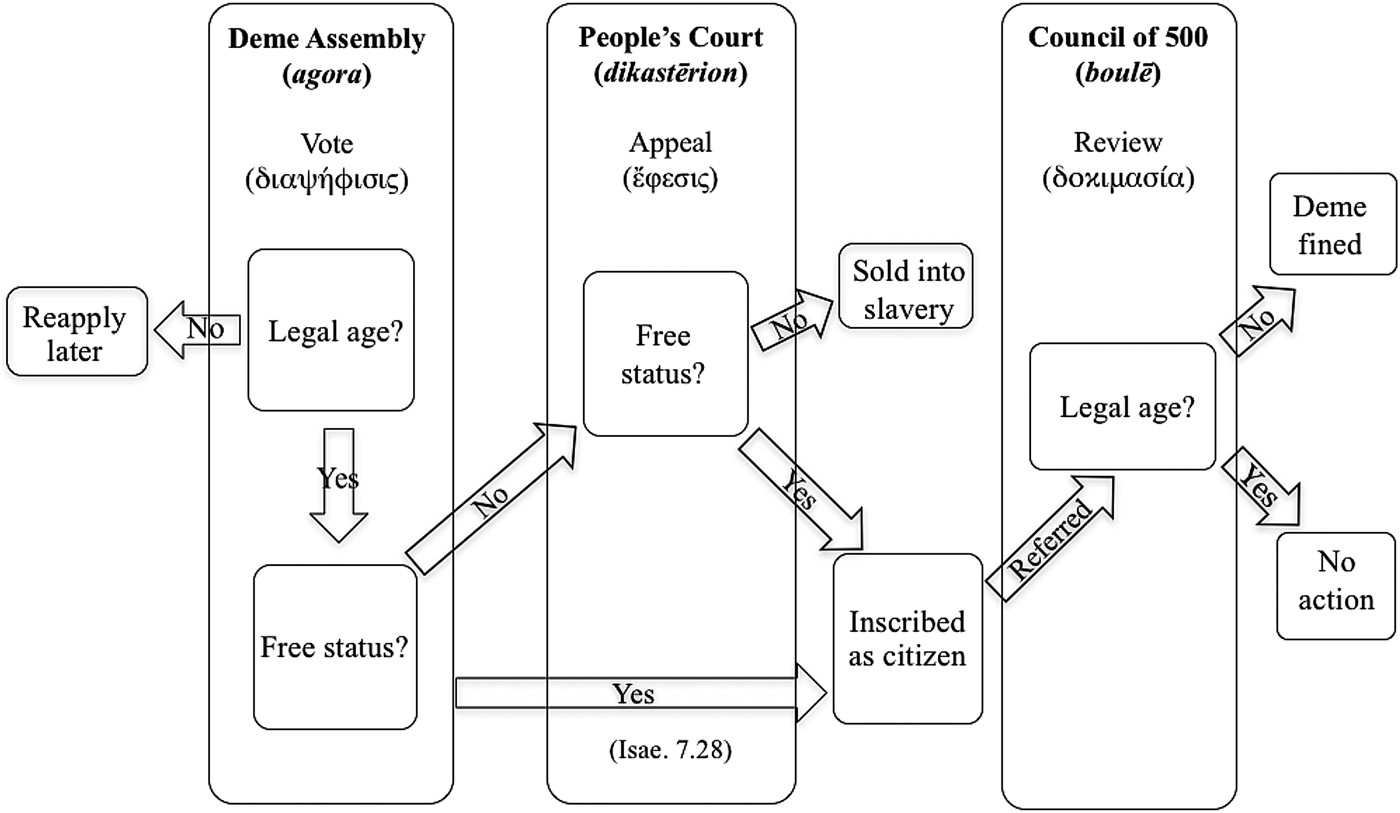
This passage provides invaluable evidence on the procedures pertaining to the admission of new citizens in Classical Athens. The picture that the author has given of the roles that were played by the institutions involved in these procedures is very clear: for the reader's convenience I display it in the form of a diagram in Figure 1. According to Ath. Pol., the deme voted on whether a candidate was both of legal age and of free status; if free status was denied by the deme, the candidate could appeal to the Central Court; and at the end of the process the Council of Five Hundred double-checked that the candidate was of legal age.Footnote 3
Citizenship procedures according to Ath. Pol. 42.1–2.

Rhodes, though, in his justly influential commentary, has rejected this account.Footnote 4 For Rhodes both the δικαστήριον and the βουλή must have verified both the legal status and the age of candidates for citizenship.Footnote 5 I argue here that Rhodes's view cannot ultimately be supported, and that there is no reason to dismiss the clear implication of the text.Footnote 6 This is important, since, if we follow what the text appears to be saying, it has considerable consequences for our understanding of Athenian citizenship procedures, as well as of the relationship between the central institutions of the polis and its various civil and religious associations. I will return to this broader point at the end of this paper.
Rhodes's discussion of our passage is necessarily compressed, but three main arguments emerge: that Ath. Pol. might not be entirely trustworthy on this point; that the system it describes is over-complicated; and that other sources show that Ath. Pol. is in error. Since Rhodes clearly relies more on this final argument than on the other two, my discussion of the first two points will be brief.
Rhodes is careful to precede his paraphrase of our passage with the condition that this is how things worked ‘if AP’s text gives a complete and accurate account of the procedure’.Footnote 7 Rhodes thinks that the second half of Ath. Pol. features a number of minor errors of omission and compression, probably owing to the fact that it represents one of the earliest attempts at systematic institutional analysis.Footnote 8 But he also gives us reasons for thinking that the author of Ath. Pol. is at his most trustworthy when he is describing how things worked in the Athens of his own day, and not when he is relating events of the distant past.Footnote 9 ‘We must remember that he will have been able to see the machinery of state working, and, if he was not Aristotle or a young or non-Athenian pupil but an Athenian who had reached a sufficient age, to take part in its working.’Footnote 10 We might add that (as noted by Rhodes) the author of Ath. Pol. was evidently someone with an unusual interest in complex constitutional procedures, as well as an unusual propensity to describe them in detail.Footnote 11 Our passage represents exactly the sort of task we would expect him to take up with enthusiasm, and to complete with some success—or, at least, without giving his readers entirely the wrong idea.Footnote 12
Rhodes's second objection (again made with the brevity enforced by the commentary genre) is that the procedures described in our passage are ‘improbably haphazard’.Footnote 13 It is difficult to see what this judgement is based on. It might be said that the procedures as described are eminently well-organized, even pleasingly symmetrical: after the deme rules on both status and age, its decision on status is subject to review by the δικαστήριον, and its decision on age is subject to review by the βουλή.Footnote 14 There seems nothing in the procedures themselves that would merit the charge of haphazardness.Footnote 15
But perhaps Rhodes means that the system is haphazard compared to other institutions found at Athens.Footnote 16 Again, it is hard to see what exactly this haphazardness might consist in; but we might reasonably suppose that Rhodes is offended by the apparent redundancy of the procedures, with three institutions and four votes where one institution and a single vote would have done perfectly well. (The deme assembly, say, could simply have been given the authority to decide once and for all whether a candidate fulfilled both of the criteria for citizenship.) But this redundancy is often seen at Athens; an example near to hand is that of the double induction of every new citizen into both a deme and a phratry.Footnote 17 As Rhodes himself admits, ‘Athenian law is not renowned for its tidiness’.Footnote 18
We have seen, then, that there is no reason to dismiss our passage a priori because of its incompleteness or inaccuracy; nor is there any reason to dismiss the historicity of the system it describes because of haphazardness. But Rhodes's most serious objections depend on appeals to a number of source-passages outside Ath. Pol. itself. His task would seem clear: for his alternative portrayal of Athenian citizenship procedures to be supported by the evidence, he needs to find indications in other sources 1) that the δικαστήριον ruled on a candidate's age as well as on his status; and 2) that the βουλή reviewed a candidate's status as well as his age.
The first passage Rhodes appeals to is from Aristophanes’ Wasps: ‘Ar. Vesp. 578, if pressed, would indicate that a δικαστήριον might also consider the criterion of age.’Footnote 19 The line in question runs as follows:
And Rhodes's thought-process is not an unreasonable one. Philocleon, the protagonist of the play, is obsessed with serving in the δικαστήριον. In this passage (458–631), he is enumerating the advantages he gains from being a δικαστής. If Philocleon as a δικαστής was in the habit of looking at boys’ genitals during a δοκιμασία, Rhodes seems to be thinking, then δικασταί must have assessed the age of candidates for citizenship as well as their status.Footnote 20
Nevertheless, there are a number of reasons why this line should not be taken as evidence that the age of candidates for citizenship was assessed in the δικαστήριον. For a start, this is a line from a comedy, and from a genre of comedy with a marked inclination towards obscene humour.Footnote 21 Moreover, it is spoken by a character who, even among the characters of Aristophanes, is notorious for being unscrupulous, greedy and lustful.Footnote 22 Still further, the line appears in a speech within an agôn in which Philocleon is attempting to convince his son, Bdelycleon, of the advantages of being a δικαστής, and thus to vindicate his lifestyle.
We should therefore be extremely cautious about using anything from this part of Wasps as historical evidence. To be sure, some of the points made by Philocleon contain accurate information about the Athenian legal system, and some of his jokes rely on beliefs that must have been widespread among the members of the audience.Footnote 23 But surely we must accept that some of the comments in this speech are gross exaggerations motivated by the agonistic pressures on the speaker; and some are pieces of pure comic fantasy, created by the playwright entirely for the purpose of raising an eyebrow or a giggle.Footnote 24 A too literal reading of the whole of the speech might force us to conclude, for example, that litigants in Athenian courts regularly appealed to the persuasive power of their daughters’ genitalia, or that daughters in Athenian households regularly inserted their tongues into their fathers’ mouths in order to fish out money.Footnote 25
Such points should be obvious enough, and Rhodes is too careful a scholar not to be aware of them. However, although he adds the disclaimer that this line would run counter to our passage only ‘if pressed’, he proceeds to press the line in a way that he has done nothing to justify. Worse, the statement that the line would support his view even if pressed is false. Even if we brush aside all considerations of genre, character and context (which we should not), this line still does not provide evidence for a judgment of candidates’ ages at the δικαστήριον.
A first problem is that, although Philocleon must be referring to his service in the δικαστήριον, he uses the participle δοκιμαζομένων. Strictly speaking, δοκιμασία was in the context of citizenship procedures the review carried out by the βουλή, not the appeal heard by the δικαστήριον (the ἔφεσις). But the word was also widely employed to refer to a broad subset of legal procedures. According to Rhodes, δοκιμασίαι in general were ‘checks on a man's qualifications for some duty or privilege’; and again according to Rhodes, ‘most δοκιμασίαι were held in the δικαστήρια’.Footnote 26
It seems impossible to rule out, then, that Aristophanes’ joke relies on the scenario of a man, serving in one of the δικαστήριον’s frequent δοκιμασίαι, finding time to sneak a peek at some adolescents who happened to be nearby. Admittedly there was usually no good reason for youths to be around the law courts, but of course they occasionally were present for various purposes (such as appealing to the jurors’ sense of pity: for this widely attested practice, see, for example, Ar. Vesp. 569).Footnote 27
We can, however, do slightly better than this. It would seem that among the many kinds of δοκιμασία which δικασταί were occasionally asked to oversee were some that involved the scrutiny of young men or boys. So much is suggested by the decree of Theozotides, which is concerned with the orphans of men killed by an oligarchic regime.Footnote 28 The boys are to receive an obol a day from the state; and at some point they are to undergo a δοκιμασία. That, at least, would seem to follow from Stroud's restoration of line 15, in which some singular person or institution is enjoined to scrutinize ‘them’ (almost certainly, the orphans).Footnote 29
Why should that singular agent not have been the δικαστήριον?Footnote 30 Stroud, who first published the inscription, wrote that ‘there is no evidence to connect the dokimasia carried out by the dikastai in Aristophanes’ Wasps, 578 with the war-orphans’. But since he immediately cited ‘MacDowell's good note’ on this line, he probably simply believed that the line was more likely to be associated with citizenship procedures than with orphans.Footnote 31 (Neither possibility is affected by other sources, so the claim that there is no evidence to support one of them is not very telling.) We have already seen that there are good reasons for rejecting MacDowell's views about this line, so it would seem that Stroud's reliance on him was ill-founded.
In view of that, there seems no reason not to believe that, when Aristophanes wrote line 578 of Wasps, he had the sort of scrutiny provided for by the Theozotides decree in mind. He was thinking, in other words, of one or other of the regular δοκιμασίαι overseen by the δικαστήριον, some of which, it would appear, involved children. It is not known exactly when scrutiny of war-orphans took place, but Stroud considers three possibilities: when the boys were first presented to the state; on an annual basis; and when they graduated into the ἐφηβεία. (Of course, any combination of these is also possible; for example, boys who were initially scrutinized when they were orphaned might have been assessed again every year.)Footnote 32
It is enough for my purposes here that the decree may provide evidence for regular scrutiny of children by δικασταί. But if war-orphans were assessed when they were in their early teens, it might give us two further reasons to link our decree with line 578 of Aristophanes’ Wasps. First, it would make Philocleon's reference to παῖδες more natural than it is when we link it (with Rhodes) to the scrutiny of eighteen-year-olds trying to gain citizenship.Footnote 33 Second, it would mean that Philocleon was expressing lust not for eighteen-year-olds but for fourteen-year-olds or fifteen-year-olds, a more typical preference for Greek pederasts.Footnote 34
Whether or not Aristophanes was referring to the scrutiny of orphans in particular in line 578 of Wasps, the idea that youths regularly (or even occasionally) submitted to δοκιμασίαι by δικασταί gives his joke point. It thus rounds out my argument that we should not take the line as evidence that δικασταί must have examined boys during the citizen procedure. In claiming above that the line should not be taken too seriously, I left myself open to an objection. Surely, the objection might have run, Aristophanes is not simply inventing the situation of jurors looking at boys wholesale? The scenario of sporadic examinations, for different purposes, of boys by jurors raised by the Theozotides inscription provides exactly the kind of context that would have given Aristophanes’ joke purchase.Footnote 35
So much for the decree of Theozotides. Let us now return to the main path of our enquiry, in which we were considering the possible use of δοκιμασία and related words to refer to a subset of procedures which usually involved δικαστήρια. Another possibility is that Aristophanes is using the term to refer to the whole procedure illustrated in Figure 1. The citations in LSJ (s.v. δοκιμάζω) for meaning II.b, ‘to examine and admit boys … to the rights of manhood, to let pass the δοκιμασία’ (Dem. 27.5; Isoc. 12.28), seem to use the word to refer to the entire procedure, rather than specifically to the final review (as do many modern scholars, as we shall see).Footnote 36 So, it is quite possible that Aristophanes is also using the word in this sense.
But, even if that were the case, Rhodes would still need Ar. Vesp. 578 to provide evidence that δικασταί were involved specifically in judgments about candidates’ ages. And though there are a number of ways of taking the line so that it produces such evidence, none of them stands up to scrutiny. One is by taking the line itself to tell us that boys were being assessed as to their age; another is by deducing that δικασταί passed judgment on the age of boys from the fact that they looked at their genitalia; and the last is by supposing that the line tells us not that δικασταί regularly examined the genitals of boys but that they regularly examined them for something, and that this something was their age.
The first possibility, that the line as it stands tells us that candidates were being assessed as to their age, would depend on taking the phrase παίδων τοίνυν δοκιμαζομένων to mean something like ‘when the boys are being assessed as to whether they are boys [or men]’. But Aristophanes would surely have found a way of expressing this idea more clearly if it was indeed what he intended to say, whatever the pressures of metre and phrasing that he had to contend with as a poet.Footnote 37 And even if good parallels could be found for reading the sentence in this way, it would have to be admitted that it is hardly the most natural way of taking the line.Footnote 38 It is difficult to imagine that a member of the audience would have understood the phrase in this way, or that Aristophanes would have expected him to—and, indeed, Rhodes does not explicitly consider this interpretation.
The second possibility was that we can infer from Philocleon's habit of looking at the genitals of boys that δικασταί must have been doing so in order to pass judgment on the age of candidates. Here, again, we should remember the points made above about genre, context and character. That a particularly dirty-minded character in an Aristophanes play says that you could, as a δικαστής, look at the genitals of young men does not establish that you in fact could. But let us imagine, without justification, just for a moment, that it does. We should still not infer that δικασταί examined the age of candidates for citizenship, for one very important reason: candidates had to be eighteen to be citizens, not thirteen or fourteen, and examining a young man's genitals would not have helped anyone decide whether a candidate had reached the age of eighteen or not.Footnote 39 The presence or absence of pubic hair might have helped them decide whether a candidate had reached puberty; but that would have been irrelevant to the question of admission to the citizen registers.Footnote 40
The final possibility was that this line tells us nothing about what most δικασταί were looking at during the scrutiny of candidates for citizenship, but it still indicates that δικασταί judged the age of youths during citizenship procedures. On this view, the particular form of activity engaged in by Philocleon in the δικαστήριον is an aberration—caused either by Philocleon's especially lustful character or by the generic demands of Old Comedy. But there was a δοκιμασία in the δικαστήριον; and most of the actual historical members of this body did not use their time in office to sneak a peek at the genitals of the incoming generation of Athenian citizens.Footnote 41
The problem with this view is that, once we admit that there is no evidence that δικασταί regularly surveyed candidates’ genitalia, or that even if they did, this would give us no reason to conclude that they passed judgment on their age; once we have admitted either of these propositions, there remains no reason to infer from this line that age ever came up for review by a δικαστήριον. The existence of this joke in Aristophanes would make perfect sense if δικασταί regularly met young men to assess them for some completely different reason—for example, to ensure that they had the right legal status. And this, of course, is exactly what our passage tells us.Footnote 42
The line from Aristophanes’ Wasps that is quoted above does not, then, establish the first half of Rhodes's picture of citizenship procedures. It does not establish that the δικαστήριον passed judgment on the age of candidates for citizenship. But note that Rhodes has so far done nothing to support the second half of his alternative vision of citizenship procedures: he has cited no passage that shows that the βουλή passed judgment on a candidate's legal status. But he does cite two more passages that we have yet to discuss.Footnote 43
Rhodes writes that ‘in the general review’ of citizens ‘of 346/5 Euphiletus, rejected as a ξένος by the deme of Erchia, and Euxitheus, rejected as a ξένος by the deme of Halimus, appealed to a δικαστήριον against their rejection (Isae. XII Euph., D. LVII Eub.)’.Footnote 44 But this supports neither of the two points that he needs to establish. It does not show that the δικαστήριον passed judgment on the age of candidates for citizenship; nor does it show that the βουλή passed judgment on their legal status. Rather, it shows that decisions concerning the legal status of candidates (including whether or not they were ξένοι ‘foreigners’) were made in the δικαστήριον; and this is entirely consistent with our passage.
Rhodes's view also has the disadvantage of rendering problematic Ath. Pol.’s statement that the candidate rejected by the deme ‘appeals to the δικαστήριον’. Rhodes writes that ‘until he has been registered as an adult citizen a man cannot initiate proceedings in the courts: presumably the appeal was made by the candidate's father or guardian’.Footnote 45 But it is surely easier simply to accept the assertion of the text that what was at issue in the ἔφεσις was citizen status and not age. If that was the case, it would have been taken for granted, at least until the review by the βουλή, that the candidate was over eighteen. He would thus have been allowed to bring his own appeal to the court—and our passage states quite clearly that this was in fact the regular procedure.
A final point. Rhodes's view of citizenship procedures places considerable authority in two central institutions—the δικαστήριον and the βουλή—at the expense of the deme ἀγορά (and of other associations, especially the phratries).Footnote 46 In Rhodes's view, the βουλή emerges as the decisive institution in the registration of new citizens, since, although both the deme ἀγορά and the δικαστήριον also rule on both of the criteria for citizenship (status and age), the βουλή has the final say on both counts. Our passage, however, offers a reason to doubt that the βουλή played this decisive role, quite apart from the reasons I have already given to doubt Rhodes's alternative construction of citizenship procedures.
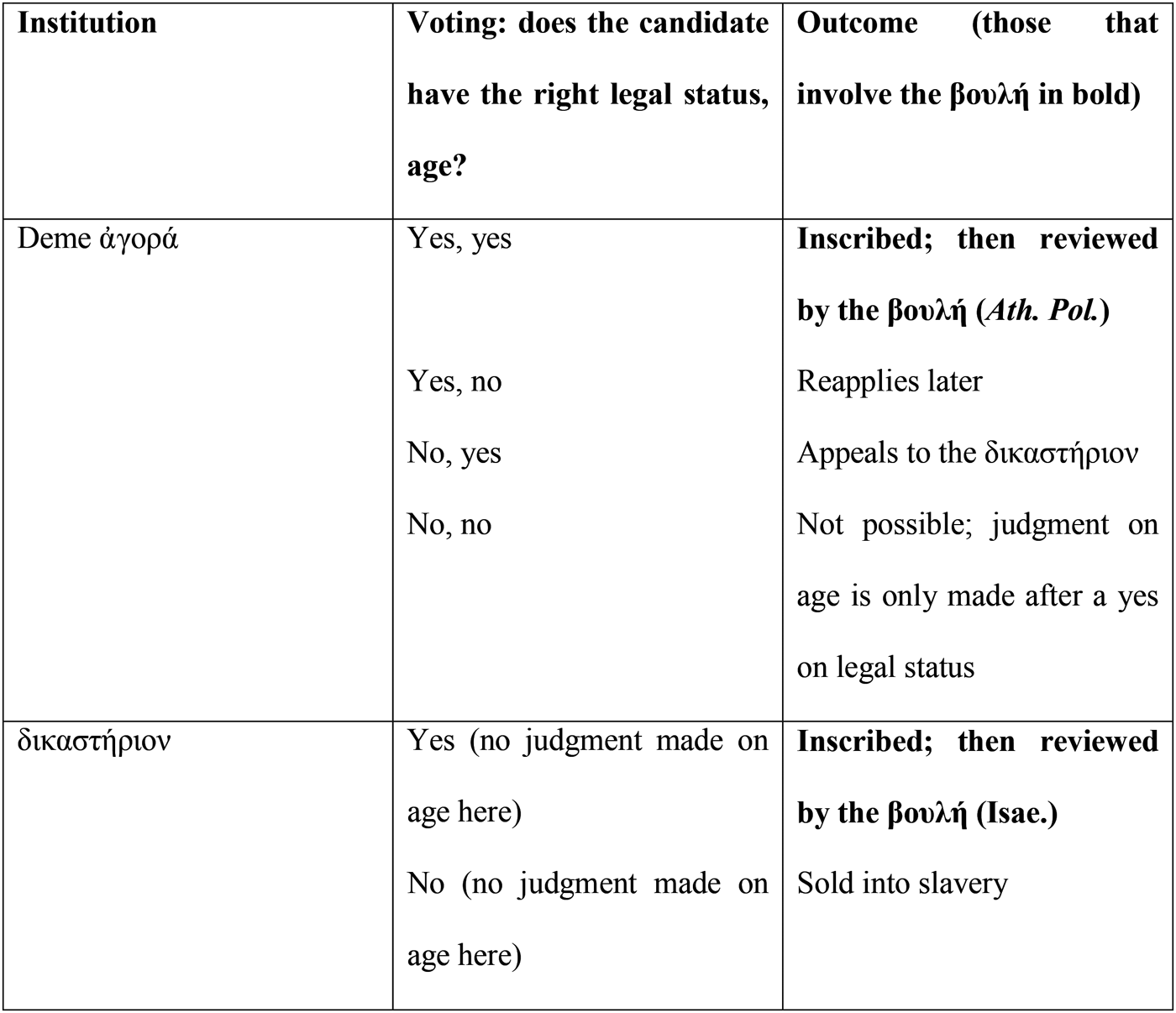
We have seen that our passage provides quite a clear description of what roles were played by the various institutions involved in citizenship procedures. What we have not yet noticed is that it also tells us quite clearly when the names of new citizens were inscribed in the deme registers.Footnote 47 As Figure 2 makes clear, whatever happens in a particular case, the candidate's name is always inscribed after the votes of the deme ἀγορά and the δικαστήριον but before the vote of the βουλή. The Figure merely illustrates what the text tells us (when supplemented at one point by one other source).
Possible outcomes of voting in citizenship procedures

The text says that, ‘if the candidate wins the case [at the ἔφεσις in the δικαστήριον], the demesmen have to inscribe him’ (this quotation describes the situation marked with Ath. Pol. in Figure 2).Footnote 48 It then goes on immediately: ‘after this the Council reviews those who have been inscribed’;Footnote 49 our passage thus does not tell us if this includes both those who have been registered after a successful appeal and those who had no need to make an appeal, having been passed on both criteria by their deme. But that this was ordinarily the case is suggested by a passage in Isaeus (which illustrates the scenario marked Isae. in Figure 2).Footnote 50
There is thus no scenario in which a candidate reaches the βουλή without already having been registered as a citizen. This may seem odd, but it is supported by the tenses in this crucial sentence: ‘after this the Council reviews those who have been inscribed, and if it decides that someone is younger than 18 years, it fines the demesmen who inscribed him.’Footnote 51 It is clear from this that the βουλή reviews citizens after they have already been inscribed; and that the fine that it can inflict on demesmen is a post hoc measure that does not necessarily have any impact on the registration of a new citizen.Footnote 52 (It is not even clear if the βουλή has the power to force the deme to erase an inscribed name from its registers.Footnote 53 )
If this is right, though, it raises the question of why the βουλή conducted a review of the age of candidates at all. Part of the answer is, obviously, that it created an incentive for demesmen not to inscribe candidates who were not yet eighteen years of age.Footnote 54 As we have seen, there is no evidence that a deme that did so could be forced to annul its decision, but a deme that was fined on one occasion would naturally be inclined to be more careful in the future, and other demes that heard of the fine would want to avoid being forced to pay one themselves. All the same, if this was all that was going on, we might expect citizens’ names to be inscribed only after the final review, since this would allow the βουλή direct control over which candidates become new citizens.
A clue to what else is going on here is provided by the final phrase of the passage, as I quoted it at the beginning of this piece. It reads: ‘and when the ephebes have been reviewed …’.Footnote 55 The implication that candidates were already ephebes when they submitted to the review of the βουλή further supports the idea that the final review merely rubber-stamped the registration of a new citizen, an act which was by that time a fait accompli.Footnote 56 But it also suggests a new perspective on our passage, one which is supported by its context.
The rest of section 42 of the Ath. Pol. is concerned with the ἐφηβεία. If we take this final part of our passage as quoted above to provide a link to this topic, the final review in the βουλή emerges not as the decisive checkpoint for the credentials of new citizens but as a final confirmation that the young man in question is ready to begin his period of military service. This is why the βουλή only checks a citizen's age (besides the fact that his status has already been checked in the δικαστήριον): because the point at issue here is no longer whether he should be a citizen; it is, granted that he is already a citizen, whether he is really old enough to begin serving as a soldier of his polis.Footnote 57
And, we might add, whether he is really old enough to begin fulfilling the other duties—and enjoying the other rights—of full citizenship. I am not, of course, referring to the βουλή, the δικαστήριον or the magistracies, since a citizen had to be thirty years old, not eighteen, in order to participate fully in one of these.Footnote 58 I am referring mainly to the ἐκκλησία, although the point is not a simple one.Footnote 59 Hansen is probably right that citizens had to be twenty years old to attend or speak in the ἐκκλησία in the fourth century.Footnote 60 So, if the δοκιμασία in the βουλή existed in the fifth century, its effect may have been to grant a young man admission to the ἐκκλησία.Footnote 61 (It did not approve him for the ἐφηβεία, which probably did not yet exist.Footnote 62 ) The author of Ath. Pol. naturally focusses on the ἐφηβεία, since that is what the δοκιμασία certified a citizen for in his day.Footnote 63
What would happen to a young man who was inscribed as a citizen by his deme but was told by the βουλή that he was not yet old enough to begin his ephebic service? Our passage from Ath. Pol. does not tell us, but we may speculate that he was simply told to reapply later. This, after all, is what happened to candidates who were judged not to be old enough by their deme ἀγορά (something our passage does tell us). The two situations are similar but not identical, since a young man rejected by his demesmen as too young was not yet an inscribed citizen, whereas a young man who failed the review by the βουλή was. He would thus have existed in a sort of limbo between attaining citizenship rights and being able to exercise them.Footnote 64
That this scenario was occasionally a reality may be supported by a passage in Demosthenes. From Dem. 27.4 and 27.6 it has been inferred that Demosthenes became a citizen when he was seventeen years of age. Sealey suggested that our passage in Ath. Pol. should be taken to mean that a citizen was inscribed in the eighteenth year of his life. Golden argues instead that Demosthenes was inscribed as a citizen in July 366, before he had turned eighteen, that he turned eighteen in August or September, and that he began serving as an ephebe in October. If this is right, the month or two that Demosthenes spent as a citizen, but not as an ephebe, in the late summer of 366 provides a perfect example of the state of limbo that we speculated might have existed above.Footnote 65 Citizens such as Demosthenes would no doubt have applied for citizenship in anticipation that they would be old enough to serve in the ἐφηβεία in due course.
In this piece I have argued that Rhodes's objections to the natural reading of Ath. Pol. 42.1–2 cannot stand. I want to close now by reiterating the importance of the point to larger issues in the study of Athenian democracy. In Rhodes's vision, as we have seen, the central institutions of the δικαστήριον and the βουλή have as much power as the deme ἀγοραί (with each of these three institutions checking both criteria for citizenship). The role of the βουλή, as the final decision-making body in this chain of three, is decisive. Whitehead, following Rhodes, grants similar powers to the central institutions, stating that ‘the courts sought to ensure that nobody was improperly excluded; the Council was watchful lest anyone be improperly included’.Footnote 66
If what I have argued here is right, we should instead accept the clear meaning of the text of Ath. Pol. 42.1–2. If we do, we will have to come to a very different view of the relative importance of the various groups involved in Athenian citizenship procedures. In this revised view, the courts did not seek to ensure that nobody was improperly excluded in any general sense; they simply heard appeals on the issue of the legal status of candidates. The Council was not watchful lest anyone be improperly included on whatever grounds; it simply confirmed that new citizens were old enough to commence the ἐφηβεία.Footnote 67
The real decision—the only vote that was neither an appeal nor a review—had already been taken.Footnote 68 It was taken in the double vote of the deme ἀγοραί in the very first stage of the procedure described in our passage. This makes perfect sense, since it was in the demes that the names of successful candidates for citizenship were inscribed. The vote of the demes, of course, had usually been preceded by admission in the candidates’ phratries and, very likely, in other smaller associations.Footnote 69
Ath. Pol. 42.1–2 is, then, ultimately incomplete, though not in the way in which Rhodes accused it of being. It gives a complete and accurate account of the role of the polis-level institutions that were involved in the registration of new citizens. But the author of the Ath. Pol., an expert in the comparative study of polis constitutions, was not as interested as he might have been in the network of civil associations that undergirded the institutions of the central polis.Footnote 70 This is where much of the real work in checking the purity and worth of new citizens lay; but that is another issue, and one which Ath. Pol. 42.1–2, for all its clarity, can shed little light upon.