





Here seven visions, seven liquid sculptures vanished through computerized calculations of a country ceasing to be human in order to become a chilly corporation, nothing more.
(Carlos Drummond de Andrade, Farewell to Seven Falls)
In October 1982, the Guairá Falls on the Paraná River (known as Saltos del Guairá in Paraguay and Sete Quedas in Brazil) – then the world’s largest waterfall system by volume – were submerged beneath the reservoir of the Itaipu Dam. Planned under the 1973 Itaipu Treaty, the dam was a massive hydroelectric project jointly undertaken by Paraguay and Brazil. Construction began in 1975 and took nearly a decade to complete, with power generation starting in 1982. Celebrated as one of the greatest civil engineering achievements of the twentieth century and voted one of the seven wonders of the modern world by the American Society of Civil Engineers, Itaipu remains the hydroelectric facility with highest energy production in the world (see Figure 1). Itaipu is, however, not just a big dam. It operates as what Christine FolchFootnote 1 calls a “political-electrical machine” that does not generate energy only as a resource but also as a form of “cultural production” that actively shapes social, political, and economic realities. The name Itaipu therefore not just refers to the hydroelectric dam but also to Itaipu Binacional, a powerful binational company co-owned by Paraguay and Brazil.
The Itaipu Dam spillway (®author).

In Paraguay, Itaipu’s financing of large-scale conservation initiatives and strategic infrastructure projects, including the Bioceanic Bridge as part of the Bioceanic Corridor linking Atlantic and Pacific trade routes,Footnote 2 has positioned it as a central political actor and helps to explain the reluctance to openly critique Itaipu within Paraguay. Today, the dam also presents itself as a site of industrial heritage and national pride. It has opened its doors as a working heritage complex that showcases the dam and its massive 1.350 km2 as a “green infrastructure”Footnote 3 that provides benefits for food production and clean, renewable energy. Since its inception, the Paraguayan state and Itaipu authorities have worked to consolidate Itaipu’s official status as a monumental feat of engineering and a world leader in clean energy production and biodiversity conservation. In doing so, they have curated a national narrative that frames Paraguay’s collective memory of the dam as a symbol of progress and modernity.Footnote 4 The scale of the enterprise was undoubtedly staggering: Six high-capacity concrete plants were built on site, and the dam used volumes of concrete 15 times greater than the Channel Tunnel connecting France and England, as well as enough iron and steel to construct 380 Eiffel Towers.Footnote 5 Such colossal works, however, required not only unprecedented engineering but also sweeping legal and territorial interventions to make space for the Itaipu megaproject.Footnote 6 In fact, the latter’s impact on the Paraná River and its flow was so extreme that the New York Times Footnote 7 wrote that it permanently changed the map of South America.
To the Paraguayan population, the Guairá Falls were more than a natural spectacle. Together with the Paraná River, they held deep historical, ecological, and geopolitical significance. For Guaraní Indigenous peoples in particular, the river and falls shaped cosmologies, subsistence practices, and spiritual lifeworlds. The very name Itaipú derives from Guaraní and translates as “the stone that sings”Footnote 8 – a reference to the deafening sound of water cascading over the river’s rock formations. The Paraná River also functioned as a transboundary waterway whose waterfalls long marked a contested boundary shaping the territorial imaginaries and political economies of Paraguay and Brazil.Footnote 9 The construction of the dam and its massive reservoir were meant to drown, quite literally, the source of territorial disputes between the neighboring nations. To achieve this, the rock faces were dynamited to eliminate navigation hazards, and in the process, the Guairá Falls were rendered irretrievable. Framed as a necessary sacrifice for national “progress,” contemporary media coverage heralded the dam as a technological marvel – a phoenix rising from the ashesFootnote 10. Yet critics have denounced the flooding not only as “the greatest loss of the planet’s scenic heritage”Footnote 11 but as an “ecological holocaust”Footnote 12 that points to the violent landscape transformations underpinning authoritarian development in twentieth-century South America.Footnote 13
In Paraguay, these transformations were not isolated ecological events but part of a broader strategy of authoritarian modernization that sought to reconfigure entire ecologies in order to consolidate state power. The Itaipu Dam thus stands as a striking example of what Amitav Ghosh refers to as “colonial terraforming.”Footnote 14 For Ghosh, colonization was never only about drawing lines on maps but about radically altering landscapes through various forms of industrialization including agriculture, the introduction of domesticated animals, and infrastructural megaprojects. The processes, he shows, often produce large-scale ecological damage and human displacement in the service of extractive and imperial logics of nation-building with impacts extending well beyond the moment of implementation.
Building on Ghosh’s concept, I argue that terraforming also operates through heritage-making practices and processes of heritagization. Using the Itaipu Dam as a case study, I examine how ecological destruction and territorial dispossession are subsequently reframed through conservation and natural heritage discourses that present themselves as forms of ecological care. I use the term “green heritage” to describe the discursive and territorial reframing of extractive or authoritarian landscapes as sites of environmental value. In this sense, I do not understand green heritage as pristine nature detached from history, but as the rebranding of ecological loss and authoritarian territorial reordering as environmental stewardship. In their work on the rise of environmentalism under Stroessner, Capellini Carvalho de Oliveira and Gómez FlorentínFootnote 15 have shown that environmental policies developed alongside the Itaipu dam project during both the Brazilian and Paraguayan dictatorships, with conservation initiatives embedded within authoritarian development strategies and at times used to justify the dam’s environmental footprint and mitigate any potential criticism. Within this context, the dam’s industrial legacy thus extends beyond the hydraulic energy infrastructure itself to include the conservation landscapes that were created around it. Natural reserves, biosphere corridors, and environmental governance regimes must therefore be understood not as separate from dams, turbines, and transmission lines but as integral components of the same industrial heritage complex through which authoritarian terraforming is enacted, normalized, and legitimized.
As a result, I approach industrial heritage not as a bounded site or finished past but as an ongoing assemblage of infrastructure, environmental governance, and heritage-making practices that continue to shape landscapes and socioecological relations. Here, I align with scholars who challenge the treatment of industrial heritage as a form of nostalgic commemoration of technological achievement.Footnote 16 However, while existing work has highlighted both the negative environmental impactsFootnote 17 and the more-than-human entanglements of industrial legacies and their ongoing material transformations,Footnote 18 I extend these insights by arguing that natural heritage and conservation initiatives must themselves be understood as integral components of the industrial heritage complex through which infrastructural violence is stabilized and legitimized. To develop this argument, I will first situate Itaipu within the history of authoritarian modernization and neo-extractivism before I discuss how conservation zones and heritage designations recast Itaipu’s “zona de influencia” (zone of influence) as a green landscape. Finally, I will turn to Indigenous territorial ontologies and debates on repair and reparation to show how green heritage operates as a form of post-extractive governance that produces curated ecological peace while leaving historical and ontological injustices unresolved.
Authoritarian terraforming and Indigenous dispossession
The destruction of the Guairá Falls was emblematic of the broader authoritarian modernization strategy pursued under Alfredo Stroessner’s dictatorship in Paraguay. Large-scale projects such as roads, dams, and industrial facilities were promoted as symbols of national progress, while the human displacement, repression, and ecological destruction that accompanied them remained largely obscured or was presented as a necessary step toward a modern state.Footnote 19 Infrastructure thus functioned not only as a technical intervention but as a political instrument through which territory, populations, and ecologies were reorganized, as illustrated by megaprojects such as the Trans-Chaco Highway. Until the building of the Bioceanic Corridor in 2020, it was the longest road in Paraguay, cutting through dry forest ecosystems and Indigenous territories to integrate remote regions into what Joel Correia describes as a “racial geography of settler-colonialism.”Footnote 20 Within this economy, Correia argues, developments such as the Trans-Chaco Highway operate simultaneously as “racial infrastructure[s]” and “spatio-temporal projects,”Footnote 21 which function as forms of governance that dispossess Indigenous communities and exclude them from accelerated capitalist modernity. The construction of the Itaipu Dam embodied this same coercive and exclusionary model of modernization. While officially celebrated as a source of clean energy and a feat of industrial engineering, the dam’s environmental footprint and sociocultural impacts were and continue to be enormous. In her work on transboundary water governance in the Yarmouk Tributary of the Jordan River Basin in the Middle East, Muna Dajani notes that water control systems such as dams transform rivers into securitized territorial environments that produce forms of slow and cumulative violence that marginalize local communities and reshape their relationships with water and land.Footnote 22 According to Dajani, these infrastructures are “not just banal assemblages of pipes and pumps separate from people and land” but become socio-ecological environments themselves.Footnote 23 Similarly, entire ecosystems and habitats of significant biodiversity were destroyed along the Paraná River. The flow of the river was permanently altered and produced long-term ecological transformationFootnote 24 and the loss of local environmental knowledge.Footnote 25
Beyond its ecological impacts, Itaipu has been denounced by the Asociación Yvy Parana Rembe´ýpe, an Ava Guaraní advocacy group demanding reparations for exile and ethnocide, as a “camouflaged genocide” that generated profound social and territorial consequences, particularly for Indigenous communities along the Paraná basin.Footnote 26 On the Paraguayan side of the river, the creation of its reservoir submerged more than 134,000 hectares of land, displacing 38 Avá Guaraní Paranaense communities comprising 688 families.Footnote 27 In her account of what she terms the “systemic genocide” of the Avá Guaraní Paranaenses, Sister Mariblanca Barón documents the forced relocation of families, mostly without adequate compensation, to resettlement areas lacking sufficient housing, health services, and arable land.Footnote 28 Entire communities were fragmented and ancestral territories inundated, including thousands of archaeological sites, a tiny fragment of which were hastily recorded by a team of Itaipu contracted specialists.Footnote 29
Projects such as Itaipu opened the Atlantic Forest to large-scale colonization and mechanized agriculture, supported by infrastructure works, land law reforms, and incentives for Brazilian settlers.Footnote 30 In his book on Itaipu’s role in the deforestation of the Upper Paraná Atlantic Forest and the uprooting of Indigenous communities, Jesuit anthropologist Bartomeu Melià concludes that environmental destruction is inseparable from the erasure of Indigenous lifeworlds.Footnote 31 Yet, despite large swathes of forest expropriated for the dam not being submerged, they were not returned to displaced Indigenous communities. According to Barón, 99,741 hectares were turned into protected nature reserves, while other areas were transferred to regime loyalists and agribusinesses, particularly Brazilian soy producers.Footnote 32 In his discussion on the expansion of soybean farming along the Paraguay–Brazil border, Correia argues that the systematic soybean territorialization of Paraguay follows an entrenched frontier logic that produces a slow violence of “racialised dispossession” inflicted on Indigenous peoples.Footnote 33 Despite recent initiatives outlining mechanisms for Indigenous land recuperation, the unresolved issue of the “tierras malhabidas”Footnote 34 or ill-gotten lands, that is land unlawfully acquired and deforested by elites under dictatorship, remains central to ongoing struggles over land rights and environmental justice.
What emerges from these transformations is a model of ongoing authoritarian terraforming: the radical remaking of landscapes and ecologies that eliminates Indigenous territorial rights and ontologies in the service of capitalist modernization. Authoritarian terraforming however, not only reconfigured landscapes and communities. It also laid the groundwork for territorial strategies later framed and legitimized as biodiversity conservation and environmental stewardship. These processes also produced a form of authoritarian heritage that is not only hydroelectric but also eco- and genocidal. It is a legacy that represents the systematic erasure of the environment and Indigenous lifeworlds in the name of development and encompasses a landscape rebranded as modern, national, and triumphant, while its violent extractive origins are selectively erased.
Green heritage
The dynamics outlined previously can be further understood through critical perspectives on development and extractivism in Latin America. As Arturo Escobar demonstrates, development operates as a discursive regime that universalizes Western notions of progress while marginalizing Indigenous epistemologies and alternative lifeworlds.Footnote 35 Building on this critique, Eduardo Gudynas introduces the concept of neo-extractivism to describe how Latin American states, often under progressive or post-neoliberal banners, continue to accumulate wealth through resource extraction, while reframing that approach as sustainable, fair, and beneficial for the respective nation.Footnote 36 In this context, ecological devastation and territorial enclosure are not abandoned but rearticulated as socially responsible development. Thus, even when presented as progressive and inclusive, neo-extractivism risks reproducing deep socio-ecological harm.Footnote 37 While these perspectives illuminate the discursive and political-economic dimensions of extractive development, they also invite closer attention to the spatial and historical processes through which such transformations are materialized. Building on Ioris’sFootnote 38 argument that Paraguay constitutes a “subtractive geography” embedded within a longer colonial nation-building apparatus, development can be understood as a modernist state project that accumulates capital through the elimination of Indigenous lifeworlds and produces spaces “less than before.” Ioris terms this dynamic “socio-spatial uncommoning,”Footnote 39 which he understands as a process of othering, grabbing, and territorial reordering that does not merely dispossess but restructures reality in ways that render Indigenous worlds marginal, fragmented, or illegible. Read in this light, large-scale infrastructure projects emerge not simply as instruments of extraction but as instruments of governance, designed to reorder territory and silence alternative ways of being.Footnote 40
This reframing operates through a set of interconnected processes of green territorialization, green grabbing, and heritage designation that structure how transformed landscapes are classified, governed, and legitimized. Green territorialization refers to the reorganization of space through conservation zoning, ecological corridors, and environmental planning regimes that render landscapes legible and governable.Footnote 41 These interventions frequently enable processes of “green grabbing,” which Fairhead, Leachm and Scoones define as “the appropriation of land and resources for environmental ends,”Footnote 42 As Correia argues, green grabbing in Paraguay is not a break from earlier dispossession but a continuation of racialized frontier governance, in which control over land is reshaped through agrarian expansion and environmental regulation.Footnote 43 Beyond material transformations, these processes operate discursively, presenting extraction and dispossession as environmental stewardship.Footnote 44
This feeds directly into what this paper calls “green heritage.” When referring to green heritage in its traditional sense, the term is used to denote natural heritage and conservation practices framed as supporting biodiversity and sustainability. Within this authorized discourse, green heritage is associated with the preservation of pristine or exemplary landscapes, the protection of endangered species, and the safeguarding of ecosystem services for global benefit.Footnote 45 National parks are arguably the most famous example of this celebratory understanding of green heritage as a timeless universal asset that is aligned with global sustainability agendas. Yet, when analyzed through a more critical lens, green heritage can be understood as a form of greenwashing that casts landscapes as pristine and globally significant while erasing their violent histories and ongoing struggles over access and management. Seen in this light, national parks rest on colonial assumptions of empty or underutilized nature, which justify territorial control and exclusion in the name of “wilderness” protection.Footnote 46 Through zoning, classification, and conservation frameworks, this version of green heritage endorses a vision of nature that supports institutional and elite interests and reframes green grabbing as environmental stewardship. In this context, green heritage emerges as a post-extractive stabilizing regime that recasts altered territories as sites of ecological care, sustainability, and global value, thereby normalizing or even obscuring the destructive rupture that made them possible. Like any category of heritage, then, green heritage functions as a nation-building tool that structures how space, history, identity, and memory are managed, often as part of broader projects of control.Footnote 47
According to Rodney Harrison, heritage management, including natural heritage conservation, “implies notions of obligation, responsibility, care, curation and ethics, but also suggests that it is as much a ‘social’ process as it is a physical or technical one – that conservation of an object, place or practice for future generations of people also requires a symmetrical consideration of the conservation of people for a future generation of objects, places or practices of heritage.”Footnote 48 In this sense, conservation is not just about the protection of nature for future generations but also about safeguarding the communities and social relations connected to this heritage. The displacement of communities and the restriction of their access to green heritage illustrates what Harrison describes as heritage’s function as a “differencing machine.”Footnote 49 According to Harrison, the processes of selecting, classifying, and managing heritage actively produce social and cultural distinctions that can become the basis for exclusion or inequality. In this sense, conservation produces “enclaves of exclusion and privilege” that transform lived and worked landscapes into curated natural assets.Footnote 50 Within this framework, conservation emerges not as a benevolent alternative or opposition to authoritarian modernization but as both an integral component of terraforming and its heritage afterlives. It operates under what Diana Ojeda calls “green pretexts,” which refers to the use of conservation or ecotourism narratives to justify exclusion and dispossession by framing areas as “paradisiacal spots in need of protection.”Footnote 51 These pretexts mask violent processes of land grabbing and socio-spatial demarcation that cast local residents as “not-green-enough” and therefore as “bodies out of place” within conservation zones.Footnote 52 Conservation zones are thus not neutral ecological projects but authorized heritage practices that regulate who belongs within this “green” landscape.
Green heritage in practice: The case of Refugio Biológico Mbaracayú
The dynamics outlined previously become visible in the everyday operations of Itaipu’s conservation regime. From the outset, environmental programs were embedded in the architecture of the hydroelectric project itself. The 1975 Basic Plan for the Conservation of the Environment laid out a range of biodiversity safeguarding initiatives on both sides of the river.Footnote 53 These included animal rescue operations, the creation of natural reserves, reforestation programs, and watershed rehabilitation.Footnote 54 On the Paraguayan side, Itaipu’s so-called zone of influence included more than 100,000 hectares, parts of which were designated as nature reserves to protect water quality, reduce sedimentation, and promote biodiversity conservation. While presented as environmental responsibility, these measures remained secondary to the dam’s commercial imperatives and, in the process, produced a double dispossession: Indigenous communities were first expelled from their ancestral lands through flooding and expropriation, and the same territories were subsequently reclassified as restricted-access conservation zones, where environmental repair and stewardship became central to Itaipu’s legitimizing apparatus.
Today, Itaipu manages eight major nature reserves in Paraguay that are legally recognized within the National System of Protected Areas (SINASIP). Within its zone of influence, the company reports having planted more than 44 million trees, restored over 100,000 hectares of land, and rehabilitated hundreds of micro-watersheds to protect water quality and turbine function.Footnote 55 These reserves connect to broader ecological corridors in the region and are celebrated as models of sustainable infrastructure safeguarding biodiversity and contributing to international sustainability agendas related to climate, water, and terrestrial ecosystems.Footnote 56 On a the global stage, Itaipu has been widely celebrated for these achievements. Barón and Mèlia remind us, however, that the existence of these reserves rests on the continued systemic ethnocide of the Avá Guaraní and other affected Indigenous groups. The forested areas now defended as global environmental assets were first cleared, flooded, and expropriated by the dam itself. Access by Indigenous communities to Itaipu-managed reserves remains highly restricted. According to Barón, these areas are frequently guarded, and Indigenous presence is treated as a threat to conservation objectives.Footnote 57 At the same time, investigative reports document how segments of the Itaipu owned and protected forests around the reservoir have been infiltrated by elite clubs, private development, and agribusiness, as well as used for illicit operations including drug trafficking, suggesting that conservation rules are enforced unevenly across different actors.Footnote 58
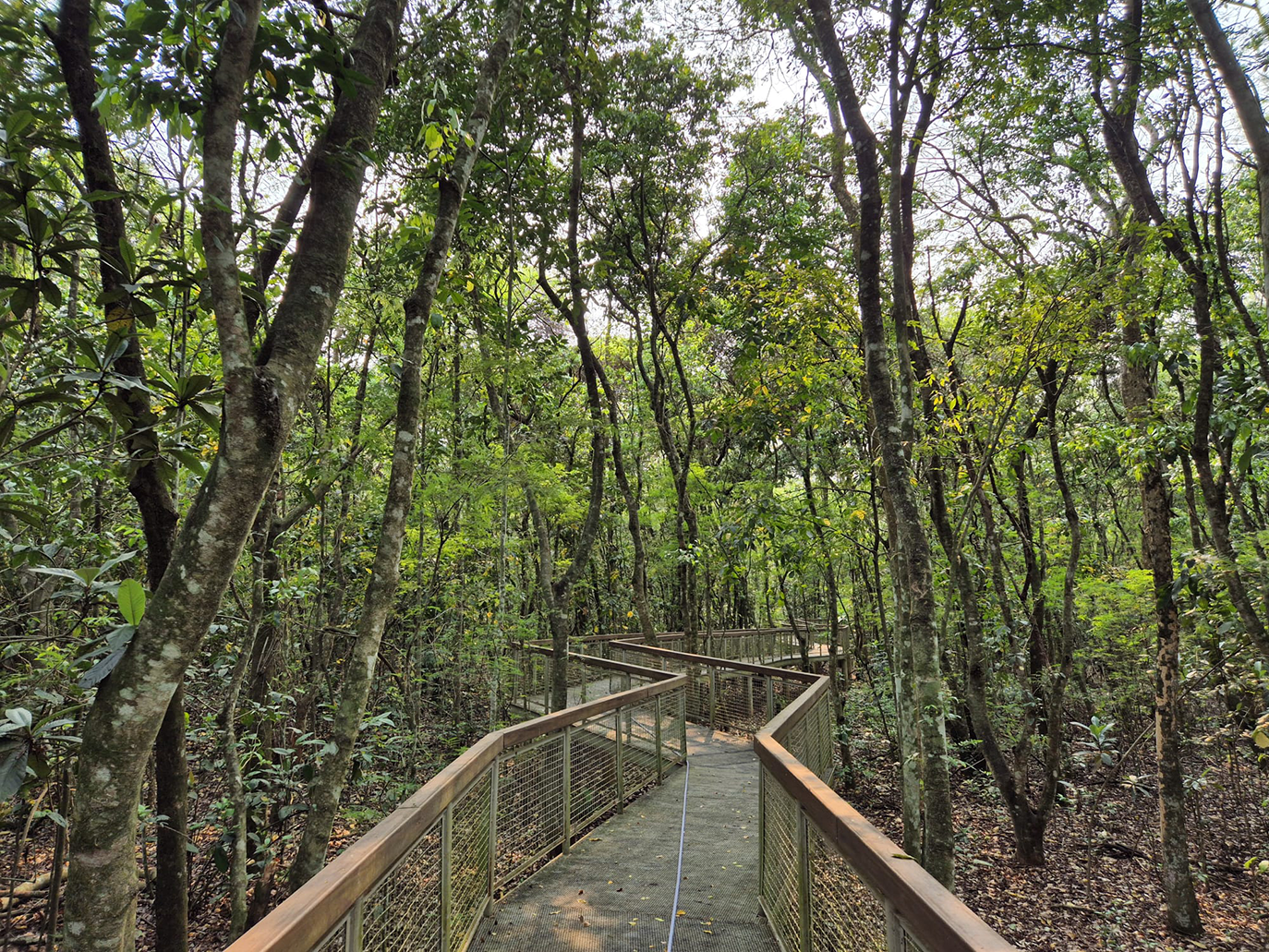
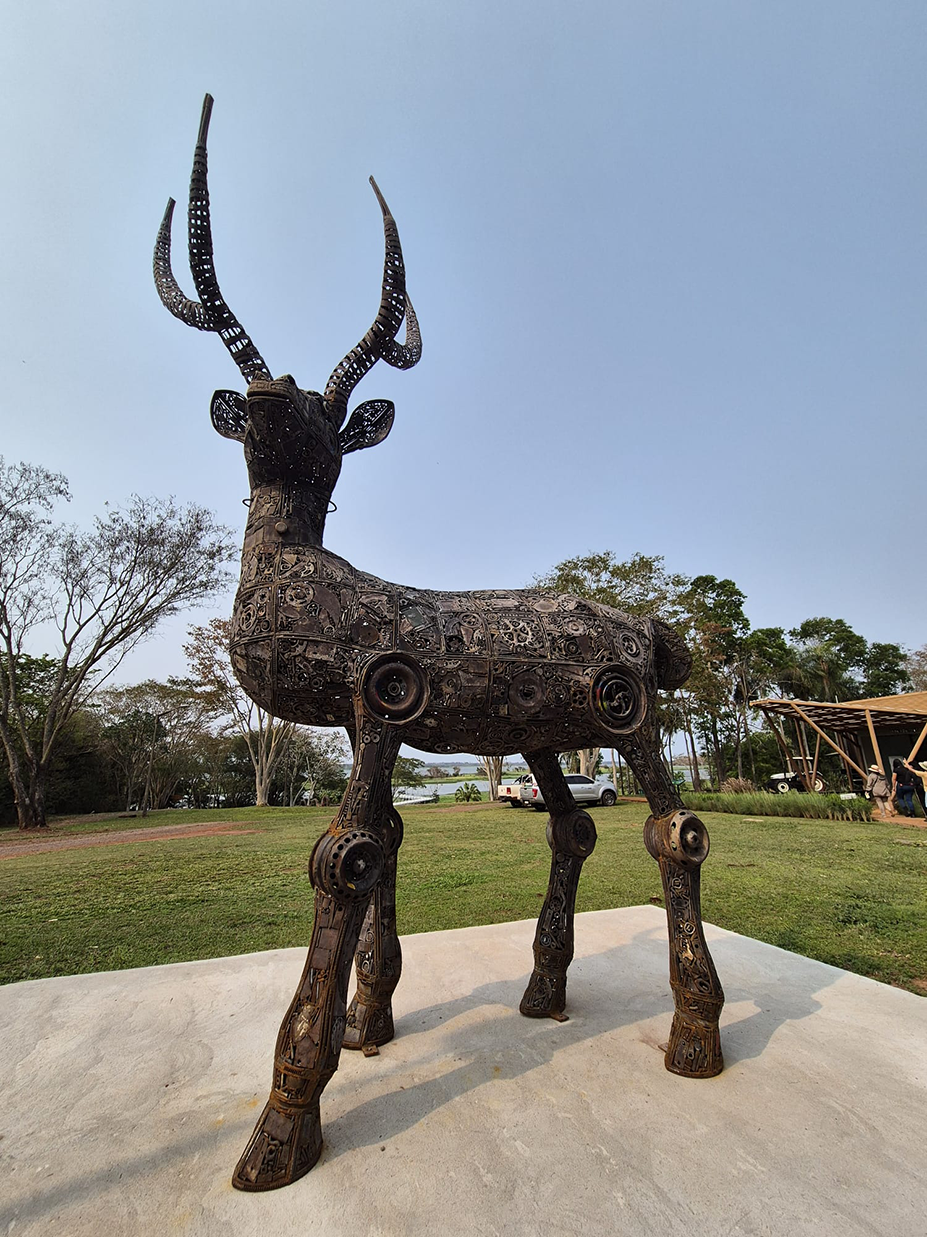
The Refugio Biológico Mbaracayú,Footnote 59 one of the protected areas managed by Itaipu, illustrates this paradox clearly. Located in Salto del Guairá in the department of Canindeyú and adjacent to the former site of the Guairá Falls, the refuge covers approximately 1,356 hectares of Atlantic Forest within Itaipu’s zone of influence.Footnote 60 Established in 1984 as part of the dam’s environmental protection belt, it is today presented as a space of environmental education, biodiversity protection, and carefully managed ecotourism. Informational panels along its Sendero de la Esperanza (Trail of Hope, see Figure 2) attribute prior deforestation to agricultural expansion during the 1960s and emphasize that in 1992 Itaipu initiated its current initiative of what they call “ecological restoration” of the Atlantic Forest within the refuge. At the end of the trail starts the Paseo de las Esculturas (Sculpture Walk, see Figure 3), which consists of a series of large art sculptures by artist Raúl Ortigoza depicting locally significant and threatened animal species crafted from metal debris left by poachers. Declared of “Tourist Interest” by the Municipal Council of Salto del Guairá, these Itaipu commissioned artworks do more than showcasing local fauna.Footnote 61 By turning tools of environmental harm into promoters of biodiversity, Itaipu is presenting itself as the benevolent protector and manager of wildlife in clear opposition to any environmental wrongdoing. The forest, the visitor is led to believe, would be eroded and littered without Itaipu’s strict intervention. This forward-looking savior narrative continues inside an equally carefully crafted visitor center that hides any reference to the destruction of the Guairá Falls, the forced relocation of Indigenous communities, and the extensive forest inundation. Through this selective framing, Itaipu repositions itself not as the principal agent of landscape transformation but as its agent of repair. Paige West and colleagues argue that “Protected areas matter because they are a way of seeing, understanding, and (re)producing the world.”Footnote 62 The Refugio Biológico Mbaracayú illustrates this precisely: It does not simply conserve forest fragments but structures how the refuge is perceived as a space of ecological restoration, responsible stewardship, and future-oriented hope.
The Sendero de la Esperanza inside the Refugio Biológico Mbaracayú (®author).
A marsh deer (Blastocerus dichotomus), which is classified as vulnerable in Paraguay, made from metal debris left by poachers (®author).
Reserves such as the Refugio Biológico Mbaracayú have undoubtedly generated measurable ecological benefits, protecting forest fragments and contributing to biodiversity and climate targets in alignment with the Sustainable Development Goals. In fact, Itaipu is funding a large number of environmental and social projects in the dam’s zone of influence, including health, socio-economic, and educational support for Indigenous communities.Footnote 63 However, this also creates a problematic dynamic and a form of neocolonial control rooted in economic dependency and territorial oversight over Indigenous communities, who were first displaced and resettled by the dam and are now dependent on financial aid by Itaipu in order to survive away from the river on the fringes of Itaipu’s nature reserves.
Authorized heritage conservation and the governance of dispossession
In a 2021 report for the Centro de Estudios Antropológicos, Universidad Católica Nuestra Señora de la Asunción (CEADUC), Jorge Servín, an anthropologist appointed by Paraguayan Supreme Court of Justice, writes that:
To date, Itaipú has acquired only 2,300 hectares for two [Ava Guaraní] communities, even though 38 tekohá (communities) existed throughout the larger Tekoha Guazú (ancestral land). It should also be noted that Itaipú has purchased a considerable number of properties and has established nine private reserve areas, totalling approximately 47,000 hectares, not including the flooded areas adjacent to these reserves. These protected areas were also established on the traditional territory of the Ava-Paranaense Indigenous people. When comparing the number of hectares allocated to Indigenous communities with those designated for Itaipú’s private reserves, the extent of the debt owed to Indigenous peoples becomes evident.Footnote 64
At the same time that these territorial disputes persisted, Itaipu’s conservation areas were gaining increasing international recognition. In 2017, parts of the Itaipu zone of influence, including the Refugio Biológico Mbaracayú, was designated a biosphere reserve under the United Nations Educational, Scientific and Cultural Organisation’s (UNESCO’s) Man and the Biosphere (MAB) program and incorporated into the World Network of Biosphere Reserves.Footnote 65 This officially elevated Itaipu’s conservation zones from national initiatives to internationally endorsed models of sustainability. Yet while UNESCO recognizes the Itaipu Biosphere Reserve as a biodiversity hotspot and recognizes that Indigenous communities in the Mbaracayú Forest Biosphere Reserve maintain strong ancestral ties to the forest while confronting deforestation and cultural loss,Footnote 66 it has not confronted the violent historical conditions that produced these protected environments in the first place. This omission from arguably the world’s most influential heritage organization can be understood as an (un)official endorsement of Itaipu’s continued erasure of Indigenous lifeworlds. In its recently published Atlas de la Reserva de Biosfera Itaipu report, Itaipu includes a thematic “Map of Indigenous Communities”Footnote 67 that incorporates Indigenous presence into the cartographic ordering of the biosphere reserve. However, while Indigenous communities are spatially acknowledged, there is no historical accountability. In the atlas’s sequence of thematic maps, which includes maps of geological formations, soil classification, hydrological units, satellite imagery, and transport infrastructure, Indigenous communities merely appear as another layer of measurable territory.
The Indigenous peoples of Paraguay, however, have not remained silent. Tekoha Sauce is one of the 38 Avá Guaraní communities displaced by the flooding of the Paraná basin. For decades, the community has demanded reparations and the restitution of ancestral land. Yet rather than addressing these claims, Itaipu has criminalized Tekoha Sauce’s efforts at territorial recovery. Community members have been labeled usurpers of protected land and subjected to legal action in Paraguayan courts, all while Itaipu continues to build its international reputation as an environmental role model.Footnote 68 In 2019, FAPI, the Federación por la Autodeterminación de los Pueblos Indígenas (Federation for the Auto-Determination of Indigenous Communities), wrote to the UNESCO director general outlining alleged human rights violations related to the displacement of Ava Guaraní communities and the situation of the Tekoha Sauce in particular.Footnote 69 The letter condemned UNESCO for collaborating with institutions like Itaipu, which have been accused of committing and continuing to commit Indigenous rights violations.Footnote 70 According to Amnesty International, UNESCO did not respond.Footnote 71
This silence is not incidental. It reflects a structural feature of authorized heritage discourses, which operate as much through omission as through celebration. By declining to engage with Indigenous claims, institutions with the power to shape heritage narratives reinforce official accounts of sustainability while excluding counter-histories of violence and dispossession. Through its UNESCO designation and its participation as a binational company in global climate forums such as COP30 Brazil, Itaipu’s green heritagization campaign has become not only a conservation but a branding strategy: It is the environmental face of a hydroelectric empire whose authority now rests as much on ecological legitimacy as on energy production.Footnote 72 Here, green heritage turns the outcomes of authoritarian modernization into stories of environmental care that are firmly embedded within authorized heritage frameworks designed to sideline Indigenous lifeworlds and alternative claims to land, memory, and justice.
Indigenous ontologies and the limits of repair
On October 29, 2025, the Brazilian State and Itaipu Binacional (Brazilian side) issued a formal public apology for their involvement in the human rights violations against the Avá Guaraní Indigenous people.Footnote 73 This acknowledgement was accompanied by a land-purchase plan to compensate the affected communities for the violations caused by the construction of the dam. The official apology and promise of tangible reparations led to a public outcry across the river, with Avá Guaraní communities urging the Paraguayan government and Itaipu Binacional to do the same on the Paraguayan side.Footnote 74 While Brazil officially recognizes the flooding and destruction of ancestral territories, cemeteries, and sacred sites, as well as the forced displacement of tens of thousands of people, Paraguay has thus far refused to acknowledge any wrongdoing. Despite strong backlash from affected Indigenous communities whose cultural and spiritual ties to the water have been severed, Paraguayan authorities insist that the relocations were carried out in consultation with the communities and that adequate and fair compensation was provided. The contrasting narratives put forward by the Brazilian and Paraguayan states illustrate that not even authorized heritage discourses are homogeneous. They can produce conflicting versions of the past, echoing Stuart Hall’s observation that heritage “is always inflected by the power and authority of those who have colonised the past, whose versions of history matter.”Footnote 75
These contradictory narratives not only shape how the past is remembered but also structure official understandings of land, loss, and repair, which are inconsistent with Indigenous territorial ontologies. As articulated through the Guaraní concept of tekoha , land is not an object to be restored or managed, but a living assemblage of reciprocal relations that sustain collective life. More than territory, tekoha refers to the place where life unfolds in its fullest sense: a sacred home that sustains cultural identity, spirituality, and community through reciprocal relationships with land, plants, animals, and spiritual forces. It is the space where human and nonhuman beings coexist, where collective decisions are taken through assemblies that prioritize consensus, and where social life is organized through reciprocity and rootedness.Footnote 76 Within this framework, land cannot be separated from cultural continuity, spiritual practice, or political autonomy.Footnote 77 Related relational frameworks such as buen vivir articulate similar critiques of extractivist and anthropocentric paradigms. According to Gudynas, buen vivir does not represent a nostalgic return to the past or a fixed utopian blueprint but an alternative civilizational horizon grounded in relational understandings of existence in which social, ecological, and spiritual dimensions are inseparable.Footnote 78 Yet scholars caution against treating buen vivir as a coherent or easily institutionalized alternative.Footnote 79 In Paraguay, where it remains largely theoretical, this critique underscores the limits of abstract policy frameworks detached from lived territorial practices. Unlike generalized formulations of buen vivir, tekoha is grounded in specific histories, places, and ongoing struggles. It offers a lived framework through which Indigenous communities articulate claims to land, identity, and autonomy in the face of displacement and environmental transformation.
Indigenous territorial ontologies reveal the limits of conservation framed as repair. Where traditional understandings of green heritage present conservation as restoration or stewardship, tekoha exposes how protected landscapes are often produced through prior acts of dispossession. The loss of tekoha cannot be remedied through ecological restoration alone, as it entails the destruction of social, spiritual, and political relations that cannot be captured through environmental indicators alone. This form of dispossession can be understood as a form of “ecological violence,”Footnote 80 which refers not only to environmental degradation but to forms of violence that undermine the relational conditions through which life becomes possible and meaningful. Ecological violence targets worlds rather than resources; it disrupts the relationships between humans, more-than-humans, territory, and memory that sustain collective existence. Even where biodiversity thrives, these ontological ruptures remain. Writing about the Korean Demilitarized Zone, Eleana KimFootnote 81 describes how conservation initiatives can be framed as ways of “making peace with nature,” where environmental flourishing becomes intertwined with narratives of reconciliation and coexistence while obscuring the violent histories that produced these landscapes.
Dimitris Papadopoulos et al.Footnote 82 show that ecological damage cannot be addressed through restoration or mitigation alone because environmental destruction is inseparable from the historical and political relations that produced it. More specifically, Correia cautions that in the context of Indigenous land restitution in Paraguay, even well-intentioned reparative frameworks often rely on assumptions that loss can be measured, compensated, and ultimately resolved.Footnote 83 However, where dispossession involves the severing of territorial, spiritual, and collective relations, repair and restitution cannot restore the ontological worlds that have been lost. This resonates with Olúfẹ́mi O. Táíwò’sFootnote 84 discussion of reparative justice. According to Táíwò, reparative justice cannot be reduced to compensation for past harms but must address the structural conditions that produced those harms in the first place. Without such transformations, reparative measures risk offering symbolic acknowledgement while leaving the underlying acts of dispossession intact. In response to these limits, “ecologies of repair” conceptualize repair as an open-ended and relational practice that emerges within damaged socio-ecological systems and accepts some losses as irreversible.Footnote 85 Rather than restoring environments to a prior state, repair is understood here as ongoing care and coexistence under conditions of loss.
Inside its zone of influence, the limitations of repair become visible in Itaipu’s green heritagization practices. Beneath the carefully curated narratives of ecological recovery, Itaipu’s protected areas function as ecological archives that retain material memories of violent socio-ecological transformations that are constantly reactivated by suppressed histories and struggles for justice.Footnote 86 Within this context, Indigenous territorial ontologies function not as supplementary cultural perspectives but as critiques of green heritage itself. They reveal how conservation can operate as an extension of authoritarian terraforming when it fails to confront the dispossession that made protected landscapes possible. These struggles resonate with what Svampa describes as the ecoterritorial turn in Latin America, where environmental conflicts increasingly center on territory, sovereignty, and ways of life rather than resource management alone.Footnote 87 From this perspective, ecological protection cannot be separated from questions of justice, territorial restitution, and political recognition. Without addressing these dimensions, conservation risks reproducing the exclusions that accompanied authoritarian modernization, even when framed in the language of sustainability and care.
Conclusion: Green heritage and the afterlives of authoritarian terraforming
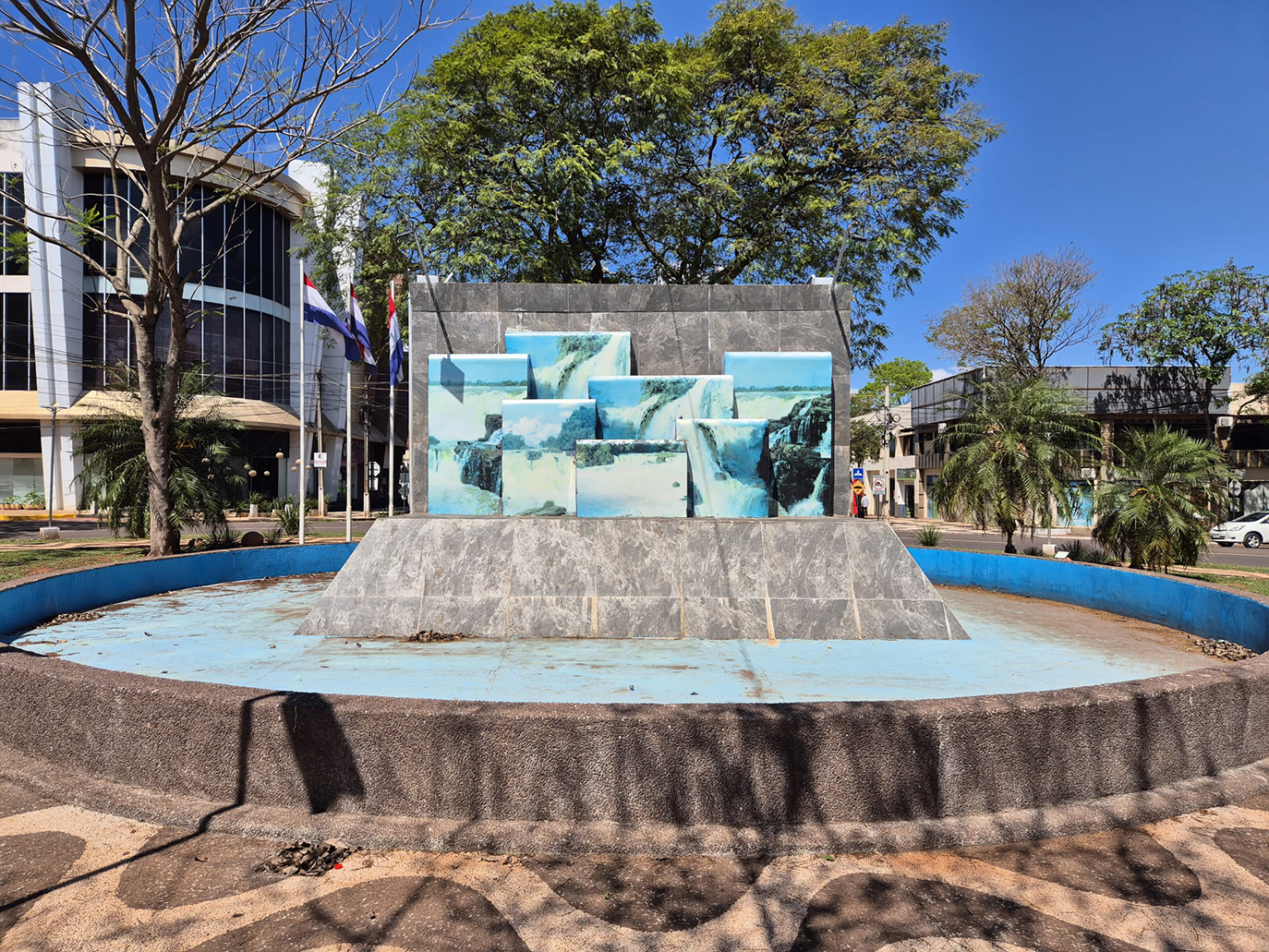
Today, in the town of Saltos del Guairá, a monument made of sun-faded blown-up images of the Guairá Falls placed inside a dried-out water fountain commemorates the waterfalls submerged beneath the reservoir of the Itaipu Dam (see Figure 4). At first glance, the memorial appears to mark a singular loss. Yet, as Stef Craps’s work on ecological mourning shows, such commemorations gesture beyond individual events toward broader histories of environmental and social transformation.Footnote 88 Like memorials to vanishing glaciers and other disappearing more-than-human worlds,Footnote 89 the monument to the falls functions as a counterpoint to narratives of industrial progress. It marks not only the drowning of a waterfall but also the remaking of entire ecologies and ways of life.
Monument commemorating the vanished Guairá Falls in the town of Saltos del Guairá (®author).
The legacy of Itaipu as industrial heritage can therefore not be limited to a single site but must be understood as a landscape-scale outcome of authoritarian terraforming and natural heritage-making practices. The dam reshaped rivers, forests, and territories while also restructuring social relations, political authority and historical memory. These processes did not stop at the end of the construction phase. They persist through conservation zones, biosphere reserves, and authorized heritage discourses that continue to organize ownership and access to land and nature in the present. Here, natural and cultural heritage are intrinsically entwined, operating as parts of the same industrial complex rather than as distinct or opposing domains. Since its inception, Itaipu has been actively curating this assemblage by presenting itself simultaneously as a monument to engineering modernity and as a model of environmental stewardship, positioning conservation as part of its industrial legacy rather than as a departure from it.
Throughout this paper I have argued that green heritage functions less as a project of repair than as a strategy of legitimation and a governing tool. Through international recognition by authorized heritage institutions such as UNESCO, ecological destruction and dispossession are reframed as exemplary stewardship. The refusal to respond to Indigenous claims for reparations, such as those articulated by FAPI, reveals how authorized heritage discourses operate through selective recognition and strategic silence. Alongside these authorized narratives, Indigenous counter-histories continue to challenge dominant accounts of progress and sustainability. Despite Salesian priest and anthropologist José Zanardini’sFootnote 90 assertion that Barón’s account of the systematic ethnocide of the Avá Guaraní should be required reading for those in positions of power, the book itself has become part of the contested memory of Itaipu. Its removal from circulation and confinement to a single publicly accessible physical copy in the library of the Centro de Estudios Antropológicos de la Universidad Católica in Asunción underscores ongoing efforts by Paraguayan authorities to contain critical perspectives. At the same time, the uploading of digital versions of the text and the sustained activism of Indigenous organizations demonstrate that these histories persist despite attempts at erasure.
Finally, this article is not an argument against hydroelectric dams or biodiversity conservation. Clean energy production and conservation programs remain essential if fragile ecosystems such as Paraguay’s Atlantic Forest are to survive. However, for conservation to be genuinely reparative and regenerative, it must confront the violent origins through which protected landscapes were produced and the ways in which environmental stewardship has historically served extractive and authoritarian projects. Moving beyond developmentalist and extractivist frameworks also requires taking seriously Indigenous territorial ontologies and productively engaging with calls for justice and reparation. The reserves and ecological corridors surrounding Itaipu exist because Indigenous communities were displaced and their territories flooded or reclassified to accommodate industrial development. Conservation narratives and practices that ignore this history risk reproducing the exclusions that accompanied authoritarian modernization, even when framed through the language of sustainability and care. Only by acknowledging the entanglement of industrial and natural heritage, and by linking ecological protection to reparative justice, can conservation move beyond reproducing exclusion. In the case of Itaipu, conservation management and infrastructural modernity form a single socio-ecological and material assemblage that cannot be disentangled from the extractive and repressive processes that produced it. Confronting authoritarian terraforming, therefore, is not simply a matter of historical accountability but a prerequisite for imagining more equitable ecological futures grounded in responsibility, restitution, and care.
Funding statement
This work was supported by a UKRI Future Leaders Fellowship Renewal–Ecologies of Violence: Heritage and Conflict in More-Than-Human Worlds (MR/X014991/1), led by Dr Esther Breithoff and supported by Dr Layla Renshaw (Co-I) and Dr Matthew Leonard (Postdoctoral Researcher).


 Open access

