INTRODUCTION
Nitrogen (N) is required in large amounts by plants to biosynthesize proteins, amino acids, chlorophyll, nucleic acids and numerous plant hormones, and comprises 3–50 g/kg of plant dry weight and c. 0·16 of plant total protein (Frink et al. Reference Frink, Waggoner and Ausubel1999). In the past two decades, N fertilizers have been applied to maximize crop yield; however, most of the N applied has been lost to air or leached into rivers and groundwater, leading to serious environmental pollution (Kondo et al. Reference Kondo, Pablico, Aragones, Agbisit, Abe, Morita and Courtois2003; Guo et al. Reference Guo, Liu, Zhang, Shen, Han, Zhang, Christie, Goulding, Vitousek and Zhang2010). It has been estimated that crops probably use less than half of the N fertilizer applied from soils (Good et al. Reference Good, Shrawat and Muench2004). Hence, it is imperative to develop genotypes/varieties with high N use efficiency (NUE) to meet the needs for high yield and environmentally friendly agriculture (Shi et al. Reference Shi, Xu, Li, Zhao and Dong2010).
Nitrogen used by plants involves several links including N uptake, translocation, assimilation, remobilization and several recycling steps. Nitrogen use efficiency, consisting of N uptake efficiency and N utilization efficiency, was defined for plants as the rate of grain yield (or dry weight) to N supplied in soils (Chardon et al. Reference Chardon, Barthelemy, Daniel-Vedele and Masclaux-Daubresse2010; Shi et al. Reference Shi, Yang, Liu, Li, Long, Xu and Meng2012a). Nitrogen partial factor productivity (PFPN) was also calculated following the rate of grain yield to N supplied and considered as the index of NUE in yield experiments (Peng et al. Reference Peng, Huang, Zhong, Yang, Wang, Zou, Zhang, Zhu, Buresh and Witt2002). There were some reports on genotype differences in NUE within species or among cultivars, and studies showed that N-efficient genotypes produced higher dry weight and accumulated more N with lower N concentration than that of N-inefficient genotypes (Svečnjak Rengel Reference Svečnjak and Rengel2006; Ye et al. Reference Ye, Hong, Shi and Xu2010).
Photosynthesis is the most important basis for plant growth and development, and is a major determinant for yield and quality of plants (Zhai et al. Reference Zhai, Cao, Wan, Zhang, Lu, Li, Kuang, Min, Zhu and Cheng2002; Chen et al. Reference Chen, Liu, Zhang and Lu2004). Photosynthesis of C3 plants is limited by many factors including genotype differences and external environment factors under the saturating light intensity in the atmosphere (Zhang et al. Reference Zhang, Chu, Chen, Shi, Zuo, Wang, Lu, Wang and Chen2007; Pang et al. Reference Pang, Kobayashi and Zhu2009). Photosynthesis parameters primarily include net photosynthetic rate (P n), stomatal conductance (g s), transpiration rate (T r) and intercellular CO2 concentration (C i). The net photosynthetic rate can directly reflect the assimilative capacity of plant leaves and thereby influences the formation of plant dry matter, which is an important index for evaluating plant photosynthesis. Stomatal conductance is often used to denote the ability of plant leaves to conduct water and CO2 by regulating stomatal opening or closure. Transpiration rate indicates the transpiration intensity of plant leaves and degree to which the stomata are open, and C i reflects the intercellular CO2 concentration of plant leaves. Photosynthetic nitrogen use efficiency (PNUE), determined by photosynthetic rate per unit leaf organic N concentration, is closely related to NUE in rice (Li et al. Reference Li, Yang, Ren, Shen and Guo2012). Li (Reference Li2011) reported that both photosynthesis and PNUE played important roles in revealing the reason why increased N fertilizer application did not always result in increased crop yield.
There are several nitrate and ammonium uptake systems with different affinities for plant roots to acquire N in soils, and the pathways of N uptake and assimilation in plants are well documented (Yuan et al. Reference Yuan, Loqué, Kojima, Rauch, Ishiyama, Inoue, Takahashi and Von Wirén2007). For many plants, nitrate taken up by roots is first reduced to nitrite by nitrate reductase (NR) in the cytoplasm, and then it is reduced to ammonium by nitrite reductase (NiR) in the plastids. It is further utilized by glutamine synthetase and glutamate synthase (Fd-GOGAT and NADH-GOGAT) in the cytoplasm and plastids. Four families of nitrate transporters (NRT1, NRT2, NAR and chloride channels (CLC)) have been identified for the uptake and translocation of nitrate in plants, and the expression of NRT genes is regulated by nitrate, pH, N metabolites and N starvation (Feng et al. Reference Feng, Yan, Fan, Li, Shen, Miller and Xu2011). The specific functions of 12 NRT1 and NRT2 genes were described in Arabidopsis by Dechorgnat et al. (Reference Dechorgnat, Nguyen, Armengaud, Jossier, Diatloff, Filleur and Daniel-Vedele2010). Most NRT1 family members are low-affinity nitrate transporters except NRT1·1 (also known as CHL1), which is a dual-affinity nitrate transporter. The protein AtNRT1·1 plays important roles in nitrate sensors to activate nitrate-related gene expression and nitrate transporters (Tsay et al. Reference Tsay, Schroeder, Feldmann and Crawford1993; Ho et al. Reference Ho, Lin, Hu and Tsay2009). The gene AtNRT1·2 is expressed in root epidermis and hairs (Huang et al. Reference Huang, Liu, Lo and Tsay1999), AtNRT1·4 is specifically expressed in midribs and petioles (Dechorgnat et al. Reference Dechorgnat, Nguyen, Armengaud, Jossier, Diatloff, Filleur and Daniel-Vedele2010) and the expression of AtNRT1·7 is induced by N stress (Fan et al. Reference Fan, Lin, Hsu, Lin and Tsay2009). NRT2 family members also show different regulation patterns and affinities with different forms of N supply (Feng et al. Reference Feng, Yan, Fan, Li, Shen, Miller and Xu2011). NRT2·1 encodes a high-affinity nitrate transporter which is regulated by N availability, especially in media with low nitrate concentrations. However, in Arabidopsis and barley, the NRT2·1 protein requires the cooperation of the NAR2 (AtNRT3·1) protein and does not act alone in the nitrate transport process (Tong et al. Reference Tong, Zhou, Li and Miller2005; Okamoto et al. Reference Okamoto, Kumar, Li, Wang, Siddiqi, Crawford and Glass2006). Another transporter that involves nitrate transport processes in the chloroplast is AtCLCe, which belongs to the CLC family (Marmagne et al. Reference Marmagne, Vinauger-Douard, Monachello, De-Longevialle, Charon, Allot, Rappaport, Wollman, Barbier-Brygoo and Ephritikhine2007; Dechorgnat et al. Reference Dechorgnat, Nguyen, Armengaud, Jossier, Diatloff, Filleur and Daniel-Vedele2010). Ammonium is taken directly from the medium by ammonium transporters or converted from nitrate, which is further assimilated as amino acids in most plants (Ludewig et al. Reference Ludewig, Neuhauser and Dynowski2007; Xu et al. Reference Xu, Fan and Miller2012). The ammonium transporter family (AMT) comprises six isoforms in Arabidopsis thaliana (Yuan et al. Reference Yuan, Loqué, Kojima, Rauch, Ishiyama, Inoue, Takahashi and Von Wirén2007). These genes play important roles in root growth, development and N uptake under low-N supply in rice (Cai et al. Reference Cai, Zhou, Xiao, Li, Zhang and Lian2009; Garnett et al. Reference Garnett, Conn and Kaiser2009).
Brassica napus (genome AnAnCnCn) is the amphidiploid species derived from natural cross between Brassica rapa (ArAr) and Brassica oleracea (C°Co) (Nagaharu Reference Nagaharu1935). It has become an important oil crop of the world, but its genetic base is narrow and genetic diversity limited (Zou et al. Reference Zou, Jiang, Cao, Li, Long, Chen and Meng2010a). To widen the genetic diversity of traditional B. napus and provide more favourable germplasm for breeding, new-type B. napus (ArArCcCc) has been developed by inter-specific crosses from B. rapa (ArAr), traditional B. napus (AnAnCnCn) and B. carinata (BcBcCcCc) (Li et al. Reference Li, Qian, Meng and Li2004; Xiao et al. Reference Xiao, Chen, Zou, Tian, Xia and Meng2010). The new-type B. napus (ArArCcCc) was introgressed with subgenomic components from related species (Zou et al. Reference Zou, Jiang, Cao, Li, Long, Chen and Meng2010a), and showed better agronomic traits and stronger heterosis in plant height, dry weight, seed yield and oil content (Zou et al. Reference Zou, Zhu, Huang, Tian, Xiao, Fu, Tu, Fu and Meng2010b; Fu et al. Reference Fu, Qian, Zou and Meng2012). The genomic components introgressed from B. rapa and B. carinata and the exotic gene expressions were observed to confer the inter-subgenomic heterosis of the new-type B. napus (Qian et al. Reference Qian, Chen, Fu, Zou and Meng2005; Chen et al. Reference Chen, Li, Shi, Fu, Qian, Zou, Zhang and Meng2008). However, the nutrient efficiency of this new-type B. napus was still unknown. The main objective of the current study was to evaluate the adaptability of the new-type B. napus to low N stress by analysing root systems and dry weight, N uptake efficiency and N utilization efficiency, seed yield and yield components, photosynthetic parameters and gene expressions under different N treatments. The results will provide a basis for further physiological and genetic study on N efficiency of the new-type B. napus.
MATERIALS AND METHODS
Plant materials
Two new-type B. napus genotypes D4-15 (N-efficient genotype) and D1-1 (N-inefficient genotype) were used in the present study, which were obtained from 46 double haploid (DH) lines by N efficiency screening. These DH lines were developed by microspore culture technique based on previous screening for N-efficient germplasms in more than 2000 new-type B. napus (ArArCcCc) accessions: the analysis showed that the proportion of exotic subgenomic fragments introgressed from B. rapa and B. carinata in the D4-15 genome was 0·65, while for D1-1 it was 0·32 (Wang et al. Reference Wang, Ding, Li, Cai, Ye, Zou and Xu2014).
Hydroponic experiment
The hydroponic experiment was conducted in an illuminated culture room at a light intensity of 300–320 μmol/m2/s, relative humidity of 65–80% and light/dark cycle of 16 h/24 °C day and 8 h/22 °C night. Seeds were surface-sterilized using 100 g/l sodium hypochlorite for 1 min and soaked in deionized water for 1 day to enhance the germination rate. Then the seeds were germinated on moistened gauze over a plastic container filled with deionized water (Wang et al. Reference Wang, Xu, Kou, Shi, Zhang and Xu2013). After about 6 days, the uniform seedlings were transferred to black plastic containers (53 cm long×34 cm wide×7·5 cm high) filled with 10 litres nutrient solution at quarter strength for 4 days. Then the concentration of the solution was increased to half strength for 8 days (replaced every 4 days), finally increasing to full strength for 12 days (replaced every 4 days), total cultivated 24 days (Ye et al. Reference Ye, Hong, Shi and Xu2010). The experiment was designed with high-N (6·0 mm N in 3·0 mm ammonium nitrate (NH4NO3)) and low-N (0·3 mm N in 0·15 mm NH4NO3) treatments with four replicates. The composition of full-strength nutrient solution except N was: calcium chloride (CaCl2)×2H2O 0·25 mm, potassium chloride (KCl) 2·0 mm, disodium hydrogen phosphate (Na2HPO4)×12H2O 0·28 mm, sodium dihydrogen phosphate (NaH2PO4)×2H2O 0·64 mm, magnesium sulphate (MgSO4)×7H2O 2·0 mm, boric acid (H3BO3) 46·0 μ m, manganese chloride (MnCl2)×4H2O 9·0 μ m, copper sulphate (CuSO4)×5H2O 0·3 μ m, zinc sulphate (ZnSO4)×7H2O 0·8 μ m, ammonium molybdate tetrahydrate ((NH4)6Mo7O24) 0·1 μ m and ferrous ethylene diamine tetraacetic acid (Fe-EDTA) 0·05 mm. The pH of the nutrient solution was maintained at 5·8–6·0, adjusted using sodium hydroxide (NaOH) or hydrochloric acid (HCl).
After the plants were grown for 18 days in total, root morphological parameters including total root length, root volume, root surface area and root tips were measured by a root analysis instrument WINRHIZO Epson Perfection (JZZIA, Seiko Epson Corp. Japan). When plants had grown for 24 days, all plants were harvested and divided into shoot and root, prior to dry weight and N concentration determination. Each N treatment had four replicates and each replicate consisted of five plants.
Pot experiment
The pot experiment was carried out in the greenhouse of the Microelement Research Center at Huazhong Agricultural University (30°28′N, 114°20′E, 30 m a.s.l.), Wuhan, China. The yellow-brown soil used in the pot experiment was collected from the campus of Huazhong Agricultural University and its characteristics were: pH 6·2 (soil water rate of 1 : 2·5), organic matter 5·9 g/kg, alkaline hydrolysis N 32·3 mg/kg, available phosphorus 10·3 mg/kg, available potassium 46·3 mg/kg. The experiment included two N treatments: high N (0·2 g N/kg soil) and low N (0·02 g N/kg soil). Each treatment was repeated four times and each pot contained 7 kg experimental soil. Chemical reagents (analytical grade) were used as the nutrients including NH4NO3 (high N: 4 g/pot; low N: 0·4 g/pot) as N fertilizer and other nutrients (g/pot): NaH2PO4×2H2O 3·075, KCl 2·221, MgSO4×7H2O 1·75 and Arnon microelements solution (1000×) 7 ml/pot, Fe-EDTA (200×) 35 ml/pot. Deionized water was used throughout the experiment. After 90 days, the high-N treatment was top-dressed according to the application rate (g/pot): NH4NO3 1·0, Na2PO4×2H2O 0·5, KCl 0·5, and the low-N treatment was the same except for NH4NO3.
At growth stage (GS) 17 of leaf development (Meier Reference Meier1997: six or seven leaves unfolded), photosynthetic parameters of the second youngest fully expanded leaf from the top and SPAD values of the leaves including the second youngest leaf (second leaf from the top) and the second oldest leaf (second leaf from the bottom) were determined at 09.00–11.00 h on a sunny day, and one plant in each pot was sampled to analyse shoot dry weight and N concentration. Then, during anthesis, different parts of the plants were sampled (root, stem, leaf, flower and pod), roots were washed in deionized water, and the samples were immediately frozen in liquid-N and stored at −80 °C for the assay of gene expression. Finally, the agronomic traits were investigated at the seed maturity stage, and then all plants were harvested. After air-drying for 10 days at 25–32 °C, seed yield and thousand seed weight were determined.
Determination of dry weight and nitrogen concentration
The selected samples were washed with deionized water, then placed in an oven at 105 °C for 30 min to deactivate the enzymes and dried to a constant weight at 70 °C (c. 72 h). After the dry weight data was recorded, the dried samples were ground to pass through a 0·15 mm sieve for analysis of total N concentration. The powder samples were digested with sulphuric acid and hydrogen peroxide (H2SO4−H2O2) and the N concentration was measured using a flow injection analyser (FIAstar 5000, Foss Tecator AB, Hoganas, Sweden). Nitrogen accumulation and NUE were calculated according to N accumulation=dry weight×N concentration and NUE=dry weight/N accumulation (Shi et al. Reference Shi, Zhao, Li, Wang, Meng, Xu and Shi2012b). Nitrogen transfer efficiency (NTE) was calculated as NTE=shoot N accumulation/total N accumulation (Ye et al. Reference Ye, Hong, Shi and Xu2010), and PFPN as seed yield/N applied to soil (Peng et al. Reference Peng, Huang, Zhong, Yang, Wang, Zou, Zhang, Zhu, Buresh and Witt2002; Beatty et al. Reference Beatty, Anbessa, Juskiw, Carroll, Wang and Good2010).
Determination of photosynthetic parameters and relative chlorophyll concentrations
At the seedling stage of the pot experiment, photosynthetic parameters of plant leaves (central function leaf) were measured using Li-6400 Portable Photosynthesis Analysis System (Li-COR Company, OSA) at 09.00–11.00 h on a sunny day. Net photosynthetic rate, C i, g s and T r of plant leaves were measured three times on each leaf under the control conditions: atmospheric temperature of 19·1 °C, photosynthetic active radiation (PARi) of c. 1200 μmol/m2/s and atmospheric CO2 concentration (C a) of 408 μmol/mol. The stomatal limitation value (L s=1−C i/C a) and PNUE (from leaf P n/leaf organic N concentration) were calculated according to the methods of Li et al. (Reference Li, Gao, Xu, Shen and Guo2009). At the same time, SPAD values were measured using a chlorophyll meter (SPAD-502 model, Minolta, Tokyo, Japan) (Liu et al. Reference Liu, Hu, Sun, Tan, Nie and Hu2010).
Analysis of gene expression
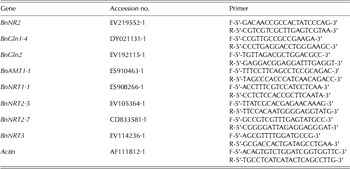
Total RNA was extracted from plant different organs using the Trizol reagent, and the cDNA was synthesised from 2 μg of total RNA using Moloney Murine Leukemia Virus (M-MLV) reverse transcriptase (Promega, WI, USA) according to the manufacturer's instructions (Invitrogen, Carlsbad, CA, USA). Quantitative real-time polymerase chain reaction (Quantitative RT-PCR or qPCR) was performed to detect the expression of genes BnNR2, BnGln1·4, BnGln2, BnAMT1·1, BnNRT2·5 and BnNRT2·7, using the SYBR® Green Real-Time PCR Master Mix Kit (TOYOBO, Japan) and the CFX96TM Real-Time PCR Detection System (Bio-Rad, CA, USA). The expression level of housekeeping gene BnActin was detected as a reference, and the relative expression levels of the target genes were calculated and normalized with respect to BnActin mRNA. Quantitative RT-PCR data were analysed following the manufacturer's instructions (Bio-Rad, Hercules, CA, USA). The ΔΔC t (threshold cycle) method of comparing expression data was used, and the relative quantitative value was expressed as 2−ΔΔCt (Livak & Schmittgen Reference Livak and Schmittgen2001). All the gene-specific primer pairs (except for BnActin) used for quantitative RT-PCR are listed in Table 1, which were designed based on B. napus EST sequences that were available in GenBank.
Sequences of primers used for quantitative real-time polymerase chain reaction (qPCR)

Statistical analysis
The data were analysed by the statistical software program SPSS version 17·0 (SPSS Inc., Chicago, IL, USA), and one-way analysis of variance analysis (ANOVA) was carried out with Fischer's least significant difference (LSD) multiple range test at P<0·05.
RESULTS
Effect of low-nitrogen stress on seed yield and nitrogen efficiency coefficient of two new-type Brassica napus genotypes
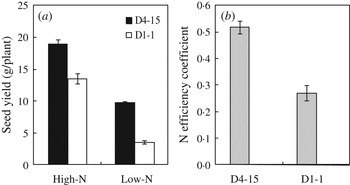
Seed yield and N efficiency coefficient (defined as the ratio of seed yield under low N availability to that under high N availability) of two new-type B. napus (D4-15 and D1-1) were determined (Fig. 1). D4-15 presented significantly higher seed yield than D1-1, regardless of N availability (high or low N) (P<0·05) (Fig. 1(a)). Low N supply decreased the seed yield of D4-15 and D1-1 significantly (P<0·05). However, compared to the high-N condition, D4-15 showed a lower decrease in seed yield (48·3%) than that of D1-1 (73·2%) under low-N stress. The N efficiency coefficient of D4-15 was 0·52, which was 1·93 times higher than that of D1-1 (0·27) (Fig. 1(b)).
Seed yield (a) under low- and high-N conditions and N efficiency coefficient (b) which was defined as the ratio of seed yield under low N availability to that under high N availability. Error bars represent s.e.s of the mean (n=4).

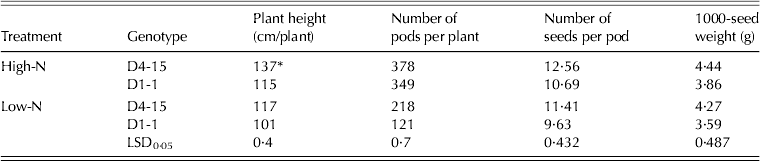
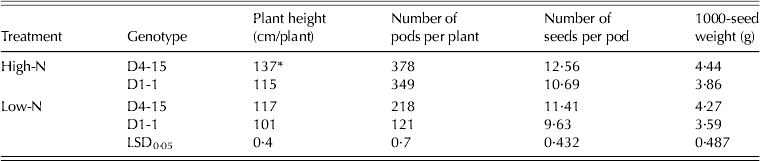
Compared to the high-N supply, both pod number per plant and plant height were significantly decreased (P<0·05) under the low-N treatment, and the pod number decreased by 65·3% for D1-1 and 42·3% for D4-15. However, there was no significant difference in the seed number per pod and the 1000-seed weight between the two N treatments (Table 2). Under the low-N condition, each seed yield component of D4-15 was significantly higher than that of D1-1 (P<0·05) (Table 2). The number of effective pods for D4-15 was 1·80 times higher than that of D1-1, and D4-15 showed 1·18 times and 1·19 times higher seed number per pod and the 1000-seed weight than that of D1-1 respectively.
Yield components of two new-type Brassica napus genotypes, D4-15 and D1-1, under low- and high-N conditions
* Data represent the mean of four replicates (n=4).
Effect of low-nitrogen stress on nitrogen uptake and utilization efficiency of two new-type Brassica napus genotypes
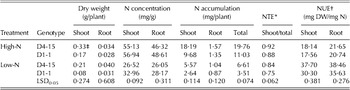
In the hydroponic experiment (Table 3), N deficiency led to a significant increase of root dry weight and NUE of D4-15 and D1-1 (P<0·05), while the shoot dry weight, N concentration, N accumulation and NTE were significantly decreased by reduced N supply (P<0·05) (Table 3). However, D4-15 showed better adaptability to low-N stress than D1-1. Under the low-N condition, dry weight, N accumulation, NTE and NUE in shoot and root of D4-15 were significantly higher than D1-1 (P<0·05) (Table 3). Compared to the high-N supply, shoot dry weight of D4-15 and D1-1 were decreased by 36·4 and 52·9%, respectively, and NUE of D4-15 and D1-1 were increased by up to 107·8 and 72·6%, respectively, under low-N stress (Table 3). The relative shoot dry weight (the ratio of shoot dry weight under low N availability to that under high N availability) of D4-15 was higher than that of D1-1 (0·64 for D4-15 v. 0·47 for D1-1).
Nitrogen (N) concentration and N accumulation, nitrogen transfer efficiency (NTE) and nitrogen use efficiency (NUE) in shoot and root of new-type Brassica napus genotypes, D4-15 and D1-1, under low- and high-N conditions in hydroponic experiment

* NTE, shoot N accumulation/total N accumulation).
† NUE, dry weight/N accumulation).
‡ data represent the mean of four replicates (n=4).
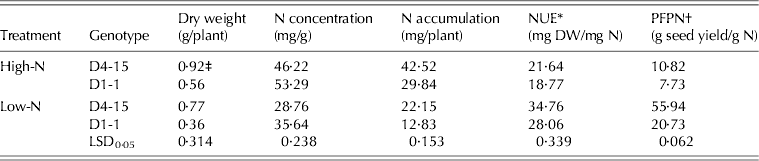
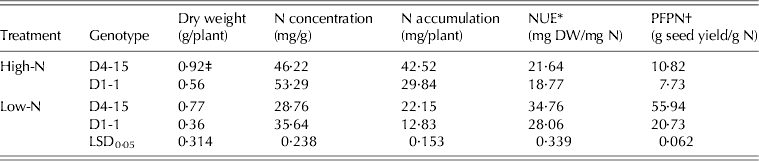
In the pot experiment (Table 4), plant NUE and PFPN of both genotypes increased significantly (P<0·05), while the dry weight, N concentration and accumulation decreased significantly (P<0·05) under the low-N condition compared to the high-N supply (Table 4). The NUE and PFPN of D4-15 increased by 60·6% and 5·17 times, respectively, while D1-1 increased by 49·5% and 2·68 times for the two indices under the low-N condition. Under low-N condition, dry weight, N accumulation, NUE and PFPN of D4-15 were significantly higher than D1-1 (P<0·05) (Table 4). Shoot dry weight and PFPN of D4-15 were 2·14 and 2·70 times of D1-1, respectively, and the relative shoot dry weight of D4-15 was higher than that of D1-1, which was 0·84 for D4-15 and 0·64 for D1-1. These were consistent with the results of the hydroponic experiment above.
Nitrogen (N) concentration and N accumulation, nitrogen use efficiency (NUE) and nitrogen partial factor productivity (PFPN) in shoot of new-type Brassica napus genotypes, D4-15 and D1-1, under low- and high-N conditions in pot experiment
* NUE, dry weight/N accumulation).
† PFPN, seed yield/N fertilizer applied to the soil -in soil).
‡ data represent the mean of four replicates (n=4).
Effect of low-nitrogen stress on SPAD values and photosynthetic parameters of two new-type Brassica napus
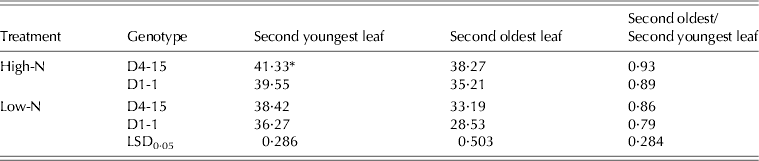
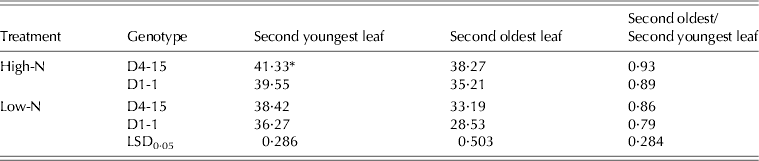
The SPAD values in the second oldest leaf of D4-15 were significantly higher than those of D1-1 under both low and high N conditions at the seedling stage (P<0·05) (Table 5). In particular, SPAD values in the second oldest leaf of D4-15 under the low N supply was 1·16 times of D1-1, whereas there were no significant differences in SPAD values of the second youngest leaf between the two new-type B. napus genotypes (Table 5). Under the low N condition, the relative SPAD values (second oldest leaf v. second youngest leaf) of D4-15 (0·86) was significantly higher (P<0·05) than that of D1-1 (0·79) (Table 5).
Leaf relative chlorophyll concentrations (SPAD values) of new-type Brassica napus leaves, D4-15 and D1-1, under low- and high-N conditions at the seedling stage
* Data represent the mean of four replicates (n=4).
Net photosynthetic rate, g s, T r and L s in leaves of the two genotypes were significantly decreased (P<0·05) under low N compared to high N, while C i and PNUE were significantly increased (P<0·05) (Table 6). Actually, P n and g s in leaves of D4-15 decreased by 12·3 and 19·3%, respectively, and 17·5 and 30·9% for D1-1 under low N. Conversely, low N supply increased PNUE in leaves by 37·3% for D4-15 and 23·8% for D1-1. Under the low N condition, P n, g s and PNUE in leaves of D4-15 were significantly higher than D1-1 (P<0·05) (Table 6), which were 1·17, 1·21 and 1·42 times of D1-1, respectively.
Photosynthetic parameters and photosynthetic nitrogen use efficiency (PNUE) in leaves of new-type Brassica napus, D4-15 and D1-1, under low- and high-N conditions at the seedling stage

* P n represents net photosynthesis rate.
† g s represents stomatal conductance.
‡ C i represents intercellular CO2 concentration.
§ T r represents transpiration rate.
# L s represents stomatal limitation (L s=1-C i/C a).
∥ data represent the mean of four replicates (n=4).
Effect of low-nitrogen stress on root morphology of two new-type Brassica napus genotypes
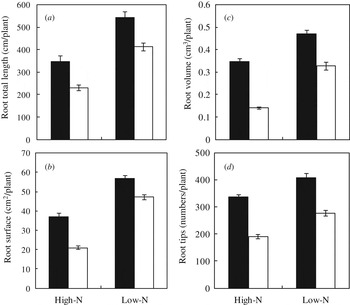
In the hydroponic experiment, plant root morphology was scanned at 18 days after transplanting. Total root length, root surface area, root volume and total number of root tips of D4-15 were significantly higher (P<0·05) than D1-1 regardless of N levels (Fig. 2). Under the low N condition, total root length, root surface area, root volume and tips of D4-15 were 1·31, 1·20, 1·42 and 1·46 times higher than D1-1, respectively. Compared to the high N treatment, low N stress resulted in a significant increase (P<0·05) in total root length, root surface, root volume and tips at the seedling stage (Fig. 2).
Root morphology of new-type Brassica napus genotypes (D4-15 and D1-1) under low- and high-N conditions. Error bars represent s.e.s of the mean (n=4). Solid and open columns indicate D4-15 and D1-1, respectively.

Effect of low-nitrogen stress on gene expression of two new-type Brassica napus genotypes
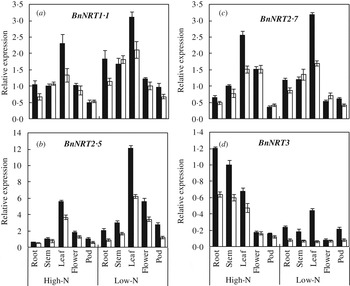
Using quantitative RT-PCR, the expression levels of nitrate transporter genes (BnNRT1·1, BnNRT2·5, BnNRT2·7 and BnNRT3) in different organs of D4-15 and D1-1 were analysed under low and high N conditions (Fig. 3). The expression levels of the four genes in roots and leaves of D4-15 were significantly higher (P<0·05) than those of D1-1 under the low N condition (Figs 3(a) to (d)). BnNRT1·1, BnNRT2·5 and BnNRT2·7 were induced by low N stress and showed the highest expression levels in leaves regardless of N supply (Figs 3(a) and (b)). Expression levels of BnNRT1·1, BnNRT2·5, BnNRT2·7 and BnNRT3 in leaves of D4-15 were 1·46, 1·91, 1·87 and 6·60 times of D1-1, respectively, under the low N condition (Figs 3(a)–(d)). No significant difference was observed in the expression levels of BnNRT1·1 and BnNRT2·7 between D4-15 and D1-1 in stems (Figs 3(a) and (c)), but the expression levels of BnNRT2·5 and BnNRT3 in stems of D4-15 were significantly higher than those of D1-1 (P<0·01) under low N stress (Figs 3(b) and (d)).
Expression of NRT gene family members (BnNRT1·1, BnNRT2·5, BnNRT2·7 and BnNRT3) in different organs of new-type Brassica napus genotypes, D4-15 and D1-1, under low- and high-N conditions. Relative expression levels were calculated and normalized with respect to BnActin mRNA. Error bars represent s.e.s of the mean (n=3). Solid and open columns indicate D4-15 and D1-1, respectively.

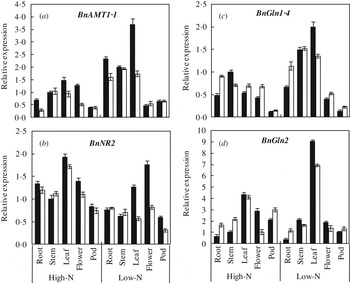
Subsequently, the expression levels of the ammonium transporter gene (BnAMT1·1) and N assimilation genes (BnNR2, BnGln1·4 and BnGln2) were analysed in different organs of D4-15 and D1-1 (Fig. 4). Expression levels of BnAMT1·1, BnNR2, BnGln1·4 and BnGln2 in leaves of D4-15 were significantly higher than those of D1-1 (P<0·01) under the two N conditions, which were up-regulated under the low N supply, except for BnNR2 (Figs 4(a) to (d)). Expression levels of BnAMT1·1 in roots and leaves of D4-15 were significantly higher than those of D1-1 under both low and high N conditions (P<0·01) (Fig. 4(a)), and the expression levels of BnNR2 in leaves and flowers of D4-15 were significantly higher (P<0·01) than that of D1-1 under the different N conditions (Fig. 4(b)). BnGln1·4 and BnGln2 showed higher expression levels in more organs of D1-1 than D4-15 under both high and low N conditions (Figs 4(c) and (d)). However, it was interesting that the expression levels of the two genes in leaf of D4-15 under low N remained significantly higher than that of D1-1 (P<0·01).
Expression of BnAMT1·1, BnNR2 and GS family members (BnGln1·4 and BnGln2) in different organs of new-type Brassica napus genotypes, D4-15 and D1-1, under low- and high-N conditions. Relative expression levels were calculated and normalized with respect to BnActin mRNA Error bars represent s.e.s of the mean (n=3). Solid and open columns indicate D4-15 and D1-1, respectively.

DISCUSSION
Effects of low-nitrogen stress on plant photosynthesis and nitrogen use efficiency
Nutrient-efficient plants are defined as those that can produce more biomass (yield) than other plants when compared to a standard genotype grown under similar conditions (Clark & Duncan Reference Clark and Duncan1991; Ye et al. Reference Ye, Hong, Shi and Xu2010). In the present study, D4-15 showed significantly higher shoot and root biomass than D1-1 under the low N stress in the hydroponic experiment, and also had markedly higher shoot dry weight at the seedling stage and seed yield at maturity than D1-1 in the pot experiment. These results indicated that D4-15 was the N-efficient genotype, presenting higher tolerance to low N stress compared to D1-1.
Photosynthesis is the main way for plants to form dry matter. Rice growth has been associated with photosynthetic rate, N concentration and PNUE (Li et al. Reference Li, Gao, Xu, Shen and Guo2009). In the current study, both P n and g s of two new-type B. napus were significantly increased, while PNUE was decreased significantly under high N supply compared to the low N condition. Photosynthetic NUE is the ratio of leaf net photosynthesis rate (P n) to leaf N concentration (P n/leaf N concentration). Compared with the high-N condition, both genotypes had lower chlorophyll content, lower leaf N concentration and P n, but higher PNUE under the low-N supply. It may be that the decrease in P n was lower than that of leaf N concentration in the low-N treatment, resulting in the higher PNUE in the low-N condition. Li et al. (Reference Li, Yang, Ren, Shen and Guo2012) found that decreased Rubisco activation and reduced stomatal opening might be the main limitations for PNUE under high N supply in rice. Thus, the fact that the N-efficient genotype D4-15 had higher PNUE in leaves than the N-inefficient genotype D1-1 under low N stress may be attributed to the significantly higher photosynthetic parameters P n and g s in D4-15 than in D1-1. Under low N supply, P n and g s of D4-15 were significantly higher than those of D1-1, but there was no significant difference in C i, and the change trend of P n and C i was not the same in D4-15 or D1-1 under the low N condition. For example, D1-1 had lower P n but higher C i under low N supply. The results suggested that a non-stomatal factor was the main cause leading to lower photosynthesis, but not the g s factor. The SPAD values in the second oldest leaf and relative SPAD values of the N-efficient genotype D4-15 were markedly higher than those of D1-1 at the seedling stage under the low N condition. The results suggested that the older leaf of the N-efficient genotype stayed green for longer to meet the need for photosynthesis, which may contribute to the high P n and PNUE in N-efficient genotype D4-15.
Nitrogen use efficiency is composed of N uptake efficiency and N utilization efficiency (Xu et al. Reference Xu, Fan and Miller2012). Although N capture (uptake) and N conversion (utilization) both play important roles in improving the NUE of spring barley, N capture plays the major role (Beatty et al. Reference Beatty, Shrawat, Carroll, Zhu and Good2009). The contributions of N uptake and utilization were also found to depend on the N supply levels of barley grown in field experiments (Beatty et al. Reference Beatty, Anbessa, Juskiw, Carroll, Wang and Good2010). Shi et al. (Reference Shi, Xu, Li, Zhao and Dong2010) reported that different rice varieties had different NUE, and that an N-efficient rice cultivar had higher NUE than that of N-inefficient cultivar under low N condition. In the present study, the N-efficient genotype (D4-15) showed higher NUE than the N-inefficient genotype (D1-1) under the different N conditions in both hydroponic and pot experiments. This may be attributed to higher N uptake efficiency, N utilization efficiency and higher PNUE in D4-15. On the one hand, D4-15 developed a larger root system including total root length, root surface area, root volume and total number of root tips and had significantly higher expression levels of the N transport genes (BnNRTs and BnAMTs) in roots than D1-1 under the low N condition. Both may confer an ability on D4-15 to acquire and accumulate more N for meeting plant growth under low N stress compared to D1-1. On the other hand, D4-15 showed lower N concentration but higher dry weight than D1-1 under low N supply, which means that D4-15 could use less N to produce more biomass than D1-1 under low N stress, suggesting that D4-15 had higher N utilization efficiency than D1-1. The higher expression levels of N assimilation genes (BnGln1·4 and BnGln2) of D4-15 in leaves may also contribute to the higher N utilization efficiency compared to D1-1 under low-N stress. In addition, D4-15 had higher PNUE in leaves than that of D1-1 under low-N stress. Ghannoum et al. (Reference Ghannoum, Evans, Chow, Andrews, Conroy and Von Caemmerer2005) found that plant NUE was positively correlated to PNUE in grasses, and Li et al. (Reference Li, Yang, Ren, Shen and Guo2012) reported that a lower PNUE will finally result in a lower NUE in rice under high N supply. Hence, the higher PNUE of D4-15 in leaves may partly contribute to a higher NUE compared to D1-1 under the low-N condition.
Genes involved in nitrogen uptake and assimilation play vital roles in nitrogen use efficiency of new-type Brassica napus genotypes responding to low-nitrogen stress
In Arabidopsis, AtAMT1·1 and AtNRT2·1 played vital roles in N acquisition by regulating root system in response to N starvation (Remans et al. Reference Remans, Nacry, Pervent, Girin, Tillard, Lepetit and Gojon2006). In rice, the expression level of OsAMT1·1 was clearly up-regulated under low-N stress (Kumar et al. Reference Kumar, Silim, Okamoto, Siddiqi and Glass2003), and some reports have shown that OsAMT1·1 played an important role in rice N acquisition by partially regulating N uptake under low N supply (Shi et al. Reference Shi, Xu, Li, Zhao and Dong2010). In the current study, the expression level of BnAMT1·1 was up-regulated in response to N starvation, which agrees with the results from Shi et al. (Reference Shi, Xu, Li, Zhao and Dong2010), and expression levels of BnNRT1·1, BnNRT2·5, BnNRT2·7 were also up-regulated under low-N stress. In addition, expression levels of these nitrate transporters (BnNRT1·1, BnNRT2·5, BnNRT2·7 and BnNRT3) in roots, leaves and pods of D4-15 were significantly higher than that of D1-1 under the low-N condition, and expression level of the ammonium transporter (BnAMT1·1) was significantly higher than that of D1-1 under different N treatments. The results suggested that the N-efficient genotype had higher N acquisition abilities than the N-inefficient genotype, which provided evidence for D4-15 (N-efficient genotype) possessing high N uptake efficiency under low-N stress.
Shi et al. (Reference Shi, Xu, Li, Zhao and Dong2010) reported that the regulatory mechanisms of glutamine synthetase are not employed during transcription in seedling-stage rice roots and conjectured that may occur at the post-transcriptional level. In the present study, expression levels of BnGln1·4 and BnGln2 in leaves of D4-15 were significantly higher than that of D1-1 under the low-N condition, showing the same trend as the expression of N transporter genes in leaves. While expression levels of BnGln1·4 and BnGln2 in different organs showed different trends between D4-15 and D1-1 under low-N supply, D4-15 had significantly lower expression levels in roots and pods than D1-1 in response to low-N stress. However, D4-15 had significantly higher expressions of BnGln1·4 and BnGln2 in leaf than D1-1 in low-N stress. Since the leaf is the main site of photosynthesis in plants, the results obtained in the current study suggest that higher expression levels of BnGln1·4 and BnGln2 in leaves of D4-15 led to higher ability of ammonium assimilation, which may explain the higher SPAD values and P n of D4-15 compared with D1-1. Therefore, regulation of BnGln1·4 and BnGln2 in leaves played important roles in ammonium assimilation under low-N stress.
Possible mechanism for genotype differences in response to low-nitrogen stress
New-type B. napus (ArArCcCc) was obtained from distant hybridization by introgression of Ar subgenome from B. rapa (ArAr) and Cc from B. carinata (BcBcCcCc) into traditional B. napus (AnAnCnCn) (Li et al. Reference Li, Liu, Wang, Yu and Meng2007; Zou et al. Reference Zou, Zhu, Huang, Tian, Xiao, Fu, Tu, Fu and Meng2010b). Traditional B. napus (AnAnCnCn) is a cultivated oilseed crop with a comparatively narrow genetic base because of its intensive breeding, limited geographic range and short cultivation history (Cowling Reference Cowling2007). Brassica rapa (ArAr) and B. carinata (BcBcCcCc) are important oilseed crops with long cultivation histories and their own valuable traits. Separately, B. rapa (ArAr) has specific traits for disease resistance and earlier maturity (Ren et al. Reference Ren, Dickson and Earle2000), while B. carinata (BcBcCcCc) has better performance under saline conditions and resistance against drought (Malik Reference Malik1990). Brassica carinata also showed stronger tolerance to infertile soil than B. napus (Enjalbert et al. Reference Enjalbert, Zheng, Johnson, Mullen, Byrne and McKay2013). Molecular analysis showed that parts of the genome in new-type B. napus was replaced by the subgenome (Ar and Cc), and the introgression of the exotic subgenomic components in new-type B. napus could widen the genetic diversity (Li et al. Reference Li, Liu, Wang, Yu and Meng2007). In the current study, the exogenous genomic fragment analysis showed that D4-15 introgressed a total of 0·65 from the two species: 0·33 from B. rapa and 0·32 from B. carinata, while values for D1-1 were 0·32 (0·18 from B. rapa and 0·15 from B. carinata). Hence, it was deduced that the higher proportion of subgenomic introgression components in the N-efficient genotype (D4-15) might lead to better tolerance of low-N stress and present better phenotypes than the N-inefficient genotype (D1-1) analysed above. However, whether the effect of exotic subgenomic introgression on the tolerance to low-N stress was attributed to allele-specific effects or the amount of introgressed genes should be studied further.
This work was supported by the grant from the National Natural Science Foundation of China [30830073].