Introduction
The severity of austerity measures in most European countries has brought renewed urgency to debates concerning the future of welfare in the modern state. Made critical by the extent and gravity of poverty and inequality across Europe, historic shifts in the governance and provision of welfare have led to profound transformations in the economic and social conditions of life for many Europeans. Framed as a rational response to changing global economic conditions, ideas of ‘new welfare’ emerged across a number of European countries during the 2000s (see Taylor-Gooby, Reference Tayor-Gooby2007; Hemerijck, Reference Hemerijck2012). As we have observed in the various contributions in this themed section, the state and nature of the implementation of ‘new welfare’ initiatives seem to vary within different socio-economic and political settings. Therefore, this review article offers a critical dissection of politico-economic drivers and outcomes of the ‘recalibration’ of welfare approaches and programs within distinct settings. The article argues that any evaluation of the implementation of ‘new welfare’ requires a critical examination of the core assumption upon which it was developed, i.e. the notion that the welfare state has ‘competitive corrosive’ qualities requiring correction through a re-working of public and private arrangements of responsibility, centrally involving a renewed split between deserving and undeserving users (Hay, Reference Hay2005; Lorenz, Reference Lorenz2005). The central organising idea of the discourse of ‘new welfare’ has been the notion that publically organised and funded welfare is detrimental to the economic competitiveness of nation states within an increasingly competitive global economy. The discourse of ‘new welfare’ has been framed as ‘positive’, ‘enabling’ and ‘activating’. Crucially, the rationale of new welfare conceptualises both ‘care’ and ‘risk’ as being, in essence, an individual rather than a collective concern and responsibility (Beck and Beck-Gernsheim, Reference Beck and Beck-Gernsheim2001). In some countries, the market rather than the state is regarded as being central to the future provision of care and protector against individual societal risks, whereas the ideology of the ‘big society’ points towards the importance of new, societal, not-for-profit arrangements that replace the state's central role in compensating for social risks. As Clarke (Reference Clarke and Seeleib-Kaiser2008) argues, welfare states articulate the ‘more specifically national character of particular places, valorising and enforcing specific conceptions of national character, values, culture and ways of life’ (Clarke, Reference Clarke and Seeleib-Kaiser2008: 7). Distinct European settings have both defined and implemented new welfare measures according to prevailing politico-economic arrangements. In states such as Britain, this has led to a radical revision of the post-war Beveridge settlement. In contrast, other states have implemented ‘new welfare’ measures within the general framework of the existing social settlement. Exemplifying this approach, recent Swedish Government policy documents posit economic growth, welfare, education and research as mutually reinforcing, articulating the central challenge as:
To achieve high growth and welfare, education and research in Sweden are to be world class. A good quality education system is required to create the conditions for each individual to develop and learn in order to meet tougher international competition, society's needs and labour market requirements. Working life requires both broad and deep skills. (Government Offices of Sweden, 2011: 27)
Here, welfare, education and research are regarded as integral to economic sustainability and growth within a global knowledge economy. Nonetheless, in common with its Scandinavian neighbours, Sweden has instituted a number of ‘new welfare’ measures in recent years, including labour market measures characterised by a workfare focus.
Further, as Cantillon and Van Lancker argue in this themed section, ‘social investment is not a full-fledged and necessarily coherent paradigm, but a set of ideas which can be and have been interpreted and implemented in different ways’. Critically, the evaluation of the implementation of new welfare strategies also requires the identification, measurement and qualitative understanding of social inequalities within distinct settings. Situational constraints related to background, origin and income inequality have recently been evidenced as being as imprisoning as they were fifty years ago (Erikson and Goldthorpe, Reference Erikson and Goldthorpe1992; Lister, Reference Lister2004; Grusky and Kricheli-Katz, Reference Grusky and Kricheli-Katz2012; Paull and Patel, Reference Paull and Patel2012). Here it is argued that ‘social risks that are likely to induce poverty (for example, unemployment, illness and disability, early school dropout, low levels of education and divorce) are socially stratified across all welfare states, including the Scandinavian ones’ (Pintelon et al., Reference Pintelon, Cantillon, Van den Bosch and Whelan2013). Of central relevance here is the contention that social investment ‘cannot and will not’ enable social progress to occur unless it is combined with the implementation of traditional forms of social protection.
Recent research has provided an evidential base to support the argument that social investment cannot be the only principle underpinning welfare interventions; democratically legitimate and economically effective measures also necessitate equally high levels of social protection (Hay, Reference Hay2005; Paull and Patel, Reference Paull and Patel2012; Grusky and Kricheli-Katz, Reference Grusky and Kricheli-Katz2012).
Focussing on the implementation of new welfare measures directed at the relationship between social protection and the labour market, this review article sets out an argument for the development of an analytical approach that problematises the purpose of ‘new welfare’ within broader socio-economic conditions and policy strategies. Following Clarke (Reference Clarke2003), this broader analytical framework theorises welfare states as being shaped by a number of ‘intersecting, multifaceted processes involving the realignment of work and welfare in post-industrial society and the integrated challenge of balancing financial viability and meeting societal needs located within the dynamics of supra-, inter- and transnationalisation’ (Clarke, Reference Clarke2003: 210). Recent research also provides an evidential base to reveal that the fulfilment of societal needs, financial viability, economic stability and growth are mutually re-enforcing within models which connect economic stability and growth to welfare, education and social protection within a global knowledge economy (Hay, Reference Hay2005; Berg, Reference Berg, Clasen and Clegg2012; Paull and Patel, Reference Paull and Patel2012).
Drawing on recent research relating to the implementation of new welfare within distinct political economies of welfare, the article argues that while there is evidence of convergence of the orientation of measures shaping the relationship between social protection and the labour market, there is also evidence that the broader political economy of welfare within distinct settings is more significant in determining socio-economic outcomes and shaping the structural conditions of the labour market. The analysis of the outcomes of recent implementations of new welfare is thus mediated by the specificities of these settings, particularly in the way that the political economy of welfare is structured and operationalised. This is a complex task requiring cognisance of prevailing economic, fiscal, political and cultural contexts, and in particular a full understanding of how the specific setting utilises social policies within the context of global political and economic interdependencies and the evolution of a knowledge economy. This article is structured as follows. Drawing upon Schelkle (Reference Schelkle2012), Clarke (Reference Clarke and Seeleib-Kaiser2008) and Hay (Reference Hay2005), we critically discuss recent theoretical and empirical findings relating to new welfare with a particular focus upon the relationship between the labour market and social protection within distinct settings. The review then moves on to a more detailed examination of recent research relating to the implementation of ‘new welfare’ measures by focussing upon social protection and the labour market in Britain and Scandinavia. Finally, the article utilises recent contributions from the current volume and other sources to begin to highlight key issues and to suggest an analytical framework for future, more fined grained research to understand the impacts of ‘new welfare’ strategies within distinct socio-economic contexts.
Theorising ‘new welfare’
Recent theoretical contributions to new welfare have located it at the axiom of the relationship between capitalism and democracy (Clarke, Reference Clarke2003, Reference Clarke and Seeleib-Kaiser2008; Hay and Wincott, Reference Hay and Wincott2012; Schelkle, Reference Schelkle2012). Schelkle draws upon notions of ‘new’ politics and economics to argue that the central challenge for ‘new welfare’ is to mediate the tension between capitalism and democracy. Schelkle's contention is that capitalism produces inequalities which distribute economic power unevenly across populations, whereas democracy allocates political power equitably and legitimately through the participation of citizens in the electoral process (Schelkle, Reference Schelkle2012). Drawing upon a critique of both the ‘Varieties of Capitalism’ (see Hall and Sokice, Reference Hall and Sokice2001) and the ‘Worlds of Welfare’ (see Esping Andersen, Reference Esping-Andersen1990) typologies, Schelkle (Reference Schelkle2012) develops a rationale based upon the notion of the specificity of political economies of welfare. Recognising the limitations of the functional reductionism of the ‘varieties’ model which constrains the analysis of social polices within the parameters of the operation of labour markets from the perspective of the firm, and the ‘worlds’ model which locates welfare policies within broader clusters of welfare regimes and does not take account of hybridisation of welfare approaches within distinct welfare states, Schelkle argues that individual welfare states are defined by a unique configuration of economic, political and social forces. Critically, Schelkle argues that the ‘worlds’ view is premised upon a ‘bold stylised portrayal of the welfare state which focuses on the employment relationship and the labour market’. However it may be argued that the ‘worlds’ typology developed by Esping Andersen (1990) does still broadly define key political and ideological distinctions between welfare states for comparative purposes. The ‘worlds’ approach classifies welfare regime types according to different degrees of de-commodification (replacement of market earnings), types of stratification (ascription of social status) and different main providers of welfare (state, family, market of the regime). Despite the limitations of these approaches, it may be argued that the new welfare or social investment paradigm is shaped within specific institutional, socio-economic, political and cultural configurations, emerging through processes of social construction rather than existing as an objective paradigm in itself. The ‘social democratic world’, characterised by substantial de-commodification and a focus on redistribution and inclusive models of social citizenship, might be assumed to consider the social investment paradigm as a requirement of its welfare state. The European conservative world, characterised by varying levels of de-commodification and stratification utilising separate insurance schemes to sustain the status of workers within distinct occupational categories, might be assumed to regard the social investment paradigm from an industrial relations perspective as much as a welfare state perspective. Finally, the ‘Anglo Saxon world’ regards the market as the main welfare provider, ensuring minimal de-commodification and stigmatising stratification through residual means-tested benefits, framing the productive potential of social policy in terms of improving the competitive advantages of individuals in the labour market within the global economy.
Importantly, the recent theoretical contribution by Hay (Reference Hay2005) focussed upon the critical deconstruction of the widely held assumption that state welfare provision undercuts economic efficiency, arguing that the relationship between the welfare state and economic efficiency and competitiveness is more complex than is currently assumed. Here new welfare approaches are located within a continuum of welfare policies and services which offer positive support for and, in effect, underpin strong economic performance. This invites the following related questions: Firstly, how do specific labour market and other policy instruments, including innovative approaches to education and training, strengthen economic performance? Secondly, how do socio-economic conditions mediate this relationship? As Hay and Wincott (Reference Hay and Wincott2012) argue, while some models of economic production and welfare provision merge effectively, there is a substantial evidential base to suggest that those countries that emphasise the role of the market, financial services and individualism tend also to experience ‘greater tension between social protection measures and economic competition’ (see also Hay, Reference Hay2005: 7). Critically, Hay and Wincott's (2012) observation of the profound interdependence between the economic, social and political spheres, serves to underline the feedback loop between socio-economic conditions of stratification and inequality and the outcomes of new welfare measures. Here, whilst activation measures may be unified by shared objectives across distinct European states, the translation of these measures into positive outcomes is itself contingent upon the interaction of political, economic, social and cultural factors within and across variations of welfare capitalism. As Clarke (Reference Clarke and Seeleib-Kaiser2008) argues, the analysis of these interactions offers an understanding of new welfare as a dynamic process within ‘constellations’ ‘assemblages’ and ‘articulated formations’ of welfare state-ness. The theoretical synthesis of Schelkle (Reference Schelkle2012), Hay and Wincott (Reference Hay and Wincott2012) and Clarke (Reference Clarke and Seeleib-Kaiser2008) enables a more grounded interrogation of ways in which the processes and outcomes underpinning new welfare programmes contribute to the evolution of welfare politics mediated by political and economic relationships between state, nation and welfare. A key factor emerging from a review of recent research is ‘societal risk’, that is the risk that societies will fail to provide adequate systems of education, health, housing or public infrastructure which may in turn limit the well-being and potential of citizens (Furlong and Cartmel, Reference Furlong and Cartmel2004; Lister, Reference Lister2004; Grusky and Kricheli-Katz, Reference Grusky and Kricheli-Katz2012; Paull and Patel, Reference Paull and Patel2012; Shildrick et al., Reference Shildrick, MacDonald, Webster and Garthwaite2013). Here, poverty, multiple disadvantage and weak labour markets are evidenced as limiting the well-being and educational and labour market potential of individuals, undermining social solidarity, destabilising social cohesion and reducing the collective capacity of the society to compete within a global knowledge economy. From this theoretical exploration, a four staged approach to further understand and explain the emergence, diffusion and enactment of the social investment paradigm across modern welfare states is suggested:
1. A detailed analysis of ideology, organisation, administration and delivery of new welfare programmes within specific settings.
2. An analysis of the outcomes of specific measures in terms of the broader interaction with wider fiscal and welfare measures as they impact and are impacted upon by socio-economic conditions and labour market structures within specific welfare settings, particularly in relation to levels of inequality, poverty and social exclusion.
3. An analysis of ways in which social protection and labour market policies impact upon the quality, condition and resilience of the labour market within specific settings.
4. An analysis of the combined effects of 1, 2 and 3 upon the economics, politics and evolution of welfare within distinct settings.
The articles in this themed section have contributed, implicitly or explicitly, to this challenge by exploring the application of new welfare, its challenges and dilemmas in different European countries and welfare state domains. However, more in-depth and systematic analyses are needed to progress our knowledge about the impact of the new welfare paradigm on the evolution of European welfare states and the potential evolution of a shared European model of welfare. To outline the possible contribution and practicalities of such an approach, in the next two sections we will discuss some general insights about the application of the new welfare paradigm in Britain and Scandinavia.
New welfare and inequality in Britain
On 18 February 2013, Olivier de Schutter, the UN's Special Rapporteur on the Right to Food, gave a lecture in London entitled ‘Freedom from hunger: realising the right to food in the UK’, in which he declared his concern that the ‘the failure of social policies’ and austerity policies in wealthy countries have created growing inequalities which imperil the security and rights of some of their poorest citizens. Here, he argued, it was the responsibility of the government not to leave the poorest behind (De Schutter, Reference De Schutter2013).
The recent reform of welfare in the UK has resulted in ‘substantial additional pressures’ for people living on the breadline, and it is anticipated that at least 250,000 food parcels will be needed to prevent hunger in 2013 (Mould, Reference Mould2013). In 2012, food banks provided emergency food supplies for 260,000 people (Mould, Reference Mould2013). For the current Coalition government in Britain, food banks are viewed as a positive translation of the ideology of the ‘big society’ – a mix of libertarian paternalism and communitarian forms of social solidarity. The new Universal Credit programme will replace a plethora of in work and out of work benefits and tax credits. A number of recent studies have analysed both the principles and projected outcomes of the new system (Fitzpatrick, Reference Fitzpatrick, Pawson, Bramley and Wilcox2012; Crisp et al., Reference Crisp, Batty, Cole and Robinson2009; Lindsay, Reference Lindsay2010; Hastings et al., Reference Hastings, Bramley, Bailey and Watkins2012; Hay and Wincott, Reference Hay and Wincott2012). Extensive debates about the legitimacy and effectiveness of these new welfare proposals have crystallised into three key areas. The first concerns the democratic legitimacy of the new social contract between the coalition government and individuals accessing the new system. The analysis of a social contract underpinning entitlement to participation in welfare to work programmes entails full cognisance of the prior obligations which are fulfilled by the government (Stanley et al., Reference Stanley, Asta Lohde and White2004; Furlong and Cartmel, Reference Furlong and Cartmel2004). This review argues that such obligations are not restricted to the effectiveness of specific welfare programmes and income transfers, but operate within an interdependent socio-economic continuum which includes social investment models, social protection and levels of inequality and poverty. Nevertheless, current and projected analysis of the implications of the new reforms has coalesced around the implications for citizenship, particularly in relation to the exclusion of specific groups (Hastings et al., Reference Hastings, Bramley, Bailey and Watkins2012). Secondly, a number of recent studies have traced new welfare initiatives relating to the work–welfare nexus as a continuum of administrative measures refined by successive governments in the UK with an underlying objective of expanding the reservoir of employable people (Laynard et al., Reference Laynard, Nickell and Jackman1991; Newman and Tonkens, Reference Newman and Tonkens2011). Thirdly, new welfare under the previous Labour government did embody elements of a moral underclass discourse (the notion that the poor are to blame for their own poverty as they do not adhere to the norms of moral and dignified behaviour of the majority of the population), particularly in relation to the use of legal instruments such as the criminalisation of begging.
In short, the Labour government strengthened the labour market by improving conditions of employment through the use of social democratic and redistributive measures such as the introduction of a national minimum wage, tax credits and the subsidisation of childcare. These interventions did improve socio-economic conditions for many while removing some significant situational constraints particularly for parents. Critically however, according to some authors the current coalition approach to new welfare is substantively underpinned by a moral underclass discourse (Lister, Reference Lister2004; Clarke, Reference Clarke and Seeleib-Kaiser2008; Newman and Tonkens, Reference Newman and Tonkens2011). Whilst current approaches to workfare do represent a re-working of the work–welfare nexus developed under the previous Labour government with a focus on the promotion of work as the central tenant of dutiful citizenship, it is the pro-active demonisation and pathologisation of people who are unable or unwilling to participate in the formal labour market which marks the key parting of the two approaches to workfare.
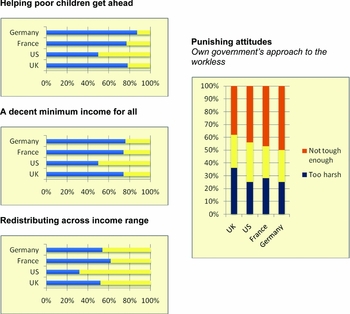
A recent report found that, in common with people living in France and Germany, the majority of people living in Britain believe it is primarily the state's responsibility to ensure a decent minimum income and help poor children get ahead, and by a narrower majority to redistribute wealth across incomes (see Figure 1). Importantly, as the data below also reveal, at 36 per cent, a substantial proportion of the population believe that the government's approach to the workless is too harsh in Britain. This compares with only 25 per cent in Germany and 28 per cent in France. As Peeters argues in this issue, the effective implementation of top-down new welfare initiatives relies upon a convincing public framing and legitimisation of ‘a new realm of state intervention dedicated to enticing, persuading and nudging citizens to ‘take responsibility’ in producing public value’ (Bekkers et al., Reference Bekkers, Dijkstra, Edwards and Fenger2007: 3). Despite three decades of government attempts to steer a shift from the ideology of collective public care arrangements towards individual responsibility for social risks through the marketised competitive provision of services, there is an evidential base to suggest that in common with their French and German neighbours, the majority of people in Britain place responsibility for production and coordination of welfare arrangements firmly within the domain of the state.
The role of the state in social policies (per cent regarding each as a government's job) Source: University of Cambridge yougov-Cambridge poll, April 2013, in Clark (Reference Clark2013).

The implications for new welfare reforms are significant because, as Hicks (Reference Hicks1999) argues, collective values are instrumental in determining institutional structures of the welfare state within distinct settings. The counter view that welfare policies and programme structures influence general attitudes towards welfare and welfare politics does seem to be less evident in the British case. One key factor which emerges is that levels of inequality and absolute poverty actively constrain the ability of individuals and groups to co-produce welfare in any meaningful way. It may also be suggested that the harshness of recent welfare measures has prompted a return to post-war welfare values in the UK. Critically however, recent research evidence also suggests that new ‘innovative welfare’ arrangements emerging at the local level are entirely congruent with values encouraging collective responsibility and state co-ordination. As Gatt's contribution to this themed section evidences, locally developed networks based upon existing institutional structures of education require no additional expenditure within the existing framework of state coordinated and produced welfare. While it may be true that programme structure influences attitudes toward the welfare state, an equally plausible argument is that collective values are a motivating force in determining the institutional structure of the welfare state (Hicks, Reference Hicks1999).
Work and new welfare in Britain
Recent transformations in socio-economic and labour market conditions are most pertinent to the rationale of new welfare measures relating to the work–welfare nexus. This provides an evidential base for the argument that the reorientation of the labour market towards flexibilisation involves a parallel process of increasing structural inequality. The situational constraints created by this inequality condemn a large group of the British population to a life clinging onto temporary, insecure and often poorly paid part-time employment – back and forth across shifting rapids of macro-economic demand and pools of economic stagnation. Yet current discourse in Britain is undoubtedly dominated by tales of the undeserving poor, with specific emphasis on vulnerable groups, such as migrants, single parents and people with disabilities. New welfare is thus characterised by an emphasis on individual pathology. Implicitly linking the personal deficits of people accessing welfare support with the state deficit, the new welfare arrangements in the work–welfare nexus are firmly focussed upon adjusting the capabilities and motivations of individuals to enable them to become integrated into the labour market. In Britain, activation approaches often involve rigid and severe sanctions on individuals who are not contributing to the formal economy (Thompson, Reference Thompson2011; Rolfe, Reference Rolfe2012).
As Bell and Blanchflower (Reference Bell and Blanchflower2010) argue, underemployment in Britain has significantly increased excess capacity in the labour market over the previous decade: that is those wanting to work more hours consistently exceeds those wanting to work fewer hours. The reconfiguration of the labour market towards more flexible part-time and temporary work is significant in this trend (Bell and Blanchflower, Reference Bell and Blanchflower2010). Equally, it might also be argued that the significant depression of income for vulnerable groups has led to increasing numbers of workers seeking more than one job. Moreover, recent research by Deacon and Patrick (Reference Deacon, Patrick and Bochel2011) underlines the failure of recent work–welfare reforms to take account of the lack of affordable childcare in the UK, which, when combined with the structural conditions indicated above, indicates a weak evidential base for the current government's assertion that a culture of worklessness exists throughout Britain's deprived communities. Indeed a number of recent contributions have substantiated the view that problems of unemployment and underemployment are more closely related to labour market obstacles that are demand-side rather than supply-side (Furlong and Cartmel Reference Furlong and Cartmel2004; MacDonald et al., Reference MacDonald, Shildrick, Webster and Simpson2005; Crisp et al., Reference Crisp, Batty, Cole and Robinson2009; Newman and Tonkens, Reference Newman and Tonkens2011; Paull and Patel Reference Paull and Patel2012; Shildrick et al., Reference Shildrick, MacDonald, Furlong, Roden and Crow2012). Reinforcing this argument, a recent major study by Shildrick et al. (Reference Shildrick, MacDonald, Furlong, Roden and Crow2012) has revealed that the current and previous government's policy in Britain has been built upon unsound theories relating to the intergeneration transmission of attitudes to work and welfare in deprived communities. This extensive and in-depth study was undertaken in Glasgow and Teesside, where there are areas which contain communities suffering extreme poverty, multiple deprivations and high levels of long-term unemployment. Here, interview data revealed that even people experiencing the most extreme poverty and long-term unemployment still strongly believed that working in the formal economy was better than relying on welfare benefits. This evidence highlights that while inequality and extreme poverty create a context of ‘persistently impoverished social and economic conditions and an increase in social, psychological and financial problems’, this did not diminish the motivation to work. However, situational constraints created by the insecure existence of ‘moving between unemployment, insecure and casual work (low-pay or no-pay cycle) did exacerbate social, psychological and financial problems’ (Shildrick et al., Reference Shildrick, MacDonald, Furlong, Roden and Crow2012: 6). Moreover, the risks experienced within this context were associated with an educational system which ‘failed to provide routes to achievement and attraction of the criminal economy against the paucity of legitimate job opportunities’ (Shildrick et al., Reference Shildrick, MacDonald, Furlong, Roden and Crow2012). The significance of this empirical work lies in the de-legitimisation of the myth of cultures of worklessness. Here the rationale underpinning new welfare measures in the work–welfare nexus is built around ways of making engagement in the formal economy more attractive than a life on benefits. This evidence reveals that it is not the values or image but the substance of working life that requires investment. In short, it may be argued that new welfare in Britain needs to address the kinds of insecurities experienced by people moving back and forth from low pay or no pay in a weak labour market. Possible measures would include increasing the financial security of people who are underemployed and in low paid jobs and addressing the societal risk of large numbers of people experiencing an education system which fails to provide routes to achievement through substantial investment across all levels of education and training.
The ‘People's Home’? The implementation of new welfare in social democratic states
In contrast to the heavily market-led approach in Britain, ‘new welfare’ in states broadly defined as social democratic has maintained an emphasis on the integral role of the state in the legitimate and effective operation of the work–welfare nexus. These states include Sweden, Denmark, Norway and Finland. In a recent comparative analysis of new welfare measures directed at the work–welfare nexus in Sweden, Finland and Denmark, Kananen (Reference Kananen2012) analyses the impact of top-down ‘activation’ measures on welfare states characterised as being social democratic. He argues that the new ‘activation’ or ‘workfare’ measures have not led to a fundamental transformation of the underlying principles of the welfare systems in Sweden and Denmark. Indeed, the top-down introduction of activation policies has reinforced the existing social order and authority of the state. This situation is less clear in Finland, where sanctions tied to non-compliance with activation and workfare measures have been particularly severe in comparison. Importantly, the antecedents of activation policies in the three states were established by active labour market policies focussed upon supply-side labour market approaches. The recent importation of workfare approaches from the USA has in some respects led to what Kananen describes as a gradual altering of the collectivist social order in the three states. Perhaps more critical for this analysis is Schelk's view that the introduction and incremental modification of new welfare policies can eventually lead to transformations of core principles of welfare impacting on the dynamics of welfare politics. Illustrating this process, Kananen traces the way in which activation policies were incrementally modified between 1990 and 2012. Activation policies introduced in the early 1990s in Denmark were locally administered and implemented (Bredgaard et al., Reference Bredgaard, Larsen and Madsen2009). Importantly, this local approach was motivated by principles of genuine social inclusion based on the rationale that ‘the needs and conditions of the local community could meet the needs and conditions of the local unemployed job seeker’ (Kananen, Reference Kananen2012). Integrally involving the third sector, new forms of organisation were combined with traditional community social work. The community based approach utilised an existing welfare infrastructure (social work) to encourage innovative community based responses to local labour market organisation. However, activation policies in Denmark then entered three major phases: Labour Market Reform I, II and III. In these reforms, activation became the major focus of the labour market measures. Importantly, the focus of these reforms was structural unemployment, and the rights and responsibilities of the unemployed were redefined in the Act on Active Labour Market Policy (Government of Denmark, 1993: §28–37). Locally based approaches to activation policies were gradually modified over the following decade. In particular, the measures are now implemented by central government and there are tighter qualifying regulations for social protection claimants. Kananen concludes that in Sweden and Denmark the new order produced as a result of the labour market reforms includes more elements of the traditional Nordic welfare state model where individuals, regardless of social background, were seen as a potential resource for the labour market, rather than as a potential threat to social order. Crucially, Kananen also concludes that the central values underpinning the politics of welfare have been retained. For example, following Carlsson's work it is argued that new welfare measures in Sweden have been ethically premised upon long-held values of community and solidarity associated with the ‘People's Home’ successfully challenging the neo-liberal notion that the ‘market was to replace politics’ (Carlsson, Reference Carlsson2003). Contextualised within a risk-reducing welfare system as a mechanism to stimulate growth and employment, work is regarded as being critical to the operation of the welfare economy. Exemplifying this, the Norwegian economy is characterised by an even income distribution, high rates of enrolment into higher education, a tax financed advanced welfare state and a high level of labour participation. Critically, the Norwegian welfare economy links strong trade unions, high taxes and high degrees of equality with strong economic performance within a global knowledge economy (Schjerva, Reference Schjerva2012).
The significance of the previous discussion on work–welfare lies in the way the ‘multiple destabilizations and dislocations that assail the welfare state nation-state complex’ (Clarke, Reference Clarke2003). For, if we are to consider the relationship between specific forms of ‘new economics’ and democracy within distinct settings (Schelkle, Reference Schelkle2012), we need to consider the way in which the politics of welfare arises out of the intersection between the discourse, policy, organisation and delivery of new welfare and the lived experiences and outcomes of new welfare programmes. As this review has shown, there is a significant evidential base to support the notion that new welfare is mediated within and by distinct political, socio-economic and labour market settings. In particular, the comparative analysis of the British neo-liberal and Scandinavian social democratic settings reveals divergent approaches to individual and societal risk within the work–welfare nexus.
Conclusion
Recent research relating to the implementation of new welfare in European settings has revealed ways in which state interventions in the work–welfare nexus are mediated by economic, labour market and political conditions and processes. The achievement of socially equal, democratically legitimate and economically effective state interventions relies upon the careful analysis of the relationship between labour market structures, inequality, forms of social investment and social protection within specific settings. As Sinfield (Reference Sinfield, Farnsworth and Irving2011) argues, this also requires a ‘broader’ societal approach to problems of inequality, differential contribution and compensation. Importantly, this review has highlighted the notion of ‘risk’ as encompassing societal risk specific to distinct settings. A major factor shaping legitimate and effective policy responses to the work–welfare nexus is the societal risk that large numbers of people may experience an education system which fails to provide routes to achievement. Distinctive forms of ‘new welfare’ across Europe have been revealed as responding to both individual risk and societal risk. Within social democratic models, such as those of Sweden, Denmark and Norway, ‘new welfare’ reform has addressed both societal and individual risk.
As the research reviewed in this article reveals, classifications and constructions of knowledge about actual and desired levels of social and economic development speak to the specificities of transformations integrally embedded within macro-economic, political and cultural factors at state and sub-state levels. The article argues that the analysis of the impact of new welfare measures requires an understanding of the interaction between top-down macro-economic policy, inequality and poverty, societal risks and welfare politics and practice.
Most crucially, as is so clearly evidenced in this themed section, social investment strategies embodied by ‘new welfare’ intrinsically require an adequate social protection system. Illustrating the distinctive approach of social democratic models within Scandinavian welfare states is the combination of new welfare ‘activation’ policies with a social rights approach. In contrast, the purist neo-liberal approach of the current British government aligns austerity measures with notions of new welfare based upon a marketised individualised conception of care and risk based upon utilitarian ideals of the deserving and undeserving poor. The implications of these distinctive articulations of new welfare are immense, impacting upon social solidarity and social cohesion and the future shape and characteristics of social and economic life within distinct settings. Critically, however, it is the way in which these paradigm shifts impact upon the lived experiences of individuals and families within societies across Europe that most cogently denotes the significance of these transformations. The continuing significance of socio-economic class in the operationalisation and outcomes of new welfare measures rests upon three central pillars. Firstly, participants in the labour market and locus of employment relations control different degrees of assets and power resources. This is particularly relevant when levels of inequality are very high, as in the British context. Secondly, the work–welfare axis is underpinned by the asymmetric influences of political democracy on the way in which the labour market operates in distinct European contexts (Korpi and Palme, Reference Korpi and Palme1998). Finally, divergent levels and forms of societal risks across European settings impact on human well-being and potential. In the British context, for example, a number of studies have found that the current British education system is failing large numbers of vulnerable children and young people (Hirsch, Reference Hirsch2007; Dearden et al., Reference Dearden, Sibieta and Sylva2010). This in turn impacts upon the capacity of the British economy to contribute to a global knowledge economy, but more importantly condemns many young people to a life where they feel they have ‘no future to risk’. Recent research relating to the implementation of ‘new welfare’ programmes has clearly identified the specific contours of inequality, societal risks and welfare frameworks within European settings. This article concludes that full cognisance of these contours as they impact on the lives of individuals within unique social settings is critical to the analysis of the democratic legitimacy and economic effectiveness of the future framing of welfare states in Europe.