Novel states of matter at extreme conditions
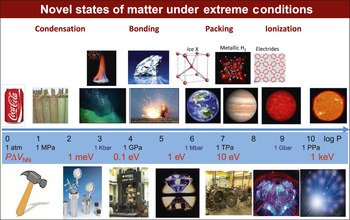
Most materials in the universe experience extreme conditions of high pressure and high temperature, as they exist deep in stars and planets ( Figure 1 ). The extreme conditions span more than 10 orders of magnitude. The compression energy (based on low-Z molecules such as nitrogen) reaches 1 meV at 1 kbar (0.1 GPa), several eV at 1 Mbar (100 GPa), and 1 keV at 1 Gbar (100 TPa). As a result, materials undergo significant changes in their bonding, structures, and properties.
Novel states of matter occur over a wide range of pressures, from ambient conditions to those of the deep interiors of Earth and planetary bodies, which can be generated by modern high-pressure technologies in static and dynamic conditions, including simple hammer, high-pressure autoclave, large-volume multianvil press, diamond anvil cell, gas guns, pulse-power machine, and high-power lasers. (bottom from left to right). The compression energy (PΔV) of nitrogen is also shown to highlight the chemistry of low-Z solids forming hydrates at 0.1 GPa, diamond at 5 GPa, symmetric water at 80 GPa, metallic hydrogen at 500 GPa, and Al electrides at 10 TPa.

The pressure at the bottom of the ocean is about 1 kbar (0.1 GPa), where the compression energy (∼1 meV) rivals the hydrogen bonding energy and drives the formation of water clathrates with the capture of small molecules such as methane—the most abundant energy source in the Earth. Reference Buffett and Archer1 At 50–100 GPa, the compression energy can exceed several eV, competitive with the chemical bond energy in simple molecules. Under such conditions, the low-Z elemental solids in the first and second rows of the periodic table, while existing as simple molecular or elemental solids at ambient conditions, form unusual dense covalent or ionic network structures such as diamond, Reference Bundy, Hall, Strong and Wentroff2 symmetric ice, Reference Goncharov, Struzhkin, Somayazulu, Hemley and Mao3 and metallic hydrogen. Reference Dias and Silvera4 Above 1 TPa, the atoms are brought so close that even valence electrons can assemble together as quasiparticles, Reference Miao and Hoffmann5 which fill the interstitial sites of core electron nuclei and form novel electrides (electron-trapped solid materials). Reference Pickard and Needs6 At higher pressures of 10–100 TPa, the compression energy can reach the core electron energy (keV), triggering nuclear chemistry in dense solids.
Recent developments of high-pressure technologies make it possible to generate extreme conditions in the laboratory. These include large volume presses and diamond anvil cells (DACs), which can generate static pressures up to and beyond 300 GPa. Dynamic pressure capabilities such as two-stage gas guns, the Z pulse-power machine at Sandia National Laboratories, Reference Knudson, Desjarlais and Dolan7 and high-power lasers extend the static pressure to 1 TPa and higher. Reference Smith, Eggert, Duffy, Braum, Peterson, Rudd, Biener, Lazichi, Hamza, Wang, Braum, Benedict, Celliers and Collins8 Combining these high-pressure techniques with advanced light sources such as third-generation synchrotron x-rays, x-ray free-electron lasers (XFELs), and spallation neutron sources, as well as first-principles theoretical developments using large computational platforms, provides opportunities to discover new materials and exploit new chemistry under extreme conditions.
Predictive solid-state chemistry
The pressure-induced chemistry occurring at the compression energy of constituent chemical bonds offers a new way of controlling solid-state reactions, as the energies of direct lattice compression are comparable to those of chemical bonds. This is unlike solid-state reactions of inorganic materials at near ambient conditions, which are largely reliant upon the kinetics of limited mass diffusion and the unpredictability of defect mobility for their investigation. Modern advances in experimental and computational capabilities have taken realistic steps toward developing new materials from computational design to experimental discovery, and vice versa.
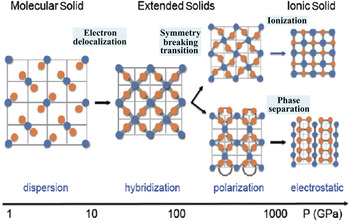
Figure 2 illustrates the predictive aspects of pressure-induced chemistry in a two-dimensional molecular lattice. Molecular solids are bound by a weak van der Waals interaction, which make them highly compressible. Upon compression, these molecules are rapidly brought together within a highly repulsive region of electron potential and transform to dense fully saturated covalent solids (or wide-bandgap insulators) in extended three-dimensional (3D) networks of corner- or edge-sharing polyhedra. The pressure-induced broadening of electronic bands, on the other hand, may lead to insulator–metal transitions, providing a competing mechanism. Furthermore, these extended structures are subjected to subtle structural symmetry-breaking distortions with electronic origin (such as Jahn–Teller or Peierls), providing pathways to local energy minima and giving rise to path-dependent transitions, phase metastability, dynamic structural distortion, and collective phonon and electron behaviors. The symmetry lowering transitions thereby enhance their packing efficiencies by polarizing chemical bonds, as observed in layered polymeric nitrogen (LP-N) Reference Tomasino, Kim, Smith and Yoo9 and polymeric carbon monoxide, Reference Ryu, Kim, Lim, Dias, Klug and Yoo10 as well as predicted extended layered ice. Reference Hermann, Ashcroft and Hoffmann11
The concept of pressure-induced changes of a 2D lattice, which include the pressure-induced electron hybridization to a high symmetry extended solid in an open structure, the pressure-induced structural distortion, and the pressure-induced bond polarization, eventually leading to the ionization or phase separation. The collective behaviors of lattice phonons, electrons, and charges in these network structures can give rise to novel chemical, mechanical, and electro-optical properties, offering unprecedented opportunities to design and discover new materials at high pressures.

Upon further compression, the valence electrons of low-Z extended solids may ionize to form an amorphous or ionic solid, as the electrostatic forces become more dominant at extreme conditions. At a given density, the delicate balance between electron delocalization (governing bonding) and ionization (governing packing) can give rise to novel structures and phenomena. These include complex structures of ionic CO2 (i-CO2), Reference Yoo, Sengupta and Kim12 simple alkali metals (e.g., Li Reference Hanfland, Syassen, Christensen and Novikov13 and Na Reference Ma, Eremets, Oganov, Xie, Trojan, Medvedev, Lyakhov, Valle and Prakapenka14 ), incommensurate electrides, Reference Miao and Hoffmann5,Reference Pickard and Needs6 and ionic boron phase. Reference Oganov, Chen, Gatti, Ma, Ma, Glass, Liu, Yu, Kurakevych and Solozhenko15 Important properties resulting from this balance between bonding and packing include transformation kinetics, structural miscibility, interfacial mixing, spinodal decomposition, and phase separation—competing processes well beyond the ground-state structure and thermodynamic constraints of molecular solids.
Low-Z extended solids
Recent discoveries of nonmolecular phases of simple molecular solids such as singly bonded cubic gauche nitrogen (cg-N) Reference Eremets, Gavriliuk, Trojan, Dzivenko and Boehler16 and the silicate-like carbon dioxide phase V (CO2-V) Reference Iota, Yoo and Cynn17 demonstrate the proof of principle for producing exotic phases by applying high pressures. More importantly, such transitions from molecular solids to denser covalently bonded framework structures illustrate a fundamental principle of high-pressure chemistry—pressure-induced electron delocalization. This occurs because electron kinetic energy has higher density dependence (ρ2/3) than electrostatic potential energy (ρ1/3), where ρ is the electron density. As a result, electrons localized within intramolecular bonds become increasingly less stable as density (or pressure) increases and the intermolecular potential becomes highly repulsive. At sufficiently high pressures, physical and chemical changes occur in molecular solids; their chemical bonds enter more delocalized states, such as polymeric and metallic solids. This is perhaps why many unsaturated molecular bonds become unstable above 10–20 GPa.
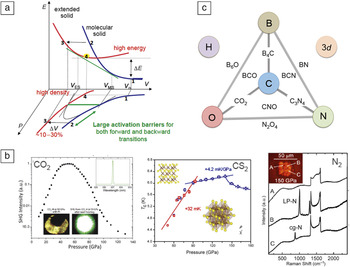
The pressure-induced electron delocalization of low-Z molecules often leads to high-energy and high-density extended states ( Figure 3a), as predicted in polymeric cg-N18 (third panel of Figure 3b). This happens because of (1) a large volume collapse, typically 10–30%, associated with the molecular-to-nonmolecular phase transition and (2) a large kinetic barrier in the reverse process. The graphite-to-diamond transition, for example, is accompanied by a huge volume collapse of ∼27% at 5 GPa, Reference Bundy, Hall, Strong and Wentroff2 as is the polymerization of nitrogen to cg-N of ∼25%, even at 110 GPa. Reference Lipp, Klepeis, Baer, Cynn, Evans, Iota and Yoo19 These covalently bonded extended solids are highly incompressible (typically, the bulk modulus B 0 is approximately 200–400 GPa) and, once formed, maintain equally high densities (often beyond 3.0–3.5 g/cc) when pressure is released. Hence, those extended solids have high energy densities that are metastable at or near ambient conditions.
(a) A thermodynamic representation of pressure-induced electron delocalization in high-density, high-energy extended solids. (b) Potentially multifunctional low-Z extended solids stable at high pressures—second-harmonic generation (SHG) of CO2-V, Reference Iota, Yoo and Cynn17 superconductivity of extended CS2, Reference Dias, Yoo, Struzhkin, Kim, Muramatsu, Matsuoka, Ohishi and Sinogelkin23 and colossal Raman scatterings of singly bonded LP-N. Reference Tomasino, Kim, Smith and Yoo9 (c) A small subset of extended solids that can be made by compressing binary and ternary mixtures of low-Z C/N/O/B molecular solids doped with hydrogen and functional 3d metals. Most of these materials are recoverable at ambient conditions.

Low-Z extended solids often exhibit novel mechanical, optical, and electronic properties (Figure 3b), well beyond high energy density, arising from their large cohesive energy, low mass density, strong covalent bonds, and dense 3D network structures. The large cohesive energy, E, and small interatomic distance, d, for example, make low-Z extended solids extremely incompressible, as evidenced by their large bulk moduli, B, where it can approximate as ∼E/d. Reference Cohen20 Furthermore, at high pressures π or nonbonding electrons in unsaturated low-Z molecules are more accessible than σ-electrons, resulting in all σ-singly bonded network structures with larger bandgaps, as in diamond and cg-N.
Note that for most covalent solids, the high bulk modulus is a reasonable indicator of high strength. The molecular-to-nonmolecular transition, on the other hand, can be viewed as a pathway for storing (or converting) the large compression energy into strong covalent chemical bonds of these 3D network structures. Reference Lipp, Evans, Baer and Yoo21 These chemical bonds also contain the largest energy density (on the order of 1–10 eV in a few Å3) outside that of nuclear matter. Developing high-strength extended solids into highly metastable high energy-density states is, however, strongly constrained by the kinetics, as in the case of diamond. These low-Z covalent networks in addition exhibit high thermal conductivities and large bandgaps, which can dissipate heat efficiently for semiconductor devices, and high Debye temperature resulting in a high phonon frequency and strong electron–phonon coupling for high-Tc superconductors. Reference Drozdov, Eremets, Troyan, Ksenofontov and Shylin22,Reference Dias, Yoo, Struzhkin, Kim, Muramatsu, Matsuoka, Ohishi and Sinogelkin23 The collective behavior of electrons, phonons, and ions in such continuous low-Z 3D network structures can result in new functionalities such as piezoelectricity, ferromagnetism, superconductivity, superionicity, and nonlinear optical behaviors, underscoring the potential of low-Z extended solids to be truly transformative.
Materials development: Challenges and needs
During the past two decades, a significant number of new materials and novel structures have been discovered by compressing simple molecular solids such as H2, Reference Dias and Silvera4 N2, Reference Tomasino, Kim, Smith and Yoo9,Reference Eremets, Gavriliuk, Trojan, Dzivenko and Boehler16 CO, Reference Ryu, Kim, Lim, Dias, Klug and Yoo10,Reference Lipp, Evans, Baer and Yoo21 CO2, Reference Yoo, Sengupta and Kim12,Reference Iota, Yoo and Cynn17 and H2S. Reference Drozdov, Eremets, Troyan, Ksenofontov and Shylin22 Yet, many of these materials are metastable upon releasing the pressure, limiting them to the regime of fundamental materials discovery. On the other hand, developing low-Z extended solids amenable to ambient stabilization poses great scientific and technological challenges. These challenges primarily stem from the formidable transition pressures and high energy states that make them metastable at low pressures. A logical way to overcome these challenges is to use dense solid mixtures, where the internal chemical pressure can lower the transition pressure Reference Kim and Yoo24 and strong heteronuclear chemical bonding replaces the dangling bonds and enhances the stability of extended network structures toward, and at, ambient conditions. Reference Raza, Pickard, Pinilla and Saitta25 The concept of internal chemical pressure has been used for chemists and materials scientists over years to develop new materials and properties by making alloys. Furthermore, a greater number of new materials can be developed via solid-state combinatory reactions of mixtures. Importantly, these mixtures permit control of transitions, properties, and stabilities.
Synthesis of low-Z extended solids amenable to scale-up synthesis and stabilization at ambient conditions is challenging, especially for those unary phases that typically require high-transition pressures to form. To overcome this, one can use kinetically controlled processes utilizing dense solid mixtures, dynamic strains, controlled heating/compression rates, and catalytic redox processes. The stabilization of high-pressure phases depends on the activation barrier associated with the depolymerization process (ΔE DP). These are typically high for H/C/N/O/B network solids (Figure 3c), all with strong covalent bonds; for example, the ΔE DP of cg-N is predicted to be approximately –0.9 eV/atom Reference Mailhiot, Yang and McMahan18 and thus is expected to be stable kinetically even at ambient conditions. Yet, defective surface atoms induce “unzipping” of the network structure, Reference Yong, Liu, Wu, Yao, Tse, Dias and Yoo26 and thus require chemical passivation to enhance stabilization—analogous to hydrogen on the surface of diamond. Reference Mankelevich and May27 This unzipping effect can be minimized or blocked by large ΔE DP in heteronuclear bonds of binary and ternary systems, especially with carbon and metal atoms. In fact, many of the hybrid products of carbons (or 3d or B metals) with low-Z molecular solids (H2, O2, N2, CO, and CO2) are recoverable at ambient conditions.
The application of high pressure and high temperature can facilitate the formation of new chemical bonds between two grossly mismatched lattices or dissimilar chemical species in the solid state. The properties of the solids are, to a first approximation, controlled by the interatomic distance and arrangement (or structure), which can be tuned precisely and substantially by the pressure, analogous to the composition in molecular alloys. The expected properties of these extended alloys are thus similar in their novelty to single-component low-Z extended solids, yet they can be tuned chemically by varying the composition, Reference Raza, Pickard, Pinilla and Saitta25 adding chemical impurities, Reference Raza, Pickard, Pinilla and Saitta25,Reference Ryu, Kim and Yoo28 or using specific structural templates. Reference Lim and Yoo29 These chemical concepts can be used to control the bonding, structure, stability, and properties of dense extended solids made from low-Z elemental mixtures.
Acknowledgments
This study was performed in support of National Science Foundation, Division of Materials Research under (Grant No. 1203834), Department of Energy–National Nuclear Security Administration (DE-NA0003342), American Chemical Society- Petroleum Research Fund (No. 54806-ND10), and DARPA Projects (Grant No. W31P4Q-12–1-0009 and Contract No. HR0011–14-C-0035).

Choong-Shik Yoo is a professor in the Department of Chemistry, Institute for Shock Physics, and Materials Science and Engineering at Washington State University. He received his PhD degree in physical chemistry in 1986 from the University of California, Los Angeles, and worked at the Lawrence Livermore National Laboratory. His current research focuses on high-pressure materials chemistry to discover and develop high energy-density materials, superhard materials, and novel hybrid materials, utilizing diamond anvil cells, various laser spectroscopic methods, novel x-ray diffraction, and x-ray spectroscopy at third-generation synchrotron facilities. Yoo can be reached by phone at 509-335-2712 or by email at csyoo@wsu.edu.